Brantley on Lord of the Rings

Frank Rich, of course, was the famous "Butcher of Broadway", who

could close a show with a single review.

But his successor, Ben Brantley, has his moments as well. Remember The

Capeman, the $11 million flop from Paul Simon? Brantley tore

it apart: "it may be unparalleled in its wholesale squandering of illustrious

talents".

But Brantley outdoes

himself today, with his review of Lord of the Rings, the musical.

It opened in Toronto, so maybe Ed Mirvish was hoping Brantley wouldn’t hop on

a plane to review it – but $25 million musicals are rare enough beasts

that he obviously had to go.

Brantley clearly had much more fun writing this review than he did eviscerating

The Capeman. He even starts to channel his inner Anthony Lane at points:

You may be interested to know that, according to a news release, the dress

worn by the beauteous Galadriel (Rebecca Jackson Mendoza, who sings of Elvish

good will in the style of Celine Dion) has more than 1,800 hand-sewn beads.

(The release does not stipulate whether nuns were the seamstresses or if they

lost their vision to the work.)

And this from a man who liked the film version! I fear to think what

he would have written were he to have hated

it.

Posted in Uncategorized | 1 Comment

Frank Stella cashes out of EV for $10m

As I was walking down 13th Street last night, I looked up, as I usually do,

to see if there were any horrendously ugly sculptures on view. For 218 E 13th

Street was for a very long time the studio of Frank

Stella, the great minimalist painter turned dreadful maximalist sculptor.

The studio is part of the same lot as the townhouse at 123 E 12th Street, where

Stella lived.

But now it seems that Stella sold the whole lot in September for $10 million.

The property on 13th Street no longer has any sculptures in it; instead, it

has a sign saying that it’s available

for lease. Looks like the owners were asking $900,000 per year, but will

now settle for $600,000. Apparently it’s "ideal for restaurants, night

clubs, art galleries and home furnishings showrooms".

Meanwhile, the townhouse can be leased too, for $300,000 per year (that’s $25,000

per month) – or you can just buy it outright, it would seem, since it’s

on

the market separately for $3,500,000. There’s an application in with the

Department of Buildings to split the lot into two tax lots, so that it can be

owned by two different people. Which explains why Elliman doesn’t know what

the taxes on the townhouse will be yet.

Is Walter de Maria, at 421

E 6th Street, the last major minimalist in the East Village?

Posted in Uncategorized | Comments Off on Frank Stella cashes out of EV for $10m

Lemann on O’Reilly

Nick Lemann has 4,685

words on Bill O’Reilly in this week’s New Yorker. At no point is the article

presented as a profile, but that’s how it reads. Until you reach the end and

you realise that although Lemann has quoted O’Reilly a lot, it’s always cited:

it’s a quotation from a book or a transcript. The absence of any visible first-hand

reporting is striking.

Lemann does note near the beginning of the piece that O’Reilly

has called on his audience to shun several news organizations, including

The New Yorker—whose specific sin was questioning the assertion, repeated

frequently on “The O’Reilly Factor” during December, that

the country is in the grip of a “war on Christmas.”

Would it have been too much to add, at that point, that O’Reilly therefore

refused to talk to Lemann for this article? As it stands, we don’t know what

happened: it’s possible that Lemann asked for an interview and was turned down.

It’s also possible that he asked for an interview but O’Reilly talked to him

only off the record. It’s also possible that he asked for an interview, spoke

to O’Reilly briefly, and got nothing worth quoting directly. It’s even possible

that Lemann, approaching the article less as a profile and more in the spirit

of media criticism, didn’t ask for an interview at all. But a full explanation

of what happened would have been worthwhile, I think, if only in the interests

of full disclosure.

Normally, I wouldn’t bother making such a minor quibble, but Lemann is dean

of the J-School at Columbia. One holds him to a higher standard.

Posted in Uncategorized | 1 Comment

Restaurant update

Le Miu. Went there last night.

Just check out the menu here.

We spent rather more than we’d intended. But it would have been worth it if

we’d spent twice as much. Quite possibly the best sushi I’ve ever had in New

York. Make sure you order the salmon toro, and the fluke. Nothing too exotic:

no sign of the freshwater obscurities one used to find at Jewel Bako, say. But

friendly service, magnificent food, and an unpretentious atmosphere make for

the best addition to the East Village dining scene in a long time. When my wallet

recovers, I’m definitely going back – and next time I’m sitting at the

sushi bar, because that’s what this place is all about.

Zum Schneider. Seems to think that

it can prevent eviction by sending a petition to the Supreme Court of New York

City. Huh? Would like some background on this.

Tarallucci

e Vino. Can’t get enough of this place. I still think the original, on 1st

and 10th, has marginally better coffee. But the wine here is wonderful, as is

the food, and the atmosphere and service are spot-on. Can’t imagine going anywhere

for a drink or a coffee or a snack else if I’m anywhere near Union Square.

Posted in Uncategorized | 2 Comments

The BBC and Brutalism

Amy Lawday sends me a rather

weird on-the-one-hand-on-the-other-hand report-slash-editorial

about Brutalism on the BBC’s website. The story comes in the wake of the first

listing of a Brutalist

building: the 1958 Old Vic Annexe, by Lyons Israel Ellis.

Writes Amy:

If it is agreed by a large majority that a building is dog ugly, and depressing,

then why save it?

I agree. I opposed the

preservation of 2 Columbus Circle for much the same reason:

Preserving great buildings, and even merely good buildings, is one thing.

But preserving provocative buildings is another thing entirely.

The fact is, the kind of people who love From Bauhaus to Our House are

exactly the sort of people who look at 2 Columbus Circle and consider it a

hideous eyesore. This building is one of the few things on which both die-hard

Modernists and most anti-Modernist laymen can agree: very, very few people

actually like it.

On the other hand, not all Brutalism is dog-ugly and depressing. The National

Theatre, for instance, to take only the most obvious example, is a wonderful

building and should be preserved. The Old Vic Annexe is not a wonderful building,

however: it’s being listed not because it’s good, but because it’s early. And

that’s a bad reason to list something.

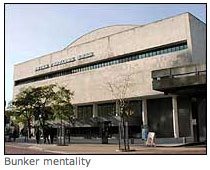
But the thing which really puzzles me is the illustration halfway down the

BBC article:

Yes folks, the editors at the BBC decided to illustrate an article about Brutalism

with an illustration of the Royal Festival Hall, one of the greatest post-war

buildings in the UK, and possibly my favourite building in London. I’m far from

alone in this: go there any day of the year, but especially in the summer, and

you’ll find both the interior and exterior spaces thrumming with life. The foyers,

the balconies and the terraces all make the RFH one of the most open and inviting

buildings in the city.

What’s more, the RFH is not Brutalist at all. For one thing it was built for

the Festival of Britain in 1951, so it’s far too early to be Brutalist. For

another thing, it’s not a big concrete slab: as this

page notes,

The brutalist approach of Modernists like the Smithsons and Erno Goldfinger

in the years ahead would owe little to the Royal Festival Hall’s inviting

curves and whitewashed friendliness.

But even BBC journalists, it seems, are so architecturally illiterate that

they see a magnificent structure like the Royal Festival Hall and just because

it’s made of concrete decide that it represents a "bunker mentality".

I hope that Ed Dorrell, the editor of the Architects’ Journal and the author

of the BBC article, gives them a suitable amount of grief.

Posted in Uncategorized | 13 Comments

More on Buses

In my first Report Report

Report (please nominate articles for subsequent ones!) I went into some

detail about the views of Austan Goolsbee and David Reiley on the subject of

incentive pay for bus drivers. Both of them agree that paying bus drivers per

passenger decreases wait times, but at a cost: those drivers get into many more

accidents.

Both would like to see bus systems experiment with introducing incentive pay,

along with safeguards which would seek to protect passengers’ (and drivers’)

safety. Goolsbee proposes docking bonuses when a driver gets into an accident,

while Reiley proposes GPS-equipped buses which calculate the average spacing

between one bus and the buses in front of it and behind it.

I suspect that neither scheme would work, and that there is actually a causal

relationship between shorter wait times and more accidents. If you keep everything

else constant – the amount of congestion, the number of buses, the price

of the fares – then any attempt to incentivise bus drivers to minimise

wait times will also end up increasing the amount of accidents they get into.

To understand why, one first has to understand the reason why buses "bunch"

in the first place – the well-known phenomenon whereby you wait half an

hour for a bus and then three arrive at the same time. This has been understood

since 1964, when it was explained in a paper by GF Newell and RB Potts. Here’s

Reiley, summing up:

Buses may start out with even intervals, but a small random shock, such as

local traffic congestion or the arrival of a sudden influx of more passengers,

causes one bus (say Bus A) to be stopped longer than usual at a stop. This

may cause the bus to fall behind schedule. As it falls behind schedule, more

and more passengers arrive at stops to wait for its arrival, which slows it

down even more. The driver must spend extra time boarding those passengers

and collecting their fares and later unboarding them. Meanwhile, Bus B, immediately

following A on the same route, starts collecting fewer passengers than usual

because the interval between A and B has diminished. The small initial change

thus gets amplified, as Bus A makes longer and longer stops to pick up and

drop off more passengers, while Bus B similarly makes shorter and shorter

stops. This process continues until Bus B completely catches up to Bus A.

Now observe what happens in Santiago, where bus drivers are paid on a per-passenger

basis:

Initially we conjectured that drivers would improve their spacing by slowing

down if they got too close to the bus immediately ahead, but this turned out

to be incorrect. In fact, once they get sufficiently close, they attempt to

pass the bus in front. This ameliorates the problem of bus bunching:

an empty bus proceeds more quickly (making quicker stops) than a bus full

of passengers, so putting the empty bus in front of the full bus tends to

reduce bunching. However, this technique often involves aggressive driving

by the driver attempting to pass, which can result in an uncomfortable passenger

ride or an increased probability of accidents.

There’s a small irony here: in order to ameliorate bus bunching, one has to

accelerate the process which causes it. Santiago has less bus bunching than

other cities not because buses catch up to the bus in front less frequently,

but because they catch up to the bus in front more frequently.

So now consider Reiley’s proposed scheme:

With a full implementation of GPS technology, drivers could have information

on the location of other buses at all times. Drivers could have a real-time

display showing the locations of other buses both in front of and behind them,

enabling them to respond with adjustments to the spacing. GPS technology opens

up a whole new realm of contractual possibilities. For example, one might

pay drivers a bonus based on the continuous-time average spacing between their

bus and other buses on the route, thus providing drivers with appropriate

incentives to minimize passenger waiting time.

Under this scheme, what is a bus driver to do if he finds himself gaining on

the bus in front? He basically has two choices: either slow down or speed up.

Given his incentives, the obvious move would be to slow down, since that would

increase the spacing between himself and the bus in front, and thereby increase

his bonus. But the bus in front is only going to get slower and more crowded

so long as it doesn’t have a bus in front helping to pick up the extra passengers

who are accumulating and waiting for it. So wait times will go up, not down.

What’s more, one overcrowded slow bus could end up slowing down a whole convoy

of buses behind it – meaning not only longer wait times, but longer travel

times as well.

But what happens if the second bus decides to speed up, and overtake the bus

in front? That would decrease wait times, but might well have an adverse effect

on the driver’s bonus. For all the time that the second bus is decreasing the

gap between himself and the bus in front, he is also decreasing his bonus. And

then once he’s overtaken the bus in front, he’ll be picking up large amounts

of passengers who have been waiting a long time, so it’s going to be more difficult

for him to pull away from the bus behind and start increasing his bonus. In

order to maximise pay, he would have to exhibit the tendencies seen in Santiago:

leaving the bus stop before everybody has fully boarded, and maybe even missing

bus stops in order to get some space between himself and the bus behind him.

All of which is dangerous behaviour which shouldn’t be incentivised.

How about a slightly different incentive system? Austan Goolsbee emailed me:

The best way to address such problems is to give incentives that include

more than just one criteria. You could pay the drivers by the passenger but

penalize them for accidents, for example.

I’m not sure that would work either. In Santiago, the incentivised drivers

have 10 accidents for every million kilometers they drive. If they drive 100km

per day, that means they have one accident every 1,000 days: on average they

will go three years without an accident, even driving as dangerously as they

do. In order to make the drivers drive more safely, the penalties would have

to be huge. That would have two effects: it would unfairly penalize drivers

who got into an accident through absolutely no fault of their own, and it would

give drivers a very strong incentive not to report any but the most serious

accidents.

The real, underlying problem is that it’s far from obvious exactly what behaviour

one wants to incentivise. In Santiago, there’s a clear and strong correlation

between how fast a bus driver drives and how much he gets paid. Or, to put it

another way, there’s a strong correlation between how aggressively drivers drive

and how much average wait times are cut. More aggression means shorter waits.

So do cities want to reward aggression in their bus drivers? You can’t have

it both ways: tell bus drivers that you want them to cut average wait times,

but at the same time tell them that you don’t want them to be more aggressive.

The two work against each other, and you’ll end up with sheer confusion.

It seems to me that the easiest ways of decreasing wait times are the most

obvious: increase the number of buses, increase the number of bus lanes, decrease

the amount of congestion. Pace Goolsbee’s original

article in Slate, drivers in Chicago could also simply be given permission

to take surface streets when Lake Shore Drive is backed up. Incentive pay is

an interesting idea, but I’m far from convinced it can work well in practice.

Posted in Uncategorized | 1 Comment

Report Report Report 1: Buses

Report Report Report 1: Buses

Many thanks to Gari N Corp for recommending this

Slate article as the first recipient of my Report Report Report, wherein

I compare academic reports with the journalism which reports on them.

At first, I thought the Slate article would get high marks. I wasn’t convinced

by Gari’s quibbles,

and what’s more the Slate author, Austan

Goolsbee, is an economics professor in his own right, rather than an innumerate

journalist.

After reading the underlying research, however, I have to give the Slate article

a C–. The research simply doesn’t say what Goolsbee says

it says, and in fact the government of Santiago, where the research took place,

has drawn exactly the opposite conclusions to Goolsbee.

The underlying research here is a paper

called "The War for the Fare", by Ryan Johnson, David

Reiley, and Juan Carlos Muñoz. Follow my

link to find it: Goolsbee unhelpfully links to an NBER page which will charge

you $5 to download it.

According to Goolsbee, the paper shows that if cities like Chicago moved to

an incentive pay system, rather than paying their bus drivers a fixed hourly

rate, that would improve productivity, "raise efficiency and save tax dollars."

Goolsbee frames the question simply: why do Chicago bus drivers sit in traffic

on Lake Shore Drive, when they could use surface-street shortcuts instead? His

answer: they wouldn’t benefit, financially, by doing so. And if you look at

what happens in Santiago, where drivers are paid per passenger rather than per

hour,

Paying by the passenger leads to significantly shorter delays. Give them

incentives, and drivers start acting like regular people do. They take shortcuts

when the traffic is bad. They take shorter meal breaks and bathroom breaks.

They want to get on the road and pick up more passengers as quickly as they

can. In short, their productivity increases.

Does paying by the passenger lead to significantly shorter delays? It depends

on what your definition of "significantly" is. The Santiago study

does find that

a passenger waiting for a bus 30 km away from the start of a route can expect

to wait 15% longer, on average, when the driver is paid a fixed wage rather

than per passenger.

Does Chicago have 30km bus routes? I don’t know. On shorter routes, the effect

will be smaller. Here’s the scatter chart:
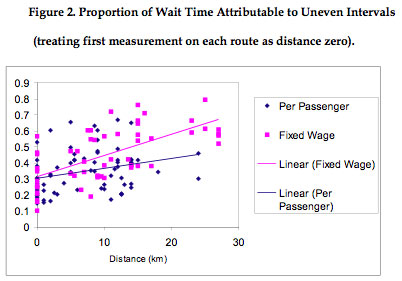
As you can see, in aggregate the per-passenger buses do have slightly shorter

wait times than the fixed-wage buses. But the difference isn’t huge.

Do the per-passenger buses "take shortcuts when the traffic is bad"?

On that subject – the key subject of Goolsbee’s article – the report

he cites is completely silent: there’s no mention of shortcuts at all.

Do they "take shorter meal breaks and bathroom breaks"? Yes.

Goolsbee omits, however, most of the downside to paying drivers on a per-passenger

rather than a per-hour basis. Here’s what he says:

Not everything about incentive pay is perfect, of course. When bus drivers

start moving from place to place more quickly, they get in more accidents

(just like the rest of us). Some passengers also complain that the rides make

them nauseated because the drivers stomp on the gas as soon as the last passenger

gets on the bus. Yet when given the choice, people overwhelmingly choose the

bus companies that get them where they’re going on time. More than 95 percent

of the routes in Santiago use incentive pay.

Do drivers paid on a per-passenger basis get into more accidents? Yes. The

report shows that they have 10.03 accidents per million kilometers travelled,

compared to just 5.98 accidents per million kilometers travelled on the Chicago-style

buses. That’s a huge difference, which can’t be shrugged off by saying that

they are "moving from place to place more quickly". The pay-per-passenger

system means that drivers have a very strong incentive to overtake the bus in

front of them, and pick up all of the passengers which the bus in front would

otherwise get. So they are likely to drive more aggressively, and less safely.

As for feeling nauseated, the report finds that

Once a bus finally does stop, the driver quickly gets the bus moving at full

speed, often in complete disregard for the stability or comfort of the passenger.

These rapid stops and quick accelerations can occur for the entire duration

of the trip.

This causes not only nausea, of course, but also injuries:

if all buses in Santiago had the same number of accidents per km as those

with drivers paid a fixed wage, we estimate that it would save 55 lives per

year. It would also eliminate 227 serious injuries, 210 less serious injuries,

and 1,293 light injuries.

And these numbers actually understate the likely truth, because the per-passenger

bus companies are less likely to report minor accidents than the per-hour bus

companies.

In economic terms, then, moving from a per-hour system to a per-passenger system

is a tradeoff. On the one hand, people will wait slightly less for a bus, and

that saved time is worth money. On the other hand, they will be killed and injured

in bus accidents more frequently, something which carries a significant economic

cost of its own.

There is another reason why the pay-per-passenger system is flawed, which Goolsbee

doesn’t mention:

When a passenger is waiting at a stop alone, sometimes the driver won’t

stop because the opportunity cost of the time spent picking up that passenger

is greater than the income from the fare. In fact, often times a single passenger

waiting will have to wait for several buses or until more passengers arrive

at the stop.

A public service such as a bus system should treat all customers equally, but

moving to incentive pay gives drivers an incentive not to.

And Goolsbee is downright wrong when he says that "when given the choice,

people overwhelmingly choose the bus companies that get them where they’re going

on time." The citizens of Santiago are not "given the choice"

between bus services running on a per-passenger or per-hour basis. Some bus

routes pay one way, other bus routes pay the other. You take the bus which goes

to your destination.

Does the report conclude, at least, what Goolsbee says it concludes? Not really:

We find our most interesting result to be the fact that per-passenger compensation

yields more regular spacing of buses, and hence lower expected waiting time

for passengers, than does fixed-wage compensation. However, this clearly

does not mean that per-passenger compensation is a superior system.

We find significant costs to the per-passenger system as well. In particular,

per- passenger compensation exhibits a much higher incidence of accidents

and much lower passenger comfort.

So to Goolsbee’s point that "more than 95 percent of the routes in Santiago

use incentive pay". Here’s what we find in the report:

In 2006 Santiago will complete a dramatic overhaul of its bus system. The

plan, called Transantiago, will replace the current system of disorganized

owners with a dozen or so large companies. Partially influenced by

conclusions of this research, drivers will all be paid a fixed wage.

Not exactly the outcome you might have expected from reading Goolsbee’s article,

eh?

UPDATE: David Reiley emails:

I do think the wait times are quite economically significant ($38,000 worth

of lost time per day!), and I’m disappointed that you don’t mention what we

think is the most important point in our article. We think that there are

significant gains to be had in improving bus spacing, and we’re interested

in finding ways to do that without promoting accidents or discomfort. We think

that it’s well worth exploring what types of driver incentives will matter,

and that’s why we speculate about GPS-based incentive systems that give drivers

a reason to try to cooperate with each other (as opposed to competing in a

way that causes traffic externalities). I would prefer it if your Report Report

Report reflected this.

Since this is a Report Report Report and not a Report Report, I did miss out

the stuff about GPS-based incentive systems. But I’m happy to oblige.

At the end of Reiley’s report, we find this:

With a full implementation of GPS technology, drivers could have information

on the location of other buses at all times, not just on corners where sapos

work. Drivers could have a real-time display showing the locations of other

buses both in front of and behind them, enabling them to respond with adjustments

to the spacing. GPS technology opens up a whole new realm of contractual possibilities.

For example, one might pay drivers a bonus based on the continuous-time average

spacing between their bus and other buses on the route, thus providing drivers

with appropriate incentives to minimize passenger waiting time. Such systems

could improve quality of passenger service in cities like Santiago, and could

be potentially even more useful in the cities of developed nations.

At some bus stops in central London, there are now signs which tell passengers

how long it’s going to be until the next bus arrives. The technology for these

static signs was expensive, but they are certainly useful. What Reiley is proposing

is a system which puts that kind of data than into a computer display which

is easily readable by bus drivers. I don’t know whether that technology exists,

how reliable it is, or how expensive it is. Neither, I suspect, does Reiley.

I do suspect that bus drivers’ unions would react badly to any attempt to pay

some drivers more than others, especially when bonuses would be based on something

as abstract as "continuous-time average spacing". There could be unintended

consequences, too, such as drivers not stopping at bus stops if they’re too

close to the bus behind them, or being much less willing to help out wheelchair-bound

passengers because the amount of time involved in getting those passengers on

and off the bus would throw off their bonuses.

It’s also worth noting that bus drivers already have a lot of demands on their

attention: collecting fares, navigating traffic, keeping an eye on the passengers,

telling tourists when it’s their stop, etc. Would trying to keep up with dynamically-generated

GPS maps impact the other aspects of their job?

It’s clear, then, that there would be a significant number of costs associated

with a scheme like the one Reiley proposes. Maybe a pilot scheme somewhere could

try to determine whether the benefits in decreased wait time might outweigh

those costs. But I suspect that simply adding more buses on busy routes might

be an easier and cheaper way of decreasing average wait times.

In any case, Reiley’s plan involves a significant up-front expense: at the

bare minimum it involves kitting out every bus with a computer and GPS system,

as well as setting up a centralised system for calculating and paying bonuses.

It’s a far cry from the quick fix that Goolsbee implies is possible.

UPDATE 2: I’ve had an email exchange with Austan Goolsbee,

some of which might be of broader interest. Said Goolsbee:

And then at the end I must wonder if you have gone crazy: "In 2006 Santiago

will complete a dramatic overhaul of its bus system. The plan, called Transantiago,

will replace the current system of disorganized owners with a dozen or so

large companies…drivers will all be paid a fixed wage." Are you under

the impression that replacing competing companies with a few giant firms and

then removing all incentives to the drivers is a good idea? It is a recipe

for monopolization. Prices will rise and delays will get worse. You are not

talking about a change that the consumers are driving. You are talking about

a change being imposed by the government. Why would you expect this to raise

consumers’ value when the evidence shows exactly the opposite?

I replied:

As for the Transantiago plan, again that was taken straight from the report

(footnote 23). It seems to me that its introduction could present you with

a prime opportunity to test your hypothesis about incentive pay. Wait for

a little while, and then see whether prices have gone up, delays have gotten

worse, or passengers are less happy. But in my experience, Chilean government

officials are generally the most economically sophisticated government officials

I’ve ever met. (Did you know that every single minister in the new government

has a postgraduate degree?) And they were very aware of the findings of this

report when they made their decision.

If you look at what Chile is doing with toll roads, you’ll know that it remains

a leader in terms of bringing private-sector discipline to government functions.

(And, of course, it was the first country ever to embark on a major privatization

program.) I would look very carefully at the Transantiago plan before dismissing

it as "being imposed by the government" and therefore likely to

decrease consumers’ value.

And Goolsbee wrote back:

This bus decision is a federal govt decision or a city govt decision? The

federal government people predominantly have Ph.D.s from here at U. Chicago

(and indeed I taught several of them Ph.D. Public Finance). My impression

was that this was more of a city level thing.

No question that I would predict that this new system will lead to

more delays and the concentration of ownership to higher prices. We will agree

to revisit this issue in a year and see if it was born out. I am prepared

to admit that the incentives didn’t work if that doesn’t happen.

Someone remind me to ask about Santiago’s bus prices in a year’s time!

Posted in Uncategorized | 3 Comments

The NYT and Sudan

Summit Communications,

a company which makes money by taking the prestige of the New York Times and

selling it to corrupt third-world governments, has outdone itself today with

a "Special Advertising Section" on Sudan in the New York Times, featuring

second vice president Ali Othman Taha on the cover. "We have approached

the formation of the united government in a spirit of cooperation and partnership,"

he says in a big pull-quote.

Stefan Geens points

me to Summit’s website, which features

a long video interview with Taha, complete with sycophantic and extremely softball

questions. The interviewer, Racquel Picornell, tells us at the beginning that

she’s going to ask him about "the economic development that will ensure

a very rosy economic outlook", and that we will hear "the words of

one of the makers of its history, a history that will lead Sudan into a new

peaceful era".

Taha does not disappoint: "I feel honored to be what God has bestowed

upon me: to be one of the peacemakers in Sudan," he says.

Taha is not a peacemaker. Quite the opposite: he comes in fact very near the

top of the list of living genocides. As vice-president of Sudan (a post he still

holds, under the presidency of Omar al-Bashir, the strongman who came to power

in a military coup in 1989), Taha was the primary architect of the genocide

in Darfur. In a nutshell, Taha and the Arab militias have been slaughtering

black Sudanese in the western Darfur region of the country.

On Friday, the US State Department put out a press

release in which Nancy Pelosi and George Bush both agreed that there is

genocide going on in Darfur. The release comes in the wake of Pelosi’s visit

to Sudan, during which Taha admitted to her group that his government has supported

the genocidal militias.

Recently, Taha’s genocide has started spilling across the border and into Chad,

a development the New York Times abhors

in its leader today.

And yet the New York Times is happy to take the Sudanese government’s money

and run an eight-page advertisement for the country.

Would the New York Times run an advertorial extolling the charitable works

of Osama bin Laden? Would it run advertisements from Nambla, or from the Ku

Klux Klan? Taha is an evil man, a genocidal war criminal who has caused suffering

on an almost unimaginable scale. What he wants now is a modicum of international

respectability – and who better to give it to him than the New York Times.

So the Times takes Taha’s blood-soaked dollars and happily funnels them to its

shareholders, even as its very own Nick Kristof files heartbreaking dispatches

from Darfur. Here’s Kristof from his latest column:

Elie Wiesel once said, referring to victims of genocide: "Let us remember:

what hurts the victim most is not the cruelty of the oppressor but the silence

of the bystander." And it’s our own silence that I find inexplicable.

The only thing worse than silence, of course, is outright complicity. I would

love to know what Nick Kristof thought of his employer when he picked up the

paper this morning.

Posted in Uncategorized | 2 Comments

Serious journalism in Vanity Fair

David

Carr ♥ Graydon Carter. Carter has just poached Cullen Murphy and

William Langewiesche from the Atlantic; they’re only the latest in a long list

of big-name journalists at Vanity Fair, from Christopher Hitchens to Todd Purdum.

Gushes Carr:

Beneath Vanity Fair’s louche exterior lies the beating heart of a well-financed,

well-edited enterprise that has managed to break news as a monthly at a time

when the news cycle is frequently measured in minutes.

Wonderful amalgam or cognitive dissonance? However you view the current cultural

conversation, some of the blame can be traced to Vanity Fair. We are either

a vacuous people who can occasionally be seduced by a big narrative about

the Asian flu or we are a serious people who occasionally need to read about

what Gwyneth really thinks. Either way, Mr. Carter is editing a magazine for

both sides of the brain.

What Carr doesn’t mention is that VF is actually a very bad home for serious

journalism. Carter can run 20,000-word articles on the run-up to the Iraq war

all he likes, but serious journalists will never dream of having their work

published by Vanity Fair in the way they dream of being published by the New

Yorker. Instead, their dream is much more prosaic: simply being paid

by Vanity Fair, with its legendary budgets and expense accounts and contracts.

Carr hints at this:

[Carter’s] magazine, the top earner at Condé Nast, spends like a pirate,

madly assigning and killing stories and buying up contracts of every writer

it fancies — an impunity that seems quite retro in a threadbare age.

In other words, Carter behaves a bit like the artist Francis Bacon, who used

first-growth Bordeaux as cooking wines. The long pieces of journalism in Vanity

Fair might pay very well indeed, but they’re still a lot cheaper than the cost

of commissioning a photographic portfolio of minor European royals. And they

never get any respect within the magazine.

While the New Yorker or the Atlantic will lead with a long, well-reported story,

Vanity Fair always leads with celebrity fluff. More to the point, VF has never

bothered to work out how to make long-form journalism readable. The New Yorker

is much smaller and lighter than VF; that makes it physically much easier to

hold and to read. And long stories in the New Yorker never do what long stories

in Vanity Fair always do, which is jump all around the magazine. A story will

be "continued on page 227"; once you’ve found page 227, which isn’t

always easy, because most of the pages don’t have numbers on them, it might

have two or three different stories on it, making it that much harder to work

out which one you’re in the middle of. By the time you’ve managed that, you’re

pretty much guaranteed to have lost the train of thought leading up to the sentence

you’re putatively in the middle of. And this can be repeated 8 or 9 times or

even more: jumping around reading one column on one page and then the next column

on a page 20 pages further back.

Vanity Fair also refuses to put any of its journalism online, where it can

be read by news consumers around the world.

In other words, Vanity Fair doesn’t seem to care about the readers

of the long-form journalism for which it pays so handsomely. It cares about

the writers, whom it looks after very well. And it cares about the prestige

they bring. But my impression of Vanity Fair is not that it’s a magazine which

wants to serve me with great journalism, so much as that it’s a magazine with

so much money it can run great journalism just by throwing its checkbook around.

When VF starts discovering promising new voices and giving them space, when

it runs fascinating articles about non-important subjects that you never thought

you might be interested in, when it stops introducing every article by telling

us how important and wonderful it is – then I’ll start taking

it seriously as a journalistic enterprise.

Posted in Uncategorized | Comments Off on Serious journalism in Vanity Fair

Crappy wine lists

Eric Asimov doesn’t like the

wine list at Cafe du Soleil:

It’s not that the wine list is too small. It offers several dozen bottles

– mostly French but some Italian, American and Spanish, too –

befitting the size of this small bistro.

But the list shows both a complete lack of imagination, and total indifference

to wine. It’s as if the restaurant abdicated responsibility for the

list and allowed the first wine salesman in the door to put it together from

the dreariest of his selections. Almost every last bottle is from a mediocre

producer from a predictable region who is simply churning out product. It’s

a complete bore, and it’s enough to keep me from going back.

Now Eric Asimov writes about wine for a living, so he’s in the tiny minority

of people who knows a mediocre producer when he sees one. He’s like the gin

rummy player who not only remembers everything his opponent picked up, but also

remembers everything his opponent discarded.

Most of us, however, find it hard enough to remember good producers, let alone

try to remember wines which turned out to be mediocre.

So, Mr Asimov (or anybody else): Is there any way that a non-professional can

recognise a bad wine list? It seems unfair to extrapolate from one bottle: if

you’re disappointed once, that doesn’t mean the entire list is weak. So when

and how does one come to the conclusion that the list is bad enough to keep

one from going back?

In my case, this has only happened at Alias, on Clinton Street, and only because

that restaurant is so excited about its wines. It has lots of them by the glass,

and everybody there seems extremely enthusiastic about them. So if you go with

a group of people a couple of times and order wine by the glass rather than

the bottle, it’s relatively easy to get through most of the list. And come to

the conclusion that none of it is particularly great.

But if a restaurant doesn’t push its wines like that, and just has a list of

a few dozen bottles which aren’t available by the glass, are there any telltale

signs of mediocrity?

Posted in Uncategorized | 1 Comment

Vigilantism on the LES?

I was a bit disquieted to walk down my street this evening and see this poster

taped to the wall. The poster (click for full version) gives the name and alias

of a man who may or may not be a sex offender:

PLEASE BEWARE

At this present time there is a preditor in our neighborhood [LES] He preys

on girls ages from 13–17. He is very cunning and manipulative. Please

talk to your daughters so they could be aware of this man. [NAME REDACTED]

It takes a whole community to stop men like him so lets all work together

to get him registered as a sex offender. We have to many children in this

neighbor so lets work collectively to keep our children safe! Thank you

There’s a lot here which makes me very uncomfortable, and I’m not talking about

the misspellings. For one thing, it feels like a call to vigilantism. I’ve explained

at length (in the comments here)

why I think it’s a very bad idea for sex-offender registries to be publicly

available.

What’s more, this guy has a common name: it’s entirely possible some entirely

unrelated person could get severely harrassed as a result of this poster. And

in what way can a community get someone registered as a sex offender in any

case? Can communities somehow vote on whether or not they think someone is a

sex offender? I thought you, well, needed to be convicted of something first.

As for talking to daughters about being aware of predators, well, that’s always

a good idea. It’s easy to find maps of sex offenders online, and there are already

eight registered sex offenders living in the East Village/Lower East Side. Let’s

teach our children to be safe, by all means. But let’s not start spilling red

ink on these people, lest we start spilling something else as a result.

Posted in Uncategorized | 3 Comments

Female partners at law firms

The NYT’s Timothy O’Brien has a long

article today – which immediately hit the top of the Most E-Mailed

List – headlined "Why Do So Few Women Reach the Top of Big Law Firms?"

O’Brien gives a comprehensive overview of the problem and possible causes.

But let me add my own, which is hinted at near the bottom of the piece:

Over the last two decades, as law firms have devoted themselves more keenly

to the bottom line, depression and dissatisfaction rates among both female

and male lawyers has grown, analysts say; many lawyers of both genders have

found their schedules and the nature of their work to be dispiriting.

"I see a lot of people who are distressed about where the profession

has gone," Ms. Rikleen says. "They don’t like being part of a billable-hour

production unit. They want more meaning out of their lives than that."

Let’s make a few assumptions here:

  1. Lawyers in big law firms are increasingly unhappy with their work.
  2. Most lawyers marry and have children.
  3. Most women marry a man who earns more than they do – this is true

    even of high-earning women.

Do you see where I’m going here? If you’re a male lawyer with the potential

to make partner, you go for it, because you have a wife and kids to support.

If you’re a female lawyer with the potential to make partner, the chances are

that your husband is earning enough to support both you and the children. Which

gives you the opportunity to seek out more rewarding work and more time with

your children.

I can absolutely see why in such a situation there would be a shortage of female

law-firm partners. And in the real world, among my lawyer friends, something

very similar is happening. None of them, having spent time at a big

law firm, actually wants to make partner. Most want a less stressful life, often

as corporate counsel somewhere. The ones who stay at the law firms are the ones

with a family to support.

At the moment, it is very rare for a female lawyer to be the main breadwinner

in a family with children. Only when that becomes more common, is my guess,

will the number of female law-firm partners start to rise.

Posted in Uncategorized | 3 Comments

Archiquiz

Which classic suite of skyscrapers is this a picture of?

Work at it: if you look in the background of the photo you’ll see a big hint.

If you really can’t get it, the answer is here.

What fascinates me is the harsh, almost brutal lines of these buildings, which

tower over their neighbours in a most unsympathetic manner. It’s amazing what

time can do to a skyscraper.

Posted in Uncategorized | Comments Off on Archiquiz

The Report Report Report

I’d like to start a new feature on felixsalmon.com, called the Report Report

Report. The Report Report Report is for anybody who has ever read a news article

whose subject is a "new report" (or survey, or study, or similar).

I will track down the original report, and judge the reporting on it. Does the

report say what the news articles say it says? Do the articles present hypothesis

as fact, or otherwise sensationalize findings? Do they display the requisite

amount of skepticism with respect to the methodology and possible ulterior motives

of the report’s authors? You ask me, and the Report Report Report will tell

you.

Nominations now being accepted – I’ll try to cover any articles pointed

to in the comments, so long as I can find the original report.

Posted in Uncategorized | 1 Comment

The NYT Magazine’s bedfellows

Pages 69 to 80 of this weekend’s New York Times Magazine comprise a 12-page

advertorial from

Rwanda. The web address given should you want even more information is www.rwandatourism.com

– yes, Rwanda Tourism. Somehow I doubt that the amount of money that Rwanda

is going to make from tourism is going to come close to justifying the cost

of a 12-page advertorial in the New York Times Magazine.

The advertorial comes with a credit: it was "produced and sponsored by

Summit Communications", a company

whose sole purpose seems to be to publish advertorials in the New York Times.

Some advertorials, like that for Libya,

for example, are even on the web at nytimes.com.

So far this year, Summit Communications has produced advertorials for Rwanda,

Congo, and Sierra Leone. Last year it did Saudia Arabia, Kuwait, and Libya –

twice. Most of these countries come very low on transparency indices and very

high on corruption indices. Most of them, too, are unlikely to benefit greatly

from this type of exposure.

One can’t help but wonder how Summit Communications persuades these ministers

from highly corrupt countries to pay large amounts of money for advertorials

in the New York Times.

Now it’s true that the fee that Summit Communications charges has to be significantly

greater than the amount that Summit Communications has to pay the NYT. That’s

right and proper, of course: Summit has to produce the report, and make some

money for itself. But maybe – just maybe – some of that fee finds

its way into an offshore bank account controlled by the minister in question?

That can’t be the case: such a practice would make it easier to sell these advertorials,

but would also violate the Foreign

Corrupt Practices Act.

So how does Summit Communications – none of whose principals are named

on its website – manage to keep its sales going? I have no idea.

Posted in Uncategorized | 112 Comments

Gutted

So you know that trip to Patagonia? The one I’ve been super-excited about for

ages? The one which begins this coming Wednesday? Well, it’s off.

I’m not leaving the country, because I’m married to a US citizen. If I wasn’t

married to a US citizen, my plan would probably work fine: pop into the US embassy

in Lima on the way back from Patagonia, pick up a new I visa, and come back

to New York. But an I visa is a non-immigrant visa, and if you’ve been living

in the US for many years and are married to an American who lives in the USA,

you don’t look much like a non-immigrant any more.

It’s a bit counterintuitive, but it’s actually much, much easier to enter the

US if you’re not married to an American than if you are. Most people,

especially from countries that are part of the visa waiver scheme, can come

in as a tourist, or on one of any number of visas. If you get married to an

American, however, you basically have to go through the laborious green card

application procedure.

The one real weirdness I’ve discovered: the famous H1-B visa (I had two, in

my time) is a "dual intent" visa. That means, according to the wonderful

definition at this

website, that the holder can have "the intent to immigrate and nonimmigrant

intent". Most other visas, however, including my I visa, don’t allow such

a useful impossibility. I’d love to know the historical reason for this special

dispensation for holders of H1-B and L visas.

Posted in Uncategorized | 10 Comments

Euphemism alert

Apparently the show I’m listening to on the radio right now isn’t a repeat

or a re-run, it’s an "encore presentation". Offender: National

Public Radio, or at least WNYC.

Posted in Uncategorized | Comments Off on Euphemism alert

Verbal tics

As I was posting the last entry, I noticed my use of the phrase "ultimately,

however" in the final paragraph. It’s a nasty, pompous phrase, but –

worse – it also felt uncomfortably familiar. So I did a quick search

of felixsalmon.com, and there it is, six times in the past four years. Must

stop now.

Posted in Uncategorized | Comments Off on Verbal tics

NYT vs Costco

The NYT is going all-out on what seems to be little more than a storm in a

teacup about whether or not Costco sold a couple of fake Picasso drawings. The

first

article was published on Thursday and corrected on Friday; today, Saturday,

there’s a lengthy follow-up

article which was reported by Daphné Anglès and Alan Riding

in Paris, Carol Kino in New York, and David Hochman in Newport Beach. Yikes!

Must be important, no?

Actually, not really. The story seems to be this: Costco started selling art

on its website, including a couple of Picasso drawings, which were sourced from

Rick Yamet, a fine-art vendor in Peekskill, N.Y. A bit of Googling finds him

authenticating

a dubious Picasso print in the past, so maybe Costco’s dealer, Jim Tutwiler

of Boca Raton, was a bit too trusting of Yamet. But ultimately the art world

is swimming in fake Picassos, which is why buying from Costco is actually a

very smart move. If a buyer has second thoughts about any drawing, be they to

do with its authenticity or even simply that it doesn’t go with the sofa, then

it can be returned for a full refund.

But here we have NYT reporters banging on buyers’ front doors, leaving messages

for the CEO of Costco, and generally behaving as though they have uncovered

a major scandal. Why the seeming overreaction?

Two reasons, I think. Firstly, the correction on Friday. No reporter likes

to have to issue a correction, so when it turned out that the original article

had got a couple of facts wrong, the Times decided it was going to town on the

story to pin it down. Secondly, the Times ran a gushing

profile of Costco’s art-selling operations a couple of years ago, complete

with details of Costco’s quality-control mechanisms and use of outside appraisers.

As recently as last November, Online Shopper columnist Michelle Slatalla was

equally

complimentary about Costco’s fine-art franchise. Maybe the Times, embarrassed

at its former enthusiasm, is now overcompensating.

Ultimately, however, the first two articles trusted in Costco for a very good

reason: the company’s full-refund guarantee, which stands uncontested. Much

dirtier dealings than Costco’s go on in the art world every day; it’s not clear

why the NYT has decided to pick on Costco like this.

Posted in Uncategorized | 1 Comment

Culture round-up

For no particular reason except to remind myself what I thought:

Arthur

& George, by Julian Barnes: Don’t believe the hype. Starts off

well, but has far too much padding. No one cares about whether, why or how Arthur

Conan Doyle related to women and/or fell in love, and we don’t want to spend

hundreds of pages wading through his thought processes while waiting for the

plot to restart. Some wonderful turns of phrase, of course, but not enough to

make the book worth reading.

The Whitney Biennial:

I like messes like this, contemporary life is messy, contemporary art is messy,

and this exhibition reflects that messiness in all its glory. There’s humour

enough here to keep one occupied, and there’s even some good art, too.

Panic.

Just watched it on DVD, so I’m adding it to the list. Fantastic cast, overly-oppressive

soundtrack. Could have been a great movie, but for the Precocious Kid. But pretty

much anything with Donald Sutherland in it is worth watching.

Posted in Uncategorized | Comments Off on Culture round-up

The American North-South Divide

The 50 least expensive cities in America are all

in the south. The 50 most expensives cities are overwhelmingly in the north,

plus California and a couple of places like Miami (which is still just 56% as

expensive as New York). A "moderately affluent lifestyle" takes an

income of $69,496 in Paris, Texas. It takes an income of $166,777 in New York.

Does that seem excessive? If you spend a third of your pre-tax income on housing,

that would be $55,600 per year. Call it $1,000 a month in maintenance payments

and $3,600 a month in mortgage repayments. That means your mortgage is about

$750,000. Which doesn’t buy much in New York City these days.

Posted in Uncategorized | 13 Comments

False Positives on Gawker Stalker

Both Joseph Clarke,

in the comments to my Gawker Stalker piece, and Andrew

Krucoff, today, make the good point that the evil nature of Gawker Stalker

can be allayed by celebrities (or anybody else) reporting false sightings. Indeed,

false sightings could be a whole new art form: imagine a series of sightings

of John Travolta, say, doing increasingly improbable things in increasingly

improbable places – but all in a manner which is consistent in terms of

the fictional celebrity being able to get from one fictional sighting to the

next in time.

I’m sure that Nick Denton doesn’t care in the slightest if people report false

sightings, so long as the feature becomes/remains popular. In fact, insofar

as the popularity of Gawker Stalker is a function of the number of sightings

reported, Denton might even like the fictional ones: there’s no such

thing as a bad datapoint, if all datapoints, at the margin, drive traffic.

I’m just not sure who we’re meant to rely on to submit the false sightings.

It’s a fun joke for Krucoff for one day, but he’s not going to do it day in

and day out – and I doubt the celebrities and their minions are going

to want to come up with such things day after day, month after month, either.

Still, if you’re ever feeling bored at work, go ahead and give Gawker something

fictional. It’ll throw some noise into the Stalker Database, and will probably

help pay Denton’s hamsters interns as well.

Posted in Uncategorized | Comments Off on False Positives on Gawker Stalker

Piggybacking, part 2

Talking of the NYT, the

op-ed page strikes back at the news pages today. Remember that dreadful

story about wi-fi piggybacking? Well Timothy Lee obviously saw it, had much

the same reaction as I had, and managed to get his response published in the

NYT’s own storied pages. Good for him. Of course, the story he’s talking about

isn’t mentioned by name, but since it sat atop the Most E-Mailed List for quite

some time, I’m sure that a great number of the op-ed’s readers will know exactly

what Lee is talking about in his second paragraph:

News reports tend to paint the practice as a growing problem. Reporters use

words like "stealing," "hacking" and "intrusion."

But despite the alarmist talk, the articles rarely explain what the problem

is.

My only issue with the op-ed comes when Lee says this:

One problem, as telecom companies will be quick to point out, is that my

unscrupulous neighbor might use my Internet connection permanently instead

of paying for his own. They have a point: that borders on theft of service.

I’d slap a password on my network if that was happening.

Well, is it theft of service or isn’t it? And who’s being stolen from here,

Lee or the ISP? Would Lee slap on that password because he feels a debt of gratitude

to his ISP for its service, and hopes that maybe the price will come down if

his "unscrupulous neighbor" pays a monthly charge as well?

Posted in Uncategorized | Comments Off on Piggybacking, part 2

NYT cripples its blogs’ feeds

What’s happened to the New York Times’s RSS feeds? Up until a day or two ago,

they were generally excellent, providing the full text and all images for blogs

like those from Bruni,

Carr and now Asimov.

Actually, Carr’s now-discontinued blog continues to have a full feed. But it

seems that Bruni and Asimov have taken a leaf out of Pogue’s

book, and started truncating their feeds. This is particularly bad news in the

case of DealBook, which I started

off loving but now will read much, much less. Be nice, NYT: bring back the full

RSS!

Posted in Uncategorized | Comments Off on NYT cripples its blogs’ feeds

Adele Fergusen’s 15 minutes

The cache function on my web browser has failed me, and now when I try to view

this

page, all I get is a 404 error. Worse, Google seems to have failed to cache

it as well. So comes the blogosphere to the rescue! For the full text of Adele

Fergusen’s op-ed in The Kitsap Peninsula Business Journal, check out Disturbing

the Comfortable. Here’s a snippet:

One of these days before I die, I hope to see a shift in the attitudes of

so many of my black brothers and sisters in this great country we share, from

perpetual victimhood, to pride in their achievements on the road from slave

to American citizen.

Remember Ronald Reagan’s story about the kid who had to shovel a huge

pile of manure? He went about it with such joy he was asked why and said,

“With all that manure, there’s got to be a pony in there somewhere.”

The pony hidden in slavery is the fact that it was the ticket to America for

black people. I have long urged blacks to consider their presence

here as the work of God, who wanted to bring them to this raw, new country

and used slavery to achieve it. A harsh life, to be sure, but many

immigrants suffered hardships and indignations as indentured servants. Their

descendants rose above it. You don’t hear them bemoaning their forebears’

life the way some blacks can’t rise above the fact theirs were slaves.

Besides freedom, a job and a roof over their heads, they all sought respect.

But even after all these years, too many have yet to realize that to get respect,

you have to give it.

It’s worth noting that before this came out, no one outside Washington State

knew or cared about The Kitsap Peninsula Business Journal. But because it has

a website, it wasn’t long before Adele Fergusen’s claptrap was winging its way,

via the likes of Wonkette,

to the world at large. New Media has changed everything!

Yet at the same time, Fergusen has gotten in trouble because her opinions

found their way into a printed newspaper, and printed newpapers still have a

certain gravitas that blogs and talk radio, say, don’t. If an unknown Washington

State blogger or talk-radio caller had said the same thing, few people would

have noticed or cared. Old Media still matters!

It’s also interesting to read this

letter from Lary Coppola, the editor and publisher of The Kitsap Peninsula

Business Journal:

Right-wing politics have proven to be a product that strengthens the bottom

line. If liberalism did, that’s would be the corporate media product. It isn’t

about the issues in the corporate boardroom, it’s about selling the product

that delivers the greatest return on investment for the stockholders. In the

case of the media, it’s conservatism.

The corporate owners of the American media are doing nothing more than catering

to their customers and delivering the product they want to buy. It’s just

that simple.

Could Coppola really be so cynical as to have published Fergusen’s hateful

op-ed because he thought he was simply "delivering the product" that

his readers wanted to buy? My guess is not, and that rather this is more of

a cock-up than a conspiracy. Fergusen filed her op-ed, and at no point in the

editing process did anybody stop to think whether simple decorum should trump

her freedom to say what she likes in her column.

Finally, it’s worth noting that it’s far to cheap and easy to equate Fergusen’s

column with Coppola’s "right-wing politics". I’m sure that Fergusen

is, indeed, a right-winger. But for every Republican who feels like this, there’s

a Democrat who agrees with her. Part of the reason that Republicans do better

than Democrats in US elections is that Republicans have fewer compunctions about

pandering to the likes of Fergusen than Democrats do. Once upon a time, Democrats

were the party of the racist heartland; now, it’s Republicans. But the racist

heartland itself has changed less than the coastal elites might think.

Posted in Uncategorized | Comments Off on Adele Fergusen’s 15 minutes