Venezuela sets $17.85 price to buy back CANTV

Well, that was better

than the market expected: Venezuela is paying $17.85

per share to buy back the outstanding stock in telecom company CANTV. The

biggest stake is owned by Verizon, which will get $572.3 million, or about 25%

less than it was going to get by selling its stake to Mexico’s Carlos Slim.

But given that there were fears Verizon would get nothing at all, an extra half

billion or so is great news to them.

The nationalization takes away by far the biggest and most liquid stock in

Venezuela, which must be tough for investors looking for ways to place bets

on the country. Maybe they should just start selling protection on Venezuela’s

bonds instead.

Posted in Econoblog | 2 Comments

The correlation between corruption and wealth

Doug Muir is a

bit late to the story that Transparency International has released its 2006

corruption perceptions index:

it actually came out back in November.

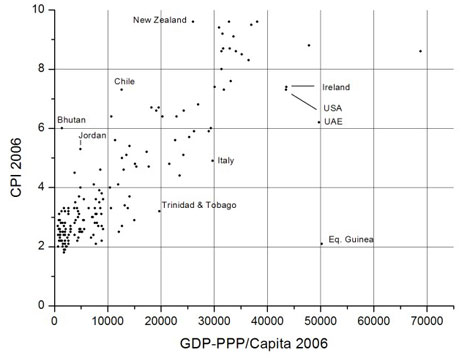
But he is good at getting people to create pretty charts for him, like this

one from commenter Christian (click for larger version):

CPIversusGDPsmall.jpg

The chart has the corruption perceptions index on the y-axis, and PPP GDP per

capita on the x-axis. As you might expect, countries with lots of oil (Trinidad,

Equatorial Guinea, UAE) tend to be more corrupt than you might expect from their

wealth alone. And I’m sure that it comes as no surprise that Bhutan, Chile,

and New Zealand are the countries which outperform.

More interesting, however, as Muir’s commenter Cyrus points out, is the fact

that there seems to be a pretty strong correlation up until you reach a perceived

corruption of about 7/10. After that level, the correlation seems to break down

quite spectacularly. Says Cyrus:

Diminishing returns to honesty? Or are people naturally somewhat dishonest,

and forcing them to be even more honest than they are inclined to be demands

a very costly enforcement effort?

Posted in Econoblog | 3 Comments

Freedom Tower: Still being built, but what will it look like?

Douglas Durst isn’t impressed that the Freedom Tower is getting

built:

Some real estate experts questioned why the Freedom Tower was being built

at the same time that the developer Larry A. Silverstein was getting ready

to build three office towers with more than six million square feet of space.

They complained that it had attracted only government tenants who were being

forced to pay higher rents than they should.

The developer Douglas Durst and the real estate investor Anthony E. Malkin

say the tower is ill conceived, the result of a hasty six-week “redesign”

after the police raised security concerns.

Mr. Durst said that the value of the tower would increase over time, but added

that it made little sense to build everything at once.

Maybe Durst has forgotten, but there is a master plan for the World Trade Center

site, designed by Daniel Libeskind, which clearly shows the Freedom Tower being

built first, and subsequent towers going up as and when the market demand for

them arises. I know that the Libeskind plan is pretty debased at this point,

but cancelling construction of the Freedom Tower now would be idiotic –

especially since Larry Silverstein hasn’t got the money to build any

of the other towers any time soon.

On the other hand, I share Durst’s distaste when it comes to the Freedom Tower’s

design – and it would be nice, seeing as how this tower is being built

with public funds, if we could actually see the design before it started

being built. We know roughly what it’s going to look like, but at the

top of the tower, especially, as far as I know the public is still in the dark.

Do even the developers have a final design for the mast which will

dominate the Lower Manhattan skyline?

Posted in Econoblog | Comments Off on Freedom Tower: Still being built, but what will it look like?

Argentina Pars and Discs accelerated

Citibank announced

today that more than 25% of the holders of Argentina’s outstanding Par and Disc

Brady bonds have voted to accelerate, making the principal amount due and payable

immediately. This means almost nothing, in practice, but it does show that Argentina’s

holdout bondholders are still active, and not giving up.

Posted in Econoblog | Comments Off on Argentina Pars and Discs accelerated

Or you could buy 2,300 shares of Fortress

You’ve gotta love eBay. Back in November, a seller known as "hdgfund"

found an old bottle of wine lying around – a 1909

Barolo, to be precise – and managed to sell it to "stefy27"

for €350.

Now, "hdgfund" is setting his sights a bit higher: he’s selling,

yes, a hedge

fund, based in the British Virgin Islands, complete with European depositary

bank and prime broker. Bids start at $70,000, but hurry: there are only 5 days

left!

(Via Alphaville)

Posted in Econoblog | Comments Off on Or you could buy 2,300 shares of Fortress

Are we genetically capitalist?

Tyler

Cowen takes issue with Greg

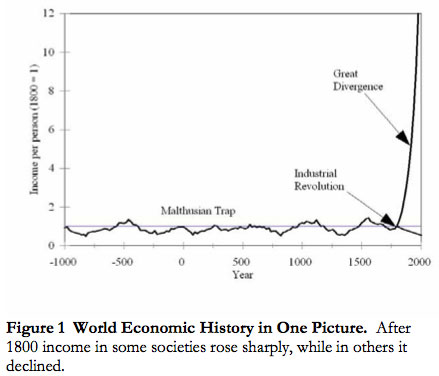
Clark, who has an interesting thesis – that world economic history

can be explained by a move from a Malthusian world where the most successfully

violent were the most reproductively successful, to a capitalist world where

the richest were the most reproductively successful. Here’s the chart:

history.jpg

Cowen’s problem is that Clark hasn’t explained a particular advantage for England,

where the industrial revolution was born, over the rest of Europe. But I don’t

see this as a problem. I see Clark’s thesis as explaining the economic history

of all of Europe, not as trying to explain why England’s growth rate took off

marginally earlier than other countries’ growth rates.

I’m quite convinced by Clark, actually, because his thesis fits neatly into

that of Dan Gilbert, of

Stumbling on Happiness fame. We’re genetically bound to strive to make money,

and to believe that making more money will make us happier. And maybe the real

hope for a country like Bhutan, which seeks to maximize "gross national

happiness" rather than GDP, is that its population doesn’t have the same

genetic makeup and therefore doesn’t have the same urge to destroy the commons

in the search for wealth.

Posted in Econoblog | 4 Comments

That Dresdner report on hedge funds

Dresdner Kleinwort certainly seems to know how to cause a stir! Analysts Stefan-Michael

Staimann and Susanne Knips have put out a 50-page report on hedge funds, warning

of a "great unwind". The report got picked up by Alan

Abelson at Barron’s and by the FT’s Alphaville

and Wolfgang

Munchau. It was blogged by Lars

Toomre and Alexander

Campbell and Michael

Panzer Pazner and Nouriel

Roubini and Naked

Capitalism and literally dozens of others – most of whom ended up

quoting either Alphaville or Barron’s and haven’t actually read the report,

not that that stopped them from praising it.

So, is it time to make this report public, d’ya think? I always feel a bit

uncomfortable when a lot of people all end up quoting the same tiny bit of a

50-page report, without even having had the opportunity to read the whole thing.

Posted in Econoblog | 1 Comment

CDOs: Understanding risk weights

I emailed Mike Peterson, the editor of Creditflux, to ask him about the "risk

weight" figures we say yesterday. (If you recall, the risk weighting

on synthetic CDOs went up from 2.89 in 2005 to 3.45 in 2006, but it wasn’t clear

what that meant.) Mike explained:

We risk weight each synthetic CDO tranche by multiplying it by a factor depending

on its seniority. So anything between 0% and 3% is multiplied by 20, anything

between 15% and 100% is mutliplied by 0.4, etc. It’s a crude version of a

delta.

Is that clear? Let me try to explain. Synthetic CDOs are structured to behave

just like normal CDOs, where you bundle up a bunch of bonds and then tranche

them. The top-rated tranches get paid first. Once they’re paid, the next tranche

down gets paid. And so on.

The way that Mike is measuring the seniority of these tranches is by looking

at something called the "attachment and detachment points". He explains:

Any tranche with [loss] attachment and detachment points between 0% and 3%

of the portfolio. If you attach at 0% and detach at 3% you get hit from the

moment of the first loss in the portfolio and by the time losses get to 3%

you are finished.

A first-loss tranche such as that one counts as an equity tranche, and carries

a risk weight of 20 in Mike’s scheme. On the other hand, if you only start suffering

losses once 15% of the portfolio has been wiped out, then you’re safe as houses,

and Mike assigns your tranche a risk weight of just 0.4.

So now we’re a bit closer to understanding what those risk-weight numbers mean.

Let’s say you took a barbell strategy on a synthetic CDO, buying an almost-risk-free

tranche from 15% to 100%, and an equity tranche from 0% to 3%. Then the average

risk weight would be (85*0.4+3*20)/88 = 1.07. That compares, I think, to a risk

weight for the all the tranches combined of 1. (I do hope that Mike will correct

me if I’m wrong here!) In other words, if you have all of the very safest tranches,

plus the entire equity tranche, you’re still taking more risk overall than is

in the structure as a whole – because you take all of the first loss.

Now the clever thing about synthetic CDOs, unlike normal CDOs, is that you

don’t need to actually sell every tranche from 0% all the way through to 100%.

And in fact there’s really little if any demand for the safest tranches of synthetic

CDOs, since it’s possible to get similar returns with better liquidity elsewhere

in the fixed-income world. So increasingly people have been buying just the

riskier tranches of these animals, with detachment points in the single digits.

And that explains the average risk weight going up to 3.5. But remember that

equity is 20, so 3.5 is still relatively safe, and I’m not sure I’d

describe it, as the FT did, as "ultra-risky".

Posted in Econoblog | 2 Comments

Ecuador to miss coupon payment, pay during grace period

The bad news? Ecuador’s missing the February 15 coupon payment on its 2030

bonds: it "lacks the funds", according to deputy economy minister

Fausto Ortiz. The good news? Ecuador will make the payment, within

the 30-day grace period. Net-net? Bonds up a smidgen. Bloomberg’s Patrick

Harrington has all the details. (Where’s Lester Pimentel?)

This news is unsurprising: It’s a good way of ratcheting up the rhetoric without

actually defaulting. And the next couple of coupon payments are relatively

small. Could there be no default before August?

Posted in Econoblog | Comments Off on Ecuador to miss coupon payment, pay during grace period

Should I lock in my Heloc?

I have a home equity line of credit (Heloc), on which I pay Prime – which

is at the moment an uncomfortably high 8.25%. (I think that Prime is always

Fed funds +300bp.) This is not debt I’m about to repay overnight, so it seems

silly to me that I’m borrowing the money right at the top of the yield curve.

One thing I can do is get a mortgage and use that to pay down most of my Heloc:

15-year rates are more like 5.6%. I wouldn’t get rid of my Heloc entirely –

it would still be there in case of emergencies, and indeed it would still be

there if I couldn’t afford my mortgage payment for whatever reason. But my interest

rate would come down substantially, and so I’d save money. On the other hand,

there are fixed up-front costs involved in getting a mortgage, and I might need

to pay a premium if I wanted to avoid prepayment penalties and the like.

Another option is that I "lock in" the rate on my Heloc for six years

at 7.25% – much higher than the 15-year rate, and equivalent to a Fed

funds rate of 4.25%, which is pretty close to neutral. But there’s no cost to

doing the lock-in, I don’t need to borrow any more money or create a new lien

on my property, and I reduce my interest rate overnight.

In this scenario, if short-term rates go up, I’m laughing. If they stay where

they are, I’m laughing. Even if they go down by a full 100bp I’m still paying

no more than if I’d done nothing. And if they start going back down towards

3.5% (which equates to a Prime rate of 6.5%), presumably then I can start thinking

about refinancing the whole Heloc.

So the way I see it, my main cost of locking in now is that I lose the ability

to lock in at a lower rate in the future. Even if the Fed funds rate stays on

hold, the curve could invert further between overnight and six years, and the

lock-in rate could go lower than 7.25%. I’m no expert in options pricing, so

how should I value the option to lock in – the thing I lose if I actually

do lock in?

And are there other considerations I should be bearing in mind here? My bank

is offering me the lock-in option, and given that we’re in something of a zero-sum

game and my interest payments are their profits, should that in itself be an

indicator that I might want to think carefully before doing this?

Posted in Econoblog | 6 Comments

US development aid in 2008: The winners and losers

Carol

Lancaster has a great post today taking apart President Bush’s 2008 budget

to see where most of the aid money is going. In a nutshell, the big winners

are, unsurprisingly, Afghanistan and Iraq, with over $1 billion each. Then,

more surprisingly, come South Africa, Nigeria, and Kenya, each of which stands

to receive over $500 million, mainly in HIV/Aids funding. Sub-Saharan Africa

overall gets an eye-popping $4.6 billion. Next in line are Pakistan ($425 million),

Egypt ($415 million), and Jordan ($280 million).

Lancaster asks, apropos that $4.6 billion in HIV/Aids funding:

Can the relatively poor recipient countries, with weak health infrastructures,

handle such an enormous increase in funding, whether for abstinence and prevention

efforts, condom distribution, testing or the provision of anti-retrovirals?

And what happens after next year? Who is going to finance the anti-retrovirals

after next year or the year after that? The countries with the high infection

rates will not be able to afford such expenditures for a long time to come.

Will PEPFAR become an entitlement for the foreseeable future – because if

we begin to finance widespread distribution of anti-retrovirals, we cannot

withdraw that financing until the recipients can finance it themselves or

we will be complicit in their certain deaths.

Lancaster also notes that aid to Israel is now zero: the aid world has changed

a lot since Israel and Egypt invariably topped the league tables. Interestingly,

she doesn’t even mention Colombia, or anywhere in Latin America bar Haiti and

Guyana.

Posted in Econoblog | 1 Comment

Meme of the day: Credit crunch!

There’s a great debate raging over at Morgan Stanley’s Global Economic Forum

today. Richard

Berner kicks it off:

The long-awaited meltdown in subprime mortgage lending is now underway, and

it likely has further to go. Fears are rising that this so-far idiosyncratic

credit bust will morph into a broader, systemic credit crunch as foreclosures

rise, lenders grow cautious, and Congressional efforts to rein in predatory

lending further choke off supply. A credit crunch occurs when lenders deny

even creditworthy borrowers access to borrowing. What are the risks of such

a scenario?

Worries about a wider credit crunch are dramatically overblown,

in my view. Spreads may widen further and the supply of subprime credit likely

will tighten. But the balance sheets of most lenders are strong, investors

are differentiating among rungs of the mortgage credit ladder, and a limited

incipient spillover into prime loans and other asset classes signals that

a credit crunch is remote.

Stephen Roach, on the other hand, is much less sanguine.

Whether it’s the bursting of the US housing bubble, carnage in sub-prime

mortgage lending, or a slowing of Chinese investment, these events are quickly

labeled as “idiosyncratic” — unique one-off disturbances that

are perceived to pose little or no threat to the larger whole. The longer

a seemingly resilient world withstands such blows, the deeper the conviction

that spillover risk has all but been banished from the scene. Therein

lie the perils of a dangerous complacency

Like virtually every other credit event that has unfolded in the past several

years — from auto downgrades to the implosion of Amaranth — our credit strategists

have been quick to label the sub-prime mortgage problem as idiosyncratic.

While spreads have blown out in this relatively small segment of the US mortgage

market — with sub-prime loans about 11% of total securitized home loans —

spreads for higher rated mortgage credits have been largely unaffected. Again,

I don’t dispute the facts as they have unfolded so far. My problem comes

in extrapolating this resilience into the future. With resets on floating

rate mortgages likely to put debt service obligations on a rising path for

already overly-indebted US homeowners, the case for increased default rates

and collateral damage on prime mortgage lenders looks increasingly worrisome.

Indeed, as the recent warning from HSBC just indicated, it’s not just

the small specialized lenders that are now being hit. Spillover effects are

quickly moving up the quality scale on the financial side of the post-housing-bubble

shakeout story, and their potential for impacts on the broader economy can

hardly be dismissed out of hand.

No prizes for guessing where Russ

Winter comes down in this debate:

We now know for a fact that the subprime mortgage market is in increasing

disarray. Although not publicized in the mainstream media (MSM) the

cracks are spreading to the midprime arena as well. I am convinced that the

next wave of stories will emerge from the Alt A market. I also strongly

suspect that any market break will come like a thief in the night…

I’m with Berner on this one. As we’ve seen at HSBC, if there are losses in

the subprime mortgage sector, they’re more than outweighed by profts elsewhere

in the subprime sector, let alone profits elsewhere in the mortgage sector.

So long as the lending you’re doing remains profitable, there’s little point

in cutting back on it just because old unprofitable lending turns out to have

been a bad idea. Subprime mortgage underwriting standards have already

tightened up considerably, and I’ll happily bet anybody that the 2007 vintage

of subprime MBSs will perform very well. Yes, there was a period of irrational

exuberance among subprime lenders. But it’s over now, and the broader systemic

risks have passed as well.

Posted in Econoblog | Comments Off on Meme of the day: Credit crunch!

Synthetic CDOs: Getting riskier, but how risky are they?

Creditflux magazine has some interesting numbers out about the synthetic CDO

market, as reported by Paul

Davies in the FT today:

Sales of public and private synthetic CDOs grew to $450bn in notional terms

last year compared with $224bn in 2005, according to data from Creditflux,

an information and news service that has the best access to the hard-to-track

private deals…

On the risk-weighted basis – where the value of a CDO is calculated by multiplying

the tranches by their risk weight – volumes grew from $648bn to $1,554bn.

I’ll do the math so you don’t have to: the risk weight on synthetic CDOs has

increased from 2.89 last year to 3.45 this year. What do these numbers mean?

According to Davies, they mean this:

Investors are increasingly purchasing ultra-risky slices of complex derivatives

known as "synthetic" collateralised debt obligations (CDOs)

"Ultra-risky"? Is that, you know, well-defined? Besides, are synthetic

CDOs particularly complex? Really, they’re just pools of assets which have a

fixed income, only the assets are CDSs rather than bonds.

It’s easy to look at skyrocketing risk-weighted exposure to synthetic CDOs

and get worried. But it’s also worth remembering that every dollar an investor

in these instruments receives is a dollar spent by somebody insuring himself

against a credit event. I’m going to try to find out what those 2.89 and 3.45

numbers actually refer to, but in the mean time I’ll remain a bit more sanguine

than Paul Davies.

Posted in Econoblog | Comments Off on Synthetic CDOs: Getting riskier, but how risky are they?

Is JP Morgan thinking of moving back downtown?

In a move quite stunning for how sensible it is, the Port Authority of New

York and New Jersey is thinking of selling all or part of the Freedom Tower

at the World Trade Center site to developers or private equity operations. That’s

a great idea: office prices are in the stratosphere right now, and the Port

Authority has much better things to do with the cash than have it tied up in

office buildings for ever.

The story comes from Alex

Frangos and Jennifer Forsyth in the WSJ – and they have an even juicier

tidbit as well:

A move on Tower 5 by J.P. Morgan, on the other hand, could take place as

soon as a month, though people familiar with the matter stress the firm is

also exploring sites in midtown Manhattan or could choose to do nothing.

If a deal is made, J.P. Morgan would purchase a long-term ground lease from

the Port Authority for what is known on plans as Tower 5. J.P. Morgan would

build and occupy a 57-story, 1.6 million-square-foot office building, housing

its trading and analyst operations. Such a move would be a major shot in the

arm for the Trade Center site, which has so far failed to land private-sector

tenants.

Of course, one of the main reasons that the Trade Center site hasn’t landed

any private-sector tenants is that it doesn’t have any buildings to put them

in – besides 7WTC, of course, which, although not technically part of

the Trade Center site, is up and running with tenants such as Moody’s already

signed up.

It’s interesting that JP Morgan, which has been scaling back its property exposure

of late, would rather build its own skyscraper on a relatively small footprint

rather than simply lease space in one of the larger buildings being put up by

Larry Silverstein. But banks love to build their own towers, as both Bear Stearns

and Morgan Stanley did recently in midtown, and Goldman Sachs did in New Jersey

and maybe again next to the Freedom Tower. (Morgan Stanley ended up selling

its new tower to Lehman Brothers before it ever moved in.)

Frankly, I think that JP Morgan belongs downtown – its present location

in midtown is big and bland and has nothing of the presence that either Chase

Manhattan Plaza or 60 Wall Street had. A custom-built new bank tower could really

help the neighborhood – and it would finally replace the ugly old Bankers

Trust building which is slowly, now, being demolished.

Posted in Econoblog | Comments Off on Is JP Morgan thinking of moving back downtown?

How Citigroup helps destroy the planet

Back on Thursday, I mentioned

that Citigroup had put coal-heavy utility company TXU on its list of companies

which stood to benefit from global climate change. It’s maybe worth quoting

the report at some length:

“Grandfathering”

We discussed various types of corporate behavior above that are positive for

the climate. Then, too, there are other strategies in response to

climate issues that are not at all “climate friendly.”

A July 21, 2006 Wall Street Journal article, “Burning Debate: As Emission

Restrictions Loom, Texas Utility Bets Big on Coal,” discussed how TXU

Corp. is “racing to build 11 big power plants [over the next four years]

in Texas that will burn pulverized coal.” A possible reason, according

to the Journal, is:

The federal government may slap limits on carbon-dioxide emissions. If

it does, plants completed sooner may have a distinct advantage. That’s

because the government may dole out “allowances” to release

carbon dioxide, and plants up and running when regulations go into effect

may qualify for more of them than those built at a later date.

It seems that TXU’s grandfathering strategy could be a smart

move — in a best-case scenario, its coal-fired power plants

might be either “grandfathered” or “cleaned” by new

sequestering technology, while, in a worst-case scenario, its “dirty”

plants might face the same carbon emissions regulations that apply to all

electric utilities across the U.S.

Does reading this kind of research make you feel a little bit, I dunno, dirty?

The idea of playing the regulatory-arbitrage game, and buying coal-fired plants

in a non-Kyoto country like the US, is a little distasteful. And now Tara

Lohan, of AlterNet, is calling out banks who are facilitating this kind

of strategy – and she’s concentrating on TXU, and Citigroup, in particular.

Merrill Lynch is one of three major financial institutions, along with Morgan

Stanley and Citigroup, that have agreed to arrange the needed $11 billion

to finance TXU’s plants…

What is the role of the global finance industry when it comes to climate change?

If TXU secures the necessary money and permits, their 11 plants will produce

78 million tons of CO2 emissions each year for the expected 50-year lifespan

of the plants.

Let’s put that number in perspective. According to Environmental Defense,

TXU’s projected output of 78 million tons of CO2 a year is more than entire

countries, such as Sweden, Denmark, and Portugal. It is also the equivalent

of putting 10 million Cadillac Escalades on the road or cutting and burning

all the trees in a section of the Amazon the size of over 9 million football

fields — larger than the state of California.

Lohan is quite right to call out Citi, Morgan Stanley, and Merrill Lynch for

their role in financing TXU – and also to praise the likes of Goldman

Sachs, JPMorgan Chase, and Bank of Montreal, who have said that they’re not

going to participate.

She also praises Bank of America, which has pledged to "realize a 7 percent

reduction in indirect emissions … within our energy and utility portfolio."

Banks, within their own operations, are naturally pretty green: their carbon

footprint per dollar of profits must be tiny. But if that tiny carbon footprint

comes by helping to destroy the planet indirectly, it does no one any

good at all. It’s worth remembering: if a bank puts out long research notes

on the subject of climate change, that doesn’t mean it’s actually going to do

something about climate change.

Posted in Econoblog | 3 Comments

BizDay gossip twofer!

Another Monday, another almost-gossipy piece about the Todd ‘n’ Maria show

on the front page of the NYT business section. Two weeks ago it was David

Carr; today it’s Landon

Thomas, but the Grey Lady remains an expert at what Jack

Shafer would call "walking the cow around the barn":

For Ms. Bartiromo, who accompanied Mr. Thomson last fall on Citigroup’s

corporate jet to a series of client and other bank-sponsored functions in

China, her ability to gain entree into the exclusive and mostly male world

of chief executives and financial titans has made her a valuable commodity

to CNBC.

After Mr. Thomson’s abrupt departure from Citigroup, however, such ties

have raised questions about her closeness to her sources…

Ms. Bartiromo declined to comment for this article. CNBC declined to comment

on whether executives had any discussions with her concerning her relationship

with Mr. Thomson.

Doesn’t the NYT know we’ve moved on, and would much rather read about Anna

Nicole Smith in the Business section rather than Maria Bartiromo? Oh, yes,

it does. Good. I was worried there, for a moment.

Posted in Econoblog | Comments Off on BizDay gossip twofer!

Silly gimmick alert: The Index of Economic Freedom Portfolio

Did the world really need yet another mutual-fund gimmick? The Liberty Investment

Group seems to think so: it’s launched something called the Index

of Economic Freedom Portfolio to no little acclaim. Here’s Mark

Skousen:

Spath and Kirkscey back-tested the performance of their index and came to

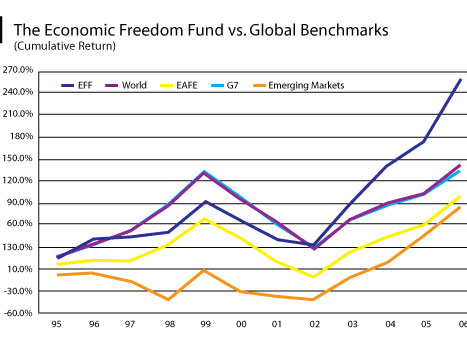
a startling conclusion: Over the past 11 years, the Economic Freedom Portfolio

has far outperformed world stocks in general. While the MSCI World Stock Index

rose 140% during this time, and the Emerging Markets Index climbed 85%, the

IEFP rose an astonishing 254%. See the graph below.

economicfreedom.jpg

I have no idea where this chart came from, but it makes no sense to me. There

are two big oddities:

  • The lines all start at different points. Shouldn’t they all start at the

    same point? (The chart is meant to show returns over 11 years, not over 12

    years.)

  • The horizontal lines look evenly spaced, but the markers on the y-axis are

    all over the shop, with the 0% line marked as 10%, and the 30% line marked

    as 130%.

I tried to look at the fund’s prospectus

for insight as to how this chart was calculated, and came up with nothing. Skousen

says that

The Index of Economic Freedom Portfolio (IEFP) is updated each year, according

to the Heritage/WSJ annual index.

And Stephen

Kirchner goes even futher:

First Trust Portfolios LP has launched a fund that tracks the Heritage Foundation/WSJ

Index of Economic Freedom.

Not true. The fund for sale now is the "Index of Economic Freedom Portfolio,

2007 Series" – which means that you buy and hold a bunch

of securities from 17 countries which came somewhere near the top of the index

in 2007. The Portfolio never gets updated: if a country falls out of the index,

its stocks stay in the fund, and if a country makes it into the index, its stocks

will never make it into the fund. If you wanted to track the index, you would

need to sell the 2007 series when the 2008 series was launched, and so on –

paying large up-front fees each time.

And I have no idea what this means, from Skousen:

In 1995, the IEFP consisted of only 6 countries. Now there are 17 countries

in the portfolio. Clearly, economic freedom has been expanding around the

globe.

There might be 17 countries in the portfolio, but there are no fewer than 30

countries ranked

"free or mostly free" by the Heritage Foundation index. And it’s not

the top 17 countries which make the cut, either. Estonia, for instance, comes

in 12th on the index, but isn’t in the fund.

So when the fund managers created their pretty chart, did they take returns

from the IEFP, which started off with 6 countries and now has 17? Because if

they did then they’re charting returns from a dynamic portfolio of stocks, which

changes according to the freedom index – and it’s a bit misleading to

then use the returns of that dynamic portfolio to sell a fund which is entirely

static and never changes.

On the other hand, did they just take the 17 securities in the 2007 series,

and see how they’ve performed over the past 11 years? That wouldn’t be much

of an indication of anything, and it’s probably not surprising that the fund

did well over the past 11 years, since the Finland chunk is invested 100% in

Nokia, while the New Zealand chunk is invested 100% in New Zealand Telecom.

Amazingly, both stocks have done very well over the past 11 years: what a coincidence!

Hilariously, they’ve even decided that in order to represent Luxembourg in

their fund, they’re going to invest 100% in Tenaris, which is really more of

an Argentine company than a Luxembourgish one. In any case, Tenaris is a very

multinational company, dependent wholly on the oil industry, which has done

very well in recent years (of course), but which has almost no connection to

economic conditions in Luxembourg.

The Index of Economic Freedom Portfolio is a joke, and I sincerely hope that

people don’t go piling into it based on misleading information from places like

"Investment U". If you really want to bet on the Heritage Foundation

index, take the top 7 countries, ranked "free", and buy the five countries

where there are ETFs based on their stock markets. I’ll even give you the ticker

symbols: EWH (Hong Kong), EWS (Singapore), EWA (Australia), SPY (USA), and EWU

(UK). New Zealand and Ireland are too small to worry about. There – I’ve

just saved you a 3.95% sales charge.

Posted in Econoblog | Comments Off on Silly gimmick alert: The Index of Economic Freedom Portfolio

Do UK central bankers think about anything other than inflation?

David Smith has an

interesting piece today about the Bank of England. The Bank kept

rates on hold at its last meeting, but it could easily have hiked: the markets

were on tenterhooks as the annoucement approached. (When was the last time you

could say that about the ECB or the Fed?)

The BoE operates under an inflation-targeting system, and inflation is high

in the UK at the moment, mainly because of a one-off spike in UK energy costs.

Says Smith, a little waspishly:

Perhaps we have reason to be grateful to the utility firms, farmers and food

retailers, and even to the government for increasing university fees. Why

so? In the absence of above-target inflation it would have been harder for

the MPC to have raised rates. Yet the economy’s exuberance — strong

growth, buoyant housing and a six-year high for the stock market — justified

at least some monetary tightening.

Some would say, indeed, the Bank’s problem is that it is obliged to

focus on the inflation target when a more rounded approach to monetary policy

might suggest higher interest rates.

MPC members, of course are going to try their best to set the best monetary

policy they can, while at the same time thinking first and foremost about their

inflation target. If asset prices are skyrocketing and GDP figures are coming

in strong, however, then they might find it just a little bit easier,

all other things being equal, to hike rates. That’s the good thing about having

a rate-setting committee made up of humans. You can give them as narrow a mandate

as you like, but if they’re smart, they’re still going to see the bigger picture.

Posted in Econoblog | 2 Comments

Summers and Oswald on the economics of climate change

Larry

Summers weighs in on the climate

change discount rate issue in the Martin Wolf forum:

A corollary of Stern’s assumption that marginal utility declines only slowly

with income is that risk aversion is not that great.

Question for John Quiggin or maybe Brad DeLong: Did Stern assume that

marginal utility declines only slowly with income? In the very next comment,

Paul Seabright has his own take on Stern’s discount rates:

The Stern report’s analytical centrepiece is a model of growth in which utility

is the logarithm of consumption, and the pure rate of time discount is only

0.1 per cent.

The logarithmic form means that if our descendants are ten times as rich as

we are, it will take an extra ten units of their consumption to justify the

sacrifice of one unit of consumption today – which looks rather egalitarian

at first sight. But there will be so many of these descendants, discounted

by so little, that they overwhelm the egalitarian reasoning by sheer weight

of numbers: transferring consumption one-for-one from us to them is justified

so long as there are eleven or more generations to benefit.

Meanwhile, Mark

Thoma picks up on Andrew Oswald’s contribution in the same forum:

It is necessary somehow to design a way of bringing the future, with their

cheque books, to the negotiating table.

Here is a suggestion.

We print a government bond called a Global Warming Bond. These have stamped

on them: "I pay out 1000 indexed pounds in every year – beginning in

the year 2050 and going on forever". These bonds would be given out,

as a subsidy, to those people and organizations who reduce emissions today.

Think of them as step-up perpetual bonds, which are issued to finance activities

which reduce carbon emissions. Thoma’s commenters don’t like the idea, and I

have to say I’m not so impressed by it either, especially not by the choice

of 2050 as the year when the bonds start paying out. There’s a set of people,

today, making the decision whether or not to issue these bonds – and the

2050 date seems designed to kick in just as those people stop paying taxes and

don’t need to worry about where the money is going to come from.

On the other hand, Oswald’s bonds are in fact distantly related to Gordon Brown’s

beloved International Financing Facility, which I think is a very good way of

forcing governments to keep their promises and front-loading needed action on

poverty reduction. So maybe a little tweak would make Oswald’s idea more palatable:

wait until governments promise to spend x% of GDP on climate-change mitigation

at some point in the future. Then securitize those future expenditures.

Posted in Econoblog | Comments Off on Summers and Oswald on the economics of climate change

RSS update

One of the rather annoying things about the old Economonitor blog was that

people who subscribed to it in FeedDemon or NetNewsWire or NewsGator kept on

seeing the entries duplicate themselves, for reasons I never managed to understand.

When I moved to felixsalmon.com, I was happy I wouldn’t have that problem any

more.

And then this morning, all the entries went and duplicated themselves, for

everybody. Sorry.

This time, however, it’s for a reason I do understand, and I can promise

you it will only happen once: I’ve moved over to Feedburner, which means, among

other things, that (a) I can put a list of my recent posts on permalink pages;

and (b) I can get a reasonably good idea of how many RSS subscribers I have.

So that’s the explanation.

The new locations of my RSS feeds: the main one is here,

the finance one is here,

and the "everything else" one is here.

But your feedreader should have switched over automatically, if things went

according to plan.

Posted in Econoblog, Not economics | Comments Off on RSS update

Del Posto

What’s happened to Del Posto? Back in March last year, I really, really wanted

to go, tantalized by the prospect of dishes like this:

Pici, a sort of fat Tuscan spaghetti, with coxcombs, chicken livers, duck

testicles and, for conventional decadence, black truffles.

Compare that to the menu now:

POTATO GNOCCHI with String Beans, Wax Beans and Cress

It’s like the menu has had all the excitement and personality surgically removed.

It probably makes sense, from a business perspective, to replace the $140 pork

loin for four with a $28 pork loin for one. But on the other hand it does mean

that the restaurant loses some of what made it unique – and without that,

it’s not entirely obvious why anybody would actually want to go there.

The food is very good, but it’s not great. I wouldn’t necessarily say that

I’ve had better Italian food in New York, although I’ve certainly had more enjoyable

Italian food here. And I’ve certainly had much better Italian food

in Italy: Del Posto is probably fair-to-middling by Bologna standards, and can’t

hold a candle to somewhere like Cibrèo, in Florence.

Michelle and I had a houseguest last week, who, reasoning that she would otherwise

have spent $400 on a hotel room, offered to spend that much money on dinner

for three. We did wonder for a minute whether we’d be able to eat at Del Posto

for that kind of money, but we decided to risk it.

I arrived early, and ordered a whiskey sour at the bar. It turned into easily

the most elaborate whiskey sour I’ve ever seen made: fresh fruit and egg whites

and shakers and all manner of mixological pyrotechnics went into this thing

– which emerged smooth, a little bland, and not in the slightest bit sour.

It was a sign of things to come.

When the other two arrived, we went straight to our table, a nice one, in the

corner. (Del Posto probably has more space between tables than any other restaurant

downtown.) The main thing we wanted was a good red wine to warm us up from the

bitter cold oustide – and that’s where things started to go wrong. The

wine list did arrive, large and impressive, with surprisingly small markups

for such a grand restaurant. But the sommelier had a lot of tables to cover,

and annoyingly spent ages at the table next to us walking them through various

madeiras, only to disappear off in a completely different direction before we

could order our single simple bottle of red.

In the mean time, our heavily-accented waiter had already come to take our

food order, so intimidating our vegetarian houseguest in the process that she

ended up ordering nothing at all as a first course, since she was so unclear

on what was what. (There’s lots of Italian on the menu, and it’s pretty tough

to navigate.)

Eventually, the sommelier turned up, and recommended a $65 bottle from Sardinia.

OK, we said – and immediately our appetizers turned up. Mine was delicious,

a small skewer of foie gras and perfectly-cooked sweetbreads, although I was

disappointed with the piece of hard and uninteresting liver in the middle. But

it was exactly the sort of thing which the wine would go perfectly with –

and there was no wine in sight.

I’ve never eaten so slowly in my life, trying to draw out this small little

dish while waiting for the wine to pair with it. We asked a couple of people

where the wine was, and eventually a completely different wine waiter turned

up, apologizing for the delay. He said that he’d looked all over the cellar

in vain for the wine that the sommelier had recommended – so here was

a similar wine (same grape, same region, same price range) we could have instead.

There wasn’t much we could do at that point, so we took the alternative wine,

which turned out to be a little uninspired, and which certainly didn’t have

the kind of earthiness I’d specifically asked for. The delay was bad, the switch

of wine waiters was bad, and the fact that our original wine waiter specifically

recommended a wine he didn’t have was just plain weird.

In general, we were served by simply way too many people: the person who took

your order was rarely the person who brought you your food, and the person who

checked that everything was OK was different still. There were apologies for

the wine delay, but they didn’t feel particularly genuine, and at no point did

we get a hint of friendliness behind the formality. If I had one message for

Del Posto, it would be this: when it comes to service, quantity is no replacement

for quality.

Mains were good, desert was a bit boring, the cart of petit-fours at the end

was a cute touch, but there was nothing spectacular on it. And then the bill

came. They charged us $65 for the wine (I have no idea what the list price was),

and the total was a mere $220 for three, plus tip. OK, we had a vegetarian on

board, but still – for that kind of money it’s really easy to find a very,

very disappointing meal in much less grand surroundings elsewhere in New York.

Obviously, if you choose the $175 tasting menu, with the optional wine pairings

at another $125 per person, you’re going to spend a lot of money at Del Posto.

But one big surprise of our visit was that Del Posto doesn’t need to

be very expensive.

Del Posto does have a lot of swankiness to it: live muzak, soaring ceilings,

formal service, that sort of thing. Everything, in a word, that you don’t

associate with Mario Batali. If you want the Mario Experience, Babbo is still,

clearly, the place to go. Del Posto was Batali’s attempt to open a three-star

restaurant (Michelin scale), and I’m mosty disappointed that he didn’t have

the balls or the imagination to try to reinvent what a three-star restaurant

could be. Right now, Del Posto is a restaurant serving quality Italian food

at high-but-not-exorbitant prices to a well-heeled corporate crowd: it is not,

by any stretch of the imagination, a Foodie Destination. For any given budget,

I would always rather go to Casa Mono than to Del Posto, even though I prefer

Italian to Spanish wines. Only if I were entertaining some very conservative

guests would I play safe and choose Del Posto.

And the fact that Del Posto is the "playing safe" choice is the most

disappointing thing of all. New York didn’t need another "playing safe"

Italian – it’s got dozens of them already. Now it has a particularly grand

one at the bottom of 10th Avenue. Big whoop.

Posted in Not economics | 5 Comments

Finally, a constructive piece on the mortgage market

Now here’s an interesting thing: Mike Mandel, on his blog, has managed to avoid

the housing mania which seems to have overtaken much of the rest of the blogosphere,

myself included. No talk about credit crunches, no talk about housing-led recessions,

no doom-mongering in general.

And now he’s written an eminently sensible and well-balanced cover

story for Business Week on the new era of cheap credit. Yes, there are some

risks involved, but let’s not lose track of the big picture, he says: the benefits

are even greater.

The low cost of capital is probably going to last "five to seven years,"

says Samuel Zell, who as chairman of real estate firm Equity Office Properties

Trust (EOP ) watched bidders wield cheap debt in a fight over his company.

(Blackstone Group, with a $39 billion bid, won out on Feb. 7.) James W. Paulsen,

chief investment strategist at Wells Capital Management (WFC ), sees an even

longer horizon: "This could be a prolonged cycle where the cost of capital

is low [for] 10 or 20 years."

It is, indeed, a low, low, low-rate world.

Easy money is creating all sorts of economic benefits. Corporations are making

capital investments again—and with their borrowing costs so low, profits

are still zooming. Private equity firms are using loads of cheap debt to buy

companies at jaw-dropping prices. Even the housing market, which boomed for

five years on cheap money, hasn’t fallen apart. It’s gliding to a soft landing

rather than a hard crash, allowing consumers to keep spending. "We are

in this era where financial innovation and product structuring, particularly

in the debt markets, has been very stimulative," says Henry H. McVey,

chief U.S. investment strategist at Morgan Stanley (MS ). Zell puts the state

of rates in similar terms: "I think that’s going to be a growth accelerant

around the world."

There’s even a sidebar

specifically on the property market, and that, too, is balanced and constructive

– to the point where, almost uniquely for a mainstream publication, something

nice is said about the CDS market!

So this is the much-feared "housing bust"? Bust Lite is more like

it. Existing-home prices are as high as they were a year ago, while sales

have receded only to 2003 levels. The only extreme decline is in construction:

Builders are trying to get rid of the houses they’ve already built before

they put up more. The overhang of unsold homes could be back to normal by

around midyear…

Low rates are still keeping a floor under housing. Thirty-year mortgage rates

are no higher than in June, 2004, even though the Fed has since pushed up

the federal funds rate by 4.25 percentage points. It’s the same in Britain,

where long-term rates have actually fallen since 2004 despite short-term rate

hikes by the Bank of England. No surprise: After a brief lull, Britain’s housing

market is booming again…

Credit default swaps, which let people bet for or against a bond or loan’s

creditworthiness, have also improved transparency. If investors bet heavily

against an issuer’s securities, its lending costs are driven up. "This

pushes out the marginal lenders," says Whalen. That creates a healthier

market—and ultimately, lower rates.

So when the likes of Dan Gross

and Nouriel Roubini

tell you that the sky is falling, just remember that low interest rates

are a good thing – and that people who think they can time the market

are nearly always wrong.

Posted in Econoblog | 8 Comments

HSBC: No reason to panic

Since moving to felixsalmon.com, I’ve tried to lay off the metajournalism.

This is meant to be a finance and economics blog, after all, and there’s no

reason why people who are interested in finance and economics should want to

read snarky prose about financial journalists.

But maybe I can spin Dan Gross’s

latest article for Slate not as a sign of journalistic innumeracy, but rather

as a sign of why people should buy when things look bad. Because things aren’t

nearly as bad as Dan says they are.

Here’s how the article starts:

Hey Sucker Banking Corporation

How a British bank blew it in America.

On Wednesday, the giant British bank HSBC

warned

of huge potential losses because of problems in its U.S. subprime mortgage-lending

unit. The company, the nation’s second-largest subprime lender, had to set

aside $10.6 billion in 2006 to deal with rising delinquency and default rates

in its vast portfolio of loans to American homeowners with less-than-stellar

credit.

That’s the spin. Here’s the truth: On Wednesday, the giant British bank HSBC

said that its US subprime mortgage-lending unit was on track to make $2.3 billion

in 2006, even after settting aside an extra $1.8 billion to cover loan losses

in the unit.

HSBC never warned of "huge potential losses" – not only is

the bank highly profitable overall, but even its US subprime mortgage-lending

unit is highly profitable. And the $10.6 billion in loan-loss reserves is not

just related to subprime mortgages, it’s related to all of HSBC’s lending, anywhere

in the world – and HSBC has $1.74 trillion in assets, which means

that HSBC is provisioning just 0.6% of its assets.

In other words, if you’re looking for news that the sky is falling, you’ll

find it anywhere you want. But really, it isn’t that bad at all.

Posted in Econoblog | 7 Comments

Gore and Branson launch climate prize

Hillary Clinton wants

to spend oil companies’ profits to subsidize R&D in the energy sector. Al

Gore and Richard Branson have another idea: they’re offering $25 million

to the person who comes up with the best way of removing carbon dioxide from

the atmosphere, and anybody who comes up with a method which will remove at

least one billion tonnes of carbon per year from the atmosphere is eligible.

I hope this is the first of many such prize funds – and I hope that the

US government gets in on the act as well. If Hillary does end up socking a windfall

tax on oil companies, a prize fund would be a better way of spending it than

a picking-winners approach.

Posted in Econoblog | Comments Off on Gore and Branson launch climate prize

Fiji water

Travis Daub finds a Pablo

Päster column:

Producing and shipping one bottle of Fiji bottled water around the globe

consumes nearly 27 liters of water, nearly a kilogram of fossil fuels, and

generates more than a pound of carbon dioxide emissions. No wonder that stuff

is so overpriced.

I find the Fiji water phenomenon fascinating. The whole marketing

schtick is that you’re drinking water from a tropical paradise. And it’s

working, says Päster:

Fiji is now # 2 in premium bottled water, behind Evian where we have the

same transportation issue. An environmental absurdity!

Now, it’s worth pointing out that "premium bottled water", here,

pretty much means "imported bottled water". Water is like

vodka: a commodity which can be distinguished only by means of clever marketing

which is nearly always based on some exotic country of origin.

The thing which fascinates me is that people are so hyperaware of the fact

that they’re being marketed to that they manage to de-guilt themselves from

the fact that they’re drinking an environmental absurdity. They think of Fiji

as a brand, not a country – and thereby gloss over the fact that

they’re drinking water which has been shipped over in containers from the other

side of the planet.

Incidentally, my cousin Tillmann,

a microbiologist, tells me that if you store water in non-reusable plastic containers

like Fiji water bottles, the amount of microflora in that water will rise much

more quickly than if you store it in glass or in a proper hardened-plastic water

bottle. So while Fiji water might indeed be very pure at source, it doesn’t

necessarily stay that way.

If consumers acted remotely rationally, there would be a kind of marketing

arbitrage here. If Fiji is a triumph of marketing over substance, then someone

else should be able to do an equally good marketing job on American water, undersell

Fiji, and drive Fiji out of the market. The problem, of course, is that Fiji’s

exorbitant price (I’ve seen tiny bottles sold for $4.50 in New York delis) is

part of its attraction.

So Fiji’s owners will continue to make a fortune, and, in doing so, cause a

huge amount of entirely unneccesary environmental damage. It’s the kind of thing

to drive Amory Lovins up the wall.

Posted in Econoblog | 2 Comments