Tom Wolfe and the New Vulgarians

Tom Wolfe

is on form, and writing about hedge-fund managers. Apparently they’re "even

coarser and ruder than their predecessors could have ever imagined being,"

but you knew that.

Only Tom Wolfe would accept such an assignment and then, as far as I can tell,

never talk to a single hedge-fund manager – instead talking to

the old money which is disgusted by the vulgarity of the new. And then write

a piece with passages of sheer genius:

He suddenly turned his head away from her. Something had caught his eye.

“Nice voz. Tiffany, right?”

It took her a moment to realize he meant “vase,” the vase on a

little table in the entry gallery. Why he had pronounced it the French way

she couldn’t imagine. She answered in a toneless voice, “No, I

don’t think so.” In fact, it was older and considerably more precious

than a Tif-fany, but she hadn’t the faintest desire to prolong the conversation

with any discussion of the higher ceramics.

The article works as a series of high-finance blind items: which hedge-fund

manager got pwned by a teenage hockey player from Port Chester – and a

girl, to boot? Which other hedge-fund manager clipped a six-figure check to

the first page of a private-school application, thereby guaranteeing his rejection?

Which hedge-fund manager’s wife insisted on their child being borne by a surrogate

mother, to save her "personal-trainer-sculpted boy-with-breasts body"

from the physical consequences of childbirth?

The article also works as a rather more subtle indictment of those who would

consider a seat on the board of the New York Public Library the highest attainment

of humankind, or who shudder at the very thought of people "who hold meetings

with their shirttails hanging outside their jeans, like college boys".

Sometimes, the war between the old millionaires and the new billionaires is

one of those fights you really want both sides to lose. But then you realize

that if it didn’t exist, Tom Wolfe couldn’t write about it. And that really

would be a shame.

(By the way, does Merrill Lynch really have a 41-story building in Times Square?

And, does Annie Leibowitz’s photo of Tom Wolfe at the top of the article remind

you of the photo which

became the drawing at the top of this column? Ach, never mind.)

Posted in hedge funds | 3 Comments

ABN’s Groenink Watches an Era’s End Approach

ABN Amro CEO Rijkman Groenink is not getting a lot of sleep

right now. He has 48 hours to do a deal he never really wanted to do in the

first place, or else see his bank broken up, reduced to little more than a financial-services

footnote.

The modern world has finally caught up, it would seem, with what the Wall

Street Journal describes as "the bank, one of Europe’s aristocratic

firms with roots dating to 1824." Arrayed against Groenink and his arranged

marriage with the just-as-aristocratic John Varley of Barclays

are some decidedly new-world names, chief among them Fred Goodwin

of RBS, Emilio Botin of Santander, and Christopher

Hohn of The Children’s Investment Fund.

Rather than a friendly merger with an established name like Barclays, Groenink

faces the prospect of seeing his Dutch assets – the crown jewel of ABN

Amro’s holdings – being sold to Fortis, of all banks. Fortis,

an expensive name from some brand factory, has no history except for being the

product of multiple mergers of entities with names like N.V. AMEV, VSB, AG Group,

ASLK-CGER, and SNCI-NMKN. You can feel the Groenink shudder from across the

Atlantic.

It’s not that old-school aristocratic financial institutions can’t survive

in today’s cutthroat world: look at UBS, for instance. But ABN Amro has been

a disappointment for many years now. Groenink is surely praying that Varley

manages to pull the trigger, or that Fortis will run

into trouble with the regulators. But he also knows that, sooner rather

than later, his bank will get sold to whoever can offer his shareholders the

most money. Which might be a little vulgar, but is also perfectly old-fashioned

in its own way.

Posted in banking | Comments Off on ABN’s Groenink Watches an Era’s End Approach

Sallie Forth to a BB Rating

If you bought the rumor

on Friday that Sallie Mae was about to go private, you’re feeling pretty smug

this morning. Sure, SLM shares closed at $46.76 on Friday, up almost 15% on

the day. But now it turns out that Christopher Flowers and

his consortium are willing

to pay $60 for them, valuing the student lender at $25 billion.

There are echoes of the TXU buyout here: both companies are in politically

fraught and unpopular industries, and private equity is stepping up where public

shareholders have proved themselves fearful. (Sallie Mae was trading at $55

per share last summer.)

Flowers, along with fellow-bidders JP Morgan Chase, Bank of America, and Friedman

Fleischer & Lowe, is making a long-term bet on Sallie Mae and trusting that

the political firestorm in New York and Washington will blow over sooner or

later.

Flowers is probably right, but it’s a risky bet all the same. Sallie Mae makes

a lot of money by lending money to students and then getting Uncle Sam to pay

it back in the event of default. If the government ever tires of subsidizing

the private sector in this way, no amount of "private student loans"

– loans made outside the federal guarantee program – are likely

to be able to justify the $25 billion price tag.

The most interesting part of the deal, however, is not the politics so much

as the financial engineering. Sallie Mae, like most lenders, has relatively

little debt, mainly because it feels it needs a rock-solid credit rating in

order to minimize its borrowing costs. But all that is about to change now:

this deal is being done with $16.5 billion in new debt, which could well bring

Sallie Mae all the way down to junk high-yield status.

And where will Sallie find the money to lend out if it has a double-B credit

rating? Why, its shareholders, of course: JP Morgan and BofA have promised a

credit line of as much as $200 billion if the bond markets prove recalcitrant.

In 1997, Sallie Mae was a government agency with a triple-A rating. Five years

later, it was down to single-A. Five years after that, it’s likely to be down

to BBB at the highest. That’s progress, that is.

Posted in private equity | Comments Off on Sallie Forth to a BB Rating

Alice Rawsthorn loves Nick Knight

The NYT is running an article about Nick Knight today, written by Alice Rawsthorn. It’s a big sloppy wet kiss of a profile, complete with gushing quotes from Nadja Swarovski, who’s not only a major Knight client but who is also the lead advertiser on Knight’s website, showstudio.com. Rawsthorn herself can’t say enough wonderful things about the site:

In 2000, Knight founded the Web site SHOWstudio as a laboratory where he could experiment with interactive technologies. SHOWstudio has since produced more than 250 projects by Knight and others, placing him at the forefront of developments in 3-D scanning, digital sculpture, interactive film and a raft of other innovations…

Despite the beauty of his still images, SHOWstudio may yet prove to be Knight’s most influential project. He has bankrolled the Web site since 2000, at considerable personal expense. As well as enabling Knight to experiment, it has nurtured a new generation of multimedia stylists, designers and digital artists. When a famous face, like Moss’s, is featured on SHOWstudio, as many as 500,000 people log on in a day.

First, about that 500,000 figure: I don’t believe it. Half a million unique visitors in a day? I just don’t buy it. But I have a couple of friends at the website, and I’ll ask them if it’s remotely realistic, or what it’s referring to. I guess it’s conceivable that if Kate Moss gets naked on the site and it’s picked up by the gossip blogs, then traffic might spike. Lord knows sex sells on the internet. But that kind of traffic hardly represents the “new generation of multimedia stylists, designers and digital artists”.

And second, don’t you think that Rawsthorn, when writing for the New York Times, might have disclosed that she was a founding editor of showstudio.com? This is America, where some people actually care about those kind of journalistic ethics.

Posted in Not economics | Comments Off on Alice Rawsthorn loves Nick Knight

John Cassidy on the Economics of Climate Change

I’m very

interested in the economics of climate change, and it’s great that John

Cassidy has an article on the subject in the May issue of Portfolio.

But I have to admit that I’m very disappointed in the tone that Cassidy decided

to take.

First, the headline – "Learning to Love Global Warming" –

is just dreadful. Global warming is not something that we should learn to love,

it’s something we should learn to fear and try to avoid.

Cassidy then leads off with a story about an unseasonably warm day in New York

this past winter:

With the temperature in the low 70s, the garden was thronged with people

in T-shirts and shorts. -After looking in astonishment at the pink blossoms

that had come out at least two months early, I did a quick cost-benefit analysis

of this presumed product of climate change.

I’m not sure who’s doing the presuming here: Cassidy knows full well that you

can’t draw a direct causal relationship between climate change in general and

a single warm winter’s day in particular. But if you’re going to take extreme

weather events and calculate their costs and benefits, it’s positively dishonest

to use a nice day in Brooklyn rather than, say, Hurricane Katrina.

Cassidy then launches into a list of the winners and losers from global climate

change. Here’s a list of the places he mentions: California’s Central Valley,

Florida, the Northeast [of the USA, which goes without saying], the Mediterranean,

Saint-Tropez, northwestern Europe, Scarborough. Here’s some of the places he

doesn’t mention: Africa. India. Bangladesh.

Any honest accounting of the effects of global climate change has to be, well,

global. And there’s simply no way that the benefits to Scarborough can offset

the costs to the 900 million people living in the Indo-Gangetic Plain, to take

just one example of an area which will be devastated by global warming.

Cassidy then quotes Yale’s Robert Mendelsohn talking about

the effects of mild global warming on countries in the polar region and in mid-latitudes,

and concluding that "warming benefits and damages will likely offset each

other until warming passes [4.5°F], and even then [the cost] will be far

smaller on net than originally thought."

I haven’t seen Mendelsohn’s sums. But it does seem that he’s taking a lot of

advantage from the fact that the world’s poor, who will bear most of the brunt

of global climate change, will also be the hardest hit. If Canada benefits and

India is severely damaged, the net effects in terms of GDP might "offset

each other", although I doubt it. But that doesn’t mean that the outcomes

are economically equivalent. After all, India has a lot more potential for future

growth than Canada does. And if you take into account the opportunity cost of

curtailing India’s future growth, I don’t think you can be quite as sanguine

as Mendelsohn appears to be.

Cassidy does dip his toe into the contentious question of discount rates, setting

up Sir Nicholas Stern on the one side and William Nordhaus

on the other. That’s fair enough, but I don’t think it’s fair to put John

Quiggin in the middle. Quiggin, as any reader of his will know, is

very much on

Stern’s side of the debate.

And although Cassidy does talk about preventing global warming as a useful

insurance policy, he does so thusly:

Statistically speaking, it is unlikely that a 40-year-old man will get run

over by a bus in a year’s time, but he takes out a policy just in case.

Similarly, there may be only a small probability that unchecked growth in

emissions would exacerbate global warming, but why take the risk?

No, John, there may not be "only a small probability that unchecked

growth in emissions would exacerbate global warming". In fact, there’s

is a pretty much a 100% probability that unchecked growth in emissions will

exacerbate global warming.

Cassidy tells us that he isn’t "secretly working for a corporate-funded

think tank that churns out skeptical studies on global warming". Maybe

he should be, if he keeps on writing stuff like this.

Posted in climate change | Comments Off on John Cassidy on the Economics of Climate Change

DoubleClick Finally Regains its Pre-Crash Valuation

One of the great annoyances about online stock-quote services is that they’re

really good at providing historical data until a company gets bought.

Then, it all disappears.

I’ve been reading all the press about the "nosebleed

price" that Google is paying for DoubleClick, and so I asked myself

how it compares to DCLK’s valuation at the height of the dotcom bubble.

This is not an easy thing to find out. But a December 1999 article from Smart

Money has DCLK trading at $216.50 per share, pre-split; and an August 1998

article from internetnews.com

puts DCLK’s fully-diluted market capitalization at $696.45 million at a share

price of $48.38.

Which means that DoubleClick was worth pretty much exactly $3.1 billion in

December 1999 – which is the same price that Google is paying today.

So "nosebleed" might be right. But it’s not unprecedented.

Posted in stocks | Comments Off on DoubleClick Finally Regains its Pre-Crash Valuation

On that illustration

There’s been a bit of interest in the cartoon of me on the Portfolio website, but no one’s worked out where it comes from. In fact, the source is my Christmas mitzvah from December 2005, when I drove a Zipcar around Manhattan giving lifts to people who were inconvenienced by the transit strike. What you can’t tell, of course, from the line drawing is the fact that my suit is purple…

Market-Movers-Illo-MediumFsatjp

Posted in Not economics | 4 Comments

Mel Karmazin, Failure?

One of the ideas behind this blog is that the world of business is full of

big egos, and that egos trump economics on a very regular basis. On the other

hand, it’s rare to find the sitting CEO of a publicly-listed company admitting

that the world of big business can often be reduced to a pissing match between

two hard-headed individuals. CEOs like to pretend that they’re selfless servants

of their shareholders, even when everybody knows otherwise.

Unless you’re Mel Karmazin, of course. Mel just gave an interview

to Portfolio’s Nancy Hass where he’s only too happy to admit that after merging

CBS with Viacom, board meetings were essentially knock-down fights between himself

and Sumner Redstone:

You could have sold tickets to those board meetings with you and Sumner.

Oh, they were fun. While I was there the Osbournes were

on MTV, and I will tell you, Sumner and I were far, far more interesting to

watch.

Yeah, loads of fun, I’m sure. Especially for those long-suffering shareholders.

Of course, Mel could always blame Sumner, back in the day, if the share price

fell. He can’t do that at his new shop, Sirius, whose shares

were last seen trading at $3.08 apiece, half the price they were at the beginning

of last year, and down from somewhere north of $80 back during the dot-com boom.

" I like the idea of the report card—the stock price," Mel

tells Hass. Does that mean he’s officially giving himself an F?

Posted in Portfolio | Comments Off on Mel Karmazin, Failure?

The $200 Million Apartment

More

evidence that house prices are moving towards a power-law

distribution, with the expensive stuff becoming insanely expensive:

Sheikh Hamad, the Foreign Minister of Qatar, recently paid

$195 million for a 20,000-square-foot penthouse at One Hyde Park in London.

Put down your calculator. That’s $9,800 per square foot.

The

Independent has more details on developers Nick and Christian Candy:

Before these penthouses went on the market, it was assumed that the upper

price limit for any London home – however luxurious – was £2,000 per

square foot. The Candy brothers made £4,000 per square foot their starting

price.

It’s also worth noting that even after spending $195 million for his flat,

Sheikh Hamad – and the owners of two other penthouses which are also rumored

to have gone for £100 million apiece – still won’t be able to move

in until 2009 at the earliest.

London, of course, is even more of a global city than New York, and as someone

who hasn’t lived in London for 10 years I view these developments with a mixture

of pride and incomprehension. I remember the area in question as being posh,

to be sure, but in a slightly shabby way: this was back when the hotel next

door, today the Mandarin Oriental, was simply the Hyde Park Hotel. Now, it seems,

there’s nowhere on the planet more upscale.

Posted in housing | Comments Off on The $200 Million Apartment

Market Movers

It’s live! Up until now, I’ve been crossposting to felixsalmon.com, but now that portfolio.com has finally been unveiled to the world, you’ll have to go there to read most of my finance blogs. You can always get there by going to marketmovers.org, in case you don’t want to navigate through the Portfolio home page.

The RSS feed is here; at the moment it’s truncated, but I’ve asked them to change that and serve the full content. In any case, if you subscribe to my “All blog entries” RSS feed or my “Finance and economics” feed, you don’t need to do anything: the Portfolio blog entries should be shuffled in there among the (now necessarily much less frequent) felixsalmon.com entries.

Posted in Econoblog | 3 Comments

When Free Isn’t Good

Anil Dash has a wonderful piece of contrarian thinking up on his blog — it’s a week old, but it’s really timeless.

A little while ago, my friend Michael Sippey, whom I had the pleasure of interviewing the other day, sent me a link to the new Google Voice Local Search

Now, this new services seems like a good product, and I know I’m supposed to say “Wow, cool! Nice work, Google!” But… my initial response wasn’t positive. My gut feeling was “Why the hell aren’t they charging for this? That sucks!

Now, I hate websites which make you pay money. And a constant problem for bloggers is wanting but not being able to point to articles which are hidden behind subscriber firewalls. But Anil’s point is a bit more subtle than that:

Having paying customers would help focus the product team… If your product “may not be available at all times and may not work for all users” (as it says on the product’s homepage), then either fix it or get yelled at by angry users. Either one is a good option. Don’t hide behind a “well, shucks, we said it was beta, and it’s free…” excuse. Being accountable to your users makes your product better…

Connecting people via VOIP or sending them an SMS, two of the key features of the new service, cost money. At Google volumes, they cost a lot of money. I want to have a service I can rely on — which again means I need to invest in it…

Google’s made the leap here before, by starting to charge for Google Apps. Even people who use the service for free were reassured by the fact there was a paid version.

Anil also has bad memories of great web products such as MSN Sidewalk which disappeared because they didn’t make money. Me, I have bad memories of iname.com, which promised me free mail forwarding for life and then broke its promise.

As a rule, companies which give things away for free care much less about their free products and about their users than do companies who charge. This tax season, if you were given a choice between a free tax-preparation tool and one which cost say $20, which would you choose? Many people, quite sensibly, would choose the latter, just because it cost money.

Nothing makes me happier than services which are cheaper and better than the alternative; free-and-better, is, in theory, the best combination of all. But it still makes sense sometimes for people like Anil to want to pay a bit of money.

Posted in economics | Comments Off on When Free Isn’t Good

When Free Isn’t Good

Anil Dash has a wonderful piece of contrarian thinking up on his blog — it’s actually a week old, but it’s really timeless.

A little while ago, my friend Michael Sippey, whom I had the pleasure of interviewing the other day, sent me a link to the new Google Voice Local Search

Now, this new services seems like a good product, and I know I’m supposed to say “Wow, cool! Nice work, Google!” But… my initial response wasn’t positive. My gut feeling was “Why the hell aren’t they charging for this? That sucks!

Now, I hate websites which make you pay money. And a constant problem for bloggers is wanting but not being able to point to articles which are hidden behind subscriber firewalls. But Anil’s point is a bit more subtle than that:

Having paying customers would help focus the product team… If your product “may not be available at all times and may not work for all users” (as it says on the product’s homepage), then either fix it or get yelled at by angry users. Either one is a good option. Don’t hide behind a “well, shucks, we said it was beta, and it’s free…” excuse. Being accountable to your users makes your product better…

Connecting people via VOIP or sending them an SMS, two of the key features of the new service, cost money. At Google volumes, they cost a lot of money. I want to have a service I can rely on — which again means I need to invest in it…

Google’s made the leap here before, by starting to charge for Google Apps. Even people who use the service for free were reassured by the fact there was a paid version.

Anil also has bad memories of great web products such as MSN Sidewalk which disappeared because they didn’t make money. Me, I have bad memories of iname.com, which promised me free mail forwarding for life and then broke its promise.

As a rule, companies which give things away for free care much less about their free products and about their users than do companies who charge. This tax season, if you were given a choice between a free tax-preparation tool and one which cost say $20, which would you choose? Many people, quite sensibly, would choose the latter, just because it cost money.

Nothing makes me happier than services which are cheaper and better than the alternative; free-and-better, is, in theory, the best combination of all. But it still makes sense sometimes for people like Anil to want to pay a bit of money.

Posted in Econoblog | 1 Comment

FS vs GS in the ES

Felix-in-the-Standard2.jpg

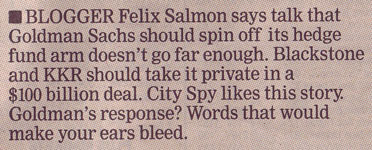
The only thing better than writing blog entries about how Goldman Sachs should be taken private? Having a journalist from the London Evening Standard phone up a Goldman flack and ask for a response. Genius.

Posted in private equity | Comments Off on FS vs GS in the ES

Vincent Price for Citigroup CEO?

Druskin-Large

The New York Post has a wonderfully gossipy piece by Paul Tharp today on who might take over at Citigroup if and when Chuck Prince gets the boot.

Tharp concentrates on the fight between Vikram Pandit and Robert Druskin, which isn’t much of a fight yet because Pandit doesn’t even work at Citigroup (yet), and because even if he did it’s far from clear that he’d actually want the CEO job.

Personally, I’d love to see Druskin get the job. Not because I think he’s particularly great at whatever it is that he does, necessarily. But more because Citigroup is considered an Evil Multinational in so many quarters that it would be great to have a man in charge who can literally twirl his mustaches as he plots and plans. Just check out his photo — definitely the kind of person that Hollywood loves to accessorize with an ankle-length black leather trenchcoat.

Pay no attention to the kindly, avuncular Druskin. It’s the mustachioed hatchet-man we want in charge!

Posted in banking, facial hair | Comments Off on Vincent Price for Citigroup CEO?

FS vs GS in the ES

Felix-In-The-Standard

The only thing better than writing blog entries about how Goldman Sachs should be taken private? Having a journalist from the London Evening Standard phone up a Goldman flack and ask for a response. Genius.

Posted in Econoblog | Comments Off on FS vs GS in the ES

Vincent Price for Citigroup CEO?

Druskin-Large

The New York Post has a wonderfully gossipy piece by Paul Tharp today on who might take over at Citigroup if and when Chuck Prince gets the boot.

Tharp concentrates on the fight between Vikram Pandit and Robert Druskin, which isn’t much of a fight yet because Pandit doesn’t even work at Citigroup (yet), and because even if he did it’s far from clear that he’d actually want the CEO job.

Personally, I’d love to see Druskin get the job. Not because I think he’s particularly great at whatever it is that he does, necessarily. But more because Citigroup is considered an Evil Multinational in so many quarters that it would be great to have a man in charge who can literally twirl his mustaches as he plots and plans. Just check out his photo — definitely the kind of person that Hollywood loves to accessorize with an ankle-length black leather trenchcoat.

Pay no attention to the kindly, avuncular Druskin. It’s the mustachioed hatchet-man we want in charge!

Posted in Econoblog | Comments Off on Vincent Price for Citigroup CEO?

Wolfowitz Must Go

L’affair Wolfowitz has been trickling out for some time now, but today I think it finally reached the point at which Paul Wolfowitz can quite clearly no longer lead the World Bank effectively. When you read the report of the World Bank’s ethics committee, it’s abundantly clear that Wolfowitz was intimately involved in getting his girlfriend as much money as he possibly could.

Wolfowitz was very upset that he couldn’t simply recuse himself from matters concerning his companion, and that instead she was being forced to leave the Bank and work on secondment elsewhere. He then directed the Bank’s human resources department “to compensate her for both the lost opportunities related to promotion and the pain, suffering, and damage to her professional reputation that has been involved in her forced departure”.

Which is the first we’ve heard of such pain, suffering, and damage.

What’s more, Wolfowitz tried his best to engineer not one but three promotions for his partner, which helps explain how she ended up the best-paid person at the State Department, before even taking into account that her $193,590 salary comes tax-free.

Sebastian Mallaby also points out today that the scandal extends to Wolfowitz’s closest aides:

Kevin Kellems, an unremarkable press-officer-cum-aide who had previously worked for Wolfowitz at the Pentagon, pulls down $240,000 tax-free — the low end of the salary scale for World Bank vice presidents, who typically have PhDs and 25 years of development experience. Robin Cleveland, who also parachuted in with Wolfowitz, gets $250,000 and a free pass from the IRS, far more than her rank justifies. Kellems and Cleveland have contracts that don’t expire when Wolfowitz’s term is up. They have been granted quasi-tenure.

Wolfowitz’s fate now hangs with the Bank’s board, and many board members dislike him. However, the US is likely to fight reasonably hard to keep him in place, if only because the convention that the president of the World Bank must always be an American now looks increasingly anachronistic. If and when Wolfowitz leaves, there’s a good chance that his successor will not be an American at all.

That said, the Washington Post reports today that “few bank insiders suggested that Wolfowitz’s job is in jeopardy”. It’s possible that Wolfowitz will hang on, an unpopular lame duck. Which would be the worst possible outcome in terms of energizing the Bank’s staff to do its vital work of fighting poverty.

Posted in pay, world bank | Comments Off on Wolfowitz Must Go

Wolfowitz Must Go

L’affair Wolfowitz has been trickling out for some time now, but today I think it finally reached the point at which Paul Wolfowitz can quite clearly no longer lead the World Bank effectively. When you read the report of the World Bank’s ethics committee, it’s abundantly clear that Wolfowitz was intimately involved in getting his girlfriend as much money as he possibly could.

Wolfowitz was very upset that he couldn’t simply recuse himself from matters concerning his companion, and that instead she was being forced to leave the Bank and work on secondment elsewhere. He then directed the Bank’s human resources department “to compensate her for both the lost opportunities related to promotion and the pain, suffering, and damage to her professional reputation that has been involved in her forced departure”.

Which is the first we’ve heard of such pain, suffering, and damage.

What’s more, Wolfowitz tried his best to engineer not one but three promotions for his partner, which helps explain how she ended up the best-paid person at the State Department, before even taking into account that her $193,590 salary comes tax-free.

Sebastian Mallaby also points out today that the scandal extends to Wolfowitz’s closest aides:

Kevin Kellems, an unremarkable press-officer-cum-aide who had previously worked for Wolfowitz at the Pentagon, pulls down $240,000 tax-free — the low end of the salary scale for World Bank vice presidents, who typically have PhDs and 25 years of development experience. Robin Cleveland, who also parachuted in with Wolfowitz, gets $250,000 and a free pass from the IRS, far more than her rank justifies. Kellems and Cleveland have contracts that don’t expire when Wolfowitz’s term is up. They have been granted quasi-tenure.

Wolfowitz’s fate now hangs with the Bank’s board, and many board members dislike him. However, the US is likely to fight reasonably hard to keep him in place, if only because the convention that the president of the World Bank must always be an American now looks increasingly anachronistic. If and when Wolfowitz leaves, there’s a good chance that his successor will not be an American at all.

That said, the Washington Post reports today that “few bank insiders suggested that Wolfowitz’s job is in jeopardy”. It’s possible that Wolfowitz will hang on, an unpopular lame duck. Which would be the worst possible outcome in terms of energizing the Bank’s staff to do its vital work of fighting poverty.

Posted in Econoblog | 3 Comments

There’s No Housing Bubble

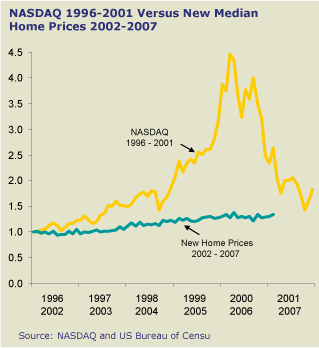
Chart of the day comes from Deloitte’s Carl Steidtmann. You wanna see what a bubble looks like? He’ll show you what a bubble looks like.

Dtt Medianhomeprices 041007

There’s much more where that came from, and of course the comparison isn’t really fair: when you consider the amount of leverage that most new homes come burdened with, the return on investment can approach Nasdaq levels. Even so, the chart does put a smile on my face.

Posted in charts | Comments Off on There’s No Housing Bubble

Pastorini vs Gold Fields: The Plot Thickens

In the FT vs Bloomberg stakes, it’s looking increasingly as though the score is 1-0 to the Brits: Bloomberg put out a follow-up article yesterday headlined “Gold Fields Takeover Interest Can’t Be Verified”, and today’s New York Times quotes Bloomberg editor in chief Matthew Winkler as saying that Bloomberg’s investigation of “Edward Pastorini,” the supposed bidder for Gold Fields, will continue.

But don’t count Bloomberg out quite yet. In an interesting factoid which the NYT doesn’t seem to have picked up on, Bloomberg is claiming that its information came not from “Pastorini” but from within Gold Fields itself. All very peculiar: Gold Fields is on the record as saying that it has received no such bid, but at the same time Gold Fields executives are leaking the details of the bid to Bloomberg? Something is very smelly here indeed.

Posted in leaks | Comments Off on Pastorini vs Gold Fields: The Plot Thickens

Mr McDade’s Inexplicable Insouciance

Ya gotta love Dan Loeb. Just check out his letter to the board of directors of PDL Biopharma, a biotech company he owns stock in, which is well worth reading in full. Most of it is a full-on broadside directed at PDL’s CEO, Mark McDade. Some choice excepts:

It became apparent that the earlier dialogue was a charade intended to stall for time, a tactic we have seen employed many times before by underperforming CEOs. Mr. McDade’s inexplicable insouciance towards us… Mr. McDade’s management blunders and wasteful spending… McDade’s Insincerity and Disorganization… what is truly galling, and what speaks directly to Mr. McDade’s lack of character, professionalism, and competence… How can Mr. McDade purport to effectively run a public biotechnology company with a market capitalization of over $2 billion when he cannot even manage his own Microsoft Outlook inbox?… so long as Mr. McDade remains CEO, which we expect will not be much longer, the Company will have no intention of doing the “right thing”… There is no better example of McDade’s “empire building” philosophy, pathological selfishness and poor business judgment than his decision to build out PDLI’s absurdly large and unnecessary new corporate headquarters (the “Taj Mahal”)… Mr. McDade has, from the beginning of this project, apparently been fixated on when his boat slip in the marina adjacent to the new corporate headquarters will be ready… Mr. McDade has made it clear in private that one of the key drivers behind his decision to relocate the Company from Fremont to Redwood City is that the new headquarters location will lead to a far shorter commute… The Company is being treated like McDade’s personal science experiment.

The stock market loves this sort of thing just as much as I do, it would seem: PDLI is up 8% today, despite Bloomberg reporting that PDL immediately rebuffed Loeb with a thanks-but-no-thanks letter saying that the company believes in its “current strategy”.

Even so, I’m setting the over/under on McDade’s ouster at three weeks.

(Via Alphaville)

Posted in shareholder activism | Comments Off on Mr McDade’s Inexplicable Insouciance

There’s No Housing Bubble

Chart of the day comes from Deloitte’s Carl Steidtmann. You wanna see what a bubble looks like? He’ll show you what a bubble looks like.

Dtt Medianhomeprices 041007

There’s much more where that came from, and of course the comparison isn’t really fair: when you consider the amount of leverage that most new homes come burdened with, the return on investment can approach Nasdaq levels. Even so, the chart does put a smile on my face.

Posted in Econoblog | 7 Comments

Pastorini vs Gold Fields: The Plot Thickens

In the FT vs Bloomberg stakes, it’s looking increasingly as though the score is 1-0 to the Brits: Bloomberg put out a follow-up article yesterday headlined “Gold Fields Takeover Interest Can’t Be Verified”, and today’s New York Times quotes Bloomberg editor in chief Matthew Winkler as saying that Bloomberg’s investigation of “Edward Pastorini,” the supposed bidder for Gold Fields, will continue.

But don’t count Bloomberg out quite yet. In an interesting factoid which the NYT doesn’t seem to have picked up on, Bloomberg is claiming that its information came not from “Pastorini” but from within Gold Fields itself. All very peculiar: Gold Fields is on the record as saying that it has received no such bid, but at the same time Gold Fields executives are leaking the details of the bid to Bloomberg? Something is very smelly here indeed.

Posted in Econoblog | Comments Off on Pastorini vs Gold Fields: The Plot Thickens

Mr McDade’s Inexplicable Insouciance

Ya gotta love Dan Loeb. Just check out his letter to the board of directors of PDL Biopharma, a biotech company he owns stock in, which is well worth reading in full. Most of it is a full-on broadside directed at PDL’s CEO, Mark McDade. Some choice excepts:

It became apparent that the earlier dialogue was a charade intended to stall for time, a tactic we have seen employed many times before by underperforming CEOs. Mr. McDade’s inexplicable insouciance towards us… Mr. McDade’s management blunders and wasteful spending… McDade’s Insincerity and Disorganization… what is truly galling, and what speaks directly to Mr. McDade’s lack of character, professionalism, and competence… How can Mr. McDade purport to effectively run a public biotechnology company with a market capitalization of over $2 billion when he cannot even manage his own Microsoft Outlook inbox?… so long as Mr. McDade remains CEO, which we expect will not be much longer, the Company will have no intention of doing the “right thing”… There is no better example of McDade’s “empire building” philosophy, pathological selfishness and poor business judgment than his decision to build out PDLI’s absurdly large and unnecessary new corporate headquarters (the “Taj Mahal”)… Mr. McDade has, from the beginning of this project, apparently been fixated on when his boat slip in the marina adjacent to the new corporate headquarters will be ready… Mr. McDade has made it clear in private that one of the key drivers behind his decision to relocate the Company from Fremont to Redwood City is that the new headquarters location will lead to a far shorter commute… The Company is being treated like McDade’s personal science experiment.

The stock market loves this sort of thing just as much as I do, it would seem: PDLI is up 8% today, despite Bloomberg reporting that PDL immediately rebuffed Loeb with a thanks-but-no-thanks letter saying that the company believes in its “current strategy”.

Even so, I’m setting the over/under on McDade’s ouster at three weeks.

(Via Alphaville)

Posted in Econoblog | Comments Off on Mr McDade’s Inexplicable Insouciance

Goldman Traders Make the Top-Paid List

There was much press a couple of days ago when Trader Monthly announced that the top five earners on its top traders listing all brought home more than $1 billion last year. (Of course, “brought home” is a really stupid way of putting it: in fact, the vast majority of these earnings are reinvested in the traders’ hedge funds.)

But who lies beyond the top five? The Guardian today has the whole list. They’re giving earnings in pounds, so double all the figures to get the dollar equivalents. Interestingly, no fewer than four Goldman Sachs traders are sprinkled in among the hedge-fund managers, and they all made more money than CEO Lloyd Blankfein.

Raanan Agus, Driss Ben-Brahim, Pierre-Henri Flamand, and Morgan Sze all made between $80 million and $100 million last year, we’re told. Meanwhile, former Goldman star Eric Mindich – one of those people who says “I can make more money at my own hedge fund” and goes off to start one – is nowhere to be seen. Maybe Agus, Ben-Brahim, Flamand and Sze would do well to stay where they are.

Posted in hedge funds, pay | Comments Off on Goldman Traders Make the Top-Paid List