Catch Me If You Can

I saw Steven Spielberg’s new movie, Catch

Me If You Can, last night. Today, I went back and watched it again.

I never do that. It’s a fantastic film, I urge you to see it, and I urge you

to take it seriously. Yes, it’s a light comedy. But it’s also a master class

in filmmaking, and I sincerely hope that Spielberg will be the first director

since Billy Wilder to force Hollywood to give comic films the critical attention

they deserve. 2002 was not a great year for films, I’m afraid, and Catch

Me If You Can stands out as one of the very few which is both popular and

first-rate.

It’s superlative from the opening sequence on. The titles, by, I think, Kuntzel

and Degas, are magisterial: this is one of the best title sequences in years.

They do a fantastic job of evoking the 1960s and encapsulating the whole story

of the film to come, all to the accompaniment of a self-contained piece of music

by John Williams. They’re much more than an homage to Saul Bass: they’re a genuine

overture. (Note the absence of a pre-credit sequence: these titles alone are

enough to grab your attention.)

Since I’ve mentioned John Williams already, I might as well say right now that

he’s done an amazing job on the score of this movie. It’s light but strong,

catchy yet unobtrusive, and, as the final credits roll, Williams even starts tipping the

hat to Aaron Copeland. It’s a great piece of American composing – and

it really pains me to say this, as I make it a point of hating John Williams

and all his works, which are usually derivative and overblown.

Catch Me If You Can also has finally managed to break the First Law

of Tom Hanks: that he’s never appeared in a really good movie. He’s not great

in this – he just about does what’s asked of him, that’s it – but

finally I’ve found a Tom Hanks film I can actually really like.

That said, Hanks is acted off the screen by an excellent cast. Leonardo DiCaprio

leads with a performance of wit and subtlety, ably supported by Christopher

Walken (who’s just Christopher Walken, really, I’m not sure where all the superlatives

for his performance came from, unless it’s simply shock that he should ever

play a character with all-too-visible weaknesses) and some wonderful cameos.

The two which really stick in the memory are Jennifer Garner as an opportunistic

model-turned-hooker and, most wonderfully, Martin Sheen as a southern lawyer

with seemingly twice as many teeth as the average man, and impeccable comic

timing.

The lion’s share of the credit, however, must surely go to Spielberg. It is

he who has really pulled off the directorial juggling tricks required: keeping

the action moving while developing the characters, wowing us with the production

design while at the same time spinning a gripping yarn. Most of all, he manages

to keep DiCaprio’s character both sophisticated con-man and naive boy at the

same time: someone who, when he phones the FBI to taunt them, does

so with a glass of milk by his side.

DiCaprio plays Frank Abagnale Jr, whom we first see suffering in a hideous

French lock-up, but who not much later is back to the final glory day of his

youth, watching his father (Walken) collect some meaningless gong from the New

Rochelle Rotarians. As Frank Sr goes up to recieve his award, his son manages

to pull the label, whole, from one of the bottles on the table in front of him,

and allows himself the briefest of self-congratulatory smiles. The moment is

caught en passant by Spielberg’s camera – the father is the center

of the action – but in that smile, in Frank’s pleasure at pulling something

off, the next three years of his life are presaged.

Labels torn from bottles become something of a recurring motif for the rest

of the film: it’s as though Frank is obsessed with possessing them, being able

to switch from brand to brand whenever he likes. His wallet contains nothing

but labels, his life is little but a successful exercise in making people miss

the boy for the label with which he presents himself (pilot, physician, lawyer).

As we’re told twice in the film, once by Frank Sr and once by Frank Jr, the

Yankees keep on winning the World Series not because of Mickey Mantle, but because

their opponents can’t take their eyes off the pinstripes.

When Frank Sr falls on hard times, his son gets sent to public school, and

quickly demonstrates his quick wit, sharp eye for detail, and general ballsiness.

After being bullied before even getting to his first class, he quickly takes

over French lessons, deciding that being a subsitute teacher has got to be a

better life than being a bullied kid. The scene where the headmaster sorrowfully

explains to Frank’s parents that their son has just called a parent-teacher

meeting to plan a school outing to the local baguette factory is a masterpiece

of comic filmmaking: for all the solemnity on screen, everybody in the cinema

is in stitches. But the real genius is the way in which Spielberg cuts back

and forth from the headmaster’s office to DiCaprio, outside it, advising one

of the girls at school that she should really fold that note from her mother

if she doesn’t want to be found out as a fraud. In the very next scene, he espies

a pin on a couch which shouldn’t be there: Spielberg is showing us Frank’s acuity in the most unobtrusive way, weaving it in to the rest of the plot.

When his parents divorce, Frank runs away from home, and has something of a

Damascene conversion on the street outside a hotel when he’s been turned away

from yet another bank where he’s tried to kite a bad cheque. A shaft of sunlight

suddenly illuminates the side of his face, and in a glow of pure slow-motion

1960s joyousness, a pilot leads his gaggle of giggling stewardesses through

adulatory throngs and on to the reception desk. It’s not long before the very

same bank manager who turned Frank away just a scene earlier is eagerly shaking

his hand, awed by his purloined pilot’s uniform.

This is a movie full of uniforms, not only of pilots but of nurses and stewardesses

too, and even of FBI g-men. The latter, true to type, wear black suits, white shirts, black

ties, and black hats. The production design is a dream: the 60s in all their

glory, with no sign of the counterculture or even of rock ‘n’ roll. Eero Saarinen’s

TWA terminal in New York has a starring role, along with countless co-eds in

tight sweaters. It’s all very 50s-innocent, for all that our hero is jetting

around the world cashing millions of dollars in bad cheques.

Even the FBI is not spared the rose-tinted spectacles: for comic relief, most

of its employees are bungling idiots, and even Tom Hanks, the agent who finally

catches his man, has to endure more than his fair share of flashing-his-ID-backwards

and seeing his shirts stained pink in the launderette by a misplaced red top.

All the same, however, Spielberg does manage to imbue Hanks with a certain

amount of fatherly gravitas: when Frank Jr loses Frank Sr, he also gains a new

father-figure in the shape of the cop who caught him and who is going to spend

the next four years trying to get him out of the jail he put him in to. Both

Hanks and Walken are divorced men who still wear their wedding rings: the symmetry

is almost too pat, but it’s done artfully enough that it barely registers

consciously the first time around.

There are some lovely Spielberg touches in this film, not least the scene where

the FBI raids Frank’s Atlanta apartment. A gun, looking like nothing so much

as a sea-horse, enters the screen from the left, silhouetted against the swimming

pool in the background. Another follows it, and then a third cuts across from

the right: it’s a truly beautiful shot. There’s another when DiCaprio is caught red-handed printing blank cheques, and he stands in his wifebeater with the evidence of his crime fluttering down all around him, even landing on top of his head. And Spielberg can swing from comedy

to pathos in an eyeblink, too: when Frank is running away from the FBI for the

last time, he has to leave his fiancée, who still considers him to be

a doctor and a lawyer. When he comes clean to her, her first reaction

– "you’re not a Lutheran?" – draws a laugh; her second

("why would you lie to me?") draws sympathy.

Spielberg is also lucky (or clever) enough to have the services of Janusz Kaminski

as cinematographer, who turns the film into a sunny delight without ever making

it sickly or camp á la Far From Heaven.

Friedrich, over at 2Blowhards, says

that Catch Me If You Can could be Spielberg’s best-ever film. It’s

up against some very stiff competition, but I’m inclined to agree. It’s certainly

better than his other film this year, Minority

Report, and is also better than the last film for which he won an Oscar,

Saving Private Ryan. I hope that this film gets a nomination too: not

only because it’s so good, but also because comedies in general, and light comedies

in particular, deserve better treatment from the drama-obsessed Academy. There

could be no better way to remember Billy Wilder.

Posted in Film | Comments Off on Catch Me If You Can

Personal Exupery

My mum sent a few gifts with me to open as and when. One of these was my childhood

copy of The Little Prince.This morning, having celebrated throughout

the midnight sunlight, I greeted the new year in with this treasure. I’m sure

you’ve all read it before but do yourself a favour and read it again.

A new year’s excerpt, on lamplighters on Earth:

Seen from a slight distance, that would make a splendid spectacle. The movements

of this army would be regulated like those of the ballet in the opera. First

would come the turn of the lamplighters of New Zealand and Australia. Having

set their lamps alight, these would go off to sleep. Next, the lamplighters

of China and Siberia would enter for their steps in the dance, and then they

too would be waved back into the wings. After that would come the turn of

the lamplighters of Russia and the Indies; then those of Africa and Europe;

then those of South America; then those of North America. And never would

they make a mistake in the order of their entry upon the stage. It would be

magnificent.

Only the man who was in charge of the single lamp at the North Pole, and his

colleague who was responsible for the single lamp at the South Pole –

only these two would live free from toil and care: they would be busy twice

a year.

Posted in Rhian in Antarctica | 5 Comments

Personal Dec 29, 2002

We made it! And here I am! Currently working night shifts, 8pm-8am, hauling

cargo. Boxes and barrels and containers and food and drums and drums and drums

of fuel. Hard hats and big machines. Cranes, skidoos, snowcats. The cleanest

construction site in the world!

Occasionally I look up, look around me and see white. White, white, white,

as far as the eye can see. Sometimes, that’s not very far at all. Other days,

it’s miles and miles. And a streak of blue on the sky perhaps. Or the water-sky

effect where clouds reflect what’s below them so they’re darker above water

than snow. Clouds. So much sky. Clouds and clouds of sky. No wonder the meteorologists

like it here so much. There’s not a lot else to focus on. Except the man-made

features. Straight lines, randomly placed. Why can’t they be spirals? Why can’t

we spell something creative out to the sky above? Straight line of cargo here.

Fuel depots. Shipping containers. Buildings, widely spaced apart (why?), on

legs. My new lab, off in the distance, still just a platform. The containers

which will go up there have, however, arrived.

This is my new home. To my surprise, it feels very normal. The wonder and beauty

that has struck me every day on this voyage is less apparrant. It’s kind of

as I expected, but in every direction. And bigger. It’s right somehow. Maybe

it’s because we’re busy, maybe because I have plenty of time ahead of me, maybe

because, unlike the other places on this trip, I’ve heard a lot about Halley

already.

Whatever the reason, it’s good to be here. And it’s been a good laugh so far

too. Everyone takes part in the relief operation, ship side, base side, in between.

It’s about 13km between ship and base and we’re operating for 24 hours. There’s

bound to be more about this written in the official

site (remember to look for Halley now, not Shackleton!) This is just a quick

entry, before I return to the fuel drums, to say I’m here, we made it and it’s

good.

Thanks also to everyone who sent me a christmas email, thanks for the pressies,

cards and letters that I got to open on christmas day and Happy New Year to

you all! (Also, my email address book was wiped upon moving up here so if you

want a personal email from me back, please just drop us a quick line –

either leave a comment here, or email

Felix.)

Posted in Rhian in Antarctica | 1 Comment

Personal Christmas in Halley

Dear All… Thank you for the wonderful, wonderful christmas emails that have

been coming in..and sorry for not replying individually: I am busy stuffing

stuff into bags that are stuffed. Rhian style. It’s mayhem. We arrive this afternoon,

christmas eve. Relief begins tomorrow. But what I really, really need you to

know, more than anything, is that I have just seen Antarctica for the first

time, up close and personal, I could almost touch her. And she is beautiful.

So very beautiful. My breath was taken away. I am in love with this landscape.

I am in Antarctica. Happy christmas to you all, and thankyou from the depths

of my heart for always encouraging me to follow this dream. xx

(On an aside, upon moving to Halley this afternoon, I have to set up a new

email account. The address will be the same for you but the reality for me is

that I lose your addresses in the system. So please drop me a quick line, either

by leaving a comment here, or by emailing

Felix.)

Posted in Rhian in Antarctica | 4 Comments

Personal: December 22 2002

Okay, I’m bundled up to the nines (?!*$!), feel like the Michelin man, look

like the Michelin Man, look like everyone else on this ship. Identikit.

Purple reversible fleecy jacket thing, huge overalls and coat with reflecty

strips, beige steel toecapped fur lined boots (nice), green heavy duty

moleskin trousers, thermals under all of this when it gets colder,gloves,

scarf and hat are still my own in a vague attempt to retain some

individuality. Won’t last though I’m sure. And for recreational gear? We’re

all wearing Ernest Shackleton polo shirts and jeans. A far flung cry from

the world of New York that occupies most of this website I’m sure. Back to

the days of not thinking at all before getting dressed in the morning.

Morning, afternoon, well, whenever you wake up really. Midday today I think

it was. But then, we were partying hard last night. Cabins small, bag

explosion, pity my cabin mates (those of you who know me, know). Random

socks in random pockets. Names written on every piece of clothing. Apple

pie and custard. Bad eighties music. This is school.

Just so you know it’s not all a deep spiritual journey into the last unexplored

wilderness. I mean it is, but it can’t be the whole time. It could be I guess,

but that would actually physically blow my mind into too many pieces to be healthy.

Still recovering from South Georgia I think. We left land

a week ago and boarded the ship a month ago. It’s been great. Yesterday, we

finally crossed the Antarctic Circle. Amazing. A great thick red line painted

across the icebergs with "Welcome to Antarctica" embellished in the

walls. We’ve crossed a ‘polynya’ too which deserves a mention because it truly

is a wonderful word. Affectionately called Pollyanna by those who know her.

A polynya is a huge area of open water that is surrounded by sea ice. So munch,

munch, munch, through the ice for days and suddenly, it’s like being in the

open sea again. Bizarre. Rocky ship, no ice for as far as the eye can see. The

occasional berg ofcourse though. Like being sent back to two weeks ago! We’ve

been probing the sea here too..throwing ‘XBTs’ off the back of the ship to get

temperature/depth profiles. Think there might be a few pics on the latest Shackleton

diary page

so have a look at them, makes it look like I’ve been ever so busy on the ship…there’s

even a pic of us circuit training on the after deck!

So what have I been seeing lately? Ice, ice, ice. Floating ice. Ice

floating. Bergs, ice, thick viscous ocean with ice floes floating on it.

It’s magnificent. Not too much wildlife..this will probably increase again

as we approach more solid land/semi- permanent ice. Did I say we saw a

whale after leaving S Georgia? Two of them. Seems like months ago!

The nights are also like day now, there is a vague darkish period around

9pm but the sun hasn’t been seen setting for a while. Magnificent long,

long (hours long) sunsets are a thing of previous latitudes. And next to

come…Halley. Due on christmas day I think but that’ll depend how

difficult it is to crunch through the next lot of ice. Have been having

lots of training sessions on the ship too: first aid, manual handling,

cargo logistics, vehicles (how to start a skidoo), clothes etc. And we’ve

been allocated jobs for the relief when we get to base. That was an

immediate morale booster in the bar. People have a purpose again. Night

shift? Day shift? Driving the snowcat? Tallying boxes? Seaice relief? In

the kitchen? Operating cranes? You could taste excitement in the air. A

24-hour relief operation is about to begin that may take two weeks. We’ll

all be exhausted and very cold. What a change from the luxury of the ship.

Our bodies won’t know what hit them! Back to the sauna now I think…I must

enjoy every luxury while they last!

Happy Christmas to all, especially those in Trafalgar Road. I’ll be

thinking of you, wherever and whatever our operations are that day.xx

Posted in Rhian in Antarctica | 3 Comments

Feyerabend and philosophy

A long back-and-forth

I was having at 2Blowhards the other day prompted Brian Micklethwait at Samizdata

to nominate

one of my postings as "the silliest and most potentially disastrous blog

comment of the year 2002". His problem was that I suggested that Michael

Blowhard read more Feyerabend, and he considers Feyerabend (or me, it’s not

entirely clear) to be an "anti-philosopher of anti-science".

At the same time, I was having a hard time with the Blowhards. Friedrich seemed

to be lumping Feyerabend in with Nietzsche, while Michael went one better and

started comparing him to Foucault, of all people. Then, a few days

later, 2Blowhards printed a guest posting by the more philosophically adept

Chris Bertram, who mentioned Feyerabend in the same breath as David Hume.

Now it’s unclear whether Mr Bertram considers Feyerabend to be a philosopher

in the same tradition as Hume, or whether he believes the opposite. But certainly

there seems to be a general perception that Feyerabend is a crazy continental

type who doesn’t belong in the tradition of analytic philosophy. And I just

wanted to use my baby pulpit, here, to assert that he is, indeed, a very rigorous

analytical philosopher, who very much works in the tradition of Hume.

The reason I say this is not necessarily because I agree with everything he

says, and it’s certainly not because Feyerabend was a very good physicist before

he became a philosopher. (Many physicists display distressingly woolly thinking

when it comes to disciplines outside physics.) Rather, I consider Feyerabend

to be at the forefront of the single most important project in philosophy: to

defeat skepticism.

What I’m talking about here is philosophy in the tradition not only of Hume,

but also of Descartes or Wittgenstein. Each of these people carried the skeptical

position further than it had been taken before, in attempt to find out exactly

what we can be sure we know about the world. Hume addressed inference: how can

we know the sun will rise tomorrow? Well, because it always has in the past,

and the future will be like the past. But how can we know the future will be

like the past? Well, because it always has been in the past. The question just

circles back onto itself, and never gets answered. So far, no one has managed

to really solve this paradox which lies at the heart of all science, and indeed

of all our everyday behaviour.

Descartes addressed not our expectations of what will happen in the future,

but our experience of what is happening in the present: what if all our senses

were being tricked by some evil demon? What if this is all some kind of dream?

Can we really trust the evidence of our senses?

And Wittgenstein addressed not what we perceive, but how we think: since we

think in language, and no one can be entirely sure exactly what we mean by anything,

can we even rely on our own thought processes as Descartes proposed?

OK, these are Philosophy 101 oversimplifications of great philosophers. Wittgenstein,

especially, is a lot more complex and nuanced than I’m giving him credit for

here. (If you want, you can dump the "real" Wittgenstein for Saul

Kripke’s "Kripkenstein": he fits my thesis a bit better.) But you

get the general idea: the way that philosophy is advanced is by philosophers

setting out a skeptical stall, and then trying to find solutions to how we can

still arrive at life and knowledge despite the nihilistic attraction of the

skeptical position.

And Feyerabend fits very easily into this tradition. For sure, he attacks science

as we know it, and sets out a position which basically says it’s no better than

witchcraft. But that’s what philosophers do: they advance the skeptical position

so that those who believe in science (which is most of us) are forced to construct

with much more rigor and clarity the argument for exactly why we do.

Check out the Stanford Encyclopedia of Philosophy’s entry

on Feyerabend. At the bottom, there’s a list of related entries: "analytic

philosophy | anarchism | essential vs. accidental properties | Frege, Gottlob

| Galileo Galilei | Kuhn, Thomas | Lakatos, Imre | liberalism | logic: inductive

| logical positivism | Mach, Ernst | Marxism | meaning | Mill, John Stuart |

Nietzsche, Friedrich | paradox: of analysis | Popper, Karl | postmodernism |

Principia Mathematica | quantum mechanics | rationalism vs. empiricism | realism

| relativism | scientific method | scientific realism | social democracy | Vienna

Circle | Wittgenstein, Ludwig". This isn’t a list of woolly-headed Frenchy

post-structuralists, this is the core of hard-nosed analytic philosophy.

So feel free to disagree with Feyerabend: most of us do. But don’t dismiss

him as an "anti-philosopher": he deserves a lot more respect than

that.

Posted in Culture | 9 Comments

The New York Times hikes its price

The New York Times announced

today that it’s raising its newsstand price in its home city by 33%, to $1.

(Sundays will stay at $3.) The price jump comes on top of a 15-cent price

hike

in September 1999, bringing the total rise over the past three years to 67%.

The Times is now, for those of you keeping score at home, fully 400% of the

price of the New York Post.

As we all know, the main development over that time has been the growth of

the internet, where nytimes.com is one of the leading news websites. Just about

every article the New York Times publishes is available for free on the web,

and you don’t need to schlep to the newsstand or wait until it’s delivered to

your door, either. By the time you’re reading Paul Krugman, Andrew Sullivan’s

rebuttal is already up on the web, posted within an hour or two of midnight.

The decision to price the paper at a buck an issue can’t have been easy. It’s

not pocket change any more: you now need folding stuff if you want to read Monday’s

Metropolitan Diary on folding stuff rather than on the internet. It’s a big

psychological barrier, and places the New York Times solidly as a premium, luxury

product, as opposed to something you might pick up on your way into the subway.

(Talking of the Metropolitan Diary, by the way, can somebody out there with

Nexis do me a favour? Find out (a) the percentage of Metropolitan Diary columns

which include at least one instance of the phrase "without missing a beat";

and (b) the percentage of New York Times stories featuring the phrase "without

missing a beat" which are Metropolitan Diary columns. I’d be most grateful!)

Certainly the price of newsprint has been going up in recent years, but I have

my doubts that paper prices alone could justify newsstand price raises of this

magnitude. The New York Times has also made large investments in colour presses,

which are expensive things, and which in the present advertising climate might

not have generated the extra revenue that was originally projected.

The official reason, or at least the only justification in the press release,

is the addition of "several new features and sections, including the Friday

‘Escapes’ section". Since these sections are wholly advertising-driven,

I’m not convinced: if they weren’t profitable, they wouldn’t exist. The release

also mentions that the metropolitan edition is merely coming into line with

the national edition: that would be more convincing if it wasn’t for the fact

that the New York Times is making a big push to become a national newspaper,

bringing down distribution costs around the country. If anything, one would

think that national prices would come down, rather than metropolitan prices

go up.

I think the real reason for the hike is twofold. On the one hand, costs and

revenues are moving in opposite directions: post September 11, the Times has

devoted a lot more resources to expensive international reporting, while ad

sales continue to be in the doldrums. More importantly, however, the Times can

do what it likes. It’s a monopoly, and people will pay whatever they have to.

But I think the internet is having an effect as well. People who buy the Times

will continue to buy the Times, and continue to pay whatever it costs. But they

will also die off steadily. People who have never bought the Times will be increasingly

likely never to buy it, working out, quite rightly, that all the same information

is right there on the web should they ever be interested in it. So to keep revenues

up, the Times is going to have to keep on increasing its price. It’s a curious

inversion of the normal law of supply and demand: here, as demand decreases,

price goes up.

Of course, if there was an alternative,

the New York Times could never get away with this sort of behaviour. But there

isn’t. So we remain at the mercy of the benign patriarchs of 43rd Street.

Posted in Media | 11 Comments

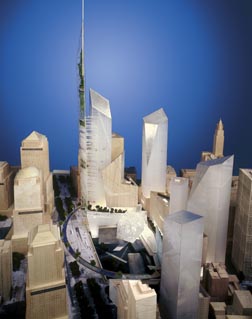
The new WTC designs

I went to the unveiling of the new plans

for the World Trade Center site this morning, and they’re miles ahead from the

vague and unimaginitive plans we saw

five months ago. There are nine plans in total, from seven architectural teams,

and between them they have a lot of excellent ideas.

There are some definite surprises, chief among them that the dream team of

Richard Meier, Peter Eisenman, Charles Gwathmey and Steven Holl – New

Yorkers all – should have come up with the worst design of the lot. SOM,

as well, the most experienced skyscraper-builders in the world, fell flat on

their face.

A notch up in quality are the teams who had some but not all of what was needed.

The urban planning duo of Steven Peterson and Barbara Littenberg came up with

a very workable but completely unimaginative design. The team calling itself

Think had no fewer than three ideas, all of which are quite clever, but none

of which stand up to much scrutiny. And Norman Foster, although he does have

a wonderful skyscraper, has little else.

The best designs came from Daniel Liebeskind, who stunned with a coherent,

realistic and highly imaginative plan; and United Architects, with an idea which

reimagines just what urban design can be all about.

The one thing which everybody did, however, was present skyscrapers as public

spaces. Something’s going to go up on the site, and whatever it

is will have much more public access than any other tall building in the world.

That’s certain, now, and it’s welcome, too.

At the risk of getting blogged down, so to speak, I’m going to run through

each in turn, since I think it’s important to point out the bad things as well

as the good.

Meier

et al first, then. Richard Meier was very cocky in his presentation:

"We’re the New York team," he said. "Some say we’re the dream

team." But what this team came up with looks like a classic case of design

by committee. They put reflecting pools on the footprints of the twin towers,

which let light through to a memorial space below – so far, so normal.

Then they took the shadows which the towers cast (to the west) on September

11, and planted them with trees. One of the shadows went into the river, so

that area becomes a "floating memorial plaza" which 5000 people can

fit onto should they so desire. It’s one of dozens of different memorials which

they’re dotting around Lower Manhattan, in a kind of distributed remembrance which I don’t think really works. You don’t want to keep on bumping unexpectedly into another memorial as you go about your daily life.

The main problem with the design is the skyscraper portion, however. The Lower

Manhattan Development Corporation (LMDC), as part of its excellent brief, told

all the competing architects that "a restored skyline will provide a significant,

identifiable symbol for the residents of the metropolitan area". Well,

this symbol looks like nothing so much as a pair of tic-tac-toe games set at

right angles to each other. Peter Eisenman tried to liken the buildings to "the

fingers of two hands embracing the site," but they aren’t. Rather, they

block off the site (and Battery Park City) from the rest of Manhattan, reading

more as barriers than as entry gates.

Next

Skidmore Owings & Merrill, who teamed up with four artists,

including Jessica Stockholder, to create what they call "a dense grid of

vertical structures that support multiple strata of public and cultural spaces".

What that means in practice is a set of no fewer than nine more-or-less-identical

skyscrapers shoehorned into a very small area, with the occasional sky bridge

connecting one to another. They all have sky gardens on the top, which is nice,

but no matter how airy they are, street level will become dark and permanently

in shadow, and it’s not going to be a nice place to be.

There’s also an element of the Jetsons in the way that SOM has designed the

transit hub with two roads as well as the 1 and 9 subway trains running straight

through it in glass tubes. The whole presentation, in fact, feels much more

like the conceptual projects we all saw in the immediate aftermath of the disaster,

and far from anything which could ever be constructed in reality.

The

odd team out of the seven is Peterson/Littenberg Architecture and Urban

Design. It’s a small partnership which impressed the LMDC with its

approach to the site and somehow made it, as architects, to the final round.

It’s one of the few teams to break the rules: while the LMDC said that it didn’t

want to build on the footprints of the original towers, Peterson/Littenberg

put an amphitheatre in one of them.

This team was also one of the prime movers beind opening up West Street into

a tree-lined promenade which stretches all the way down to the Battery. It’s

a great idea, and one which the LMDC has adopted, but it was specifically exluded

from this particular brief. Again, Peterson and Littenberg ignored the brief.

As urban planners, rather than architects, this pair spent a lot of time designing

a lovely garden, and constructing a pedestrian-friendly street grid. They’re

the only team which not only extended the original streets into the World Trade

Center site, but also added a brand new street as well. The final plan is certainly

a nice place to be, but it shows very little in the way of boldness or imagination.

And the new skyscrapers aren’t imagined at all, beyond the fact that their height

is limited to 55 stories (roughly the height of the existing American Express

building). Two of them will have 35-storey campaniles on top (one a hotel, the

other residential); these will serve to replace the lost elements of the New

York skyline. There’s very little mention of public access to the new buildings,

something that is at the forefront of the other schemes.

Think,

a huge team including Frederic Schwartz, Rafael Viñoly, Shigeru Ban and

David Rockwell, couldn’t come to any decisions at all, and instead presented

three different designs. The first, called Sky Park, floats a 16-acre park into

mid-air, with various buildings huddled in the darkness below. The last, called

the World Cultural Center, is a crazy idea to build a latticework around the

footprints of the original towers, and then slap various cultural institutions

(schools, theatres, whatever) inside the latticework at various different

heights. At the exact points in midair where the planes flew in to the World

Trade Center would be a memorial linking the two structures. Whatever. This

is a flight of fancy, it could never happen.

Think also proposed what they call a Great Room, which basically comprises

enclosing most of the site in a huge 30-storey glass plaza. The roof would be

held up by office buildings around the perimeter, as well as by another pair

of latticework columns surrounding the footprints. Next door to the site, where

the Deutsche Bank building currently sits empty, the tallest building in the

world would be constructed to help out on the skyline front. The whole thing

is less bad than the other two ideas, but I’m not sure there would be too much

demand for offices which front straight on to a memorial, or even for any new

structure of this magnitude.

Foster

and Partners is definitely an improvement on the previous four. Lord

(Norman) Foster knows his onions when it comes to monumental architecture, and

he’s designed a beautiful twisting "twinned tower" which would be

a welcome addition to any city’s skyline. He calls it "the most secure,

the greenest and the tallest in the world," and there’s no reason not to

believe him. It will be filled with high tree-filled public atriums at various

levels, which will provide stunning views over the rest of the site as well

as far beyond. There could even be funiculars sweeping us all up the side of

the building at high speed – what an attraction, and not just for tourists.

Foster has kept the footprints as voids, and placed high walls around them

to set them apart and intensify the memorial experience. You can’t go into them,

but you can go around them, and then up a ramp into a huge green park which

stretches over the top of West Street and all the way to the river. (In this

way, Foster avoids the huge expense of burying West Street, freeing up those

funds for other transportation or infrastructure projects.)

What

keeps Foster out of the top two, however, is a certain lack of imagination.

His plan is workable, and strong, but it’s not really bold. Daniel Liebeskind,

however, has a wonderful central idea (you can read his statement here)

which he’s managed to turn into a compelling architectural concept.

It all starts down in the dirt, by the huge slurry walls which stop the Hudson

River from rushing in to the site. These were and are true engineering marvels:

as Liebeskind says, they "withstood the unimaginable trauma of the destuction

and stand eloquent". He keeps them exposed, 70 feet below ground, and then

spirals up and out, into the rest of the site and beyond.

At the bottom is the museum and the memorial; at the top is a vertical "gardens

of the world", rising in a glorious spike well above the rest of the skyline.

The buildings in the rest of the site are extremely strong as well, especially

the ones which border on what Liebeskind rather unfortunately calls the "wedge

of light". This is a triangular plaza which will have no shadows each year

on September 11 between the hours of 8:46am and 10:28am. It’s mirrored by the

Heroes Park, one of three or four green spaces in the plan. Finally, symmetrically

opposite the gardens of the world is the transit hub, a center not only for

PATH and subway trains, but also the point to which the "paths of heroes"

– the routes taken by the fire and police forces on September 11 –

converge. Everything, down to the parking area for tourist buses, has been carefully

thought out and put in what feels like exactly the right place.

Finally,

there’s United Architects, a group including Foreign Office

Architects, Greg Lynn, Kevin Kennon, RUR Architecture, and UN Studio. Somehow,

they’ve managed to transcend all the problems which faced the other large groups

in the competition, and come up with a very strong, simple and new idea.

United Architects, just like Liebeskind, go down to bedrock and build vertical

sacrosanct areas around the edge of the footprints. Looking up from the bottom

of their voids, however, one sees not just sky but skyscrapers too: "the

memorial and the development are not divided, but linked," in the words

of Greg Lynn. The effect is a cathedral-like space, where the buildings carve

out a volume of light.

One enters the space walking down a sprial from Greenwich Street, passing various

cultural institutions on the way; to go back up, there are elevators back to

ground level and higher still, up the sides of the new buildings.

There are five of them altogether, each at least 65 stories tall, and each

touching on the next at least once. At street level, there will be huge gaps

between the buildings, maintaining street grids and view corridors. But 60 stories

up in the air, they converge onto a minimum of five stories of contiguous space:

a whole new public area, 200,000 square feet in all, high in the sky.

The buildings would all be self-standing, and could be designed by different

architects, within the basic constraints of the overall plan. But they would

all support each other, too, both architecturally and structurally, creating

an incredibly strong and safe set of skyscrapers. They would have 29 exiting

cores between them, all accessible from any building, and 43 areas of refuge,

combining to create thousands of different exit routes. The tallest of the buildings,

at 1,620 feet, would be the tallest in the world, but would also be much safer

than the twin towers were. (Liebeskind’s tallest tower, by comparison, is a

more symbolic 1,776 feet. Its top, however, is filled with plants rather than

offices.)

The way the five towers link to each other would create, in the words of the

architects, "a new symbol of unity and interdependence"; it would

also be a very impressive addition to the skyline.

Of all the plans, it seems to me that the last two are easily the best. It’s

hard to choose between them: they’re both bold and exhilarating, but in different

ways. Liebeskind creates an exciting new area of New York City; United Architects

limn a whole new way of living, based as much in the air as on the ground. Of

course, neither of these two visions is going to make it into reality: there

will be committees and compromises and revisions galore before anything even

starts getting built. And a lot of them will be for the better. But at least

now, unlike five months ago, I can hope that what we will end up with at Ground

Zero will be a truly wonderful piece of first-rate architecture, something the

rest of the world will envy us for generations to come. Those who died on September

11 would want nothing less, for us and for them.

Posted in Culture | 15 Comments

Broadband’s killer app arrives

A standard lament in the communications industry is that American consumers

have been slow to adopt broadband internet connections. DSL and cable modems

have been around for years now, but the vast majority of internet users continue

to stick with dialup accounts rather than upgrading.

The reason that people don’t upgrade is that they consider a high-bandwidth

connection to be a luxury, not a necessity. Faster web browsing is nice, as

is the ability to download pictures, MP3s and applications in minutes rather

than hours. But it’s not a reason to spend an extra $25 a month or so –

$300 a year.

In most of these cases, the reason why they’re on the internet at all is email.

Even web access is, for most people, a luxury: the reason that they’re coughing

up $20 a month to be online is that email is a necessity. And email, of all

internet applications, is the one least improved by upgrading to broadband.

Now, however, Vonage has arrived. Broadband

providers should be ecstatic, dialup providers worried, and traditional telecommunications

companies terrified. Finally, there’s a reason for just about anyone to upgrade

to broadband.

Vonage is basically a way of plugging your phone into your cable modem or DSL

connection rather than into a phone jack. Peter Rojas, in Slate, has the goods:

For $40 a month, Vonage gives you unlimited local and long-distance calls,

along with free voice mail, caller ID, call forwarding, and call waiting.

A cheaper version of the service costs $25.99 a month and includes just 500

minutes of long distance. (It’s 3.9 cents a minute after the 500 minutes are

used up.) With the average American household paying about $36 just for local

phone service, Vonage looks like a pretty good deal.

In comparison, I’m paying Verizon $50 a month, plus $16 in taxes, just for the local

component of Vonage’s service. (Tax on Vonage is only 3%, or $1.20 a month on

the premium package, since it’s classed as a data service.)

The great thing about this service is that you don’t need to plug anything

into your computer. In fact, you don’t even need a computer! The router plugs

straight into your broadband connection, and your standard home phone plugs

straight in to the router. (You then need to plug all the other phones in your

home into the same router: this might involve a trip to Radio Shack and a little

bit of time, depending on the size of your house. If you’re in a New York apartment,

it’s not an issue.)

What Vonage has done is make local phone service more or less obsolete. Vonage

makes no distinction between local and long-distance calls, and offers competitive

rates on international calls as well. The baby bells – the companies which

provide the copper wires into your home – used to have a complete monopoly

on local calls. Then other companies were allowed to offer local phone service

too, but still using the baby bells’ copper wire, and still paying them for

that service. Mobile phones offered the first opportunity to lose local phone

service completely, but you couldn’t dial up to the internet on them, and international

calling rates remain appallingly overpriced. Also, you had to change your phone

number.

With Vonage, I can keep my phone number. I can even travel with it: if I hook

up my computer to a hotel’s dataport, plug in the Vonage router, and plug the

hotel phone into that, it’s automatically become my home phone, wherever I am

in the world. I could be in Moscow or Buenos Aires, and I would receive phone

calls for free, and make calls to the US for free, all from my home phone number.

Just think – no more overpriced hotel international phone calls! And at

10 cents a minute to Argentina, even local calls in Buenos Aires might be better

placed through Vonage.

I’ve already persuaded my friend Stefan, in Stockholm, to sign up for the service.

Even when it doesn’t cost very much, people often think twice about calling

internationally when it’s not necessary. Now, if anybody wants to call Stefan,

they can just dial a New York number, and it will go straight through to him.

This is a godsend for ex-pats, even though for some reason Vonage will only

post the necessary router to a US address.

I think that Vonage is going to revolutionise telecommunications. It’s got

good pedigree: Jeffrey Citron, the chairman and CEO, also founded Datek Online

Holdings, the fourth largest US online brokerage, and Island ECN, the second

largest global financial exchange. Pretty soon, competitors will spring up,

and prices will come down further, to the point where Vonage plus a broadband

connection will cost less than the combination of your monthly ISP charges and

your monthly phone bill. At that point, it will actually be cheaper

to have broadband than to have dialup.

My only worry is that the FCC, which is the

creature of the baby bells, will cave

in to them again, and somehow come up with regulations and taxes which put

Vonage out of business. I hope it doesn’t, though. There’s a lot of excess bandwidth

in the US, the product of wildly overoptimistic investment by telecommunications

companies who thought the internet was growing much faster than it actually

was. Vonage could be the perfect application to eat up that bandwidth and get

the telecoms industry going again. Except for the much-hated local phone companies,

of course.

Posted in Culture | 2 Comments

The soft racism of high expectations

Community standards exist in even the largest of cities. Discussions about

them tend to concentrate on whether they’re good or not – whether they’re

epitomised more by friendly neighbours looking out for each other, or by redneck

homophobes beating up guys they suspect of being gay. But there’s another, less

dramatic, side to community standards: an unthinking assumption that everybody

else in my community is basically just like me.

Living in New York, for instance, I generally assume that anybody I meet is

going to be broadly liberal and broadly secular. Every so often I’ll meet a

Republican, which is fun in a kind of "fancy that" kind of way; very

rarely do I meet people who take their religion very seriously and who go to

a house of worship on a regular basis. On the other hand, I make no such assumptions

if I travel down to, say, Washington DC.

Right-wingers are often highly attuned to these kind of assumptions: they say

that since journalists are generally liberal, and they generally hang out with

other liberals in liberal media enclaves, there’s going to be a low-level seepage

of liberal bias into the news on a regular basis. They might be right. Certainly,

anybody who thinks it’s the job of journalism to afflict the comfortable and

comfort the afflicted (and that’s a lot of journalists) will probably have something

of a liberal bias in their work.

Dig down a bit deeper, below the assumptions about political leanings, and

there’s another assumption which I think most of us make: that the people we

meet are not racist, or at least are very uncomfortable around any kind of overt

racism. Whether we live in New York or Washington, we might meet people who

react differently to a black kid approaching them to ask the time than they

would to a white kid asking the same question. But we generally assume everybody

agrees that such reactions are a bad thing: something it’s right and proper

to feel bad about having.

William Saletan, the chief political correspondent of Slate, is a white guy

in Washington who’s surrounded by a lot of other white guys in Washington who

all basically believe the same thing about racism. He has a general assumption

that anybody he’s likely to meet isn’t a racist, and he’s carried that assumption

all the way through into an astonishing article

which gets prime placement in the e-zine over the weekend. Trent Lott isn’t

a racist, says Saletan: he stands up "for the autonomy of neighborhoods,

states, and religious schools," and gives speeches to racists "because

he wanted to be nice".

This goes way beyond the standard contrarianism we’ve learned to expect from

Slate. Because he wanted to be nice? This is willful blindness of the

first order. Saletan should read the front-page history

of Lott’s racism in the New York Times today by David Halbfinger. It’s a great

piece of reporting: Halbfinger went down to Mississippi and found out all about

the kind of person that Lott used to be: his racist mother and father-figure,

his racist political mentors, his racist campaigns against desegregation of

his fraternity.

Lott now says that he repudiates such things – of course he says that,

he’s a national politician. But we’ve seen precious little evidence, beyond the

simple fact that he says he’s done it. He’s had a great deal of electoral success

by pandering to the white racist part of his constituency, and his response

to the recent calls for his resignation seems to have followed the pattern of

saying as little as possible, seeing if that will do, notching up the apology

a little bit, and repeat. And he still hasn’t answered the question of when,

exactly, he changed his views. It can’t have been easy, making a 180-degree

U-turn on what was probably the single most important issue in Mississippi politics,

especially considering the large number of close friends and family he would

have disappointed in the process. But somehow Lott seems to have done so effortlessly,

to the point at which he can barely remember it any more.

"If politeness to bigots, comfort with principles congenial to them, and

amnesia about struggles for equal rights are now crimes worthy of ending people’s

careers, then let the inquisition begin," says Saletan. "Lott’s accusers

will be sorry they started it." In doing so, he seems to imply that Lott’s

resignation as majority leader of the Senate would be the end of his career.

Far from it: he would remain senator for Mississippi, in an august institution

which has happily housed the likes of Strom Thurmond, Jesse Helms and Robert

Byrd.

More interestingly, however, Saletan shows the depth to which community standards

can seep into commentators’ views. Anti-racist sentiment is so ingrained that

Saletan simply takes Lott’s latest repudiation at face value, without seemingly

ever even considering the alternative hypothesis – which has been well

supported by Josh Marshall,

among others – that Lott is, in fact, a racist.

The fact is that just as there are church-goers in Manhattan, there are racists

in Washington. Does Saletan really believe that of 100 senators and 435 members

of the House of Representatives, precisely zero are racists? Especially considering

the number who, like Lott, are 60-something white men who grew up in areas where,

as one resident puts it in the Times article, "everybody’s racist, black

and white"? Or is he simply giving in to a quirk of probability theory?

Let’s say there’s a 5% chance that any given senator is a racist. Confronted

with a specific senator, the responsible journalist then gives him the benefit

of the doubt, 95% certain that he’s not racist. And the five racist senators

continue to serve unchallenged, safe in their minority.

To assume that everybody shares one’s anti-racist views is easy. But although

it’s not racist in and of itself, it protects racists and makes it less likely

that they will be held to account. It’s wrong to assume that blacks won’t be

able to perform as well as whites academically; it’s also wrong to assume that

all senators, by virtue of their position, are anti-racist. Both assumptions

serve to perpetuate institutionalised racism, to use the term which was applied

so famously to the Metropolitan Police in London. In general, thinking well

of others is a positive trait. It’s less positive, however, in journalists.

Posted in Culture, Politics | 1 Comment

Personal South Georgia

We have been in South Georgia for the last few days. I had no idea. No-one

ever told me. Did you know? This is one of the most beautiful places I have

ever been. Possibly the most,- but then, how to rank? Mountains. Mountains,

huge and white, loomimg, soaring out of the ocean, blue and cold. It sounds

so simple but it is breathtaking, I don’t have the words or capability I’m

afraid, to explain it better. This is where Shackleton came to search for

help after a year and a half of being stranded on a floating ice shelf. You

know the story. And at the very end, the bit with the best bumslide in

history, it says ‘they landed on the wrong side and so had to climb across

S. Georgia to get to the whaling station’. They didn’t say how huge and

impossible and breathtaking a hike that would be. Or that no-one has ever

managed to repeat it. Forget the miraculous journey that got them this far,

I don’t care what you say, Shackleton was a hero. On the back of his grave

is a quote by Robert Browning:

"I hold…. that a man should strive to the uttermost for his life’s set

prize".

I am in love with the landscape here. Truly, I think I could live here.

And you could even visit me (and I could leave to visit you) as there are

fishing and tourist boats coming and going the whole time (during the

summer). So it’s not that remote. Really.

After an inital stop off at King Edward Point to pick someone up, we went

to the other side of the island, to Bird Island, a "site of special

scientific interest" (SSI) so has restricted access …certainly no access

for cruise ships. It was a real honour to be allowed to visit (we had cargo

to offload and there was some building work to be done too). The smell is

horrible. Really awful. Fur seals. They stink. It’s rank. Beats smelling

salts for waking you up. Yuk. The island, however, is gorgeous. Nesting

albatrosses (wanderers and black-brows), so beautful, peaceful and

enormous. And a penguin colony on the side of a majestic crevasse… with

35000 nesting PAIRS. That is, 80,000 macaroni penguins at the height of the

season. Breathtaking. And no fear of humans. You wouldn’t ofcourse, but you

could, get close enough to touch them. With their funny bright yellow head

embellishment. Amazing. It is said that David Attenborough came here and

said "wow". Praise indeed!

Penguins and albatrosses appear unthreatened by humans which is more than

can be said for the fur seals. Territorial. And so many of them that it’s

impossible to not be in someone’s territory. So we were armed with sticks

upon arrival. Back on King Edward Point however, there is more space and

are more elephant seals. These ones are beautiful flobbedob creatures with

large round eyes and peaceful mongolian faces. They’re territorial too I

guess but not very scary. The fur seals are scary and bite people. They

look more like city traders with stuck up noses and long chinese emperor

whiskas. In the water, however, they are sleek and beautiful.

Travelling between the two bases was also breathtaking (I need another

word I know. Sorry.) In the water, seals everywhere, playing. And penguins!

Loads of them flying through the air, it’s called ‘porpoising’. They were

porpoising. That’s when they fling themselves in the water and fly upstream

like a skimming stone. So contrary to their land-style. Penguins are the

comedy relief when it all gets a bit too much, too astounding, too

enormous, too, takingawayofbreathlike. Nothing like a comedy penguin to

remind you that you’re still on planet Earth after all.

We also had the amazing opportunity to sail close to the shoreline, past a

number of old Nowegian whaling stations. Like abandoned shanty towns,

rusting and forgotten, falling into the sea. A reminder of days when the

sea around here was very red. And not so long ago either. Discarded towns

hidden in bays defined by glaciers, mountains, wildlife, rock formations,

icy sea.

So that’s where we’ve been, we are in the sub-Antarctic here, the ‘banana

belt’ but are headed back to the colder regions now. First east for a long

way to avoid sea ice and then south-west, crawling in along the coast

towards Halley. Sea ice conditions look great for our purposes and I think

everyone is optimistic that we’ll make it in with good time. I think the

current arrival date is estimated to be around christmas time so the big

festivities may have to wait until New Year after most of the cargo has

been unloaded. Time is still flying by on the ship, much to my astonishment

and enjoyment. I wonder how there can be enough minutes in the day at home

to achieve anything at all! Love to you all. This place has been calling me

for so long and it’s all my dreams coming true. xx

Posted in Rhian in Antarctica | 2 Comments

Three To See The King

Magnus Mills, Three

To See The King:

How indeed was I to pass the time until Simon left? Before now I’d seldom

been concerned with such questions. Existing in a house of tin was an end

unto itself, a particular state of being, and time didn’t come into it. You

did not need to know what time it was, for example, to witness dry lightning

as it flashed across the plain at dusk. Or to feel the threat of an approaching

storm. These things occurred independently of time, which was why there was

no clock in my house. I simply had no need for one. Nonethless, as I led Simon

back inside for breakfast, I realized that time was already beginning to slow

down.

Rhian Salmon, South Atlantic:

Days on the ship are defined by meal times. In between, we have conversations,

play games, write, read, think and watch the wide ocean from the deck of the

ship. It’s like summer camp. It’s beautiful. There is time for everything: to

get to know people slowly, to be lighthearted, to socialise, to dissappear on

your own. It’s the perfect life in many ways since we also have a destination

and a purpose.

Read this book. It’s short and sweet and was recommended to me by two

friends whose opinions I don’t take lightly. I met Magnus Mills once on the

stairwell at Anna’s old place. He won’t remember me and I don’t suppose

he’d want to be remembered either. There’s a thread of that in this book

too. The peace in solitude, the timelessness. With little to do, my days

are filled frutifully and with satisfaction. I do not have the sense of

Time pressurising me continually. However at home, in the evening, I don’t

know what to do with myself in an empty house. I rattle and fuss and reach

for the phone. What is different here, where there is nothing I can do?

Posted in Culture, Rhian in Antarctica | 6 Comments

Personal December 6: Falklands – Signy

(Note from Felix: This is being posted on December 9 as email somehow doesn’t

seem to get through BAS on weekends. So the first update has already arrived,

and is sitting in the comments section.)

Thanks to all for jumping on the website comments boxes… it’s great to have

the feeling of a conversation from such a remote place! Days have actuallly

flown by since my last entry and there’s no chance of boredom setting in. Out

on deck, sea birds, also saw some dolphins and then today, my first icebergs!

Fantastic!

The Falklands were surreal, well worth a visit were it not that they’re so

damn far away from everywhere. People say there’s a similarity with the Hebrides

and I believe it although surely I should have been to the latter first? Topsy

turvey. Go to the Shackleton diary website

for photos of the place. I don’t know what I expected (Patagonia?) but not that.

Long white sandy beaches on the edge of bleak and barren emptiness. Windswept,

wild, more remote than remote but never far from a reminder of the huge military

presence.

Penguins on the beach are as comical in real life as all the documentaries

suggest and just inland we found them nesting, hundreds of them sitting on eggs,

building up nests with pebbles, no fear, just metres away. The thriving metropolis

of Stanley has a handful of pubs and great shops that specialise in unlikely

combinations like carpets and cd players or earrings and tracksuits. The accent

is some kind of cross-breed of kiwi, west country and south african with an

unknown corner of Scotland thrown in for a giggle. Sounds great though; the

chameleon dialect of english.

Back on the ship, we’ve been sailing for a couple of days and are due into

Signy tomorrow morning. The sea there is too shallow for the Shackleton to get

right up to land so unloading of cargo and people is usually carried out by

boat. There’s been a lot more sea ice than usual lately though so they were

hoping be able to dock right up against the ice and walk/skidoo in. Difficulties

have however already arisen as recent temperatures around +10C mean the sea

ice is rapidly melting (so we can’t walk/skidoo there) and there’s also lots

of ice floating around (so we can’t get in by little boat). I have no idea what

will happen but it sounds like getting ashore is unlikely for me. A shame since

there’s meant to be wonderful wildlife and walking to be experienced there.

Considering how little there is to do, time on the ship has been flying by.

I described a typical day in the comments of the last entry but added to that

tough life ofsleeping, eating, seawatching, eating, drinking and sleeping we

have now started adding parties. Roger should also be bristling with pride knowing

his daughter is playing backgammon and cribbage every night…all those painful

nights teaching me game etiquette as a kid have paid off! I think there might

even be a photo in the next Shackleton diary to prove it.

That’s all for now. Summary is, I’m as happy as a kid in a bathtub (with loads

of bubbles and icebergs and dolphins and flying things and friends).Rh.

Posted in Rhian in Antarctica | 5 Comments

Heaven

Did you know that Krzysztof Kieslowski has a posthumous movie out? It’s called

Heaven, and it was slated

to be the first in a new trilogy, called Heaven, Hell and Purgatory.

It has the allegorical strength that we have come to expect from Kieslowski;

indeed, its simplicity and directness represents something of a return to the

Dekalog days. The director is Tom Tykwer, who doesn’t quite have Kieslowski’s

sense of visual magic and wonderment, but who can craft some astonishing shots

all the same.

Somehow, despite Cate Blanchett in the lead and distribution by Miramax, Heaven

seems to have fallen through the cracks this autumn: I, for one, didn’t even

notice when it came out, and it’s gone nowhere at the US box office. (Just as

with

All or Nothing, I owe my local rep cinema, the Pioneer

Theater, many thanks for giving me the opportunity to see it.) Maybe the

problem is that it looks like a classic europudding: a French-German co-production

of a Polish script shot in Italian and English by a German director. But if

you’re a Kieslowski fan, you should definitely check it out.

The story begins when Philippa (Blanchett), an English teacher in Turin, leaves

a bomb in the office of a local drug dealer who is responsible for killing both

her husband and her pupils. The assassination attempt goes awry, however, and

four innocents are killed instead. When Philippa learns this, her life loses

all meaning, and only the love of the translator in her interrogation room,

Filippo (Giovanni Ribisi) saves her and redeems her.

Philippa doesn’t even particularly want to be saved: devastated by the effects

of her bomb, she agrees to Filippo’s escape plan only so that she can have a

second attempt to kill the drug lord. Once he’s dead, she says, she will happily

pay for what she has done, but of course by that point she’s starting to reciprocate

Filippo’s love, and runs away with him instead.

Philippa and Filippo share not only their given names but also their birthday,

and for much of the second half of the film they even look almost identical,

with shorn heads, white t-shirts and jeans, angels with dirty faces. When they

finally couple, at sunset, under a tree, we see them in silhouette, and it’s

not all that easy to tell which is which.

This is not a naturalistic film: while Philippa has a comprehensive enough

forensic background to know that she can insist on giving her answers in English,

it never seems to occur to her that as someone responsible for the deaths of

four people, she might do well to ask for a lawyer. And by the end of the film

and a final shot reminiscent of Breaking the Waves, all pretense at

realism has been thrown to the skies.

For his part, Tykwer has gone to great lengths to get his film to look just

right. The stunning shots of the Italian countryside in and around Montepulciano

are matched only by some astonishing SpaceCam vertical photography of Turin

shot straight down from above. The credits even said something about parts of

the movie being filmed on location in Oxfordshire, as though Italy didn’t look

Italian enough for some scenes. In any case, I can’t readily think of another

film which has so many helicopter and crane shots: it’s airborne not only in

spirit. Even when the camera is very low, such as at the beginning, when it

looks up past Philippa at the building she’s about to bomb, or at the very end,

it’s focussed on the heavens.

He’s less successful with the score, which is reliant mainly on excruciatingly

dull solo-piano pieces by Arvo Pärt. And he only scores .500 with the leads:

Blanchett gives her all in a performance of searing beauty and pain, stealing

the film and leaving no oxygen for Ribisi to breathe. If we believe his love

for her it is because of her, not him.

A word about authorship: I haven’t suddenly joined the camp of the screenwriters,

who think that they, and not the directors, should generally get the "a

film by" credit. All the same, occasionally one comes across a film which

is more writer than director. True Romance is one; Heaven

is another. I would guess that if you like this film you’ll say it’s by Kieslowski;

if you don’t like it, you’ll say it’s by Tykwer. I’m one of the former.

Posted in Film | Comments Off on Heaven

The point of tipping

I went upstate on the weekend after Thanksgiving, and stayed at the Hudson

House in Cold Spring, "the second oldest continually operating inn in the

state of New York". It’s a pleasant enough hotel, a nice place to spend

the night if you’re travelling in the Hudson valley, but not the sort of place

I’d normally be tempted to blog about.

But in this bucolic setting, proudly described as "quaint" in the

hotel’s promotional literature, I found something a little jarring. On entering

the room, the first thing I noticed was a little envelope propped up against

the mirror. Here’s what it said:

Thank you for staying with us!

Your Housekeeper has been _________. We hope that everything done for you

has met with your satisfaction. Your Housekeeper has tried to make your stay

with us as pleasant as possible. If there is anything we can do to make your

stay even more pleasant, please let us know.

If you wish to leave anything for your Housekeeper’s effort, we are providing

this envelope.

Please come back and stay with us again soon. It has been our pleasure to

have you as our guest.

The Management

I hadn’t seen anything like this before, but apparently it’s quite common,

since the envelope is manufactured by the American Hotel Register Co., of Northbrook,

IL, which helpfully provides a reorder number on the front. My Housekeeper,

Irene, had equally helpfully filled in her name in the blank provided.

The following morning, I went down to breakfast, which is for hotel guests

only. At the bottom of the breakfast menu, a notice in block capitals said that

although the cost of the breakfast was included in the room rate, a gratuity

was not included.

Twice, then, I was hit up for tips by a hotel in a none-too-subtle manner.

I can see why they had to be unsubtle about it, though: since most hotel guests

consider both housekeeping and breakfast to be part of the service they’re paying

for in the room rate, they see no need to tip.

People don’t customarily leave a tip when paying their bill at a hotel: I think

it’s assumed that service is included not only in the room rate but also in

the inflated prices for things like the minibar. (At the St Regis in Manhattan,

the New York Times informs

us, room-service tea, including finger sandwiches, scones and a fruit plate,

costs $102.17.)

At the Hudson House and places like it, however, there’s no room service and

no minibar. Even so, I was opposed to tipping. It’s hard to decide to tip at

the Hudson House, but not to tip at higher-end hotels or at lower-end B&Bs

where the owners do all the work. And in fact it’s extremely difficult to tip

one’s maid in the vast majority of hotels, since she obviously couldn’t take

any money you left out unless it was very clearly marked.

Also, it’s impossible to calculate the tip using the normal percentage technique.

Since the cost and/or value of the housekeeping and the breakfast are unknown,

you can’t divide them by five to get a tip amount.

All the same, it’s hard to justify withholding tips from maids when one tips

the surly barista at the neighbourhood coffee shop. I guess the difference is

that the barista is basically just getting loose change, maybe the occasional

buck on a big order, while if one places money in an envelope it’d better be

something a bit more substantial.

In general, though, I’m sure that these envelopes and menu notices are a regressive

phenomenon. Tipping is a bad habit, and one which society as a whole should

be working to abolish: the more service compris restaurants the better.

Service personnel should be paid a decent wage, and customers should be spared

the difficulty of working out how much to leave: if you normally double the

tax, should you tip 20% for really good service? How much should you deduct

for bad service? Should you include the cover charge when calculating the tip?

What about the tax? And that expensive bottle of wine? The situation of sitting

in a hotel eating breakfast and being asked to calculate the tip on a nonexistent

bill is just one of many decisions we shouldn’t be asked to make.

All the same, I was overruled on the breakfast, and a tip was left. In fact,

it had to be planned out carefully: after the meal was over, two of us had to

stay at the table, while a third went up to her room, got some cash, and came

back with it so that when we departed the tip would be there. I won on the housekeeper,

however. She left a large piece of furniture blocking the window, and the duvet

cover was upside-down, with the cold brass buttons up at the head of the bed

rather than at the foot, where they won’t be felt. No tips for that.

Posted in Culture | 16 Comments

All or Nothing

The great British film director Mike Leigh has come out with a new film –

not that you’d be likely to have noticed if you live in the US. Despite critical

and commercial success with his last three releases, Secrets & Lies,

Career Girls, and Topsy-Turvy, All

or Nothing seems to have vanished without a trace, playing at 15 cinemas

for two weeks and then disappearing altogether. I saw it at my local second-run

art-house cinema (not too many of those to go round) only one month after it

opened.

But in a way, it’s more surprising that Secrets & Lies ended up

with with more than $13 million at the box office and an Oscar nomination to

boot than it is that All or Nothing has managed to pull in less than

one percent of that figure. Insofar as UK films do well across the pond, they

seem to be either costume dramas or comedies; Mike Leigh, on the other hand,

specialises in the kind of closely-observed working-class kitchen-sink pieces

which generally don’t do well even when it’s a big-name American helming.

And while Brenda Blethyn had a wonderful opportunity, in Secrets &

Lies, to indulge in wide-barrelled melodrama, Timothy Spall, in All

or Nothing, is quite the opposite: shut up, worn down, a man who essentially

has the same expression on his face for 90% of the film. Here he shows nothing

of the natural exuberance we saw in Life is Sweet: his south London

minicab driver would consider liver in lager to be a depressing joke rather

than an unmissable business opportunity.

The film is set over a long weekend on a typically bleak council estate, where

we concentrate on three families struggling to keep things together. Spall has

a common-law wife (Lesley Manville) who despairs of the situation she’s found

herself in, and eventually cracks; an overweight daughter (Alison Garland) who

never even comes close to breaking out of her shell; and an even more overweight

son (James Corden) who rages in a late-adolescent way against everything and

everyone, especially his mother. Meanwhile, a single mother watches her daughter

fall pregnant by an angry and abusive young man, and the daughter of a pair

of alcoholics tries to demonstrate some degree of control over her life by teasing

a shy young boy and stealing other girls’ boyfriends.

But All or Nothing is not unremittingly bleak in the way that, say,

Nil by Mouth was. In a rare case of directorial flinching, Leigh actually

provides the film with two endings. The first comes at the emotional climax

of the film, when Spall finally breaks down and Manville attempts to comfort

him. Tellingly, however, Manville never requites Spall’s declaration of love,

and after they kiss, we get the following exchange (or something very like it):

Spall: Shall we go to bed?

Manville: Yes, we’ve got to get up very early.

We then fade to black, and enter the coda: an upbeat scene in a hospital, of

all places, where everybody seems to have had an overnight spa treatment and

laughter flows freely. The other story lines are forgotten: we leave the drunks

passed out over each other, and the single mother and her single mother-to-be

stuck on the sofa, with nowhere to turn. Only the drunks’ daughter (Sally Hawkins,

in a role which recapitulates that of Jane Horrocks in Life is Sweet)

seems to have learned anything, shocked into reality by the degree to which

her teasing has been taken seriously. We only appreciate the power we have when

we see it go too far.

One thing for which we really should be grateful is the way in which Leigh

is attempting to break the mold of gritty, working-class filmmaking by spending

a lot of time and effort lighting and framing every shot. No hand-held graininess

here: Leigh is closer, in this sense, to Spike Lee than he is to someone like

Ken Loach. The director of photography, Dick Pope, doesn’t romanticise the housing

estate, but he gives the characters dignity by shooting them all with the care

and attention that he would give a king.

That said, All or Nothing will work very well on the small screen

as well as in the cinema. If you’ve missed your chance to grab its theatrical

release, I highly recommend you rent it when you get the chance.

Posted in Film | 3 Comments

Die Another Day

As ever in a Bond film, the Americans get it wrong, and it’s left to the Queen’s

loyal subjects to make things right. And in Die

Another Day, the latest installment in the greatest moviemaking franchise

of all time, the New Zealand director Lee Tamahori shows Francis Ford Coppola

a thing or two about the waves off the coast of south-east Asian peninsulas.

If Robert Duvall’s Bill Kilgore thought he was being wild and crazy surfing

off the coast of Vietnam, he’d have been put right in his place by the opening

sequence of the new 007 flick: James Bond and two sidekicks surfing their way

in to North Korea – at night, no less – on some of the

biggest waves you’ve ever seen in your life.

The film never lets up from there. Tamahori seems a little over-reliant on

the rush-cuts of John Woo: no need to explain how we got from A to B if you

can simply make a whooshing sound, speed the film up a little, and jump straight

into the action elsewhere. But it doesn’t matter: he’s got the gadgets, the

punchlines, the cocktails, the banter, the girls, the exotic baddies down pat.

He also has the attention span of a gnat. Die Another Day is 132 minutes

long, but it never even thinks about getting boring: it passes in a rush of

adrenaline, and you’re shaking when you leave the theatre.

I have quibbles: although I love Judi Dench as M, I’m tired of her leaving

her office the whole time and putting herself in harm’s way. The virtual-reality

jokes set in MI6’s Vauxhall HQ are obvious, and the second one risks jeopardising

the timeless relationship between Moneypenny and Bond. And although no Bond

film would be complete without a gadget-filled car, I really don’t see the point

of having two gadget-filled cars face off against each other on some

frozen lake in Iceland. Oh, and while I’m at it, the convention of having the

baddies scream for a second as they realise their impending doom is getting

very tired (although, conversely, the convention of having the baddies always

choose the slow-and-spectacular death over the quick-and-easy is here gloriously

revived).

Part of the problem, I think, is that although Bond films have always sent

up a certain genre, they’ve now become that genre, and they’ve become

reduced to sending up themselves. Bond plays with his old gadgets in Q’s lair,

and old Bond films are referenced more than once: a car chase in an ice palace

which is a facsimile of one in a car park in Tomorrow Never Dies (I

think); Halle Berry emerging from the Caribbean in a two-piece in an unmistakeable

homage to Ursula Andress in Dr. No. I’d also like to think that that

the horribly bad back-projection in the Icelanding surfing scene is some kind

of a nod to Roger Moore’s skiing sequences: I can’t think of why else they did

it.

But for all that it’s becoming harder and harder to come up with something

original, this remains one of the best Bond films in memory; indeed, it could

well be the best since Sean Connery hung up his license to kill and disappeared

off to start selling whisky to the Japanese instead. Bond shows his normal flair

not only at surfing but also at fencing, in a fantastic scene which almost (but

not quite) matches the swordfight in The Princess Bride; and Halle

Berry makes a superb Bond girl, with attitude to match her high-diving skills.

The credit, I think, is to be shared equally between Tamahori and Pierce Brosnan.

The keepers of the Bond flame have done extremely well by taking critically-acclaimed

filmmakers (Tamahori directed the Maori film Once Were Warriors; Michael

Apted, of The World Is Not Enough, is an acclaimed documentarist),

giving them silly budgets, and telling them to go have fun. Tamahori has never

directed an action film before, but he did do an excellent job with the underrated

thriller Along Came A Spider, and he obviously loves Bond. This, for

all its knowing references, is classic Bond, complete with ’61 Bollinger and

sleeper agents for Her Majesty running cigar factories in Cuba.

Brosnan, for his part, is at this point a master of the Less Is More school

of acting. When he finds a Chinese secret agent in his hotel room, he merely

hints at what he would do if he could be bothered to act: he knows that what

we’re doing is remembering Connery do the same thing, so he more or less fades

into the background and lets our nostalgia take over. And when he’s chatting

up Berry on the terrace of a Cuban hotel, he basically lets his cigar do the

talking, as though he’s almost too sophisticated to actually deliver the lines.

As for the baddies, it’s interesting that they’re North Korean this time. It’s

also interesting that they’re renegade North Korean: even the old general thinks

it’s all a bit much. For all that the Americans exist in this film mainly to

perpetrate an all-too-plausible intelligence cock-up, they’re still setting

the geopolitical stage within which Bond operates. "The world has changed,"

M tells Bond at one point, "I don’t have the luxury of seeing things in

black and white like you do." Replies Bond: "Well, I haven’t

changed." For which we should all be grateful.

Posted in Film | 2 Comments

Gay Talese in the New Yorker

This

week’s issue of the New Yorker is an excellent reminder of why it is

the best magazine in the world. Who else would commission the great Michael

Sowa to do a Thanksgiving cover illustration? (Talking of the cover, I have

a rare early-print-run copy of the magazine which is missing the "The"

in "The New Yorker" on the cover. Make me an offer and buy this collectible

now, while you have the opportunity!)

Anyway, where but the New Yorker would this

wonderful piece by Gay Talese ever appear?

Talese has revisited the Verrazano-Narrows Bridge, the most elegant suspension

bridge in New York, 40-odd years after it was built. He covered the original

construction of the bridge, and now, in his trademark style, has gone back to

find the same people he talked to back then. Not all are still alive, of course,

but one of them was still working on the bridge as recently as 1991. Here’s

Talese, with his limpid prose style:

Despite his advanced age and his occupational ailments, Edward Iannielli

had drawn one of the most difficult assignments on the renovation project—that

of removing rust from the highest points of the towers… After arriving at

the top of the tower—a journey that took twenty minutes—he leaned

out into the sky and went to work with wire brushes and scrapers to remove

rust, and then, wearing rubber gloves, to smear a rust-resistant paste onto

whatever corrosion existed along the flat surface and bolts of the tower.

As he did this, he envisaged himself thirty years earlier, inserting these

same bolts into the same steel, and once more he felt a sense of identity

with the great structure. Tears came to his eyes, and, dipping his gloved

left hand into a bucket of reddish paste, he reached out to touch an untarnished

plate of steel which was secured by a row of bolts and, with his bent middle

finger, he wrote as clearly as he could, in block letters, "Catherine"—the

name of his wife of thirty years, who had recently died of cancer.

"Leaned out into the sky" – I love that. And Talese’s a master

of the comma: there are eight in that last sentence, but he uses an em-dash

where 95% of people would use a comma. Most powerfully, there isn’t a comma

or any punctuation at all after "bolts", where the big break in the

sentence occurs. It might be reading "bolts and braces" but in fact

it’s "bolts and now I’m on to something completely different". I’ve

noticed this in a lot of writers, especially Updike; I don’t know whether it’s

got a name. But I’m sure, again, that the vast majority of people would simply

end the sentence at "bolts" and then begin a new one.

There’s no real story to Talese’s piece: it’s episodic, moving from character

to character, stopping along the way to remember how things were 40 years ago,

and to compare how things are today. The attack on the World Trade Center features

prominently, of course, this time viewed from a fresh perspective – that

of the people who worked on its construction. (Naturally enough, there was a

large overlap between the Verrazano-Narrows workers and those who built the

twin towers.)

At one point the towers are described as "ninety-five per cent air".

In that one phrase is encapsulated a whole world of difference – between

the old world and the new, and between the blue-collar world and the white-collar

world. Skyscrapers which predate the World Trade Center are big, solid buildings

– think the Empire State. And people like Edward Iannielli, who worked

on 50-odd skyscrapers in and around New York, like them that way. But things

are different now: property developers want buildings to be as airy as possible,

since that makes them more desirable to tenants and maximises rentable floor

space. Even classicist architects, who might put columns or stone cladding on

a new building rather than the standard modernist curtain wall, will still use

modern construction techniques to keep the inside as column-free and airy as

possible.

I think (and this is only a hunch) that people like – and classicist

architects use – columns and their ilk in contemporary architecture precisely

because they give the impression of support and solidity, even when they’re

purely decorative. While the architectural world continues to use state-of-the-art

technology to create bigger and bigger open spaces, a lot of people still like

to feel that they can see the way in which their building is being

held up. In the World Trade Center, they couldn’t: the interior columns were

thrust out to the walls, and read to the eye simply as window-frames. What modernists

considered genius made the likes of Iannielli very uncomfortable. But the modernists

have won this war, and "flimsy", to use his word, is here to stay.

Posted in Culture, Media | 1 Comment

Personal November 26: Montevideo-Falklands

I’m on the ship! It’s great. Big ports, big boats, black oil on your

hands, real people, really real people, gritty town, hot weather, bumpy

seas. It’s real and it’s great.

Bought four cheap watches in Cambridge before leaving: two analogue, two digital.

Daft really; didn’t stop to think that the analogue will be only half helpful

where we’re headed. Two am or pm? Does it matter? There’s still night and day

here though… not even as far south as Britain is north. I have a cabin with

a porthole (that even opens) and our own shower and loo. Height of luxury.

Twenty-one of us travelled from Heathrow to Montevideo and we only managed

to lose two bags and a passport along the way. No-one went AWOL in Monte despite

the local attractions and we’re due to pick up another 10 or 20 in the Falklands.

This is on top of the crew who number about 20 as well I guess.

The men are fantastic,- really nice. Mandy (personnel), Penny (dentist), Jo

(senior scientist) and myself are the women aboard so far but that’s going to

increase too so it’s not as biased as people imagine. And I’ve seen albatrosses

(black browed), dolphins (or porpoises?), penguins and petrels already. Sunburn

and seasickness allowing, I could stand on that bow forever. Over.

PS: The Shackleton’s website

is updated weekly… with pictures! You can also email

me (make sure the subject line says ‘personal’) or leave a comment below.

As for books, I’ve been drawn to two that aren’t read-alongs, I’m afraid. Stupidly

left Magnus Mills’ latest

on the plane but will hopefully get a replacement soon so that’s the one to

start with. Unless you can get your hands on the latest by Dave Eggers. Hope

you’re all okay.

Posted in Rhian in Antarctica | 22 Comments

Eliot Spitzer vs Sandy Weill

New York’s attorney general, Eliot Spitzer, stood up in front of a Wall Street

crowd last week to give a 20-minute speech. He started with a joke: he was glad

he’d been invited, because he really wanted to put faces to emails. The following

morning, the assorted research analysts found outexactly what kind of emails

he was talking about. The front page of the Wall Street Journal had

a story which had clearly come directly from Spitzer, referencing a message

that Salomon Smith Barney’s star telecom analyst, Jack Grubman, had sent to

an unidentified client.

For the next four days, that email was front-page news. It was a masterpiece

of slow leaking for maximum damaging effect. First we learned that Grubman said

he had upgraded his rating on AT&T as a favour for Citigroup chairman Sandy

Weill; in return, AT&T chairman Michael Armstrong, who sat on Citigroup’s

board, would help Weill "nuke" his then co-head, John Reed. The following

day, the other shoe dropped: never mind Weill v Reed, now Grubman had done Weill

the favour in return for Weill getting his (Grubman’s) twins into the 92nd St

Y, a posh pre-school on the Upper East Side.

The revelations kept on coming: after the email, the memo; after the memo,

the name of the person to whom the email was sent. Feature articles were commissioned

about the competitiveness of pre-schools, and Spitzer announced he was looking

into whether Citigroup’s $1 million donation to the 92nd St Y – which

even Citi officials didn’t bother denying was linked directly to Grubman’s twins

– might have violated some regulations.

Even before the latest set of leaks, Citigroup had already had so much bad

press that, in the words of a recent piece

in Fortune, "in the public’s mind, Salomon Smith Barney surely

is regarded by now as the top villain among Wall Street firms." Last week’s

coverage, which was surely the worst yet that any bank has had to go through,

by all accounts made Weill incandescent with rage.

But curiously, no one seems to have covered the reason why all of this is going

on. The Wall Street Journal and the New York Times, it would

seem, are so keen to keep their channels of communication to Eliot Spitzer open

that they won’t print any speculation as to why he’s leaking all this stuff

to them. Rather, they continue to print pieces which follow the Spitzer line

slavishly: Gretchen Morgenson wrote

last Sunday that "thousands of individual investors lost millions of dollars

because of what appear to have been self-interested actions by Mr. Grubman and

Mr. Weill".

In order for this to be true, thousands of individual investors would have

had to have bought AT&T just because Grubman upgraded it, and then held

on to that stock all the way down to its present level: that is, trusted Grubman’s

upgrade, but not the downgrade he made a few months later.

The thing is, there’s no doubt that a lot of what went on at Citigroup during

the bubble years was smelly. But smelly is not illegal, or not always illegal

(although Spitzer has proved adept at using a dusty piece of New York State

legislation, the Martin Act, to make it so). And it’s now reached the point

at which practices which banks used to be very proud of are being looked at

askance. Fortune cites "tying", where banks make the granting

of a loan contingent on investment-banking mandates. Under the names "relationship

banking" and "one-stop shopping," this has been something many

banks have been bragging of for years: the way that they’re exiting their low-margin

lending businesses, or at least trying to "add value" to them by converting

them into high-margin client relationships.

So it’s easy to see where negotiations between Spitzer and Weill might have

become bogged down. Weill was paying Grubman $20 million a year: an extra $1

million donation to the 92nd St Y would be little more than a perk as far as

he was concerned, not to mention a donation to a worthy cause. In Spitzer’s

eyes, of course, it looks like a quid pro quo. And for all that Weill has now

embarked on a major spring-cleaning operation, including the defenestration

of Michael Carpenter, the head of Salomon Smith Barney, he remains the man who

spent $31 billion on Associates First Capital, a company which makes its money

by charging usurous rates of interest to individuals with weak credit.

My guess is that Spitzer long ago confronted Citigroup with the Grubman email,

and that Citigroup didn’t react with the degree of remorse required to placate

the crusading attorney general. After all, Grubman said immediately and publicly

that he’d made the whole thing up, and both Grubman and Weill seem to be in

full agreement that there was no basis in reality for the allegations in the

email: it’s likely that Citigroup wouldn’t consider it worth however many tens

or even hundreds of millions of dollars Spitzer wanted to get out of it.

So Spitzer made it public, in the most damaging way he possibly could. He wasn’t

just acting out of spite, either: he was getting public opinion on his side.

The more angry the public is at Citigroup, the more pressure Weill is going

to feel to make spectacular amends. Certainly, he now wants nothing more than

to make all the bad press go away.

And in a weird way, the more spectacular the settlement the better, for Citigroup:

the higher the dollar amount that Spitzer gets out of Weill, the more important

Citigroup is seen to be. After all, if no one paid any attention to Grubman’s

recommendations, then the damage caused would be zero. And whatever the final

sum works out to be, it’s going to be negligible in the context of Citi’s $16

billion in annual earnings.

Spitzer surely had another motive in dragging Citi through the mud, too: to

persuade the rest of the banks he’s got his eye on to be more cooperative in

their own negotiations, lest they, too, end up going through the same process.

Spitzer has neither the time nor the manpower to go after them all himself:

by some quirk, Goldman Sachs is being investigated by the state of Utah. It’s

in everybody’s best interest that negotiations come to a quick and clean end,

and maybe Citi is being treated harshly pour encourager les autres.

It’s one of the downsides to being enormous: you’re always the biggest and the

juiciest target.

Posted in Finance | 4 Comments

Femme Fatale

Femme Fatale, the new

film from Brian De Palma, opens with the heist of a bra. This bra is not particularly

good at doing the sort of things bras are normally expected to do – support

the breasts, shield one’s nipples from prying eyes, that sort of thing –

but it is stunningly beautiful to look at and extremely impressive all the same.

Femme Fatale is really very similar. The actors can’t act, the plot

doesn’t make sense, and the trailer is enough to put anybody with a brain off

going to see it. But it’s still enough to send the most highbrow

of intellectuals off onto raptures about how watching this film is like reading

Hart Crane.

De Palma has the wonderful combination of possessing an acute visual intelligence

without having a pretentious bone in his body. So he’ll cobble together any

old script (Mission: Impossible, anyone?) because that side of filmmaking

doesn’t really interest him. He’ll also cast, as he does here, for looks rather

than acting chops: five of the seven leads have English as a second language,

two of them are professional models, and no one has ever considered Antonio

Banderas to be an actor of subtlety or range. Even the supporting cast is weak:

while there is no shortage of great French actors, Eriq Ebouaney and Edouard

Montoute aren’t. The latter is such a bad baddy that he can’t even convincingly

throw a hot babe off a hotel balcony.

It doesn’t take long for us to realise that the tissue-thin plot (heist, double-cross…

stop me if you’ve heard this before) is really only an excuse for De Palma to

set up little pieces of magic for us to be awed by. The eponymous lead (Rebecca

Romijn-Stamos) seduces the wearer of the aforementioned bra (Rie Rasmussen)

in a Cannes bathroom, full of frosted-glass doors against which Rasmussen’s

mind-blowing body can be pressed and through which it can be opaquely viewed.

When the heist goes wrong and the mastermind gets arrested in his blood-stained

tuxedo, the authorities feel no need to spring for a dry cleaner, with the picturesque

result that seven years later, upon his release, he’s left in exactly the same

outfit in what looks like the middle of the desert.

Where De Palma fails, however, is to create a great genre film. He starts off

with the highest of ambitions, announcing that here we’re going to see something

which will rival – or at least approach – Double Indemnity,

which is arguably the greatest film ever made. (I’m not sure I believe

that it’s the greatest film ever made, but I could certainly argue

that it is.) But it goes without saying that Rebecca Romijn-Stamos is no Barbara

Stanwyck – and not just because one can act and theother can’t. Stanwyck

had a magnetic draw when on screen: you couldn’t take your eyes off her. Romijn-Stamos

has sex appeal, and a great body which De Palma loves to show off in as many

gratuitous ways as possible, but she doesn’t have the sense that she’s cold,

capable of anything, which is necessary for any great film noir. (And

you don’t need to be filming in 1944 to have it, either: Linda Fiorentino had

it 50 years later, in The Last Seduction.)

De Palma also doesn’t seem able to bring himself to create a truly dangerous heroine.

Romijn-Stamos’s character takes a few bold steps into noir territory,

but ultimately saves herself: there’s even a happy ending, I’m distressed

to say. The paparazzo-with-a-heart played by Banderas (a man who seemingly spends

seven years stuck on the same balcony, taking photographs of exactly the same

scene, and doing nothing else of note until Romijn-Stamos comes along) achieves

neither the nobility nor the undeserved end that are his film-historical due.

These aren’t weaknesses of script, they’re weaknesses of directorial vision

– especially considering that De Palma wrote this film himself.

That vision is great in individual scenes. The steadicam exiting the elevator

into the atrium of the Charles de Gaulle Sheraton; the camera, low down by the

ground, watching in secret past an overflowing fish tank as a distraught girl

places a loaded revolver to her head; Romijn-Stamos plunging naked, feet-first

and in slow-motion into the depths, lit from above as though in a Bill

Viola installation. But these moments never gel into a coherent whole: the

film is less than the sum of its parts.

It’s very clear that what De Palma was aiming for was some kind of grand vision,

made up of precisely such carefully-framed individual scenes. The person we

identify with more than anyone else in the movie is Banderas, and if he’s done

anything over those seven years, it’s create a huge Hockneyesque montage on

his wall, made up of individual shots taken over the years from the same balcony.

The finished product is a coherent artwork in its own right, with a moment of

transcendence standing out in the center from under a lowering sky. It’s also

the image that De Palma chooses to end his film on. We only wish that he, too,

had managed to create a well-structured forest from his finely-honed trees.

So go see this movie if you’re a Brian De Palma die-hard, or if you’re in the

mood for a masterclass in camera-slinging. Or go see this movie if, like me,

you’re simply in the mood for a diversion on a rainy Saturday afternoon. If

you don’t go in with high expectations, you won’t be disappointed.

Posted in Film | 1 Comment

The Fourth Sister

Over

the weekend, I went to see a fantastic new play, which is running

at the Vineyard Theatre on 15th Street: The Fourth Sister, by Janusz

Glowacki. Full disclosure: I’m a friend of the translator, Eva Nagorski, and

I went to a preview, since the official opening isn’t until November 21. So

consider this advance buzz, rather than any kind of official review. But I enjoyed

the play so much I had to write about it.

The play is set in Moscow, in "the present", by which Glowacki means

not some vague idea of post-Communist Russia, but rather a very specific place

and time, with references to Chechnya and George W Bush. It opens with an old

babushka (is there any other kind?) complaining about the fact that she’s being

charged $300 for the removal of her late husband’s body from her second-floor

walk-up. The amount is shocking not only for its size, but also because we’re

used, in the theatre, to shocked reactions to sums which today would be laughably

small. Five pounds! Fifty kopecks! An amount which is actually shocking to us

– in today’s money, in the US – is a rare thing in theatre, and

makes us sit up and take notice. I don’t know whether this play is going to

become obsolete in the future, or whether it’s meant

to, but the fact that it’s so focused on the actual world as it is today,

specifics and all, is refreshing.

The next thing we notice is that there’s an equally refreshing headlong exuberance

to the writing. Scenes rush straight into other scenes, with hours or even days

elided as though they simply didn’t exist. Tania (Alicia Goranson), who is the

centre of the first half of the play, speaks in a beautifully-captured early-adolescent

stream of consciousness, full of strange and wonderful jumps from astonishing

solipsism to penetrating psychological insight. She’s the youngest of three

sisters, all of whom yearn for a romantic ideal we know they will never achieve.

But we’ve come a long way from Chekhov: the buttoned-up manners of Russian country

houses have been replaced by a world filled with gun-toting gangsters and Hollywood

film directors.

Much of the comedy in this play is broad, in a crazy, exaggerated sort of way.

When the gangsters kill the wrong man, they apologise to his mother and make

over-the-top amends. A film of a blatant deception wins an Oscar for Best Documentary.

A lot of people lose limbs, one of them the manager of a circus, whose leg is

eaten by a starved tiger called Pepsi. (Another of the sisters has been taking

half of Pepsi’s meat home, to feed her family.) These are the sort of things

we might be used to finding in the works of Gabriel Garcia Marquez or Salman

Rushdie, but they work just as well on stage.

If one author springs to mind more than anybody else, however, it’s probably

Zadie Smith, another talent who uses her out-of-control imagination to illuminate

lower-middle-class life. And just like White Teeth, The Fourth

Sister rocks about so joyfully that it pretty much collapses at the end.

On the way there, though, there’s a great deal of fun, interwoven with drama

and tragedy. I don’t want to give away too much of the plot, since the twists

are delicious, but suffice to say that it includes defenestration, cross-dressing,

drug deals with warlords, and a newborn baby toting a kalashnikov. (And if that

sounds like it comes straight from a film script by Quentin Tarantino, don’t

worry, Glowacki and the director, Lisa Peterson, are one step ahead of you on

that front, too.)

The acting is excellent, especially from the supporting cast. Rarely will anybody

have relished playing Ganster No. 2 quite as much as in this play, and in return

for some great writing, Glowacki gets some great performances. Goranson is particularly

good in a very difficult role. (And I don’t particularly want to say this, but

if I don’t, you’ll spend half of the beginning of the play wondering why she

looks so familiar: she was Becky in Roseanne. Don’t let that

put you off.)

Ultimately, however, the play is Glowacki’s triumph. Peterson keeps it moving

at a cracking pace, and Nagorski has done a great job, with Glowacki’s help,

in preserving the individuality of the voices. But it is Glowacki who has managed

to take an important and depressing subject, and turn it into a grand and dark

comedy. Go, and

enjoy.

Posted in Culture | 9 Comments

Decasia

Old celluloid decays in a spectacular manner. Ricky Jay and Rosamond Purcell

have just published a fine book

on what happens to old dice (they start cracking up, quite literally, and quite

beautifully), and Bill Morrison has made a film,

called Decasia, made up entirely

of old footage which is now falling apart. Both of these were on display last

night at the Angel Orensanz Center on Norfolk Street.

The

book is a pretty diversion, the sort of thing which will probably mostly be

bought as a gift. (The price is right, too: just $12.95, or $10.36 at Amazon,

for a hardback, albeit one of only 64 pages.) The film, on the other hand, is

much more ambitious. It’s Morrison’s first feature: up until now, he’s made

short art films which get shown at the likes of MoMA

and the ICA.

Decasia started life as a visual accompaniment to the premiere of

a symphony by Michael Gordon. Last night, however, the symphony was reduced

to a soundtrack, and the film itself was the center of attention. It’s structured,

in Morrison’s words, "like an onion": the further towards the beginning

of the film a certain piece of footage appears, the further towards the end

more footage from the same sequence is likely to reappear. All of the footage

has been slowed down, so that you see each frame two or three times, in order

to make the decay visible to the eye.

It

doesn’t take long to get the general idea. At the beginning, the eye is naturally

caught up by the scratches, abrasions and other signs of dying celluloid, but

soon it notices the original picture remaining relatively steady even as the

film stock itself erupts with random nitrate-based excrescences.

Celluloid does not decay in any kind of predictable way. Sometimes it gently

warps, so that it looks as though we’re viewing the original image through a

veil of water, with drops falling down on to it at various points. Sometimes

the film is completely scratched out in the middle or at the edges. Sometimes

black becomes white and white becomes black, and the image looks irised, with

edges emphasised and subtle shades of grey eliminated. (The final film is in

black and white, although some of the original footage had colour in it.)

Most startling are the times when faces get stretched, as though they were

rubber, in a manner very similar to what happens if you scratch around on a

still-wet Polaroid with the cap of a ballpoint pen. A friendly judge can suddenly

become an horrific death’s-head mask, and then go back to normal a couple of

frames later. The fact that the change is pure happenstance only adds to the

feeling that we suddenly got a glimpse of ugly reality below the surface.

Other sequences linger in the memory: a crocodile of children, for instance,

walking slowly towards the camera under a lowering black sky, overseen by a

shadowy pair of nuns who have been transformed into ghoulish sentinels. Or a

boxer, attacking something unseen in the middle of the frame, as though he’s

battling for the victory of something over nothing.

Two sequences form the centerpiece of the film, however. The first is a very

short snippet from an old Eisenstein documentary, showing a baby, blackened

by celluloid decay, being born by Caesarean section. The second, which is far

too long, shows aeroplanes silhouetted against a dull grey sky, dropping dozens

of parachutists who then descend slowly to the ground. It’s at this point that

Morrison is most hamstrung by the fact that he’s working with an already-existent

symphony, as opposed to the composer working with him. The music forms an extended

climax, and so what we see must be extended as well.

At other points, however, the music is a saving grace: it gives the audience

something to hold on to, and gives the dialogue-free film something other than

a wholly abstract structure. The film is already too long, at 70 minutes; it

would be completely unwatchable without music. The dark and looming symphony

also gives the film its low center of gravity, as it were: makes the audience

ponder questions about the connection between growing and decaying, rather than,

say, thinking about the mildew on the inside of their shower curtain.

I do have a couple of questions about the influences on Decasia. The

title (and the New York Times) seem to posit a link to Fantasia,

which I don’t see at all. Fantasia is one of the greatest films ever

made, and I’d hate to think that anybody setting images to music thinks that

they’re working in the same tradition. I think a much more obvious influence

is A Zed & Two Noughts,

Peter Greenaway’s meditation on the beauty of decay. But in a way, the films

got made in the wrong order: there’s so much more to the Greenaway than there

is to watching old rotting newsreel. (And Michael Nyman is a better composer

than Michael Gordon.)

The difference, of course, is that the films come from very different traditions:

Greenaway from making movies for theatrical release, and Morrison from making

artworks using the medium of film. And while Greenaway is big on constructing

his own art installations, and Morrison showed Decasia at Sundance,

the gap still remains. Art films are always too long, and artists working in

film always slow down their films too much. If someone has paid a couple of

hundred thousand dollars for a film, they’re not likely to feel impatient while

watching it. If someone has paid ten dollars to go see a film, on the other

hand, they expect to be entertained. And no one really expects anything to happen

in an art film, for better or for worse.

If you’re interested in seeing Decasia, by the way, it’s going to

be on the Sundance Channel towards the end of the year.

Posted in Film | 3 Comments

Bill Viola’s Going Forth By Day

You wait years for a major piece of contemporary non-secular art to blow you

away, and then two come along at once…

Back in New York after my trip to San Francisco to see Saint

François d’Assise, I accompanied a couple of houseguests on

their first trip to the Guggenheim Museum. The main exhibition there, Moving

Pictures, is a chronological survey of photographic and video pieces

from the permanent collection. It includes a lot of first-rate artists, but

many fewer first-rate works. It’s probably worth a visit, but it’s certainly

not the kind of show you’ll remember for years to come.

At the top of the museum, however, is an amazing piece by Bill Viola, called

Going Forth By Day. If you’re one of the handful of people who consider

themselves to be big fans of video installations, then I’m sure you’ve seen

this already and don’t need me to tell you how good it is. If, on the other

hand, you’re the sort of person who would rather eat nails than stand uncomfortably

in a darkened room for 35 minutes while nothing much happens in videos projected

onto the walls, then I would very much encourage you to go see this installation:

it just might change your mind about the whole medium.

Going Forth By Day was commissioned by the Deutsche Guggenheim Berlin,

which has a pretty good English-language website

devoted to the piece. The installation comprises five panels, representing a

cycle from birth through to resurrection. In the original installation, in Berlin,

one stepped into the room through the first panel: "To enter the space,

visitors must literally step into the light of the first image," in the

words of the website. For whatever reason, New York turned the installation

around, so you enter between panels 2 and 3 and then exit through panel

1 into a little room with wall texts and sponsorship details.

I kind of see why Viola might have wanted people to "step into the light"

in Berlin, but certainly the way the installation is configured in New York,

I hate the way that the portal to the back room cuts a huge hole in the first

panel. It’s a bit like the huge Arthur Boyd tapestry

in Canberra’s parliament building: for all that people say it’s meant to look

like that, it still looks wrong. You can’t ignore the hole: in that sense it’s

more like the Nasdaq

Sign in Times Square. And Viola’s videos are so luscious that you don’t

want large chunks removed from them.

In New York, then, you end up really looking only at the last four of the five

panels. You occasionally glance over to the first one, but it’s hard to make

out what’s going on, there’s a bright room behind it which makes it difficult

to concentrate on the video, and in any case nothing really happens: it’s just

a kind of amniotic underwater scene, filmed in orange.

The second panel is the most technically astonishing: long and thin, it uses

three state-of-the-art RGB projectors, each not only perfectly aligned itself,

but also perfectly aligned with its neighbour(s). I fear to think how long it

took to set up this room. The upshot is an endless procession of people, walking

from left to right in a forest. (The title

"isolated elements swimming in the same direction for the purpose of understanding"

springs to mind; Viola has gone for the more simple "The Path".) Each

walks in his own way, at his own pace, although it looks as if Viola has also

done his trademark slowing-down here. It would be fascinating to just sit and

watch this line of individuals walking towards something unknown, but there

aren’t any seats in the room and there’s too much going on elsewhere.

The third panel is the centerpiece of the suite. Called "The Deluge",

it shows a stone building, and the people who pass into, out of and past it.

It fits into Viola’s recent rubric of making films where first you wait for

something to happen, then something happens suddenly, and finally you watch

the aftermath of the thing which happened. The temporal framing heightens the

impact of the thing which happens – in this case, a flood of water which

washes away those people who dallied too long. And the fact that you’re forced

to spend a lot of time looking at the high-definition video also serves to make

you notice things you might normally ignore. Most good art gets better the longer

you spend with it, of course, but that doesn’t stop most of use from failing

to give great paintings the amount of time they deserve. Viola forces us to

give him time, and in return he gives us something genuinely transcendent.

Viola has done similar things with the fourth and fifth panels, called "The

Voyage" and "First Light" respectively. He’s timed them so that

the main event in each panel happens sequentially: first in the third, then

in the fourth and finally in the fifth, with the resurrection of a woman’s son

from under the flood waters. Viola is directing our attention to a certain place

with both action and sound, but of course we’re free to keep an eye on the other

panels as well.

The crystal-clear images are deliberately designed to echo Renaissance fresco

painting: they’re projected directly onto the wall, with no framing mechanism.

Viola is positioning himself as the heir to the non-secular masters of the past,

although his vision is more broadly religious than specifically Roman Catholic

or even Christian. (The title Going Forth By Day is derived from a

literal translation of the title of the Egyptian Book of the Dead, "The

Book of Going Forth by Day".)

After having experienced both this work and Saint François d’Assise

in short succession, I’m beginning to see what it is that the likes of Kim

Howells see missing in contemporary art. I’m a huge fan of conceptualism,

and I think that works like Damien Hirst’s shark

and fly-zapper

can raise deep and troubling questions about mortality. Other works, such as

the spot paintings,

can be very beautiful. But faith, an idea of deeply-felt conviction

and artistic vision, is largely missing.

Religion is definitely uncool in the art world, and often when it does appear

it’s so nauseating

that one can forgive the gallery-going public from being turned off it altogether.

But occasionally an artist will have the courage of his religious convictions,

risk ridicule, and try to create a work which touches the spirit as well as

the mind. Even more occasionally, he will succeed – even in the case of

those of us who don’t even believe in the existence of the spirit in the first

place. And when that happens, art reaches levels which even the most sublime

of modernists could never hope to achieve.

Posted in Culture | 7 Comments

Why the Republicans won the election

I’ve avoided blogging these midterm elections because (a) I’m not nearly as

much of a US political junkie as thousands of other webloggers out there; and

(b) I was just too depressed at the result. But this is my website, and the

elections were important to me, so here goes.

A lot of people are saying that the Democrats lost the election. They didn’t

have heart, they didn’t have a clear position, they aimed for the marginal voter

rather than laying out a big plan. All of which is true. Certainly a position

of opposing the Bush tax cuts without proposing they be repealed is a little

on the mealy-mouthed side. And the fact that not a single Democratic candidate

voted against the war in Iraq (the late Paul Wellstone excepted) is profoundly

depressing.

But I think that it’s easy to miss the wood for the the intra-Democratic recriminations.

Terry McAuliffe may or may not have made an error of judgement: certainly he

left himself wide open to the last-minute across-the-board surge in Republican

support which we saw over the past few days. Rather, much as I hate to say it,

I think that the election result constitutes not a Democratic defeat so much

as a Republican victory. Specificially, it was a victory for George W Bush personally.

What we saw yesterday was a vote for leadership in uncertain times. Bush might

not be the sharpest tack in the drawer, but he makes decisions, sticks to them,

and is unapologetic about them. As far as he’s concerned, he knows what’s best

for the country, and he’s going to do it. That is what’s behind the unprecedented

mid-term success for the party in the White House. And so long as times remain

uncertain (which they surely will if the US invades Iraq) the same calculus

will apply in 2004. The standard incumbent’s advantage will also help, of course.

And on top of that, the GOP will have a much larger war-chest than the Democrats,

McCain-Feingold notwithstanding.

Bush has managed to identify himself with Freedom and Democracy, and his enemies

with terrorism and evil, to the extent that even youth

and vigor is going to find it hard to run against Bush without seeming unpatriotic.

All wars confer an electoral advantage on the party in power; the advantage

of a permanent war is that it confers a permanent advantage. That’s the really

depressing legacy of Florida: if it weren’t for a handful of confused elderly

Jews in Palm Beach, Al Gore would be the powerful President, the Democrats would

have picked up the We Want Leadership vote, and the House, Senate and White

House would all be under Democratic control.

But that’s not the way it is. And now I think the chances of a Democrat wresting

the presidency from Bush in 2004 are slim indeed: in order for that to happen,

the economy will have to continue to deteriorate, the housing-market bubble

will have to burst, and the US will have to fuck up in Iraq. Two out of three

might just do it; one out of three won’t be enough. I remember 1992, when a

weak Tory party somehow managed to win a general election in the middle of a

recession; and George W Bush is certainly a much more accomplished politician

than John Major.

And if Bush retains control of the White House, the odds have to be good that

the Republicans will retain Congress as well. So for the next four years, expect

more tax cuts for the rich, more right-wing activists appointed to the judiciary,

and all manner of other Republican mischief. The national debt will start to

soar again, the dollar will weaken, the economy will get worse, and the stage

will be set for Democratic victories in 2006 and 2008. Until then, however,

the prospects are bleak indeed.

Posted in Politics | 5 Comments