Distributed decision-making

I spent a chunk of this afternoon at Bush

in 30 Seconds, a website from the people who brought you moveon.org.

The purpose of the website is to find a 30-second ad which can then be run in

Bush’s State of the Union speech. Between November 24 and December 5, anybody

could make their own ad, save it as a QuickTime file, and submit it to Bush

in 30 Seconds for consideration.

The organisers expected about 300 entries; in the end, they got over 1,000.

And even if there are lots of eager volunteers, it’s hard to approach 1,000

Bush-bashing ads and keep a fresh and open mind with respect to each one. Many

were excellent, but choosing between them was going to be very arduous.

So they didn’t. Instead, they basically decided to use the same kind of web-based

system that was initially popularised by Hot

Or Not. Once you register at the website, you’re shown a sequence of no

more than 20 ads, chosen at random. (Of course, you can vote on just one or

two if you like.) You then rate each ad on a range of criteria, ending up with

an overall grade. Even if each person only votes for a handful of ads, pretty

quickly the total number of votes will add up, and, with luck, a handful of

spots will emerge as the clear favourites.

I looked at 20 ads in total, and some of them were truly appalling. Others

were very good, however, like Bushopoly,

featuring a Monopoly set; If

the Bush Administration Was Your Roommate (pretty self-explanatory, but

well executed); and a wonderful little spot called Bush

Doesn’t Tip, featuring his former beer vendor at the ballpark in Arlington,

back when Bush was an owner of the Texas Rangers.

Three out of 20 is a pretty good hit rate, I think, and I can only imagine

how good some of the other ads are that I haven’t seen. I guess I’ll find out

when the 15 finalists are announced. More importantly, I have a lot of faith

in this process: it’s a lot more reliable than shutting a bunch of people in

a room with junk food and asking them to choose between hundreds of different

entries all of which start blurring into each other after a while. Moveon.org

isn’t being particularly innovative here: TriggerStreet.com

has been doing a similar thing for the past two years with screenplays, cutting

out the Hollywood bullshit to try and find the very best product.

Now, Jeff Jarvis seems to be proposing

something very similar for the World Trade Center memorial competition.

Don’t trust a small jury to find the best submissions, he says: "Viewing

5,201 entries is a daunting prospect. But by the time Web viewers get finished,

they’ll have whittled that to, oh, a few dozen."

But a Hot or Not / TriggerStreet model wouldn’t work in this situation. When

people are competing on the quality of their television ads or their own individual

pulchritude, a popular vote is a good way to measure quality. The ability to

read, understand and judge an entry for the WTC memorial, however, is far more

difficult, and in any case there are often very good reasons to dismiss memorials

which might look good at first glance.

Jarvis, in fact, doesn’t propose any kind of randomising device which would

ensure that all the 5,201 entries got a reasonable amount of scrutiny. Just

put them all up on the web, he says, and we’ll do the rest. But we won’t. His

own entry, and those of a few other people with strong web presences or other

brand names, would get quite a lot of discussion. And the vast majority of web

browsers, not wanting to jump into such a huge pool at random, would seek out

guides to the more interesting designs – guides which, pretty much by

definition, would not have been written by people who’ve actually gone through

all the entries individually. Take a design without significant traffic being

driven to it: the chances of its being discovered and acclaimed are actually

pretty thin.

That said, putting all the entries online is not a bad idea. The simple act

of doing this could, as Jarvis, says, be positive:

What it does is open up the process, allow all of us to feel involved and

to help point to those designs that touch us and speak to us. There are bound

to be surprises there.

In addition, this also meets the jury’s fine goal of displaying all the proposals

as a memorial in and of itself. The heart and soul that went into those 5,201

entries will be, I guarantee you, inspiring.

And if it should happen that one or two of the entries do start getting a lot

of popular support, then at the very least the LMDC can start wondering why

that is, and whether certain elements might not be incorporated in the final

design.

In general, though, the concept of using the internet to whittle down an unwieldy

number of entries to something more amenable to straightforward "which

of these is the best" comparison is surely an idea which is only taking

off. Imagine if we could have had something similar in the California gubernatorial

race: rather than everyone simply voting for Arnold because he had the name

recognition and the momentum, all those tiny individuals might actually have

been in with a chance. (Of course, you’d need to implement something like Single

Transferable Vote or instant-runoff voting in order to make this worthwhile.)

And if it worked in California, imagine what could happen in a presidential

race! Of course, if the WTC memorial is too controversial for such tools, then

a political election is certainly beyond the pale. But just imagine… maybe,

some day, there will be a way for voters to rank a large number of candidates

based on something other than campaign money and name recognition. Then, a very

minor candidate could win an election just by being ranked in the top 10 of

most voters’ lists. Choire Sicha for

president!

Posted in Politics | 4 Comments

Opera on the radio

Anthony Tommasini is on holiday; in his place yesterday (the "critic’s

notebook" feature on the front page of the New York Times arts section),

the Metropolitan Opera ran a 2,000-word

fundraising drive under his byline. Or maybe he wrote it himself; if he

did, the Met couldn’t have wished for anything more fawning.

Terry

Teachout paraphrases:

ChevronTexaco, which has been sponsoring the Metropolitan Opera’s Saturday-afternoon

radio broadcasts for the past 64 years, is pulling the plug at the end of

the current season. (They now have other corporate priorities.) The broadcasts

cost $7 million a year, and the Met doesn’t have that kind of cash to

spare.

Tommasini makes it as clear as he can that it’s ChevronTexaco who’s the villain

in this piece – he even calls down the wrath of Wotan on what he calls

"the merged company that has pulled the plug". The contrast, you see,

is with the virtuous pre-merger Texaco, which underwrote the broadcasts for

62 years, and whose CEO said in 1999 that "sponsoring the Met has become

part of our corporate DNA".

The difference between Tommasini and Teachout is that the former clearly sees

the potential demise of the broadcasts as disastrous for global civilisation,

while the latter is less sympathetic, saying that "I don’t believe

in sinking money into obsolete cultural ventures that have largely outlived

their utility, and it occurs to me that the Met’s radio broadcasts—at

least as presently constituted—may well fall into that category".

His argument is that

the future of classical radio lies not in what has come to be called "terrestrial

radio" (i.e., conventional radio broadcasting) but in satellite and Web-based

radio, which make it possible to "narrowcast" a wider variety of

programs aimed at smaller audiences. I suspect that’s where the Met

really belongs—not on terrestrial radio. And if I had to guess, I’d

say that the Tony Tommasinis of today would be more likely to listen to the

Met on their computers than on high-quality radios bought by their parents.

He’s wrong. The Met radio broadcasts reach 11 million people – vastly

more than will listen to classical music on their computers worldwide over the

course of a year. Tommasini makes the point that the broadcasts "have been

a cultural lifeline for generations of listeners, both those who live in places

far removed from any opera company and those who may live just a subway ride

from Lincoln Center but can’t afford to attend". Teachout, it would seem,

would restrict them to the lucky inhabitants of the affluent side of the digital

divide, those with satellite radios and broadband internet connections.

Teachout even gripes that he’d "like to know how many of the Met’s

11 million listeners live in the United States" – as though non-US

listeners are second-class opera buffs, about whom we shouldn’t really care.

Terry, those non-US listeners might well number millions in Latin America and

China – people who are certainly not going to get satellite radios any

time soon. Would you deprive them of what is quite probably their only access

to opera just because they’re not smart enough to live in the USA?

Teachout just doesn’t get it: he writes that he’s never listened to the broadcasts,

implying that therefore there’s something irrelevant about them. But Teachout

is a member of the cultural elite that they aren’t aimed at –

the people who, if they fancy some opera, can just hop on the subway to Lincoln

Center, pull out some of their disposable income, and experience it live. If

those people never listened to an opera on the radio, it really wouldn’t matter.

It’s everybody else – those without easy access to an opera house

– who are the people that the radio broadcasts are trying to reach.

That said, I do agree with Teachout on the subject of what Tommasini calls

"compensation to commercial radio stations" – something which

accounts for an undisclosed chunk of the cost of the broadcasts. Subsidising

the wide dissemination of opera is a good thing indeed, but I’m not sure it

should go so far as to directly contribute to the bottom line of for-profit

radio stations.

But I also think that the whole debate is a little bit overblown. For the fact

is that the Saturday broadcasts will go on, even if the Met can’t find a big-name

corporate sponsor to replace ChevronTexaco. The Annenberg Foundation has already

given $3.5 million to keep them on the air, and both Joseph Volpe, the Met’s

general manager, and Beverly Sills, its chairwoman, have personally pledged

that the programme will continue.

Why? Certainly, it’s close to their hearts for all the reasons that Tommasini

rehearses. But, more prosaically, it’s crucially important if the Met is to

continue to receive funding from the large foundations. Tommasini’s article

appeared on the same day that George Hunka blogged

about how "Lincoln Center Theater, in particular, has an active education

department that seeks to bring young audiences into the theater (mainly for

the benefit of funders and New York Times reporters, it appears)".

I’m not nearly that cynical, but I’m sure that Volpe has done his maths: if

he doesn’t spend a couple of million on the radio broadcasts, he would risk

losing much more than that from the kind of foundations that are very keen on

public outreach, and very dubious about throwing money at institutions which

cater only to the rich opera-going elite. Anthony Tommasini can stop losing

sleep: the Met has every interest in ensuring that these broadcasts continue.

Posted in Culture | 20 Comments

Ice-castles at Signy

This is fairy-tale romance country. Well, my kind of fairy-tale anyway.

A long, long time away, in a land far, far ago, is an island. This island,

Coronation Island, has mountans like you have never dreamed, snow covered,

rearing out of the ice cold ocean. To get here, you must navigate past

icebergs forty metres high and whales forty metres deep. In this magical

land, the sun barely sets, it just glides around the horizon leaving an

ever-pink tinge in the sky. Every direction you look is breath-taking.

Mountains next to glaciers, glaciers next to rocky outcrops full of cape

pigeons flying to their nests. Snow petrels, perfect white on white,

gliding the shape of infinity a foot from my face. Mosses and lichens that

take hundreds of years to develop. An ecosystem that would not survive the

impact of mankind. This land has never been explored.

Nestled within a secret bay hidden by Coronation is a yet smaller island,

only four miles long by two miles wide, named Signy. And hidden behind a

hill within a bay guarded by icebergs are a few huts with green roofs, and

a jetty. This is my dream home. Navigation skills and wisdom alone are not

enough to bring you to this land. The blessings of the gods are also

required as fair weather is rare in these parts and seldom do the

inhabitants see the glory of their surroundings. Perhaps it is too much to

take in too often.

But the gods were having a party when we arrived. Never have I seen such a

panoramic vision. It was simply too large, too awe-inpsiring, to take in.

It’s one of those moments that you just have to accept and enjoy in the now

because no photo, no writing and no memory will be as fulfilling. So I spun

around and around and around.

There was a buzz of excitement on the ship when we first arrived. Some

folk had been up since 5am wondering at their first icebergs, the

spectacular scenery, the truth that we finally had arrived, that we were in

THE ICE at last! There was also much excitement about going ashore and

working. Working, justifying our existence here, showing our new friends

what we actually were worth, moving some limbs, exercising muscles other

than those needed to lift beer bottles. Big burly steelies in orange telly

tubby flotation suits grinning like seven year olds who’ve eaten too much

birthday cake. It was infectious. There were masts to replace, reverse

osmosis systems to install, a VHF antenna to mount and all sorts of IT

troubles to attend to. Even I found myself a purpose: in a science lab,

troubleshooting a petulant autosampler and, just as important, providing a

bit of female company to a friend who is posted here for six months with

seven men. She’s no complaints but it’s nice to have a change every now and

then.

We went for a stomp, we slid down hills, we rolled and laughed and skidded

and skipped like people who have been cooped up on a ship for six weeks. We

visited elephant seals,- they’re HUGE, eight feet long at least and I hate

to think how heavy, and saw a sole penguin wondering amongst them. An

excited biologist came running into the lab to tell us his penguin colony

had just had it’s first chicks and there were a bunch of eggs rolling

around, chirping, due any day. We drank tea. We found friends in the

remotest of places.

Leaving Signy was as stunning as the place itself. Coronation island as a

backdrop: thirty miles long with peaks 4000m high, us sailing through a

field of icebergs, all shapes and sizes, all around, all awesome. Penguins

on some, seals on others, birds following us. It was like a cheesy clip

from a japanimation film. Blue sky with pink bits, twinkly ripply sea, huge

silent icebergs.. and, to top it all off, three mountain peaks rising

separately out of the ocean: The Innaccessibles. This is the landscape that

sailors and climbers dream of. To ascend these peaks you have to jump

straight from the yacht to a sheer face of ice. Something about them was

alluring but also terrifying. I’m beginning to understand why they call

this the Last Great Wilderness on Earth.

Note from Felix: this is a photo by Simon Coggins, who’s also on the Shackleton

and who also has a blog. Go check it

out!

Posted in Rhian in Antarctica | 5 Comments

The Death of Klinghoffer at BAM

Last night was a sad day for New York classical music: it marked the departure

of Robert Spano from this city, after eight years as music director of the Brooklyn

Philharmonic. The fortunes of the two have diverged wildly: while Spano is now

heading up the Tanglewood contemporary music festival and the winner of two

2003 Grammys, the Brooklyn Philharmonic has been on a downward path over the

past couple of years, suffering strikes and declining attendance.

Spano’s last engagement with the Brooklyn Philharmonic was conducting three

performances of The Death of Klinghoffer at BAM, the Brooklyn Academy

of Music. Despite its name, BAM has always seemed to have a rather distant relationship

with the orchestra: while the Brooklyn Philharmonic performs there, its concerts

don’t generally feature in BAM mailings, which are much more likely to emphasise

dance or theatre performances.

The Death of Klinghoffer, however, was a co-production with BAM. That

meant a much bigger budget than the Brooklyn Philharmonic could manage on its

own, both for marketing and the production as a whole. But seeing what happened

as a result, I have to say I wish that the orchestra had simply decided to stage

a cheaper concert version on its own.

What we ended up with, you see, was a pudding of a show, with far too many

cooks and a spoiled broth. Not only was it a BAM / Brooklyn Philharmonic co-production,

but the staging was "produced in association with Ridge Theater",

and the chorus was provided by the New York Virtuoso Singers, under the direction

of Harold Rosenbaum.

All of these players, it would seem, came together only at the very last moment.

Bob McGrath, the director, had put together a talented group of artists, with

visual design by Laurie Olinder and film by Bill Morrison, who made Decasia.

Faced with what was clearly a very limited budget, his set was more or less

nonexistent, and the stage was instead dominated by two large scrims, onto which

were projected images and films.

Both BAM and the Brooklyn

Philharmonic had described the performace as a "staged concert version"

of John Adams’s opera, but that’s not what we got. Just to be sure, I checked

with Terry Teachout,

and he confirmed that in a "staged concert version",

  • The performance takes place in a concert hall, not a theater with a pit.

    (If the house has a pit, as in the City Center "Encores!" series,

    it is not used.)

  • The orchestra is placed on stage, with no attempt made to conceal the players

    or conductor from the audience.

  • The singers work in a small playing area, engaging in directed movement

    intended to create a theatrical illusion.

  • There are no sets, but there may be minimal set pieces.

None of these were true in the BAM production. I don’t know exactly what happened,

but it seems as though McGrath, given the kind of limited budget which would

normally accompany a staged concert version, managed to stretch it to the point

where it took up the whole stage and relegated the orchestra to the pit.

I have no idea what kind of discussions took place between McGrath and Spano,

but I have a feeling that the former persuaded the latter that he could basically

deliver a fully-fledged operatic production on the budget of a concert performance.

The problem was that he did this was by relying on scrims and projections.

I would like to make a plea, here, for an end to scrims in all opera productions.

When they first appeared, they were a fantastic innovation: in a second, with

a flick of a lighting switch, they could go from transparent to opaque. But

then directors decided that singers could be forced to stand behind scrims without

affecting sound quality (not true), and all of sudden the things were everywhere,

a cheap and easy alternative to actually presenting something imaginative.

So when all the actors finally got together at the Howard Gilman Opera House

for the first time, only a few days before the first performance, no one knew

exactly what to expect. (A friendly member of the production crew explained

some of this to me during the interval.) While the chorus and the singers and

the orchestra were getting comfortable with each other and the omnipresent scrims,

the director was trying to work out the blocking, and the technicians from Scharff

Weisberg were fiddling with the video projection.

Suddenly, it seems, the needs of the video projection started overwhelming

everything else. The front scrim was very near the front of the stage, and the

lights from the orchestra pit were reflecting off it, much to the annoyance

of the video people. Similarly, if the orchestra were put on stage, where they

would be heard to best effect, that would ruin the quality of the video projections.

So, faced with a trade-off between video quality and sound quality, the producers

chose… video quality. In an opera.

That’s right: not only was the orchestra in this "concert version"

relegated to the pit, but it was also covered with a black scrim of its own,

to minimise light reflections. A tiny hole was left open at the front of the

pit for Spano to be able to peer out and actually see the singers he was conducting.

The black scrim effectively muted most of the higher register instruments in

the orchestra. Suddenly, the sound engineers had to scramble to mike up every

instrument in the pit, and artificially boost those who had been muffled using

the opera house’s sound system. They were also told that since the New York

Virtuoso Singers numbered only a couple of dozen where the score called for

a chorus of well over a hundred, everything sung by the chorus would have to

be amplified as well.

For his farewell appearance in Brooklyn, then, Spano basically became someone

telling the players in the orchestra when to come in. Any subtleties in emphasis

were basically the job of the sound engineers, who spent the entire production

making some instruments louder, some much louder, and amplifying the singers.

In other words, we had all the hassles of a live performance (like trudging

to Brooklyn in a blizzard), without most of the benefits, since everything we

heard was amplified. (One would assume that a crucial part of a "concert

performance", whether staged or otherwise, would be to keep amplification

to a bare minimum.)

Some of the time, the amplification was reasonably successful and unobtrusive.

At other times, it became a distracting annoyance, especially for those of us

who weren’t seated dead-center, and for whom the sound appeared to be coming

(indeed, actually was coming) from a speaker at the edge of the stage, rather

than from the pit.

The whole production, indeed, had a slighty thrown-together feel. Not only

was the chorus severely undermanned, but they also needed to carry the score

around with them: despite the fact that they weren’t on stage very much, apparently

these Virtuoso Singers weren’t virtuoso enough to actually memorise their lines.

At the beginning of the first act, there’s a chorus of exiled Palestinians,

followed by a chorus of exiled Jews. In this production, what that meant in

practice was a group of black-clad singers on stage left singing through a scrim,

then the lights going down, a loud rustling of papers as they closed up their

scores and moved across the stage, then the lights going up again on the same

black-clad singers, this time at stage right, singing through the same scrim.

And although the video projections were pretty enough, they didn’t help us

understand what was meant to be going on. Adams left a lot of work to the stage

production: most of what happens in the synopsis isn’t actually reflected in

the lyrics. Projections of birds and water and hourglasses are all very well,

but if you’re going to go to the trouble of staging the opera, it would help

if major plot points, like the gun at the head of the first officer, or the

bird landing at the captain’s elbow, or the terrorists leaving the ship in Cairo,

actually took place on stage. Otherwise, at the risk of seeming horribly literal,

what’s the point? To me, at least, it seemed that at the end of it all, we were

left with musical theatre without the music and without the theatre.

All in all, it was a disappointing note for Spano to go out on. He should have

been up on stage the whole time, coaxing great music out of one of America’s

more improbable orchestras – something he’s done dozens of times over

the past eight years. Instead, he was buried in the pit, amplified by under-rehearsed

sound engineers, reduced to providing the soundtrack for a show of conceptualist

video art.

With Spano gone, I fear that the Brooklyn Philharmonic will do more of this

kind of thing: essentially becoming the house band for BAM when it needs one,

but largely losing its briefly-held cachet as being a cooler and more interesting

alternative to the New York Philharmonic.

A few weeks ago, Terry Teachout posted a very

enthusiastic review of a performance by the Elements String Quartet, which

consisted entirely of 16 newly-commissioned pieces. They sold out the Merkin

concert hall, which Teachout loved to see:

Michael Tilson Thomas and the San Francisco Symphony are by all accounts

galvanizing local concertgoers with unexpected combinations of old and new

music, beautifully performed and imaginatively presented. But they’re

a conspicuous exception to the numbing rule. I no longer go to hear the New

York Philharmonic under Lorin Maazel, for example.

Unlike the New York Philharmonic, the Elements String Quartet went out of

its way to offer a musical experience I couldn’t even begin to duplicate

in the comfort of my living room—which is why I made a special point

of coming out to hear it on a dreary November night. So did a whole lot of

other people, and judging by the eavedropping I did during the two intermissions

and at the post-concert reception, most of them had a hell of a good time.

For a while there, a couple of years ago, I had hopes that Spano and the Brooklyn

Philharmonic could be another of those combinations, like Twinkle-Toes and the

San Francisco Symphony or Simon Rattle and the City of Birmingham Symphony Orchestra,

which could successfully galvanize a new audience to come out and enjoy live

classical music. It was not to be; I only hope that, having failed in Brooklyn,

Spano will succeed in Atlanta.

And just to make it clear, I in no way blame Spano for the failure of the Brooklyn

Philharmonic to get up to speed. I think the management has been weak, that

it suffered greatly in the New York budget cut-backs after September 11, and

that it needed – but never got – a much closer relationship with

BAM. But even if it died tomorrow, I would remember it not as a failure, but

as the orchestra which turned out such a magnificent performance of Saint

François d’Assise in May 2000. Now that was a concert

performance: an enormous orchestra and chorus up on stage, blasting out truly

magnificent contemporary classical music without the need for any tarting-up

by stage directors. And not a scrim in sight.

Posted in Uncategorized | 4 Comments

“War”: What is it good for?

When I was growing up in London, I occasionally suffered a mild bout of cognitive

disconnect when I heard words used for purposes which went slightly beyond my

own ideas of what they referred to. For instance, when London Underground talked

about their "trains", I would do one of those internal double-takes:

trains, for me, were above ground, while the things which ran intermittently

up and down the Northern Line were tubes. I had a similar experience

when McDonald’s would talk about how many "restaurants" they had:

restaurants, for me, were places where a waiter would recite specials,

and where you ate your food with cutlery.

I got a similar feeling when US presidents would talk about the "war on

drugs" – similar, but different. In the "train" and "restaurant"

scenarios, I reckoned that basically LU and McDonald’s were perfectly right:

they did, in fact, have trains and restaurants respctively, even if they weren’t

the kind of trains and restaurants I was used to. (But I’d still look askance

at anybody who said that they took a train to a restaurant, when in fact they

took the tube to a McDonald’s.)

In the "war on drugs" scenario, I reckoned that the word "war"

was being used metaphorically, and that although it wasn’t a real war, the usage

could be understood by considering it to be political rhetoric. I was helped

along in this understanding by the fact that the leader of the war on drugs

was known as the "drugs tsar" – clearly, he wasn’t a real tsar,

which meant that everything could be best understood as being mediated by a

scrim of metaphor.

Which brings us, of course, to the "war on terror". I think that

one of the differences between conservatives and liberals is that the former

consider the war on terror to be a bit like the trains and the restaurants:

not, perhaps, the kind of war you’re used to, but a genuine war all the same.

Whereas the liberals are more likely to consider it to be a metaphor, and are

therefore much more likely to get upset when the US does something like invade

a foreign country in its name.

And in fact, I think that many of the disagreements about the Bush administration’s

foreign policy basically come down to this largely semantic question. The hawks

are saying "don’t you understand, we’re at war here", while

the doves are saying "no, the ‘war on terror’ is a rhetorical device,

not a prima facie justification for invading whomever you want".

Of course, we can all agree that the US military actions in Afghanistan and

Iraq were real wars, with real troops losing their lives in battles for the

control of foreign countries. But the decision to go to war in those countries

is maybe not as difficult to make if you consider yourself to be at war anyway.

Looked at from that point of view, Afghanistan and Iraq are important parts

of a much bigger war, rather than unprovoked and probably illegal invasions

of independent states.

As a general rule, I think it’s probably safe to say that how you read the

phrase "war on terror" is a very good predictor of how you’ll vote.

Literalists will vote to re-elect the present administration, while those who

consider the phrase to be more metaphorical are likely to vote Democratic.

This is bad news for the Democrats, I think. Whoever ends up running against

Bush is going to have a very hard time of things trying to persuade Middle America

that the war on terror is a metaphor – especially when most undecided

voters are unlikely to even know what a metaphor is. (It’s a curious characteristic

of the US electoral system that towards the end of an election campaign, the

people who still haven’t made up their minds tend not to be the sharpest knives

in the drawer. They’re perfectly happy holding two or three contradictory opinions

at once, and are as likely as not to simply vote for the candidate with the

best hair.)

The problem is that the Bush administration has done a very good job of selling

the war in Iraq as part of the war on terror, and therefore has a great response

to anybody trying to say that the war on terror isn’t a real war. All the Republicans

need to do is point to Iraq, and the heroic troops serving and dying there under

horrendous conditions: "you say that’s not a real war"? Anybody trying

to answer "no, you don’t understand, the war on Iraq is a real

war, but the war on terror isn’t" is going to come off as a hair-splitter

who has problems with Moral Clarity.

Maybe the Democrats should launch their own War on Obfuscatory Rhetorical Devices,

like "war on terror", "death penalty" (to mean inheritance

tax), and "healthy forests initiative" (the name of a pro-logging

bill). I fear they’d find themselves on the losing side, however.

Posted in Politics | 1 Comment

Port San Carlos, East Falkland

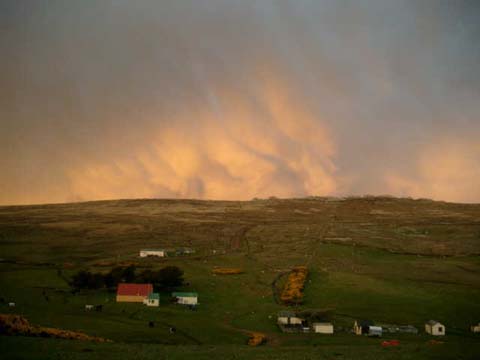
It was hailing when we got to the Falklands. Really hard. Then snow, sun,

rain, sleet, you name it, all within the hour. “A cross between Dartmoor and

the Scillies”, “like Scotland but with penguins”, “Bryher with more rust”, “Landrover

mecca”, “bizarre”, and other first impressions. By the evening, we’d stopped

noticing how odd it was to be in a very familiar place. The beer, the products,

the language, currency, even the familiar faces. Stanley was overrun with BAS

employees waiting to go South, held back by poor weather for weeks.

The James Clark Ross was also in town, waiting for cargo that we were

carrying. I was fortunate enough to have blagged my way onto a trip

organised by the JCR doc, Emma. She had a mission to accomplish and I was

honoured to be invited.

Back in the sixties, a young man came upon the opportunity to work as a

travelling teacher in the Falklands. The journey from Britain took months:

six weeks from Montevideo alone where we took three days. He arrived on a

barren island and was given a horse. For houses not accessible by

horseback, he was flown in and spent weeks to months living with each

family that had children. After three years, he returned to the UK and

worked in a range of socially active jobs. He travelled. He lived. He had

an Alvis Grey Lady. He had a beard when he was younger. He looked like he

could be your grandfather, father or uncle depending on your age and his

age in the photo. He lived life to the full.

When he died, last January, his last wishes asked that his ashes be

scattered off the jetty at Port San Carlos, East Falkland. A friend of a

friend of my friend’s friend’s boss knew his wife. And so it was that we

found ourself in a tiny japanese 4WD, lost, having missed the only other

road that leads out of Stanley, with a cardboard box at our feet that had

been lovingly carried all the way from the UK by ship.

“Tolkeinesque,- this is the last valley before Mordor.” The landscape was

bleak en route. Undulating flatness, scree, occasional outbursts of craggy rock,

tussock grass. Very windswept. And water on all sides, there were so many bays

and inland waterways that I was never sure which way the open ocean was. In

some places, a rich turquoise bay, then around the bend, grey and wild sea.

Four seasons and ten landscapes in an hour but always barren and British, in

the most beautiful way possible.

Port San Carlos itself is gorgeous. There are three houses and an old jetty.

A walk to a memorial stone brought us hail, snow, sun and much wind. We hid

behind a bush while the weather passed. Gorse that smells of honey. In the evening,

the sunset made you want to sing, or cry, and laugh, dance, inhale deeply, take

it all in. It was so huge, immense, the skies here change so quickly that they

tell a story. Reds and pinks, oranges blacks. The yellow yellow gorse in sunset

light. A bird flying against dark skies, illuminated white from beneath. Horses

and sheep in our garden. A bed, a real bed! Great company, a pack of cards,

plain food that we made ourselves, water from the ground, peaty. I felt nourished

and refreshed. We drank it all in.

The farmer owns thirty-two thousand acres of land and has seven thousand sheep.

Over here, you talk in acres per sheep rather than the other way around. One

glance at our wannabe 4WD in the morning and he offered to take us himself to

the penguin colony. Serious cross country for a good hour through every weather.

This country may look small on a map but it feels huge and endless, uninhabited,

when you cross through it. Five hundred gentoo penguins nesting in tussock grass,

the sound of purring and chirping, the smell of ammonia. Sheep, cattle and geese

wander past oblivious of the fact that they should be in Scotland and penguins

but a hallucinatory dream. Wobbly legged lambs next to freshly hatched penuin

chicks, in a hail storm.

Posted in Rhian in Antarctica | 4 Comments

Uninspiring shortlists

What do you do when you’re presented with a short-list of eight or nine candidates

and none of them is particularly appealing? That seems to be the case, now,

with both the World Trade Center memorial and the Democratic presidential candidates.

I’m quite glad, now, that I was out of the country when the finalists

for the World Trade Center memorial were announced. I’d been looking forward

to blogging them for a long time, and was very disappointed when I found out

I couldn’t make it.

Now, however, that the initial flurry of attention is dying down, the consensus

opinion is loud and clear: none of the above. It’s not the "we hate them

all" that greeted the original

plans for the site as a whole: it’s more inchoate than that. Rather, there’s

a niggling feeling that none of these concepts is quite right, and that if we

rush ahead and build one of them now, we’ll probably regret it.

I certainly have no faith in the ability of any of these memorials to stand

the test of time. I remember, as a kid, being rather perturbed at war memorials

with eternal flames: it seemed to me axiomatic that whatever else the flame was, it obviously wasn’t eternal.

What I didn’t realise then is that eternal flames have a habit of sputtering

out wherever they are in the world: this is a known issue which still hasn’t

been resolved. But faced with an enormous acreage to convert into a memorial,

everybody seems to have resorted to some kind of technological wizardry vastly

more complex than a common-or-garden eternal flame.

Dual Memory is the worst

offender in this resepect, with its "evolving images [which] are reflected

as water flows down the walls that support the plane of water above". But

did Michael Arad stop

to think about what might happen if his water features had to be turned off

during a summer drought? And there are huge practical difficulties associated

with keeping 3000 votives

in suspension, or maintaing a crystalline

cloud. Remember, these things are meant to last for dozens, if not hundreds,

of years.

With hindsight, the "program guiding principles" were far too broad

and ambitious. The memorial had to, inter alia, "respect and enhance

the sacred quality of the overall site"; "evoke the historical significance

and worldwide impact of September 11, 2001"; "inspire and engage people

to learn more about the events and impact of September 11, 2001 and February

26, 1993"; and, for good measure, "create an original and powerful

statement of enduring and universal symbolism".

It seemed that the winning entrants didn’t take the guidelines all that literally,

but even so, original, enduring and universal symbolism is a tall order for

anybody. (Quite literally: many people, including LMDC bigwigs, seemed to think

that the memorial would include some kind of skyline-restoring structure which

would complement or even outdo the Childs/Libeskind Freedom Tower. It’s interesting

that none of the finalists go much above grade.) In the end, we’ve arrived at

a shortlist of plans which either ignore a number of the principles entirely,

or which fail to meet their high standards. Better to wait a while, now that

Plan A seems to have gone off-track somewhat, than to rush ahead with a proposal

which doesn’t have public support and which, in any case, has been designed

to complement a general site plan which could change significantly between now

and even its first built stages.

But at least, in the case of the memorial finalists, waiting is an option.

In the case of the Democratic

presidential candidates, the timetable is set, and we’re stuck with the

ones we’ve got. One of them, for better or for worse, is going to go up against

George W Bush in November 2004, and it’s up to the country’s registered Democrats

to pick the candidate with the best chance of success.

Once again, received wisdom has it that "none of the above" seems

like the best choice. That’s why Wes Clark joined the race so late: his advisors

were telling him that it was still wide open, and that none of the candidates

had caught the public imagination. In opinion polls, Bush has a narrower lead

against an unnamed "Democratic candidate" than he does against any

named individual: none of the choices, it would seem, has any appeal beyond

simply being not-Bush.

The front-runner, of course, is Howard Dean, who recently went on Hardball

to embarrass himself on

foreign policy:

the key, I believe, to Iran is pressure through the Soviet Union. The Soviet

Union is supplying much of the equipment that Iran, I believe, most likely

is using to set itself along the path of developing nuclear weapons. We need

to use that leverage with the Soviet Union and it may require us to buying

the equipment the Soviet Union was ultimately going to sell to Iran to prevent

Iran from them developing nuclear weapons.

Yeah, that’s right, the Soviet Union. Four times in three sentences Dean proved

himself to be completely out of date, living in the past, and hardly the sort

of person you’d want putting in place a coherent statement on America’s position

in a unipolar world.

Dean is doing very well in galvanising the younger end of the Democratic party;

he’s raising lots of money, and none of the other candidates look like toppling

him in the near future. That said, however, I’ve never liked the guy, mainly

because he seems to have no policies. Push on something like gun control or

gay marriage, and all you’ll find is the federalist cop-out: that’s not a question

for the president, that’s a question for the individual states.

When I saw Dean at an event in New York, he certainly came over very pro-gay,

talking about his implementation of civil unions in Vermont. What he didn’t

say was that they were court-ordered (he didn’t really have a choice in the

matter); and that when he’s pressed, you get exchanges like this:

KING: So you would be opposed to a gay marriage?

DEAN: If other states want to do it, that’s their business. We didn’t choose

to do that in our state.

KING: And you personally would oppose it?

DEAN: I don’t know, I never thought about that very much.

Yeah, right.

The problem, or the reason that Dean is doing so well, is that none of the

rest of the field seem to be having any luck at all in getting Democrats to

care about them. Personally,

I’m a big fan of Edwards, but even I have to admit that he’s done an atrocious

job in getting his message out. Or rather, that’s been his problem: he’s been

concentrating on substance, and thereby losing out at the expense of Dean, who’s

nearly as good as Bush when it comes to showy rhetoric unencumbered by actual

positions.

There’s still a possibility that Kerry or even Clark might manage to get a

groundswell going, but I feel Edwards slipping away into the land of the once-likely,

along with Joe Lieberman.

Of course, the fact remains that it probably doesn’t make the slightest bit

of difference who wins the Democratic nomination. I wrote

last year that

The chances of a Democrat wresting the presidency from Bush in 2004 are slim

indeed: in order for that to happen, the economy will have to continue to

deteriorate, the housing-market bubble will have to burst, and the US will

have to fuck up in Iraq. Two out of three might just do it; one out of three

won’t be enough.

And just as the Democrats started seeing Iraq as good for them and not the

Republicans, we get this economic turnaround. Alan Greenspan is going to be

able to keep rates down for one more year, which means that even if Iraq is

an election-winner for the Democrats, the economy and real-estate wealth is

going to go for the GOP. They’ll have two out of three, and the election in

the bag.

Against that sort of incumbency advantage, the present line-up of Democratic

candidates looks decidely sub-par. And no, there isn’t a white knight (Eliot

Spitzer, Hillary Clinton) waiting in the wings to gallop on stage at the Democratic

National Convention and ride into the election with a huge and unexpected mandate.

Unfortunately, unlike the WTC memorial, "do nothing" is not an option.

The Democrats are going to have to choose someone, rally behind him, and hope

for the best. All we can hope is for the best candidate to win – and for

some much-needed luck.

Posted in Culture, Politics | 5 Comments

New York Stories

Firstly, many apologies for not updating this blog in a little while. I would

use the excuse that I was in Uruguay for most of the time, but that would be

disingenuous, since I had (a) laptop; (b) internet connection – albeit

dialup and spotty; and (c) lots of spare time while I was down there. It’s just

that the drive to blog was missing.

So instead, I decided to use that spare time to catch up on some reading. The

main course was The

Fortress of Solitude, the hugely ambitious new novel from Jonathan Lethem;

for dessert, I read The

Colossus of New York: A City in 13 Parts by Colson Whitehead. It’s an unoriginal

combination: not only are they both about New York City, but they even share

a publisher. And browsers

looking at the latter book on Amazon are encouraged to buy it in conjunction

with the former for a combined price of just $29.57.

My advice is to save your pennies, or at least the $13.97 that Amazon wants

for the Whitehead. It’s a small and slender volume, with very little substance.

If you want to get 90% of the benefit for free, wander into your local bookshop

and simply read the first real chapter (after the introduction), called The

Port Authority. It’s eight short pages long, and turns acute observation into

allusive, almost epigrammatic prose. Unfortunately, the book only goes downhill

from there, and since there’s no kind of narrative arc, there’s really no reason

to read on.

As the book continues, you’re bound to have an emperor-has-no-clothes moment

at some point. And once you’ve had it, there’s no going back. Would-be profundities

become silly at best, idiotic at worst, and reading any further loses all of

its appeal. Whitehead loves switching points of view, from first person to second

to third. But he also anthropomophises everything, from grains of sand to the

entire island of Manhattan, with less than happy results. Take the Coney Island

chapter, for instance:

Naturalized styrofoam bits recite pledges and names of presidents at the

slightest provocation.

The number of house keys lost this day will fall within the daily average

of lost house keys.

Their castles rise proudly from soggy plots of real estate, yet despite their

enthusiasm a very small percentage of these children actually go on to careers

in construction, it’s very strange.

The unseen infrastructure of waves. Events a thousand miles away find their

final meaning in these gentle little consequences begging at the shore.

Underneath the boardwalk is where they store failed mayoral candidates.

Never mind that you can’t fall within a daily average. None of these sentences

– and they’re a pretty representative sample of what you’ll find in the

rest of the book – means anything at all. They’re held together by nothing

but grammar: our minds desperately scramble to find some kind of meaning in

them, as though confronted by "colourless green ideas sleep furiously".

But the real response is much more simple: no, styrofoam bits don’t recite anything.

No, it isn’t strange that kids building sandcastles don’t all grow up to become

Donald Trump. No, underneath the boardwalk is not a store of failed mayoral

candidates.

This book is Whitehead’s first since he won a MacArthur genius

award in 2002, and it seems that the praise might have gone to his –

or his editor’s – head. If he’s a genius, he doesn’t need to worry about

whether he’s making any sense, right? It’s the same thing that happened to Jeanette

Winterson after she got praised to the skies for Oranges Are Not the Only Fruit.

Bourgeois extravagances like plot and meaning got jettisoned, in favour of Art.

Well, excuse me, but I’d rather have comprehensibility.

So there’s no doubt that The Fortress of Solitude is much better suited for

someone like me. While there are no shortage of digressions and passages of

beautiful observational writing, there’s still a plot, something to keep you

turning the pages.

Once again, however, there are good reasons to stop turning at the end of the

first chapter. In this case, I hasten to add, the first chapter, called Underberg,

is 292 pages long, and makes for a wonderful and self-contained book in and

of itself. It tells the story of a kid called Dylan Ebdus growing up in Gowanus/Boerum

Hill in the 1970s, and is full to bursting with wonderful riffs on popular culture.

From the games children would play on the slate sidewalks of Dean Street, through

the birth of cultural phenomena from rap to graffiti to crack, Ebdus experiences

it all.

Every so often, this comes across as slightly boastful. Ebdus, who is clearly

modelled on Lethem himself, shows us his streed credentials at every opportunity:

all of us who didn’t grow up in a black neighborhood of Brooklyn in the 70s

have to concede that Lethem has one over on us. And because Lethem seems to

feel that Ebdus has to personally witness just about every important cultural

development of the time, the character sometimes loses versimilitude. Is it

really possible that a kid whose father spends all his time holed up in the

attic, whose pothead mother abandoned him at an early age, whose friends rarely

turn up to school at all, whose teachers barely notice him, who displays no

signs of academic ambition, whose only reading material seems to be comic books

– is this kid really likely to make it into Stuyvesant High School by

dint of sheer natural intelligence and/or whiteness?

It is at Stuyvesant, we assume, that Ebdus learns how to write, and once he

graduates, the third-person first chapter ends and we move into the first-person

second chapter. (There’s also a brief intermission, where you can get up, stretch

your legs, and go to the bathroom.) Ebdus moves on to a Camden College which

is entirely familiar from Less

Than Zero, where he becomes popular by wearing a Kangol cap "long enough

before the Beastie Boys made it widely familiar". He loses touch with his

best friend from Brooklyn, a black kid called Mingus Rude to whom Lethem shows

no mercy at all in terms of plot. No miraculous tickets out of the ghetto for

Rude: instead, we see a textbook descent into drug addiction and worse.

Lethem’s very good, actually, on the mechanisms which reinforce the class and

race divide in America. While Rude never has a chance, Ebdus’s friends from

Camden almost have too many:

"How’s Karen Rothenberg?" I asked, shifting to safer ground.

Euclid goggled. "She quit calling when she came back from Minneapolis

– rehab. Now she’s got this custom hat shop on Ludlow Street. They look

like hemorrhoids, if you ask me. But Dashiell Marks – you remember Dashiell?"

I lied and said I did.

"Dashiell got Karen’s hats listed on the Best Bets page of New York

magazine, so everything’s hunky-dory."

There’s a lot of such good observation where that comes from, although most

of it’s in the first half of the book. The second half spends too many pages

tying up loose ends from the first, as well as helping to explain why we kept

on running across a character called Robert Woolfolk rather more often than

seemed plausible. Turns out Lethem has something in store for him: a baroque

revenge fantasy involving a magic ring which gives its wearer comic-book superpowers.

In general, the first half shows and the second half tells. Confined mostly

to one block in Brooklyn, the childhood portion of the book manages to raise

the largest of themes (race, class, drugs) while keeping its feet on the ground.

Once Ebdus moves to California in Part II, everything is viewed through a distorting

veil of self-knowledge which the third-person narrration of Part I happily avoids.

Both parts, however, suffer from a surfeit of specificity. Most of the time,

this book says a lot more about a very specific part of Brooklyn at a very specific

point in time than it does about America or life more generally. People who

aren’t intimately familiar with Brooklyn’s geometry are going to get hopelessly

confused by the constant refrains about which streets divide which neighborhoods,

while readers who don’t particularly care about the evolution of popular music

from the mid-70s to the early 80s will find their eyes glazing over at the endless

musical references.

This novel was almost designed, you might say, to be read by an overeducated

thirtysomething New York-based book reviewer – such a person has all the

background knowledge and interests necessary to really appreciate it. Had it

been set in Detroit instead, then I daresay the reviews would have been less

numerous and less positive. The Fortress of Solitude doesn’t so much transcend

its setting to make larger points: rather, it relies on that setting to provide

a foundation for the whole project.

Lethem’s still a long way from the Great American Novel, then. But in this

book’s first 292 pages, he might well have written the Great Brooklyn Novel.

And that is no mean feat.

Posted in Culture | 1 Comment

Jeff Jarvis is pro-American

Read

this. It’s an unexceptional, and unexceptionable, article by Stryker McGuire,

the London bureau chief of Newsweek. The subject is anti-Americanism. It’s fading,

he says: Bernard-Henri Levy recently won a debate in London arguing the proposition

that ‘The American Empire is a force for good’. There’s a whole America out

there which isn’t Bush and his policies, and it does great things, from encouraging

competition and entrepeneurial practices to separating Egyption conjoined twins.

Now read

this. That selfsame Observer article has turned überblogger Jeff Jarvis

into some kind of crazed jingoist, calling McGuire a "cultural traitor"

and posting a series of blog entries, each more frenzied than the last. The

final (at least so far) is this "I am pro-American and I’m goddamn proud

of it" screed. (At one point, Jarvis conflates McGuire and the 9/11 terrorists

into one "anti-American" lump, and then compares them to Hitler. Very

useful.)

Never mind, for the moment, that Jarvis accuses McGuire of saying that all

Americans are ammoral (sic) – something McGuire never came close to saying.

(Has Jarvis forgotten that bloggers are pretty good at checking out original

sources, especially when you link to them?) What interests me is the comments

on Jarvis’s blog entry. Read them, and you’ll find a long series of Americans

basically saying "Yeah! You go, guy! I’m a pro-American, too!" It’s

weird: it’s as though the comments section of this particular blog entry has

become a support group for the poor, beleaguered pro-Americans in America. First

it was white males who claimed

victimhood, now it’s patriots?

When a Newsweek journalist can’t even bring up the subject of fading anti-Americanism

without being bitch-slapped by soi-disant liberals like Jarvis, I think

it’s pretty clear how difficult it’s going to be to successfully oppose Bush

in the 2004 presidential election. Reading the comments on Jarvis’s blog, one

is struck by the way in which "I’m pro-American" serves as a kind

of trump card, successfully squelching all attempt at reasoned debate.

Let me just single out one theme from Jarvis’s post. "When people attack

my countrymen so readily, as if it is the accepted wisdom of the age, I have

no choice but to defend myself," he says. "This is a very serious

point. It is a warning: Keep attacking America and Americans — not just American

policy — and beware of the hands into which you play."

It goes without saying that these kind of threats go down very badly with foreigners

and anti-Americans. But it would seem that they go down very well with

the man on the street, the average American voter. And after starting two wars,

there’s no way that Bush is going to lose out to his Democratic opponent on

the let’s-be-tough-with-those-who-hate-us front.

Jarvis’s moral certitude – he makes this quite explicit – is born

of the fact that he came close to being killed himself on September 11. I can

see how someone in that situation might have a pretty black-and-white view of

the world. But it’s not just New Yorkers who feel this way: it’s the the whole

Bush administration. And black-and-white moral certitude plays well at the polls.

Just ask Reagan, or ask just about any American what they think of Clinton’s

foreign policy. If it’s hard to soundbite, it’s hard to admire.

So at the moment, I’m decidedly bearish on the Democrats’ prospects in 2004.

They can’t win on domestic policy, because the economy is finally turning around

in the wake of Bush’s fiscally-insane tax cuts. They can’t win on foreign policy,

because their vision is more nuanced and subtle than that of the Bush administration,

and therefore more open to being attacked on grounds like Jarvis’s. And they

certainly can’t win the fund-raising race. It seems to me that their only hope

is narrowly psephological: if they can carry California and Florida, they might

be able to squeeze a win, maybe even with a minority of the popular vote. But

the nation will remain bitterly divided.

Never mind, though. At least Jeff Jarvis will always stand up for himself,

his countrymen, his country’s ideals, and the only heritage he knows.

Posted in Politics | 4 Comments

Pledge a bald head!

Dear friends, strangers, kind people out there in the ether….

We have had over SEVEN AND A HALF THOUSAND POUNDS in pledges for my hair to

be shaved off! Thankyou so much,- I had no idea you felt so strongly! We have

been amazed and very touched by the generosity that has been shown this last

week,- thank you all for your pledges. Below is my

blog about the head shaving extravaganza, and there will be a slightly more

official version here

pretty soon.

Payment methods for those of you who pledged, or meant to….

If you are a UK taxpayer, whatever your payment method, it is possible for

the charity to claim an extra 28% of your donation. If this applies to you,

please include in your email or letter a statement that this is intended to

be gift aid for the The Queen Elizabeth Central Hospital Charity Fund. Please

also state your name, address and amount being donated. This might sound a bit

silly, but we also need to know that 28% of your pledge is actually a smaller

amount than the total amount of tax that you pay. If you really want to know

more, you can download the official

inland revenue PDF file (360k).

Wherever you are, if you can read this website, the simplest way to pay (in

any currency) is probably to use a secure on-line system called PayPal,

which is now a part of eBay. If you already have a PayPal account or feel comfortable

setting one up on your own, you can simply send your donation to charity@felixsalmon.com.

Otherwise, send an email to the same address and we will then reply with a personal

weblink allowing you to authorise the payment and give details of your account.

If you use telephone or internet banking, you can transfer money directly

to this account in the UK; all of its contents will then be transferred to the

charity. The account details are:

Nat West Alsager Branch

2 Crewe Rd, Alsager

Stoke-on-Trent ST7 2ER

Account name: Mr P J Clarke & Mrs E L Clarke

Account No : 91939461

Bank Sort Code: 60-01-12

Alternatively, you can send a cheque made out to: The Philippa Clarke Malawi

Appeal Fund and send it to:

The Philippa Clarke Malawi Appeal Fund

c/o Philip Clarke

Cooksgate Farmhouse

Church Lane

Betley

Crewe

CW3 9AX

UK

Thankyou all once again. That was the most expensive haircut ever and

worth every penny!

Posted in Rhian in Antarctica | 6 Comments

Crossing the line

It’s been quite a week. Quite a surreal week. But great too.

There are all sorts of things I want to write about and they don’t have

much coherence except that they all occurred this week and were experienced

by me. It’s gonna be a long one I’m afraid so print it off and put the

kettle on. Or pour yourself a drink.

There was some gag about headshaving

to start with. It really did start out jest-like and then escalated like nothing

I have ever experienced before. Every time I turned on my computer there were

another ten or twenty pledges rolling in. Ben would pop by, “you’ve never guessed,

someone I’ve never met has just quadrupled their pledge!” What’s going on? What

did we tap into out there? It’s not just about hair and it’s not just about

the charity, somehow when the two were combined they were squared, or cubed.

Or maybe, like marzipan, when you combine sugar and almonds you get something

out that is altogether another experience. Yeast and hops, bubbles in fermentation.

Talking of fermentation, the slops bucket made me want to wretch. That

morning I was on ‘gash duties’ which means you clean the public areas and

wash up after meals. “Where do you want the beans and tomatoes, Rich?”, I

ask after breakfast. “Yup, they’re good.” “What?” “In there, in the bin.”

He is pointing to a hip-height yellow bin full of yuk-yellow goo. That’s

bubbling. O no. O no no no no no. Here I draw the line. “I refuse to be

made to mix my own slops bucket. That’s too much.” “Fair enough,- just put

it on the side there and I’ll do it.” Five minutes later, his thick Geordie

accent calls out “eh, Rhiannon, you like gorgonzola don’t ya?” As I peer

around the corner, he is crumbling, no chucking great lumps of the stinky

stuff, into the bucket, “it’s vegetarian, like”. Wink.

An hour later, they added the yeast and left it out in the midday sun. By

the time we saw it, it was a bubbling, curdling, vomitous slop, fish heads

and potato chunks swimming around in it, and it was going to be poured on

our heads.

Where next? Ah yes, painting. That’s been my main activity this week, leaving

little time to attend to the multitude of emails rushing in or look for hiding

spots. Painting the white bits whiter. And believe me, there are a lot of white

bits. We start at nine, end at three and have two smoko breaks and lunch at

exact hours in the middle. Woe betide anyone who turns up late or, worse yet,

works into a break. “You won’t catch many seamen taking a crap during smoko”.

Of course, none of us wanted to piss the crew off, this week particularly. Neptune’s

court would punish us accordingly. I was pretty happy on deck with my paintbrush

but others got worse jobs. Stripping floors, polishing brasswork, peeling potatoes,

scrubbing walls – at least I got the waves and the sun all day long to

keep me company. And there’s something very satisfying about painting over grubbiness,

not to mention much of myself. Later on in the week Charlie gave us a real treat:

we got upgraded to GREEN! I could have kissed him. Charlie the bosun: “If it

don’t move, paint it. If it moves, paint it ’til it don’t move”.

Back to the Line Ceremony. We had a fair inkling by this time when it was

going to happen and had hatched a Cunning Plan. First-timers usually

scatter and hide, trembling alone in a dark and uncomfortable hole until

the policemen find you, which they will, eventually, beat you up with

batons made from duct tape and drag you to Neptune’s court. Not an exciting

prospect for a sunny afternoon in the mid Atlantic.

No, a few too many of us had seen ‘Pirates of the Carribbean’ before we

left and the group decided to team together and Take the Moneky Island. Oh

yes, this was going to be a daring and dastardly event. For two days

beforehand, people started sneaking ammunition up there,- 25kgs of flour,

sloppy burns bandages past their sell-by date, marmite(?!), condoms,

cutlesses made from cardboard and tinfoil, earrings sneakily soldered from

copper tubing and, the piece de la resistance, an enormous bucket of water.

There is no water point up there so two anonymous pirates hauled up large

plastic bags filled with water in the middle of the night,- lower a rope,

tie on the bag, three tugs, up you go. A true stealth mission. They would

never get us! Heck, we could take the conning tower too and then the ship!

But none of us know how to drive a ship, maybe not such a good idea after

all.

After lunch on the fateful day, eight pirates all appeared on the Monkey

Island from various angles. Wigs, make-up, ripped t-shirts, tattoos, fake

teeth, fake blood, ooo arr, shiver-me-timbers, bandanas, skulls and

crossbones and a great big banner pronouncing ‘FID ISLAND: Cross at your

own risk”. Photos will appear on the Shackleton website soon I’m sure. Then

the production line: condoms filled with water, flour and water, marmite

and water. We were ready for them.

The next bit is a blur. The captain welcomed Neptune and his wife on

board, policeman got hit with balloons (they looked angry), lots of people

shouted “oo arrrr, oo arr”, more ammo, water, water, we were doing well…

and then, aaaa, the FIREHOSE. They attacked with a FIRE HOSE! Up the

ladder, up onto the island. There was a mighty battle, hotstages were

taken, struggles, scars, bruises, screams of pain as those great big duct

tape batons thwacked and thwacked and thwacked. What was going on, where

was our ammo? The police were sodden as well, we were all soaking. They had

taken us, but not without a struggle. Dripping and forlorn, we were forced

to climb down the ladders, wrists cable-tied together, and marched to the

Court. One pirate was pulled by a dog lead, another flung into the court, I

tried to run but there was no escape. A sorry looking lot we were. Ooo

arrr.

By the time I arrived, some of my fellow criminals had already been

sentenced. Another was just having his verdict called out. The one before

him was,- no, no, NOOOO, ooo, yuk, please, no, yup… o god, you guessed it.

The Slops. The Slops and The Medicine. Ooo, I really did want to wretch.

Anything but The Gorgonzola Slops!

Two before me and then it was my time. Pushed into the box for sentencing,

a judge read out my crimes. “Rhian Salmon, You are hereby charged with the

following heinous crimes against the state, against the Monarch of the

Seas, and against mankind in general.

The charge laid before you is that you have more excuses for avoiding the

FID duties of painting and soogying than anyone else on board. ‘Taking

sunsights’ is an old device and frankly wearing rather thin. You are

charged with ‘skiving in the greatest order.” It’s true, I have been

skiving off to learn how to use a sextant.

It didn’t stop there. I was subsequently accused of pestering the chief

officer about cargo within 5 minutes of coming onboard and repeating the

offence (all true, I’m afraid) as well as ‘blatantly coveting ship’s

property’ known as the Monkey Island and being in possession of

particularly wild and offensive hair. How did I plead? GUILTY I’m afraid.

Very, very guilty. It didn’t help. I was dragged to the slops (trying my

very best to escape, a la Capt’n Jack Sparrow) but there was no mercy. Slops

on the head, I screamed and a doctor adminstered the Pink Medicine from a

syringe straight into my mouth. Spit, splutter, in the hair, down the

shirt, in my face. I still shudder and cringe to think of it.

A long blast with the firehose (this time, welcome), a cold beer, five showers

and a cuppa tea later, there was a barbeque. And as if the day hadn’t had enough

excitement already, my fate still awaited. There’s not much I can say about

this bit,- the photos will speak for me once they’re on the web.

Suffice to say, it’s all gone, and it was emotional.

I now wake up with a fuzzy head and a fuzzy feeling. The wind outside, the

rain, people stroking my hair, is fuzzy. Head on a pillow,- fuzzy. Shower,-

fuzzy. It’s all fuzzy. Fuzzy, but good. Funny, like funny haha, when I look

in a mirror. I get a surprise and then I laugh out loud. It’s really easy

to look butch but the minute I open my mouth people still don’t take me

seriously. I like it, it makes me laugh. It’s almost liberating. All that

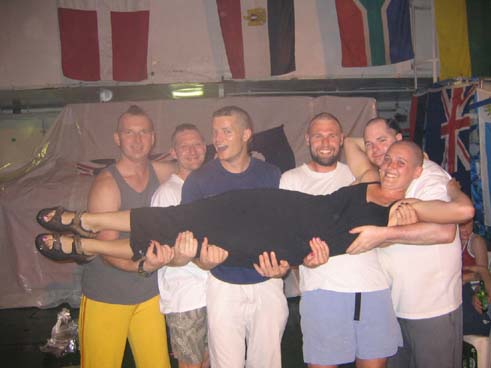
fuss about hair (75 dreads by the way for those of you who pledged per

dread), I’m exactly the same. And we raised over seven and a half thousand

pounds. An astonishing amount, in less than a week.

I still don’t know what we tapped in to, I’d love to understand it more but

maybe it’s just one of those miracles of humanity that don’t want too much analysis.

It’s like everyone out there is just waiting always, for an opportunity to do

a good thing, to be nice, to contribute somehow to the world.. but we don’t

know how. We have so much cynicism and bitterness built up from everyday experiences

that we no longer know how to channel that desire. Take away the barriers, offer

an opportunity, demonstrate your belief in the cause, show people that it’s

ok, they won’t be ripped off, and hearts and pockets seem to flood open. I almost

don’t want to write about this as it’s so precious and delicate that if I advertise

it, the cynic in me says, this channel will surely also be abused like so many

others before. But I don’t know how else to tell you all, thankyou. Not just

for the hospital donations which will make an enormous difference, but also

for the experience. This was the most expensive haircut that I’m sure I shall

ever have but I shall cherish the memory forever.

(If you pledged on this website, you should have got an email explaining

how to pay by now. If you didn’t, there will be more details in Rhian’s next

blog entry, but you can always send money via PayPal

to charity@felixsalmon.com. Thanks for all your donations, big and small!)

Posted in Rhian in Antarctica | 3 Comments

Windowless buildings

When I posted an entry

on 2 Columbus Circle last month, I said that "The lack of windows gives

it the feel of a prison: you imagine yourself stuck inside, unable to look out.

It is an exercise in claustrophobia, and the new design [with lots of glass

and light] constitutes a vast improvement." I also said that "the

mood in the city these days is that brand-new buildings are usually pretty good".

Maybe

I spoke too soon. Lockhart Steele has gotten

himself a press kit for the new New Museum building, which is going up on

the site of what is now a parking lot across from Prince Street on the Bowery.

And far from being a "pretty good" improvement on the brutalist nightmares

of the past, it seems determined to make every old mistake in the book all over

again.

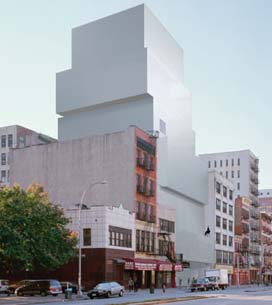
Lock quotes the New Museum describing its new home as "a dramatic stack

of rectangular boxes, each with a different height, shifted slightly off axis

in different directions and clad in textured, galvanized zinc-plated steel".

The point of all this architectural cleverness, it would seem from reading

the New Museum website,

is to ensure that the building doesn’t have to bother with windows at all. After

all, they explain, "SANAA’s concept for the site proposes a series of shifting

sculptural boxes that allow for skylights on every level". And who needs

windows when you’ve got skylights?

Of course, art museums need wall space; they don’t need windows – although

places with great views, like the Tate Modern or Dia:Beacon,

use their windows to fantastic effect. The problem is not so much how things

feel on the inside, since with sunlight from above and intelligently-designed

lighting, the spaces will probably work perfectly well. Rather, my issue is

with the way the museum presents itself: it looks to the world like a dark fortress.

Added to the windowlessness is the problem of scale: the museum is going to

tower over its neighboring buildings without any attempt to integrate itself

in terms of either the street wall or the vernacular of the downtown tenement

building. There is no chance that the local residents are going to embrace this

building; rather, they are (rightly) going to consider it an eyesore and a bad

neighbour.

Here’s what the architects have to say on the subject:

We wanted to be as consistent as possible with the scale of the existing

surroundings. However, our building has to accommodate a much bigger program

than its neighbors do. By shifting the different levels of the structure in

relation to one another, we are also diminishing the bulk and establishing

a more effective, dynamic relationship with the buildings in the area. On

the other hand, because this area is in transition, we believe the New Museum

building should have a strong identity of its own in order to survive, especially

on a street as tough as the Bowery… To us the Bowery is less a boundary

than a neutral "demilitarized" zone between neighborhoods that have

very distinctive personalities—Nolita, the East Village, Chinatown.

This is gruesome stuff. I can’t for the life of me think how the shifting levels

establish any kind of effective or dynamic relationship with the buildings in

the area, none of which have any shifting levels at all. As for the idea that

the building "should have a strong identity" because it lies on a

"tough" street without a "distinctive personality" –

this is simply crazy. Architecturally, Nolita and the East Village are very

similar, characterised by low-rise, brick-built residential structures with

retail on the ground floor. The Bowery is much the same, enlivened by the Bowery

Mission and by the competing signage of the restaurant-supply and lighting shops.

It has a very strong and distinct character, none of which is reflected in this

design at all.

You might remember that when the New Museum bought this site and announced

that it was moving there, it made a big song and dance about how happy it was

to be remaining downtown and helping to revitalise Lower Manhattan in the wake

of September 11. Of course, Prince and Bowery is a world away from Lower Manhattan,

and many of us, at the time, thought that the New Museum was clearly trying

to come up with reasons to push the site after they’d already decided to move

there.

The rhetoric surrounding this building is similar: a Japanese architectural

firm comes up with a "bold" design, and then pays lip service to the

neighborhood, despite the fact that they obviously couldn’t care less. This

building would be equally ugly anywhere, but it certainly doesn’t belong in

residential downtown New York, where commercial high-rise structures are unheard

of.

In fact, it feels like nothing so much as Marcel Breuer’s Whitney

Museum, complete with windowlessness and cantilevered upper stories. The

only difference is in the cladding: zinc-plated steel as opposed to concrete.

No, I have no idea how or whether zinc-plated steel will age on a street full

of belching trucks rumbling to and from the Manhattan Bridge. Breuer’s building

is not well loved, and even architects generally admire it more as an important

piece of avant-garde 1960s architecture than as a perfectly-formed

art gallery. It’s squat, ugly, and generally pretty depressing; it certainly

can’t hold a candle to Frank Lloyd Wright’s Guggenheim a few blocks uptown.

I have a feeling that the New Museum got sick of people walking straight past

its present location on Broadway without even noticing them, and decided that

in their new digs they were going to make a splash. But it would have been nice

if they did so by commissioning something beautiful and interesting, rather

than sentencing their new neighborhood to cower under a teetering pile of metal

boxes.

Meanwhile,

in Birmingham, the new

Selfridges has opened, and it, too, has no windows. Here, rather than a

neo-brutalist tower we have a biomorphic alien spacecraft. Both, however, are

primarily illuminated by skylights, and utterly fail to even try to fit in with

their surroundings.

Now I’m no curmudgeon who hates all new

buildings unless they look old and hates them even more if they try to do something

interesting. But if you’re open to the possibility that contemporary architecture

is good, you also have to be open to the possibility that it’s bad. And as a

rule, buildings without windows are bad buildings. (Of course, there are truly

great exceptions to the rule.) So just because a department store don’t

need windows, doesn’t mean it shouldn’t have them. Indeed, department

store windows can look fantastic – just consider Peter

Jones in London, whose undulating curtain wall still feels very contemporary

despite the fact that it’s almost 70 years old.

It’s a psychological thing. When we look at a building, we naturally imagine

ourselves inside it, and no one wants to live in a building without windows.

The fact that no one does live in a museum or a department store is

irrelevant: when we’re simply looking at the outside of the structure, we want

to be able to look in, and, more importantly, we want the people inside to be

able to look out. It takes some kind of architectural genius to make us get

over that initial repulsion, and neither of these two buildings – nor

2 Columbus Circle, for that matter – has it.

Posted in Culture | 6 Comments

Misinterpreting Greg

It’s the battle of the ArtsJournal bloggers! Taking a perfectly good Boston

Globe editorial as their jumping-off point, Terry

Teachout and Greg

Sandow came to different conclusions about what National Public Radio (NPR)

can and should do with its $200 million windfall from Joan Kroc, wife of McDonald’s

founder Ray Kroc. Now Teachout has responded to Sandow directly, in an interesting

piece which addresses the whole raison d’être of what Teachout

calls "public entities".

Here’s Teachout today:

The difference between us—as I understand it, and I may be misinterpreting

Greg—is that I don’t start from the assumption that National Public

Radio has an a priori obligation to exist, and thus should ensure

its survival by any means necessary, even if that means scrapping musical

and other cultural programming in favor of Car Talk… The whole point of

subsidizing a radio network is to ensure that it will do things that commercial

broadcasters won’t do.

Well, of course he’s misinterpreting Greg. It’s a cute piece of rhetoric:

by spending most of his time expounding on Lord Reith and the role of a public-service

broadcaster in an otherwise commercial medium, Teachout essentially is saying

that the main difference between himself and Sandow is on the question of whether

NPR should compete at all with commercial radio stations.

In reality, I’m sure that the one thing that Sandow, Teachout and the Boston

Globe editorial board can all agree on is that NPR should do things which aren’t

already done elsewhere. Teachout thinks this means more cultural programming,

the Globe thinks it means more documentaries, and Sandow thinks it means the

kind of popular music (whole Neil Young album, for instance) which don’t get

airplay anywhere.

Teachout, meanwhile, is slyly pushing his reactionary views with a studied

nonchalance. Let’s say you want to persuade people that B. One way would be

to attack B directly, looking at the arguments for an against. Another way,

however, is to present a syllogism saying "A, and B, therefore C",

and then spend most of your time concentrating on A. Since you just throw in

B at that point, your readers are likely to assume that it’s relatively uncontroversial.

Here’s the genuinely controversial (and wrong) part of Teachout’s essay:

Between them, Big Media and the new media provide 24/7 news coverage in every

imaginable flavor. In what way does NPR’s news department do something that

isn’t already being done?

In other words, there’s no point in having loads of news on NPR, since there’s

already loads of news everywhere else and NPR, by definition, shouldn’t replicate

what you can get from FoxNews on the telly.

This is erroneous on two counts. For one thing, radio news is a very different

animal to news in print, on television, or online. Radio news is usually consumed

by people actively engaged in something else – driving, say, or ironing.

That means that it can give its listeners news in more depth than they get from

other news sources: while the average news consumer might not devote a full

10 minutes of their time to a TV news item or a newspaper feature, they don’t

mind listening to the radio for 10 minutes while stuck in a traffic jam.

Consequently, radio also has the ability to draw people in to subjects they

never knew were interesting. Most of us, I’m sure, have had the experience of

suddenly realising that we’ve been listening intently to a story about Bolivian

sewerage systems or Wisconsin filing-cabinet manufacturers – the sort

of subjects which would never make the television news, would never be sought

out on the internet, and which would be glossed over with one glance at the

headline in a newspaper. To paraphrase Reith’s formulation once again, radio

is uniquely placed to give us the news we didn’t know we wanted, and therefore

cannot be replaced with other news sources.

There are other great advantages to radio news as well: for one thing, it can

pull together expert commentary over the phone if needs must, since it doesn’t

need to set up cameras. That means it has access to a much deeper pool than

television, and that it can be more immediately responsive to events. It’s not

reliant on visuals in the way that TV is, and it doesn’t ignore other newspapers’

scoops in the way that print can. It’s also very fast: it can be faster than

the wires on reporting big local news first.

So Teachout is wrong to cite "Big Media and the new media" as reasons

not to support NPR’s news efforts. But even if he restricted himself to radio

news – which there is a lot of – he would still be wrong. For NPR

provides not only a different political slant to most other news programs –

it’s left where they’re right – but also a range of features and documentaries

which are expensive to produce and therefore nonexistent elsewhere on the radio

dial.

A similar argument can be put forward against Teachout’s dismissal of Car Talk

and All Things Considered. While commercial radio stations do have talk-based

shows which are superficially similar, they have very little, if anything, of

comparable quality. Teachout says that NPR’s talk-based shows cannot "justify

the continued existence of NPR as a subsidized public entity," on the grounds,

it would seem (he’s not entirely clear on this) that commercial stations have

talk-based shows too. Would he treat music-based shows in a similar manner?

No: he would differentiate between the high-production-value programming he

would like to see, and the lowest-common-denominator stuff churned out by the

likes of Clear Channel Communications.

I suspect that Teachout is, in this case, simply a curmudgeonly old right-winger

who objects in principle to NPR’s lefty programming getting public subsidy.

He’s just using a new approach to achieve an old end: rather than complain about

bias (yawn), he simply says that having any news at all on NPR constitutes a

dereliction of its public-service mandate. I’m not buying it.

I also note that Teachout has no ideas at all when it comes to addressing Sandow’s

point that the public – the very people NPR exists to serve – have

no desire for the kind of cultural programming that Teachout so desperately

desires. Here’s all he has to say on the subject:

Here’s where I agree with Greg: if NPR’s listeners won’t

listen to the cultural programs it does broadcast, then NPR should change

those programs, or create new and better ones. Do them creatively, do them

imaginatively, do them with an ear toward appealing to more than a handful

of listeners—but do them.

Surely Teachout is not so naive as to think that some magical injection of

creativity and imagination is going to start sending the audiences for such

programs soaring. Very creative and imaginative people have been working for

many years on precisely this problem, with no visible success. Of all the things

which Kroc’s $200 million could be put towards, a desperate attempt to buy widespread

popularity for cultural programming would probably be the most quixotic. This

money represents an enormous opportunity for NPR; it shouldn’t be wasted on

pipe dreams.

Posted in Culture | 5 Comments

Ten miles an hour around the globe: travelling through a meteorology text book

We have crossed the equator! I still have my hair (the ceremony is

sometime this week but we won’t know when until it’s too late to run) and

the fish are still flying. Birds have now joined us as well, boobies

they’re called, that soar above the ocean, watching the fish and then, in

the blink of an eye, turn upside down and sky rocket downwards into the

ocean. In, deep in, maybe a metre or so, grab a fish and bounce out again.

It’s incredible to watch. The concentration, the energy… if only we could

apply that to our daily activities!

As much as I love staring at infinity,

it’s nice to have some activity happening in the foreground as well, it

keeps you alert I guess. Soaring, soaring, flying with the ship, flying at

10 knots. Mindboggling. No, not the birds speed, but ours. Our slow speed.

You can ride a bike at 10 miles an hour can’t you? OK, I know it’s nautical

miles but still, not far off. I am travelling around the circumference of

the Earth at ten miles and hour. From Britain to Antarctica. Ten miles an

hour! Doesn’t anyone else find that utterly bizarre? That we get there at

all, let alone in as little as two months.

A common reaction when I left was, “two months on a ship?! That’s crazy”.

We are so time oriented. On the ship, it doesn’t feel long at all. It

feels, appropriate, I guess. I mean, it’s a long way we’re going and we’re

on a not-massive ship with an awful lot of Stuff on it. And we keep going.

Ten miles an hour maybe but no traffic lights, roundabouts, jams,

meetings. this is way beyond commuting, or even going for a Sunday

drive.

One of the most remarkable things for me has been to watch the world go by,

underneath us, past us, as it were. The weather hasn’t improved, we’ve moved

into better weather. We are the ones doing the moving. Leaving Immingham, cold

and dreary, the first few days were cold, windy and wet. Then, in the Bay of

Biscay, they were rough. Rough Seas. It’s all about ocean circulation and wind

systems and how they all meet and create this amazing chaotic regime right there.

And there we were, right there, feeling the chaos in our stomachs. Somehow,

the energy circulating around our bodies at that time, unpleasant as it was,

had been sourced from the sun and the sea and the turning of the earth. I am

sailing through a meteorology text book.

After the Bay of Biscay, we moved into calmer seas, warmer, gentler wind,

past the Meditterranean, the Canaries, the east coast of Africa. It wasn’t

sweltering, it was perfect. The mid-latitudes. Of course! Then, as we sail

further south the air has become hotter, the direct rays from the sun more

intense and the weather, stormier again. Nothing like the Bay of Biscay but

we’re definitely rocking and afternoons have sen some ominous dark clouds.

We must be near the equator!

I hadn’t thought if it before, I’m desperate for my old notes on earth

weather systems, but it makes sense, in my very amateur perception of

what’s going on. Imagine the earth, a round ball, with the sun above the

equator. For now, neither are moving. Hot air at the equator rises and

travels to cooler areas, the higher latitudes, towards the poles. So you

have air rising from the middle and the separating, like a T-junction, at

around cloud-height, some going south, some going north. This happens to

air all around the Earth. From the side, two donuts: air rising at the

equator, travelling high up towards the pole, sinking when it’s no longer

less dense than the surrounding air, and travelling back along the surface

of the earth, this now-cold air seeking warmer climes. At the equator,

therefore, you have winds from the south and the north converging and

rising together, starting the whole circulation system again.

Now, add spin. Make the Earth spin. All that air that is moving up, out

high, down and back low, is trapped within the spinning earth -system but

not fixed to the earth. It creates a circulation system of its own in

response to the spinning of the world. Like the ripples that happen in

water when you skim stones. The combined effect of air flowing from the

poles to the equator at the surface, and the spinning of the earth, makes

the trade winds. At the equator, hot, damp air flowing from both poles

meets and rises upwards. So there’s your low pressure zone. As the air

rises, it cools, water vapour condenses and clouds form. The waterless air

then continues its way, high up, back towards the poles. Round and round

and round and round. It’s amazing. And that’s not even mentioning what’s

going on in the oceans. The more you think about it, the more you realise

how great, and complex, this place is, this Earth. And I’m honoured to be

travelling around it, learning from it, at ten miles an hour.

—addendum: this is straight from distant memory as I haven’t consulted

any books recently, please, please, correct my misconceptions and broad

generalisations!——

Posted in Rhian in Antarctica | Comments Off on Ten miles an hour around the globe: travelling through a meteorology text book

Stefan Geens on the New York Times

Stefan Geens, once a journalist himself, really ought to know better. He’s

just published a bizarre essay

on his website, which alternates between bog-standard European superciliousness

("Go ahead," he tells the New York Times, "become openly slanted,

crusading, editorial, the way that European papers are") and utter idiocy

(the Wall

Street Journal "is clearly thriving where the NYT is stagnant").

It’s not entirely clear what Stefan’s point is, beyond the fact that he likes

the Journal more than the Times. But his arguments are ridiculous. "How

is a newspaper supposed to compete these days?" he asks, apropos of the

World Wide Web. "The New York Times a while ago decided to compete by becoming

more like that other unquestionably compelling toilet read, The New Yorker,

with long meandering articles that go in-depth in ways that Reuters and AP do

not." He says this in response to my

article on reporting simple news, but he gets his chronology completely

wrong. The long meandering articles predate the rise of news websites, and are

much more the product of American journalistic self-importance than they are

of a need to compete with cyberjournalism.

If Stefan can trot out tired old canards like the one about the way in which

American newspapers should embrace an editorial viewpoint, then I can rehearse

the old observation that most American newspapers don’t, in fact, compete with

anybody at all, and that this is why they’re often so dry and puffed-up. European

newspapers are nearly all national, while US newspapers have metropolitan monopolies:

the New York Times in New York, the Boston Globe in Boston, and so on. Very,

very few cities have real competition between newspapers, which means that both

readers and advertisers are stuck with one paper. This is not, quite obviously,

a recipe for innovation.

What does happen, on the other hand, is that journalists start to write not

with their readers in mind, but looking more towards higher notions such as

Posterity and the Fourth Estate. Only in America would a major

motion picture be made about a scandalette in which a magazine journalist

was caught inventing stories. I shan’t belabor the point, as Anthony

Lane has made it much better than I ever could. But in a nutshell, American

journalists, at least in their own minds, are a pillar of the constitution,

while the Brits are writing tommorrow’s fish-and-chips wrapping.

In any case, for what it’s worth, I agree that there’s no such thing as objective

journalism, and that it’s better to embrace that fact and be opinionated than

it is to fight it and desperately attempt to tread an inoffensive middle ground

at all times. But that’s where I part ways with Geens. For one thing, he seems

to think that it would be a reaslly good idea were the Times to write long-form

articles: he even tells the mandarins on 43rd Street "to poach some of

those editors at The New Yorker". In order to back up this assertion, he

points to the popularity of the Journal’s Middle

Column.

This is simply confused. For one thing, the Middle Column is closer to the

New Yorker’s short-but-perfectly-formed Talk of the Town pieces than it is to

the heavier, longer features. There’s one Middle Column story per day, and it

provides an oasis of light relief amidst the relentless dullness of the rest

of the paper. While the New Yorker rises or falls on the strength of its long-form

journalism, the Journal’s strength is its business reporting, which is generally

written in a very straightforward manner.

So it’s ironic, then, that Stefan says that "writing short straight news

is a recipe for decline into irrelevancy" at the same time as praising

the very organ which does short straight news better than anybody else.

But that’s not the only way in which Stefan is dreadfully confused. His statement

that the Journal is "is clearly thriving where the NYT is stagnant"

is linked to a story

in the Wall Street Journal about the newspaper industry’s twice-yearly circulation

report. In it, we find that daily circulation for US newspapers was up 0.2%.

The New York Times outperformed, rising by 0.5% – more than twice the

average – while the Wall Street Journal underperformed, rising by, um,

0.002%.

What the Journal did do, however, was start adding 290,412 of the paying subscribers

to its website to its circulation figures; it was this one-off statistical sleight-of-hand

which gave the surely completely objective Matthew Rose the ability to lead

his story with his own paper’s "16% circulation gain".

Of course, those 290,412 subscribers at $79 a year for the website only –

or even the 686,000 people with access to the Journal’s webiste at all –

are a mere fraction of the 9,109,000 unique visitors that nytimes.com got in

September. Stefan’s

all over himself praising the Journal for being "merely a record of the

state of the newsroom’s reporting efforts at the end of the day," when

in fact many more people read the Times on an intraday basis than keep abreast

of what the Journal is reporting to its select group of subscribers.

By this point, Geens has pretty much lost the plot entirely. He criticises

the vaguely-liberal Times editorial page for being more strident than it should

be, in the same breath as saying that the Economist "smudges the line between

informing and opining in ways American media should emulate". Surely, the

Belgian is the only person on the planet who thinks that the New York Times

editorial page is more strident than the editorials which constitute the beginning

– and the front cover – of every issue of the Economist.

We shall pass over without comment Stefan’s discovery that "wifi plus

laptop actually makes for great toilet reading". But at least today’s newspaper

can be dragooned into a vital secondary purpose in the case of emergency; Stefan’s

verbiage, unfortunately, cannot, despite being much better suited to the task.

Posted in Media | 1 Comment

Flying Fish

I am more and more convinced of the necessity of ignorance in appreciating

the world.

One and a half days into a two or three day bus journey to Ayers Rock, I

was dismayed when photos and postcards of our destination began to appear.

I closed my eyes tight and tried desperately to not look at the image. I

was probably the only person on that bus who had absolutely no idea what

Ayers Rock looked like, or even what it was, and I didn’t want my blank

expectations to be ruined. Things are so much more startling when you

discover them for yourself.

I don’t want you to think that I had deliberately hidden myself from images of

this Great Wonder, saving myself in purity until I could behold it with my own

eyes. No, I am just ignorant. There are lots and lots of things I don’t know.

It astonishes me sometimes how I can know nothing about so many things and quite

often it astonishes my friends too. For someone with a number of years of formal

education under her belt, you’d think I’d know something. At least in

my own field? Nup. Most regular readers of newspapers or New Scientist are far

better informed about environmental issues than I am. I suppose I know a thing

or two about hydroxyl radicals and why you would never want to detect them using

soluble aspirin, but that’s not going to get me very far in the Real World. No,

I want to know about knots and stars and sextants and ocean circulation and clouds

and practical things like how to build things and make stuff. I am on a ship after

all and I’ve just finished a truly great book, Tamata

and the Alliance by Bernard Moitessier, that has had an obvious impact.

Anyway. Flying fish. This was one thing that I was really looking forward

to for this part of the voyage. Everyone told me about them and they were

everyone’s favourite thing, like penguins. They are fish that fly. Fish

That Fly! Imagine that. What? Do they actually fly or do the just jump far

and fast? No, they fly. They have wings that flap and glide and soar.

They’re big, these fish, like big, flat flying fish. I couldn’t wait.

Imagine! Fish That Fly! With Wings! Like a plaice, I imagined, or some

other flat fish. Like a bat fish. Bat-fish, flat fish, flying fat bat fish.

How excited was I?!

And then they arrived. The flying fish. Have you seen the fish?, they kept

asking me. No, I haven’t, I’m so frustrated. Where are they? Usually I see

everything. There, there’s one. Where? There. What? There, over there, and

another, o my, wow, a whole load of them. What?! I don’t see anything. Do

you need glasses? NO! WHERE? O. There’s no more now. Maybe later.

Grrrr.

Later. They’re out again, quick, look. What, those little specks I see fluttering

in the distance? Yes, aren’t the great? What? No, that’s just ocean spray, surely.

O my, a whole field of ocean spray. I guess you’re right. You mean that’s them,

that’s it? THAT’S flying fish? Yes, what did you expect? Great big batlike fish

with wings that soar?! Well, um, um.

Now, a few days after my initial dissapointment, I can see their attraction. They

are lovely actually. On first sighting it looks like a blue bird flying above

the sea. Or a hummingbird maybe. Definitely a bird, and a little one. Really sweet.

Then you see it’s jumped out of the waves. Amazing! Little fish they jump out

of the sea, flutter wings, sometimes for really quite impressive distances, and

then dive back in again. Someone out there can surely tell me what’s really going

on (Jim?!) but that is what I see. And then, there’s a whole flock of them. A

flock of fish. All, jumping out of the sea together and flying en masse away from

some predator. Come on sharks, come on, where are you, I want to see the fish

that fly!

So that’s flying fish for you. They’re great. I really like them. Had I heard

nothing about them, I’d be enchanted and raving: guess what, it’s a miracle! As

it is, I am enchanted, I understand the delight they bring, but I’m still on the

lookout for big bat flat fish that can fly and fly and fly.

Posted in Rhian in Antarctica | 1 Comment

Pledge-a-dread

Dear friends and friendly strangers,

It’s true! The dreads are being

pledged. What am I doing?!!!

This week, the RRS Ernest Shackleton is CROSSING THE LINE and the eight

uninitiated BAS employees on board are scared. Very scared. Especially me.

For those of you unfamiliar with the rituals of the sea, you have a thing or two

to learn. Crossing the equator for the first time is no trivial matter. If you

dare to slip into the other hemisphere without permission from Neptune himself,

you will pay for it. In hair. In my case, lots of hair. Hide where you may, Neptune’s

policemen will find you, will drag you kicking and screaming to Neptune’s court,

and will try and make you fit for his presence. You will have slops poured on

your head, you will be scrubbed and shaved, you will be taken to see the King

himself, and his wife. At his court, you will be tried and most likely found guilty

of several heinous crimes. If you plead not guilty, you will have more slops poured

on your head, and the crimes you are accused of will escalate. Then the verdict

and punishment will be announced. This is all I have managed to gleam from the

crew thus far. This time next week, I’ll be able to tell you the truth of what

happens.

So anyway, what started out as an innocent joke in the bar has escalated beyond

all proportion. ‘What would it take for you to cut off your dreads?’ turned to

‘would you cut your dreads for charity?’ to ‘how much?’ to ‘what charity?’. They

offered £300, I upped it to £500 and a swim in the sea (which I knew

would never happen) and they upped it to £1000, no swim but compulsory donations

from every member of the ship. Something had been started that couldn’t be stopped.

Ack!

The cause we chose is for building an urgently needed intensive care ward for

a children’s hospital in Malawi. The dentist on board, Ben, grew up in Malawi

and his mum, Prof Molyneaux, works in the hospital. She is on site to hand to

deliver all donations directly into the project. As the crazy plan escalated,

Ben found himself offering to match whatever the ship raised. We have already

gone over £1000 from the ship alone. So now we’re opening it out to the

big wide world out there.

Go, on, it’s easy, for the click of a button you can see my dreads go. If we raise

over £1500, we’ll put the photos on the web. All you have to do is send

me an email or write a comment below stating the amount you pledge. After the

dreadful deed is done (sorry!), I’ll send you an email telling you how and where

to send your money to. Simple!

Go on. Pledge-a-dread! You know you want to!

Posted in Rhian in Antarctica | 4 Comments

Pledge-a-dread: Sponsored Head Shaving Extravaganza!

This week, the RRS Ernest Shackleton is CROSSING THE LINE and the eight uninitiated

BAS employees on board are scared. Very scared. Especially Rhian.

In what started out as an innocent joke in the bar, Rhian has found herself

committed to having her DREADS CHOPPED OFF for charity.

On the proviso that every one on the ship makes a contribution, Rhian has agreed

to have her head shaved and Ben (the dentist) has agreed to match the sum they

raise. The money will go towards building an urgently needed intensive care

ward for a children’s hospital in Malawi – see the attached poster, in

either pdf

(2.2Mb) or Word

(260 Kb).

We’re now opening bids to bases, ships and the world at large! How much would

you give to see Rhian’s dreads go? How much would you give to see the photos?

All you have to do to pledge-a-dread is send an email, now,

to Ben Molyneux or Rhian Salmon stating the amount you pledge. If an excess

of £1000 is pledged, and the crew all sign up, the dreads go, photos will

be published on the Shackleton website

in a week, and you’ll get an email explaining where to send your money to. We

accept cash, cheque and BAS account transfers!

More details are in the poster, but this is a really good cause – the

Philippa Clarke Hospital Wing (the children’s ward) of the QECH hospital in

Blantyre, Malawi.

So, please, send an email now to rasa@south* if you’re within BAS, to rhian(at)felixsalmon(dot)com

if you’re in the rest of the world, or leave a comment below if you want to

make your donation public and thereby encourage others.

Thankyou!

Posted in Rhian in Antarctica | 29 Comments

Chagall at SFMOMA

If you’ve picked up a reasonably highbrow magazine recently, chances are that

you’ve seen a feature on Diane Arbus. She’s all over the news because a major

retrospective, Diane

Arbus Revelations, opened at SFMOMA on October 25. It would be reasonable,

then, to assume that the show, barely a couple of weeks old, is packed.

Reasonable, but wrong. It turns out that anybody going to see the Diane Arbus

show between October 25 and November 4 – its first 11 days – more

or less had the exhibition to themselves. Not because the exhibition is bad

– far from it. But because of the incredible incompetence of SFMOMA.

The first 11 days of Arbus, you see, coincided with the last 11 days of Marc

Chagall, a major retrospective of the Russian artist which was on show only

in Paris and San Francisco. Chagall is a popular painter, and as the show started

coming to an end, people flocked to the museum to catch it before it closed.

None of this, of course, should have anything to do with Arbus. But SFMOMA’s

reaction to the Chagall crowds was so idiotic that almost nobody ended up seeing

anything else: the 5th floor, home to the Chagalls, was packed, while the rest

of the museum was a ghost town.

The reason was that SFMOMA clearly has no idea how to ticket a blockbuster

exhibition. The standard setup at the glitzy newish museum is to have two lines,

one for members and one for non-members. The line for members is generally shorter:

they can usually just turn up, get free admission for themselves and their guests,

and walk in. The line for non-members is longer, since everybody has to pay

to get in. Non-members can buy general admission, or pay $5 more to get into

the big shows.

Obviously, with a really big show, this system doesn’t work. Since

there’s no difference between the line for general admission and the line for

the blockbuster show, the would-be blockbuster-goers form a queue so long that

no one else would ever dream of joining it. Anybody wanting to see the permanent

collection, or even the Diane Arbus show, takes one look at the length of the

line and decides to come back another day.

Dealing with this sort of thing is not exactly rocket science: museums from

the Tate in London to the Natural History Museum in New York have separate lines

for the big exhibitions, as well as timed tickets which sell out when the show

is full, preventing people for waiting unnecessarily long to get in. And when

the crowds really start to metastasize, the museums stay open later –

the Tate opened its doors 24 hours at the end of its Picasso Matisse show.

SFMOMA, on the other hand, had other ideas. Firstly, they never had timed tickets

at all: the closest that they ever came was offering admission for a specific

day, which meant that if lots of other people turned up at the same time, the

queue to get into the show – even for ticket holders – could be

the best part of an hour long.

Also, SFMOMA never saw any need to change its ticketing situation. The Friday

I went, the members stood in a short line waiting for three employees to hand

out their free tickets, while the non-members stood in a two-hour queue

waiting for two employees to get around to serving them. Yes, that’s

two hours just to get into the museum, over and above the amount of time spent

waiting to get into the show itself. I fear to think what the situation was

come the weekend.

Even if you really, really wanted to see the Chagall show – say, because

you were in town with your mother, who named you (middle name, at least) after

him – the wait was daunting. The obvious alternative to standing in line

was to phone up SFMOMA’s ticketing agent, TicketWeb, and book a ticket for that

or a different day. But here’s where SFMOMA’s unique brand of genius comes in

to play: at the end of the Chagall show, when demand for tickets was higher

than it had ever been, the museum simply stopped selling them through TicketWeb.

No one was to be able to buy their tickets in advance: everybody had to suffer

equally in line.

And even the one thing that SFMOMA did do right – expanding its opening

hours – it still managed to cock up. For one thing, the only difference

between Chagall hours and normal hours was that the museum stayed open a bit

later on Friday nights. More germanely, however, the new hours were not well

advertised: they were nowhere on the information line, and only on the special

exhibition page (not the general information page) of the website.

SFMOMA sits in the heart of Silicon Valley, where sporting stadiums are named

things like Network Associates Stadium and 3Com Park. It gets funding from Hewletts

and Googles and everything. But it can’t manage a basic technology like timed

tickets, with the result that whenever more people turn up than can fit into

the exhibition, the only mechanism it has to deal with the problem is to let

lines grow to the size at which people give up and go home instead.

Here’s what would have happened in a halfways-sensible world. We would have

turned up on Friday morning and the show would have been sold out, certainly

for the morning, and maybe for the rest of the day. Either by joining a queue

or by buying tickets from TicketWeb over the phone or online, we would have

got ourselves admission for a set time in the future. We would have gone off

to enjoy one of the most beautiful cities in the world, come back when our tickets

told us to, and entered with almost no wait: after all, with timed tickets,

the museum can ensure that it has never admitted more people than can fit into

the exhibition.

Here’s what actually happened: we turned up on Friday morning and waited interminably

for our tickets, then waited all over again to get into the show. Total time

in line: two and a half hours, give or take. Children, pregnant women, elderly

patrons, anybody without five hours to spare – all of these potential

patrons were denied any entry at all. And, of course, the Diane Arbus show languished,

all but unseen, a victim of the Chagall show’s mismanagement.

Meanwhile, the Chagall show itself was packed insanely tight, as harried SFMOMA

employees desperately tried to deal with the lines by letting in as many people

as they possibly could. Here, in a nutshell, is the difference between a timed-ticket

system and the lack of one. When you don’t have timed tickets, frazzled patrons

just want to be let in, with the result that so many people pack the galleries

that you can barely see the art. When you do have timed tickets, patrons complain

about the crowded galleries, with the result that the Royal Academy in London

(to take one recent example) extends its opening hours and reduces the number

of tickets that it sells for any given time, making life much more pleasant

for everyone.

A free suggestion, then, for SFMOMA: get a tech-savvy donor to give you a timed-ticketing

system. Your patrons will be happier, your employees will be happier, and when

people talk about your headline exhibitions, they might even mention the art

rather than just griping about how horrible they were to get into.

Oh yes, the art. How was it? Good, although the exhibition seemed intent on

presenting Chagall as an Important Artist rather than as the more or less unchanging

maker of beautiful paintings which he really was. There’s no real need for a

chronological approach in the case of Chagall, since his work from 1920 is not

all that different from his work from 1970.

Biggest disappointment? The emphasis on large-scale spiritual works meant that

my favourite part of his oeuvre – the heartbreakingly simple pastorals,

with maybe a goat, a tree and a farmhouse – were glaringly absent from

the show. Biggest revelation? The works on paper, stunningly preserved, with

a wonderfully vibrant immediacy.

Was it worth a 160-minute wait to get into the packed galleries? No: I can’t

imagine any exhibition which would be. Art appreciation is a solitary affair,

and tough enough in a popular exhibition at the best of times. When you’re physically

exhausted from the queuing process and mentally drained from trying to comprehend

the paintings through the crowds, there’s a limit to how much you can take from

any exhibition. I’d recommend going to your local museum and checking out its

two or three Chagalls instead. There won’t be any crowds, you can go back as

often as you like, and you can develop a relationsip with the specific pieces.

In the case of Chagall, there’s nothing bigger that you really need to know

about the artist’s life and work as a whole.

Posted in Culture | 3 Comments

Bay of Biscay to Madeira

It has been a most beautiful night imaginable. And day, for that matter. A

perfect day. A perfect, beautiful day. I don’t know where to begin.

The air, for starters, is gentle and the sea, calm. This means much more than

you think I’m saying. The air is gentle, not grim and stormy, and the sea, Calm.

I had thought my next blog entry would be about the Bay of Biscay. Green faces,

objects flying through the air all night long, walls, floors, mattresses creaking

and groaning as the ship lurched yet again. Stomachs experiencing zero gravity

for the nth time. It wasn’t fun. The choice was one of drug induced technicoloured

dreams that you-just-could-not-climb-out-of-however-hard-you-might-try* or the

body’s natural response to 3 days on an extreme rollercoaster ride. To think

that people pay for even 10 minutes of this! I’m afraid I was feeling rather

green already when I wrote the last entry and that would have rubbed off on

my tone. It was pretty hard to be excited about anything except surviving another

night, or day, without throwing up.

I didn’t fare as bad as most of the passengers – one poor fellow was

left in his cabin with just his pills and a stick of rock for two days! No one

wanted to stomach anything, we just wanted it to end.

And it did!

Today, as I was saying, was a most perfect day. The seas were calm, but I now

have infinite respect for the energy and potential held within. The air was

soft, but we know our place now. We have been humbled.

Sunset on the monkey island (roof) was silent and eternal. Not a sunset to

die for, not a picture postcard sunset, but a very real, “look at me, I happen

every day and continually, why does it still surprise you?” sunset. Pinks and

oranges. The moon. Mars. And between us and all of these things, the massive

ocean. Water, water everywhere. Everywhere! I love it! We are sailing on the

huge open water. I can’t say it any more bluntly. Sailors will either roll their

eyes or smile to themselves if they read these words. It’s just,– the

ocean. Like trying to describe mountains, I can’t, but I think you know already.

Like describing the ice last year – I didn’t need to; it was exactly as

I knew it would be before I saw it.

This morning we passed Madeira. The ship’s crew are great – they’re taking

us past all the sights that are remotely en route. Cape Verde and the Canaries

next. Somewhere else as we approach S. America. But it was Madeira this morning.

Spanish? No, Portugese. Cake? No, wine, surely. Both? I think so. What else

do you know about this place? Tell me! It was land anyway. And then, since I

was up on deck already, I set up my hammock, pulled out my book and started

gently swinging into the day that lay ahead.

Posted in Rhian in Antarctica | 3 Comments

Rhian leaves Immingham

It’s blogtime again! I’m sailing on the RRS

Ernest Shackleton from the UK to Antarctica via Uruguay, Falklands, Signy

and South Georgia. We left yesterday and are due to arrive at Halley around

Christmas. And that’s just the journey to get there! We all have different terms

to serve on the base but mine is for 16 months, followed by another month or

two to get home, which brings me back to the UK in a year and a half: April

2005. It’s not that long really, considering all that I’ll see and do along

the way, but I know that others in the outside world think I’m crazy. Fair enough.

A long as we’re all happy with our own lives.

So Felix, my brother (for those of you new to the site), is nagging me for

news from Immingham. He’s quite right: best to document the lows as well as

the highs!

It was actually really exciting for Mum and me as we drove around, dwarfed

by Huge Lorries, past lots of Big Ships and Big Cranes next to the Big Train

Carrying Coal and other Real Things that I have only ever heard about in history

lessons about the Industrial Revolution. It was all so real, and made so much

sense compared to the gazillion office jobs out there. If you worked here you

could answer the question ‘but what do you actually DO all day?’ with a clear

conscience and simple response. But Immingham itself is fairly barren and grey

and I’m sure not at all exciting to a seasoned visitor. So we went out to Grimsby

for our final pints on Monday night instead.

There were several delays to the ship’s departure meaning that we were summoned

for Friday, and then Monday, afternoon but didn’t leave until Tuesday at 4pm.

The main dissapointment with this, of course, was that no-one was waving us

off as we left. As it turned out, that was probably a good thing since it was

cold and dark and rainy when we did finally leave and it took an age for us

to move from the quayside to the open water. I was glad that my mum wasn’t still

waving an hour and a half later (as I know she would have been) when we finally

got out of the lock.

I had been surprised at my lack of excitement with the lead up to departure.

Even when they raised the glang plank my tum was calm. As we pulled away from

the concrete wall, however, and saw a gap between Immingham quay and the side

of the ship, a surge of excitement flodded through me. WE’RE OFF! WE’VE LEFT!

HURRAH! GOODBYE IMMINGHAM,GOODBYE UK* goodbye Mum, waving me from her garden

in Cambridge, goodbye Granny, good bye friends and family and 30th birthdays

and weddings and babies and other events I’ll miss, goodbye shops for my favourite

food, goodbye long walks, goodbye anonymity, goodbye phone, goodbye independence.

Goodbye everything.

It was exciting, yes, but we have months to enjoy the future and that moment

was a mix and a muddle, then it rained and got colder and we all decided that

above all, we were glad to be leaving Mingingham.

If you want to email me, leave a comment below and the email response

you get will give you my email address. Otherwise, write to rhian(at)felixsalmon(dot)com.

NO ATTACHMENTS OR PHOTOS PLEASE!!! I can also get POST if you

write to Rhian, Halley Base, Antarctica c/o BAS, Stanley, Falkland Islands,

South Atlantic. Look forward to hearing from you! Rhian.

Posted in Rhian in Antarctica | 3 Comments

Reporting simple news

Howell Raines, the former editor of the New York times, recently said that

the biggest threat to US journalism was news pieces which betray a political

point of view, the way things are done in Britain. (The story was reported by

the FT, which now requires a subscription to read it; if you have one, you can

find it here.)

Raines was brought down by the Jayson Blair and Rick Bragg affairs –

the two were both star journalists who were deft at purple prose and who therefore

got their pieces on the front page without the scrutiny their work deserved.

And one of the things which I think Raines should have spent much more time

doing – and which his successors ought to be doing as well – is

thinking about the very American idea that front-page stories should be long

and elaborately written, rather than simply reporting the news.

Look at a front-page

story today, about the fact that the official death toll from the World

Trade Center attack is now 2,752 rather than 2,792. It’s an interesting fact,

and I can certainly see why the Times put it on the front page. But once that

decision was made, it seems that they needed to gussy it up a lot, since a just-the-facts-maam

approach would have been too boring.

The headline –  "A New Account of Sept. 11 Loss, With 40 Fewer

Souls to Mourn" – is portentious, and the article itself is worse.

It starts with this:

The sun inched across a cloudless sky yesterday, the breath of October rustled

trees, and the number of people killed in the World Trade Center disaster

dropped by 40. Just like that: 40 fewer souls to imagine rising from the dust;

40 fewer people to include in nightly prayers.

Eight hundred and eighty words later, it ends with this sentence: "The

fewer the better, perhaps; the fewer the better."

Of course, since the story is so long, it can’t all fit on the front page.

Most people, it is well known, don’t read past the jump, especially when, as

in this case, the rest of the story is on an inside page of a completely different

section of the newspaper. So the last thing that most people will read of the

story is this:

But what do we do with this information — this 2,752, down from 2,792?

Do we grieve less? Are we happy? What does it mean?

"The question is, does it make it any less tragic?" said Jonathan

Greenspun, the commissioner of the

Five questions, no answers. One assumes that Greenspun goes on to answer his

own question, but many of us will provide our own answers – mine would

be "yes, about 0.18% less tragic, assuming that the degree of tragedy is

proportional to the log of the number of victims".

By that point, we’re 268 words into the story – more than enough space

to put the whole thing on the front page if you’re anybody but the New York

Times. But given all that extra space, the writer, Dan Barry, actually contrives

to add literary ambiguity to a very simple story. Look at that first sentence

again: "the number of people killed in the World Trade Center disaster

dropped by 40".

This is the kind of reporting you’d never find in the business section. If

the US government thought that the economy grew at 2% in 2002 and then gets

new data showing that in fact the real figure is 1%, you’d never find the Times

saying that "the 2002 US growth rate fell to 1% from 2%". But in order

to accommodate Barry’s extravagant riffs, the front page is perfectly happy

making it sound as if the number of people killed that day has actually changed.

What’s more, Barry is a lazy writer. Most accounts of September 11 start off

with a description of the beautiful cloudless sunny day that morning, and so

today we have to slog our way through suns inching across equally cloudless

skies. It’s a completely random and pointless way to begin a feature; it has

no place whatsoever in a news article.

This week, the Times appointed its first ombudsman, Daniel Okrent. Speaking

to the New York Observer, Okrent said that "I’m not going by whether

those people are good journalists, whether they write well." This, I am

sure, is a failing, and I would urge Okrent to change his mind.

If Okrent takes his job description this narrowly, he will end up skirting

some of the most important questions about how journalism is practiced at the

New York Times. At the moment, it is clear, there is very much a culture of

overwriting front-page stories. Since a byline on A1 is a key sign of success

at any newspaper, there’s a strong incentive to follow in the footsteps of Bragg

and Blair, writing stories which read like cheap literature rather than simply

giving us the who what when why where how. It is that incentive, and not opinions

finding their way into news stories, which is the real threat to journalism

at the New York Times.

Posted in Media | 4 Comments

Applause between movements

Terry Teachout chimed

in yesterday on one of those low-level debates which never seems to get

resolved one way or the other: whether it’s a good or a bad thing to applaud

an orchestra between the movements of a concerto or symphony. Teachout finds

a 1959 interview with maestro Pierre Monteux to bolster his case, which is that

such applause is "the most natural thing" and that anybody who sneers

at it is a "spine-starched prig".

I’m not sure if Teachout realised, but his comment came less than a week after

a minor

fiasco at the Sydney Symphony. The piece in question was Tchaikovsky’s Pathétique,

which I’m sure has received more applause between movements than any other symphony

ever. (It’s got four movements, but the third is the one which ends with huge

bangs and crashes.)

Sydney’s conductor on that Thursday was Alexander Lazarev, who is firmly in

the no-applause camp. When the audience started clapping after the first movement,

"he asked the musicians to return the applause, mocking the ignoramuses

in the audience," according to a report

on the web. The audience had no idea they were being mocked, of course, and

when the inevitable thunderous reception greeted the third-movement finale,

things got rather out of hand. Lazarev, very pissed off at this point, asked

the orchestra to stand up, and some members of the audience took their coats

and left, thinking it was all over.

Now I’m sure that Teachout will think that Lazarev’s behaviour was abominable,

and I would agree with him. Conductors are, of course, within their rights to

get angry at rude audiences who let cellphones ring, talk over the music, or

decide to leave their mid-row seat in the middle of the performance. Simon Rattle

once stopped in the middle of a New York concert to berate noisy concertgoers,

earning himself the heartfelt thanks of most present. But ultimately it’s the

audience which is paying the conductor, and the maestro should not sneer in

public at the lack of sophistication of his patrons.

Besides, as Teachout and Monteux point out, it’s not only hicks who like to

applaud between movements. An increasing number of sophisticated classical music

lovers are coming around to their way of thinking, and while standard advice

is still to keep schtum, some pretty high-profile

symphonies seem fine with the practice.

Certainly, it’s easy to think of times when applause would be both warranted

and harmless. Teachout uses the image of "obviously excited concertgoers

shamefacedly sitting on their hands," while, in the

best article I could find on the subject, Stephen Johnson, in the Guardian,

cites the end of Mars, the first movement in Holst’s Planets suite, during a

CBSO performance at the Proms.

Johnson immediately notes, however, that the audience, emboldened by their

applause of Mars, felt that once they’d started they couldn’t stop, and went

on to clap at the end of the second movement, Venus, as well. Venus is a slow

and quiet movement, and anybody who was genuinely responding to the performance

would have kept their hands by their sides. This is the problem with being too

all-inclusive: it inevitably results in the same kind of grade inflation which

gives virtually every Broadway show receiving a standing ovation every night.

People might start off clapping between movements because the performance demands

it, but it takes no time at all before they feel obliged to applaud every movement,

whether they liked it or not.

I’m sure that neither Teachout nor Monteux wants a world where there are six

breaks for applause during a single performance of the Planets, or, to use Johnson’s

example, where the conductor has to stop and wait for the clapping to die down

12 times during a single operatic act. Audiences these days can’t be trusted

only to applaud the good stuff: give them half a chance and they’ll cheer the

downright mediocre as well. And there’s no doubt that too much applause in the

middle of a symphony, opera or concerto can definitely break up its drive and

flow.

Besides, if people get the idea that it’s fine to clap at the end of movements,

they’ll start clapping at every false ending as well, with disastrous consequences.

I’m having visions here of people bursting out enthusiastically half a dozen

times within ten minutes at the end of a Haydn symphony: something I’m sure

no one thinks is a very good idea.

If asked, then, I’ll continue to tell novices to classical music that, in general,

one doesn’t applaud until the end of the whole piece – and even then,

one stays still until either everybody’s applauding or the conductor lowers

his arms. I won’t get annoyed with them if they don’t follow my advice, but

the fewer people clapping, the more quickly the conductor can get on with playing

the music, and the less disruptive the applause is.

On top of all that, of course, there’s also the question of respect for your

fellow concert-goers, the majority of whom still subscribe to the notion that

applause between movements is always wrong. They might be mistaken in their

belief, but it’s genuinely and firmly held, and you should know that they will

be annoyed at you if you clap. It’s a bit like splitting infinitives in a newspaper:

while you’re more than welcome to go ahead and split away, you should be aware

that there’s a lot of Bufton Tuftons out there who will start fulminating at

how ungrammatical you are, and there’s no particular reason to gratuitously

aggravate them.

So yes, if there’s a particularly fabulous aria or movement, and other people

are already clapping, and I know I’m not going to make a habit of it, and the

mood takes me, then I’ll join in the applause. And I’ll always clap at the end

of a performance: I vividly recall being completely flummoxed once after a long

ovation following a concert of Rachmaninov’s Vespers, when the woman

to my left turned to me, disgusted, and said that no one should have clapped,

because it’s a religious piece. It’s certainly possible to be too high-minded,

and I do disapprove of such an exclusive and unhelpful attitude. Equally, however,

I don’t think that encouraging more intra-performance applause at concerts is

a very good idea.

Posted in Culture | 8 Comments

Credit counselling services

The New York Times fronts a story

today on not-for-profit credit-counselling services. Here’s the nut graf, which

comes very high up for a NYT piece:

The investigation could jeopardize the agencies’ nonprofit status and upend

the industry just as a proposed change in federal bankruptcy law stands to

steer many thousands more people to debt counseling. As nonprofit concerns,

the agencies are now exempt from dozens of state and federal regulations.

The investigation is long overdue. The industry is huge, and almost certainly

achieves more harm than good. While it’s necessary in theory, in practice it’s

a disaster, and needs a radical shake-up.

A lot of the blame for the present state of affairs can be laid at the feet

of the people who first decided that these companies could be eligible for non-profit

status. Of course, a lot of very rich and successful institutions have such

a status, like Harvard University or the Brooklyn Botanical Gardens. But in

the case of the credit counselling services, the people who benefit are basically

only the owners and senior employees. Meanwhile, as nonprofits, the services

are essentially unregulated.

It shouldn’t be like that, of course. The level of consumer debt in the US

is skyrocketing, helped along by record-low interest rates and a negative or

extremely low savings ratio. At the same time, the economy is decelerating sharply

from the 1990s boom. The entirely predictable result is that the number of credit

cards which are 30 days past due is at an all-time high, while – more

seriously – the number of home equity loans in default has doubled in

just nine months.

The interesting thing is that credit-card defaults, while high, don’t seem

to be accelerating. I put that down to two factors: for one, credit-card companies,

which went after people lower and lower down the credit spectrum during the

boom years, are now becoming increasingly picky about their customers and how

much money they’ll lend them. Second, when credit-card debts start spiralling

out of control, consumers are likely to take out some kind of home equity loan

in order to pay them off and bring down interest payments. In effect, they’re

jumping out of the frying pan of credit-card debt and into the fire of potentially

losing their house.

Such consumers are easy targets for the more unscrupulous end of the financial-services

industry. The IRS’s official

warning gives a good idea of what many such firms get up to:

Beware of high fees or required “voluntary contributions” that,

with high monthly service charges, may add to your debt and defeat your efforts

to pay your bills. It is illegal to represent that negative information, such

as bankruptcy, can be removed from your credit report. Promises to “help

you get out of debt easily” are a red flag.

In the New York Times article, one of the biggest such services, AmeriDebt,

justifies its practice of asking for a 3% "voluntary contribution"

from its clients. Yes, that’s 3% of their entire debt, upfront, on top of any

recurring fees they might charge, which start at $20 a month. AmeriDebt says

that it’ll happily do the same job without the voluntary contribution, but if

there’s one thing that nearly all of these services have in common, it’s a lack

of transparency.

The IRS encourages prospective clients of such firms to ensure that any deals

they sign include the company’s name and address: it’s often very difficult

to find out exactly who you’re dealing with. Companies change their name frequently,

and payments must be put in the mail to a post-office box somewhere: no easily-traceable

automatic-payment plans or direct debits allowed. If you’re trying to sign up,

the toll-free number will put you straight through to a sales agent, but if

you have any questions about where your money is going once you’re already on

the plan, expect interminable hold times and less-than-forthcoming customer

service representatives.

In an ideal world, these companies would have good relations with major creditors,

such as credit-card issuers, cellphone companies, and the like. They could then

negotiate deals with them much more easily than an individual could: "Hi,

we’ve put this person on a strict payment plan and they’ve torn up all their

credit cards. In return for a much higher probability of payment in full, can

you reduce your interest rates to something slightly less eye-watering?"

In practice, while that happens in a handful of cases, it’s very unlikely to

happen with all of an individual’s creditors, and in fact many are downright

hostile to the prospect of dealing with a credit service rather than the individual.

It’s not uncommon for one or two creditors to fall through the cracks, with

the debtor falsely believing that the credit counselling company is taking care

of the debt – and that can devastate someone’s credit report.

What’s more, most of these services are very bad at providing any kind of statement.

The idea is that you send them one monthly payment, which they then divvy up

and send out to all your different creditors. And since the individual credit

card companies still have you as a client, you can usually see what’s going

on with those debts. But a universal statement, with all the debts and payments

clearly listed along with any extra fees charged on top, is extremely rare.

Worst of all, many of these non-profit organisations are run by or closely

associated with the owners of predatory lending companies. Rather than pay off

umpteen different bills and credit cards, they say, why not simply consolidate

all your debt into one simple loan? Inevitably, there will be an upfront fee,

and the rate of interest probably won’t be very clear, and any property assets

will be at risk. But since the lender was referred by a non-profit credit service,

a lot of people’s defenses are down, and they just take what they’re offered

without shopping around.

The fact is, that most of these services provide very little in the way of

value beyond allowing their clients to make only one payment a month rather

than many. Needless to say, the total amount of money spent per month doesn’t

usually go down, and sometimes goes up, thanks to the fees charged. What the

clients really need is to talk to a financial adviser who can lay out their

options, from simple household budgeting to declaring bankruptcy, in an impartial

manner. Local community-service centers are good at that sort of thing; faceless

billion-dollar nonprofits are not. Unless these companies clean up their act

and agree to be regulated by someone like the SEC, they shouldn’t just lose

their nonprofit status: they should lose their right to exist altogether.

Posted in Finance | 3 Comments

2 Columbus Circle

Sunday is clearly the day for long-windedness in the New York Times. The paper

leads with a 9,500-word investigation

of the Lackawanna terror case (don’t ask me), complete with a 1,300-word kicker.

And on the op-ed page, we’re subjected to 2,300

barely-coherent words by Tom Wolfe on the subject of 2 Columbus Circle,

complete with a note mentioning that this screed is only "the first of

two installments". (Update: The other shoe dropped today, Monday.)

Tom Wolfe, of course, is the author of From Bauhaus to Our House,

the favourite architecture book of the kind of people who have only ever read

one architecture book, or of people who don’t know much about art but know what

they like. Still, the book is deservedly popular: while Wolfe can be wrong-headed

a lot of the time, he’s also a great writer, and lots of fun to read.

He was a great writer, anyway. Back in the day, he could construct

265-word sentences which were masterpieces of virtuoso journalism. Nowadays,

as his op-ed shows, he seems to be of the opinion that any 265-word

sentence of his must, perforce, be a masterpiece of virtuoso journalism, with

the result that he rapidly degenerates into into little more than "coherently

challenged" babble, to use his own favourite term of abuse.

Wolfe is also much better when attacking architects than when defending them.

The point of the op-ed, one assumes, is for Wolfe to throw his weight behind

the preservationists seeking to restore Edward Durell Stone’s 2 Columbus Circle

and keep it more or less as is, albeit both occupied and safe – neither

of which it is at the moment. The alternative, against which Wolfe spends much

time wailing, is a plan by Brad Cloepfil to basically rebuild the structure

as a new home for the Museum of Arts and Design, completely revamping it inside

and out.

Here’s the building, as it looked when it was first built, as it looks today,

and as it is proposed to look after the refit.

Clearly, Stone’s gleaming white marble isn’t gleaming any longer. But the fact

is that the building was never all that good, and the arguments for its preservation

are generally pretty weak. Here’s

Robert A M Stern, of the Yale architecture school:

New York is where orthodoxies are challenged by new ideas. Two Columbus Circle

was just such a challenge, and it clearly challenges us to this day. Its provocations

are as important now as ever. It was and is a pot of paint flung in the face

of the high Modernist establishment. For this reason, if no other, Two Columbus

Circle must be preserved intact for future generations to enjoy, consider,

debate, and learn from.

The building must be preserved, if only because it’s provocative? This is the

height of silliness. Preserving great buildings, and even merely good buildings,

is one thing. But preserving provocative buildings is another thing entirely.

The fact is, the kind of people who love From Bauhaus to Our House

are exactly the sort of people who look at 2 Columbus Circle and consider it

a hideous eyesore. This building is one of the few things on which both die-hard

Modernists and most anti-Modernist laymen can agree: very, very few people actually

like it.

What’s not obvious from the photographs is the way that 2 Columbus Circle makes

you feel when you look at it in real life. It’s a tall building, even if it’s

not as tall as the skyscrapers which surround it, and the vast majority of its

height is simply a vast expanse of crumbling blank stone, with no features at

all, redeeming or otherwise. The lack of windows gives it the feel of a prison:

you imagine yourself stuck inside, unable to look out. It is an exercise in

claustrophobia, and the new design constitutes a vast improvement.

Wolfe’s op-ed appeared on the weekend of Open

House New York, the annual and incredibly popular event where interesting

buildings around the city are opened up to the public. I went to a few, and

would loved to have gone to more, except a lot of them were booked out very

early and in any case I was busy on Saturday with a wedding to go to.

But what is clear from the popularity of OHNY is that New Yorkers have a genuine

enthusiasm for new architecture, and that there’s lots of very cool and interesting

stuff going on at the moment. Now New Yorkers love old architecture as well:

some of the best bits of OHNY are where they open up an old lighthouse in Fort

Washington Park, or the Tweed Courthouse, or the Washington Square arch.

Still, I’m pretty sure that the mood in the city these days is that brand-new

buildings are usually pretty good. Places like the Hayden Planetarium are instant

classics, and although there are certainly some dull office buildings under

construction, the knee-jerk public reaction against nearly all new architecture

is a thing of the past. Think to yourself: if you heard that your local train

station or airport was being rebuilt, would you be happy or sad? Happy, I think:

such projects are nearly always improvements, these days, in contrast to the

days when the old Penn Station could be razed to make way for Madison Square

Garden.

It takes a particular type of pessimist to look at something like 2 Columbus

Circle and decide that although it has many failings, it must surely be better

to preserve it than attempt to create something better. To have that mindset

you basically have to work from the assumption that nearly all new architecture

is crap, and that as a rule the past is going to be better than the future,

architecturally speaking. That kind of defeatist attitude is not the kind of

thing which built the Chrysler Building, and it’s frankly unNew Yorkish. Wolfe

should retreat to his wood-panelled study on the Upper East Side, and leave

the rest of the city to the people who will inherit it with enthusiasm.

Posted in Culture | 13 Comments