Waking Up

It has felt like waking up out of a dream, that slightly hazy feeling after

a crazy night out, a little disorienting, stretching, opening eyes, rolling

over again and returning to the comfort of covers. Dizzy and perplexed, happy

memories, smiles creeping in upon recollection. And then looking around to see

a familiar landscape, a much loved desert, a place that was once filled with

busyness and now is so empty, so solitary, totally isolated – but not

threatening or scary. I have been in this half dreamworld for most of the week.

I feel as though I’m waking up after a long and restful sleep. Realities of

the otherworld coming back to me like lost memories. They have meant nothing

lately, have had no role in my life.

We had a storm, a big storm. Fast and furious winds, white-out conditions,

snow everywhere. Then we had snow, lots of white fluffy christmassy snow. No,

hang on, the snow came first, then the storm. And all that freshly fallen white

powder swirled around our heads. Stomping through it you could step knee deep.

Normally, it’s like walking on hard ice here. See, even my analogies are referenced

only to themselves. It’s normally like styrofoam, crunchy and squeaky to walk

on. This fluffy stuff was like blancmange, like the soggy snow we get at home

but dry. Just powder snow and air. You couldn’t tell how far your foot would

sink at any placement.

And then the storm. And then the lull. That was an eerie day. In the morning,

40 knot winds, Vanessa and I clinging to a handline. By lunchtime the flags

were drooping and it was flat calm. We even saw stripes of blue sky to the west.

For an amazing half hour we saw the antarctic plateau to the south. I thought

about turning the telescope on again to measure molecules to the east but by

the time we did, clouds had rolled in again. Craig flew a kite and nearly lost

his arm when it took off. The boys moved skidoos and shifted wood from the dump

line. Everyone was out and about. Steph and I hadn’t been able to get to the

lab for three days and we ran out there hoping nothing had been too neglected.

Vanessa came out to check the met equipment, Simon appeared to back-up computers.

It was a mysterious day outside. You could feel the storm systems near-by over-head.

What was coming next? Were we in the eye of the storm, or had it passed. Look

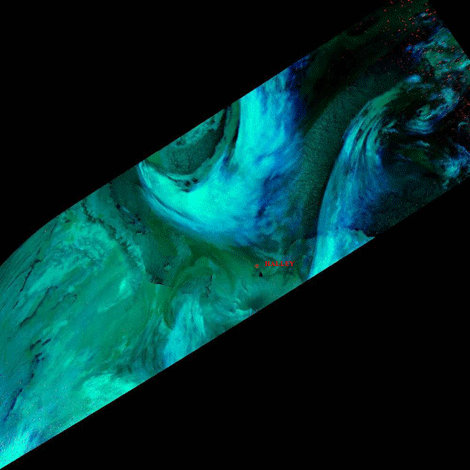
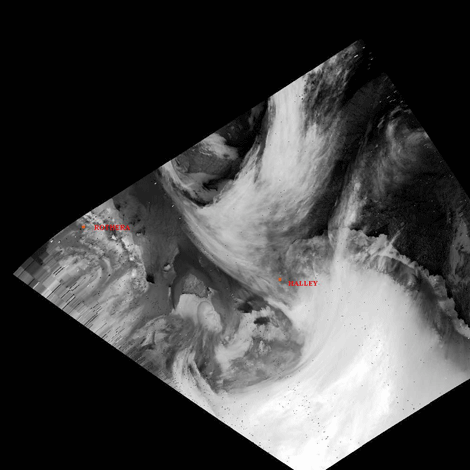
at the satellite photos. We were between two swirling systems, swirling madly

above our heads. By 6pm, the winds were increasing again and the following day

we were back at 30 knot winds. I kept blinking. It was so bright outside, so

white. It’s time for squinting and shades. Really bright and no contrast. Nothing

but white in every direction. Where are we?! If you look carefully you can see

the shape of the peninsula curving down the left hand side, the Weddel Sea in

the middle and then the Brunt Ice Shelf (where I live) going off to the right.

I think the next day was a Friday and winds dropped gradually throughout the

day. In the evening I stayed in the caboose again. It seems so close to base

now that you can see it from the window. I understand why some people, most

people here, don’t see the point in going there. All the flags and drums seem

like overkill. Was there really a time when we couldn’t find it for what felt

like hours?! And the caboose was so warm! How odd in the morning to not have

to reach for the matches and tilly lamp before doing anything else, to be woken

by daylight. How much simpler that makes everything!

Saturday was calm and clear. Huge mirages of icebergs dominated the view to

the north-east, the plateau rising to the south incredibly clear. Is that really

land, so high? Are we really living on a moving ice shelf?! Ludicrous existence!

Sastrugi still cast long shadows, patches in the snow. At first the memorial

looked like a pyramid tent, so did a tarped-up skidoo and a red flag in the

distance. There is no sense of perspective. I kept looking around – what’s

this? What’s that?! The refuelling depot looks strangely like the Shackleton

returning to pick us up. You can see all around, a perfect flat circle, restricted

only by the curvature of the earth. There is so much to see, my eyes aren’t

used to this much information. Ironic: when I first came here the same landscape

struck me as incredibly empty. I remarked on how little there was to focus on.

Saturday night there was a themed party, come as your favourite star. I guess

I should have come as Sirius but Tank Girl was much more fun. Lots of costumes,

special food, the last big party before post-winter trips begin. At the end

of the night we watched Human Traffic and I was pulled back into the world of

nightclubs heaving with bodies, Saturday nights in Britain.

Felix has been writing about Critical Mass, about protests on the streets of

New York. Thousands of people in one small space? What was once my reality is

now almost incomprehensible to me. I share a huge section of ice shelf with

17 other humans and a couple of penguin colonies. We don’t come into contact

with political strife on a global level. The news-sheet this morning talked

about people being massacred in a school in Russia. How have I missed this story

completely? I hurriedly looked through the last week of papers printed off and

there were a few lines each day, a couple of paragraphs in the last couple of

days, but still less coverage than the Royals or Beckham ever get. I would have

missed it completely a couple of months ago. I am waking up, see.

Sunday, another glorious calm day and we played golf in the afternoon. My first

time ever holding a golf club! I can’t very well shout hatred at the principle

here for its not as though woods are being clear-cut for the sport! It was fun,

great to get out and about for a change. I stepped through a motion of Tai Chi

and started growing sprouts again. In the evening we had a small fire. It’s

a beautiful place to wake up, Antarctica, and I’ve had a lovely dream.

Posted in Uncategorized | 2 Comments

The NYPD is out of control

After the Critical Mass ride, I suspected

it. The following day, I thought

it might just be a bike thing. But events today have made it clear: everything

we thought we knew about the NYPD’s ability to manage protest is wrong. Today,

another

550 arrests, bringing the total well over the 1,000 level. Here’s the New

York Times, which has not been noticeably protestor-friendly:

The turning point appeared to come as several hundred protesters with the

War Resisters League tried to begin a march up Fulton Street that organizers

had negotiated with police, although they did not have a permit. Ed Hedemann,

one of the organizers, said their understanding was that if they stayed on

the sidewalk and did not block foot traffic or vehicles, they could proceed

toward Madison Square Garden. But within minutes, the protesters were confronted

by a line of police officers who told demonstrators they were blocking the

sidewalk and would be arrested, although they did not appear to be blocking

pedestrian traffic at that point. A commanding officer, telling the crowd

of about 200 "you’re all under arrest," ordered other officers to

bring the "prison van" and the "orange netting" with which

to enmesh the protesters.

"We don’t know why we are being arrested, we were just crossing the street,"

said Lambert Rochfort, who was among the protesters. "We were told if

we don’t do anything illegal we would be allowed to march on the sidewalk

and we did just that. Then they arrested us for no apparent reason."

These are tactics we’re beginning to get used to. The orange netting –

that came out first on Friday; the police would use it to stretch across two

ends of a block, and arrest everybody in the middle. The mass arrests; the needless

antagonism; the way in which the NYPD seems determined to make sure every protestor

in the city considers them the enemy. It’s all utterly stupid, and I can’t for

the life of me work out why they’re behaving this way.

Ironically enough, the "New York City Welcomes Peaceful Political Activists"

webpage

is still up, although its rhetoric is increasingly hollow. "New York City

– a melting pot, home of the Statue of Liberty and first capital of this

nation that was founded on the basis of freedom of expression – welcomes

all peaceful visitors," it says. "There is no better place than New

York to speak one’s mind and have one’s message heard."

There’s been precious little regard for freedom of expression this week: I

think the arrest

of Josh Kinberg is probably the clearest single indication of that. At this

point, you don’t even need to be marking the sidewalks with chalk or riding

bikes more than two abreast to get arrested; merely marching on a route which

has been negotiated with the police is enough, if you don’t happen to have a

permit. And the stories

from the diesel-sludge-filled holding cell show that the NYPD is intent on making

life as miserable as possible for those they hold.

One commenter on this blog said

that after similar arrests at a Critical Mass event in Los Angeles in 2000,

eventually the LAPD had to pay out a lot of money in class action claims. They

NYPD, with its indiscriminate behaviour, has to be risking a rash of similar

lawsuits, and I can’t see what the upside is.

The downside isn’t purely financial, either: it seems pretty clear that the

one standout incident

of real violence was prompted by police aggression. Of course, anybody who beats

a police officer unconcious deserves to go to jail for an extremely long time:

there’s absolutely no excuse for such behaviour. On the other hand, any police

force in the world should be able to tell you that if you get aggressive with

a penned-in and angry crowd, violence is likely to result. In this

case, the police officer who was hurt was one of a phalanx of plain-clothes

police who rode their scooters straight into the crowd. I saw the same thing

happen on Friday: it’s scary, I can tell you.

Walking down the street today, alone, nowhere near any demonstrations, I passed

a police van. The occupants were just sitting around: one was eating a banana.

But I got some nasty-looking stares, all the same, and felt a hell of a lot

more threatened than protected by their presence. And I was looking perfectly

presentable, without a single item of protest-style clothing on.

Over the past few days, the NYPD has created a climate of fear and resentment

in New York. Of the thousand people arrested, I’d wager that fewer than 10 were

being at all violent, and that most are the kind of New Yorkers who have been

slowly coming to trust and respect their police since the low point of the Amadou

Diallo shooting. Now,

all those people, and their friends, will be mistrustful and fearful of the

police all over again. And no longer will I be able to look smugly at Seattle

or Genoa and say that New

York’s police are much better than that, a cut above, well trained and highly

disicplined.

The weird thing is that New York really has been very good at dealing with

protests in the past. The anti-war marches last year, the demonstrations at

the World Economic Forum in 2002 and the UN Millennium Assembly in 2000 –

all went off very smoothly. Someone high up in the NYPD – I have no idea

who, and I certainly have no idea why – has clearly made a decision that

there will be lots of arrests at the RNC this year. There will surely be debates

about whether the arrests will make the Republicans look better on national

TV; all I know for sure is that they will severely damage New Yorkers’ faith

in their own police force.

Posted in Uncategorized | 22 Comments

Blowy Snowy Day

I really can’t believe it’s September tomorrow. But I have no frame of reference

either. I guess at home you’ll be watching the leaves become less green or recently-born

animals becoming be less cute. You can feel it in the air, the crisper breeze,

the extra layer you need to wear outside. In Australia and NZ the changes are

different but it’s change towards an equinox season nonetheless. I guess that’s

the only similarity I share – the change towards equinox, the hours of

light and dark becoming more equal. That is something we’re experiencing everywhere

around the globe.

Today is a snowy, blowy day. I looked at the weather chart this morning and

saw it was blowing 37 knots with an ambient temperature around -17C. Thirty-seven

knots… hmm, I tried to remember: was the threshold for visiting the lab 30

or 40 knots? Minus seventeen?! That can’t be right, it’s toasty outside! What

a change from the minus forties and clear skies we had last week.

Still, at least you could work outside in that weather. The first time I experienced

weather like this it was exhilarating, it was phenomenal, it was an Incredible

Storm. We found excuses to go outside just to know what it felt like, to say

we’d been here and battled it. In contrast, no-one seemed very fussed at all

this morning. Breakfast, cup of tea, melt-tank was a bit of a slog I imagine

and off to work. The CASLab is out of bounds but we expected that yesterday

and Steph set it up to run without us today so I’m not concerned. I went to

the Simpson platform to work on some emails and make some chemical solutions.

Digging snow for the Simpson melt-tank was a bit cold on the face but not as

bad as I had expected it to be.

It’s not like we aren’t fussed or touched by this weather – I wore goggles

today, pulled my bearpaws well over my sleeves and made sure to put my windy

top hood up before going outside. Ness and I unwound and connected the line

between the Laws platform and the other hand-lines so we can feel our way home

from anywhere even if the visibility craps out completely. I mean, it was blowing

40 knots outside! When I got inside finally I was covered in snow and exhausted.

Battling against that wind is a struggle but going home is bliss!

It’s now reached 45 knots and -13C. The temperature is a bit deceptive though

since at wind speeds like that you don’t feel much warmth. The subjective temperature

is -37.8C, much closer to what we’re used to! Still, I didn’t bother with my

dead rabbit hat today: already had enough clobber on my head without the hassle

of that! The building is shaking and wind howling, you can hear it everywhere.

I can’t weigh anything accurately in the wet chem lab cos the platform is shaking

so much. The rocking chairs in the living room rock on their own and pictures

start tilting. I have to head back to the Laws now and know it will take a good

ten minutes to get properly togged up and I’ll be fairly tired when I get there.

I don’t really know why I’m writing this blog – I have nothing new and

exciting to report. Just thought I’d say hello and talk about the weather. Some

things are the same all the world over I guess.

Posted in Uncategorized | 6 Comments

Scenes from the protests

A nice balmy summer’s night – perfect for a group bike

ride around New York City, no? I thought so, anyway, so I joined about five

thousand other like-minded bicyclists at Union Square this evening for the

monthly Critical Mass event.

It’s a Take Back The Streets thing – get enough cyclists together in

one place, and they can actually control the roads rather than being sidelined

(literally) by cars. There’s something really rather exhilarating about pedalling

down the middle of Sixth Avenue in such numbers that the cars have to yield

to you, rather than the other way around. The most popular chant is simple:

"Whose streets? Our streets!"

Normally, the police are well disposed towards Critical Mass events. They help

the cyclists stay together, even if it means allowing them to run through red

lights. Ultimately, so long as the bikes keep moving, the disruption to traffic

is minimised. This time, however, was different: the AP reports that the police

made nearly 250

arrests.

I feel a need, here, to explain what these people were arrested for –

and to complain about the rather incoherent attitude of the NYPD tonight. According

to news reports, the police were handing out flyers at the start point in Union

Square – although I saw many police officers there, and none handing

out flyers. Organisers were apparently told in advance that the police would

be strict about enforcing traffic laws – even saying that we weren’t allowed

to ride more than two abreast.

But when the ride started, everything seemed copacetic between the police and

protestors. A clearly senior police officer in suit and tie, rather than any

uniform, let the riders out of Union Square and down Broadway in batches, allowing

traffic to flow sporadically along 14th Street. We had no problems riding down

Broadway and then making a right onto Houston Street; we then turned onto Sixth

Avenue to make our way up to Midtown.

The general M.O. in such events is that if you’re in the part of the pack which

happens to hit an intersection as the light turns red, you stop your bike in

front of the traffic so that it can’t move until the pack has passed the intersection.

This ensures the safety of the riders: no one wants to be sideswiped by a car,

so it’s best to make sure they don’t even think about driving into the peloton.

I found myself on such traffic-calming duty a couple of times, and it’s a nice

feeling, necessarily a little bit reminiscent of that famous photo of the lone

protestor holding up a long line of tanks outside Tiananmen Square. Mostly,

the occupants of the cars were supportive: New Yorkers are generally well disposed

towards these kind of actions, I think.

At one intersection in the 20s, however, things got ugly: a middle-aged white

guy in a shirt and tie stormed out of the taxi he was in the back of, and tried

to physically shove me out of the way. Naturally, dozens of cyclists immediately

surrounded him, and he backed off, but he tried the same stunt a minute later

with another guy.

I was a bit shaky after that, but relaxed when we hit 30th Street, where the

ride moved east over to Madison Avenue. Suddenly, the police seemed to be in

control again: rather than leaving the traffic control to the standard Critical

Mass DIY method which had caused the confrontation on Sixth Avenue, the NYPD

was making sure that tempers didn’t fray too much on either side. We crossed

Fifth Avenue without incident, biked up Madison to 55th, and then went over

to 7th Avenue with police seeming very much accommodating of the bike ride the

whole way.

The highlight of the evening was Times Square, for sure. Hundreds of cyclists

filling up the Crossroads of the World, slowly – the police were manning

42nd Street, so we backed up into Times Square proper, and at one point somehow

all managed to raise our bikes in the air at the same time, above our heads.

I hope someone posts a picture online!

After Times Square, as the New York Times puts

it, police patience appeared to grow thin. I suppose I must have been near

the back of the pack at this point, since I was up by 36th Street, while netting

was dragged across 14th Street, backing up riders. I did, however, see a major

police operation, with riot police and motorcycle cops rushing down 34th Street

in formation, creating a cordon around a group of riders, and, I assume, pretty

much arresting them all. What you have to understand is this: every single one

of the 5,000 riders was technically breaking the law, since we were not confining

ourselves to bike lanes, we were riding more than two abreast, and we had to

run through red lights just to stay with the pack.

The crowd was hyped up, and enthusiastic, but by no means were we a bunch of

anarchists intent on violence. I’m sure that the arrests were entirely random:

the police, at whatever point they decided to move in, simply rounded up whomever

they first laid hands on, either on 34th Street or a bit further down the ride,

at 10th Street in the East Village. I have absolutely no idea what they intended

to achieve by this: it certainly didn’t stop the main peloton from continuing

the ride up First Avenue and on to 23rd Street, and everybody who witnessed

it, I’m sure, was rather taken aback by the NYPD’s sudden heavy-handedness.

The thing is, this was very much the kind of peaceful protest which Mayor Bloomberg

has repeatedly said that he welcomes. Yes, we disrupted traffic, but that has

always been the whole point of the Critical Mass ride, and traffic disruption

is not violence. New Yorkers on the sidewalks, whether it was uptown or downtown,

East Side or West – even the tourists in Times Square – were all

hugely supportive of us, cheering us on all the way and flashing peace signs.

They understood what we were about.

And the NYPD has a history of being very good at dealing with protests –

when the World Economic Forum was in New York in 2002, say, or during the UN

Millennium Assembly. Very few arrests, professional crowd control – I’ve

always thought that New York managed to show its mettle in hosting such events,

in contrast to, say, Seattle or Genoa.

The RNC, however, is a whole different kettle of fish. When protestors abseiled

down the Plaza Hotel with an anti-Bush banner (great stunt), a policeman on

the roof fell through a skylight, which allowed the protestors to be charged

with assault: they now face possible long jail terms. And the hundreds of arrests

today have already easily broken the total for the entire duration of the DNC

in Boston – and the RNC hasn’t even officially started yet.

Up until this evening, I was confident that the protests, though large, would

not be marred with too much antagonism between the protestors and the police.

Now, however, I’m not so sure: the NYPD seems keen to prove a point, even if

the point it’s trying to prove is hard to fathom. Earlier this evening, I inwardly

scoffed at the grungy downtown types handing out emergency phone numbers for

people who got arrested. Now, I’m going to make sure that I take that phone

number with me to the big demonstration on Sunday. I have no idea what might

happen.

Posted in Politics | 12 Comments

Zen Ice

I’m not sure if Emperor Penguins are right at the top, or the very bottom,

of the karmic evolutionary scale. "Who would be an emperor penguin?"

has not been uttered infrequently around here lately. Abandoned to the loneliest,

coldest and most desolate ice sheet on Earth, destined to sit on an egg for

four months during the coldest part of the year, starving, only to be relieved,

you hope, by a fattened mate who brings up the chick whereupon you have to trek

for days, weeks maybe, to find open water and seek food, which you then bring

back to your mate – and reinitiate thecycle. By any beasts’ standards

it has been cold around here lately and it boggles the mind to think that any

penguins survive at all, let alone chicks. It’s a hard life.

To me, however, they are the epitome of Zen (about which I know very little).

Patient, curious, animated, interested but apparently never hassled, never in

a rush, strong, calm, self-aware while also totally dependant on the community

for survival. I like them. They don’t, it must be said, strike me as being particularly

intelligent – but that really doesn’t matter, they don’t seem unhappy,

either. The Adelies last summer were forever squawking and chirruping, placing

themselves right at the foot of the lab steps and then getting in a fluster

if you came anywhere near them. The Emperors seem more aloof. Upon seeing a

gaggle of humans dangling down the ice cliff, a greeting party wanders towards

us, curious about visitors. Walking in single file, looking in front and behind

as though to check that they haven’t been mislead and are suddenly on their

own, they will walk right up to you. Once their curiosity is satiated, or you

start walking towards the colony, they turn around and wander back.

There is a lot of anthropomorphising going on here I know, but it’s difficult

not to. They walk on two feet, look you straight in the eye if you kneel (when

they are about chest or chin height), they chat and coo, a cross between a rattle

and an eerie echo – and their cry is returned by companions. These curious

ones seem to be a year or two old: fully grown but still too young to breed,

adolescents to us. They walk around in groups, fight with each other and then

snuggle up for warmth, show their chests off and rattle their heads and then,

for no apparent reason, wander off somewhere else. They show no fear and as

a spectator I did not feel that I was interfering with nature. I am undoubtedly

wrong. I had no desire to get overly close or touch them, if for no other reason

than that I was wearing such huge mitts that there would be no point and there

was no way I was going to reveal bare skin to the elements even for the touch

of penguin feathers, but also, because if you wait a short while, they come

up to you. As curious as us. They, too, are living on a fairly monotonous ice

shelf and are happy to see something new for a change. These are our closest

neighbours.

Now the huddle, that’s something else entirely. As you probably know, Emperors

huddle to stay warm in winter. I had imagined a huge circular group with some

kind of re-shuffle order so the ones in the middle eventually move to the edges

and no-one gets too cold for too long on the outside. I don’t know why, but

I had imagined order. By now, I should know that nature exhibits order using

chaos. Through a chaotic system, the most perfect solution to any problem will

emerge. The penguin huddle was entropy embodied. No circle, no order, a number

of large clumps. The ones in the middle roasty toasty, the ones on the outside

burying their heads deep into the penguins in front, using that beautiful rounded

back as a shield against the wind. Layer upon layer of buried-headed penguins

like the centre of a sunflower.

At some point, the penguins on the outside get cold, or bored, or, I don’t

know, it doesn’t matter, the point is, they decide to leave. So they wander

off. And, I guess, that means the next layer gets cold. Heads pop up, necks

stretch, lots of hustling and bustling, the odd peck, and before you know it

the one-time calm huddle of heat generation has become a squawking, shrieking

flurry of bristling heads shaking and pushing, confusion, ripples of movement

in every which direction. I tried to watch for long enough to see what happened

next but it wasn’t entirely obvious. I thought the ones on the outside would

start forming their own huddle with them at the core but more often than not

they just walked off, single file, to apparently nowhere. A clown-like walk

too since most were shuffling on their heels with their toes in the air, making

sure the egg on their feet didn’t touch the ice. Sometimes one would bend down

and rotate the egg. A couple of them could be seen regurgitating food and stretching

to their toes whereupon a tiny chick would appear from under the belly flap

and stick it’s head in the parent’s mouth. Chirrup chirrup chirrup, you could

hear them cheeping. It was beautiful. Thousands of them probably, clustered

in groups of a few hundred, steam coming off the middle, heads buried on the

outside. All calling, all doing their thing.

I’ve had an incredible week. Incredibly full, by my winter hibernation standards.

I had forgotten what it was to be truly busy, at different times rushed, excited,

stressed, exhausted, responsible, cold, high, low, confused and rejuvenated.

I had forgotten what it was to multi-task. I am not looking forward to returning

to ‘normal life’, whatever that is, I’m not looking forward to the summer season

even. I’m not excited by the prospect of mental stimulation and the buzz of

activity that I thrived on previously. It will come though, as I acclimatise

to progressively more sun and more activity, when I drink my last bottle of

wine, eat my last good quality chocolate bar, realise the prospect of fresh

fruit is only a few weeks, rather than months away. Remind myself that with

the first plane comes first post. With all of these things will my enthusiasm

return. And probably my energy as well. I think this week was just a shock to

the system.

It is well documented that August is often the hardest month here and I, who

thought I was breezing through this whole Antarctic wintering thing, am starting

to understand why. We are running out of things, I ate the last real apple on

my birthday a month ago. Tinned potatoes, carrots and beans are, to my palate,

fresh veg. All my clothes are tattered and holey, my hair has been dyed and

re-dyed and now looks like it has a washed out blue rinse – it looks a

bit how I feel. For some people, August is hard because the excitement of mid-winter

is over but it is still months before the first new people arrive. For me, August

has been hard because I’m sad to see the darkness go. I’m already forgetting

what it looked like. It was never this dark in the middle of the day was it?,

I found myself asking Frank yesterday. Even for me, it’s difficult to conceive

how little we could see. And I miss those beautiful, beautiful red stripes on

the horizon at 2pm. Now at two the sun is well above the horizon, the world

is light and white, I can see all the way to the lab and far beyond. On a good

day. On a bad day I can’t see beyond my feet but it’s still white-mauve-cotton-wool-not-seeing

as opposed to pitch dark not seeing. I couldn’t see a thing today, I don’t know

why, but I was glad to still be falling over my feet and into unexpected valleys

in the sastrugi. At night time Orion appears only to the night watchman but

Scorpio still twirls his pincers around my head. The occasional aurora mists

the sky with green. I love my darkness.

Anyway, I think the light has been a shock to the system. It’s colder than

we have ever yet experienced (approaching -50C at times) but the light misleads

you into spending much more time outside, doing all those long-awaited jobs,

taking your [outer] mitts off to take a photo for longer than you ever would

have in June. Without question work outside is a lot easier if you can see what

you’re doing, even if it’s cold – so we’ve been doing these things, and

probably over-doing these things, not realising that we’ve just been jolted

out of hibernation. In addition, where we used, during autumn, to stop activity

after dark, we now see this as no hindrance, we know where the torches are kept

and which clothes to wear in a gale. Everyone perhaps has been doing just that

little bit more.

For me, the return of the sun means the start of spring-time chemistry. This

is when it all kicks off. This is, if I’m brutally honest, the reason why I

am, or my job is, here. The loss of a few weeks’ data in mid-winter wouldn’t

be heart-breaking. A similar loss during spring-time would be quite upsetting

for many. When the sun rises, all those chemicals that have been pooling in

the snow and at the surface are activated, photolysed, react with photolysis

products, come out of the snow, go into the snow, blow in from the coast, fly

in from the plateau… different molecules in different air masses that all

react and interact differently once they are zapped by the sun. This is what

has not been studied before and why we are here.

When ozone drops and air comes in from the coast, we fly a blimp, we take height

profiles, we align the telescope and try to measure halogens in the air. On

calm days, we dig a pit and take samples of snow from different depths. On days

when the air comes in from the east, we ensure the inlets are clear and compare

chemistry in the snow with that in the air. My tank of helium ran low a few

days ago and I haven’t been able to change it since the temperature in the gas

store has been below safety limits. Today the temperature warmed up but I found

I wasn’t strong enough to do this job on my own and will have to take a companion

with me to help tomorrow. All this time, I feel the loss of data keenly.

On Tuesday morning at 3am I was woken by Steph, who was on night-shift, because

the chemical and meteorological conditions we had been looking for were ideal

for a blimp flight. It was 3am and our probe wasn’t yet tested to perfection

so we decided to wait until the morning. Still, I got up for a few hours to

make some preparations in case we decided to fly. At 9am conditions were still

looking good. At 10am I was told that a penguin trip, which I was meant to be

on, was going ahead. We’ve been waiting for these for weeks but until now been

prohibited by either temperatures that are too low for driving the vehicles

or winds too high to abseil down the ice cliffs. What a conundrum!

I went on the trip, I had an amazing time. The minute we crossed the perimeter

drum line I felt the burden of base life dissolve, evaporate, off my shoulders.

It was so good to get out! Only then did I realise how captive we have been

here, kept within a circular perimeter defined by empty oil drums and flags,

5km round and 2km wide. We were off to the coast! It felt great. An hour later

we were there. On the cliffs! A different view, the ice, a sea-lead in the distance,

sun, clouds, beautiful beautiful coast. This was enough for me, I didn’t even

need to see the penguins! But there they were, a seemingly small huddle on the

ice below. Jingly janglies, harnesses, crampons, ice axes, hats, balaclavas,

cameras, hot ribena, backpacks and sausages later and I’m abseiling down the

cliff. I love abseiling, I love dangling off ropes! Look at me, this is great!!!

Once everyone was down, we spent a couple of hours on the ice, hanging out

with the penguins, getting cold but never bored, taking photos, just sitting

with them, walking around, flapping our arms as they flap their wings, calling

back at them. When the time came to leave, people harnessed and clipped again,

climbed up the ice wall, chose to either pull themselves up a rope mechanically

or use a ladder for the last bit. I was going for the ladder. At the last minute,

I ended up on the alternative route. I don’t know why but I suspect my pride

and big gob had something to do with it. It was a stupid decision. Everyone

else had gone, it was -37C, I was cold and clueless. I had two crampons on my

feet, two ice axes in my hands, two jumars on the rope (for pulling myself up),

hard helmet, various caribeners and jangly things on my belt and a great big

backpack pulling me backwards. I have never, except in practices, had to use

jumars, ice axes or crampons. (You will recall that for my pre-winter field

training trip I spent 9 days in a tent due to bad weather.) I knew, and the

people with me knew I knew, how all these thing worked. But my brain failed

me, my fingers cried with pain of cold, my pride held back tears and my legs

started to feel a little less comfortable hanging off a rope, dangling in mid-air.

In retrospect it was a good experience, it is always important to know your

limits and appreciate the skill levels of people around you. At the time, I

felt like I was being pushed to a limit I hadn’t ever yet experienced, meeting

a part of myself that was so true, so deep, so cutting to my soul, I met a person

who was at one moment angry and proud and arrogant and livid while a second

later she was swinging upside down, laughing with the sun and penguins, giggling

at her fate and her situation, being hauled over the overhang by her ever-reliant

buddies upstairs.

And then the angry one kicked in again: "STOP IT, STOP IT, STO—–P,

YOU BASTARDS!!! I can do it on my own damn you!" I was screaming but they

couldn’t hear me and they were getting cold too. It was like being utterly alive

and learning who you are at the core. I know I could have got out on my own

but it might have taken a while. I had figured the system out just before they

haulked me over the edge. But I also know that they made the right call because

they didn’t know my situation and they themselves were getting cold. And that

had been the deal from the start: "Don’t worry, Rhian, give it a go, and

if you can’t do it, we’ll Z-pulley you out." There was never any danger

I wouldn’t make it: had that been the case, I would have gone the ladder route.

I am determined to return, and next time, I’ll get out on my own.

Trundle, trundle. The cosy journey home. Tired and happy people. All these

new experiences. See what the sunshine brings us?! When we get home, it all

floods back. The chemistry, the met, the blimp – o god, conditions

were ideal… o no, I shouldn’t have gone… no, I went, enjoy it, remember

it. But conditions were still holding and there was no reason we couldn’t do

a flight that night.

That night I realised for the first time how truly committed people here are.

We worked from 6:30 pm to 2:30 am inflating the blimp, working on the probes,

winching it up, winching it down, downloading data. It was seriously, dangerously,

cold and everyone was already tired when we began. Plus, the nature of the task

meant that the helpers were outside in the cold for many more hours than I was.

Some people helped out to help their friends, others were interested in the

blimp in and of itself, but many I discovered later were doing this for the

science. This is why we’re here, I was told, and if you tell us this is cutting

edge stuff and important science, then we’ll pull out all the stops to help

you do it. It was incredibly humbling. I often feel like our work here is an

excuse to have an Antarctic presence, but this week I have realised that science

is still a purpose for those of us living here. It is a great honour to have

this opportunity and we should make the absolute most of it. All aspects of

being here.

Life is very simple here, it is remarkably free of conflict. It is rare that

I have to make a decision of the type you make hundreds of during a normal day

at home. Sometimes conflicts of interest arise: penguins or molecules, melt-tank

or machines, scrub-out or pit-digging, dinner or the lab – but the right

choice usually becomes clear pretty quickly. We are all here to do our jobs

but it is also in our jobs’ best interest for us to remain sane and happy. Plus,

ultimately, we are all on call 24-7. Try as we might to differentiate between

communal duties, work and recreation, they are all just different sides of the

same round fruit. Last week the plumber had a virtually sleepless week because

the sewage pipes kept bursting in the cold. And since he couldn’t fix the problem

alone, most of the technical staff dropped everything to help him as well. Friday

night I stayed in the caboose with Frank. Saturday night I was woken by the

night watchman because a science alarm was going off – that was rare,

usually it’s the plumber, electrician, Piggott engineer or generator mechanic

who gets woken. Ultimately everything we do here is one and the same thing,

there is no differentiation. It is all part of wintering at Halley.
Posted in Rhian in Antarctica | 2 Comments

Blodget on Google

I was never a big fan of the Google IPO. I didn’t

understand it when it was announced, and it looks even more

stupid now that the prime reason for doing it – allowing big VC investors

to monetize some of their stake – hasn’t happened. As GOOG starts trading

on Nasdaq today, however, Slate has stepped in with a guide

to stock-market valuations. A good idea, right? Not really: the author is disgraced

stock analyst Henry Blodget.

Blodget’s thesis is that "most valuation conclusions are extraordinarily

subjective," and that there are much better ways of working out whether

or not to buy a stock. This is very dangerous stuff, and anyone who cares about

their money should do their best to ignore everything he’s saying. We’re finally

entering a world now where people are starting to pay attention to things like

valuation again; this is unambiguously a Good Thing.

Floyd

Norris, in the New York Times today, makes an intertesting aside:

The offering’s lowered price represented something of a victory for institutional

investors who had taken the extraordinary step of going public with analyses

suggesting a fair price was in the $80’s or $90’s, or even lower.

In other words, old Wall Street ways die hard, and people who aren’t directly

involved in an IPO are still very wary about saying anything about the stock

before it starts trading. That’s silly, of course: especially with a well-known

and well-liked company such as Google, there is likely to be a large number

of individual investors who want to buy the stock but don’t know whether or

not it’s overpriced. (This is true regardless of the technique used to price

the IPO.) It shouldn’t be "extraordinary" for sophisticated participants

in the financial markets to share their own analyses of what a fair price is:

the underwriters shouldn’t have a monopoly on telling people what the company

is worth.

To read Blodget, however, the value of the company is more or less irrelevant:

Even if we could establish for certain what a stock was worth, this would

be no guarantee—or even indication—that the stock would

trade there in any reasonable timeframe (or ever). [empahsis added]

Blodget, of course, was paid millions of dollars a year to tell investors precisely

this – that buying a company for god knows how many times its actual value

could be a really smart thing to do. But that doesn’t make it right. Buying

a stock without knowing what it’s worth is a fool’s game, and Blodget really

over-eggs the pudding in trying to persuade us that valuations don’t matter.

Let me quote at length:

Let’s assume, for example, that we know that a company will earn $1 per share

per year forever (an other-worldly assumption, but go with it). In this case,

all we need to determine the "present value of future cash flows"

is a discount rate. Because, in our example, the cash flows are known and

guaranteed, we can use the so-called "risk-free" rate, the prevailing

rate of interest that an investor can earn without risking a loss of capital.

One proxy for the risk-free rate is the yield on short-term Treasury bills,

which, as of this writing, is about 1.4 percent. Discount 150 years of earnings

of $1 a year (the financial equivalent of "forever") at this rate

and—voila!—the value of our hypothetical stock is about $63. If

the stock is trading at $50, we have apparently found ourselves a "bargain."

But what if we assume that the "risk-free" rate changes, as it always

does? What if, for example, we assume that the return on 3-month T-bills will

regress to its long-term mean of about 5 percent, a scenario that, given enough

time, is probable? Well, then our $63 stock will only be worth $20. Or what

if the T-bill yield jumps to 10 percent, as in the inflation crisis of the

early 1980s? Then the stock will be worth $10. In other words, even if we

know for a fact that a company will earn $1 per share per year forever—something

that, in practice, we will never come close to knowing—we might conclude

that the stock’s "fair value" is anywhere from $10 to $80 (the T-bill

yield could always drop, too), with a central value around $20 (the value

generated using the T-bill’s long-term mean). Fifty dollars might not be such

a "bargain," after all.

Talk about making a simple concept ridiculously complicated! Blodget’s hypothetical

is, to all intents and purposes, something called a perpetual bond. These things

have a simple, unambiguous value in the markets – and that’s exactly what

Blodget’s stock would be worth. No one would ever conclude that the stock’s

"fair value" was $10, based on the off chance that interest rates

are going to rise enormously in the future; similarly, no one would conclude

that the fair value was $80, based on the possibility that they might fall.

There’s something called a yield curve, Blodget – maybe you should bone

up on it one of these days.

Blodget really hates the idea that a stock is worth the net present value of

future cashflows, though, and he’ll use any old argument to discredit it. Here

he is right at the beginning:

Given the confidence with which some commentators cite the theory, a casual

observer might assume that the "present value of future cash flows"

is an indisputable number, akin to a price tag on a can of soup. In reality,

however, it is not a number but an argument. [Blodget’s emphasis]

Again, he’s wrong. The present value is not an argument, and it is

a number. There can be an argument over what the number is

– it’s something mathematicians like to call an "unknown". But

numbers can be useful even if you don’t know what they are. For instance, when

Blodget put his famous $400 price target on Amazon, a lot of people made the

very coherent argument that there was simply no way, no matter what assumptions

you made about discount rates, future growth, and whatnot, that the present

value of Amazon’s future earnings per share could ever be $400. That was a good

argument, and those people were right, and Blodget, if he disagreed with them,

was wrong. He still is.

Today, Blodget is still looking on the sunny side of things:

If one assumes that Microsoft and Yahoo! will develop superior search services,

that Google will collapse under its own arrogance, and that interest rates

will rise (all reasonable possibilities), one might conclude that Google’s

"fair value" is in the teens.

No, if Google collapses under its own arrogance and stops making a profit,

then the present value of its future earnings is zero. Fair value isn’t in the

teens, it’s nothing. Google has very little in the way of assets, certainly

not the $4 billion that a $15 share price, say, would value the company at.

If it has few assets and no profits, why should it be worth even that much?

Some of the Kool-Aid is still, it would seem, circulating in Blodget’s system.

Blodget was completely wrong when he covered the Martha Stewart trial for Slate,

and he made the same mistakes there that he makes here: he thought he was still

living in the world in which he originally made his name. He isn’t: the bubble

has popped, and it’s not returning. Slate has a very good economics columnist,

in Steven Landsburg, who can explain concepts like net present value a lot more

clearly than Blodget can. They should use him more, and arrogant former Wall

Street BSDs

a hell of a lot less.

Posted in Finance | Comments Off on Blodget on Google

Daylight

had brunch with my friend Geoff today, and he turned to me and asked: "does

Rhian ever have a day where she just goes to work, rather than being blown away

by the fabulousness of where she is?", Felix told me a few days ago,

and I’ve been pondering it ever since. I do and I don’t. I do, and then I find

myself doing so and immediately make an effort to remind myself of where I am.

It’s a beauty of being here, I guess – even in the hardest of moments

or when I’m at an all-time low, I think, this is a part of it. I came here for

this too.It’s a commitment that’s more than woweee.

Anyway, I’m feeling a bit blah right now so, in Geoff’s honour, I figured I

should write a blog to show that I’m not on cloud cuckoo the whole time. Thing

is, the reading might as a result be that much more bland but at least you won’t

be expecting me to be as exciting as my stories are once I return.

Believe you me, there’s nothing I want more sometimes than to just walk down

the streets of London (it has to be both big and familiar to fulfil my needs),

totally anonymous, shooting the shit with my mate Steve as we amble from pub

to pub – in the rain. I’d do anything for that right now. The rainier

and greyer the better. Totally unfabulous (the weather that is, not the company!).

See, if Toni was there, we’d be dancing in the rain and if Anna was there she’d

be visiting from Australia so it wouldn’t be just another day. It’s never ‘just

another day’ though is it, wherever you are? Shit. And then I realise I sound

like some fluffy-bunny-spewing evangelist drunk on the beauty of the world when

all I really truly want is another blah day with nothing spectacular happening

at all. Just once in a while – enough to get my breath back and discover

my thirst for adventure again.

So what gets me down? Not the weather. It’s glorious when it’s windy, sunny,

dark, still, you name it. This is Antarctica, and Antarctica here is described

by weather since there are no other physical features to speak of around here.

The sastrugi’s getting awful big these days, mind you (oh yeah, and it’s nice

to not have to add a glossary to the end of everything I write or say!).

The work? Yeah, the work gets me down. But when it does I try to find something

interesting to do to wake me up. There’s so many opportunities – so many

other jobs to share a part of. In the last couple of weeks, for instance, I

have helped with the gash run, when we bury our waste food; helped jack the

buildings at -50 subjective (and got white fingertips as thanks); helped the

gennie mech with flubbering, when the big bag of fuel under the base gets refilled

with Avtur (the help involves switching a switch on, and then, an hour later,

off); and helped the comms manager to loosen the stays on the masts that our

aerials hang off. It’s by no means one way – I’d say I receive a lot more

support from fellow base members than I provide. People help raise to the handline

to the lab, jack our building, attend to electrical, heat and vent problems

– and, most importantly, I’m always asking for help with digging holes

for samples and snow for the melt-tank!

Anyway, that’s what I do when I get bored of my job – I look to do something

else for a while. On the whole though, my job keeps me fairly busy at a cruise

speed, nothing overkill and crazy like last summer but I’m certainly not twiddling

my thumbs either. So work, does work get me down? No, not really – if

I fix something I come home feeling dead chuffed and if something remains broken

I have learnt, or am learning, to not lose sleep over it. We’ll get there in

the end.

I guess the thing that can really sway my day is other people. I used to think

I was fairly stable, fairly reasonable (don’t we all?), sensible, even. But

you’ve got to remember that BAS sets out to employ reasonable, stable, independent

people. And mainly blokes. So here, I am none of my previous selves. PMT hits

me like a blast from the east, a word from a colleague can send me above the

clouds or into dephs of navel gazing, innocent banter at dinner can fuel my

energy or force me to leave the room protesting. This being a British base,

there is a lot of banter, a lot of piss-taking, a fair amount of sarcasm and

the inevitavble gossip. I thought I could give as good as I got but I’m learning

to coat my shoulders with teflon – something I’ve never been a master

of. Still, although I am improved from earlier in the year, one emailed sentence

from a fellow inmate down here had me instantly in tears today. Tears of anger

or despair, I’m not sure which, but whichever it is, it’s not right. And while

my friends here say "don’t let it get to you", and I know it wouldn’t

get to them, it still finds its tender spot. I don’t want sympathy, I’m not

unhappy, PLEASE don’t now elevate me further into ‘I couldn’t do it’ levels

– I just am answering a question since I realise that in this mood, and

this isn’t the first, I rarely write blogs.

The sun rose yesterday but we still haven’t seen it – it’s been hidden

behind clouds. Maybe tomorrow. I had intended to write a blog tonight about

the joys of daylight, the colours on the horizon, the effect it’s had on raising

the spirits of all on base, the increased energy around the place and all the

outside jobs we can now do. Of how bizarre it is to see the landscape we have

been creating in the dark – some things now buried, many things needing

attention. The wonder of clouds and stars at dusk. How much closer everything

seems. Everyone is rushing around happy that they can work without the aid of

a torch. Skidoos are running and trips off-base being organised. Light first

appearred around 10am, beautiful pink and orange sky, and dissappeared after

dinner, around 7pm probably. Amazing. Last week we had a storm so the change

from dark to light is spectacular and sudden. I had forgotten how normal daylight

is. I don’t particularly like the normalness of it, but it is very convenient.

Love, me.

UPDATE: Geoff, I’m not sure we have met, but to answer your

question, no, I don’t think there is ever a day here where I ‘just go to work’.

It’s now 3:40am on the same night as the earlier entry I sent to Felix. I went

to sleep for a few hours but was having bad dreams, tossing and turning, feeling

too warm. The clock said 2:30. I went back to sleep and had an intense and weird

dream. When I hauled myself out of it, groggy and shaking myself, the clock

still said 2:30. I sleep in a sensory deprivation chamber, without my clock

I have no reference of time.

Maybe my clock was wrong. I’m on gash today – surely someone would have

woken me if I hadn’t got up for cleaning? Or if it was 2:30pm (my clock is analogue)?!

I got up, I don’t know why, it’s rare for me to get up in the night. I was still

discombobulated from the evening’s earlier interaction and I think that was

why I didn’t sleep well. As I pottered down the corridor in my dressing gown,

very sleepy eyed, I met the friend who had earlier upset me. He apologised,

I apologised, we made up and chatted for a while. It was really important to

me to do this. Some people here have the ability to allow things like this to

slippery slide off their shoulders but I don’t. I take personal actions directed

at me very seriously. You might say I over-react. I’m learning a lot from these

blokes here, the ground rules of live and let live, and learning that I have

a lot to learn.

My friend told me there was a beautiful aurora happening outside. Could I

be bothered to get dressed for it? Twenty minutes later the night-shift person

confirmed it was a good ‘un, though not necessarily good enough to wake people

for. I never regret going outside, never. So after goodnights I returned to

my room for clothes and a ‘doo suit. Ten minutes later I was walking like the

Michelin man down the steps of the platform outsiude, crunch rustle rustle.

The ‘doo suits (glossary: doo =skidoo) are warm but cumbersome!

There was an aurora. Gentle green swirls in the sky, clear starry night. The

swirls of aurora, the low-level mist, the milky way, all washed foggy stripes

around the place, merged together, glazed the sky. Scorpio laughing from the

north now, Orion not yet risen. I really do miss him. But to the South was another

constellation I have been chatting with for a while but have not yet found a

name for. Simon was outside with me, he’s on night-shift but also conveniently

has a PhD in astronomy. I’ve been meaning to show him this constellation for

weeks.

As we’re looking around the sky he points out that Scorpio’s tail is in the

Milky Way. It’s good to know for when we get home. Oh – so when I see

the Milky Way, I should look for Scorpio’s tail and know the rest is out there

somewhere?, I ask. Scorpio is huge in the sky and apparrantly also visits the

north sometimes, like Orion visits us down here. I could believe that sometimes

you can only see his tail. No, Simon says, it’s so that when you see his tail,

you know that’s where the Milky Way is. I can’t imagine the stars without the

Milky Way. It’s sad to think the only reason we don’t see it is due to our own

light pollution. While we’re staring to the north watching the crustacean’s

pincers, a bright orb appears in the sky, falls, keeps falling, falls further

and eventually fades. It is the brightest shooting star either of us have ever

seen. Not so much shooting as dropping. There must be a meteor out there now,

about to be buried in snow. It’s funny to think that we’re closer to that then

any other people.

When we came in we looked the constellation up: Canis Major, Orion’s hunting

dog. So, Orion might be around less these days but at least he’s left his puppy!

Posted in Rhian in Antarctica | 2 Comments

WHOOOSH

I left the lab late today, around 9:30 pm, but it had been a productive afternoon

so I bore no grudges. A nice little blast of work to clear my conscience for

the weekend. Truth be told I haven’t done much up there this week as it’s been

stormy for the past few days and there’s no fun in going to the CASLab in winds

above 30 knots, vis less than 10m, unless you really have to. Anyway, I left

the lab in the dark. Two steps down and there was a breeze down my ankle –

I hadn’t pulled my overalls fully over my boots. Back indoors to re-attire.

And check the mitts are snug as well.

I reached the bottom of the steps and was nearly knocked over by a gust of

wind. It’s blowing 25 knots and though that’s low compared to the last few days,

I was reminded that it still gives the air a significant force. But nothing

unmanageable and the wind was behind me and slightly to my side, in my favour

at any rate.

I thought, I love this, this is great. I wanted to remember what it was like

so I stopped and looked around. Behind me was my beloved lab, shining white

by the floodlights, still looking as though it belongs on the moon. Inside it

is hot or cold, loud, buzzing, clicking and full of problems. From the outside,

it still makes me gasp with pride. I work there. That’s my lab. I even saw it

being built!

In front of me, well the direction I was headed, were three dim lights. Hazes

of light denoting the Piggott, Laws and Simpson platforms. Are they clear enough

to follow home or should I stick to the handline? I love following the lights,

there is so much space around me then. In every other direction I could see

nothing. I couldn’t see the surface my feet were walking on, I couldn’t see

my black mitts against the black sky. It does get really dark here still, thank

God. I felt elated. This is what I love. A strong wild wind, space in every

direction and a strong, deep, sense of security. Someone recently told me I

was brave; I couldn’t relate to that at all. Here I feel absolutely safe, at

one, at home. It’s wild but it’s wonderful.

Dark. The surface, I was thinking about the surface and how my feet feel the

way forward. Crunch crunch they squeak on the hard snow. Then suddenly a soft

patch, like icing sugar, it’s divine. Then back to the polystyrene chunks. Snap:

so easy to break. The worst thing that can happen between here and the Laws,

I feel, is that I fall over!

And as sure as mud is mud, you will fall over. I fall over the whole time.

I love falling over, we always laugh. It doesn’t hurt, there is nothing to be

scared of. Why does it hurt at home? Maybe the scrapes and bruises – but

here I am padded everywhere. A twinge in my lower back when my foot lands on

air and I fall deep into a sastrugi hole perhaps, but that’s the worst of it.

It makes me laugh always. I love tripping people up too. You’re never safe here

if someone is walking behind you! Come to Antarctica and learn to rugby tackle

(I was rubbish when I first got here – I’ll be responsible for all sorts

of bloody noses and lost friendships when I get home, no doubt, forgetting that

concrete hurts!).

So I’m thinking about the surface beneath my feet that I love walking on so

much. I could ski, not in this, but sometimes – but I prefer walking.

I like to feel the sastrugi under my feet, the snow, the ice, feel the ice,

a hundred metres of it maybe below me, and then below that is water. Salty,

cold and dense ocean. It’s great. Nothing like snow on concrete, snow on earth,

this is snow on snow on snow. All water molecules.

So I’m watching the world around me, so dark, so blowy, so exciting. Remarking

on how little there is to focus on, unlike at home. At home there would be buildings

everywhere, or at least trees. Here I just have three blurry lights in front

(I’m heading for the middle one) and one behind me. Black everywhere else. O

my – there’s a dot of light in front of me and up a bit. Bend, bend, bend

your back upwards, Rhian. My hood and dead rabbit hat and goggles are obscuring

anything above me, keep bending. O MY – LOOOK!! STARS!! Soo many stars

you have no idea, I am clapping with joy. There’s big smiley Scorpio and the

bright lights of the Southern Cross. The Milky Way streaking like a great smoky

line across the sky, even the magellanic clouds are clear tonight. This storm,

this 25 knots of blowing snow around my head – it’s just here, just at

ground level. Not even on the platform of the lab was it this blowy. It’s amazing.

I knew I wasn’t alone! Now I really am laughing, I can’t contain myself. Who

could ask for more?! Stars and storm?!! Woweee! I keep looking up but then I

can’t go forwards and I fall over. In the end I lie on my back, in the 25 knot

blow, snow flying past my ears, and stare at the sky. HALLO SKY I shout!! I’m

Rhian!!! I know, you fool, say the stars, we’re billions of years old. Now get

up before you never get up. And they accompany me all the way home.

Just before I reach the platform I am called in from my silence, my chest

bleats "Rhian, Rhian- Laws" and after some fumbling inside two jackets

I manage to extract my radio to inform them I’m ok, nearly there, nearly home.

"Would you like a drink waiting for you?" Oh yes, a gin and tonic

please, this is a night to celebrate.

Posted in Rhian in Antarctica | 11 Comments

Google IPO questions

I’m a financial journalist, but I’ve never pretended to understand the stock

market. Bonds, yes; stocks, no. A recent Reuters

story, for instance, includes this bizarre segue:

“In a deal like that where it’s priced for perfection, anything that occurs

that isn’t right on the number, you get hammered,” said Jim Huguet, chief

executive officer of Great Companies LLC. The Florida firm manages $230 million

in technology shares.

Of the thousands of U.S. public companies in the United States, barely more

than a dozen have prices above $100 per share and trade at least 10,000 shares

a day. As of mid-afternoon Monday, none of the Nasdaq-100 stocks (.NDX) or

the components of the Morgan Stanley High Tech Index traded over $90 a share.

The US stock market is obsessed with dollar price – you often hear people

jumping up and down saying that such-and-such a company just rose or fell $5

on the day, without bothering to mention what the bloody thing is selling at.

This is just another example of the same syndrome: the journalist clearly reckons

that being "priced for perfection" is more or less the same thing

as being priced above $100 a share.

The way I see it, pricing the shares in the triple-digit realm is basically

a way of deterring speculators and trying to ensure, as much as possible, that

the people who enter bids in the IPO are the buy-and-hold investors that Google

is looking for, rather than small day-traders. It probably doesn’t make a whole

lot of difference, but I reckon that a $20 stock going to $24 in the course

of a week is probably slightly more likely than a $130 stock going to $156 in

the same timeframe. So if you want to decrease volatility, price high.

The key way that Google is ensuring low volatility, however, is through its

use of a Dutch auction. I’ve touched

on this before, but basically the price is set by investors, not underwriters,

which means that no one’s going to buy with the intention of selling almost

immediately. Daniel Gross says

in Slate today that "most professional investors will likely boycott the

offering" – but that doesn’t really matter: they’ll have to buy sooner

or later (and sooner rather than later, I think), and so will provide a natural

offset to the phenomenon of the "winner’s curse" which is often associated

with auctions.

But amidst all the concentration on the style of IPO that Google has chosen,

I get the feeling that people are overlooking some rather obvious questions.

So, here are two of my own; I’m sure there are more. If anybody would like to

hazard an answer, I’d be very interested.

1. What’s with the fees and the underwriters? Google has two

lead underwriters – Morgan Stanley and CSFB. Normally, IPO underwriters

have a lot of work to do: they have to value the company, set an issue price,

and market the shares to investors. In this case, they can basically sit back

and let the internet do the work for them: they simply issue the prospectus,

wait for the bids to roll in, and then use those bids to set the offer price.

Not a single phone call needs to be made to a single investor.

Daniel Gross says that "to add insult to the injury of the chastened investment

bankers, Google has decreed that it’ll only pay a 3 percent underwriting fee"

– but in an offering that could reach $3.3 billion, a 3% fee comes to

an extremely respectable $100 million. Does anybody really think that the banks

are doing $100 million’s worth of work on this deal?

Even more puzzlingly, Google has taken its two lead underwriters and saddled

them with 29 – count ’em – extra

underwriters, comprising pretty much all of Wall Street and then some. What

on earth are 31 underwriters supposed to do in this deal? They’re not drumming

up investors, so what’s their role, beyond earning fees?

2. Why is Google selling 14 million shares? A large part of

the reason why Google didn’t go public ages ago is that it has no need for cash.

It is minting money, actually – even after paying for what is probably

the largest, most expensive and most sophisticated server farm in the world,

it made $79 million last quarter, and is now sitting on $548 million in cash.

That’s enough money to buy one hell of a lot of Bloggers:

it’s hard to see what use the present half-billion is to Google, let alone the

$1.7 billion or so it stands to receive from the IPO.

There are, of course, good reasons for the IPO beyond raising money for Google.

Most obviously, Google was funded with venture capital, and venture capitalists

want an exit strategy. Existing shareholders are selling about 10 million shares

in total, which is much more than enough to give Google an unambiguous stock-market

valuation and, should it need it, a currency for further acquisitions. My question

pertains to the 14 million shares Google is selling over and above that number,

with the proceeds going, we’re told, "for general corporate purposes".

If Google is already profitable, what use has it for having $2.2 billion sitting

in the bank?

Raising equity, for a company like Google which is likely

to sell at more than 150 times its previous four quarters’ earnings, is cheap.

But even so, is the accumulation of an enormous pile of cash really the use

to which Google shareholders would like to see the company’s equity put? Or

is there (and I’m genuinely ignorant here) some kind of rule which says that

a company has to sell at least as many shares in an IPO as its existing shareholders

do? Absent such a law, I simply can’t see why Google is doing this.

Posted in Finance | 14 Comments

A triptet for Thirty

house-party

I’m having a party tonight and you’re all invited. I hope you can make it –

it would be cool to see some new faces for an evening, a novelty you could say.

Not that we’re bored of the faces that are here… it would just be a change.

Anyway, I’m having a house-party, at my home, and I’d love you to be there.

You can take the number thirty-two bus and ask the driver to drop you off at

the corner… he normally doesn’t mind as it’s fairly friendly in these parts.

Not like in the big smoke. There’s plenty of room to crash if you want to stay

for the weekend too.

I think we’ll have pizza and I’m hoping for a chocolate cake … I’ve dropped

enough hints ("what would you like for your birthday, Rhian?"- "Chocolate

cake") but you never can be sure about these things. I’m pretty sure that

Scorpio will be there, and the moon, but I’ve unfortunately been seeing less

and less of Orion lately. I miss him but know he’s out there still, keeping

watch over me. It’s funny – the light seems to have returned surprisingly

fast and I already miss the midday stars. I loved the peace of permanent night.

Others on base are reborn though since midwinter has passed – it’s like

you can visibly see them re-enthuse with every extra photon of light we receive,

each lengthened hour.

I remember the first day when the sky was so red and clear that I could see

the Rumples again. I’d forgotten there was a horizon you could focus on… odd

to have my immediate surroundings expand so suddenly. But in another way they

have shrunk, back down to an earthly proportion: now I see distant buildings

and coastline features where previously I saw stars and other galaxies. Don’t

forget there are other days when you can’t see beyond your outstretched arm,

but that happens year-round. It is all magical.

We went outside at 2pm today (for melt-tank and photos) and were amazed how

light it was – you wouldn’t even think of taking a torch on this weather.

There was a light dusky blue in every direction and faint hint of red to the

north. Not a stunning National Geographic type day but a lovely day, a normal

day, a day when I appreciate how much I like being here. It’s 3:30pm now and

thankfully dark again. This is the Halley I love the best.

What makes me smile is realising that eight weeks ago, in exactly the same

light conditions, I was commenting on how short the days were. Now it’s the

nights that are getting shorter. Soon we’ll be living in day and night and that

ordinariness of diurnal variation will return. And after that, the midnight

sun and sunglasses 24-7. It’s all happening very quickly, but maybe I’m just

entering that time of year again when the changes are most noticeable. We still

have four or five months before the first plane arrives and about eight before

we get home, so I needn’t worry that it’ll go by too quickly. I just don’t want

to miss anything along the way.

aurora (written at 4am, very sleepy)

There is an impression that down here we see auroras, haloes and sundogs the

whole time. So much so that we become almost passé about them – yet another

aurora lighting my way to the lab, the antarctic street lamps.

Not so. I have now seen two or three stunners and a couple of cloud-like wisps

during my time here. They almost always happen at night and some years more

vividly than others. This year has not been prolific in its atmospheric light

shows. We have an ‘aurora wake-up list’ on the wall of the mess room but until

last night it has only been used once before.

This morning the night watchman woke me at 3am: "Rhian, there’s a bit

of an aurora outside, it’s not amazing but it’s something". When I got

outside I was glad to have got up but he was right – it was cool but not

heavenly.

To start with.

There was a big streak to the north stretching horizontally across the sky,

with patches above it, as though dabbed onto the night canvas afterwards with

a dry, short-bristled brush. To the south were also a few patchy clouds of light.

As my eyes began to adjust, so too did the light. The patches became swirls,

the clouds, spirals, before dissolving back into the night sky or metamorphosing

into a duller version of its former self. The whole sky had these patches of

light on a dark background. To orient myself, I located Scorpio and the southern

cross, unusually far to the west (to my work-day eye) which shone out bright

on the pitch black background. For a while I gazed at the stars, forgetting

the aurora completely. It was a beautiful night even without these light clouds.

As my nose was getting colder and I started thinking of going in, the light

show began to kick off. Patches expanded and flickered in the brightness like

a pulsating dance of light in the sky, and as they pulse, the seem to draw together

to an apex above our heads, the top of a cone from which luminescent light then

starts to pour. It’s dazzling. The whole sky gets filled with this smoke, pouring

in between me and Scorpio, forming a veil of light around the atmosphere of

the Earth. This is an earthly dance, like clouds: you can feel how much closer

it is than the stars. The bursts to the south that were formerly patches above

the CASLab have formed an S-swirl now and the stripe to the north grown to fill

the whole sky, not linear any more, organic.The intensity is always varying,

flickering, moving around the hovering light patches, adding brightness here,

dissolving the veil there. The movement makes me laugh out loud. Dynamic. Alive.

But very much an atmospheric phenomenon. A dance of wispish light in the sky.

birthday

I celebrated my thirtieth birthday last week, it was great. Thirty in Antarctica!

Thankyou for the emails, the good wishes, the cards and letters that missed

the post, the presents unwrapped when I was still 28,- a guitar, a watch, a

big birthday hug. I’ve been looking forward to this so much it’s amazing that

any celebration would suffice. But it was brilliant. I went out to the caboose

on Tuesday night and stayed until Thursday morning. Different people joined

me at different times and for a few blissful hours I was alone as well, in a

caboose, in antarctica on my birthday. Who could ask for more?! If I could,

I think I would live in a caboose forever. Maybe I’ll have to find a caravan

or boat when I get back. Maybe these places are all an essence of the same place.

And to have an impromptu party out there was even better. I haven’t been able

to have people ‘pop by’ for years now and I suddenly realised how much I missed

that. "Would you like to pop by for dinner?" I asked over the radio

and that night Vanessa, Steph, Frank, Craig and Jeff all appeared at different

times to share different parts of the evening’s celebrations. Steph, bless him,

even brought a bottle of bubbly and some glasses out there. So all that is missing

now from this week of celebrations is a chocolate cake.. and that, I think,

might be my special treat tonight.

Hope to see you later!

Love Rhian.

Posted in Uncategorized | 1 Comment

The WTC panel

I wasn’t the only person to get up early in order to go to a "professional

forum" at the Center for Architecture in Greenwich Village on the subject

of the World Trade Center site. The auditorium was packed, mostly with men in

suits, who looked remarkably alert for 8 o’clock in the morning. The meeting

was off the record, which means I won’t tell you who said what. I can tell you,

though, because the details are on the AIA website,

that the panel discussion included most of the important stakeholders, including

Daniel Libeskind, Michael Arad (the memorial designer), and Jeffrey Holmes,

from SOM, who’s working on the Freedom Tower. Kevin Rampe from the LMDC was

also there, along with Tony Cracciola from the Port Authority and Vishaan Chakrabarty

from the New York City department of planning. The whole thing was run by New

York New Visions.

The only major stakeholder who wasn’t there was Larry Silverstein, who yesterday

got served with a lawsuit

from Libeskind demanding $843,750 in architectural fees. We were told at the

very beginning of the two-hour session that there wasn’t "enough time"

to talk about the Freedom Tower – the only thing on the site which is

actually being built at the moment – so we’re none the wiser about what

this landmark building is actually going to look like, how tall it’s going to

be, or anything along those lines. I, for one, have learned nothing new since

I wrote my WTC update in

February, beyond the fact that the complicated site-wide ramping system for

truck deliveries probably won’t be finished in time for the Freedom Tower’s

completion. In the interim, it looks as though the tower will be serviced from

an entrance on the Vesey Street side of where the new performing arts center

is going to be, with a possible elevator system maximising the number of trucks

and cars that can be dealt with in a very small footprint.

In fact, there are still some questions about whether the ramping system will

go ahead as planned, with the entrance to it, on Liberty Street, being described

as "universally disliked". One suggestion was that a building of some

description could be built on top of the ramp entrance, framing the new Liberty

Park and making the cut look a bit less ugly.

And in general, it was hard to see why this panel was so ostentatiously off-the-record,

given that no one said anything particularly newsworthy. A couple of pointed

questions were asked, but in general it was something of a love-fest, with everybody

making extremely nice noises about Libeskind, and – more surprisingly

– everybody also standing up for the absent Silverstein’s right to build

10 million square feet of office space on the site. Lip service was paid to

having "vibrant street life" and all the rest of it, but it was very

clear that Silverstein’s need for commercially viable floor plates will ultimately

drive decisions as to, for instance, whether Cortlandt Street will be open to

the sky.

Dey Street, however, will

certainly be open – the only question is whether it will be pedestrian

or open to cars. There will therefore be a new public space to the south-west

of the PATH terminal, north of Dey and east of Greenwich, and there was a fair

amount of speculation as to what might go there – people seemed quite

keen on "kiosks", although I wasn’t entirely clear on what they meant

by that. The Greenmarket could go there, too.

On the other side of Greenwich from the new public space will be the International

Freedom Center – apparently a museum dedicated to human rights and the

memory of September 11 – and the Drawing Center. But everybody seems keen

that this development not get in the way of people going to the memorial proper

from the PATH station or the north-east more generally. The memorial will be

approachable from every direction, including the west – apparently it’s

only going to be a few steps up from West Street to the flat memorial space.

The issue of burying West Street was raised, dropped, raised again, and not

really ever addressed: Pataki likes the idea, although it would be very expensive,

and the residents of Battery Park City hate it. My guess is that the cost is

too high and the benefit too low for the plan to go ahead, although at the margin

it would make the WTC site cohere a lot more effectively with the World Financial

Center and the Hudson River ferries.

Interestingly, in the midst of the fight over whether there’s anywhere in New

York suitable for a mass demonstration during the Republican National Convention,

there seemed to be general agreement that the huge memorial space could be used

for such gatherings if they were of a suitable nature: the Martin Luther King

march on Washington was cited as a precedent.

As for the general feel of the public spaces in the site, we were told that

fully half of all the retail would be above ground, which is great news. And

below ground, especially in the huge retail concourses of the PATH station,

will often be full of natural light thanks to the Calatrava oculus design. (Those

concourses, we were told, will be as big or bigger than the grand room at Grand

Central Terminal.)

We can also expect an announcement as to who will design the cultural buildings,

both north and south of Fulton Street, in about six months. My guess is that

Libeskind will end up getting at least the southern one, and possibly the northern

one as well.

As for who’s in charge of the site, it’s still something of an alphabet soup.

That said, however, a certain division of labor does seem to have emerged. Libeskind’s

still got a finger in every pie, as the master site planner. The LMDC is concentrating

on the memorial (with Arad) and the cultural buildings, while the Port Authority

is concentrating on the offices (with Silverstein), the retail shops, and the

transportation hub. New York City is mostly interested in the street life of

the neighborhood, recognising that it’s more of a New York state site.

But the street design is important, with crucial decisions yet to be finalised.

Will Fulton Street be a major two-way thoroughfare, exiting both north and south

onto West Street? Will Greenwich Street be open to taxis and limousines between

Vesey and Fulton? Will Greenwich Street between Fulton and Liberty be permanently

clogged with both MTA and tourist buses? Will Cortlandt Street even exist?

In general, I think people left the meeting buzzing with more questions than

answers. But I remain impressed by the quality of the professionals in charge

of this project, and reasonably confident that if anybody can come up with a

workable solution to the myriad of problems that the site throws up, they can.

Even if some of them are suing each other in court.

Posted in Culture | 5 Comments

Gwathmey on Meier

The August issue of Vanity Fair – not online, of course –

runs a letter from superstar architect Charles Gwathmey, responding to an article

the magazine ran in June about Richard Meier’s Perry

Street towers:

I was disappointed by the article’s inadvertent association of Richard Meier

with complaints about the construction and condition of the buildings. What

may be lost on those not familiar with the design and construction industries

is that, while an architect is responsible for the architectural design of

a project and may be in a position to advise the owner of observed contractor

deviations from the design, he or she has limited control over the quality

of construction, limited power to require that construction defects be remedied,

and absolutely no input into the maintenance of a building after construction

is completed. Therefore, it is truly a mixed blessing for well-known architects

when their names are instantly associated with any project they design, both

in the rave reviews for the quality of the design and in the frequently mixed

(or worse) reviews for the quality of the construction.

What should be clearly acknowledged is not the internal power struggle nor

what appear to be rectifiable construction and maintenance issues but, rather,

the superb architecture of the Perry Street towers.

Poor Richard Meier, having his name associated with the buildings he designed!

At the risk of sounding rather Blowhardish,

I simply don’t think you can divorce design from construction in quite as black-and-white

a fashion as Gwathmey does here.

For one thing, I simply don’t buy the idea that a megastar like Meier would

be little more than a disposable freelancer on his first major New York project.

To infer from Gwathmey’s letter, Meier saw the site plan, designed the buildings,

handed over the blueprints, and left the project in the hands of the developer,

his job having been done. Sound like any big-name architect you’ve ever heard

of? Me neither.

What’s more, Meier designed a pair of structures which ostentatiously pushed

the envelope of what New York contractors are used to building. If the building

trades in this city are used to throwing up things like 90

Clinton Street, then you simply can’t expect them to put together a state-of-the-art

curtain wall without any kind of quality guarantee. Architecture is an applied

art: if you’re going to ask millions of dollars for an apartment, then you have

to be sure that it’s going to be first-rate in the real world, not simply on

paper. Meier and the developer both have a responsibility here.

Gwathmey also raises the question of what "superb architecture" is,

exactly. In his mind, it’s clearly something divorced from construction, or

the experience of actually living in the building. He’s surely wrong on that

front: a residential building can’t be admitted into the architectural pantheon

if its residents dislike living there.

If Meier had designed something which was within the abilities of the developer

to build; if he had designed something which people liked to live in; if he

had designed something which didn’t stick out like a sore thumb in terms of

the architecture along the Greenwich Village stretch of the Hudson riverfront;

and if he had designed something which still, all the same, elicited the respect

and awe of passersby – then I would confer the status of "superb

architecture" on the Perry Street towers. A good architect can sit in his

studio and design something iconic; a great one can do so while working within

the host of real-world limitations that New York City uniquely provides.

Posted in Uncategorized | 7 Comments

Winter

We’ve had some beautiful skies lately. Fire red. What’s another word for sky?

That whole space, dome, all the air, that void around you, the entire thing,

the bell, the hemisphere is seems, fills with red. Excess light from a sun that

is still focused on Spain and far below our horizon. When the globe is visible,

it’s so bright we just get white. So I like it shaded, this way we see the glory

of the red. The sun’s overflow of light.

It’s not every day: just on clear days. Cloudy days are dark. So dark you trip

over your feet. Which makes me realise – it’s the cloud that makes days

dark, that obscures the light, not the lack of sun. There’s a moral in there

somewhere. Like when you fly above the clouds in a plane and suddenly it becomes

a glorious day despite the grizzliness below. But here, when you clamber above

the clouds, the stars and sometime moon are waiting. That’s the best bit. The

night sky is so full of stories.

I’ve had a few emails lately from friends and colleagues. ‘I hope you’re not

too lonesome down there’, ‘you must be pleased the light is returning’, ‘rest

assured the worst is over’, ‘you’re very brave’ and so on and so forth. I appreciate

the concern but feel like a bit of a con. Gnarly hard-core antarctic heroes

and all that. One hundred and five days of darkness, temperatures so cold it

doesn’t matter whether you speak in Farenheit or Centigrade (they cross at -40), blizzard conditions, isolation, the extremes of communal living. It is

all that, it is all that and more, but it’s easier for me than navigating the

streets of Manhattan, far less stressful, much simpler. There’s no questioning

what’s happening when it’s blowing a hoolie outside. More than that, the winter

is comforting somehow. I know some of my companions are struggling a bit without

the sun but so far it’s been my favourite time of year. And when the clouds

do part, well, there’s nothing close to it that can touch on it. The entire

sky is sunset light. The snow reflects pink. You realise that the sun, far away,

really truly is a ball of fire. And you get to see the stars. I’ll miss them

most when the light returns. But like the clouds, I just have to remember that

they’re there, even if I can’t see them.

I’m reading a book at the moment about the first international antarctic expedition

in 1949-52 (Foothold on Antarctica by Charles Swithinbank). So far, it is all

very familiar: the work, the weather, the struggles and highlights, even the

clothing and equipment. Sixteen men wintering for 2 years to study science.

It makes me smile when there are translations for words I use daily: sastrugi,

dunnage, mirage. However much our society develops, some things here will never

change. Dogs may leave, women and internet may arrive, but the place is the

same, the conditions will always be the same, and, to a certain extent, so will

the people who come down here. He talks about the different jobs – the

scientists and techies, the doctor who works all night and is never up for breakfast,

the meteorological observers who work shifts, record the weather every three

hours and launch daily met balloons.

It makes me see my job as a scientist down here in a new light – as part

of a long tradition. Gives it more purpose and reason somehow, something to

be proud of. The tents are identical and so are the supplies boxes used on a

field trip: tent box, pots box, personal box. We even have manfood boxes still,

all the same size, all designed to fit on a sledge and laid out inside the tent

according to the same tried and tested system. They even use the same stoves,

lamps and pots and keep the snow on the same side of the tent for melting. I

like it. It feels very familiar. I haven’t been very interested in reading about

past antarctic adentures until now because I wanted to form my own opinions

first. But now that I’m here, it seems to me that in some ways not much has

changed in the past 50 years and not much will change, however hard we try.

Posted in Rhian in Antarctica | 5 Comments

Cassis on Stone

I love New

York Restaurant Week: just last week I had an absolutely stunning lunch

at Aureole, with fantastic wines and great service, for a fraction of what such

an experience would normally cost me. Unfortunately, NYRW has spoiled me somewhat:

if a restaurant is offering a special deal, I now expect something special.

And when things go wrong, I get angry.

Take, for instance, the latest attempt to bring some of NYRW’s buzz to the

Financial District. The Downtown Alliance, along with various downtown corporate

and quasi-statal sponsors, has come up with something called the River

to River Festival: lots of fun for all the family this summer, with everything

happening south of Chambers. You should check out the website, especially if

you live nearby: there’s an enormous number of free events, some of them extremely

appealing.

Downtown restaurants, of course, want in on the action as well, so they’ve

copied NYRW’s pricing and implemented something called Meals to Music (PDF here), running

from July 9-23. There are 28 restaurants involved, and they will each serve

you a $20 prix-fixe lunch or $30 prix-fixe dinner if you pay with your American

Express card.

It seems quite impressive, until you realise that at some of the participating

restaurants, like Seaport tourist traps Sequoia and Red, you’d be hard-pressed

to spend $30 on the food at dinner at the best of times. Still, there are some

pretty high-end restaurants on the list, like Battery Gardens (great views of

the Statue of Liberty) and 14 Wall Street (great views of, well, pretty much

everything).

I’d heard some good things about Cassis on Stone, another restaurant on the

list, and decided to check it out. Better yet, its listing

on the River to River website said that if I went on a Saturday, I’d get an

even better deal:

Saturdays prix-fixe dinner for $22.50. Three courses, menus change weekly.

Saturdays, from June 5 through August 30, 5–10pm.

We had guests in town, and the guests had friends, and in the end six of us

ended up schlepping down to Stone Street to take advantage of this offer. But

when we got there, not only was there no $22.50 prix-fixe in sight: there wasn’t

even the standard Meals to Music $30 prix-fixe, either. It was a la carte or

nothing, we were informed in a none-too-friendly manner by our waiter. Oh, and

this was the first Saturday that the restaurant had even been open this summer:

if you’d turned up any time in June, say, for this special offer, you’d have

found Cassis on Stone shuttered.

Eventually, after an extremely long absence, our waiter returned with good

news – there was a $22.50 prix fixe, after all! Just order one of the

two cheapest starters on the menu (normally $6.50), and one of the two cheapest

mains (normally $16), and they’d charge us only $22.50 in total. Hell, they’d

even throw in a sorbet for dessert.

Needless to say, the prospect of getting $22.50-worth of food for the special

bargain price of just $22.50 excited me enormously, so I ordered a green salad

and a chicken ravioli. The former was small and tasteless; the latter was stolid

and gelatinous. Maybe it was something to do with the fact that service was

painfully slow: despite the fact that only a handful tables – all outdoors

– were occupied, our waiter was usually nowhere to be seen. It’s conceivable that the

ravioli was wonderful when it left the kitchen, and simply congealed on its

long journey to my table. I doubt it, though: I think that the very idea of

chicken ravioli is just fundamentally misconceived.

After the main courses were cleared away, there was a very long wait, and eventually

our waiter appeared just long enough for us to ask him where the sorbets were.

Another long wait, and they did eventually appear; some of them were even eaten.

By this point, we basically just wanted to pay and leave; the total, between

six of us, came to $330 including tax and an absurdly generous 16% tip. Not

a hugely expensive dinner, to be sure, but none of us felt we’d got anywhere

near our money’s worth. The night before, I’d had a wonderful meal for two at

Danube which cost more or less the same amount, and was one of the greatest

dining experiences of my life. There’s simply no way that three meals at Cassis

on Stone could ever approach the fabulousness of just one at Danube.

Maybe that’s an invidious comparison. But the broader point still stands: in

an attempt to bring some kind of life to Wall Street at weekends and after dark,

the restaurants there – Cassis on Stone, at least – are essentially

engaging in false advertising and bait-and-switch promotional tactics. After

all, if you turn up there at 8:00 on a Saturday night, there’s not much in the

way of local alternatives for you to go to once you’re told that the special

offers you went for don’t exist.

More generally, I think it’s worth taking all restaurant "special offers"

with a large pinch of the salt which Cassis on Stone never even saw fit to provide

on our table. If you know the restaurant and are taking part in NYRW specifically,

you can get a genuine bargain. Otherwise, you’re just as likely to get a rip-off

masquerading as a promotion.

Posted in Restaurants | 3 Comments

How many people read Gawker?

Überblog Gawker is running a house

ad between the fourth and fifth entries on its homepage. "SPONSORSHIP"

it says:

"Gawker, part of the largest weblog media group, reaches over 600,000 media

junkies each month."

This comes as something of a surprise to those of us who doubt that there are

over 600,000 media junkies in the known universe. But there’s no easy way of

checking: unlike sister sites Wonkette and Defamer, Gawker doesn’t have a Sitemeter

button which makes its site stats public.

Today, however, Gawker publisher Nick Denton put a little

graph up on his personal weblog, charting pageviews per month for all of

the Gawker properties. Here it is:

If you’re an ultranerd, you can download the graph, open it up in Photoshop,

and look at it magnified so that all the juicy bits of data are a bit more obvious.

Once you’ve done that, you can use Photoshop’s measure tool to work out approximate

pageviews per month for the most recent month, June. In order of popularity,

we get:

Site Pageviews in June
Fleshbot 6.9m
Gizmodo 3.0m
Gawker 2.7m
Wonkette 2.2m
Defamer 1.3m
Kinja 0.4m

Caveat: these are rough numbers, although they probably overstate the real

ones: if you look at Wonkette’s official

stats, for instance, they show just under 2m pageviews in June. But they’ll

do as a rough guide, and from them we can certainly learn a fair amount.

1. The flagship Gawker property has actually seen a substantial decrease

in pageviews month-on-month. This isn’t a reversion-to-mean after a big spike,

either: looking at the graph, it certainly seems as though people are getting

a little bored with Gawker, and moving on to other things – maybe, even,

other Gawker Media weblogs. With Gawker editor Choire Sicha being elevated

to a broader Editorial Director role, is it time to juice up Gawker with fresh

blood? After all, the flagship is meant to be the biggest and the best, and

Gawker is now languishing in third place when it comes to size.

2. As suspected, Kinja is nowhere, barely registering on the graph. (It’s

that dark yellow band near the top.) Denton put an enormous amount of time,

energy and money into Kinja, and at this point I think it’s safe to say that

it didn’t work out.

3. Fleshbot is now clearly the single most popular Gawker site. Pace

Jason Calacanis at the Apple Store event,

does that make Nick Denton a pornographer? It’s certainly something which

I’m sure he doesn’t stress overmuch during his media

lunches at Lever House.

4. Gizmodo seems not to have been damaged at all by the defection of Pete

Rojas to Engadget, and in general the brands are much stronger than the writers.

Look at what happened to Gawker pageviews after Elizabeth Spiers left for

New York magazine last year: they almost trebled, from about 0.8m in October

to about 2.3m in November.

But back to the original question: can Gawker reasonably claim that it reaches

600,000 media junkies per month? I originally spent three convoluted paragraphs

here turning pageviews into visits and visits into visitors, ending up with

the conclusion that no, it couldn’t. Then I found this

page, which has all of Gawker’s site stats. And I was right: Gawker had

just 375,000 unique visitors in June.

Even more interesting, that’s the lowest number of the year so far, if you

don’t include Februrary, which seems to be a very weird outlier. The record

was set in May, with 589,000 unique visitors; June saw a nasty 36% plunge from

May’s numbers. But even if the ad copy was written before June’s numbers were

in, Gawker has never had more than 600,000 unique visitors in any given

month. And at present rates, it looks as though it could be a very long time

until it does.

Posted in Media | 24 Comments

Trips out and mid-winter

I’ve been out and about lately and it feels good. Nothing as exotic or high

speed as what you folk out there in the ‘Real World’ can do I admit, but a kilometre

away from the base makes all the difference. Remind me in the future that you

don’t need to go far, or for long, to have a holiday.

The first trip out was on the Friday before mid-winter. There is an old caboose

called Wonky just beyond the perimeter that is equipped with

basics and beds. Frank and I went out

there after scrub-out and before dinner, pulling our huge

p-bags and two small backpacks, containing dinner and stories,

on a pulk.

Caboose Like a caravan but on skis.

Perimeter The perimeter drum line around Halley base

has a circumference of about 5km and rolls around 1km from the main building

at any point. As a general rule, we stay within this boundary for our own

safety but the CASLab and some containers are betyond its reach.

Basics Frozen butter, dried food, pots, pans, primus

stoves and tilly lamps, sheepskins, candles and fuel.

Frank Doctor and good friend.

Scrub-out Fortnightly intensive cleaning of the base

– everyone does something.

P-bag "Personal -bag". A massive bag containing

thermarest, insulating foam mat, sheepskin rug, down sleeping bag, fleece

sleeping bag liner and bivouac bag.

Pulk Small plastic or fibreglass sledge used for

manhauling stuff around the place.

It was an absolutely stunning night. Clear to the horizon, no moon, stars so

bright you could navigate by them. After dinner, we took two sheepskins out

of the caboose, dug some seats in the snow on which to lay them and stared at

the sky. Orion setting, Scorpio dancing, the old familiar faces, the southern

cross. And shooters! So many shooting stars. A beautiful crystal clear night.

After about 5 minutes my toes were numb and I had to go in to warm up.

The caboose is equipped with a slow oil-burning stove in addition to the lamps

and primus which, once it got going, kept us toasty all night. The familiar

smell of kerosene, slightly sweet, the tent-like banter, bedtime stories.

The next day I had to go the the lab to do daily checks and then most of the

weekend was spent by people finishing up presents. Monday finally arrived, June

21st, mid-winter, the day we’ve been counting down to since the ship left. It

was a great day. Breakfast in bed from the Base Commander, The Shining as a

traditional morning movie, everyone gathering in the lounge around lunch- time,

surrounded by decorations, a newly created fire-place and a christmas tree.

Awaiting Santa. Ho Ho Ho! He’s not that busy this time of year so he stayed

for a while. Under the tree was one present for each person (a miracle of trust

and memory, if you ask me!), made by a secret friend on base, often involving

hours of unknown heartache behind workshop doors. No-one was dissapointed and

I was reminded again what present-giving is supposed to be about. Intricate

models from brass, carvings from wood, a fully functioning stove, an engraved

knife, hand-developed photos, paintings, stories, picture frames and glossy

photographs, games, plaques and stories. Each very personal, each unique and

each made with love. Then the bubbly was popped, wine bottles opened and the

festivities began! Christmas with none of the bad bits, none of the consumerism,

an amazing meal, great stories, everyone dressed up to the nines. Celebrations

into the night.

The next day I had to go to the lab to do daily checks. I didn’t think I’d

make it.

In honour of reaching mid-winter, all British bases have a week holiday at

this time of year, but obviously everyone has a certain amount of maintenance

work to do. It was a relaxed week, a fun week but very low key and I for one

spent most of the time asleep.

On one of the evenings a group of us went to the igloo to read poetry and stories.

I had my big fat book of native american tales and delved back into the world

of Coyote and Iktome. Others brought poems and we passed the book around. After

a couple of hours, folk were cold. It was, after all, approaching -40C outside

and body warmth can heat you only so far. Another beautiful, starry starry night.

Kev (the chef) and I decided to stay the night in the igloo and had brought

our p-bags just in case – in case we dared, that is. It was cold. The

tilly was providing light but little heat and our sleeping bags needed unrolling,

sorting out, mattresses blown up etc. Not easy with bear-paw mitts the size

of your head on the end of each hand. Not easy in fits of giggles eaither. Kev

first clambered into his sleeping bag, overalls and all, to warm up. I tried

the more sensible approach of taking off atleast one layer of down in order

to allow the bag to work its magic. But this involved getting cold first so,

in retrospect, I wasn’t much better off. Invariably, just when you’ve warmed

up, your bladder decides it’s time to make itself known. Out of the sleeping

bag, back into boots (ooo so cold!), out the chute of the igloo, down the tunnel,

up the entance that is now buried and has no steps, out, out, spat out into

the glorious night sky. And then repeat. The only good thing about this whole

charade is the amusement it provides your companion.

Eventually we settled down to try to sleep. All thermals, all liners, all zips

zipped and toggles toggled, cosy cosy. Turn over in the middle of the night

and BLAST a shot of icy cold air shivers right down to your toes. In the morning

we tried to light the tilly but the meths wouldn’t take. When it eventually

did, we got a plume of smoke in our face. It was all comical and awkward, and

cold. We just needed to get some light and warm up enough to get out of our

sleeping bags and go home. But this involved putting on boots that had been

sat at -45C all night. Still, it’s a record I’m proud of. I came in, had a mug

of horlicks and a hot shower and then went straight to my bed.

The week continued with celebrations and events. A murder mystery night, a

barbeque, a fancy dress party. It was so cold for the barbeque that the wood

had to be doused in petrol and the petrol lit with a soaked rag. Even on a red

hot stove the meat barely cooked because of the icy air above and before not

too long, people ended up inside again.

Then we went back to work for a week. It wasn’t as bad as I had expected. The

sun’s coming back now. It’s a shame – I like it dark, I like it in winter,

this is my pace of life.

Last Friday, Simon and I went out to the caboose, this time equipped with bottles

of plonk and ingredients for fish butties. The night was not clear. It was foggy

foggy, no, misty. I can’t explain it. The world has a mauve haze about it. The

moon has returned now so there is light even if you can’t see where you’re going.

It’s a bit like, I imagine, being inside a mothball inside a freezer looking

out. With a dim blue light on in the freezer. That’s the best I can do. Isotropic.

Every direction in a sphere around me looks the same. I can’t see a thing. I

can’t see where my feet are going, where my body is headed, what’s up, what’s

down, what’s in front or behind. I quite like this haze too though, it’s enveloping.

We found the caboose eventually but not without some difficulty. Inside, once

again, was warm and welcoming – eventually, that is. I like it there so

much that I’ve now left my sleeping bag out there. At the very least I intend

to go out there for my birthday. We talked through the night like you do when

you’re students, or kids at a slumber party, and slept like babies late into

the morning. The day that greeted us was stunning. The haze had gone completely,

the moon was bright and there was a striking red glow from the horizon to the

north. It was huge and red and so uplifting! It took us a while to sort ourselves

out but by 3pm we were walking the long way home, past some old Roman Ruins

and a cow called Cyril. It was like being a tourist in your home town. The sky,

the light, the shapes in the snow revealed after days of wind and fog.

I didn’t want to go in. But it was cold, so we did, at 5pm. And then I had

to visit the lab to do my daily checks.

Posted in Uncategorized | 7 Comments

Before Sunset

I’m probably biased, but I’ve always considered Richard Linklater’s Before

Sunrise to be a film which is loved by those who have seen it, and hated

by those who haven’t. Linklater is one of the most interesting American directors

working today, but Before Sunrise has always had difficulty being taken

seriously. It’s obvious why: its central conceit is incredibly corny, and Ethan

Hawke has always been rather off-putting. I’m convinced, however, that the film

is a minor masterpiece, a genuinely romantic film with so much intelligence

and honesty that it transcends and reinvents its genre.

I was worried, then, I have to admit, when I saw the trailer

for the sequel, Before Sunset. Mister Voiceover – you know him,

the guy with the deep voice who does all those "in a world…" trailers

– intones dreadful copy ("now, they have one afternoon to find out

if they belong together") over a horribly obtrusive soundtrack. I was convinced

that Linklater had sold out, delivering a schmaltzy piece of summer romantic

fluff in the wake of his kid-friendly School of Rock.

I should have had more faith. After all, School of Rock was an excellent

film itself, and Linklater is still at the stage of his career where he’s

much more likely to overreach

than he is to phone it in. (I must wonder, however, how on earth he ended up

allowing that trailer to go out.) It turns out that Before Sunset is

just as wonderful as Before Sunrise was, and despite having a budget

four times the size of the original, actually works within much greater limitations.

Before Sunset is, to all intents and purposes, a Dogme film. Look

down the list of criteria in the famous vow

of chastity, and, if you consider a Steadicam to be handheld and ignore

the director’s credit, Before Sunset fulfills all of them. Unlike the

trailer, there is no soundtrack: the only music comes when Celine (Julie Delpy)

sings a song, and when Jesse (Ethan Hawke) plays a CD on a home midi system.

In fact, Before Sunset imposes another genuinely onerous limitation

upon itself: the entire film is shot in real time. The 80 minutes of the film

correspond to 80 minutes in the lives of our protagonists, which means the whole

dramatic arc has to play itself out over the course of one long conversation.

And there really is a dramatic arc: this is not – or not only

– a film of ideas, in the tradition of My Dinner With Andre.

Real feelings get explored, and one scene, in the back of a limousine, is the

equal, in emotional clout, of any Oscar-winning drama.

That said, Ethan Hawke is still rather off-putting. His annoying facial hair

remains from the original movie, but in the intervening years he also seems

to have picked up Tom Cruise’s horrible, fake, please-kick-me-in-the-teeth grin.

Frankly, he’s an obnoxious arsehole. His opposite number, Julie Delpy, is not

much more attractive herself: both actors wear decidedly unflattering clothing

(although Hawke clearly spends far too much time on his hair), and a large part

of the genius of the film is the way in which it touches us with the love that

two people feel for each other, even when we can’t really see what the attraction

is in either of them.

There are weak points in the film, especially when Julie Delpy recounts the

time she spent in New York. She talks about living "in the US", and

recounts a story of a police officer telling her that she should go out and

buy a gun – something which would simply never happen if, as she says,

she was living on the corner of 11th Street and Broadway in downtown Manhattan.

Similarly, she compares the "have a nice day" attitude of Americans

to the more dour people she encounters in Paris – again, that’s the sort

of observation which rings true anywhere in America except New York

City.

I was also not entirely taken with the ending, which I shan’t give away here,

but which felt far too clean and simplistic to me. In some ways, Before

Sunset is much more romantic than Before Sunrise. Even as Celine

and Jesse talk at length about their loss of innocence over the past nine years

and the way in which they no longer aspire to or think in romantic clichés,

the director seems to have moved in the opposite direction. The sequel doesn’t

have the wonderful bittersweet open-endedness of the original, nor does it leave

open, as Before Sunrise did, the question of whether the two kids were

ultimately deluding themselves if they thought that a highly artificial night

in Vienna could bespeak eternal love.

Before Sunset does, on the other hand, have some great dialogue, filmed

in endless virtuoso takes, and it shows us that most difficult of emotions to

pin down on screen – love – with a tender yet unblinking eye. The

real achievement of this film is in its asceticism, in its ability to give up

not only the crutches which Dogme has already abandoned, but also give up the

plot twists and complications which turn most love stories into fully-fledged

movies. In one scene, Jesse watches Celine dance. And despite the fact that

you don’t really care about either of the characters, you can see that Jesse

loves Celine, and loves the way she dances. And so, even though we might not

think much of Jesse, or of Celine, or of Celine’s dancing, we still care: about

the emotion that connects them, and which is the raison d’être

for this film and its predecessor. Linklater has gambled, successfully, twice,

that love, alone, can make a movie.

Posted in Film | 7 Comments

Solar energy in California

California, we were repeatedly told during the gubernatorial

recall election last year, is largely ungovernable. The reason? California’s

version of direct democracy, with an initiative process which has been hijacked

by special interests, means that there’s very little discretion in the budget

– either to raise taxes (see the infamous Proposition

13, which severely curtails the amount that the state can tax property)

or to cut spending. To make matters worse, it also suffers from perennial energy

shortages.

So I was surprised to see Virginia Postrel, today, rail

against a piece of legislation which looks, on its face, like a very smart

way of tackling the problem. Postrel starts off with the observation that "whether

or not there’s actually a bubble in places like L.A. and San Francisco, housing

is unbelievably expensive in most of California." That is undoubtedly true

– but the problem is that most of the wealth being created by rising housing

prices is going to property developers, while none is going to the state.

California, even more than most other growing economies, needs extra power.

The usual way of getting this is to build power stations, but there are problems

with that approach: it costs money the state doesn’t have; it’s harmful to the

environment; and no Californian wants a new power station in their backyard.

Wouldn’t it be great if you could somehow get the booming property sector to

help pay for California’s energy needs in an environmentally-friendly way which

doesn’t involve building any power stations? Well, that’s exactly what the California

legislature has just done: they’ve mandated that homebuilders install solar

energy systems on 15 percent of new homes, starting in 2006, rising to 55% in

2010. In the first year alone, even at the bare minimum 15% rate, that would

provide the same amount of energy as a new power plant operating at peak capacity.

Smart, eh? Not according to Postrel: her reading of all this is that "the

California legislature is working to make new houses even more expensive",

and she quotes opponents of the bill saying that "the solar systems will

add $20,000 to home costs".

No one, here, seems to have stopped to ponder the difference between the cost

and the price of a new home. Yes, a house with solar panels costs more

to build than one without them. But that doesn’t mean it will be more expensive

to buy: in the present market, housing prices are entirely driven by salaries

and interest rates, along with whatever feedback loop there might be from the

housing market itself. Ultimately, homes sell for whatever the market will bear.

Increasing the cost of building a house might decrease the amount that the developer

pays for the land and building rights; it might decrease the profit that the

developer makes when he sells it. But it’s very unlikely to have much effect

on the final purchase price.

All Postrel can see here, however, is "greedy and self-serving" lobbying

from the manufacturers of solar panels. Yes, there’s no doubt that they are

going to benefit if this bill passes. But somebody always benefits when new

energy comes on stream: most of the time, it’s petrochemical and construction

companies who build power plants. This time, it’s not only the solar energy

lobby, but all Californians who come out on top, due to the fact that pollution

will come down, California’s energy needs will become increasingly sustainable,

and everybody who buys one of these houses will see reduced energy bills for

as long as they live there.

Postrel, a libertarian, has a natural tendency to react negatively to any government

meddling in private commerce. But here’s an example of when government regulation

is a good thing. Even if solar panels had a negative cost on a net present value

basis, with future energy savings outweighing the costs of installation, most

homebuilders would not install them unprompted. Markets are inefficient that

way: private-sector contractors are just like the government contractors whom

Postrel has criticised in the past for building roads too thin. It decreases

costs in the short term, and increases them in the long term.

If homebuilders are forced to install these panels, however, they suffer no

competitive disadvantage with rivals who are more concerned with total bottom-line

costs. And Californians will start living in a more energy-efficient manner,

which is excellent for the state’s economy, both public and private, in the

long term. I think this sounds like a very smart bill, and I hope that Governor

Schwarzenegger ends up signing it into law.

Posted in Politics | 16 Comments

Corporate profits

I got an email this morning pointing me to an entry

at the Washington Monthly weblog, which essentially excerpted a longer

post by Brad Delong. The heart of the argument is a graph, showing how corporate

profits are going up, as a share of GDP, even as labour compensation is going

down. Here it is:

It’s interesting that the compensation line has been drawn underneath

the corporate profits line, because a glance at the left-hand and right-hand

scales will show that compensation is still more than five times greater than

corporate profits on an absolute basis.

It’s also interesting to note the conclusions being drawn from

this graph – essentially, that the economic recovery is not helping real

people, with the benefits going instead to MegaCorp. I would read it very differently.

Firstly, look at the long decline in corporate profits during

the stock-market boom from 1997 to 2000. A company with $1 at the end of its

fiscal year has two choices. On the one hand, it can declare it to be profit,

pay tax on it, and then distribute the remainder to its stockholders in the

form of a dividend. On the other hand, it can take that dollar and reinvest

it somehow – in equipment, or R&D, or advertising, or acquiring rival

companies, or even giving its workers pay rises.

During the stock market boom, almost no one valued stocks based

on their dividend yield: actually returning profits to shareholders was seen

as hopelessly old-fashioned and a sign that the CEO wasn’t really on board when

it came to the new economy paradigm. (Microsoft, it’s worth noting, has never

paid a penny in dividends, despite sitting on more than $50 billion in cash

which it simply doesn’t know what else to do with.) Profits weren’t important:

a rising stock price was. And so companies made sure that they minimised their

profits (and taxes) while trumpeting the fact that they were spending lots of

money on whatever the flavour of the month was on the stock market that week.

The stock market, of course, loved highly-paid "knowledge

professionals" who were expert at, say, turning a large manufacturing company

into a lean brand-management shop which outsourced all the real work. Technology

salaries went through the roof, and in general, the more you were earning, the

bigger your pay rises would be. Labour compensation naturally started rising,

but it was just as much a consequence of the rich getting richer as it was anything

to do with the increase in total employment.

Fast-forward to recession, stock-market crash, and falling employment

levels. A lot of the people being fired were pretty high up the food chain:

computer programmers, investment bankers, advertising professionals. At the

same time, the Bush Administration started enacting very corporation-friendly

tax cuts, and stock-market investors started looking at profitability again.

The consequences were entirely predictable. First of all, companies

cut back severely on any kind of discretionary investment, concentrating instead

on the bottom line. Profits, naturally, started increasing, even as rising unemployment

meant that wages and salaries were going nowhere. Then, when the economy started

picking up again, it was suddenly the low-cost workers who were most in demand,

rather than the high-cost workers whom everybody had wanted in the boom years.

Most of the current increase in employment is concentrated in the very low-wage

sectors: hourly workers, burger flippers, and the like.

As the economic boom continues, things will start changing. Already

the stock market is looking reasonably healthy, and companies are likely to

start hiring more people on six-figure salaries, even as real wages start rising

again. Corporate profits won’t be declared any more, since that’s the most wasteful

thing to do with them: rather, CEOs will reinvest them, increasing GDP growth

even as it will bring the top line of this graph back down towards its historical

mean. Meanwhile, labour compensation in total will be growing even faster than

real wages, due to increased employment and the fact that most of the cheapest

workers have already been hired.

I think, then, that the graph shows pretty much what you’d want

to see in a country coming out of recession: a corporate emphasis on making

money by hiring low-cost workers. That’s both the best way to jump-start the

stock market, and the best way to increase total employment. Once things start

ticking over nicely again, then you can start going back to creating

high-value-added jobs. It’s a simple matter of sequencing, is all.

Posted in Finance | 4 Comments

Writing from Halley

It’s a been a busy day by Halley standards. We’ve had just a mere glimpse

of the speed of things back home and are retreating back into our shell. To

plot. It’s a nice shell, it’s safe and warm and has lots of laughter all the

time reverberating off walls. It’s our place, our home. There are two places

at the moment: here, and not here. You are not here. I am here. It’s very, very

simple.

But we also like to communicate with the world out there. Some people use

the phone a lot, justifying the huge bills each month as their way of staying

in touch with friends and family. Other people write emails. I write blogs.

I sometimes forget why I do and then one of you nice folk out there, not here,

writes and reminds me. It’s not just about telling you, but also about reminding

me. And a way to make me open my eyes to where I am. I would hate to have this

incredible opportunity and find upon looking back that I can’t really remember

anything at all.

But I’m not writing for the future either – it’s very much about now.

Here and now. The present that I’m experiencing that I’ll never, never be able

to describe so well as in this moment. Ask me now about the journey down on

the ship and already I muddle things up. It would be catastrophic, but I might

forget completely to mention phosphorescence or flying fish!

There’s a third reason for writing these blogs that I discovered upon my return

to Blighty last year. You’ve heard the stories, you’ve seen some pictures, you’ve

tried to travel with me. When we meet, your questions are sincere and interesting.

I answer without even realising that I’m talking about It again.

When I got back to London, Felix had to hold my hand crossing Tottenham Court

Road, he saved me a number of times from impending crashes with cars, he veered

my eyes away from the tops of buildings (did you know there were gargoyles up

there?) towards pavements and tube entrances. He did his best to find a route

through greenery and spacious bars but still I felt overwhelmed. And I’d only

been gone for four months. Phones and keys and dates to be in places… it was

all so unnecessarily exhausting.

I found myself planning delightful days, entire days, with friends instead

of the usual hurried meetings between meetings squeezed into a schedule you’ll

never be able to keep to. Friends who had been reading my scrawl would say,-

those ice crystals sounded amazing, or, what do penguins smell like? Other friends

hadn’t read anything but it didn’t matter, we just sat still and allowed experiences

from both sides to slowly unravel. Both of these were delightful. The hard ones

were with strangers or acquaintances who’d heard ‘she’s been to Antarctica’

and would target me like that car at Piccadilly Circus. What was it like? Is

it cold? Why did you go? What do you do? What are penguins like? What do you

eat? Didn’t you get bored? AAAAAAAAAAaaaaaaaaaaa!

If I was lucky, Felix or one my friends nearby would see the fear on my face

and jump to my rescue. But sometimes I just had to go it alone. "Cold,

white, flat." was my usual response. And then I’d feel bad for being a

bitch. How do you describe this place in the midst of that bustle? How can you

possibly squeeze even an idea of it into the soundbite of, what, 30 seconds,

that your interrogator has scheduled in for an answer? So to them I could say,

well, I wrote about stuff while I was there and if you’re really interested,

you can read that. If you’re not, that’s fine too: if I was you I probably wouldn’t

bother. It’s true, I know me and I never research anything, I rarely read about

adventures or follow stories, and I don’t mind in the slightest if you don’t

follow these. This is my adventure and you’re welcome to join me or not.

What prompted this? Ah yes. Our Busy Day. Well, in my last entry I mentioned

that I’d been working on the Halley webpage. Today it finally got hosted,

but looked different from bits that I’d sent. (We don’t have internet access

down here so I only know this because I asked Felix to send me the text.) I

wrote to the guy in Cambridge and it now looks a lot more similar. So thank-you,

friend in Cambridge.

It got edited in order to conform with the BAS corporate image. I understand

even if I was a bit disappointed. Photos were removed and shrunk so the page

would load up quicker, text was changed so it would seem as though we were working

more and partying less. Millions of exclamation marks were added to the end

of my sentences to ensure that everyone could tell which bits were meant to

be tongue-in-cheek. It lost some of its charm perhaps but already I don’t mind

so much.

What I minded was not being asked to do the editing myself and, more importantly,

not even being told that the changes had been made. I guess we have no idea

what our past pages look like either. It’s a time like this that I realise,

a little sadly, that we are still the puppets of the organisation that we work

for. On the whole, I think they’re ok people to work for and I understand most

of their decisions even if I don’t always agree with them.

In the summer, I wrote a piece trying to describe the incompatibility of this

beautiful vast continent with the industrial site that it becomes when the ship

arrives, riddled with noise, politics, gossip and unnappeciative punters. In

the winter, we love the peace, it’s the best time of year. We’d like to think

that once the ship leaves, They can’t touch us. "What are they gonna do,

fire you?!" is a common joke around here.

But on the whole we follow the rules. We write risk assessments for every possible

activity, we fill in accident, incident and near miss forms every time something

doesn’t happen, we phone Cambridge if a field party is delayed due to bad weather

and have regular email contact and phone calls with line management. We go to

work every day. We could, it’s true, go on strike. But we won’t.

There have been years in the past that are infamous for their post-winter cliqueism

– the classic was the catapult built one year to greet the ship’s arrival.

I think any good wintering team will necessarrily have a hard time when the

new faces arrive; we are a team, but we’re not deliberately antagonistic. We

like to think we have power but in fact BAS owns us – we depend on them

for food, clothing, heat, mail, and communication. They even prescribe how much

alcohol we are allowed for the year and sell it to us.

Like teenagers trying to rebel, we want to have our own voice. The webpage

is one small, but very important, part of that. It’s a place we direct our friends

and family to, a place with lots of photos that we can’t afford to send on our

1MB/month email allowance. It’s a way of trying to describe to you out there

what we’re experiencing down here. If it’s tongue-in-cheek, well, maybe that’s

a reflection of how we’re feeling at the moment. So for the friends and family

of everyone down here, click here

for the original webpage. (If you don’t understand the "on fire"

reference at the end, try clicking on one of the photos…)

Posted in Uncategorized | 11 Comments

A Brief History of Jake Dobkin

I’ve long been a fan of Gothamist:

in my very first BlogWars posting, I anointed Jen Chung Queen

of the Blogosphere, with a superior site to Gawker and The Kicker. A few

days later, in BlogWars III,

I said that "amateurs like Low Culture,

Gothamist and even MemeFirst [are] keeping

up with the pros like Gawker and The Kicker" – drawing a distinction

between amateur and professional blogs.

The distinction’s still there, but Gothamist, along with its publisher, Jake

Dobkin, has now clearly moved from the amateur to the professional side of the

dividing line. And with its new status comes new problems. As I noted on MemeFirst,

It’s an expectations game: people don’t mind when an amateur blogger goes

on holiday, say, or posts infrequently when their day job starts making bigger

demands on their time. Gawker and Weblogsinc can’t get away with that. They’re

held to a higher standard.

Part of that higher standard is that the publishers of the websites in question

become spokesmen for the whole blogging protoindustry. Jason Calacanis is a

master of the art of rustling up publicity, but even he’s not half as good as

Nick Denton, who’s probably had more stuff written about him than he’s actually

published.

Calacanis and Denton have long had a public rivalry, snarking at each other

from their respective weblogs

and keeping us all guessing as to how much they like or hate each other. Jake

Dobkin, on the other hand, was generally seen as more of an amateur: while Calacanis

and Denton both ran dotcom-era hot properties in their day, Dobkin is a fresh

graduate from NYU biz school, while his resumé

features mainly web design and information architecture work.

In the past couple of months, however, Gothamist has started growing like topsy.

For most of its existence it was essentially a single weblog written by Jen

Chung; now, says Dobkin, "the Gothamist collective has only twenty

writers" (my emphasis).

That line comes from Dobkin’s latest trolling

expedition, but first a bit of background. Gothamist first started expanding

with Gothamist Events, an absolutely

wonderful what’s-on guide which never really got the publicity or the praise

that it deserves. Then came the Gothamist

Interview (if you’re talking to Jake), aka the Young Manhattanite Interview

(if you’re talking to Andrew Krucoff). Pretty soon, the spin-offs were coming

thick and fast: Gothamist

Weather, Ask Gothamist, Gothamist

Sports; even Chicagoist. More are

certain to come.

Somewhere along the line, Gothamist stopped being just another New York blog,

and started being a proper business which was competing directly with Gawker.

The Interview, for instance, got high praise from Nick Denton, who has said

that he thinks it’s a great feature and wishes he’d launched it rather than

Dobkin.

All that was missing was for Dobkin to start taking potshots at Denton and

Calacanis from his personal site, like those two have been doing for a while

now. But Bluejake is a photolog, not

suited for such things, and jacobdobkin.com

isn’t even a weblog. So he used Gothamist instead. The move wasn’t unprecedented:

he’d already dipped his toes into the water with a long

post entitled "Gothamist Notes 1: What Not to Do When You Blog".

But it was only this month, with an entry entitled "Blogertisements!"

that Dobkin really threw his gauntlet down and started taking on the Denton-Calacanis

axis directly. Nike had decided to launch a website

called Art of Speed, and publicise it with a weblog

published by Gawker. Dobkin was not impressed – although he did sell an

ad for Art of Speed to Nike, which can still be seen between the fourth and

fifth posts on the Gothamist home page. In his Blogertisements post, Dobkin

kept the tone relatively light and fluffy, but still called Denton "unspeakably

devilish", said the blog "isn’t too different from writing the text

on the back of a cereal box", and used words like "contaminate".

Then, today, Dobkin ratcheted the rhetoric up another couple of notches, with

a pretty blistering entry entitled "Calacanis

Jumps the Shark?". Go there now, and you’ll be presented with all manner

of caveats and we-don’t-really-mean-its, most of which weren’t there originally.

But even so, you’ll still find some very sharp language: Dobkin refers to Calacanis’s

latest blog as "poopydiaperblog",

and uses words like "mind-numbingly", "unspeakable", and

"subpar". What’s more, you’ll also find, in the comments, the transcript

of the IM conversation that Calacanis and Dobkin had after the piece was published.

Dobkin didn’t put it there himself, but he certainly hasn’t taken it down, and

let’s just say that it does somewhat contradict Calacanis’s claim

elsewhere that "these days I’m just not as aggressive and confrontational".

(The phrase "you are fucking asshole piece of shit" springs to mind

as one counterexample.)

Most of the personal animus seems to spring from the fact that Dobkin railed

not only on Calacanis, but also, implicitly, on his mother, who co-writes the

new blog. Evidently, insulting Jason Calacanis’s mother is something one simply

doesn’t do: Calacanis says in the comments that "First, I take this very

personal… you don’t talk about people’s mothers and wives in Brooklyn–not

if you’re smart". Now, Jake, what was that you were saying

about how in 2004, "blogs will play a role in a major crime, either murder

or assault"?

All this culminated in a slightly

defensive public apology from Dobkin to Calacanis, with Dobkin saying that

"was meant to be light hearted", and repeating in many different ways

that he didn’t mean to offend. On the other hand, he does say that publicising

the IM transcript "was not my intention", which raises the question

of why he’s kept it up on the Gothamist comments.

In any case, it’s clear that the war of the New York blog entrepeneurs, which

heretofore has been a simple Denton vs Calacanis affair, is now very much a

three-way affair. Dobkin says in the comments to the shark-jumping post that

he "likes to take a close look at these things once or twice a month"

– it’s going to be very interesting to see what’s next, in the wake of

the Art of Speed and BloggingBaby posts. He’s certainly demonstrated an ability

to put people’s backs up – which may or may not be a good thing in this

line of business.

Posted in Media | 13 Comments

An Average Day

While writing my weekly letter to my Granny yesterday, I found myself stumped

for words. Stumped for material more like. What to say? Nothing has changed

since last week, there is no news to report. It’s still cold, it’s still dark,

I still go to the lab to work and I still live with the same 17 people who I

have lived with for the last four months. We have had no visitors, no mail,

no dramatic new events unfolding. Don’t get me wrong – we’re happy here,

laugh a lot, party, play games, watch videos, read books, have a million bizarre

conversations and a few serious ones too. But there’s not much to report.

I feel like I’ve already told you anything worth telling but that you somehow

expect more. You want drama and excitement, courageous battles with the weather,

brilliant diversions from near-miss incidents, comrades going mad with winter

depression and skin shrivelling up through lack of fresh fruit. But it’s not

like that. When you’re here, it just makes sense. But then maybe that means

I’m taking it all for granted. So this morning I thought I’d pay a bit more

attention to my daily routine and see what might be there out of the ordinary.

The sunshine lamp flooded my room with squintingly bright light around 7am

this morning thanks to an old fridge defrost-timer that the wintering electrician

rewired for me. Unimpressed, I crawled back under my duvet and hid my head.

At about 7:45, my alarm clock went off, jolting me back out of dreamland for

just long enough to hit the red button on the top. I was parched. At 8:45, I

finally pulled myself out of bed, downed the glass of water I had left there

the night before, climbed off the top bunk and into my issued clothing of thick

thermal socks, green moleskin trousers and a thermal top. Yum. O god, you’re

thinking, is this the kind of detail she’s going to go through the entire

day in? No. Well, maybe, we’ll see.

The point is, it’s really hard to get out of bed in the morning (and the driest

place on Earth). I’ve never found it easy, I know (past friends and housemates

are already laughing that I bothered mentioning it), but it’s really, really

hard. One guy here even asked if gravity was stronger at the poles due to some

effect of the rotation of the Earth! There is definitely a winter lethargy about

the place. It’s not that we don’t get stuff done. We just get it done at our

own pace, in our own time. There are plenty of theories about why this is; the

most widely accepted is that daylight acts as a reset switch in your bodyclock,

helping us to remain in approximate 24 hour synchronicity with each other. It’s

well documented that antarctic winterers can rapidly lose synchronicity from

each other ultimately resulting, in extreme situations, in social breakdown.

Which is precisely why I insist on dragging myself out to work for 9am and try

to finish before dinner – something I have never done at home when I have

had the freedom to work whatever hours I choose. Ironically, I have never lived

such a disciplined life as here, where the only social constructs are those

respected by the wintering contingent.

I digress. I get up, have breakfast, chat over a cup of tea, peg out, tog

up and go out to the lab. Need that expanded too?

Get up but don’t have a shower as water is limited and I like to have

a shower after I’ve hauled myself indoors, sweaty and tired, for the last time

of the day.

Breakfast is toast or cereal. Bread varies according to the person

on night-shift, apples and oranges are still around but the quality is a lottery,

and I often make yoghurt so that might go in a bowl as well.

Tea is obvious, chat usually is related to articles in the

newspaper that arrives in the middle of the night and has a scarily biased perspective

on everything. I am now an expert on the comings and goings on reality TV, Big

Brother, David Beckham’s sex life and where the Royal Princes will be holidaying

next.

Peg out – well, there’s a peg out board where you put your name

to the place you’re going to and write it in a book along with the time you

expect to be back. The daily gash person keeps an eye on the book throughout

the day and tries to find you if you’re out beyond your self-provided curfew.

It’s a little Big Brother-ish but could save your life.

Togging up, now I could write a whole book on antarctic clothing but

in short here’s what I add to my clothing in the boot room: ‘mucklucks’ on my

feet (big moon-boots, almost knee high, hard toe-capped), a thin fleece top,

all-in-one orange padded overalls, a balaclava, a neck-warmer, a dead-rabbit

mad bomber hat, a thick ‘windy’ cotton smock which blocks out the wind like

no other material I have ever experienced, goggles, thin glove liners and large

mitts. Plus an emergency back-pack with more clothing if I’m going to the CASLab

and a radio worn like vest under the outer layer to keep batteries warm. Ok,

so I’m togged up and ready to leave the building. It’s probably 09:30.

As I was leaving, I realised that I needed to go via the Simpson platform to

pick up some solutions I had mixed on Friday and some more deionised water for

various machines at the lab. Last summer a wet chemistry facility was built

on the Simpson platform since three of our instruments use liquid methods but,

for space, safety and practicality reasons, there is nowhere to prepare liquids

at the CASLab. The CASLab is about 1.3km from the Laws platform (where we live)

but if you go via the Simpson, the journey is a bit longer. In any bad weather

or reduced visibility conditions, we have to walk via the Simpson anyway as

this is the way the handlines are routed.

Leaving the Laws I remember that I bust the binding on my skis last week so

will have to walk. Since I’ll be taking lots of liquids with me, I take the

orange pulk sledge and harness, dump the emergency bag inside it and pull the

lot to the Simpleton. It’s not a long stop there – I pick up 5L of dilute

sulphuric acid in a glass bottle, 3L of sulphanilamide solution, a few pots

of pre-weighed powder, 3L of de-ionised water, 50ml of acetone and some crunchy

granola bars. I’m sure I’ve forgotten something but it’ll have to wait. It’s

cold outside so before leaving I make sure there are no bits of skin peeking

through my various headgear. I got a reasonable sized patch of frost-nip last

week on my left cheek and eye, now healing nicely, and I don’t want to re-expose

it. I load everything into the sledge and start the slog to the lab.

But what’s 24-hour darkness like?, you’re asking. Well, at this time of day,

it’s dark still, always dark. Today was quite cloudy so there wasn’t even the

joy of stars to carry me along the commute. The moon is waning but still shedding

quite a lot of light and the lights from the lab are bright enough that I can

follow them without needing a head torch. We had another brief storm last week

that dumped a lot of soft snow unevenly in lumps and bumps across the ice so

the walk is quite hard going. I fall over a couple of times and struggle when

the sledge catches on sastrugi (the hard bumpy bits on the snow). I’m pulling

less than 15kgs on the sledge but it feels like a lot more when we’re going

in opposite directions.

It seems to take an age to get to the lab, in reality it was probably about

20 or 25 minutes but I’m sweating loads when I do finally get there and relieved

to get indoors. There are a bunch of outdoor checks I usually do upon arrival

but today I’m too tired, and will cool off rapidly, so decide to do them when

there’s a bit more light outside. I get to the lab at 10:30.

Thankfully, everything seems fine once I get unwrapped and my breath back.

First I check the telescope room but it’s too cloudy to see any return signal

from the mirror bouncing light back at us from 4km away. On a clear day, this

is one of the most satisfying experiments as the return beam looks like a star

on the horizon and is easy to optimise and focus onto the optical fibre. We’re

looking for absorbance of light by a range of atmospheric species: mainly halogen

oxides and the nitrate radical. We don’t expect to see much chemical activity

during the winter months but it’s important to measure this so we know how it

compares to the increased signals when the sun returns. Year-round studies of

this nature in Antarctica are still pretty special.

The next instrument I check measures formaldehyde in the air. It seems to be

ticking away nicely but one of the reservoirs is running low: hence the sulphuric

acid I brought with me. That should last another week or two now although the

other liquid it uses is also running out and I’ll have to make a new batch this

week, maybe tomorrow afternoon. The HONO instrument is next – I refill

the Helium bag and feed the empty reservoir next to it with 3L of deionised

water. Sometimes it feels a bit like watering plants!

Next to this instrument is a gas chromatograph (GC) that measures Peroxy Acetyl

Nitrate, or PAN, and I notice that its water reservoir, used for circulating

coolant, is also low. This instrument stands in a rack. On the bench next to

it is a GC that monitors non-methane hydrocarbons (NMHCs) that is working well

at the moment. It needs a blank run though so I set up a Nitrogen cylinder and

change the programme accordingly.

The last of my instruments to come on-line is around the corner next to the

formaldehyde monitor; this measures peroxides and will hopefully be running

soon. While checking these five machines, I have barely had to move my feet

at all as they are crammed together around one human-sized patch of floor. Like

the conductor of an orchestra!

I make a note of the various solutions I need to prepare next. Ok, so everything’s

moderately happy, fed and watered. I spend the rest of the morning paying them

a bit more attention – running calibrations and blanks, troubleshooting

things I don’t understand, feeling a bit like a teacher in a room full of restless

children, all wanting a bit more attention than I have the time to provide.

It was a nice morning all-in-all: not too hectic and I made some good progress.

The lab is cramped and noisy though, so I was hoping to make it back in time

for lunch at 1pm. Around midday I venture outside for the outdoor work, hoping

it might have warmed up a bit. I go outside onto the platform and collect a

small plastic jar for sampling snow. It’s a dark day today so I need a torch

to find the pole where we sample from, about 100m from the lab. Once back on

the platform, I check the pressure in various gas cylinders, look at the air

inlets on the roof to check they’re not blocked, and pick up some freezer blocks

to keep solutions indoors cool.

By the time I get back inside, less than 10 minutes, the end of my nose and

tips of my fingers have gone white and are screamingly cold. The pain doesn’t

get better as I warm them up with the palm of my hand. Damn – I must have

not covered up properly, I’ve been nipped again. It’s time to leave, I want

to leave, I’m hungry and not looking forward to the journey back. I get dressed

again, this time with another balaclava and even bigger mitts from the emergency

bag, grab the bag, empty bottles and a 20L jerrican full of waste chemicals

that needs disposing back on base (to be eventally shipped back to the UK).

The air is dark, I can’t see any definition in the snow, the sledge is heavy

and difficult to pull on this lumpy surface. I’m being obstinate: I should really

dump the sledge and pick it up tomorrow but some days you just don’t want to

let the weather beat you. So I keep going. Within a few minutes my goggles are

steamed up and frozen – I put them on in a different order this time that

obviously doesn’t work. I can’t see squat. Without them I can see lights of

the Laws but risk getting more frostnip.

I realise that I’m not in a good mood and that it’s unfortunate that today

of all days is the day I decided to document in writing. Some days, when it’s

clear, the walk home is a joy. I chat to the stars, dance with the snow, sing

to myself. But today, it’s a slog. It’s cold, it’s dark, it’s 1pm for crying

out loud, I can’t see a thing and am having to direct myself through a tiny

slot between my furry hat, balaclava and windy hood. I tried wearing the goggles

and hanging onto the handline but that was even more ludicrous. I know I’ll

be ok, I have no doubt about my safety or ability to get home, I just wish that

I could be there now.

Forty minutes and a couple of stumbles later, I crawl indoors and collapse

for a couple of minutes. Melodramatic drama queen! The gash dude did call me

on the radio just after my last stumble which was kind of comforting –

knowing that if I hadn’t replied they would have come out looking for me. Nice

to know that the system works, anyway.

A bowl of tomato soup and a bacon roll later, I’m laughing about it. I’ve checked

the weather data and it’s not as bad as it felt: only -31C with 15 knot winds.

It felt a lot colder, I guess the subjective was -42C though. Still, at this

time of year it usually has to reach -40C or windspeeds above 30 knots to get

much of an oo and an aah around the table. What a wuss!

I’ve warmed up but my nose is sore, my cheek raw and I don’t fancy returning

to the lab. All is fine there and I have plenty I can be getting on with on

the Simpson platform for the afternoon. But no, damn, I realise I might have

left the gas store open when my fingers got frostnipped with the intention of

closing it later. Damn. It would probably be ok for the night but if the wind

picks up, not good – the bottles would get cold and the store fill with

snow. It’s my colleague’s day off today (we alternate weekends and Mondays)

but bless him, he offers to go out and check for me in the afternoon. I am so

grateful! None of my face fancies more of that journey again today.

Truth be told, I’m a bit bored of this blow – it’s not big enough to

be exciting but is too big for any good outside activity. Like how you get bored

of grey days and dull rain in Britain. Last week was much nicer: I was on melt-tank

duty and often sat on the snow mound after the tank was full, looking at the

night sky in the morning or enjoying the red glow if it was an afternoon dig.

I even went for a walk on Saturday, the weather was so calm.

I spend the afternoon replying to work-related emails, fixing a pipette and

analytical balance in the wet chem lab, and preparing some more chemicals. That

winter lethargy seems to have crept back in again. Dinner’s at 6pm, after that

our usual banter and then I pick up a new book. My last books were ‘Love in

The Time of Cholera’ followed by ‘Touching the Void’ (Joe Simpson) and am now

starting ‘Oranges are Not the Only Fruit’.

At 8pm we have our Monday night double bill of ’24’ and then, after my heart-rate

calmed down, I plugged in my laptop and started writing this. It was a fairly

typical day I guess, if a bit colder than usual. Somedays the weather is better

but the lab is much worse. I’d rather have the former by far. I thought it was

nothing to report but I guess it only feels normal if you do it every day.

Posted in Rhian in Antarctica | 16 Comments

White collar crime in the New York Times

I was wrong: my report

on the death of the New York Times magazine was, as they say, exaggerated. In

fact, the latest issue is the best magazine of any description I’ve read in

many months, if not longer. There are still weaknesses, of course, but the beating

heart of the New York Times magazine – the feature well – is as

strong, this week at least, as any issue of the New Yorker you might care to

mention over the past couple of years. The June

6 issue, called "Money 2004: The Moral Quandaries", would, if

there was any justice in this world, win a National Magazine Award; unfortunately,

it’s not

eligible.

There are weaknesses, of course, starting with the cover, which is a bad idea

badly executed. The photography in general could be punched up a lot, and the

Style pages in particular need a lot more imagination. ("I know –

for an issue on white-collar crime, let’s take black-and-white photos of models

in trenchcoats being escorted down courthouse steps!") And the two profiles

from new staffer Jon Gertner read like the puff-pieces one might expect from

a writer who has just jumped ship from Money magazine: they’re starry-eyed about

these men’s ideas not because the ideas are so particularly amazing, but because

the men are rich and successful.

But that’s nit-picking. The rest of the book is good, starting with a thought-provoking

essay

on the spending habits of the poor from Adrian Nicole LeBlanc, who famously

spent years following the lives of an extended family in the Bronx. One day,

she followed one family member as she did her supermarket shopping, seemingly

without any regard to saving money or maximising value:

It wasn’t that Lolli didn’t know she was poor; it was that she couldn’t

see her way to being anything but. Perhaps it was the justness of her disregard

for the future that shocked me to the core — the surrender of tiny, mitigating

hopes; perhaps I instinctively realized at that moment that the plodding strategies

that had saved me could never do enough good for her.

The essay is echoed,

66 pages later, by former New York Times restaurant critic William Grimes.

In the 1930’s, when nearly a fifth of England’s working class was on the

dole, a helpful newspaper ran an article explaining how a family could eat

a healthy diet on the approximately 30 shillings a week that the government

paid in unemployment benefits. George Orwell analyzed the shopping list and

the menus that had been calculated to the last halfpenny and admitted that

the writer had done his homework. A family could survive, just barely, on

the dole. But only a theoretical family. What the writer failed to take into

account, Orwell said, was the need to break routine, to reward oneself with

a treat, something ”a little bit ‘tasty,”’ and hang the cost.

The two pieces are talking about very different things, of course: Lolli wasn’t

treating herself in the present, really, so much as she was refusing to subject

herself to rigorous fiscal discipline for the sake of a future which she wouldn’t

have in any case. But both are interesting meditations on the uniquely fraught

nexus between food and money, and the way in which spending the latter on the

former seems to bring out the worst in a certain kind of middle-class observer,

who considers it, essentially, to be unethical.

Ethics, indeed, is the theme running through the whole issue, and it’s

addressed

directly by Rob Walker in his regular column on consumer culture. This week,

he looks at Fair Trade coffee, and asks whether its sales (30 million pounds,

roughly, in 2004) are high (up from 2 million pounds since 1999) or low (just

5% of premium coffee sales). The bigger question, of course, is whether it’s

possible to sell ethics – a question addressed at some length by Michael

Lewis, who neatly

stilettoes one Kellie McElhaney, who teaches Corporate Social Responsibility

at the Haas School of Business at the University of California, Berkeley. Her

students recommended that Birkenstock ditch most of their good works and

put all of their energy into a single very public act that connected up naturally

to footwear. They shrewdly recommended that Birkenstock sponsor walks for

causes. The cause did not matter so much as the fact that potential customers

would be walking many miles on its behalf, and, somewhere along the line,

encounter a giant sign that said birkenstock.

Lewis, as ever, is a master of the narrative journalistic form, even when there’s

really no narrative to tell. But he can certainly structure an argument: at

the beginning, you can kind of see the point when McElhaney says that "I

don’t think unprofitable corporate goodness is sustainable" – after

all, if you don’t make any money, you can’t give it away. By the end, however,

Lewis has dug deeper:

The instinct to give quietly to a pediatric AIDS foundation is second cousin

to the instinct not to use slave labor to make your shoes, or not to manipulate

your earnings. It is part of a struggle against the market’s relentless pressure

on the business executive to behave a bit too selfishly — to become one of

those corporate villains whom investors can one day profitably sue.

And one of the reasons why we find this compelling is precisely because, elsewhere

in the issue, Bruce Porter has spent 7,400 words following

Jay Jones, a common-or-garden white-collar criminal, on his way from his mansion

to the big house. There’s a slight twinge of journalistic earnestness to Porter’s

piece: we’re told that he teaches at Columbia Journalism School, and sometimes

his obvious diligence can be a little holier-than-thou, if you’ve ever done

any journalism yourself. But in one quote, from defense lawyer Benjamin Brafman,

he manages to cut to the chase of exactly what it is about white-collar jail

sentences that separates them from the majority of prison terms.

As a rule, he has noticed, the more unassailable a person’s background, the

harder it is for him to take the fall. The boiler-room shark, the Mafia interloper

in the business world — they seem capable of accepting punishment as just

a disagreeable cost of doing business. But, Brafman says, ”when a person

with an impeccable history, with no prior experience in the criminal-justice

system, suddenly finds himself under investigation or under indictment, his

world completely collapses around him. It’s much worse than being told you

have a terminal illness, because when you’re told you have a terminal illness,

everyone who loves you rallies around you, and all of your friends and family

offer support and compassion and help because they recognize they might soon

lose you. But if you’re suddenly indicted, you’re a pariah. You bring embarrassment

and shame into your home and into your extended family. You lose your business;

you lose your money; you have the possibility of going to prison. The life

support you counted on for your entire existence begins to disappear. It’s

a terrible, terrible thing. I’ve seen middle-aged people in my office grow

old in front of my eyes. And I don’t think anyone ever recovers from the experience.”

Now, that, admittedly, is a defense lawyer speaking. But we’re given the opposing

side of the story at some length, in a first-person

account by Mark Costello of nine years prosecuting white-collar criminals.

We get the full range of outcomes here: Jamie Olis, the former Dynegy director

now serving 25 years for a crime which didn’t really enrich him at all; contrasted

with the multimillion-dollar fraud, which took more than three years to fully

unravel, and which ended in a non-custodial sentence because the fraudster had

a sick son.

We know that sentences for white-collar crime are a crapshoot: the crime is

usually incredibly hard to prove, and juries don’t like to wade through the

intricacies of hugely complicated frauds. And as Costello notes, even if you’ve

been able to bring a case to court, and the defendant has been found guilty,

the sentence can often amount to little more than a slap on the wrist.

Which is why I don’t shed too many tears for Jamie Olis, or for Martha Stewart,

if and when she ever goes down. It’s not that what they did, specifically, was

deserving of whatever sentence they will receive. But someone has to

be convicted and locked up for something, or else fraudsters –

who already have more de facto impunity than virtually anybody other than third-world

dictators – will simply have no incentive whatsoever to cease committing

their crimes. Here’s Brafman again:

Other kinds of business-class fraudsters, he says, become so successful and

powerful that they can’t imagine that the laws applying to others are also

meant for them. ”I’ve met people in different professions who are simply

stunned by the suggestions that they are subject to prosecution, that they

could end up in jail and the government would have the temerity to take them

on.”

What kinds of business-class fraudsters could he be talking about? Surely CEOs

– the Ken Lays and Dennis Koslowskis and Martha Stewarts of this world,

members of the G-V classes who sail above the real world in a bubble of wealth,

power and privilege. If you can’t get them for their crimes, then by all means

get them for their cover-ups. Martha needs to do time, simply to put some fear

into her fellow CEOs.

The best piece of all in the magazine, however, doesn’t look big, it looks

small. Stephen Dubner and Steven Levitt have found an absolute gold mine in

Paul F., a trained economist who now runs a bagels-and-doughnuts service for

local offices. His business runs on the honour system: throw a buck in the box

for a bagel, or 50 cents for a doughnut. And, of course, he’s kept detailed

data on delinquency rates, which go up when the weather is bad, or Christmas

is nigh, or even when the office exceeds a certain size. There are some wonderful

results:

He says he believes that employees further up the corporate ladder cheat

more than those down below. He reached this conclusion in part after delivering

for years to one company spread out over three floors — an executive floor

on top and two lower floors with sales, service and administrative employees.

Maybe, he says, the executives stole bagels out of a sense of entitlement.

(Or maybe cheating is how they got to be executives.) His biggest surprise?

”I had idly assumed that in places where security clearance was required

for an individual to have a job, the employees would be more honest than elsewhere.

That hasn’t turned out to be true.”’

But wait! As they say, that’s not all: this issue of the New York Times magazine

also includes Augusten Burroughs overdosing

on credit cards and alcohol; a photo

essay on people fired from WorldCom; and – to top it all off –

Paul

Krugman laying into Alan Greenspan.

It’s not often I write good things about the New York Times, and I’m sure I’ll

go back to bashing it in short order. But credit where credit is due: this one

issue of the Sunday magazine is absolutely magnificent: top-notch. If the editors

can maintain this kind of quality week in and week out (which I have to say

I doubt), it will certainly be one of the best magazines in America today.

Posted in Media | 1 Comment

Luxury buildings

I’ve long had an interest in what was going on at 90-96 Clinton Street, between

Rivington and Delancey. For a long time it was one of the neighbourhood’s better

99-cent stores, before a long demolition job started which carefully left the

façade intact. Weirdly, the façade was then torn down anyway,

and a bland new apartment building went up in its place.

I checked it out yesterday: I’m interested in how the process of gentrification

does or doesn’t affect the quality of new apartment buildings. I expected something

pretty snazzy, since I’d noticed during construction that there were some duplex

apartmentspeople who pay a premium for higher ceilings generally

want, well, a premium apartment.

In fact, however, 90 Clinton is one of the shoddiest buildings I’ve seen. Everything

from the paint jobs to to the tiling looks as though it was done as hurriedly

and cheaply as possible, and the apartment themselves are almost comically nasty.

The kitchens, especially, are really gruesome: the stoves are electric, with

old-fashioned coil elements (no halogen here, or gas), and in the one I looked

at, the doors to both the cupboard and the oven couldn’t open all the way because

they bumped into the light fixture and another cupboard’s door handle, respectively.

The duplex apartments felt pokey, with long, narrow rooms which seemed expressly

designed to minimise whatever benefit you got from the extra height. Even the

windows are stupid: each double-height room has two air-conditioner sleeves,

one down at room level, and one slightly more than halfway up, right in the

middle of where you want the windows to be. At the back, a rickety wooden staircase

leads up to a dingy sleeping den upstairs, which not only receives very little

sunlight, but doesn’t even have an built-in light of its own. As for the bathrooms…

well, you get the picture.

Of course, as a paid-up Lower East Side ironist, I naturally looked up as I

left the building, to the big sign advertising "luxury rentals". The

obvious reaction is that "luxury" has lost all of its original meaning

in recent years, and now simply means "expensive": the duplexes, with

one small bedroom and one smaller, open loft space, rent for between $2700 and

$2900 per month. By comparison, a proper 2-bedroom in my building, around the

corner, with high ceilings and rooms which all have doors, is currently on

the market for $2400 a month.

But then I had an epiphany: "luxury" is to developers as "like"

is to valley girls: it’s actually a completely meaningless word, which gets

thrown around willy-nilly when they can’t think of anything substantive to say.

In an attempt to back this up, I’m hereby launching a competition: a free drink

to anybody who can find a new market-rate development in Manhattan, either condos

or rentals, which doesn’t call itself "luxury". Any takers?

Posted in Culture | 8 Comments

Time

It’s been a while – thanks for prompting me. I have no excuses except

to say I’ve been working on the Halley May webpage which I hope you’ll enjoy.

A refreshing change from my usual drivel, this one contains loads of photos

and chat about everyone else on base. (Who was it asked for the Hollywood trailer

in a comment?!) Also, Simon here has put a bunch more

photos on

his website so for those of you with some time to waste on the internet, have

fun!

Thinking about time. Here’s what I came up with. Stars moving overhead, Orion

setting to the northwest as I walk home from the lab, the Southern Cross moving

from the south, the glow of rainbow hue from below the horizon to the north

east in the early afternoon. Midday stars. Time referenced to events: before

the storm, the night of the aurora, the full moon.

And then there are human changes. Beards growing, the length of my hair, everyone

gradually becoming more chunky with hibernation fat, body cycles. Growing familiarity

between compatriots: inside jokes, jests, rumours, a new comfort level, a sense

of safety within the devil you know. Subtle changes to personalities, people

coming out of their shells, surprise reactions, mood swings, the unveiling of

pasts and sharing of thoughts. And, for structure, base activities: Monday is

’24’, doc school on Tuesday, Workshop Wednesday, aerobics and curry on Thursday,

Friday night at the bar, end of the working week, Saturday some themed festivity,

Sunday telly throughout the day and big screen movie. These are the ways I notice

time passing.

A dear friend wrote to me recently asking about time and why we never have

enough of it. It’s an age old question I guess and one that shouldn’t be relevant

here. I was about to say it is timeless but I’m more aware of the passage of

time here than ever before. Just not as defined by watches and clocks, schedules,

meetings, events and plans. I remember the horror I felt last summer when Louisa

and I were trying to meet up and our first available opportunity was 6 weeks

ahead. Now I’m back in the days of todays and tomorrows. If I don’t do something,

it’s because it’s not been made a priority.

Work is different, I’ll never have enough time to do all the things we want

to do in the lab. Instruments will continually break and need attention. Most

of my time is spent on maintenance of kit and on top of that there are specific

investigations we want to do at different times of year. Work is work but it’s

still pretty varied and to a large extent I am in control of what I do.

But my free time, that’s my choice how it’s spent. No shopping, communal cooking

and cleaning (and we get the day off work to do that), no commuting, no old

friends to catch up with or must-see events, no choice of parties on a Saturday

night!

How do I spend my time here? On some level it’s much the same as home –

as many distractions as you could ever want and an equal number of good intentions.

There’s always someone to chat with, always some conversation happening or sit-com

running to pass the time. It actually takes effort to take yourself away. Another

thing everyone’s scurrying off to do is make their mid-winter presents. I’ve

lost hours in the dark room and am trying to teach myself the guitar. But I’m

never bored, never wondering "what shall I do now".

But it’s also not like home at all. We are, very much, in a communal bubble.

All experiencing this strange continual cold and dark, all restricted by the

weather, all living in a world with the same structure of time: melt-tank digging,

gash day, weekends, midwinter. The thought of being dropped back in a world

where your daily existence is totally different from that of your partner or

housemate is a little scary. We have to take in so much at home, process so

much information every second. Even if you try to empty your thoughts, a hundred

more rush in. Here, I guess, it is a slower and simpler life.

I’m busy, I’m never bored, but I’m not stressed either. There are stressful

moments for sure, and at times like that you crave anonymity and a space to

escape to almost as much as a fresh mango (please, please don’t torment me with

even the memory of one!), but that blows over just like everything else. It’s

like a microcosm of society, a time to try and understand yourself and other

people on a most basic and simple level. Myth holds that folk leave this place

with the ‘Halley Stare’ and that we all go a bit mad but it’s not true! Everyone

I’ve met who’s wintered just seems more at ease with themselves and perhaps

aware of what they do and don’t like. Maybe that’s just it – I won’t care

if you think I’m mad, it doesn’t matter any more.

Felix thought I might write less frequently during the winter and said he’d

nag me. Instead, the rest of you have, and I appreciate it. At some point, my

time here as become my ‘norm’ and I feel like there’s not much left to say.

Not much changes on a week-to-week basis. Not much that I imagine you’d be interested

in anyway. We keep doing our things, having our weird, wonderful and increasingly

more bizarre chats, watching films, drinking wine. It’s very comfortable. I

was going to say it’s even busy but not compaerd to your lives – busy

here means that there’s something going on every night. But you’d never dream

of combining two events in one day!

Yes, maybe time has slowed down… or maybe I’ve slowed down to the comfortable

speed that we’re meant to enjoy time at. At this speed, there’s plenty of time

for everything you want to do and never enough for the things you don’t. Perfect.

Posted in Rhian in Antarctica | 2 Comments