Hillary proposes a windfall tax on oil companies

Greg

Mankiw, after watching Hillary Clinton:

For some reason, energy is one of those topics that makes politicians sound

like Soviet-era central planners.

Here’s Hillary’s official

site on the subject:

Hillary proposed a simple idea to help end the cycle of dependence: put some

of the oil industry’s windfall profits into a fund that would help develop

practical new sources of renewable energy.

OK, so there we at least get the addition of the word "windfall",

which might (or might not) imply a one-off windfall tax as opposed to something

more ongoing. Who knows. But it certainly seems that Hillary agrees with Mike

Mandel that the best way to develop alternative energy sources is for the

government to spend money on energy-related R&D. It’s certainly a

way, but is it the best way?

Posted in Econoblog | Comments Off on Hillary proposes a windfall tax on oil companies

Fortress leaves $450 million on the table

I’m pretty impressed with

the idea that hedge fund fees are high because hedge funds, as the ultimate

capitalist machines, naturally charge whatever the market will bear.

In which case, what was Fortress Group doing pricing

its IPO at $18.50, when the market values

the stock at over $30? By my back-of-the-envelope calculations, the lucky few

who got in at the IPO price are now sitting on some $450 million in mark-to-market

profits. Why didn’t the Fortress Group want any of that money?

Posted in Econoblog | 1 Comment

Should US retail investors be able to invest in foreign companies?

Floyd

Norris, today, devotes his column to a recent paper from a senior SEC executive,

Ethiopis Tafara. He’s so unimpressed, indeed, that he doesn’t either link to

it or give us its name. Well, I’m here to help: it’s called "A Blueprint

for Cross-Border Access to U.S. Investors: A New International Framework",

the abstract is here, and

the paper itself is here.

Here’s Norris summarizing the paper:

The idea, proposed in an article in The Harvard International Law Journal

by Ethiopis Tafara, the director of the commission’s office of international

affairs, and Robert J. Peterson, a lawyer in that office, is that the commission

would reach deals with other regulators to recognize each other’s regulation,

and to cooperate in providing information.

Once that was done, stock exchanges in the affected countries, and brokers

from those countries, could sell securities directly to all American investors

without having to conform to American rules.

Norris isn’t impressed:

At worst, such a move could expose American investors to added risk and less

protection, while leaving American stock markets at a new competitive disadvantage…

technology has progressed, and the S.E.C. and other regulators are going to

have to design an international regulatory regime to deal with the new realities.

How well they succeed may determine whether future investors have adequate

protection, or whether an international regulatory race to the bottom ends

up making it easy for crooks in jurisdictions with little effective regulation

to prey on people the world over.

There are three things which rub me the wrong way here. The first is the implicit

idea that the SEC, at present, has the best regulatory structure in the world,

and that if the US system moves towards, say, the UK system, then that would

be a move in the wrong direction, away from investor protection and towards

corporate impunity. No one, to my knowledge, has come close to demonstrating

such a thing.

The second is that a "regulatory race to the bottom" is really something

which anybody needs to worry about. Again, is there any evidence that regulators

in developed countries have competed with each other to have the most market-friendly

and consumer-unfriendly regulations?

And third is the zero-sum assumption: that anything which is good for consumers

is bad for companies, and vice versa. Not at all. Here’s Tafara:

Investors now search beyond their own borders for investment opportunities

and, unlike the past, many of these investors are not large companies, financial

firms, or extremely wealthy individuals. A good number are “typical”

retail investors—individuals with normal jobs and average incomes—who

save for retirement and their children’s education, and who may be well-educated,

but nonetheless are not “sophisticated investors” in the legal

sense. Investors (whether retail or professional) and large firms pursue international

opportunities for the same reasons: higher investment returns and the reduction

in risk offered by portfolio diversification.

In other words, there’s a very real cost to preventing retail investors from

being able to participate in the same markets that more sophisticated investors

play in. And I’m not talking about structured products here: I’m talking about

foreign stock markets, which are all completely open to retail investors in

their respective countries. There are many more stocks in the world than those

listed in New York, and anything which increases the number of stocks available

to US investors might well help them reduce their investment risks,

through diversification, rather than increase them, through decreased regulation.

Posted in Econoblog | 1 Comment

Did Wall Street treat CDSs as securities?

It’s worth reading through to the end of Jenny

Anderson’s profile of Tim Geithner today. It’s not just a personal puff-piece

(although it’s that too): there’s also some very good reporting, at the end,

on how Geithner managed to reduce counterparty risk in the CDS market.

In 2004, Mr. Geithner’s staff conducted an extensive review of counterparty

risk. But rather than dump its conclusions on the industry, he chose to stay

behind the scenes while encouraging Mr. Corrigan to reconvene the group. In

January 2005, Mr. Corrigan brought together a group that included some of

the most senior executives on Wall Street. Six months later, the group produced

a report that made 47 recommendations on issues from the very technical to

the philosophical.

Central to the report’s findings were shocking weaknesses in the way

credit derivatives were being assigned and traded around without any sense

of who owned what. The so-called “assignment issue” was simple:

credit derivatives were negotiated by two parties, say JPMorgan and Goldman

Sachs. But banks were “assigning” the contracts out to others

— like hedge funds — without telling each other. It was a little

bit like lending money to a friend who is really rich who in turn lends it

to her deadbeat brother and fails to mention it.

“It violated the first and most sacred principle of banking: know your

counterparty,” Mr. Corrigan said.

In September 2005, Mr. Geithner brought together the so-called 14 families

of Wall Street and told them to fix the problems they had found. They set

goals. Then he raised them. “You want to have a tipping-point dynamic,

where the targets were ambitious enough that they would be forced to put a

lot of resources to work, all together, quickly, otherwise you might not get

traction," he said.

Standards were set, and backlogs came down sharply. One particularly effective

tactic was to collect data from everyone and anonymously distribute it to

the group so that every bank — and that bank’s regulator —

could see how it measured up.

The industry felt triumphant about being part of the solution. It was a classic

“collective action” problem solved: the industry had set an abysmally

low standard and no one would budge for fear of losing business, so someone

had to move everyone.

I’m not sure whether or where this has been reported before, but it’s new to

me, and very interesting – although I’d be interested in whether Wall

Street’s biggest CDS players, such as Deutsche Bank and Goldman Sachs, see the

episode in quite the same way.

What strikes me, from the way that the problem is described, is that CDSs were

being treated as though they were securities, which could be "assigned"

rather than sold. Of course, one of the reasons why Wall Street loves the CDS

market so much is precisely that they are not securities, and therefore

they are subject to much less regulation. But you’d think that Wall Street banks

would at least pay lip service to the distinction, and simply write a new contract

rather than "assigning" an old one.

In fact, that’s a big reason, I’ve always understood, why total notional CDS

outstanding has been rising so quickly – when people trade in and out

of a CDS, they generally write a new contract each time, rather than treating

the CDS as a security. Was that not always the case in the past?

Maybe that practice only became universal after Geithner got involved. In which

case, he can consider himself to some degree responsible for the rise

in total CDSs out there!

Posted in Econoblog | 1 Comment

Must-reads: Michael Pollan and Daniel Gilbert

Do you have a minute? Go read Michael

Pollan on nutritionism in the New York Times. It’ll change the way you think

about food, and how you eat. All that mumbo-jumbo about vitamins and minerals

and nutrients and good fats and bad fats and so on and so forth? Fuhgeddaboudit.

Just eat food – not health food, just food – and try not to eat

too much, and don’t overdo it on the meat, and you’ll be fine. A stunning, wonderful

piece of contrarian writing.

Maybe you have enough time to read a book? Just one? Go read Daniel Gilbert’s

Stumbling on Happiness,

an even more wonderful piece of contrarian writing. Once again, it’ll make you

change the way you look at the world, only this time it’s not just food, it’s

everything. Why is it that the things we think will make us happy,

don’t? And why is it that the things we think will make us unhappy,

don’t? Gilbert has really, really good explanations for both of these things

– plus he’s a fantastic prose stylist. Here’s a little taster:

To my knowledge, no one has ever done a systematic study of people who’ve

been left standing at the altar by a cold-footed fiancé. But I’m willing

to bet a good bottle of wine that if you rounded up a healhty sample of almost-brides

and nearly grooms and asked them whether they would describe the incident

as "the worst thing that ever happened to me" or "the best

thing that ever happened to me," more would endorse the latter description

than the former. And I’ll bet an entire case of that wine that if

you found a sample of people who’d never been through this experience and

asked them to predict which of all their possible future experiences they

are most likely to look back on as "the best thing that ever happened

to me," not one of them will list "getting jilted". Like so

many things, getting jilted is more painful in prospect and more rosy in retrospect.

Or this thrown-away aside:

Rare events naturally have a greater emotional impact than common events

do. We are awed by a solar eclipse but merely impressed by a sunset despite

the fact that the latter is by far the more spectacular visual treat.

Gilbert’s main point, for me, comes later, when he talks a bit about the power

of ideas, and how false beliefs can be self-perpetuating. One such false belief,

which is pretty obviously self-perpetuating (although less obviously false:

for that you need empirical studies, which Gilbert provides) is that having

children makes you happy. People who have that belief tend to have more children,

and pretty soon most of the world believes it to be true, even though it isn’t.

The other such false belief, of course, and to oversimplify a little bit, is

that having more money will make you happy, or that having less money will make

you less happy.

In general, concludes Gilbert, we’re often very, very, very bad at predicting

what’s going to make us happy and what isn’t. On the other hand, there’s a very

reliable way of making exactly that prediction, which no one’s likely to ever

use: simply look at other people in the situation we’re thinking of putting

ourselves in, and ask ourselves if they’re happy. The fact is that their happiness

level is a much better predictor of our happiness level in that situation than

is our own intuition. Humans are basically all the same: it’s just that we concentrate

on the differences between us so much that we forget how similar we all are.

Which is not necessarily to say that if you want to be happy you should take

up blogging, even though it’s making me very happy at the moment. But hey –

give it a go!

UPDATE, from comments: Check out Dan Gilbert’s TED talk. It’s great.

Posted in Not economics | 4 Comments

Zipcar insurance, part 2

Last August, I sent an email asking Zipcar to clarify their insurance situation,

and received no reply. In September, I blogged

the issue, and still got no response. Then, yesterday, I got a comment

on that blog which seemed to confirm all my suspicions. I decided to try Zipcar

one last time: this time, I sent an email to their PR agency.

And this time, they responded.

Not just with their own comment, mind you, but with a fully-fledged conference

call between me and three Zipcar employees, all of whom wanted to explain their

insurance setup to me.

Zipcar has now confirmed that they do not provide any liability insurance

beyond the minimum levels they’re mandated to provide by the states in which

they operate. In the case of my commenter Martin, that minimum was $5,000 –

which meant that after he caused $19,255 of damage while driving a Zipcar, he

was responsible for paying $14,255. If he’d been responsible for any kind of

personal damage requiring hospitalization, then his liability could have been

orders of magnitude greater.

Zipcar told me that they’re going to make it much clearer on their website

that their liability coverage is pretty weak; this fact has been very, very

buried up until now. They also told me two other things I should pass on: firstly,

that only a tiny proportion of Zipcar drivers who get into accidents end up

with damage over the state minimum – they say it’s much less than 1%.

And secondly, no one is ever liable for anything unless they’re found to be

negligent or at fault in the accident.

Nevertheless, I have a number of issues with the way that Zipcar handles this

issue, and not only with the way in which they have buried it on their website.

Firstly, they tend to take a very legalistic view of their responsibilities

to their members. Martin complained, in his comment, that he might well have

been able to file a claim with his credit card – but that he didn’t find

out until six months after the event that he owed this money, and that at that

point the 30-day time limit for filing a credit-card claim had long expired.

I asked if at any point in his dealings with Zipcar – and there must

have been quite a few, since he got into a serious accident in their car –

they explained to him that he might be liable for excess damages over

$5,000. Oh no, they said, it wasn’t their job to do that, since they wouldn’t

be making the claim: rather, it was entirely up to the other car driver’s insurance

company whether they made a claim on Martin. The actual Zipcar quote? "It’s

irresponsible to tell someone that they will have a huge financial obligation".

Well yes, it’s irresponsible to tell someone that they will have a

huge financial obligation. But it’s not irresponsible to tell them that they

might have such an obligation, if damages turn out to be more than

$5,000. In fact, it’s the least that Zipcar could have done.

Secondly, if anybody works out that renting a Zipcar gives them huge potential

liabilities if they get into an accident, they’re told, to quote the comment

on my blog:

If our policy does not meet the needs of members/potential members, we encourage

members to contact insurance brokers in their state to learn about additional

options that are available.

Again, this is not helpful. What’s more, buying liability insurance costs some

$300 per year – four times the cost of Zipcar membership. I don’t know

how many times the average Zipcar member uses the service, but in my case it’s

maybe once every two months – which would mean that I was paying $50 per

trip for that insurance.

I was also told, on the phone, that Zipcar was hesitant to provide more insurance

coverage because that might be very expensive: "Our main goal is to keep

prices affordable," said Zipcar’s Kristina.

Now this is where I start getting confused. If much less than 1% of accidents

cause damage which goes over the state minimum, then the total cost of all that

extra liability simply can’t be all that great. It can’t be big enough

to justify a $300 annual premium – that’s a premium suitable for people

who drive every day, which takes into account all the adverse selection problems

associated with the type of people who are likely to buy liability insurance.

If I were Zipcar, I’d look at the numbers for the past few years, and work out

how much it would cost to insure or even to self-insure the liability, at least

up to the kind of limits that rental car companies and insurance agencies offer.

If most drivers don’t get into accidents, and over 99% of drivers who do get

into accidents don’t cause damage over the state minimum, then, really, how

much money are we talking about here, divided between 80,000 members?

But let’s say that if that extra cost was incorporated into the Zipcar rental

fee, then rentals would become too expensive. What should Zipcar do then? The

answer’s obvious: Do what the rental companies do. They don’t force you to take

liability insurance, but if you want it, you can check a box, and – presto

– you have it. Zipcar could do the same thing: When you reserve your car,

simply check a box, and you’ll pay an extra 25 cents per hour or whatever it

would be, thereby getting liability coverage and safety of mind.

Zipcar is apparently looking into this issue, and I hope they implement either

much stronger liability coverage across the board, or at least some kind of

opt-in system.

If I were being cynical, I’d say this: Zipcar has known full well about this

issue from day one. But their sales pitch is simple: one fee, and we’ll take

care of everything, including gas and insurance. Check out the page entitled

"Is it for me? Compare

to Car Rental":

Everything is included

Gas, reserved parking and insurance are included in all of our rates

and there’s no crazy paperwork and waivers to fill out.

It’s hard to tell prospective members that insurance is included, and then

to ask them to pay for insurance. Better to fudge the issue, as they have done

up until now: say that insurance is included, and never really mention that

"insurance" doesn’t include liability insurance beyond the state-mandated

minimum (which you also get from any car rental agency).

I find it fascinating that Zipcar and car rental agencies take completely opposite

tacks on this issue: they both provide exactly the same minimal level of liability

insurance, and they’ve both tried to hide that fact: the car rental companies

because they want to upsell more insurance at a profit, and Zipcar because they

want to seem different to the car rental companies.

On the other hand, maybe I shouldn’t be cynical about this at all, and Zipcar

just made an honest mistake, and they’re doing their best to correct it. I look

forward to seeing what they do, if and when they do it.

UPDATE: I’ve now determined that Zipcar is acting in bad faith. See part 3 for all the details.

Posted in Not economics | 31 Comments

Yet more climate change reseach: UBS

I’ve now got my hands on the UBS climate change report (98 pages, dated January

2007), to accompany the Lehman

and Citigroup reports.

UBS’s paper doesn’t have much of an equities focus at all, but it does include

an interview with Armory Lovins, the recipient of a fascinating New Yorker profile

by Elizabeth Kolbert last month:

What are the highest priority areas for technological development to

bring about reductions in greenhouse gas emissions? What sort of leading technologies

need to come first?

You seem to be very interested in future technologies to solve our climate

change problem. However, that is not really my focus. The technologies that

are already on the market offer everything we need and more, to reduce greenhouse

gas emissions dramatically…

The climate debate has unfortunately been misguided as implying large costs

of climate protection. In my view there has been a “sign error”

here. In fact, the opposite is true. Climate protection can save money, because

energy efficiency costs less than the fuel it saves. Interestingly enough,

100% of the experts involved in energy efficiency measures talk about profits,

and 100% of the politicians concentrate on the costs.

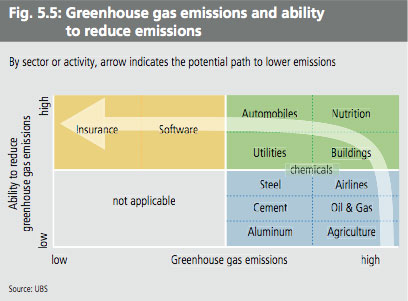
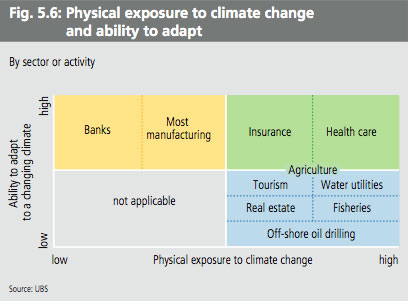
In terms of what this all means for investments, here’s a couple of interesting

charts from the report.

55.jpg

56.jpg

Posted in Econoblog | 3 Comments

Mortgage delinquencies: up!

Freddy Mac’s official statistics

notwithstanding, HSBC

is facing heavy weather in its US subprime operations:

The impact of slowing house price growth is being reflected in accelerated

delinquency trends across the US sub-prime mortgage market, particularly in

the more recent loans, as the absence of equity appreciation is reducing refinancing

options. Slower prepayment speeds are also highlighting the likely impact

on delinquency of higher contractual payment obligations as adjustable rate

mortgages reset over the next few years from their original lower rates.

As a result, says HSBC, its total provision for the year 2006 is likely to

exceed by 20% the $8.8 billion consensus estimate. Says Peter

Thal Larsen in the FT:

The worsening picture in the US helped push HSBC shares, which were the worst

performers in the UK financial services sector last year, to a 9-month low

on Thursday. By mid-morning they were down 231⁄2p at 907p, the lowest

level since last May.

Concerns about HSBC’s US mortgage book have triggered a sharp fall in

the bank’s share price, largely because the problems raised questions

about the bank’s ability to price correctly loans in the sub-prime lending

market.

Mike Verdin

at Breaking Views also piles on, but he has a few more numbers:

The bank has just added an extra $1.8bn in 2006 provisions for Household,

now HSBC Finance. That will drag the division’s pre-tax profits to about $2.3bn,

40% below previous estimates. It’s a big enough hit to deprive the whole group

of half its profits growth.

The bad news will certainly revive doubts about whether Household was worth

buying, even at the cut-price $14.2bn HSBC paid in 2003.

There seems to be $300 million missing somewhere, since profits seem to be

only $1.5 billion lower than expected, by these calculations. But putting that

to one side, can I just point out that HSBC’s subprime mortgage business is

still on track to make well over $2 billion in 2006? I appreciate that

2007 might be worse, with ARMs resetting and all that. But I have a feeling

that the subprime business is never going to lose money for HSBC –

the worst that happens is that its profits will be less spectacular than they

might have hoped.

Once again, there’s nothing indicating a massive credit crunch. I see increased

provisioning much the same way as I see wider MBS spreads: as an indication

that the market’s own cushioning systems are working pretty well.

Posted in Econoblog | Comments Off on Mortgage delinquencies: up!

Mortgage delinquencies: down!

Mike

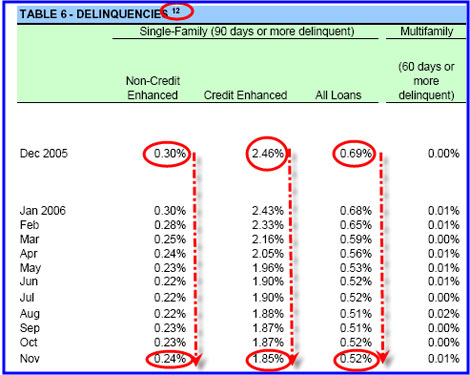
Shedlock (Mish) is convinced that mortgage delinquencies are rising, despite

finding this chart in a recent Freddie Mac report:

footnote12.jpg

That’s Mish circling the footnote: he’s convinced that the explanation for

the drop can be found in the footnotes.

Essentially Footnote # 12 says that if Freddie Mac renegotiates the terms

of the loan with someone who is delinquent then "voila" that person

is no longer delinquent. It seems to me that since about June of 2006 Freddie

Mac is struggling to keep this ponzi scheme afloat.

Does Mish have any evidence that Freddie’s renegotiation rate is increasing?

No. And in fact, if renegotiation rates were increasing, that would

be great news for the subprime mortgage market. A lot of the subprime

crunch can be explained by the fact that up until recently, underwriting

standards were getting ever looser, which meant that borrowers in trouble could

always renegotiate rather than default. But if Mish is right – and he

cites a WSJ article by Ruth

Simon in support of his thesis – then in fact many subprime borrowers

might well be able to refinance their way out of trouble, rather than falling

into default and foreclosure.

The Simon article also notes an increase in "short sales":

The rise in bad loans also is leading to a pick up in so-called short sales,

in which a lender allows the property to be sold for less than the total amount

due and often forgives the remaining debt. For the lender, the process can

be shorter and less costly than foreclosing, especially in a declining market.

For borrowers, it is a way to avoid having a foreclosure on their credit report.

If such things are allowed, they’re much better than foreclosure for both borrower

and lender; it’s good news that these things are increasing despite the boom

in mortgage-backed securitizations (which you’d expect might make short sales

more difficult).

It seems to me that the market is actually doing a very good job, so far, of

coping with developments in the mortgage sector. MBS prices for 2006-vintage

subprime loans are down, and underwriting standards are getting tighter, as

you’d hope and expect – but at the same time, overall delinquencies are

falling, not rising, and lenders are being constructive when it comes to relations

with distressed borrowers. A massive credit crunch is by no means a foregone

conclusion.

Posted in Econoblog | 1 Comment

Is Bob Shiller, housing bear, beginning to capitulate?

Robert Shiller has been predicting

a housing-market crash for as long as anybody, which is why his piece in the

Wall Street Journal today

is so interesting: it seems he’s not predicting a crash any more! Here’s the

final paragraph of his piece in the same space on August 30:

Unfortunately, there is significant risk of a very bad period, with slow

sales, slim commissions, falling prices, rising default and foreclosures,

serious trouble in financial markets, and a possible recession sooner than

most of us expected. Deterioration in that intangible housing market psychology

is the most uncertain factor in the outlook today. Listen hard and watch out.

And here’s his conclusion today:

We are left with a deeply uncertain situation, but one in which it would

seem that a sequence of price declines continuing for many years has some

substantial probability of happening. Traditional finance theory has trouble

reconciling even a semi-predictable sequence of price declines with basic

notions of market efficiency. The situation we are facing is a reminder of

the glaring inefficiencies and incompleteness of existing markets for residential

real estate, and may be regarded as evidence that institutional changes will

be coming in future years to fundamentally change the nature of these markets.

There’s the move from "significant risk of a very bad period" to

"some substantial probability" of "a sequence of price declines".

But there’s also a more philosophical shift: the first piece was often reprinted with a graph

which was clearly designed to show that the housing boom looked just like the

dot-com stock-market boom, and that the housing bust would not be dissimilar.

Now, Shiller’s saying that there’s nothing predictable about housing prices

at all, and that anything can happen:

With the failure of anyone really to predict today’s high home prices, one

may well conclude that no one can predict today whether a home-price bust

is coming, or whether the housing market will land softly, or even is poised

to resume its upward climb. That may be the right conclusion about our ability

to forecast the markets…

We haven’t seen really long and significant strings of price decreases in

the U.S. since the first half of the 20th century. The consecutive-year home-price

declines in the major U.S. cities from 1990-93 amounted to a total drop of

only 8% from peak to trough. More recently, we have seen sharp reversals of

sudden price drops. San Francisco home prices dropped 7% between 2001 and

2002, and then resumed a strong upward climb. London home prices dropped 5%

between 2004 and 2005 and then resumed an upward climb…

Of course, Shiller balances all his upside scenarios with downside scenarios.

But my point is that that balance was nowhere visible in August, when he was

nothing but downside scenarios. Why the change, I wonder?

Posted in Econoblog | 3 Comments

Q4 productivity surges, bringing 2006 back to normal

Dean Baker has been worrying

for a while

about US

productivity. Could it be that he needn’t

have worried?

U.S. productivity up sharply in 4th quarter

The productivity of U.S. workers rose sharply in the fourth quarter and labor

cost growth slowed, but future revisions may temper what at first blush is

good news for the inflation-wary Federal Reserve.

Nonfarm business productivity, a gauge of how much a worker produces per hour,

mounted at a 3 percent annual pace in the final three months of 2006, the

Labor Department said on Wednesday.

Wall Street had expected a 1.8% rise in Q4 productivity, not a 3% rise –

so you can see why David

Altig (who has lots of pretty charts) says that the report "makes it

easy to feel good".

On the other hand, it’s not that hard to feel bad if you try hard enough: Q3

productivity was revised down to -0.1%, which is frankly dreadful.

Here’s one of Altig’s charts. It seems that overall, 2006 (the yellow bars)

was pretty much in line with 2005 (the blue bars), while the final quarter of

2006 (the pink bars) was very strong indeed. So I’m not worrying too much.

Productivitycosts_2707

Posted in Econoblog | 1 Comment

More Wall Street climate change research: Citigroup’s top stocks

Yesterday I mentioned that Lehman Brothers had released a 145-page research

note on climate change. In response, a friendly reader sent me a similar report

from Citigroup (120 pages, dated January 19), and said that UBS might have one

out as well. Interestingly, the Citigroup report came out of the New York office

– and although it’s similar in structure to the Lehman report, it’s more

optimistic about the list of 74 companies which it says "seem well positioned

to benefit" from climate change-related trends. It strikes me, however,

that those 74 stocks – which I’ve summarized after the jump – are

overwhelmingly in the energy sector, one way or the other, and I’m sure that

quite a few of them would be anathema to "green" investors.

Continue reading

Posted in Econoblog | Comments Off on More Wall Street climate change research: Citigroup’s top stocks

The kind of subsidies Larry Summers likes

Larry

Summers doesn’t trust the judgment of the market, and thinks the government

should step in to intervene – by throwing money into R&D related to

the life sciences:

In today’s economy, an outstanding graduate of a leading business school

earns a substantially higher salary than a potential Nobel Prize winner graduating

with a doctorate in biology. Several years after graduation, the differences

are even more pronounced. It should not be a surprise that more talented young

people are not headed toward careers in basic research in the life sciences.

Michael

Mandel doesn’t trust the judgment of the market, and thinks the government

should step in to intervene – by throwing money into R&D related to

energy and the environment:

I won’t believe that the U.S. is serious about global warming until I see

the feds start throwing real money into R&D into energy and environment-related

R&D. After all, no matter what your political views, everyone can agree

that more R&D in energy and the environment can only be a good thing.

Isn’t interesting how Davos Man is perfectly happy with the idea of government

subsidies in the realm of scientific research, while being very, very uncomfortable

with the idea of government subsidies for, say, agriculture?

I’m not saying that either Summers or Mandel is wrong. But all this does strike

me a little bit as the overeducated shilling on behalf of the overeducated.

When the elected representative of an agricultural community asks for more life-science

research, or when the former president of the world’s foremost research university

asks for more agricultural subsidies, then I think we might be moving towards

consensus. But for the time being, I’m tempted to conclude that no one has quite

as much objectivity as they like to think they do.

Posted in Econoblog | 8 Comments

Felixsalmon.com redesigned

You might have noticed that felixsalmon.com looks a little different to how

it looked before. It’s still a work in progress, so do let me know if there’s

anything you want added or changed. The main new development is that there are

two new RSS feeds: this one

for the finance and economics blog entries which now comprise most of what I

write, and this one

for everything else. (Stay tuned for news of my visit to Del Posto!)

Many, many thanks to Stefan Geens of

Ogle Earth for all his fabulous

work on this site. Now it’s up to me to keep the content coming…

Posted in Econoblog, Not economics | Comments Off on Felixsalmon.com redesigned

Hoisted from comments: Why Bush is aiding Africa

Matthew Tubin comments,

apropos the large increase in bilateral overseas development assistance to Africa

under the Bush Administration:

Given the geostrategic competition that is emerging over oil (Nigeria, Chad

and even the Sudan) and influence in Africa between the United States and

China the substantial rise in bilateral ODA is not surprising.

This is mildly depressing: There was definitely a certain amount of hope at

the beginning of the post-cold-war era, that aid might become depoliticized

and targeted at poverty reduction rather than at geostrategic goals. Is Bush’s

aid to Africa simply a pleasant byproduct of his trying to keep increasingly-important

oil producers onside? And if so, does that bode ill for poverty reduction?

Posted in Econoblog | 3 Comments

Indonesia gets into the IP protectionism racket, endangers millions

Indonesia has signed a memorandum of understanding with Baxter Healthcare,

whereby Baxter will pay Indonesia for samples of the avian flu virus.

At the same time, Indonesia has stopped sending samples of the virus to the

WHO.

Baxter Healthcare says this development is not its fault, reports Donald

McNeil in the NYT:

A Baxter spokeswoman said the company had not asked Indonesia to stop cooperating

with the W.H.O. She added that the agreement under negotiation would not give

it exclusive access to Indonesian strains…

“Baxter has nothing to do with this,” she said. “Our role

is in developing vaccines. We’re not involved in ownership decisions.”

Some leading flu experts said they believed that Indonesia was acting on its

own, not understanding the ramifications.

Nevertheless, is Indonesia is standing firm, and seems to understand the ramifications

perfectly well:

A spokeswoman for Indonesia’s Health Ministry told Reuters yesterday

that the country “cannot share samples for free.”

“There should be rules of the game for it,” said the spokeswoman,

Lily Sulistyowati. “Just imagine, they could research, use and patent

the Indonesia strain.”

What’s going on? It seems that Indonesia has

a beef with the WHO:

The action underscored in dramatic fashion Indonesian displeasure over the

production of a vaccine from a strain of H5N1 the Indonesians sent to WHO.

WHO in turn sent it to Australian blood products company CSL to produce an

H5N1 vaccine, using a model of non-exclusive seed strain sharing with vaccine

makers now used for seasonal influenza. In this context, CSL did not notify

or ask permission of the Indonesians:

[The] news this week that the Australian pharmaceuticals company CSL had

developed a vaccine against the H5N1 bird flu virus was met with alarm by

Indonesian Health Minister Siti Fadillah Supari.

She says Indonesia is seeking intellectual property rights over the Indonesian

strain of the virus on which the vaccine is based.

In other words, it’s Indonesia, not Big Pharma, which is trying to

assert IP rights over viral isolates – something which is allowed, if

not usually practiced, under international IP law.

Concludes Tyler

Cowen:

If this entire episode does not convince you that IP law is out of control,

I don’t know what would.

Well yes, IP law is out of control. But it’s kinda ironic that it’s

only when a developing country starts trying to take advantage of it that big

multinationals like the WHO go whining about it to the New York Times.

Posted in Econoblog | Comments Off on Indonesia gets into the IP protectionism racket, endangers millions

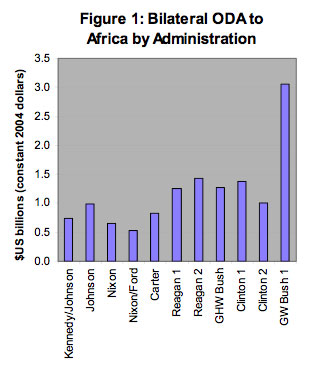
Development datapoint of the day

Todd Moss:

Under President George W. Bush U.S. assistance to Africa has sharply increased,

reaching $4.2 billion in 2005, nearly four times the level of 2000, and more

than twice the level of any previous administration.

Here’s the chart:

aid.jpg

(Via PSDBlog)

Posted in Econoblog | 4 Comments

In search of Sarbox defenders

Thomas Palley has a blog entry

today entitled "In Defense Of Sarbox". If only it were. In fact, it’s

more of an argument against anti-Sarbox arguments, some of which – Palley

is right – are pretty weak.

On the other hand, Palley comes up pretty short himself in terms of actual

arguments in favor of Sarbox. Is there any evidence that Sarbox has

made the stock market a safer place to invest, or has otherwise improved corporate

governance in the US? Does Sarbox’s rules-based approach to regulation really

have a more beneficial effect than a principles-based approach? Has there even

been the slightest attempt to run some kind of cost-benefit analysis on Sarbox?

If so, has anybody determined that the benefits outweigh the costs?

Sarbox strikes me as a classic "something must be done; this is something;

therefore this must be done" piece of legislation. I understand the reasons

why it was brought into law – but even if those reasons are very good,

that doesn’t mean Sarbox is a very good law. If we can reduce the harmful aspects

of Sarbox – and, by the Law of Unintended Consequences, there are sure

to be some harmful aspects of Sarbox – would that not be a good

thing?

Posted in Econoblog | 2 Comments

Lehman report on climate change

Lehman Brothers has released

a 145-page report (out of its London office, natch) entitled "The Business

of Climate Change". It’s a very solid book, with excellent analysis of

the facts as we know them, the prospects for how climate change might be mitigated,

and the role of both governments and the private sector going forwads.

Of course, it also looks for investment opportunities related to climate change:

although the downside is big, that doesn’t mean there aren’t companies who might

be able to position themselves to benefit from it, such as Renault, GE, Siemens,

uranium miners, and healthcare companies who can benefit from an increase in

respiratory diseases, such as GSK and AstraZeneca. The big picture, however,

is pretty gloomy: climate change is definitely bad for markets, it would seem.

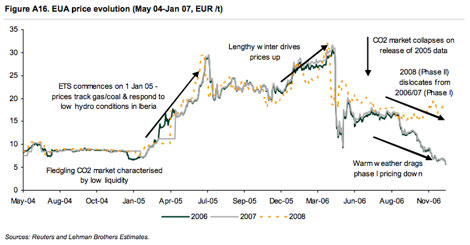
Here’s one interesting chart from the report, showing developments in the EU

carbon-emissions market (click for larger version):

carbonsmall.jpg

Posted in Econoblog | 2 Comments

What’s going on in the subprime mortgage market?

Deep breath… and… subprime mortgages! It’s almost impossible, but let’s

try to be dispassionate here, in contrast to the hyperbole of, say,

Nouriel Roubini.

First, where’s the risk? A huge chunk of it resides at mortgage insurers, two

of which just announced their merger.

These companies insure lenders against default on loans with more than 80% LTV,

and they seem to be doing reasonably well: the combined MGIC-Radian will be

worth over $10 billion. So there’s a pretty large equity cushion there before

any kind of systemic risk starts turning up.

Who else bears risk? Most subprime mortgage lenders operate as small shops

with credit lines from big banks, which securitize their loans almost immediately

and keep as little risk as possible on their own balance sheets. So the risk

is borne mostly by investors in mortgage-backed securities. Now read this,

about a new instrument designed to allow those investors to hedge the risk on

hybrid ARM mortgages, many of which are subprime. That’s good news: the more

hedging that’s allowed, the more that the risk ends up in the hands of people

who really want it, rather than with bond investors who have found themselves

stuck with underperforming paper. But there’s better news at the end of the

story: it turns out that essentially all of the risk in these MBSs is basis

risk and not credit risk. "Your main risk is not default," says one

banker in the article.

On the other hand, the riskiest tranches of subprime-backed MBSs are

gapping

out: to as much as 640 basis points over Treasuries. Even distressed players

are cautious, although maybe they just want the market to themselves:

“With subprime mortgages, you’re dancing on the edge of a razor

blade – they’re awful investments,” said John Devaney, CEO

of United Capital Markets, a specialist in distressed asset-backed securities.

What’s certain is that underwriting standards have tightened up enormously

since this time last year, which means that refinancing could be impossible

to find for many people whose teaser-rate loans are soon resetting. As Russ

Winter says:

Conditions are rapidly and clearly tightening for various “toxic”

mortgages used by marginal subprime buyers to purchase housing. This would

include the ability to refi into churned mortgages (same toxicity with a new

term) to avoid two and three year rate resets. This churning in the past has

enabled old mortgage pools such as the 2004 vintages to avoid these subprime

resets deadlines.

My problem is that so much of the information on this market is anecdotal.

I’m quite sure that various lenders have, at some point, offered all manner

of crazy mortgages with teaser rates or high LTVs or "stated income"

or negative amortization – and I’m equally sure that no lender managed

to roll all these different things into one product, as Nouriel would have you

believe.

My gut tells me that the main problem lies with the small brokers and origination

shops, many of which are closing. Barney Frank is ironically right when he says,

as quoted by Nouriel, that "you can’t just make a loan and then sell it"

to investors without any liability. If that loan turns out to be particularly

toxic, there’s a very good chance that the investors will make you take the

loan back. And the risk of being saddled with vast amounts of what the mortgage

industry charmingly refers to as "nuclear waste" is actually much

more of a deterrent to originators than any potential legal liability is.

What happens when the small origination shops close their doors? They’re not

taking back their nuclear waste any more, so it stays in the MBS vehicle, and

the spreads on the riskiest tranches – which used to be low on the assumption

that the worst loans could be put back to the originator – gap out.

Is this all making a bit more sense now?

My feeling is that the regulatory sideshow, with all its talk of "predatory

foreclosure" (which is not the same as predatory lending) is largely

irrelevant, an exercise in trying to shut the door to a stable which no longer

exists. Yes, some lenders do have large potential legal

liabilities, but I don’t think those liabilities are going to be remotely

big enough to pose a systemic risk.

In terms of individuals, then, a lot of people who took out subprime mortgages

when underwriting standards were lax, especially if they hoped to refinance

before their adjustable-rate mortgage reset, could find themselves in a world

of pain and foreclosure. In terms of the financial markets, on the other hand,

I don’t see a huge amount of risk. My guess is that there are already hedge

funds circling the subprime lenders, looking for opportunities to buy foreclosed

properties in bulk – something which would mitigate, to some degree, the

oversupply issue in the housing market.

In other words, let’s not throw ourselves off any bridges just yet.

Posted in Uncategorized | Comments Off on What’s going on in the subprime mortgage market?

The downside of Kenya’s economic strength: A stock-market bubble

Is economic stability always a good thing? Well, yes, of course it is. But

look at what’s happened to Kenya over the past few years, which have seen what

JP Morgan, in a recent research note (yes! a research note on Kenya!) calls

"broad-based, accelerated economic growth" – a crazy stock-market

bubble, with prices up 787% in dollar terms since 2002. The Guardian’s Xan

Rice has the story:

Stories of overnight wealth creation have created a huge frenzy for shares

from people who have never invested in the stock market before. When KenGen,

the state’s biggest electricity company, listed its shares last year, there

were queues at brokerages all over the country. Local media reported how small-scale

farmers were selling their cattle to buy the shares. Banks suddenly offered

"share loans" to people who had been considered unworthy of credit.

The KenGen offer was more than three times oversubscribed, and 70,000 people

were allocated shares. The price quadrupled on the first day of trading.

Both the strong economy and the soaring stock market date to the departure

of strongman Daniel arap Moi at the end of 2002, and his replacement by the

democratically-elected Mwai Kibaki, who is favored to be re-elected this year.

But now we can add a stock-market crash to all the other risks facing Kenya:

it borders the likes of Sudan and Somalia, for one thing, and of course there’s

the long-term toll of HIV/Aids. All the same, it seems that Kenya is much better

off now than it has been at any point in recent history – which is not

something which can be said of most sub-Saharan countries.

(Via Alphaville)

Posted in Econoblog | 1 Comment

Rules vs Principles in London

One of the most compelling parts of the Bloomberg-Schumer

report was the way in which it praised London’s principles-based approach

to financial-sector regulation over New York’s rules-based approach: "our

regulatory framework is a thicket of complicated rules, rather than a streamlined

set of commonly understood principles, as is the case in the United Kingdom

and elsewhere", it

says.

But London itself, it turns out, is struggling with the same problem, and not

only because of EU regulations which threaten to override and generally defeat

the purpose of the FSA’s principles. Ian

Morley, the CEO of Dawnay Day Brokers, writes in the FT today:

The problem is that the FSA approach seems to lack courage and consequently

may result in a craving for certainty and a move back to rules. The situation

may be compounded by the fact that many people in the trade associations (and

compliance departments) that deal with such issues are themselves of a legal

background and prefer black and white to grey.

The FSA’s proposed approach is not really helpful. For example, in point 2.3

of this paper, it states: "Industry guidance must not claim to limit

or affect the rights of third parties." That is an understandable legal

point but means anyone who does not like it can drive a truck through it by

suing; in effect, of little real value to the industry.

In other words, a principles-based approach is hard, and is likely to be continually

threatened by lawyers both within the financial services industry, who want

certainty, and within national and international legislatures. Given the degree

to which laws and lawyers control the US economy, it could be impossible to

develop a principles-based approach here.

Posted in Econoblog | Comments Off on Rules vs Principles in London

The value of education is not the same as the value of a degree

A few commenters have

said that they like the recondite stuff, so I did quite enjoy, earlier today,

throwing out a blog post talking about the CFTC and the CDS market and hazard

rates without bothering to spell everything out. Maybe I went too far –

but it just so happens that Arnold

Kling Bryan Caplan has a blog entry today which allows me to spell out some of the assumptions

I was making. Here he is on bankers:

Borrowers rarely default on their loans. Nevertheless, differences in default

rates have huge effect on rates of return. Suppose, for example, that two

lenders charge 3% interest, but one has a default rate of 1% and the other

has a default rate of 2%. The first lender has twice the rate of return of

the second. After all, when the first guy lends out $100, he gets back .99*$103=$101.97,

while the second only gets back .98*$103=$100.94.

Caplan’s rhetorical point is right, but his mathematics is wrong, unless the

recovery rate on the loans is zero. When a borrower defaults, the bank

doesn’t get back nothing. Usually the borrower has already repaid some principal

and interest, and nearly always the bank can sell the loan to a collections

agency for more cash still. Let’s say the lender with a 2% default rate has

a 50% recovery rate – then his total return is .98*103+.02*50=101.94.

See, I’ve doubled his return at a stroke!

Caplan goes on to talk about education in similar terms:

People often enroll for

a year of school, attend for a while, and then give up. And sometimes they

attend for a full year, but get failing grades. Either way, they spend most

or all of the cost of a year of education (including foregone earnings), with

little or no benefit. It’s analogous to defaulting on a loan – you spend the

resources, but don’t get the return.

The omission matters. If there is a 7% return to successfully completed education,

but a 3.5% default rate, the expected rate of return is 3.5% – half as big

as the naive estimate.

Once again, Caplan is assuming a recovery rate – the value of a non-completed

transaction – of zero, which is ridiculous. Obviously an extra year’s

education has some value. Let’s say that the 7% return to a successfully-completed

four-year degree is comprised of 1% for each year completed, plus an extra 3%

for the piece of paper you get at the end. Then if 3.5% of students "default"

– drop out after one year, say – then the expected rate of return

is 0.965*1.07+0.035*1.01=1.0679, for a 6.8% return.

It’s important not to write off anything completely – either loans or

students.

Posted in Econoblog | 2 Comments

Development idea of the day: Vocabulary enhancement

Jean Rogers waxes Wittgensteinian:

Arabic, for example, can convey business, merchant, etc., in a word, but

it takes a lengthy explanation to capture ‘entrepreneur’. After

the recent success in working with Ministries and linguistic experts to invent

an Arabic word for “corporate governance”, which also did not

exist until the recently approved “hawkamat ash-sharikat”, CIPE

and its Egyptian partners are now raising the issue of creating Arabic terminology

that captures the breadth of meaning in entrepreneurship. This is really a

process of concept formation. It can be lengthy and seem esoteric, but it

is essential to moving forward on these issues — if there is no common

word or language for a topic, then the concept itself does not adequately

exist in society.

As something of a Wittgensteinian myself, I’m attracted by the implied argument

here: all of our thoughts can be expressed in a public language, and if an important

word does not exist in a given society’s language, then the idea associated

with that word can’t really take off an that society. If there is no word for

entrepeneurship in Arabic, then in some important sense there is no

entrepeneurship in Arabic-speaking societies. Wow, that sounds racist, doesn’t

it? I think I need to talk to a Proper Philosopher before I take this any further.

Any suggestions of Philosophy of Language types who might be able to help?

Posted in Econoblog | 4 Comments

Why is it so hard for business travelers to enter the US?

Sara

Welch of the NYT has been talking to the State Department about the difficulty

of getting visas to enter the US:

Changes added after Sept. 11, 2001 “came so quickly that we weren’t

as efficient as we wanted to be,” said Maura Harty, assistant secretary

for consular affairs in the State Department. “But we now have an expedited

service for business travel visas in place in every U.S. consulate and embassy

in the world.”

Ms. Harty said that only 29 percent of the respondents in the Discover America

Partnership survey had applied for a visa in the last 18 months. “I

urge people who haven’t applied for a visa in a few years to come back,”

she said. “Try us, you’ll like us.”

I’m sorry, I should have warned you to put your coffee down before reading

that, so you didn’t spew it all over your keyboard.

Welch herself, of course, finds no difficulty in finding all manner of people

who have tried their local US embassy, and not liked the experience one bit:

Luis Gómez Hernández, a meeting planner in Ecatepec de Morelos,

Mexico, said he used to bring groups of 30 to 40 businesspeople to the United

States four times a year, but stopped in 2003 because of the difficulty in

obtaining visas. It took up to three months for applicants to get an appointment

at the United States Embassy or a consulate and at least two more weeks to

obtain the visa, “and in a group of 40, only 3 or 4 would get them,”

he said.

I’m sure there are some business trips which can be planned on three months’

notice, but I’m equally sure there aren’t many. One of those trips is the Consumer

Electronics Show in Las Vegas – but this year, stories were legion of

overseas attendees not being able to come, especially from China, for failure

to be able to get a visa. And it’s hard to argue with the numbers:

In November, Euromonitor International, a London-based market research firm,

found that the number of business arrivals in the United States fell 10 percent

from 2004 to 2005, while the number of such arrivals in Europe grew 8 percent

over the same period.

Clay Risen,

at TNR (HT: Gross),

also has numbers, altough they have a slightly more dubious provenance: he cites

only "one industry group" as saying "that, between July 2002

and mid-2004, border restrictions cost U.S. businesses $30 billion". He

sees which way the wind is blowing:

The United States must make a decision. Much of the world believes that the

benefits of open borders trump the threats. We obviously feel differently

but have yet to recognize the costs involved. But, by tightening our borders,

we risk being passed over by a globalizing, integrating world…

The economic consequences are obvious enough: Why headquarter a company in

New York if its international employees, let alone clients, can’t get there?

As a foreigner who’s spent a great deal of time in the US (I’ve had, in my

time, not only tourist waivers but also a B visa, two H visas, an I visa, a

J visa, "advance parole", and – finally! – a green card),

and also as a New Yorker with many foreign friends, I know full well how unpleasant

the whole immigration palaver can be.

And the fact is that it’s simply untenable these days to ask a Chinese CEO,

who’s jetting all over Asia on a regular basis, to surrender his passport for

two or three weeks while maybe or maybe not getting a visa to visit the US.

What’s more, such procedures do absolutely no good whatsoever in terms of protecting

US homeland security.

My wonder is that the business lobby hasn’t made this much more of an issue.

But the more press we can get on this idiotic state of affairs, the better.

Posted in Econoblog | 2 Comments