
Help me change my mind on mortgages!

Brad Setser asks whether I’ve changed my mind about the mortgage market in the wake of today’s data and the market’s reaction to it. I haven’t really looked at either yet, and tomorrow I’m going to be spending the day at Disneyland. So do please use the comments section here to give me all the datapoints I need. Then I’ll answer his question on Thursday, probably.

Posted in Econoblog | 7 Comments

Can the amount of alpha keep up with the number of hedge funds chasing it?

Whither alpha? Alexander Campbell, in fine form, officiates at a debate between David Rowe and Barry Schachter. All of them, refreshingly, reject the idea that there’s some limited supply of alpha, and that as the number of hedge funds and others chasing it increases, there will be less to go round for the average hedge fund manager.

Campbell’s blog entry is a fine introduction to the debate. My view is that alpha comes from global imbalances — things like currency pegs which cause distortions in the market. Right now, there are more global imbalances than ever before, which implies to me that there should be more alpha than ever before.

Specifically, I think there’s a big delta in the financial markets right now. (I think delta is the right word…) You have the hedge funds and private equity types at one end, who are all about making money and generating alpha. And then you have the world’s governments at the other end, who are all about accumulating reserves and who really don’t seem to mind very much if they underperform the market. So long as this state of affairs continues, both can be very happy.

(One extreme example of this is Russia, where the government sold off its patrimony at fire-sale prices to ultracapitalist investors. Lots of alpha for the investors there — and the Russian people are the losers.)

More generally, there seems to be more money chasing low-risk fixed-income investments now than at any point in history — this is why private equity is making so much money by issuing vast amounts of cheap debt. There are lots of investors who want risk-free debt, and lots of hedge funds, investment banks, and the like who can make money off the fact that issuing debt can generate higher returns for equity investors.

So count me in with the people who think there’s likely to be more than enough alpha to go round for the foreseeable future. That said, of course, there will always be a lot of hedge fund managers who think they’re better than they actually are, and who end up just giving money away to the managers who really generate alpha.

Posted in Econoblog | 1 Comment

Simple bond mathematics

Dean Baker doesn’t seem to quite understand how the inverse relation between price and yield works in practice:

Back in the summer of 2003, the interest rate on the 10-year treasury bond bottomed out at 3.05 percent. Today, it stands at around 4.6 percent. This means that the bonds China held back then have lost approximately one-third of their value. (The price of the bond is inversely proportional to the yield. The actual calculation of the bond price is a bit more complicated, since it does matter when they reach maturity.) If the yield on 10-year treasury bonds rises back to its avearge rate for the decade of the 90s (6.8 percent), then the value of the bonds would drop by another 30 percent.

Let’s go to the SmartMoney bond calculator, and look at the price of a 10-year, 5% bond. (Feel free to use any other maturities or coupon rates: the results won’t be all that different.)

If the yield is 3.05%, the price is 116.6.

If the yield is 4.6%, the price is 103.5. That’s a drop of 11.2%, which is nowhere near “approximately one-third”.

If the yield is 6.8%, the price is 87.2. That’s a drop of a further 15.7%, which is nowhere near “30 percent”.

But of course those drops overstate reality quite a lot. Because between summer 2003 and now, there have been 7 coupon payments, totalling 17.5 cents. So if you bought that bond at 116.6 in 2003, it might be worth only 103.5 today, but you will have received 17.5 cents in coupon payments along the way — which, added to the value of the bond, brings you to 121, or a 3.7% net gain.

Of course, there are lots of extra variables involved, including the fact that a bond’s maturity goes down over time. But I really don’t think it’s possible for a US Treasury bond to lose two-thirds of its value, as Baker implies that it can — especially if you take coupon payments into account.

Posted in Econoblog | 2 Comments

Felix’s high-powered bedfellows

I was quoted in an article by Alen Mattich of Dow Jones this morning. I certainly can’t complain about the company I’m keeping:

Some like James Grant of the respected industry newsletter, Grant’s Interest Rate Observer, have been warning about the wider implications to the credit markets of rising default rates. Collateralized debt obligations, made up of repackaged mortgages and sliced into various grades of creditworthiness, are likely to see defaults higher up the credit scale than investors suspect, according to Grant.

Not everyone is convinced.

Felix Salmon, an economics blogger, points out that you need to separate out the companies making subprime mortgages from the mortgages themselves. While equity in a number of subprime originators has collapsed, it doesn’t follow that debt structured from these pooled mortgages will implode, he says.

That’s the way the Federal Reserve seems to see things. Subprime doesn’t represent a systemic risk to the financial sector. The problem will stay localized.

So there you have it. Me and the Fed, we’re like this.

Posted in Econoblog | 2 Comments

Does Robert Parker’s ego know no bounds?

I’m reading Elin McCoy’s book The Emperor of Wine, on Robert Parker. Here’s a chunk of page 153, as grabbed from Amazon:

Parker

I like that “Parker interpreted”. Remember that this is the 1990s we’re talking about here: How much of an ego does a man need to interpret a “sly introduction” as a winemaker essentially pimping out his own daughter for a higher score?

Posted in Not economics | 1 Comment

The Frankfurter Allgemeine’s overwhelming beauty

What’s the most boring newspaper in the world? There are many, I’m sure, but I know a lot of people who would put the Frankfurter Allgemeine at the top of the list. Well, the Society for News Design has some news for you: it’s just announced that the Sunday version of the Frankfurter Allgemeine has won its award for the best-designed newspaper of the year.

From classically formed fonts to page-dominating visuals, the Frankfurter Allgemeine exudes beauty, overwhelming beauty. This is a masterfully designed, visually intelligent publication. Turning the pages of this paper — with its great expanses of white — is like walking through a gallery that’s filled with sophisticated photography, sensuous illustrations, and damn-near-perfect typography. There are surprises and special treats, too. Like graphic novel treatments and illustrations on the TV page. Clearly aimed for an educated audience, this paper is filled with nuance. It doesn’t shout — it illuminates.

Wow!

My only question: Is the Frankfurter Allgemeine Sonntagszeitung a completely different paper from the daily version, like the Times and the Sunday Times in England? Or is it just a Sunday version of the same paper?

(Via)

Posted in Not economics | 1 Comment

LA Times shows how to write sensibly about the housing market

I’m in California this week, which is why posting is rather light: the beach is rather more attractive than squabbling over mortgage-backed bonds. But of course California is the poster child for the housing market boom and bust, and so one can’t get away from it entirely — and the LA Times leads this morning with a story headlined “As sub-prime lender implodes, housing shudders“. It also has another story, headlined “Home woes don’t hurt most bonds“.

It’s rare that I go out of my way to praise newspaper articles which have essentially no new information in them, but in this case both articles are clear, fair, and informative. The lead article explains that New Century Financial, which is based here in Orange County, “skidded closer to bankruptcy Monday, stoking fears that the mortgage industry’s woes could further damage a sluggish housing market.” It went on to explain that with refinancing options being taken away from them, many subprime borrowers are defaulting and could end up in foreclosure. With less demand from subprime buyers and more supply from foreclosures, the housing market is certain to be adversely affected to some degree. But the story also has a quote from Pimco’s Scott Simon, saying that the MBS market — which is by no means the same thing — “should be just fine”.

The bond-market article explains that subprime MBSs might be performing very badly at the moment, but that there’s no sign of a more generalized flight to quality, nor any risk of a more generalized credit crunch.

So bravo to the LA Times, and its journalists David Streitfeld, E. Scott Reckard, and Tom Petruno. I’ve seen more than enough overheated scaremongering in recent months to know that writing sensible articles like these is harder than it looks.

Posted in Econoblog | Comments Off on LA Times shows how to write sensibly about the housing market

Is there a looming crisis in the mortgage market?

The world is full of people desperate to know what Gretchen Morgenson thinks about the market in mortgage-backed securities, or MBSs. The problem is that her column last week on the subject is hidden behind the Times Select firewall. So we can all be very grateful that she has now rewritten it, at even greater length, and republished it under a “News Analysis” slug. (No firewall!) The headline? “Crisis Looms in Market for Mortgages“.

Or, you know, we can ignore it, on the grounds that Morgenson adduces no evidence whatsoever that any crisis is looming at all. For one thing, she doesn’t seem to understand the difference between two entirely different types of investment: equity in subprime mortgage originators, on the one hand, and debt backed by pools of subprime mortgages, on the other. It’s certainly true that originating subprime mortgages does not seem to have been a very good business to invest in over the past year or so. But Morgenson never connects the dots and explains why that means that the market in subprime MBSs is likely to implode.

Morgenson also talks at great length about the enormity of the market in MBSs, but never stops to point out that the vast majority of that market is in bonds issued by Fannie Mae and Freddie Mac, and that no one has any worries whatsoever about those securities crashing.

Here’s a bit of typical overheated prose:

Wall Street firms and entrepreneurs made fortunes issuing questionable securities, in this case pools of home loans taken out by risky borrowers… Regulators stood by as the mania churned, fed by lax standards and anything-goes lending.

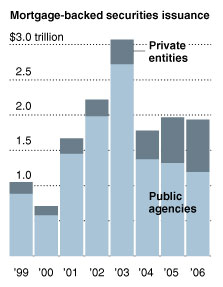
IssuanceBut here is Morgenson’s own graph, showing the practical effects of that churning mania: MBS issuance more than $1 trillion lower in 2006 than it was three years earlier. It’s very hard to look at this graph and see any evidence of a bubble: rather, it seems that private-sector MBS issuance has been rising only to make up for a large drop in issuance from Fannie and Freddie.
Morgenson’s most substantive problem is that there’s a ticking bomb in the MBS market, in the form of investors failing to mark their securities to market. First she says they don’t, then she says they do, and then she says they don’t — let’s see if you can make more sense of it than I can.

Owners of mortgage securities that have been pooled, for example, do not have to reflect the prevailing market prices of those securities each day, as stockholders do. Only when a security is downgraded by a rating agency do investors have to mark their holdings to the market value. As a result, traders say, many investors are reporting the values of their holdings at inflated prices…

Years ago, mortgage-backed securities appealed to a buy-and-hold crowd, who kept the securities on their books until the loans were paid off. “You used to think of mortgages as slow moving,” said Glenn T. Costello, managing director of structured finance residential mortgage at Fitch Ratings. “Now it has become much more of a trading market, with a mark-to-market bent.”…

Interestingly, accounting conventions in mortgage securities require an investor to mark his holdings to market only when they get downgraded. So investors may be assigning higher values to their positions than they would receive if they had to go into the market and find a buyer. That delays the reckoning, some analysts say.

Of course, Morgenson is missing two crucial points here. The first is that here simply isn’t a market in most MBSs tranches — that’s why so much of the recent activity has concentrated on MBS indices rather than the underlying securities. The liquid, mark-to-market activity that Costello is talking about is entirely in Fannie and Freddie bonds, not in individual tranches of securitized subprime mortgages. You can’t mark subprime MBS tranches to market daily for the very good reason that most such tranches simply don’t trade on a daily basis.

And the second point is that if you actually look at the prices for those subprime MBS tranches when they do trade, guess what? They haven’t actually fallen much in price at all. If investors were marking to market, it really wouldn’t make much difference. As Josh Rosner told me, the problem is not that existing MBSs are likely to default or drop in price. A default is much like a prepayment, from an investor’s point of view, so investors only really care about default rates when they start approaching prepayment rates. And they’re nowhere near those levels.

Anyway, here’s my favorite bit from Morgenson’s article. Before you read it, ask yourself what a scary loan-to-value ratio for subprime mortgages would be. 125%? 100%? 95%?

The rapid rise in the amount borrowed against a property’s value shows how willing lenders were to stretch. In 2000, according to Banc of America Securities, the average loan to a subprime lender was 48 percent of the value of the underlying property. By 2006, that figure reached 82 percent.

There you go: 82%, in the year universally considered to be the laxest year in the history of subprime mortgages. Now do you understand why investors aren’t particularly worried about default?

Invidiously, Morgenson even hints darkly at nefarious conflicts of interest at the ratings agencies, saying that they might be soft-pedalling downgrades to save their own hides. I don’t think they are. Mortgage pools are designed to be able to withstand a temporary drop in house prices or rise in default rates. I look at the tiny number of MBS downgrades and take comfort in it. I’m perfectly happy to concede that subprime mortgage originators who were active this time last year are going to be in a lot of trouble now. But I’m nowhere near convinced that there’s any real problem in the market for the securities based on the mortgages they originated.

Posted in Econoblog | 27 Comments

Rent vs buy redux: Is buying a useful commitment device?

One of the things l love the most about having a blog is the way in which I often bring up a subject and then get a stream of commenters — many of whom know much more on the subject than I do — really move the topic forwards.

A prime example is my post from Friday on rent vs buy calculations, itself prompted by a previous comments stream. My back-of-the-envelope calculations only looked at the position after one year, but a number of commenters have looked out much further than that, and one even did a Monte Carlo simulation! What’s more, my commenters didn’t just pull numbers out of thin air, as I did, but gave me some very useful real-world datapoints.

Nicholas Weaver put a spreadsheet online for one property in California, assuming rent stays constant starts at $1325 a month and rises by 3% a year, and using a real-world purchase price of $400,000. Upshot? Renting was a lot cheaper. Now, he says, his rent is $1675, for a house worth more than $600,000.

And RichB, in England, came up with an even more elaborate spreadsheet for a UK place listed at ߣ795,000 which is renting for ߣ2750 per month. (Remember that the UK abolished mortgage-interest tax relief, with no appreciable effect on housing prices.) He assumed upkeep costs of 0.5% of the purchase price (about ߣ330 per month), and rent rising at 3% per year. Again, renting was a lot cheaper than buying: if you held the house for 10 years and prices rose by 6% per year annualized that whole time, you’d still be ߣ115,000 worse off by buying.

But. Buying is what economists like to call a “commitment device” — one of those situations where you can make yourself better off by reducing the number of options available to you. RichB, for instance, makes this crucial assumption:

The difference between the monthly mortgage payment and monthly rent, as well as all up front costs, are assumed to be invested at 5.5% (with a 40% tax rate).

This strikes me as both reasonable, in terms of the rent vs buy calculation, and also, at the same time, utterly unrealistic. People stretch themselves and bend over backwards and perform all manner of other metaphorical financial calisthenics to make their mortgage payments every month so that they can continue to live in their home. People buy homes at the outer edge of the affordability envelope because they value all that space and light and convenience in terms of commuting, and so on and so forth. No one will have the same kind of real and emotional attachment to a monthly plan involving paying a certain amount of money into a savings plan yielding 5.5% per annum. In other words, the difference between rent payments and mortgage payments, if the mortgage payments are higher, is not likely to get invested: it’s likely to get spent.

So maybe there’s a good reason why people buy houses even when it would be mathematically cheaper for them to rent: it’s a forced savings device. All that money they save and scrounge up for the down-payment; all that extra money they find every month for a mortgage payment which they wouldn’t bother doing if they were renting — it all goes towards building up equity in a very valuable home. Theoretically, they could do the same amount of savings with money rather than with property, but in practice very few people ever do. To take RichB’s example, after 10 years someone who bought the house would have hundreds of thousands of pounds of equity in his house. While someone renting the house would have memories of great holidays and meals at restaurants, and would have a spiffier wardrobe, but would have much less total net worth.

Posted in Econoblog | 12 Comments

Why playing the lottery can be a rational thing to do

Benedict Carey finds a 2000 paper by Lloyd Cohen, which is well worth rediscovering. From the abstract:

The central purpose of this paper is to show that lottery play is not economically irrational and uninformed. The paper presents a theory of lottery tickets not as misguided inputs into wealth production as some critics believe but as valuable inputs in creating a sense of open-ended possibility, specifically the possibility of escaping one’s current life by acquiring great wealth.

Cohen has some interesting ideas surrounding the idea that lotteries are a regressive tax:

The regressivity or progressivity of the tax implicit in the monopoly rents collected by the state turns on the question of whether it is the universe of lottery players who pay the tax or just the winners. Imagine that $10,000,000 is wagered at $10 a person from 1,000,000 people and a single winner is paid $4,000,000 and the state keeps $6,000,000 as a tax/rent. Who has paid this $6,000,000, the 1,000,000 purchasers or the one winner?

It’s certainly true that people who play the lottery are almost certain to lose money. But Cohen’s insight is that playing the lottery is not therefore automatically irrational. People like me love to calculate the expected gain or loss from buying a lottery ticket: back in 2005 I wrote a little post on the subject at MemeFirst. A commenter then came along:

Personally, I can afford a dollar (or equivalent) every now and then to keep the dream of international playboyery alive.

In other words, as Carey puts it:

Like a throwaway lifestyle magazine, lottery tickets engage transforming fantasies: a wine cellar, a pool, a vision of tropical blues and white sand.

People don’t invest the money they spend on lottery tickets. They spend it, and get those transforming fantasies in return. Cohen even manages to put this in economic terms:

In all things economic, there is a diminishing marginal something. In the case of ” belief in possibilities,” the most initially steeply diminishing marginal utility is that of probability. That is, one requires some real finite probability to support a belief in the possibility of escape, and while the more the better, the falloff in gain from additional probability is precipitous. On the other hand what is indispensable is a scenario that could conceivably be realized that satisfies the conditions of the hoped for fundamental transformation of one’s life.

Cohen even manages to use his theory to explain not only why one would expect the poor to play the lottery more than the rich, but also why one would expect the middle-aged to play the lottery more than the young, and so on. It’s all rather appealing — as a work of theory.

Does Cohen’s argument stand up against the kind of people who would abolish lotteries? It’s certainly true that those people rarely stop to spend much time considering the real benefit that lottery-players obtain from merely buying tickets even if they don’t win the lottery. Economists, who like to assume that individuals are economically rational (more or less), will move quickly to the conclusion that playing the lottery can therefore be a rational thing to do. Such a conclusion has the pleasant side effect of avoiding the opposite conclusion, which is that poor people are stupid and should be protected from themselves.

On the other hand, the money which poor people lose spend on playing the lottery is large enough to really make a difference to the communities in which that money is lost spent. Maybe the solution is for local lotteries to be set up, with the help of insurance companies who will insure against a tiny chance of an enormous payout. Lotteries have historically been organised on a statewide or nationwide basis because they payouts have historically had to come directly from ticket sales. But it’s very easy to envisage a lottery with an enormous jackpot ($100 million, say) which never generates anywhere near that amount of money in revenues. If such a lottery spent all its profits in the neighborhoods where the lottery tickets were bought, lotteries would be more defensible.

Posted in Econoblog | 16 Comments

Rent vs buy calculations

There’s an interesting debate going on in the comments section of yesterday’s housing post about the relative costs of buying and renting a house.

David Sucher is in Seattle:

We have had a great discrepancy between buying & renting since the early 1970s i.e. it has always been far more expensive to buy than to rent and very few (like show me one and I’ll buy it) residential properties ‘cash-flow’ at a 20% down purchase. But people do buy when they can afford it. As markets are not likely to be wrong over such a long period of time, my conclusion is that the psychological value of owning is simply worth the extra $$$ and responsibility.

And Nicholas Weaver responds:

In terms of raw cash flow, buying costs more than renting under ALL conditions I’ve looked at. Even in a “sane” market, on a cash-flow basis, buying is expensive.

But notice that for “cheaper then renting”, I only consider lost-money (interest, tax, HOA) as ‘cost’ for buying, the rest of that huge mortgage payment you should see again, evenutally, so I don’t consider that a cost.

Well, maybe not all conditions. In fact, I’ve been doing some back-of-the-envelope sums and have come to the conclusion that buying is likely to be cheaper than renting. Take the example of someone who can buy their house with cash, and who doesn’t consider themselves a particularly astute or successful investor. Let’s say that the house costs $1 million, that renting it would cost $5,000 per month, and that property taxes and other costs of ownership are $500 per month. Let’s also say that the interest rate on cash deposits is 5%.

Do you buy the home or rent it? If you buy it, after one year you are down $6,000 in taxes and other expenses, so the cost of buying is $6,000. If you rent it, after one year you are up $50,000 in interest on your $1 million, and down $60,000 in rent, so the cost of renting is $10,000. Then come taxes. If you rent, your rent payments aren’t tax deductible, but your interest income is taxable. So if you pay 30% tax on that $50,000 interest income, that puts you another $15,000 in the hole. Meanwhile, if you own, those property taxes are tax deductible. Buying just became significantly more attractive still. Then, of course, you’re better off still if the value of your house appreciates over the course of the year.

How does a mortgage affect these calculations? Let’s say that you have $200,000 for a down payment, and the rest of the purchase price comes from a 6% mortgage. Now, if you buy, you’re still down $6,000 in property taxes, but you also need to pay 6% interest on an $800,000 mortgage, which is another $48,000. Total cost of buying: $54,000, all of which is tax-deductible. If you rent, you pay $60,000 in rent, while earning $10,000 in taxable interest income. Total cost of renting: $50,000, plus another $3,000 in taxes. You’re still better off buying, certainly if there’s any kind of nominal house-price appreciation going on.

Of course, if you tweak the numbers, you get different results. Crucially, if you can invest your money and get a higher return than prevailing mortgage rates, then it becomes much less attractive to buy. But no one would lend money to homeowners if it was that easy to get a higher return elsewhere.

In my example, how much would that house have to cost before it became cheaper to rent? Let’s say the house was $1.2 million, and we still had that 20% down payment. Cost of buying is $63,600, tax-deductible; cost of renting is $52,000 after taxes, which is over $74,000 before taxes at a 30% tax rate. How about $1.5 million? Cost of buying is $78,000, tax-deductible; cost of renting is $49,500 after taxes, which is about $71,000 before taxes. Finally, it’s cheaper to rent than to buy — assuming, of course, that house prices have zero nominal appreciation.

I’m not intimately connected with the housing market, but my gut feeling is that it’s not easy to find $1.5 million houses renting for $5,000 per month. Then again, depending on what state you’re in, the property taxes on a $1.5 million house might well be vastly greater than $500 per month, and I’m unclear on the extent to which property taxes get passed through into higher rents.

Still, this is all highly theoretical; I’d love to see some real-world calculations.

Posted in Econoblog | 16 Comments

How much of Harvard’s black population is descended from slaves?

Aditi Balakrishna, in the Harvard Crimson, looks at the reasons why recent immigrants are overrepresented among black Harvard students:

“In practical terms, immigrants, no matter what color they are, are a highly selective group of people,” [said Camille Z Charles, who wrote the study on which the article is based].

“At some level, there will always be an immigrant-native difference because you only get the most motivated, best prepared, cream-of-the-crop set of immigrants,” since their families have had to leave their native countries and start anew in the United States, she said.

Greg Mankiw, however, picks up the story and puts a very different spin on it:

It has been widely noted that Senator Barack Obama, while black, is not a descendant of slaves. Instead, his father was a recent immigrant from Kenya. An article in today’s Harvard Crimson suggests Obama (Columbia undergrad, Harvard Law School) is representative of a common story.

It’s true that most African-Americans are descendants of slaves. But it’s not true that black immigrants are not descendants of slaves, as Mankiw implies. Many black immigrants come from the Caribbean, and Caribbean blacks are just as much descended from slaves as American blacks are. A good proportion of African immigrants are descended from slaves, too. Where else might black immigrants come from? If the UK, then they’re probably descended from slaves, since they’re likely of Caribbean heritage. You get the picture. It might well be the case that Obama is not a descendant of slaves — in fact, he’s a descendant of slave-owners. But you can’t extrapolate from his case to all the other black immigrants at Harvard.

Posted in Econoblog, Not economics | 3 Comments

Private equity is the new banking, if the Rothschilds are any indication

Two interesting stories today: a big profile of Nathan Rothschild in the NYT, saying that his buy-side activities might make him the richeset Rothschild ever:

In five short years, the man in line to be the fifth Baron Rothschild is close to becoming a billionaire through a web of private equity investments in Ukraine, Eastern Europe and most significant, his partnership stake in Atticus Capital, the fast-growing $14 billion hedge fund.

Meanwhile, Nathan’s father is making similar bets:

Lord Rothschild, the veteran City figure who is part of the banking dynasty, has agreed to back Darwin Private Equity, a new ߣ250m private equity group founded this year by a trio of youngprofessionals from CVCCapital and Permira.

RIT Capital Partners, the publicly traded investment trust that is 17 per cent- owned by Lord Rothschild, will take a “significant minority” stake as well as making a ߣ50m cornerstone investment in its maiden fund of up to ߣ250m.

And, notes the FT, the other branch of the (English) Rothschilds is also heavily involved in private equity: Sir Evelyn de Rothschild and his wife own private equity shop EL Rothschild.

Meanwhile, NM Rothschild, the bank, has a new rival, known as JNR, which is owned by the 35-year-old Nathan Rothschild, and, according to the NYT, “run by a small crew of investment bankers”. But JNR isn’t an advisory shop like NMR; rather, it looks very much like a gussied-up investment firm. Why make millions on fees when you can make billions in investments?

Posted in Econoblog | Comments Off on Private equity is the new banking, if the Rothschilds are any indication

Barnes on England vs France

Julian Barnes on That Sweet Enemy, a book about Anglo-French relations over the centuries:

Although public opposition to the Iraq war in Britain is high, it would take a lot more fair-mindedness than most British (or Americans) are capable of for them to utter, instead of “Blair [or Bush] was wrong,” the simple words “Chirac was right.”

The Anglophone reader is made forcibly aware that, even at the basic level, each supposed fact and understanding about our conjoined cross-Channel history has an equal and opposite counter-fact and counter-understanding. Did the British hold the key German attack on the Somme in the spring of 1918, and then make the thrust that ended the war? Or did they collapse in shameful panic and have to be rescued by French reinforcements? Was Dunkirk an example of British heroism which, by prolonging the struggle, gave France hope and eventually liberation? Or was it a further demonstration of the traditional British willingness to fight to the last Frenchman and then decamp, leaving their ally to its fate?

It’s a great review, well worth reading. And the final word — well, I shan’t ruin it for you, but here’s the setup:

For all the high military and diplomatic dramas described by the Tombses, the one I would have most enjoyed witnessing occurred during an official visit to Britain by General de Gaulle. The regular assassination attempts on the French President meant that he always traveled with a bag of his own blood, in case a sudden transfusion was required. When he arrived at Harold Macmillan’s house in Sussex, his entourage handed the blood to Macmillan’s cook, and instructed her to put it in her fridge…

Posted in Not economics | Comments Off on Barnes on England vs France

How convincing is Roubini’s argument that the housing recession will only get worse?

Nouriel Roubini today blogs his new paper which argues that the US housing recession is far from bottoming out. In truth, however, the paper is really just a longer-than-usual blog: it generally asserts at least as much as it argues, and is written more colloquially than formally. Not that there’s anything wrong with that.

There are basically two parts to the paper, which attempts to try to work out how much longer the current housing recession will continue. The first takes a basically chartist approach, looking at previous housing recessions and assuming that the present one will be similar. The second takes more of a supply-and-demand approach.

The problem is that a chartist approach is never particularly convincing, and certainly not in this case, where the charts themselves seem to disprove any attempt to demonstrate that the housing market has remotely predictable cycles. And the supply-and-demand approach has two big problems: it doesn’t explain housing-market movements in the past, and it basically assumes its own conclusions.

It’s also worth noting that nowhere in the paper does Roubini talk about housing prices, as opposed to housing construction. His definition of a housing recession is nowhere made explicit, but seems to be based on housing starts, and is certainly not based on house prices. So even if he’s right about the future of the housing recession, that doesn’t necessarily mean that prices will go down.

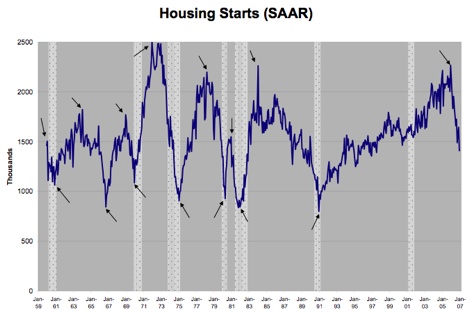
A few specifics, for those who care. First, his main chart:

Roubini

A large amount of Roubini’s analysis comes from looking at this chart and performing all manner of inductive feats on it. He looks at the size of the drops between arrows, the amount of time elapsed between them, and so forth, and then makes predictions as to the position of the next up arrow based on those old datapoints.

This last housing recession lasted 12 months so far. The average duration of the previous seven housing recessions was 32 months. Housing starts are down (as of January 2007) 38 percent from the January 2006 peak, but only 16 percent from their moving average peak. In past housing recessions starts bottomed, on average, after a 51 percent drop form the peak, and after a 37 percent drop from the moving-average peak. Thus, the past housing recession episodes tell us that housing starts could fall another 13 percent from their actual peak (or another 21 percent from their moving average peak) and that it could take another 21 months to reach that bottom.

Is all this of any use to anybody? If you’d tried that technique with the last housing recession, which lasted 84 months by Roubini’s calculation, you’d have been well off base: the average of the previous six housing recessions was just 23.5 months. And you’d have been even more off base if you’d tried to predict the length of the last housing upturn, based on the length of previous housing upturns.

It does seem to me that Roubini is looking at an extremely noisy series and trying desperately to find patterns in that noise which simply don’t exist. I mean, just look at that chart. Does it really strike you as the kind of thing from which any useful prediction can be extracted? A nice pretty sine wave it is not.

Nevertheless, Roubini is so bought in to the concept of housing-market cycles that he writes things like this, without any empirical support:

Inventories are as important as excess inventories are crucial drivers of demand and supply cycles.

To be fair, I have no idea how one would even start trying to demonstrate that a given series was a “crucial driver” of any economic “cycle”. But whenever one reads a sentence like that, it’s worth remembering that it comes entirely from the world of economic theory, as opposed to the world of empirical fact.

After all the cycle-based stuff, it’s refreshing to get some real supply figures in the second half of the paper. After all, economic luddite though I am, I will concede that prices tend to go up when demand exceeds supply, and that they tend to go down when supply exceeds demand.

The problem is that although Roubini has supply figures dating back to 1968, he doesn’t really have any kind of data series at all on the demand side. So all of his calculations are based on demand increasing steadily with population growth: he makes no allowances, for instance, for shrinking family size. And although he’s happy projecting both supply and demand forward until 2010, he never stops to ask whether his model can explain the developments we’ve already seen in the housing market. After all, if the housing market hasn’t been following his rules of supply and demand for the past few decades, then there’s no particular reason it should start now. And all those crazy spikes in the housing-starts chart don’t look to me as though they were perfectly predictable reactions to changes in supply and demand. Or, to put it another way, the changes in supply and — especially — demand which caused those crazy spikes are hardly the kind of changes which Roubini is modelling in this paper.

It also seems to me that all of Roubini’s models assume what he’s purporting to conclude: that various data series, such as the stock of housing inventories, will revert to mean over the next four years. Again, this is chartism, and I see no reason at all to consider that assumption a reasonable one. And while Roubini’s predictions for supply in the housing market seem perfectly reasonable to me, I’m not at all convinced about his predictions with respect to demand. With prices stagnant and rents rising, it’s making increasing amounts of economic sense to buy rather than rent — and even to buy for rental income. Add to that the effects of mortgage-interest tax deductibility, and the effects of a weakening dollar on demand from overseas, and I think it’s quite easy to paint a scenario with rising, rather than falling, demand.

I should say that it’s entirely possible that Roubini is right, and that both housing starts and housing prices are going to fall substantially over the next couple of years. I certainly don’t have any privileged information on the subject. But he doesn’t either. And I’m no more convinced that the sky is falling now than I was before I read his paper.

Posted in Econoblog | 15 Comments

Are “brain drain” effects real?

Greg Mankiw worries about the effect of a brain drain on the Indian economy, were the US to open its doors to skilled workers:

If skilled software engineers leave India for Silicon Valley, the unskilled workers left behind in India could well be worse off. Allowing more skilled workers into the United States might exacerbate global inequality, even if it enhances global efficiency.

I’m not convinced. “Brain drain” effects always seem to me to be more anecdotal than empirically proven. And if I recall correctly, one of the countries in the world which was most worried about a brain drain was Ireland. How did that work out?

Posted in Econoblog | 1 Comment

How derivatives could have saved the mortgage market

What went wrong with the subprime mortgage market? In a nutshell, a lot of the problem was that it wasn’t as sophisticated, in terms of derivatives, as the rest of the bond market.

Let me explain. Investors demanded vast amounts of subprime mortgages in the form of MBSs, and Wall Street did everything it could to meet that demand. Unfortunately, Wall Street met the demand by happily securitizing anything and everything sent to it by originators using ever-laxer underwriting standards. Think of it as the mother of all reverse inquiries: CDOs and other investors essentially went to the originators and told them they would love it if they could originate vastly more in the way of subprime MBSs than they ever had in the past. And so the originators did just that — by writing mortgages which turn out, in restrospect, to have been very bad ideas for the homebuyers, for the originators, and for the investors.

How could all this have been avoided? Quite simply, in theory: Wall Street could simply have started issuing synthetic MBSs. Total subprime originations would not have risen nearly as much, underwriting standards could have remained relatively strict, and the investors would be much happier today. There would also have been less of a housing bubble, as individuals would have found it much harder to buy houses they couldn’t afford.

But financial technology never really got as far as synthetic MBSs. And so we find ourselves in the situation we’re in today.

Posted in Econoblog | 15 Comments

Is Federated Media worth $300 million?

Blog ad-sales network Federated Media is not for sale, says its founder John Battelle, although he does concede that “any startup has its price”. And what would that price be? According to a MergerMarket interview with Federated COO Jason Weisberger picked up by TechCrunch, 8 to 10 times gross revenue, which in turn is likely to be $30 million in 2007. Let’s say $270 million.

Weisberger also throws out the figure of 25 times Ebitda; if that was also $290 million, then that would put Federated’s Ebitda in 2007 at about $11.5 million.

These are big numbers for a company which owns no IP of its own and essentially just sells ads for other people. On the other hand, Federated does seem to be doing very well, and now employs well over 30 full-time staffers, it would seem.

The sums actually add up. Federated takes 40% of revenues: if it pulls in $30 million in 2007, that would be $12 million. Let’s say payroll and other overhead is $3 million: that still leaves Ebitda of $9 million. Plus, it’s growing fast: it had 365 million monthly pageviews in January, up from 200 million in September.

Let’s conservatively say that FM averages 450 million pageviews a month in 2007: that’s 5.4 billion pageviews for the year. And let’s say they manage to charge $10 CPM to their high-end advertisers. Revenue of $30 million for the year would imply 3 billion impressions, or less than one impression per pageview, on average. That’s definitely doable. Even at $5 CPM they need to sell only 1.1 impressions per pageview, which I’m sure is much, much lower than their total inventory. And it’s worth noting that their rack rates for BoingBoing, say, to pick a blog pretty much at random, range from $7 all the way up to $20, while GigaOm’s rates are as high as $35.

So could Federated Media really be worth $300 million? There certainly seems to be no shortage of blogs out there which could be brought under the Federated Media umbrella, and I’m quite sure that advertisers aren’t going to stop their migration from TV and print to the web any time soon. It’s not unrealistic to see Federated Media serving 20 billion pageviews per year, 2 impressions per pageview, at $10 CPM, which would add up to total revenue of $400 million, of which FM would keep $160 million. Profits could approach $100 million per year at that point, which would make a $300 million purchase price seem eminently reasonable.

Of course, just because it could get there doesn’t mean it will get there. Any of FM’s authors can leave at any time for a richer deal from a rival network — although there’s no sign that any of them are particularly discontented at the moment. If I were serious about monetizing felixsalmon.com, I’d first try to get my traffic numbers up a bit and then I think I’d try to sell myself to FM. Let’s say I started at 5,000 pageviews per day, 2 impressions per pageview, $10 CPM — that would work out at $26,000 per year in total, of which I would receive $15,600. Not megabucks, by any stretch of the imagination, but this is the Long Tail of internet content, and FM would seem to be very well placed to sell it. And there are thousands of baby blogs like mine out there. FM can make minibucks off a lot of them, and then be in there from day one when, inevitably, a few of them really take off. And there are economies of scale for authors in the network, too: while I doubt all that many advertisers would want to advertise on felixsalmon.com specifically, they might well be interested if I was bundled in with, say, Marginal Revolution. (Which is actually with BlogAds at the moment.)

And although FM doesn’t have any real IP of its own, that also means that it doesn’t need to create compelling content, either — something which is becoming increasingly expensive, these days, in terms of staffing costs and getting websites successfully off the ground. Many try, few succeed.

Nick Denton reckons that FM is going to be bought by AOL, which would make quite a lot of sense: AOL’s ad-sales team is strong, but FM has blog-specific expertise which would help sell Engadget and the other AOL blogs. What’s more, buying FM would mean that AOL could bundle Engadget with all manner of other similar blogs . And it would also mean that rather than simply shuttering blogs which don’t get a million pageviews per month, it could spin them off to their authors, who could make a decent living under the FM umbrella. 100,000 pageviews per month could mean income for the author of $300,000 per year.

So how much would AOL be willing to spend for FM? On that front, I have no idea. But I reckon Battelle would want at least nine figures.

Posted in Econoblog | Comments Off on Is Federated Media worth $300 million?

Adventures in real-estate terminology

If you got the hard-copy version of the New York Times Magazine last weekend, you almost certainly skipped past the advertising sections at the end: an eight-pager on El Salvador from our old friends Summit Communications, followed by a “Best of the West” real estate section from something called Andrew Kay Concepts but which was also, peculiarly, copyrighted by the New York Times.

In any case, I’m not sure how I noticed this, but clearly the world of “luxury apartments” is far, far too déclassé for the people being targeted to buy into the Waldorf=Astoria Residences Las Vegas. (Oh yes they did.) The blurb actually calls them — wait for it — vertical estate residences.

What does that even mean? I thought it meant they were triplexes, or at least duplexes, but looking at the floorplans, apparently not. The only vertical thing about them is that they’re stacked on top of each other.

In any case, if you’ve got something over $3.2 million to spend on a Las Vegas apartment, go take a look and tell me what a vertical estate residence looks like in reality — or at least in a showroom. The mind boggles.

Posted in Econoblog, Not economics | 1 Comment

What are the implications of Nick Stern’s utility function?

Now here’s a provocative paper, from the ever-astute Charles Kenny. In all the talk about Nick Stern’s discount rates, he points out, there has been relatively little ink spilled on the fact that Stern uses a declining marginal rate of utility. But seeing as how he does, says Kenny, there are lots of other consequences we should be thinking about if we are to start thinking that way. For one thing, if what we want to do is maximize global utility, we should immediately and fully liberalize the global labor market. And for another thing, since it’s a lot cheaper to increase the utility of the poor than it is to increase the utility of the rich, we should be funneling hundreds of billions of dollars a year at the world’s poorest.

In fact, the numbers involved are not impossible by any means:

Raising the incomes of the poorest ten percent of the world’s population to the second poorest ten percent’s level (from $291/year to $577) takes $172bn. Raising the two lowest deciles to the income of the third ($829) takes $474 billion.

That’s right: you could effectively double the income of the poorest 10% of the world’s population, taking them out of the extreme poverty of living on less than $1 per day, for less than the annual cost of the war in Iraq. Well, maybe you couldn’t: there are practicalities involved which would doubtless cost hundreds of billions of dollars themselves, if they didn’t make the project downright impossible. But even if you took a decent stab at it, it’s a no-brainer: global utility would go through the roof, while the opportunity cost (the global utility foregone by stopping the war in Iraq) might even be negative.

The problem, of course, is that we live in a world of nation states; there is no global government, and there is no politician who is primarily concerned with maximizing global utility. But if there were, would you be willing to pay an 82% rate of income tax to see the world’s poorest brought out of poverty?

Posted in Econoblog | 3 Comments

Listing to port

Steve Cuozzo is so fed up with wine lists in New York he hankers for BYOB. Which I do, too — but since BYOB is technically illegal here, we have to all pay corkage, which is often unpleasantly expensive. (I’d be happy paying $30 corkage on a $100 bottle of wine, but I don’t generally rock up to restaurants with $100 bottles of wine. If I have a perfectly good $10 bottle, I don’t want to pay $30 corkage on it.)

I can solve the mystery for Cuozzo about why Pizza Fresca on East 20th Street has a ridiculously long and expensive wine list: the answer to the riddle is a certain Swiss bank whose US headquarters are around the corner and whose seven-figure bonuses have to keep more restaurants in gravy than just those owned by Danny Meyer.

But I do find it annoying, with Cuozzo, when you walk into a Greek restaurant and find an all-Greek wine list, and even more annoying when a wine list is so over-the-top that anything under $100 seems like slumming it. And as for Peter Luger — well, that’s just atrocious.

In any case, Daniel Boulud seems to have found the answer to all our problems: rent out 36-bottle wine cellars to your patrons! That way they can be sure of having exactly the wine they want, and pay no corkage! Of course, this being Daniel Boulud, the rental isn’t cheap: $15,000 per year.

I’ll do the math for you. Let’s say that a wine which retails for $150 sells at a restaurant for $400. Then a diner drinking such a wine would save $250 a pop by going into his own private cellar rather than ordering off the wine list. How many such bottles would he have to order to justify a $15,000 per year wine rental? 60 — or five per month. Which is doable. I certainly know people who order five $400 bottles of wine per month in restaurants, although I’m not sure I know that many people who do so in just one restaurant. But if you’re not the kind of person who orders $400 bottles of wine on a regular basis, you’re probably not the sort of person who Daniel wants to rent his wine cellars to in any case.

Posted in Not economics | Comments Off on Listing to port

I’m feeling lucky

The word for happiness is, often, the same as the word for luck. Today, I learned something about my own name, which I was always told meant “happiness” in Latin:

In every Indo-European language, the modern words for happiness, as they took shape in the late Middle Ages and early Renaissance, are all cognate with luck. And so we get ‘happiness’ from the early Middle English (and Old Norse) happ — chance, fortune, what happens in the world — and the Mittelhochdeutsch Glück, still the modern German word for happiness and luck. There is the Old French heur (luck: chance), root of bonheur (happiness) and heureux (lucky): and the Portugese felicidade, the Spanish felicidad, and the Italian felicita — all derived ultimately from the Latin felix for luck (sometimes fate).

—From the happiness of virtue to the virtue of happiness: 400 B.C. – A.D. 1780, Darrin M McMahon, Daedalus; Spring 2004

Many thanks to Nassim Nicholas Taleb for sending this to me!

Posted in Not economics | 2 Comments

Jean Baudrillard, RIP

“The sad thing about artificial intelligence is that it lacks artifice and therefore intelligence.”

Jean Baudrillard, June 20, 1929 — March 6, 2007

Posted in Not economics | Comments Off on Jean Baudrillard, RIP

Who was the economist on the Libby jury?

Here’s the information that the New York Times decides to give us:

  • Investment banker and PhD economist
  • Has a PhD from MIT
  • Worked at the Council of Economic Advisers for a year in the Clinton Administration

This is almost certainly the same person that fellow juror Denis Collins refers to as “Steve”:

Does the fact that he also worked for the Clinton administration help his credibility? Steve, our numbers guy, gives us a number. “He only worked there four months.”

At one point a few of us decide to change seats. It is a providential move because it put Steve next to the Post-it board. He immediately takes over the presentation of the five counts against Libby. For more than six weeks, Steve has been logical, self deprecating and unbiased. Now he uses that reservoir of trust to guide us through our hesitation. When count 3 the False Statement made by Libby to Time magazine reporter Matthew Cooper runs into a dispute over a technical point, he tables it before any rancor develops and moves to another.

Note that Steve “worked at” the CEA, he wasn’t a “member of” it. But given how few investment bankers live in Washington, there can’t be many people who fit the NYT’s description.

(I have no idea if Collins has changed names in his report. My guess is that he hasn’t, and that we’re dealing with a Steve, Steven, or Stephen here.)

Posted in Econoblog | 1 Comment

Does philanthropy drive the American economy?

I went to a press conference today with Claire Gaudiani and Mario Morino on the subject of philanthropy in general and “venture philanthropy” in particular. Gaudani has a book out, called “The Greater Good: How Philanthropy Drives the American Economy and Can Save Capitalism,” and she basically gave us her stump speech today. Basically, philanthropy is what makes America great.

Gaudani loved to talk about how various philanthropies helped the US economy: by allowing the poor to go to university, for example, by helping to develop a vaccine against polio, or just by creating businesses such as the big Chicago museums. She was particularly enthusiastic, being a former college president, about philanthropies in the education world, both at college level and for younger children, which she saw doing massive amounts of good.

Mario Morino then talked about his own philanthropy, called Venture Philanthropy Partners, which is largely education-based and which is aimed at low-income children. Morino explained that his father was an immigrant coal miner and that he grew up in a low-income household himself in he 1950s before eventually making his millions in the technology industry. Nowadays, he says, low-income kids don’t have one one-thousandth of the opportunity that he had.

No one remarked on the obvious irony: that the past 50 years, which if Gaudiani is to be believed have seen a magnificent flowering of philanthropic fabulousness for the benefit of America’s poor, have also, if Morino is to be believed, seen a massive drop in the opportunities afforded to those self-same poor.

One German journalist, however, did remark that one of the reasons that philanthropy was much less common in Germany than it is in the States was that taxes are higher there. People help the poor through taxes in Germany, and through philanthropy in the US — and it would seem that the former method is more effective. Gaudiani herself conceded that the US came near the bottom of the OECD rankings when it comes to most social indicators.

What’s more, almost everything that Gaudiani said seemed to be rooted solidly in the anecdotal, rather than the empirical. I asked whether she was saying that the returns on philanthropic capital, broadly calculated, were greater than the returns on capital generally, as her book title implied — and she backed off from that. The idea that there is an opportunity cost to philanthropic capital never seems to have occurred to her.

So, color me unimpressed. Of course, I’m all in favor of individuals doing good. But if I were a low-income individual looking for opportunity, I’d much rather have certain opportunity from the government in Germany than hope for some friendly philanthropist to come along in the US. I daresay that if I found the right philanthropist in the US, my outcome might be better. But given that the odds of my doing so are well below unity, I’m not at all convinced that the US system is better than the German system.

Posted in Econoblog | Comments Off on Does philanthropy drive the American economy?