Art and technology

Arts bloggers love to get all techno-utopian about the way in which advances

in technology, especially the internet, are wonderful for the arts. I’m far

from convinced: I think technology can cut both ways.

Take recorded music, for example. The advance from LPs to CDs was

an advance: you could put more music on a disc, you could store it a lot more

easily, you didn’t have to worry about warps and pops and scratches, etc etc.

What’s more, for the vast majority of the population, there was a large increase

in sound quality as well.

Then, however, we moved from CDs to MP3s. An entire generation is growing up

which listens to its music downloaded from the internet, in formats which are

generally much worse than CD-quality. What’s more, because it’s stored on a

computer it’s normally played on a computer as well, through nasty computer

speakers rather than through a reasonably good stereo system.

Even people who still buy CDs on a regular basis, like me, often simply rip

them onto their computers and then play them, either on their computer or through

their stereo, from iTunes or the like. It’s a lot more convenient, but there’s

no doubt you lose sound quality. And if you’re working on the computer at the

same time as playing music, you’ll end up with your stereo making weird pinging

and clicking noises occasionally, which is definitely suboptimal.

Standards, then, when it comes to music at least, are certainly on the decline.

For every audiophile upgrading from CD to SACD,

there are thousands of regular people who are downgrading just as far by moving

from CD to MP3. Just look at the enormous success of the iPod, which comes with

rather nasty little white earbuds as standard. The vast majority of consumers

don’t seem to mind in the slightest.

What goes for music, it would seem, goes for art, too. Check out the article

today by gadget reviewer David Pogue in the New York Times, on something called

the Roku HD1000. This is a box, basically, which will "play" your

digital photographs on your high-definition TV set. Pogue raves that "photos

look spectacular, crisp and clear on a high-def set," and then moves on

to the Classics Art Pack, which "cycles through 50 famous paintings by

Monet, Manet and about 30 other dead guys whose copyrights have expired."

Soon, Pogue has been transported to seemingly another planet entirely:

Hate to say it, but the vivid, glowing pixels of a TV do better justice to

the color and texture of these masterpieces than dried paint.

Even better than the real thing, as Bono might say.

Suddenly, I have visions of technology billionaires founding a national franchise

of art museums to be built in towns and small cities – hell, even big

cities, for all I know – around the world. Kitted out with HD plasma screens,

they’ll be able to show whatever masterpieces they want: a Rembrandt retrospective

one week, Van Gogh the next. The largest permanent collection in the world –

all easily accessible to people thousands of miles from Vienna or Paris or New

York.

The David Pogues of this world would love it: no inconvenient travel! No annoying

crowds! And, to top it all off, pictures which glow!!!

It’s easy to get sarcastic about this sort of thing, but we’re talking a high-profile

New York Times journalist here, judging paintings by how vivid their, um, pixels

are. There are surely lots of Thomas Kinkade lovers out there who might share

Pogue’s enthusiasms, but they don’t normally get staff jobs on 43rd Street,

and if they do, they generally know better than to start parading their lowbrow

prejudices in front of the entire planet.

In the case of technology, however, there seems to be a general idea that technology

is, ever and always, good. You know those dioramas you see in Chinese takeaways,

where a rotating light is placed behind the river so it looks like it’s flowing?

Well, you can get that in high-tech form now, and rather than laughing at it,

Pogue embraces it wholeheartedly.

In the Nature pack, some of the photos have somehow been animated: brooks

flow, flowers blow, clouds drift across the sunset sky. Only a handful of

photos in each set are alive like this, but leaving even one of them "playing"

on your wall all day is so majestic, powerful and calming, it will probably

add two years to your life.

Trust me, that isn’t sarcasm: Pogue’s really into this kind of thing, and the

Times seems more than happy for him to wax rhapsodic about it. Here’s my theory:

when art and technology intersect, all joined-up thinking generally goes straight

out the window. Look at the way Terry Teachout extols the virtues of satellite

radio, blind to the virtues

of its old-school cousin. Look at the "internet biennial" at the Whitney

Museum in 2000, where curators desperately competed with each other to get excited

about Websites As Art.

As technology progresses, there’s always a strong temptation not to appear

Luddite, and therefore to give every new technology the benefit of the doubt.

But it’s equally important, I think, for art lovers to occasionally stand up

and say the emperor has no clothes. In this case, that’s easy: I doubt many

museum professionals want glowing pictures on their wall instead of paintings.

But when it’s someone more important than David Pogue, it’s harder. Remember

when fax machines were new and special, and David Hockney started faxing

his work to art galleries around the world? As I recall, the critics were pretty

soft on him.

Posted in Culture | 1 Comment

Sunset

Posted in Uncategorized | 8 Comments

WTC update

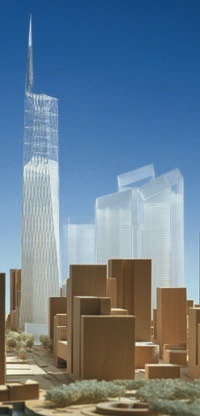
It’s been two months since David Childs unveiled

the Freedom Tower in a blaze of publicity. Since then, of course, most of the

WTC attention has been focussed on the memorial, with a little left over for

Santiago Calatrava’s magnificent new PATH station. But work on the Freedom Tower

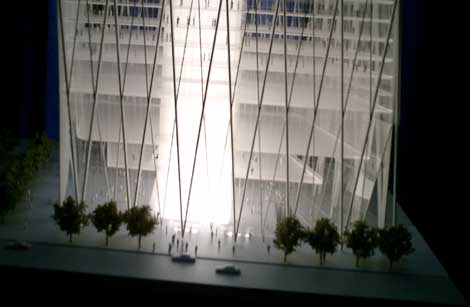
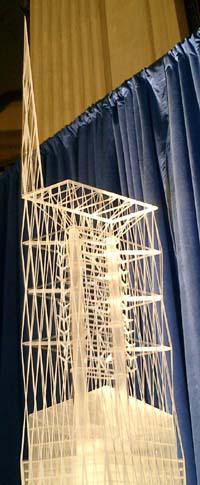
continues, and I took the opportunity last week, when Childs presented the model

for it at the Center for Architecture, to ask him how things were coming along.

Then, last week, I travelled to Washington on the train, and, purely by coincidence,

ended up sitting opposite architects in both directions. It turns out that the

WTC is proceeding apace, and that there’s quite a lot of information I haven’t

seen reported. So, to keep you up to date, here’s a bit of what I’ve learned.

¶It looks increasingly as though Daniel Libeskind has given up on his

initial dreams of controlling the design of the entire site. He fought long

and hard with David Childs over the Freedom Tower, to little effect, and has

since waged almost no battles at all over the memorial or the PATH station,

despite the fact that both of them essentially tore up his plan and started

over from scratch. In return for keeping quiet and not kicking up a fuss, there

seems to be a gentlemen’s understanding that the LMDC is going to commission

Libeskind to design the interpretive museum and cultural facilities on the site.

¶In terms of the tower, what you see when you look at the model is only

vaguely related to what’s actually going to be built. Childs told me that the

model was "a diagram of an idea of a basic concept". Specifically:

  • The heights as announced in December are far from set, and the tower might

    yet end up being significantly taller than the 1,500 feet plus a 276-foot

    spire that we were told would be there. There will be some kind of significant

    architectural inflection point at 1,776 feet, but the antennae could well

    go higher. That’s certainly what the broadcasters want – and will pay

    for – while the FAA is happy with buildings as tall as 2,000 feet in

    total. So expect Libeskind’s symbolic height to go out the window, as it were.

  • The spire, as seen in the model and plans, is basically just a place-holder.

    Childs and his team thought of a number of different ways of doing it, couldn’t

    agree on any of them, and just kind of plonked the thing you see now on top.

    Childs is very keen that the spire as finally designed will be (a) much more

    integrated with the rest of the the building, while (b) remaining fundamentally

    asymmetrical. He also said that he’s very much working on integrating the

    antennae into the spire.

  • At the moment, the spire is on the southern edge of the tower, while and

    the peak of the sloping roof is on the northern edge – which looks horrible,

    especially when the building is viewed from the west. It probably won’t stay

    that way, partly because the spire hasn’t been designed yet, but mainly because

    even the sloping roof is far from certain.

    The only reason for having a sloping roof in the first place is the Libeskind

    plan of a spiral of skyscrapers all genuflecting down to the memorial below.

    As we have seen, however, Libeskind is losing a lot of influence here, and

    it’s increasinly unlikely that the architects for the other towers on the

    site – Silverstein has already named Normal Foster, Fumihiko Maki and

    Jean Nouvel – will sign on to the sloping-roof condition.

    Clearly, if they don’t have sloping roofs, then Childs doesn’t need to have

    one. And Childs doesn’t want one: he told me that often the streets around

    the Citicorp tower need to be closed off, because snow and ice and water can

    shear off the sloping roof and come plummeting down onto the sidewalk below.

    So if he can unslope the roof, I think he will.

  • There will be a second observation deck: Silverstein has signed off on this.

    It will be right at the top of the trellis, open to the elements, and therefore

    accessible only in good weather. It will be reached by a glass elevator, which

    would pause at the heights of the old WTC towers on its way up.

¶In terms of the rest of the site, the LMDC yesterday announced

that they have finally reached an agreement with Deutsche Bank to buy up the

former Bankers Trust building for $90 million and then spend $45 million demolishing

it. This has long been crucial to the site plan, and it’s very good news. That

said, however, it’s still far from clear what exactly is going to happen in

that neck of the woods – generally, the southern boundary of the site.

With the cultural buildings now clustered north-east of the memorial, the south-west

corner generally is little more than a blank space – and south of it,

Liberty Street, at the moment, dominated by a large truck ramp, looks like it’s

going to be far from beautiful. Apparently Michael Arad, the winner of the memorial

competition, is pushing for entry to the memorial from the south-west, but that’s

just weird when the PATH station, most public transport, and nearly all the

rest of the island of Manhattan is to the north-east.

¶The PATH station, while beautiful, is basically little more than an oculus

at street level: most of the really grand stuff happens below grade. So, now

that Dey Street has been reconstituted, what is going to actually go on there?

One group, apparently, is pushing for a greenmarket, which sounds like a great

idea to me. It can happen south of the PATH station, so that it doesn’t interfere

with whatever symbolism is going on to the north.

¶It’s looking increasingly unlikely that New York City Opera is going

to make it downtown. The hope was that an opera house could be attached to the

eastern side of the Freedom Tower, maybe overlapping a little below grade. But

now, I’m told, even that wouldn’t create a large enough space for what the opera

company wants.

Overall, the site plan is moving from grand visions to something rather more

realistic, which is inevitable and not to be mourned overmuch. While many of

us would have preferred something which cleaved much more closely to the original

Libeskind vision, that was never very likely, and I do still have faith in the

LMDC to do its best to create a vibrant new neighborhood.

Posted in Culture | 5 Comments

Photoblog

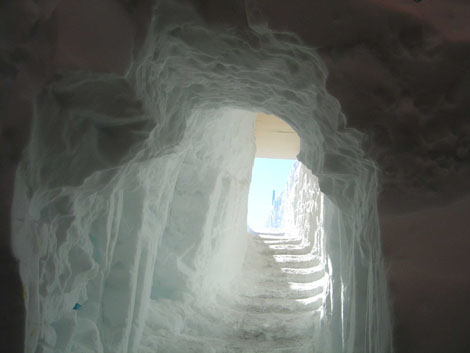
Greetings from Antarctica!

An Argentine helicopter

Two BAS ships at Halley

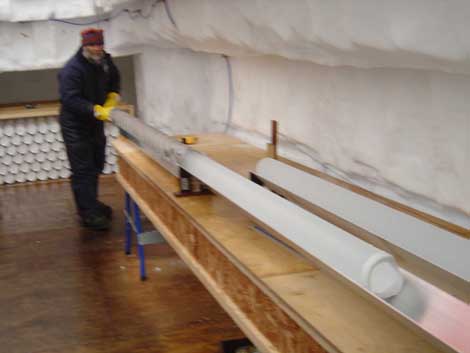
Me at my lab

Penguins messing up my clean air

And finally… manhauling stuff to my lab

Posted in Rhian in Antarctica | 5 Comments

Winter begins

If a mother’s love could be shown in presents, I think my mum has just succeeded!

The summer crew have left at last and it’s time now to settle in for the winter.

First we picked rooms out of a hat and, ironically enough, I landed the room

that I first had last summer and hated. The windowless cell, the tiny pit. Now,

it has been transformed. An oil burner, poems, photos, cards, shelves and beautiful

things like conkers and crystals – I’m discovering the girl in me who

I never knew existed! It’s my den, my escape, my very own space for me and my

stuff where no-one can come in without asking first.

Yes, it’s tiny, yes, it doesn’t have a window, but funnily enough, I don’t

mind so much this time around. The allocation was fair, the first community-spirited

activity.. and, after all, I do have to brave the elements every day to go to

work, unlike some of the folk here. The chef, the comms manager – if they

didn’t have windows they might never even have an inkling of what it’s like

outside!

And so it came to unpacking all the boxes I had stored away until now. How

much stuff did I bring for a year! All so unnecessary. More books than I might

ever normally read, a thousand photographs, creative supplies, food: chocolate,

dried fruit, chewy sweets, teabags and rusks. Games. As I sit here and write,

I can’t imagine ever needing any of these things. But it’s still light outside,

everyone is enthusiatic about being here, there’s loads to do and certainly

no such thing as boredom. Ask me again in five months!

What I didn’t bank on is the amount of time and effort my mum had put into

wrapping little presents, finding cards, thinking of things I might need here.

And it made me realise that a year away in the Antarctic sounds an awful lot

longer to people outside this environment than the reality feels down here.

As far as I can tell, it’s going to fly. If I had no emotional attachments outside

of here, and if my job were to exist, I think I would happily stay for a second

winter. Thirty-three months sounds so long, it did to me as well, but once you’re

here, it seems just about the right amount of time to fit it all in, to take

it all in.

It’s wonderfully simple here but there’s always something to be done. It’s

a pace of life that I like. The pace of the summer was too much: it smacked

of bringing the city to the desert. This space wasn’t designed for meetings

and deadlines. It is perfect space, space for breathing, looking around, smiling

and, of course, doing your work.

It is absolutely beautiful outside. I look out of the window next to me and

see a blue sky, bright evening, flat calm snow surface, slightly icy, covered

in shadows from sastrugi. It’s like the ocean, frozen. It is the ocean,

frozen! A snapshot in time. Endless white to the horizon. And on the horizon:

mirages of icebergs. In three of four directions the strange effects of layers

of stable atmosphere bounce light around and mean we can see far beyond the

expected, we see the reflection of icebergs in the mirror-like atmosphere above

it.

In the fourth direction, I see in the sky the reflection of the antarctic plateau.

Out there, about 30km away, are four of our team members on their first winter

trip. Mine is in three weeks – I can’t wait. The Hinge Zone, where the

ice leaves the plateau and there are large crevasses to explore. To sleep in

a tent, to really take in the stage of the setting sun, to wake up to ice: that’s

something I came here for.

In the meantime, there are a hundred things I haven’t told you,. The visit

by the Argentinian helicopter, posh dinner on HMS Endurance, the return of the

beloved Shackleton, the penguins who have set up camp outside my lab (damn them

– this is supposed to be a Clean Air Area!), the sun setting and the increasing

blue of the night sky, the flares we set off as the ship sailed away, the first

dinner as a wintering crew, the normality of it all.

I know for sure that this is the right place for me to be right now. It’s a

special place and a shame it’s so inaccessible. To me right now, it’s not the

harsh barrenness that everyone describes, it’s actually quite friendly –

and when the winds howl, they’re only playing with you.

Ask me again in five months!

Posted in Rhian in Antarctica | 10 Comments

Q&A

I have so much to say that I almost don’t know where to start! So here are

some answers to questions from Stefan.

Post your own, and I’ll see if I can answer them too!

Does one have affairs? How do the guys (and girls) cope if they’re not,

like, getting any? Is there sexual tension? Are there fits of jealousy that

get in the way of rational decision-making?

Yes, people do have affairs. There aren’t that many women to go around though

(as it were), and any woman with half a brain here will realise that if you’re

gonna, then stick with just one. Otherwise there might be social hell to pay.

So no, most people aren’t getting it. At the moment, to the best of my knowledge,

no-one on base is. But we’re only in our first week of the winter. There’s months

to go.

It’s quite odd being a woman here, in that regard. Cos everyone’s gagging for

it on a very carnal animal level but we’ve (statistically) got more chance of

getting it (it’s fairly homophobic here), so there’s almost a sense of inevitability

and ‘who will it be’ in the air. It’s not exactly flattering but it does put

you on guard a lot of the time and give you a wierd kind of power at times.

And the jokes and innnuendos are incessant. But quite funny. Usually.

The presence of women is definitely one of the potentially most dangerous things

here to the social set-up. And note, I’m not saying that women are, but rather,

their presence is. That is, their effect on men. But then, I would say that.

If I was a bloke, I think I’d rather have an all-male base too.

‘Potentially dangerous’ makes it sounds like the only effect our presence might

have is negative. Word on the street is that the feeling on base has also become

more balanced since women started wintering. Either way, while everyone has

the potential to have a massive negative or positive impact on base life, I

guess we could make it or break it easier. And it’s not a balance that’s easy

to find.

The main problem now is that the balance between men and women is so out of

kilter. We have 2 out of 18, Rothera has 1 in 21, Bird Island 1 in 5… and

the women who do winter tend to be younger (and therefore perhaps easier targets)

than the average on base. It’s a tricky one to answer as most of the jobs down

here are typically jobs that more men are qualified for but I just saw a photo

of the current german wintering team and they have five women to four men. The

dynamic would be very different then I’m sure…

Are there cliques? Are some people considered lazy, or not pulling their

weight? How are such matters brought to the general attention? Are there official

bitching sessions? Is there an official government representative with the authority

to marry, throw people in jail, judge who ate all the pudding last night, etc…?

There will almost certainly be cliques forming (as I said above, it’s still

early days yet) and there are definitely people considered to be lazy. This

is the worst of all sins on base and a definite friend-loser. There is a structure

to the base, with a ‘base commander’ who I guess such issues could be channelled

through if it got really out of control, and monthly base meetings. The base

commander has been sworn in on the ship as a magistrate and has legal powers,

but, alas, we have no jail. We don’t even have a gun or a straitjacket, although

apparently the stretcher works quite well for tying people down..

Why aren’t you being televised for a reality TV show? I think the BBC should

run with it, they can pretend (and get away with) it being a science show. It’d

be a thinking person’s reality TV show, and we could have Cambridge psychologists

and philosophers opine from comfy chairs in the shires as to why you did what

you just did. Every show, one person gets voted off the base, and has to wander

off into the -40C night.

One massive difference between us and Big Brother is that we all want to end

up being friends. Quite boring watching most of the time – lots of people

being nice to each other, watching videos, playing pool, eating, working and

sleeping. Not a crowd winner.

Posted in Uncategorized | 2 Comments

FreshDirect on the LES: WTF?

Lockhart Steele is not much of

a crusader, it would seem: he will fight

for FreshDirect delivery on the Lower East Side only until they start

delivering to him. Then, he’ll just give up: his latest

post completely fails to communicate the utterly illogical craziness of

the new delivery area.

Let me illustrate, with the help of some extremely basic HTML, and using my

own block (why not?) as an example. My street is a narrow one-way road:

clearly, if FreshDirect can deliver to any of the buildings on any given block of Rivington Street,

it should be able to deliver to all of them.

In fact, however, FreshDirect delivers to three of the buildings on the block:

106 Ridge, 206 Rivington, and 210 Rivington, all of which are walk-up tenements.

It does not deliver to 203 Rivington, which is a nice deliveryman-friendly elevator

building.

Ridge Street
106 Ridge: YES! 202: NO 206: YES! 210: YES! 83 Pitt: NO
Pitt Street
Rivington Street
203: NO

The situation gets even weirder when you realise that Rivington Street runs

west, and Pitt Street runs north. In other words, in order to deliver to 206

Rivington and 210 Rivington, the only way that the FreshDirect trucks are going

to be able to get there is by driving north up Pitt Street from Delancey. Yet

none of the buildings on Pitt between Delancey and Rivington (like 65 Pitt and

67 Pitt) get delivery either. Meanwhile, all the buildings on Ridge

Street get delivery.

I phoned up FreshDirect to ask about this on Saturday, and spoke to a friendly

woman who agreed that it made no sense at all, and who said that she’d get

a supervisor to look into it on Monday morning. But when I called back today,

Tuesday afternoon, I got someone much less friendly, who simply said that the

Marketing Department hadn’t made the decision to deliver to my area yet.

I’ve been racking my brains to try and work out how you could possibly include

206 Rivington in your delivery area and yet exclude 202 Rivington, and have

come up completely blank. If anybody has any bright ideas, do post them here. Meanwhile,

FreshDirect people, if you’re out there, do let me know what kind of person

would single out individual buildings in this manner, refusing to deliver to them

while happily delivering to their next-door neighbours. Don’t you realise you’re

causing strife down here?

UPDATE: I eventually managed to speak to a very friendly chap

called John in Marketing, and he told me that the official boundary on Rivington

Street was Ridge. So how 206 and 210 Rivington got included no one knows. But

he said he’d talk to somebody, and today I checked the website again… and

FreshDirect now delivers to the whole block! Wahey!

Posted in Announcements | 7 Comments

Gay marriage: Where’s the backlash?

22fiel.big.jpg

Anybody remember that in the wake of the Lawrence v Texas decision, everybody

was talking

about the anti-gay backlash which would only intensify if gay marriage started

getting onto the agenda? Well, guess what: gay marriage is about to be made

legal in Massachussetts, it’s already happening in San Francisco, and the only

people railing against it seem to be the professional haters who were railing

against Lawrence when that happened, too.

The thing is, you really do need a heart of stone to look at photos

like the one above and not feel happy that this is happening. Now the debate

has come out of the law courts and op-ed pages and onto the streets, people

are seeing what gay marriage actually looks like in practice, and I have a feeling

that they like what they see. Elizabeth McElhinney and Siddiqi Ray are no imminent

threat to America or Americans; they’re just a very happy couple in love who

are now, I presume, enjoying a fabulous honeymoon somewhere.

Meanwhile, President Bush has said as little as possible on the subject since

the San Francisco weddings started happening, and his storm troopers, like California

governor Arnold Schwarzenegger, look increasingly silly when they assert

that these happy loving couples constitute "an imminent risk to civil order".

Even if Bush does eventually come out in favour of a constitutional amendment

banning gay marriage (and it will have taken him long enough), there’s now essentially

zero chance of it actually passing. Meanwhile, when paleoleftists like Chicago’s

Richard Daley also come out in

favour of gay marriage, it’s not hard to work out which way the wind is

blowing.

But three years of being bashed by Bush has made some on the left overly cautious,

it would seem. Josh Marshall ties

himself up in knots, for instance, trying to explain why he doesn’t oppose

gay marriage, but, then again, doesn’t support it, either. In an ideal world,

he seems to be saying, we’d have gay marriage, but practically speaking, he’s

worried about the backlash. Just think what those nasty Republicans

will do once gays start getting married!

Well, I’m sick of second-guessing what Republicans will and will not want to

vote for. Michael Kinsley wrote a wonderful

article about this a couple of weeks ago, poking fun at Democrats who supported

Lieberman because they disagreed with him on everything, or fled Dean because

"he was so appealing that he scared them".

Political activity is a bit like when government intervention in the foreign

exchange market: it only really works when the momentum is with you, but if

that’s the situation, then it can work wonders. Right now, San Francisco mayor

Gavin Newsom is probably the most astute political activist in the world. He

picked his moment perfectly –Valentine’s Day! Genius! – and ran

with his issue as hard as he could, picking up support from across the country.

As Andrew Sullivan says,

Newsom is also entitled to act according to his conscience and to his own

reading of the state constitution’s guarantees of equal protection, just as

(Alabama judge Roy) Moore was. If he is found guilty of violating his oath

of office, he should face the consequences. Somehow I think one of them might

be re-election in a landslide.

Now I’m not saying that the gay marriage issue might not be bad for the Democrats,

net-net, in the presidential election. Massachussetts senator John Kerry will,

I’m sure, have a hard time selling himself to the Bible Belt if his state is

overrun at the time by gay couples from all over the world lining up to get

married.

But it’s also clear that the US public, in general, has reacted with markedly

less horror to the marriages in San Francisco than it did to the half-second

exposure of Janet Jackson’s right nipple during the Super Bowl half-time show.

It’s slowly becoming clear, I think, that gays are not sexual deviants intent

on undermining the institution of marriage: they’re perfectly normal and ordinary

people who fall in love and want to get married. The queue outside San Francisco’s

City Hall is not made up of the characters who populate Gay Pride parades –

topless dykes on bikes, leather-and-chains bears, drag queens, that sort of

thing. Instead, Middle America looks at the lovers waiting hours and days for

the chance to get married and sees normal people, intent on fulfilling their

own American Dream.

Three thousand married gay couples in San Francisco can’t even come close to

inflicting the kind of damage on marriage as an institution that Britney Spears

managed to do in a drunken weekend. When given the opportunity of taking part

in an institution as important and solemn as marriage, the gay community has

come through with flying colours, treating it with the seriousness and joy it

deserves. In return, I have a feeling that the self-appointed arbiters of public

morality might just feel a twinge of hypocrisy if they rail too loudly about

who can and can’t get married these days.

Now, then, is not the time to pussy-foot around the issue. There’s the smell

of historical inevitability in the air, and we who care about civil rights should

have no compunction in following our noses. Don’t worry about what the Republicans

might think: go out, celebrate gay marriage wherever it occurs, and fight for

it everywhere else. Vermont might have blazed the trail with its civil unions,

but already they’re an anachronism: the institutionalisation of gay unions as

different and unequal.

Gay marriage is not an issue which you can triangulate, Clinton-style, and

end up in some wishy-washy John Kerry "civil unions good, gay marriage

bad" unhappy compromise. If you don’t believe me, look at the disaster

that is Don’t Ask, Don’t Tell. Gay marriage is a civil right, which means that

opposing it is, in a crucial way, un-American. It would be depressing beyond

words if the left, through natural cowardice in an election year, lost the momentum

on this one.

Posted in Uncategorized | 8 Comments

Monet in Vegas, part 2

Joseph Clarke, over at unfolio, calls me one "of the blogosphere’s great

arts writers" today, which is more than enough reason for me to link

to him. He also joins in the Monet

debate, and adds some new arguments of his own as to why "it is wrong

to think that a non-profit museum and a for-profit gallery can offer the same

cultural service to the public".

Of course, the two types of institution perform different roles, both necessary

in their own way. And you’ll never find me saying that we might as well do away

with the Whitney so long as Larry Gagosian’s got his space in Chelsea. But in

the context of the issue at hand, it’s also worth pointing out that we’re dealing

with Tyler Green’s hypothetical

here, in which he asks why Boston’s Museum of Fine Arts loaned its Monets to

the Bellagio rather than to the Venetian, which houses the Vegas branch of the

Guggenheim.

In this context, I really don’t see that there would be much of a difference

at all between an MFA Monet show at one and an MFA Monet show at the other. Might the Bellagio’s audio

guides come in slightly more languages? Might the Guggenheim’s catalogue be

more academically rigorous? Whatever. To all intents and purposes, the galleries

in the two casinos would offer exactly the same cultural service to the public.

After all, we’re talking Vegas here: the presence of Dave Hickey notwithstanding,

the audience for this show is not going to be the kind of people who read catalogue

essays for pleasure.

Nevertheless, Joseph makes a couple of points which are worth addressing.

According to the MFA’s mission statement, "the Museum’s ultimate aim

is to encourage inquiry and to heighten public understanding and appreciation

of the visual world." By contrast, the raison d’etre of a for-profit gallery

— or any for-profit business — is to make money. This means that while the

MFA values Monet paintings in cultural and artistic terms, the Bellagio values

them in dollars and cents.

This is true, and something the MFA should bear in mind when it enters into

deals such as the one it has with the Bellagio. When the MFA loans its paintings

to another non-profit institution, it can work on the assumption that both institutions

have the same goals. If the paintings are going to a for-profit gallery, on

the other hand, the MFA has to be sure that the show will advance its own goals

as well as those of the gallery in question.

But it’s easy to overstate this point. Even when the MFA is loaning paintings

to a fellow museum, it should still examine the proposed show very carefully.

Sub-par curatorial standards crop up in shows at non-profit and for-profit galleries

alike, and it’s up to the lending institution to ensure that its works don’t

get abused in an unbefitting setting. So long as the Bellagio show meets the

MFA’s standards, the fact that the Bellagio is a for-profit institution should

be neither here nor there. Similarly, if a museum does not meet the MFA’s standards,

Boston would be wrong to part with its paintings anyway, just because they’d

be going to a non-profit institution.

More importantly, though, the MFA and the Vegas Guggenheim are "public

space" in a sense that the Bellagio gallery is not. The Bellagio did not

choose the Monet paintings for the general edification of the denizens of Las

Vegas; it chose those paintings–over millions of other works of art it could

have sought to display–for financial reasons. A non-profit museum might have

opted to show different paintings.

Different, maybe, although as I understand it the choice of Monets was largely

left to the MFA, rather than to the Bellagio. But I have to admit I don’t quite

understand Joseph’s point here. Is he simply saying that different galleries

do their shows in different ways? That’s true whether or not they’re non-profit.

Rather, he seems to be saying that a show which is driven by financial considerations

will, prima facie, be culturally inferior to a show driven by purely

cultural considerations.

I’m not convinced. The high-minded non-profit cultural institution across the

street has spent most of its short life showing The Art of the Motorcycle,

while the Bellagio has been showing Warhols and Monets. Could it be –

could it possibly be – that the need to make a buck might actually

make a show better? Look at all the stodgy old museums in the former

East Germany. When they stopped sitting on their arses and started trying to

attract a paying audience to justify their existence, standards went up,

not down.

The art a gallery chooses to display will, in turn, have a direct effect

on who comes to view it. We cannot really speak of different galleries’ giving

"the art-going public" equal opportunities to view art when the "publics"

that may patronize them are different.

We can’t? Why on earth not? If I didn’t know any better, I’d think that Joseph

was valuing the traditional museum-goer over the lumpenproletariat

who might be attracted to a well-marketed for-profit art show. If the Bellagio

succeeds in attracting a different audience from the kind of people who go to

the MFA in Boston, so much the better! It would be genuinely shocking

if the MFA were to turn to the Bellagio and say, in effect, "well, you

might attract a lot of people to the show, but we’re not sure they’re the

right kind of people, do you know what we mean?"

It is certainly part of the MFA’s mission to ensure that its artistic treasures

are seen by as wide a cross-section of the general public as possible. I can

think of no better way to achieve that than to send a group of paintings (a)

to a city thousands of miles away, where most of the visitors will never have

been to Boston; and (b) to a small private gallery in a casino, from a large

public gallery in a city. The audience will be completely different? Perfect!

It may be argued that the distinction between public and private galleries

is, in this case, purely theoretical; that this specific rental does not, in

fact, violate the public trust. This may be true. But given the dangerous precedent

this arrangement sets, and given Rogers’ seemingly flippant attitude towards

the controversy, it is critical that we ask the questions Tyler has articulated,

to see that Monet’s trip to Vegas does not push us down a slippery slope of

arts privatization.

Ah, yes. Dangerous precedents and slippery slopes. Thin end of the wedge, and

all that. Malcom Rogers might just be toking on a cigarette right now, but before

long he’ll be freebasing cocaine under a railway bridge somewhere.

The thing is, in this case I’m far from convinced that the highly-addictive

art-world crack cocaine in question – arts privatization – is necessarily

a bad thing. I say this not because I think it’s necessarily good, but because

I think we’ve seen so little of it that it’s far too early to tell whether it’s

good or bad.

Certainly, I can think of examples of for-profit organisations putting out

culturally-dubious material in order to make money. It happens quite frequently

in the classical music world, where classical radio stations play "bleeding

chunks" rather than entire pieces, and the Three Tenors clean up with their

accessible medleys while high-minded opera houses struggle to stay out of the

red even after receiving large state subsidies.

On the other hand, it’s easy to see how the private sector might be more efficient

than the public sector in a lot of cases. For instance, Philippe de Montebello,

the director of the Metropolitan Museum of Art, gets

paid $866,583 a year, while president David McKinney gets another $601,905.

Beneath them are a staggering 1,800

full-time employees.

Now, I’m not saying the Met should be privatized. But there’s no doubt that

non-profits can be sluggish, bloated, and unoriginal. Just look at the New York

Philharmonic (Zarin Mehta, executive director: $750,000 a year).

Anybody who’s

spent much time in any part of the non-profit sector will attest to rampant

mismanagement, often linked to out-of-control egos and a sense of entitlement

among the independently wealthy people who usually end up founding and staffing

such places. There is no doubt in my mind that given a modest endowment and

non-profit status, the Bellagio art gallery could start making substantial losses

in no time at all. And would the quality of the programming there improve as

a result? I doubt it very much.

Both the Guggenheim and the MFA have ventured into Vegas. The Guggenheim spent

a fortune on a Rem Koolhaas art gallery which almost nobody went to visit; the

MFA, if you will, outsourced its Vegas operation to the private sector. Financially

and organisationally, the Guggenheim Las Vegas has been a complete disaster,

while the MFA’s Monet show is quite the opposite. Yet the cognoscenti remain

happily ensconced in their prejudices, denouncing the MFA show just because

it’s making money, and asking whether it couldn’t be shown across the street

instead. Slippery slope? Slide away, Mr Rogers. We might just love what lies

at the bottom.

UPDATE: This is almost too good to be true, but back over at Modern Art Notes today, Tyler Green links to a review of a new Rothko show, saying “This show is my early leader for best show of 2004”. Click over to the review itself, and you find it starting thusly: “Among the many exhibitions of Mark RothkoÃŒs paintings I have seen over the course of many yearsÛand this includes major museum retrospectivesÛthe two that have most profoundly defined for me the quality of his artistic achievement have both been organized at the PaceWildenstein Gallery.” PaceWildenstein, of course, is the gallery which is putting on the Monet show in Vegas.

Posted in Uncategorized | 5 Comments

Monet in Vegas

Tyler Green is, I daresay, the best art blogger in the world. But today he

harshes,

quite unjustifiably, I think, on Malcom Rogers, the director of the Museum of

Fine Arts in Boston.

Rogers’ crime, in Green’s eyes, is to have loaned 21 of his Monets to the Bellagio

hotel in Las Vegas for an exhibition there. In return, the MFA will probably

receive a seven-figure sum. The Boston Globe has

the story; Green says that the link will expire tomorrow, so I’ve mirrored

it here.

The main critic of the arrangement seems to be Christopher Knight, of the LA

Times, who wrote an article on February 3 headlined "A new low in the business

of high art". It’s behind a subscriber firewall, unfortunately, but the

gist of Knight’s complaint is that the Bellagio gallery – which is run

by a subsidiary of art gallery PaceWildenstein – is a for-profit organisation.

Writes Knight:

[The] MFA could have taken its paintings across Las Vegas Boulevard, ironically,

to the Guggenheim Hermitage Museum, where Boston could actually be lending

its Monet paintings to a fellow cultural institution. But it didn’t… Context

confers meaning. The Monet show’s context is purely commercial. It teaches

audiences that, for an art museum, financial worth is art’s primary value.

Knight has also been widely quoted as saying that the Monet show "is without

intellectual merit" and "is educationally corrupt". But those

quotes are usually taken a little bit out of context: Knight was not writing

a review, and has not seen the show. Rather, he was holding up the MFA’s actions

to the guidelines of the Association of Art Museum Directors, which say that

the primary considerations that a museum should weigh before making any loan

should be its "intellectual merit and educational benefits".

Let’s ignore Knight’s take on the intellectual and educational merits of the

Monet show, then, since he hasn’t seen it and really can’t say. His substantive

point is that if the MFA loans works to the Guggenheim Hermitage Museum in the

Venetian hotel, that’s fine, whereas if it loans works to the art gallery at

the Bellagio hotel across the street, then that’s beyond the pale.

I don’t see why there’s such a clear distinction to be drawn between the two.

Both hotels use their art galleries as tourist attractions, as a way to appeal

to the slightly more highbrow gamblers in Vegas. In that sense, they’re both

for-profit, commercial concerns. One is run by a pair of museums, while the

other is run by a commercial art gallery, but I’ve seen many excellent gallery

shows and dreadful museum shows. It’s entirely possible that taking an art gallery

and moving it from non-profit to for-profit status could actually make it better.

Knight says, in as many words, that the art gallery at the Bellagio is not a

"cultural institution". Bollocks to that: of course it is!

Tyler Green, however, has actual questions for Rogers. Here they are, with

my own answers.

1. In the Globe story, you conceded that there is a small "issue here."

Could you outline the "issue" and explain why it is a small issue

and not a big one?

The issue here is very similar to the issue of Charles Saatchi sponsoring the

"Sensation" exhibit at the Brooklyn Museum of Art. In that case, the

value of Saatchi’s own paintings was likely to increase due to their receiving

the imprimatur of a major museum show. Similarly, PaceWildenstein is a major

dealer in impressionist paintings, and in Monets specifically. If this show

is a huge success, they could benefit not only from increased admissions revenues

(which are shared with the MFA), but also from increased prices for their stock

of paintings.

Why is this a small issue and not a big one? Because the market in Monets is

mature, and the chances of a Vegas show increasing the value of PaceWildenstein’s

Monets (assuming they have any) is very small.

Now, it is true that there is a very large chance that PaceWildenstein will

make money from the show directly. But that’s always the case with museum loans:

the only difference here is that the operator of the exhibit is a private, rather

than a public, organisation. And, of course, a public museum is benefitting

as well: the MFA itself, which is getting a tidy sum.

2. Are there groups, people or organizations to whom you would not rent

the art in your museum’s collection? If there are not, please list a few of

them and explain how renting to those groups are different from renting works

to a private corporation gallery that is based in a casino?

A museum’s works should be accessible to the public. If somebody wanted to

rent an MFA Monet so that they could hang it in their front room or otherwise

keep the public from seeing it, the MFA would rightly refuse. Now many art galleries

charge admission – mostly non-profit art galleries, it must be said. Admission

fees, while regrettable, are generally understood to be a necessary evil. If

the MFA loaned out 21 Monets to a public art gallery, there would still be admission

fees. But the fact that the admission fees go to a private rather than a public

organisation does not change the degree to which the art is accessible to the

general public.

3. In Edgers’ story, he (apparently) paraphrases you asking how people

can be so critical of a show they haven’t seen? Why is it not fair to criticize

the concept of a museum renting out work to a for-profit gallery in a casino,

regardless of what the resulting show is?

It is fair to criticize the concept of a museum renting out work to

a for-profit gallery in a casino. Knight wrote an opinion piece, and he’s more

than free to express his opinion that what the MFA did was wrong. Similarly,

the MFA is more than free to defend its actions. What is weird is when Knight

criticizes not the concept, but the show itself, calling it "without intellectual

merit". How could he make that judgment without seeing the show? In fact,

on the very same page of the newspaper, Suzanne Muchnic describes the show as

"beautifully installed", and nowhere gives the impression that it

is in any way sub-par.

4. The Guggenheim runs an accredited space at the Venetian Hotel. If this

is really about sharing your Monets with culturally bereft Las Vegas, as you

say, why not loan your Monets to the Vegas Guggenheim? Is it because they wouldn’t

pay you $1M+ and someone else would? Did you explore all available options regarding

showing the Monets at an accredited, non-profit space?

As far as the art-going public is concerned, the benefit to them is more or

less identical whether they pay $15 to see Monets at the Venetian or $15 to

see Monets at the Bellagio. So the MFA was faced, hypothetically, with two choices:

  • Give the Vegas public the benefit of access to the Monets; or
  • Give the Vegas public the benefit of access to the Monets, and give the

    MFA – a cash-strapped museum in need of funds – a million bucks.

Seems like a no-brainer to me.

Where is the advantage to the Vegas public in seeing the paintings at "an

accredited, non-profit space"? Does that make the paintings any better?

Where is the advantage to the MFA in lending the paintings to such a space?

The MFA certainly doesn’t get more money. It’s worth turning the question around:

why should the MFA embrace the Venetian rather than the Bellagio? What is the

non-financial value of this "accreditation" of which you speak?

In fact, since we’re dealing in hypotheticals here, here’s another one. Let’s

say the Horseshoe Casino in Vegas opened up its own gallery, accredited by the

Kalamazoo Art Club, a non-profit organisation dedicated to showing pretty pictures

to people. Would you prefer that the Monets went there, even if they weren’t

nearly as well hung, and even if the admission price was bumped to, say, $30?

What is the magical value of non-profit status?

5. In talking with Suzanne Muchnic of the LA Times, you justified your

decision to rent out your Monets by saying that you are always looking for "new

funding source[s]." Museums do more than show art, a significant part of

their mission is to preserve cultural legacies that are important to humankind.

Is treating art as a "funding source" appropriate given a museum’s

mission? Can you give us some examples of what would be inappropriate funding

sources for a museum?

All museums treat art as a funding source. Every time they sell a postcard,

license an image, loan a painting, or charge an admission fee to see art, they

receive money in return. Ultimately, it seems fair to say that every penny that

every art museum has ever received is in some way leveraged off the art in that

museum. So the question isn’t whether it’s appropriate to treat art as a funding

source; the question is what types of uses of art as a funding source are inappropriate.

I’ve already said that loaning a painting to an individual who would not let

the public have access to it would be inappropriate. More generally, selling

art is something which museums should think long and hard about before doing,

especially if they’re selling to a private collector as opposed to another museum.

But more importantly, preserving a cultural legacy is in no way inconsistent

with showing art to as many different people as possible. Ultimately, any cultural

legacy is going to die out if nobody sees it, and the more people who see a

body of art, the more of a cultural legacy it is likely to become. If the private

sector is better at bringing art to people than the non-profit sector is, then

all power to them, and may a hundred relationships such as the one between the

MFA and the Bellagio blossom.

Posted in Culture | 11 Comments

The ethics of blogging

Over the course of the past year, I’ve had quite a lot of experience with the

intersection between blogging and journalistic ethics. I have been accused,

and have accused others, of blogging unethically. And yesterday, I said that

one website was blogging too ethically.

So I’ve decided to outline my thoughts here, in the hope of starting a discussion.

The one thing I’m pretty sure of is that there is really no consensus at all

about the degree to which normal journalistic ethics (say, the rules governing

what appears in an average US newspaper) apply to blogs. Now that the blogosphere

is maturing into a news source in its own right, I think the time is ripe to

have this debate.

1. Is there a limit to what blogs should and shouldn’t publish?

Some blogs clearly think there is. Wonkette,

part of the Gawker Media empire, even went so far as to publish a Statement

of Principles yesterday, after I criticised

her for not, as she puts it, "naming the name that’s everyone’s heard but

no one’s said". She’s clear that she won’t print the name, but that didn’t

stop her linking to a news article which did print it. Meanwhile, the Columbia

Journalism Review links

to a number of different bloggers in a piece about who printed what, mentions

the fact that Wonkette links to an article with the name, and then conspicuously

denies her a link of her own. The obvious implication is that linking to Wonkette

linking to the name would be unethical, while simply saying that Wonkette

links to the name is OK.

Wonkette, in not printing the name, is actually following the lead of Matt

Drudge. Drudge, too, links to stories which name her and even print her

photo, but he has stopped short of printing her name himself. As for the press,

no US newspaper has named her, as far as I know, but the Sun and the Telegraph,

in England, have.

(Update: The Chicago Sun-Times, a major US newspaper, has now named

her, in a column which uses the word "reportedly" five times in three

paragraphs.)

When would it be kosher to name the girl? the New York Daily News fronts

the story, but says that "The News is withholding her identity because

there is no clear evidence of any relationship between her and Kerry."

Wonkette, meanwhile, just says that "We’re not going to post her name until

she has a chance to launch her own handbag line just like any other scandal-plagued

intern."

My take on this is that if the Sun prints her name and puts it on the internet,

the name is in the public domain, and no material extra harm is done by putting

it in a blog. Newspapers, especially big ones, can work on the conceit that

they have all the news that’s fit to print, and that their readers don’t necessarily

get their news anywhere else. Blogs are almost the diametric opposite of that

paradigm. So "X has named her, why can’t we" works much better as

a defense for a blog than it does as a defense for a newspaper. Especially if

you’re going to link directly to X, you might as well print the name yourself.

But clearly I’m in the minority here. After all, even Drudge won’t print the

name, and the CJR won’t even link to a blog which links to the name.

I ought to mention one other wrinkle to this debate, and that’s legal liability.

Newspapers have expensive lawyers and can afford to defend themselves from libel

suits; blogs don’t and can’t. That’s a practical concern, and it can intersect

with journalistic ethics. If you’re going to accuse a notoriously litigous person

of something bad, then you run the risk of being sued. You might feel comfortable

on an ethical level making the accusation, but still feel uncomfortable on a

practical level, especially if you live and/or publish in the UK. It’s worth

mentioning that anonymous

bloggers have relatively little protection in this regard: if someone’s

really determined to find out who you are, they probably will.

But my main concern here is the ethics of the situation. As far as I know,

no one has successfully sued a blogger for something they printed: the most

clear-cut case, that of Blumenthal vs Drudge, ended with a clear victory

for the blogger.

It’s worth looking at Blumenthal vs Drudge, though, because I think many bloggers

would consider Drudge’s original accusation – that Sidney Blumenthal was

a wife-beater – to be clearly unethical, even if it wasn’t illegal. Bloggers

often have many very influential readers, and once a rumour has been printed

somewhere it’s almost impossible to make it completely go away, no matter how

outlandish it

might be. So while the bar might be set lower for Drudge than it is for the

New York Times, I think there’s a very strong case that it ought to be set somewhere.

Once an accusation about somebody is out on the internet, people googling that

person will often end up at the accusing page, and many of them will believe

what it says. The person printing the information bears some responsibility

for what their readers go away believing.

Printing something about someone can also be wrong even if it’s true.

I noted in November that

Fleshbot, another Gawker Media site, was (a) publishing extremely graphic stills

from the Paris Hilton Sex Tapes while (b) refusing to publish her phone number,

which was doing the rounds at the time. (It was actually left in a comment on

my MemeFirst entry; I ended up deleting a lot of comments and, ultimately, closing

the entry to comments altogether, just because I felt that publishing either

the pictures or the phone number was clearly unethical.)

I’ve also noticed that since I started blogging, a lot of people have started

inserting an "off the record" into their conversations and emails

with me. They’re obviously worried that, being a blogger, I might turn around

and publish their confidences for all the world to see, and they’re also worried

that there isn’t some kind of obvious ethical code that would preclude me from

doing that. This despite the fact that in almost four years of blogging, I’ve

only quoted people from what they’ve said online or in print – the

single exception being Peter Kim, of Puma.

So there does seem to be a perception that blogs are an unfiltered, unedited

news source, and that if you’re communicating with a blogger, then you run the

risk of having those communications published on the internet, even if that’s

not what you want. Blogs can undoubtedly invade peoples’ privacy, by, say, publishing

their phone number, or photographs of them naked, or simply betraying their

confidence. My view on the ethics of blogging is that they shouldn’t do that,

although I’m conflicted on the subject of whether, if someone does

do that, it’s OK to link to them.

2. Should bloggers attempt to verify information before publishing it?

Whenever a newspaper prints a story, the reader can assume that if an accusation

is being made against someone, the paper made an attempt to contact that person

and ask them for comment. On the other hand, if a blogger links to an accusation

against person X, most of the time that blogger will have made no attempt at

all to contact X and ask them if the accusation is true.

I’ve done this myself. I am an acquaintance of Nick Denton, and he has always

responded promptly to any emails I’ve sent him. Yet in December I linked

to a web page accusing him of pilfering code, without trying to contact Denton

or get his side of the story. (He did leave comments on the page in question,

which I took into account in my entry.) I’m a professional journalist, and I

would never dream of submitting the kind of thing I wrote to a newspaper or

magazine – not without contacting all the principals and talking to them

about the issue in question. Yet still I went ahead and published the item anyway,

without talking to anybody at all. Did I behave unethically?

I can certainly see the argument that what I did was wrong. Blogs are

a media outlet, as Denton and I were keen to assert

in l’affaire Puma. If you’re going to claim Media Outlet status, you

should try to live up to the responsibilities such status confers upon you.

But I also think that blogging is fundamentally different from most journalism.

There’s almost never any pretense of objectivity: a genuinely fair and balanced

blog would be boring even if it were possible for such a thing to exist. And

a large part of blogging is simply linking – I was initially pointed to

the page in question by Anil Dash, who put it on his Daily

Links page. I doubt many people would consider Anil’s action to be unethical:

his links are so short and plentiful that he can’t be expected to go to work

vetting each and every one.

In the Denton case, I never considered myself to be reporting the

story: rather, I thought, I was simply linking to it, and adding my own personal

opinion, clearly labelled as such. I consider that anything I publish either

here or on MemeFirst should automatically be considered my personal opinion,

but in this case I even threw a few "I think"s in just to make things

perfectly clear. That said, it’s generally a good idea to back up one’s opinions

with verified facts rather than web-based allegations. Even if I was writing

the story for the op-ed page of a newspaper rather than the news page, I would

still make sure to talk to the principals first.

Nevertheless, I felt no guilt when I published the story: I didn’t feel that

I was doing something wrong. Rather, I felt that I was simply adding my own

two cents to the blogosphere’s ongoing conversation about a certain allegation.

But part of the reason I didn’t feel bad about writing such things was that,

deep down, I didn’t think that anybody really cared what I wrote in the first

place. A newspaper is a powerful institution; I’m just a small-to-middling voice

in a cacophony of blogs. Now, however, I’ve thought it over a bit more. Why

is there a generally-accepted set of journalistic ethics in the first place?

Precisely because newspapers are powerful institutions which can do significant

damage to reputations and lives.

But so are blogs. Just ask Trent Lott.

Insofar as people care about blogs, then, we bloggers should probably be careful

what we write, and even make some kind of attempt to check our facts and do

a little bit of homework before rushing to publish. And the more popular your

blog, the more hits and inbound links you get, the more this applies to you.

In general, though, if you’re writing about someone you know, then it’s only

polite to run it by them first. (After all, it’s not like they’re not going

to see it once you publish.) So: apologies, Nick, and apologies, Elizabeth.

My bad.

3. Should blogs maintain a wall between content and revenues?

One huge difference between blogs and newspapers is that with blogs, there’s

no difference between a journalist, an editor, and a publisher. Increasingly,

blogs are making money – even felixsalmon.com has made the grand total

of $159.17 since I started running Google ads in September. It barely even rises

to the level of pocket money, but it does cover hosting fees.

Other blogs, however, really do make significant amounts of cash. Daily

Candy, which has bloggy properties, recently got sold for over $3.5 million.

Both Nick Denton and Jason Calacanis

are setting up multiple weblogs with an unashamed profit motive. Andrew

Sullivan, Matt Haughey (at PVRBlog),

and Rafat Ali (at PaidContent.org) all

now make more than the average American wage earner just from their blogs. And

Drudge, of course, makes a lot of money.

When weblogs were just beginning, many of the most successful ones were set

up by professional journalists who simply ported over to the web their ingrained

journalistic ethics. When Andrew Sullivan was accused of a conflict of interest

after he accepted advertising from the Pharmaceutical Research and Manufacturers

of America, he took those complaints very seriously, returned the cash, and

stopped running the ads.

Increasingly, however, bloggers will not come from a journalistic background,

and in any case many are more interested in making money than they are in adhering

to Old Media rules. What is the point, for instance, in maintaining a strong

distinction between editorial and advertising on a blog like Fleshbot?

The types of sites that Fleshbot wants as advertisers are precisely the type

of sites it wants to feature in its editorial content. If advertiser suicidegirls.com

wants Fleshbot to feature a "Suicide Girl of the Week" in its editorial

column, why on earth not? That’s just the kind of thing that Fleshbot’s readers

want to see.

(Update: I have now been informed that the "Suicide Girl of the Week"

feature predates suicidegirls.com signing on as an advertiser.)

Daily Candy is more of an ethical grey area, I think. The site became financially

successful by sending out "dedicated" emails, in its trademark editorial

voice, which were actually pure advertising. If you read the small print, it

was possible to work out which emails were "real" and which were paid

for, but it wasn’t easy. Advertisers clearly hoped that the recipients of the

dedicated emails would mistake them for unsolicited raves by the Daily Candy

editorial team – and Daily Candy more or less gave them what they wanted.

Still, Daily Candy did make some kind of distinction between editorial

and advertising. Other bloggers might not. Harry

Knowles, for one, doesn’t seem to care in the slightest about journalistic

ethics or conflicts of interest, and neither do his readers, it would seem.

In fact, the louder and brasher bloggers (Drudge springs to mind as another

example) are doing very well indeed despite – or perhaps because of –

their cavalier attitude towards traditional journalistic mores.

But again, I’m not writing about how to be a successful blogger, I’m writing

about the ethics of blogging. And I think that it is unethical to accept payment

for editorial content, especially if it’s undisclosed.

4. What would adopting an ethical code mean for the blogosphere?

Clearly, there is no institution which can regulate or bully bloggers into

acting ethically, even if there could be any kind of agreement on what constitutes

ethical and unethical activity by bloggers. But if individual bloggers, especially

the higher-profile ones, made it clear what kind of things they will and will

not do, at least some kind of consensus might start to emeerge.

If that happened, would the blogosphere lose its appealing, free-wheeling,

anarchic flavour? I very much doubt it. Would anybody still be free to publish

anything they wanted? Absolutely. Would blogs still deliver the kind of content

which is hard, if not impossible, to get from any other media outlet? I should

bloody well hope so. I would simply like to think that, in aggregate, blogs

might get taken increasingly seriously by the kind of people who naturally discount

anything which isn’t published on paper.

But there could be a downside, as well. If bloggers started censoring themselves

in an attempt to stay on the right side of the ethical line, their blogs might

become duller. If they started double-checking things before publishing them,

they could lose both speed and volume of posting. If they refused certain forms

of advertising, they could both lose money and hinder the growth of a whole

new form of media.

What bloggers might consider doing now, I think, is ask themselves what kind

of limitations they place on what they publish, and why. At least that way we

will be able to get some kind of idea of where we stand, before asking whether

that’s where we want to be. Is there a role for ethics in blogs? If so, what?

Let the debate begin.

Posted in Media | 11 Comments

Urban retail

I’ve spent a lot of time on this blog writing about a big new Manhattan development.

It features a landmark office building designed by David Childs, and is meant

to be one of the most important new shopping and dining destinations in the

city – augmented, of course, by cultural attractions. I refer, of course,

to the World Trade Center site, although I could just as well be talking about

the new Time Warner Center.

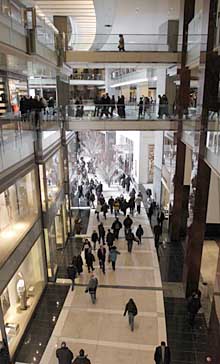
So, in an attempt to get a feel for what we might be in for, I ventured boldly

forth to the Upper West Side this afternoon, to check out The Shops at Columbus

Circle (for that is what this mall

urban retail center has been called). As I walked down Central Park

West towards the new building, I had my own prediction

(about the World Trade Center) in the back of my head:

A large number of national chain stores is an inevitability, if only because

– obviously – there can’t be any small local shops who have been

there for generations. Judging by the World Financial Center, there might

be a few independent restaurants, but the shops are likely to be pretty bland

and corporate.

It

turns out that my invocation of the World Financial Center was prescient. Take

a look at the photo to the left: it’s basically the WFC with catwalks. Inside

and out, the space looks and feels very WFC-esque: there’s the same pattern

of large square windows in steel and stone; the same antiseptic corridors lined

in expensive marble; the same feeling that, basically, you’re shopping in a

high-end office building, or a luxury hotel. Which, of course, you

are.

There is a reason why the best hotel restaurants in New York go to great lengths

to disassociate themselves from their hosts – they have different names,

different addresses, and their own dedicated street entrances. Large hotels

and office buildings, no matter how high-end they are, basically work from the

assumption that they have to be all things to all people. The blandness is not

the result of a lack of imagination: it comes out of the necessity of not offending

anybody.

New Yorkers, on the other hand, have very little truck with not being offended:

if we were easily offended, we would have left this city long ago. What we want

is something interesting, something with character. We’ll try anything once;

if we don’t like it, we won’t go back. But better to err on the side of the

overly

adventurous than to stick to the formulaic.

In such a town, the most successful hotel restaurants don’t look like hotel

restaurants at

all.

As it goes for restaurants, so it goes for shops. One of the hottest shopping

districts right now is 14th Street between 9th and 10th, home to the likes of

Alexander McQueen and Jeffrey. It’s hard to get to, it’s convenient for almost

nothing, and it smells of rotting meat. New Yorkers don’t just not mind a bit

of inconvenience: they actively seek it out. Ever since the light-industrial

wastelands of Soho and Tribeca were first populated by loft-dwelling bohemians,

there’s been a sense that grotty beats glossy every time.

This isn’t just a downtown thing, either. New Yorkers love their quirky department

stores, like Henri Bendel, almost as much for their limitations as

despite them. When it comes to shopping, bigger is most definitely not better:

while we might have one of the largest shops in the world, I’m pretty sure that

Macy’s customers are mostly tourists.

What’s more, New Yorkers are finely attuned to what is unique and what is not.

New York’s most successful retail openings in recent memory were those of the

Prada store on Broadway and Prince, closely followed, in time, geography, and

sensibility, by the Apple store on Prince and Greene. Beautifully designed,

light-filled spaces work wonderfully in Soho, where they contrast with the older

architecture to create a lovely interplay between the industrial and the high-tech

eras.

At Columbus Circle, there’s certainly no shortage of light and space. But there

are no objects of desire fetishistically displayed within the glass and steel

enclosure: rather, all that you see upon entry is walls, escalators and store

logos. Walking around the building, it’s depressing to note that probably the

most inviting part of it is the Thomas Pink store which occupies the 60th Street

end of the arcade on ground level. Visible from the street, the shirts in the

window attract passing foot traffic. At the main entrance, however, there’s

really nothing pulling the pedestrian in to the atrium, since there’s no product

to be seen. Instead, you’re simply pointed to what is where: a bookshop upstairs,

a kitchen-equipment store at the back, a supermarket down the escalator.

A word about that supermarket is probably in order. Yes, it’s big, and yes,

it’s impressive. But it also seems to have been designed by a madman: at the

bottom of the escalator, there’s a food hall behind you, where you can’t buy

food, just sit down and eat it once you’ve bought it. There’s a supermarket

to the left of you, where you get your groceries. And there’s a food court in

front of you, where you get the food to be eaten in the food hall. Then –

and this is the genius bit – there’s a bunch of check-out counters, with

a very incoherent queueing system, to your right. Everybody, whether

they’re buying groceries or ready-prepared food in plastic washable bowls, pays

at the same place. I tried to get a chicken vindaloo, but rapidly realised that

it was going to go cold by the time I was able to sit down and eat it.

The above-ground levels have similarly bad design: one would think that it

was crucial, in a vertical mall, to have lots of stairs and other means of getting

easily up and down from one level to another. Instead, escalators are placed

at the ends of the arcades, and I didn’t even bother trying to get to the top

level.

At the ground level, things are even worse. Upstairs, at least, the shops seem

to know how to present themselves. But down at street level, the same design

plan seems to have been imposed on everybody, where you have to crane your neck

and look up just to find the store logo and work out whose merchandise you’ve

been admiring.

And nowhere is there any sense of surprise or joy. As Manhattan Users Guide

says,

New York derives a lot of its energy from fresh, absurd, or delightful juxtapositions.

But what do you get when you juxtapose J. Crew and Sephora? Crabtree &

Evelyn with Godiva? (For how to do it right, the planners should have spent

some time in Grand Central.) You could name most of the retailers without

knowing a thing about the place.

Indeed, I might add, you could name most of the retailers just by looking at

the type of shops in the World Financial Center, that epitome of Stepford-style

blandness. And MUG is absolutely right about Grand Central, which is a masterpiece

of well-edited retail and food outlets, with nary a national franchise in sight.

So what does this mean for the WTC site? I fear the prognosis is bad. The original

WTC mall, after all, was truly gruesome: the only saving grace in the entire

site was the Borders bookshop. Other than that, it was The Limited next to Sbarro

next to… well, the fact that I can barely remember anything else, despite

the fact that I used to walk through there every day, speaks volumes. It was

home to commuters with thousand-yard stares occasionally picking up a birthday

present for the kids on their way home.

The new WTC won’t be as bad as the old one, of course. For one thing, most

of the shops will be on streets, as opposed to being in a contiguous mall. But

if Time Warner starts making money off The Shops at Columbus Circle, I wouldn’t

be at all surprised to start seeing vertical malls popping up in the WTC office-tower

designs. And even without vertical malls, if the shops are just rented out to

the highest bidders, we’re going to see the same set of nationally-recognisable

franchises, and no sense of character or individuality.

Everybody involved in the WTC planning process agrees that the site should

be a vibrant new city district, with streetlife, nightlife and cultural life.

But entire districts are hard to build from scratch: any new development will

inevitably have a certain amount of sterility to it. What I hope is that someone

smart will take MUG’s advice, look at the Time Warner Center, look at Grand

Central Station, and realise that a bit of central planning can go a long way

in giving an area a personality.

For too long, the west side of lower Manhattan has been devoid of any kind

of positive characteristics. A little slice of suburbia nestled next to the

financial district, it stands in stark contrast to the riotous streets found

east of Broadway. It desperately needs an injection of a little bit of New York

attitude.

There are two things which could happen when the Fulton Street corridor is

completed, and downtown becomes a coherent whole again. Homogenisation could

creep eastwards from the WFC and WTC towards Fulton and Nassau, especially if

lots of new retail is auctioned off as part of the subway station redesign plans.

Alternatively, the reintroduction of Fulton and Greenwich streets, finding their

rightful way back onto the map after a long and painful absence, could create

a lively new civic center: think the Beaubourg in Paris, with Santiago Calatrava’s

gorgeous new PATH station playing the role of the Pompidou Center.

In order for that to happen, the designers of the new site are going to have

to leave themselves open to uncertainty and a little bit of chaos. If everything

is planned and profit-maximised, it’ll just be like today’s Upper West Side

(complete with unimpressive David Childs monolith), only even more boring.

Posted in Culture | 5 Comments

Cities in the Snow

It seems to me that we create cities wherever we live, however much we try

to escape them. And when we hate them, we go further remote just to repeat the

same mistakes. At the risk of sounding overly deep and philosophical in an entry

that has expectations of pure light-hearted escapism, why is this?

I had an amazing day recently. The hassle of Halley had been wearing me down

a bit and I needed a break. We all need a break, we’re working hard and have

long hours, but it’s more than that. It’s impossible to be autonomous, independent.

To move things, you need the vehicle mech, to build things, a chippie, to wire

things up, a sparkie, and to seal things, a plumber. In addition, the steelies

are jacking buildings, the field assistants providing safety guidance for all

off-base activites as well as a lot of on-base ones, the genny mechs keep the

place warm and comms managers work shifts to keep us in contact with the world

and run radio scheds with planes and field parties. Met babes are also on shiftwork,

taking air observations and launching balloons to add to the Met Office weather

forecasting, electronic engineers are probing the crazy currents in the sky

and data managers trying to look after all of our numbers. Plus, handovers are

happening between last year’s winterers and this, people are flying in and out

so there are pilots and plane mechanics requiring support, and the various summer-only

scientists are trying to get their tasks completed before the ship takes them

out in February.

But that’s not it either. I like hubub, I like buzz. It’s the politics, the

interdependencies, the rules and regulations, that’s wearing me down. Every

little thing every person does has an impact or demand on someone else. Usually

it’s a demand for time, expertise or advice. Even if it’s a job I’m intending

on carrying out alone, I need to ask advice on relevant safety procedures and

standard protocol. There are forms and procedures and politics surrounding everything

plus the necessity of keeping people in the loop so they know what’s going on

but not boring them with inessentials about your work that they don’t need to

know. Sometimes I even forget, for a moment or three, that it’s great to be

here, it’s an honour, it’s a dream come true. It doesn’t feel like a dream come

true, it feels like a job I don’t particularly like. At times. It’s exhausting.

For everyone.

So then you have to be extra careful and extra considerate and extra nice because

you know that everyone is as equally knackered as you are. Plus, you live with

these people, and are due to live with them and only them for the next year

or two, so you don’t really want to piss anyone off, or talk behind anyone’s

back, or just VENT because they know the person or situation you’re venting

about and that then will influence their impression of that subject which is

the last thing you want because really, really, it’s not a personal thing, it’s

not even a big or important thing, you just want to go and talk to a stranger,

or a friend, who knows none of these people, and talk shit all night in the

pub.

So there you have it: it’s not all roses. But then, I never said it would

be. I just don’t generally talk about that stuff on the internet! Anyway, it

was time to get out of the big smoke and remind myself of where I was for a

while. I’d been on standby for five days for a co-pilot jolly to Berkner Island

where there’s a deep core drilling project occurring that is very, very cool

indeed. Every morning, 7am. And every morning, no, not today… or maybe, we’ll

check the weather again in 2 hours. And eventually the weather would get worse

or they’d decide to go elsewhere and I’d get on with whatever it was I was meant

to be doing that day. Or trying to get on with it until some other divergence

came along that required more immediate attention. A day of divergences is,

I guess, as productive as a linear path although the final arrival point often

feels much closer to home, where you began, than the intention might have been.

Anyway, I got up at 6:30. 7am sched? Nope, we’re going elsewhere. And so finally,

finally, I made it out to my lab in the bondoo to start unpacking my final machine.

Or penultimate machine. Well, one of the big ones anyway. And finally, finally,

was on a roll, colleagues away at lunch, music turned up loud… and the phone

rings. “The plane’s leaving for Berkner, you’re on it if you want it, how quickly

can you get here?!” Never have I skiied so fast!!

And there I was, 40 minutes later, in a twin otter, flying high, flying away

from Halley, away from the chaos, out over the ice, over the ocean, the waves,

the icebergs, the reflections of the sun through clouds and onto the water below.

It’s ironic really: this is the driest place in the world but yet we’re surrounded

by water molecules, and only water molecules! I live in a giant frozen ocean!

I love it! The clouds are water, the snow is water, the ice and its hundreds

of forms, the ocean – it’s all water, beautiful, wonderful, flowing, moving,

dynamic, water.

Water water everywhere but not a drop to drink. But that’s a further beauty:

you melt it, and you can drink it! Immediate water supply wherever you care

to pitch your tent. How amazing is that?! How convenient! I love it so much.

And my whole scenery, the sphere in which I am flying, it is all composed of

light from the sun interacting with water in various beautiful forms. That’s

it: fire and water. So simple, so incredible. So vast. Shimmerings on ice, crevasses,

glaciers, ice cliffs, ocean waves, clouds, clouds, clouds. I was flying over

Antarctica! Wow!

The flight takes two and a half hours along the coastline, across some frozen

ocean and then onto the south dome of Berkner Island. Berkner is much larger

than I expected; I don’t know what I expected, but I’m sure there are countries

in the world smaller than this island. When we arrive there, I see a few orange

pyramid tents, some flags, skidoo tracks and some people. There’s not much here

at all. I breathe a deep, deep sigh of fresh, unpolluted air. I am here, in

the middle of nowhere, far, far, far away from the politics of bases. This here

is a field camp. It’s great.

Genevieve, a friend from Cambridge, greets me. It’s not at all odd to see

a familiar face in the middle of nowhere although I know it should be. “Welcome

to the city!” she says, and I laugh. And then I realise that she’s only half

joking. There are certainly people in the party who feel it is too luxurious

for a field party. It’s more comfortable than I was expecting, yes, but then,

why not, they’re here for three months every year for three years. And by luxury,

what do I mean? There are a few pyramid tents dotted around, a couple of weatherhavens

and a large drilling tent. That’s it.

Two people share a pyramind tent so your personal space is essentially limited

to the size of your sleeping bag. (In a tent with a relative stranger, that

could get very claustrophobic.) The dome shaped weatherhavens provide a space

to escape to. One has an eating and drinking area, a kettle, some chairs and,

sacrilige for the field, a stereo! The other is an office space. There is also

a toilet tent and a shower tent, again, luxuries of the modern era. The toilet

is an oil drum covered by a sheet of foam with a hole in the top. The shower

is one of those camping bags hanging on a hook holding melted snow. Chilly.

The drilling tent is incredibly impressive. The entrance is at the bottom of

a long deep tunnel and there, inside, in the middle of nowhere, is state-of-the-art

engineering equipment, retrieving ice that was first deposited 5000 years ago!

The floor of the room is about 4m under the snow surface with walls of blue

ice covered by a large dome tent that reaches maybe 3m above the surface. Spacious,

blue, cold. And here they sit and work shifts, drilling, drilling, pulling,

coring, cleaning, processing this precious ice. I saw a core being pulled out

of the ice, carefully, lovingly handled by the ice chemists. This is a true

jewel. It’s so dense, so cold, so brittle, so old. The air bubbles inside are

tiny, compressed under the weight of the ice above. As the ice relaxes to atmospheric

pressure, it hisses and bubbles, you might hear a quiet fizzing and sometimes

shards bounce. Amazing and beautiful to see.

We fly home along the coast and listen to the radio. The antarctic equivalent

of driving home on the motorway tuning in to the stereo. Halley to us, Halley

to field parties, Rothera to field parties, us to Rothera… when you get bored

of one channel, tune into another! All the gossip on these airwaves! You can

even get the world service up here!

And so we fly home and I stare at the ice, at the sea, at the waves and the

clouds. I look around and see no human habitation, no human impact, no wildlife

at all except a couple of birds above the sea. We are far away, this is a special

place. Approaching Halley, I see a few boxes on matchsticks, a couple of masts,

some flags, vehicle tracks and some people. That’s it. There’s not much here

at all. It’s miles from anywhere.

Very soon, only eighteen people will be here, living in these blocks on twigs.

The scenery is huge and vast and dismissive of the human presence. There is

no reason for us to be here. It’s the furthest place in the world from civilisation.

It’s tiny. I breathe a deep, deep sigh of fresh, unpolluted air. I am here,

in the middle of nowhere, far, far, far away from the politics of the world.

This here is an antarctic base. It’s great.

Posted in Rhian in Antarctica | 7 Comments

Who designed the WTC memorial?

One of the more intelligent comments about the World Trade Center memorial

competition – I can’t seem to find who said it, right now – was

that with some 5,200 entrants, the winning design would not be one individual’s

uncompromising vision, pace Maya Lin. Rather, it would essentially

be exactly what the jury wanted it to be: whatever it was that the jury collectively

wanted, they could surely find it among the thousands of different plans with

which they were presented.

This idea gained currency when Reflecting

Absence was chosen, for two main reasons. Firstly, it bore a startling resemblance

to a plan that Maya Lin – a jury member – had previously sketched

out for the site. But more importantly, it suddenly carried the name of Peter

Walker, a celebrated landscape architect, alongside that of the original designer,

Michael Arad. The clear implication was that the jury was essentially forcing

Arad into a direction in which it (the jury) wanted to go. Arad is a mild-mannered

mid-level architect for the Housing Authority in New York, who, frankly, seems

perfectly amenable to being pushed around.

Today, the New York Times runs a long

article about the selection process, which only reinforces the original

thesis. Here’s the key bit:

What swayed the jury was that the "Reflecting Absence" team was

joined by Peter Walker, a well-known landscape architect in Berkeley, Calif.,

who had also submitted a plan to the competition.

"Without Walker, there would not be Arad," Dr. Gregorian said.

"Garden of Lights" had a lot of support, a juror said, but the support

evaporated after a "very unfortunate last presentation" in which

the design team failed to satisfy requests for refinements. Jurors who favored

the "Garden" plan moved to "Reflecting Absence."

The Times has already reported that the jury essentially forced a landscape

architect on Arad, giving him a shortlist of people to choose from and basically

telling him that if he didn’t pretty things up substantially, he had no chance

of winning.

But the bit about "Garden of Lights" is even more germane, really.

The jury wants changes, the designers stay true to their vision, and –

bang – they’re out.

What’s more, the jurors seem to think that their job is not yet done. Here’s

further evidence that the memorial has essentially been comandeered by the jury,

rather than the jury simply picking a designer and letting them run with it:

In a sense, it is just the beginning of a process that could further transform

the memorial. Some jurors vowed that the voice of the jury would continue

to be heard. "We intend," Ms. Berry said, "to see it to the

end."

Now I’m not convinced that having a memorial designed by this particular jury

is necessarily such a bad thing. It’s a very distinguished and intelligent group

of people, who have clearly thought long and hard about the whats and the whys

of building a memorial. They’re working and deliberating at a very high level,

and clearly were not swayed by political or public pressure.

Ironically, they might even have done the very thing that a couple of them

were adamant that they would not do. Here’s the Times article again:

Jurors read an article in The Times on Dec. 7 titled, "Ground Zero’s

Only Hope: Elitism," by Michael Kimmelman, the newspaper’s chief art

critic. He contrasted populism with democracy and suggested that the competition

be started over and limited "to participants of the jury’s expert choosing."

Jurors, including Mr. Puryear, were incensed. "Elitism was something

I was absolutely opposed to," he recalled. "It smacks of smug cultural

superiority, the opposite of the inclusive process we signed onto."

Certainly the jurors spent a lot of time and effort going through the thousands

of submissions. But smug cultural superiority seems to be exactly what the jury

ended up going with: deciding that they knew best, that they could and should

make sweeping changes to the Arad plan, and that if they couldn’t make similar

changes to a rival plan then it would be out of the running.

In fact, the voting process is very interesting in that, it would seem, no

one on the jury ever really voted for anything, at least not until

the very end. The jury set a 100% quorum for making decisions, and every single

juror needed to sign off on every single entry that was eliminated. In other

words, simply by withholding his elimination signature, any one of the jurors

could basically ensure that their favoured plan made to the final nine, and

even maybe the final three.

But at the end, it would seem that the jurors were quite disappointed in the

teams that they had picked. They gave the final nine each $130,000 to turn their

original presentations into professional renderings, models and computer animations

– and discovered that the promise they had seen was not, in many cases,

delivered upon. "A lot of these schemes didn’t deliver the promise of what

was on the stage-one boards," said Michael R Van Valkenburgh, a juror who

is a landscape architect. "It was a very heartbreaking time for the process.""

That probably explains why the shortlisted nine candidates were generally considered

to be so uninspiring. Some

of the jurors didn’t even want the finalists displayed in public. At least we

know now that their reaction was pretty much the same as our reaction: the jurors

weren’t as out of touch as we had thought.

When they saw that the public was on board with their misgivings, I wouldn’t

be surprised if the jury felt empowered to take more control over the final

design of the memorial. None of these designs was all that great, so best that

the jury start pushing the finalists in the right direction. Some designers,

of course, react much better to such pushing than others, and it’s clear that

Arad is one of them. He won in the end, and will always have his name associated

with the memorial if and when it’s built. In reality, however, the WTC memorial

will have been shaped at least as much by the jury as by him.

Posted in Culture | 5 Comments

Long-form reporting in the New Yorker

In his profile

of Larry David in this week’s New Yorker, James Kaplan finishes with an

anecdote. David is sitting in his editing suite, working on a scene where he

gets egged by a carful of teenagers. He can’t work out whether to cut to the

teenagers driving away, or to leave the camera lingering on his egged face.

"I don’t know," David says. "I mean, it’s kind of

fun to see them drive away. On the other hand, it’s fun to see that egg.”

That anecdote, as I just wrote it, takes 68 words to tell. In the magazine,

as Kaplan writes it, it takes 439 words. We learn who’s operating the Avid machine,

and what he’s wearing. We learn the colour and brand of the director’s shoes.

We learn that Avid systems involve both a keyboard and a mouse. We inwardly

scream "get on with it, already!" about half a dozen times.

The New Yorker prides itself on its in-depth features, and the fact that it

is able to devote a lot of space to subjects which in any other magazine would

be drastically truncated. Increasingly, however, I’ve found the magazine devoting

equal amounts of space to subjects which desperately need truncating. We learn

virtually nothing about Larry David in this 6,559-word article, which probably

earned Kaplan a good $20,000.

Weirdly, the piece actually feels brutally truncated in places. We follow David

and Jerry Seinfeld into an NBC meeting where they pitch a sitcom, for instance.

We’re told that "At first, the idea was to have two comedians walking around

in New York, making fun of things, and in between you’d have standup bits."

The NBC people didn’t like it – and next thing we know, the show’s been

going for three seasons.

Kaplan also doesn’t seem to have a clue how much technical knowledge he expects

us to have. One minute we’re expected to know the difference between a one-camera

sitcom and a three-camera sitcom; the next we’re being told how many frames

of video there are per second.

David’s show, Curb Your Enthusiasm, is incredibly self-aware, doing a magnificent

job at skewering the hubris of television types in Hollywood. Yet when its director

launches into hyperbole – something which I’m sure was accompanied by

no small measure of sarcasm in real life – Kaplan simply reprints his

comments verbatim, making him look like just another LA asshole with no sense

of perspective.

The show’s pivotal moment came in the third season, in 1991. Charles

remembers walking with David from the “Seinfeld” offices in Studio

City up to Fryman Canyon to try to break a story: the library-cop episode,

in which Jerry is investigated for keeping a book out for twenty years. “We

had a couple of strands, and I don’t know if it was the oxygen from

the walking, but we were very exhilarated,” Charles said. “We

went, ‘What if the book that was overdue was in the homeless guy’s

car? And the homeless guy was the gym teacher that had done the wedgie? And

what if, when they return the book, Kramer has a relationship with the librarian?’

“Suddenly it’s like—why not? It’s like, boom boom

boom, an epiphany—quantum theory of sitcom! It was, like, nobody’s

doing this! Usually, there’s the A story, the B story—no, let’s

have five stories! And all the characters’ stories intersect in some

sort of weirdly organic way, and you just see what happens. It was like—oh

my God. It was like finding the cure for cancer.”

It seems clear, from reading the piece, that Kaplan never really got what the

New Yorker editors had hoped for when they sent him off to spend a bunch of

time with Larry David and talk to the people around him. Yet after investing

all that time and effort, the magazine evidently felt that it had to publish

something.

Critically, that’s where the general rules of the New Yorker feature well became

a large liability. This is a profile, it’s appearing in the New Yorker, and

New Yorker profiles run between 5,000 and 10,000 words. More, if they’re Joe

Klein on Bill Clinton. Even if the amount of substance in the piece would best

be conveyed in a 1,500-word "Larry David’s show is back on TV, here’s a

little story about him" piece, the New Yorker evidently feels incapable

of doing that.

So we end up with vast amounts of ill-constructed padding. "“Seinfeld”

was scherzo, its fun stemming from the constantly shifting play among its troupe

of four," we’re told. "David’s new form was" – and

here, of course, one expects another musical metaphor, to close the circle.

It never comes: "David’s new form was simpler and starker".

I’ve worried, recently,

about the front of the book; now I’m worried about the features. The New Yorker

under David Remnick is certainly very good at timeliness, and covers foreign

affairs magnificently. Newsier subjects in general are excellently done. But

the kind of thing the New Yorker is famous for – long articles about people

and subjects you didn’t know you might ever be interested in – have been

very weak for a long while. No one cares about John McPhee’s fish, and, as TMFTML

so eloquently put

it, "enough with the fucking bags already" when it comes to picaresque

tales of picking up litter.

We’re told that the New Yorker has recently moved into the black, after costing

Si Newhouse some exorbitant amount of money – much of which went on catering

to Tina Brown’s every whim. It would be a great shame, however, if financial

success came at the expense of the great long-form reporting in which the magazine

specialises. Weak long-form reporting is no replacement.

Posted in Media | 5 Comments

Week One at Halley!

It seems to me that a day lasts a week down here, and a week lasts a month.

But time doesn’t drag, it’s chock to the brim, and there’s barely time to breathe.

But when you do breathe, it’s stunning, and you realise that really, in a place

like this, that’s all we should be doing: breathing, and taking it all in.

Then you get busy again and start forgetting. It’s all very incongruous –

the work and the environment, the office politics and the snow, the meetings

and discussions and then the activity itself. But the ice itself, the place,

the space, that’s not incongruous, it’s simple. Simple (not perfumed, not coloured,

just kind!). And you wonder how a world could have ever existed that could have

filled a brain with so much nonsense as advertisement slogans. Give me time

and space here and I will fly with the fairies.

But what have I been doing? Why the busy-ness? What fills a day? Each

day holds a story, I don’t know where to start. There was the day that I jumped

off a trailer, cut my bum (radio call: “Frank Frank, Katie: we need your help,

Rhian’s cut her bum”; radio silence; construction site laughter rebounding off

the clouds) and had to have three stitches. It was the best hospital in the

world and I recommend it to anyone. We had a meeting of friends, classical music,

poetry recitals (me to them, while they stitched my arse), stitching classes,

much laughter and then three days of happy pills. I was much more chilled out

after that. And the corners that did the damage in the first place had all been

filed down before the end of play that day.

And then there was the day we built a big mast (lots of digging) and today,

when we put a massive mirror on the mast and bounced a light off it from 4km

away… and it worked! Oh yes, and I forget,

best of all was last week on Saturday when the whole base stops work at 5pm

instead of 7pm (we start at 8am) and have Saturday night scrubout and I got

to clean the library for two hours.

What a joy! I had to get someone to check up on me in the end because more

pages were being cleaned by my eyes than shelves by my duster. What a great

library! You can tell loads about the type of people who come here – I

could write a chapter on the library alone! There’s a whole section with great

Antarctic literature and diaries, of course, and then polar exploration, exploration

in general, sailing, rock climbing, skiing. I’m talking a shelf each for these

topics in a room the size of your average boxroom.

Top shelf in the corner has religion and psychobabble next to history, and

then, below it, military greats. The bottom shelf, of all levels, has antarctic

press cuttings and records. Around the corner we have, top shelf again, poetry,

travel, languages and music and then lots of humour, cartoons, sci-fi (shelves

and shelves of star trek and Stephen King) and then at last, the alphabet begins.

I’m not as savvy at perusing the alphabet because the shelf doesn’t give you

any hint of what you might be looking for, but already I’ve seen some classics

that I want to dive in to – how do you book lovers do it? I know this

room is stacked with Great Novels by Great Writers (I barely got beyond rows

of Amis and Amis) but how do you know which to pick when the only way they’ve

been organised has been alphabetically? Far too sterile. I’m looking forward

to finding out though. if I ever get time to breathe.

Posted in Rhian in Antarctica | 5 Comments

Victims’ families

Wednesday’s Guardian led, reasonably enough, with the suicide of Harold Shipman.

The headline,

though, splashed across the front page, was peculiar: "The final betrayal".

Here’s how the story started:

Just after 6am yesterday, Harold Shipman, described as a man addicted to

murder by the judge inquiring into his 23-year killing spree, wound one end

of a prison sheet round his neck and the other round the bars of his cell

and took his own life on the eve of his 58th birthday.

It was the final betrayal.

The Guardian clearly took the view that on the day of Shipman’s death, the

defining point of view was that of the victims’ families. They, after all, were

the ones who were "betrayed":

Jane Gaskill, daughter of one of Shipman’s victims, 68-year-old Bertha Moss,

said: "He has won again. He has taken the easy way out. He has controlled

us all the way through and he has controlled the last step and I hate him

for it."

What a horrible man this Shipman was! Not only did he murder at least 215 people,

but he also betrayed their families!

When I read something like this, I feel a screeching of ethical gears. Yes,

betraying victims’ families is a bad thing: we should all have compassion for

these people. But compared to one of the biggest killing sprees the world has

ever known? It’s not really up there on the scale.

The Guardian also reported

on the fact that Shipman’s wife would now be receiving a pension. Once again,

the victims’ families are trundled out:

Some relatives of his victims were said to be upset at hearing that she would

be receiving the money. Ann Alexander, the lawyer representing relatives of

many of Shipman’s victims, said: "The families that I have spoken to

are deeply uncomfortable with this."

Anybody associated with the WTC, of course, knows what it’s like to be guilt-tripped

by victims’ families, who seem to have more control over the rebuilding of the

World Trade Center site than even Daniel Libeskind. It was the victims’ families,

for instance, who more or less forced the WTC footprints to be treated as "sacred",

thereby essentially dictating the overall site plan. They also forced the memorial

designers to go down to bedrock (that’s "sacred", too), include an

area with relics from the disaster, and even include a special room in the memorial

just for them. They also managed to frame the terms of the debate, making it

clear that the more acreage that was given over to the memorial, the happier

they would be. Never mind the quality, feel the width!

Oh, yes, and they also got $5.2 billion of federal funds in compensation for

their family members’ having been killed. In my last posting I complained about

the enormity the $1.5 billion that Bush is intending to spend on marriage: that

sum is dwarfed by the amount he’s already spent on WTC victims’ families, and

which, of course, comes on top of enormous life-insurance and charitable contributions

the families also received.

It seems that when lots of people lose their lives in a headline-grabbing event,

the families first receive sympathy, then are told that nothing can possibly

compensate them for the loss they have suffered, and then finally everybody

starts, well, trying to compensate them for the loss they have suffered –

if not with money, then by making every effort to give their opinions on anything

to do with the tragedy much more weight than everybody else’s.

The upshot of this is that we essentially get a hereditary system of control

over enormously important matters such as the rebuilding of lower Manhattan.

And just as there are good kings and bad, there are useful victims’ family members,

and then there are ones who are, well, not so useful.

Sometimes, as in the case of Pan Am flight 103 and Jim Swire, the spokesman

for UK relatives in Lockerbie, the victims’ families end up playing an extremely

important role in a very professional manner. At other times, we get quotes

like this one, from Anthony Gardner, a member of a coalition for WTC victims’

families, on the subject of the proposed memorial:

"This is minimalism, and you can’t minimalize the impact and the enormity

of Sept. 11," Gardner said. "You can’t minimalize the deaths. You

can’t minimalize the response of New Yorkers."

Even so, criticizing family members is completely taboo. Everybody involved

in the WTC project, for instance, insists on referring to pretty much all the

victims as "heroes", even when they did nothing heroic. This pisses

off the family members of the uniformed personnel, who want their family

members singled out as being the real heroes of the day. A lot of them

received so much money in the wake of the tragedy that they have essentially

now become professional Family Members, spending vast amounts of their time

lobbying for whatever it is that they want to see on the site. Far from moving

on with their lives, they are stuck in September 11, 2001, reliving it over

and over again.

One word that frequently comes up in such discussions is "closure":

Shipman’s victims’ family members need him to describe what he did and why he

did it before they can achieve closure, or the WTC victims’ family members need

a place where unidentified remains are kept before they can achieve closure.

But I’m far from convinced that closure really exists in the kind of sense

that these family members seem to think it does. Even if it did, I’m pretty

sure it can’t be achieved through external, as opposed to internal, means. But

it’s taboo to say such things: the family members have become secular saints,

and anything they say must be given the fullest measure of respect, just because

of who is saying it. No one else in society has their words received so uncritically,

and I’m not sure that it does anybody any good in the long term.

Certainly, its very far from edifying to see a 9/11 firefighter’s widow splashed

all over the front page of the New York post for taking up with another, married,

firefighter. The saint is in fact a sinner! We all know that the tabloids love

to raise people up only to knock them down again, but adulterous affairs happen

the whole time, and this is only news because it’s based on the erroneous assumption

that as a Victim’s Family Member, she was somehow raised up to a higher level

to start with.

I think that this deification of the family members is actually a byproduct

of our media-saturated society. After all, people die tragically every day,

in car accidents or from rare diseases, and the deaths reverberate in their

families for years. But those families don’t get kowtowed to in the national

press, don’t get to tell the rest of the world what’s sacred and what isn’t,

don’t dictate front-page headlines in sensible papers like the Guardian. It’s

only when the tragedy makes news headlines that the transformation occurs.

Wouldn’t it be great if news organisations pledged not to quote victims’ family

members unless they say something useful and/or interesting? If they realised

that such people simply don’t have privileged access to the truth? But that

will never happen. The family members would never stand for such a policy.

Posted in Culture | 1 Comment

Maybe they can sign up Britney as a spokesperson!

We’ve known for a while that the Bush administration’s fiscal policy can roughly

be summed up as "throw money at anything that moves; reduce taxes on anything

with money". But this really takes the biscuit: the White House has now

managed to dream up a plan to spend $1.5

billion to promote marriage.

Most of us have daydreamed occasionally about what we’d do if we won the lottery,

and had $1 million or 10 million or $100 million to spend. At some point, the

amount of money just becomes ludicrous, and you have to start dreaming up increasingly

outlandish notions just to make a dent in it. But $1.5 billion on marriage?

What are you going to do, give 150,000 couples a $10,000 wedding each?

We’re told that "under the president’s proposal, federal money could be

used for specific activities like advertising campaigns to publicize the value

of marriage". With that kind of money, he could buy every single spot in

the Super Bowl ten times over, or alternatively buy every single ad page in

every single Condé Nast magazine for an entire year. If that’s what marriage

is worth, how much will he spend on babies next year, I wonder?

Hilariously, the Times characterises the program as being "relatively

inexpensive", without bothering to say what it’s inexpensive relative to.

The cost of invading Iraq, perhaps?

Politically, I have to say, the move makes enormous amounts of sense, killing

lots of birds with one stone.

  • It’s almost impossible for Democrats to oppose: anybody who speaks out against

    it will be "anti-family" and "anti-marriage". So Bush

    will continue to set the agenda, while the Dems struggle to keep up.

  • It appeals directly to fast-growing evangelical churches, who believe strongly

    in the sanctity and desirability of marriage.

  • And if you combine those two reasons, you get the real kicker: it’s almost

    impossible for homophobic "pro-family" types to oppose. You can’t

    oppose a pro-marriage program, especially when it’s confined to heterosexuals,

    on the grounds that it’s not an anti-gay-marriage constitutional amendment.

No one ever said that Karl Rove wasn’t clever: he’s throwing the rabid Christian

right a bone to shut them up during the general election, when the last thing

he needs is a bunch of grass-roots supporters banging on about gay marriage

and constitutional amendments. That kind of rhetoric might get votes in Alabama,

but what Bush really needs is California and Florida, both of which are crawling

with gays and gay-friendly voters.

There’s nothing gay-friendly about this proposal, of course. That’s the genius

of it: in order to quash the unhelpful gay-marriage debate, Rove is trying to

quieten down the agitators on the right, rather than the pro-gay campaigners

on the left. He’s even rolling out Wade Horn, the assistant secretary of health

and human services for children and families, to say things like "If a

gay couple had a child and they were poor, they might be eligible for food stamps."

Gee, thanks, Mr Horn, I didn’t realise there was a movement afoot to deny food

stamps to otherwise-eligible homosexuals. (In contrast, of course, if a straight

couple had a child and they were poor, the government would be falling over

itself trying to use that $1.5 billion to make sure they got married and stayed

that way.)

But my favourite bit of the article is this:

This year, administration officials said, Mr. Bush will probably visit programs

trying to raise marriage rates in poor neighborhoods.

"The president loves to do that sort of thing in the inner city with

black churches, and he’s very good at it," a White House aide said.

Of course he "loves to do that sort of thing in the inner city".

Fly in, get your picture taken with a passell of grinning brown children, shake

hands with a priest, and fly out again. Does wonders for your reputation as

an elitist oligarch who only looks out for his bazillionaire friends.

The sad thing is that in its own narrow way, the thinking behind this program

might well be right. Yes, if you persuade young parents to get married and commit

to bringing up their children in a stable family environment, then those children

are likely to turn out healthier, richer, better educated, and less likely to

be in trouble with the law.

On the other hand, if you really wanted healthier and better educated

children in the inner cities, maybe you’d invest a bit more in, well, healthcare

and schools. But providing healthcare for all children is "socialistic"

and beyond the pale, while any attempt to redirect funds from richer to poorer

school districts is "class warfare". This, on the other hand,

telling everybody to marry up and settle down, this is compassionate

conservatism. Do try to keep up.

Most depressing of all, thanks to Bill Clinton, who unforgivably signed the

Defense of Marriage Act into law, we can’t even have a sensible debate about

whether the benefits of this program should be extended to gay couples as well

as straight ones. It might be desirable in theory, but unfortunately, thanks

to DoMA, it would be illegal.

So we’re left with yet more hugely expensive photo-opportunities, trying to

solve deep social problems while using only techniques with an overtly religious

bent. I’m sure that Joe Lieberman will be leading the applause when this is

announced in the State of the Union. Separation of church and state, my arse.

Remember that the first words David Frum heard when he started working at the

White House were "missed you at Bible Study".

Posted in Uncategorized | 4 Comments

On the ice at last: it’s all go!

Happy New Year, Happy Christmas, and thank you to all who have left messages

here or sent emails. It’s lovely to receive word from home and from friends,

and amazing to think that folk out there are reading this stuff!

Word on the ice is that, as the winter progresses, the volume of correspondence

from the Outside World decreases such that, come mid-winter, you truly are an

isolated core, desperate for news or proof that you did once have friends, somewhere

in the world. Here, the solitary Antarctican thinks, “oh, so the novelty’s worn

off, has it, and now I’m no longer worth remembering,” while at home, no doubt,

life goes on so busily that you scarcely notice it’s been a month and, anyway,

there’s not much to say these days.

It’s been interesting for me to hear these stories, wondering if we, too, will

experience all these apparent inevitables. In fairness to the folk who have

remained throughout, they all still smile a lot and appear to be sane, so I

retain faith.

We stopped bashing the ice. It hurt too much and got us nowhere. Halley base

pulled out the stops, fashioned a bridge across the big crack and located safe

spots to cross the smaller cracks, laid out a 7km drum line from the ship to

edge of the ice-shelf and then another from these cliffs to the base, about

13km.

Relief was carried out in two camps: shipside and base-side. I was shipside.

(Last year I stayed on base so check that

entry if you want the full picture.) It was great. There was action at last!

Unloading boxes, discovering new levels to the Shackleton that I could never

have believed, days of fuel drums, nights and days of 12 hour rotating shifts,

hard physical work. Cargo is offloaded to sledge. Sledge is pulled by sno-cat

across sea-ice. Sno-cat driver drives cat, driver’s mate sits on sledge with

radio and throw bag. If driver falls into ice, driver’s mate saves him. If the

sledge is too full, driver’s mate follows on sno-cat.

My sometime job, driver’s mate, was the best job in the world. Sitting on a

sledge, watching the world go by, staring at clouds, admiring icicles and cliffs

on the shelf, blue blue ice, imaging what must be inside those crevasses, away,

away, away, from the mayhem of the cargo hold. Strops and straps, weight loads,

cranes, crossed information, endless, endless boxes and crates, drums and drums

and drums and drums. So much fuel, so much impact, can we really justify our

existence?

And then the skidooing, hard work, bounce, bump, steer her back, topple over,

jump up again, zoooom, up beside the driver, wave, yup, communication all intact,

mine sits like a Harley, I feel like a motorbike bodyguard beside a limousine.

Zooom, bounce, bounce, o my, look up, can’t; wind in face, thumb hurts, wind,

I’m cold, but sweating lots, this thing is heavy.

Penguins. The wildlife! O! the wildlife… I had no idea so much was going

on down here at the coast when up there on the ice shelf it is all so barren

and bare. The wildlife! I saw whales, up close, checking out the ship, amazing,

and then swimming under us, under the ship, under the ice we are moored against

and driving on (it is 3m thick, don’t fear). And seals: leapoards and weddels,

a pup sliding right close, snapping at the lines holding the ship in. Lots of

emperor penguins, always nearby, and the occasional adelie, so sweet, so comical,

bewildered by our activity, not knowing where to go, or how. Wilson’s storm

petrels, a giant petrel and the ever beautiful snow petrels. (There are lots

of petrels, – the name apparently comes from Peter, biblical, the fisherman

who tried to walk on water, because they fish, and when they take off, they

walk on water, or something like that. Their beaks are very cool anyway, – little

in-house desalination plants. You can even see the salt that has crystallised

out!)

But I don’t want you to get the wrong idea. It’s like German irregular verbs:

you spend so much time learning about them that you never really get the ‘regular’

bit right. Most of the time, it is still void of life here, these sitings are

a song in silence. But so wonderful when they do happen. Them in just their

skin while there’s me in my orange dayglo gortex super everythingproof allinone

tellytubby outfit, and mask, and three hats. And the patterns in the snow and

the cliffs, and the ice, the ice, the ice!! There is so much to see in a landscape

that is apparently empty. I now realise why Manhattan did my head in last March.

You start to see detail in the plainest of things. Angel-dust in the air, arches

in sastrugi, the accumulation of snow on yesterdays footprint. I love it, I

love it, I love it here. And then we came to Halley, and I love it here too.

But I’m knackered.

Posted in Uncategorized | 2 Comments

Hey! It’s a brand-new Dey!

The New York Post has a great scoop

today about the new Santiago Calatrava PATH station at Ground Zero. Unfortunately,

the Post spins the story as being about Libeskind’s Wedge of Light: the headline

is "PATH Plan May Dim Libeskind’s Tribute". Of course, it won’t, and

as the story goes on to say, Libeskind considers the Calatrava design to fit

perfectly into his master plan.

According to the Post, the Calatrava plan moves the new PATH station north

a little bit from where Libeskind had it. That does two things, one minor and

one major. The minor change – which the Post fixates on – is that

the Wedge of Light becomes a little bit smaller. But the Wedge of Light was

never about internal area: it was always about the angles of the walls abutting

Fulton Street. The angles, we can safely assume, remain intact.

The real story here, the major development, is that Calatrava has resuscitated

Dey Street. Under the original Libeskind site plan, Dey stopped at Church Street,

right where it ends today. Post-Calatrava, however, it continues all the way

on to Greenwich Street, as a pedestrian promenade. As ever, the more streets

the better, so this is officially a Good Thing.

Interestingly, as the designer of the first major public building on the site,

Calatrava has managed to do wonders for the commercial building next door. Now

that it has a north-facing street frontage opposite the station, the tower between

Dey, Church, Greenwich and Cortlandt can have shops on all four streets, including

the most-trafficked side of all. Critics of the WTC redesign often play up the

conflict between good public spaces and profitable commercial buildings; in

this case, what benefits one also benefits the other.

Meanwhile, it looks increasingly as though Cortlandt Street, which Libeskind

had as a pedestrian promenade between Church and Greenwich, is going to be upgraded

to something which can accommodate cars. (Just because it can have

cars doesn’t mean it will, of course.) The office buildings planned

for the WTC site are all going to be grade-A towers, full of lawyers, bankers

and the like. Such tenants nearly always want a fleet of Town Cars at their

disposal at all times, and those cars need to line up somewhere; Cortlandt Street

seems as good a place as any. It’s entirely possible, of course, that Cortlandt

will be closed to all but fleet traffic.

The real thing to get excited about here is the prospect of genuine street

life within the WTC site. Greenwich and Fulton streets were always going to

be major pedestrian thoroughfares (albeit with cars as well, of course), but

now the addition of side streets to the plan gives a little bit more humanity

and a little bit less of a corporate theme-park feeling to the site. The more

streets there are, the less likely it is that the area between Fulton, Greenwich,

Church and Liberty is going to be another montrosity along the lines of the

Time Warner Center on Columbus Circle. Thank you, Santiago Calatrava, for making

a good site plan even better.

Posted in Culture | 3 Comments

Sharon Waxman shames the New York Times

The New York Times, in its efforts to transform itself into a truly national

newspaper, has of late decided to beef up its coverage from the third most important

city in the country, Los Angeles. LA has never had anything approaching the

depth of coverage that New York and Washington have, but now the Times wants

to start breaking entertainment-industry news, and to become more relevant to

west-coast readers.

After a long and high-profile

search, then, the Times finally alighted on Sharon Waxman, a Washingon Post

style reporter, to replace the fluffy and harmless Rick Lyman. A former foreign

correspondent, Waxman was charged with getting her byline on the news pages,

rather than simply observing the Hollywood hype machine.

And she’s done just that, with two consecutive stories, yesterday and today,

on the ongoing Michael Jackson affair. The first

one put a lot of meat on the bare bones of the "Jacko X" story,

trying to get to the bottom what the Nation of Islam was and wasn’t doing with

the beleaguered popster. After talking to half a dozen sources, both named and

anonymous, Waxman said that the Nation of Islam was essentially controlling

all access to Jackson, resulting, inter alia, in the departure of his

longstanding spokesman, Stuart Backerman.

The story was solid and well-reported, and even included a classic non-denial

denial from Jackson’s lawyer, Mark Geragos: "Mr. Geragos said that members

of Mr. Jackson’s security detail were Muslim but that that did not mean they

belonged to the Nation of Islam." That’s right, Mark, but it also doesn’t

mean they don’t.

Ultimately, however, the Times was late to the story, which was first

broken as early as December 18.

Waxman’s big

scoop, then, was today, with an article headlined "Michael Jackson’s

$1 Million Interview Deal". This story, in contrast to yesterday’s, is

a lot rockier, and, frankly, not up to the normal reporting standards of the

New York Times.

This isn’t a case of solid reporting under a sensationalist headline: the lead,

in typical let’s-try-to-fit-everything-into-one-sentence fashion, says that

"Michael Jackson struck a deal with CBS to be paid in effect an additional

$1 million for both an entertainment special to be broadcast on Friday and his

interview on ’60 Minutes’ this past Sunday, part of yearlong negotiations between

CBS and Mr. Jackson, a business partner of his said on Tuesday."

There follows 1,200 words of very dense and hard-to-follow prose, during which

none of the questions raised in the lead are really answered. What does "in

effect" mean? Who’s the "business partner"? And was Jackson paid,

or is he just of the opinion that he has "struck a deal to be paid"?

The story, of course, if it really was a story, could have been reported much

more simply: "CBS paid Michael Jackson $1 million for the interview he

gave to them." But the Times never really comes out and says that: rather,

it says that the $1 million was "additional", while remaining tantalisingly

vague on the subject of what, exactly, it was additional to.

What we know is that CBS had a $5 million deal with Jackson to put on an entertainment

special during a sweeps period, and that CBS had already advanced the singer

either $1 million or $1.5 million of that fee, depending on whom you believe.

The special was cancelled when Jackson was charged, and then reinstated after

Jackson gave the interview.

Everything else is murky. Here’s the Waxman reporting:

Both CBS and the Jackson business associate said that Mr. Jackson had failed

to record the show, effectively rendering the $5 million deal moot. CBS tried

to recoup some of the money it had advanced by offering another $1 million

in exchange for an interview by the correspondent Ed Bradley of "60 Minutes"

last February, the Jackson associate said.

Everyone agrees that interview never happened, because CBS never paid Jackson.

Fast forward to last week:

The latest round of negotiations resulted in an agreement to do the aborted

interview with Mr. Bradley, an airing of the special without the still-incomplete

music video and another $1 million to Mr. Jackson, according to the Jackson

associate.

I’ve read these paragraphs over and over again, and I just can’t make sense

of what they’re trying to say. If the Michael Jackson special was "moot"

as long ago as February and CBS wanted its $1 million back, how was it going

to get that money by paying the star another $1 million on top?

More importantly, what was the $1 million on top of? Was it on top of the $1.5

million already advanced, or was it on top of the $5 million already agreed

for the special? It’s a world of difference: if it’s the former, then far from

paying for the interview, it would seem that CBS actually managed to get its

Michael Jackson special for half the agreed price. But nowhere in her 1,241

words does Waxman deign to actually do the maths, and tell us that $1.5 million

+ $1 million = $2.5 million total, or that $5 million + $1 million = $6 million

total.

If CBS ends up paying $6 million for a special plus an interview, after already

agreeing to pay $5 million for a special, then it certainly looks as though

the station has paid $1 million for an interview. If, on the other hand, CBS

ends up paying either $2.5 million or $5 million for the special plus the interview,

then it looks as thought the interview was free.

But Waxman completely fudges the question, simply saying that "it was

unclear how much Mr. Jackson will ultimately earn from the programs."

In a case like this, where you’re accusing a major news organisation of a major

ethical impropriety, you had better have your facts straight: making the

accusation and then saying that the facts are "unclear" is pretty

dodgy journalism.

What’s worse, this entire story is based on a single anonymous source.

The only backup that Waxman has for her claims is this one "Jackson associate,"

whom she admits "was speaking to the news media because he had not been

paid his commission for negotiating the deal and had been denied access to Mr.

Jackson".

So scratch that: the entire story is based on a single anonymous source

with an admitted axe to grind. How often do such stories make it into the

New York Times’s news pages? Not often, I’d hope. If the Times does run such

stories – and I’m sure that most of us would rather it didn’t –

then it should do so only when the source is very, very senior, and very, very

trusted. But neither of those crtieria seems to obtain in this case: in fact,

Roger Friedman of Fox News says

today that

Maybe someone should tell Times editor Bill Keller that Waxman spent a good

deal of her day on Monday chatting up Jackson’s former manager Dieter Wiesner.

Now back in Germany, where he owns sex clubs, Wiesner was very happy to tell

Waxman anything he could think of to destroy Jackson’s reputation.

I have no idea if Friedman is right, but it certainly fits: Wiesner was a named

source in yesterday’s story about the Nation of Islam, although he provided

no on-the-record quotes. He was also certainly in a position to be getting commissions

for negotiating deals.

In the end, I’m perfectly happy to believe the worst of everybody involved

in this – Jackson, Wiesner, Moonves, Friedman, and all the others. But

the New York Times shouldn’t print such an incendiary story about a rival news

organisation unless it’s sure it’s got its facts straight. I’m reasonably sure

that the New York and Washington news desks would never have printed this story;

the LA bureau should not be held to a lower standard.

UPDATE: Lisa de Moraes, in the Washington Post, weighs in with vehement CBS denials of just about everything in the article.

Posted in Media | 6 Comments

So close but so far away

(A quick note of explanation from Felix: sea ice has blown back towards

Halley, and where it meets the sea ice which never detached itself in the first

place, there’s a five-foot crack which precludes moving heavy equipment off

the boat and onto the base. So the RSS Ernest Shackleton is trying to crunch

its way through the ice until it reaches the crack and can start unloading.)

I will try and describe what I see before me when standing out on deck. Firstly,

it is not that cold, especially not with Antarctic gear on. Minus a few perhaps,

sometimes even up to plus one. Secondly, there is a lot of white. And a lot

of white on white. Without sunglasses, you can’t see much at all; it’s too white

and too bright. With sunglasses, the picture gradually emerges, like one of

those computer-generated posters that first looks like nonsense until an elephant

appears in 3D. Once you see the elephant, you will never see the nonsense again.

So it is with the ice cliffs.

But first, the immediate surroundings. We have barged and bashed a channel

through the sea ice that is 1-2 km long, a couple of ship-widths wide and has

a bend in. It took three days to do this. The motion of the ship was worse than

Biscay when ramming at top

energy – we back up, speed up, ram ram ram, brace brace brace, the ship

hull slides over the sea ice and crashes down: thump. Often one whole side of

the ship points worryingly to the sky. And then we sink down again, anxiously

scanning the ice for any sign of a crack that we can pursue. Usually there is

none, the result being more of a nibbling than a munching. So we’ve now stopped.

It’s stalemate0

It could take weeks for to reach the crack between us and Halley. Maybe Halley

can find an alternative route for us. I’m glad I have no role in the decision

making right now. After making such good time here we might end up with a significant

delay in arrival. For winterers expecting a handover and no more, that’s no

calamity, yet, but for folk here for the summer only, time is already pushed

in a six week season. At some point, we’ll have to start prioritising tasks.

The good news is that we can cross the crack by skidoo and some people have

gone up to base already. The bad news is that none of our heavy cargo will make

it as things currently stand.

Back to the scenery. Around us is a channel of ice porridge, slushy, on the

cusp of freezing and thawing. It looks like Lux flakes, I don’t know why. Above

the surface is the sea ice we’re trying to break up. This is perhaps 2-3m thick

at its worst, easily 1m thick in most places. This is ice that formed last winter

and hasn’t melted or been blown out to sea yet. On top of the ice therefore

is a years accumulation of snow,- at least another metre and heavy. So we’re

driving through porridge, trying to break up a heavy, soggy, very stable wall

of ice. And when it does break up, it falls into the porridge and stays there.

We need wind. Usually there has been a strong burst of wind by this time of

year that creates a large swell and breaks up the winter ice. This year’s winter

was particularly cold but the summer has been amazingly calm. Nice for the residents,

not for the ship.

On top of the sea ice is sastrugi, beautiful sastrugi, and penguins. Sastrugi

forms when the wind blows snow about,- it is the formations of snow on the top

layer. It’s all the vertical structure I have to feast on, maybe only 5cm high,

but to my eyes, as beautiful as a forest. In a very different way. The penguins

are emperors, large and elegant, yellow collar, head held high, proud. I hadn’t

seen them swim before; they are more like seals than dolphins in the water,

unlike their littler cousins. Adelies, gentoos, chinstraps – they fly

out of the water, following a parabola with their entire bodies, completely

air-borne at the top of the jump. This is called porpoising and makes you giggle

every time you see it. Emperors are larger, sleeker and, I imagine, heavier.

When they swim, their backs emerge but not their whole selves. Watching them,

they are less playful but just as much fun. Only when following an emperor swim

deep, do I realise how clear this seemingly black water really is. Deeper and

deeper they twirl, then they dissappear. A minuter later, flying, flying, they

fly out of the water and onto the ice, slip slide, wheeeeeeeeeeeeeeee on their

bellies, brace with their wings, stand up, shake off and walk away as though

that wasn’t really the best thing they could imagine doing ever.

There is about 10km of sea ice between us and the ice shelf. Half way between

the two is this damned five foot wide crack. Everywhere else, the sea ice is

thick and strong, perfect for relief of the ship. The ice shelf however, that’s

what calls me. The cliffs are about 50m high and, when the sky’s clear, endless

in both directions. They look a bit like Beachy Head or the Seven Sisters except

they’re white all over. That is the edge of the ice shelf which is the edge

of the continent, miles and miles away, that is Antarctica. The pedant in me

knows that although this place is known as ‘The Real Antarctic’, it’s not –

one day I’d like to feel the Land under my feet as well. Perhaps in the Dry

Valleys or the South Pole. I’m not picky! For now, however, I’ve arrived, I’ve

come home to Halley. I don’t know why this place makes me tick but it does.

It’s just so huge, and so white, and there’s so much ice.

Posted in Rhian in Antarctica | 6 Comments

Selling Apples

There’s a lot of garbage

written about Apple, but the cover

story of the latest issue of Fast Company seems pretty fair, if unoriginal.

(Innovation on its own doesn’t make money: who’d’a thunk?) The bit which piqued

my interest was in the sidebar at the bottom of the article, on the new Apple

store in Burlingame, California:

The store is done in iPod shades of white. "We chose hand-selected Tuscan

stone for the floors–a stone that’s somewhere between sandstone and limestone,"

says Ron Johnson, Apple’s vice president of retail. "It’s the same stuff

Florence was built on." …

Apple is holding leases on some of the most expensive real estate in the country,

in places such as tony Michigan Avenue in Chicago and New York’s trendy SoHo.

And then there are those Tuscan stone floors. "Apple is creating a boutique

environment, and they’re doing it in a very expensive way," says Roger

Kay, from the technology market research firm IDC. "It doesn’t seem very

reliable as an approach for selling large quantities of goods."

I think Kay is exactly right. People tend to ooh and aah whenever they see

an Apple store: they’ll even line

up round dozens of blocks to get in. It’s far from clear, however, that

the Apple stores are particularly good at getting people to actually buy their

computers: the company’s market share seems to be stubbornly stuck at around

3% these days.

Apple’s retail strategy isn’t working,

and the reason, I think, is the signal that the expensive polished fabulousness

of the stores sends to the Great Unwashed on Wintel machines. Tourists from

Pennsylvania come to New York to window-shop, and if they walk down Prince Street

from the Prada store, they’ll find Apple just past the Mercer Hotel, and opposite

Miu Miu. All of them have austere white interiors, carefully designed to showcase

objects of unrivalled beauty and sophistication (or, in the case of the hotel,

Christina Aguilera). For all that people are welcome to browse the machines

in the store, check their email, and ask questions, you’re never quite rid of

the feeling that you’re basically in a design museum with price tags.

Virginia Postrel is making a

big splash these days with her book

about how great design is becoming ubiquitous in contemporary culture. But there’s

something interesting about, say, the huge success of Michael

Graves at Target: while the individual items are wonderfully designed, they’re

still sold alongside bog roll and Wonderbread in cavernous warehouses abutting

even larger car parks. They’re cheap, they’re accessible, and they’re not in

the least bit intimidating.

Now, New Yorkers do not get intimidated by retail spaces such as the Apple

Store Soho, and in fact it might be the perfect shop for them. But selling Apples

to downtown New Yorkers is a bit like having half a dozen shops in the Bay Area:

you’re preaching to the converted. Apple wants its stores to appeal to the 97%

of the population who use Windows, and that means going beyond the creative

metropolitan types with high disposable incomes and targeting what politicians

like to call Working Families.

For

one thing, Working Families live in places like Oklahoma and Oregon, neither

of which have an Apple store. If you look at the map on the left, the black

dots represent Apple retail outlets: they’re clustered in Boston-Washington

corridor, the two big California conurbations, and a handful of other urban

centers. Dye the Apple stores blue, and you could almost have a map of Democratic

states. (No wonder Al Gore’s on Apple’s board.)

More importantly, however, Working Families, even if they’re in Oakland or

Staten Island and have easy access to an Apple store, tend not to pride themselves

on paying extra for glitzy packaging. That’s not to say they won’t do so if

given the opportunity: if they see a sleek stainless steel dishwasher next to

an ugly beige one, they might well pay a small premium for it. But here’s a

thought experiment: take that same sleek stainless steel dishwasher, at

the same price, and put it in a super-sleek Soho kitchen-design store,

full of polished marble countertops and state-of-the-art ranges. Then, take

your average working stiff, put him or her in that shop, and ask him if he’d

like to buy the dishwasher. There might be lots of cooing over it, but ultimately

the answer will be "oh, no, that’s not for me."

What Postrel talks about in her book is not just a reflection of the way in

which Americans are increasingly conscious of good design; it’s also a reflection

of the way in which American mass retailers are increasingly proficient at selling

that design to their customers. But Apple is not, and never has been, a mass

retailer, and its aesthetic is much closer to Helmut Lang than it is to JC Penney.

It’s entirely natural and proper for Apple to position itself as the computer

company for people who "think different". But the risk in that strategy

is that people will consider themselves more-or-less normal as far as computers

go, and therefore not the kind of people who should be getting a Mac. I have

a nasty feeling that Apple’s ultra-high-end retail stores only serve to reinforce

that notion: that Apples are for the kind of people who shop in Soho, or Michigan

Avenue, or Ginza.

What Apple needs to do, I think, is break out of the white box. The white stores,

the white-background television ads, the white computers: these all look gorgeous,

but they’re also somewhat intimidating. People need to be persuaded that the

guy next door has an Apple, not because he’s different or particularly cool,

but just because it does what he needs it to do much better than a Windows machine

could.

In a way, the evangelical fervour of the Apple faithful works against the company:

the average Windows user, looking at the wild-eyed fanatics who’ll line up round

the block to celebrate the release of an upgrade to their operating system,

simply doesn’t understand why anybody would feel so strongly about their computer.

These people, maybe they Think Different because they are different.

Most people are intimidated by computers, and Apples, by right, should be less

intimidating than PCs. Apple should, really, be able to paint PC users as the

megahertz-and-gigabytes crowd, while Mac users don’t really care what’s going

on under the hood, they just know that they find it really easy to get things

done. Apple shouldn’t be the computer equivalent of a Viking

range. Rather, it should be a George

Foreman grill: simple, accessible, and popular.

Apple probably came closest to that ideal when it released the original iMac

in a rainbow of fruit flavours, back in the olden days of OS 9. But, bizarrely,

now that it has an operating system which is orders of magnitude better, Apple

doesn’t seem to have capitalised on its newfound user-friendliness to gain any

market share at all.

When Steve Jobs gives his next major speech, at Macworld

San Francisco on January 6, everybody’s expecting him to announce new, lower-priced

iPods. What I’m hoping for are new, lower-priced computers: when the iBook went

from G3 to G4 a couple of months ago, the prices actually went up,

ferchrissakes! If the iPod can come in a low-priced, mass-market, brightly-coloured

version, then – fingers crossed – maybe the Macinosh can, too.

Posted in Culture | 21 Comments

Before and After

Note from Felix: Due to email cock-ups, I received both these blogs

at the same time. So here they are, Before and After.

Before, Part 1:

Arbritrary day, arbritrary time.

I feel as though we are floating through a mirage. The water outside is so

calm, it can only be identified by reflections of cloud and ice. Behind us,

we leave a wake of ripples like velvet chocolate. The space in front is

dappled and continuous, occasionally broken by the landing of a bird or,

magically, breaching of a whale. It is silent outside. Inside, it is

impossible to feel any motion of the ship, so calm it is. Floating through

a mirage of grey. Mesmerising.

Yesterday I could see nothing but open water in every direction, to the horizon.

Today there are a few bits of broken pack ice floating around, blue and melting

below the surface, snow-like above, perfectly reflected in the mirror underneath.

The more I contemplate it, the more erie it becomes. So still, so silent, so

smooth, and so huge. An enormous expanse of open water so close to the Antarctic,

surrounded by ice. This is a polynya: at some point, the Shack

website should have my entry about it and photos. We’ve been sailing through

this for a couple of days now and probably have another day to go. At the other

side: The Ice Shelf and hopefully a shore lead all the way to Halley.

We went to Bird Island after Signy. From ice castles and magical light to

a heaving, overpowering concentration of life. The smells, the sounds, the activity.

Continual and everywhere, the dance of life. Mating, fighting, hunting, flying,

nesting, feeding, killing, breeding. “My anxiety on Bird Island is similar to

that which I feel in central London on a Saturday night” said one, others were

spellbound by the activity and proximity of wildlife around us.

I was a little overwhelmed by the fur seals upon arrival, unavoidable and territorial.

Similarly, the colony of 70,000 macaroni penguins was almost too large to comprehend.

But in between these two, we walked through marshland amongst large, peaceful

birds. The Wandering Albatross. Imagine you are crouching down, as though to

speak to a child. At eye level, you look at the nesting bird, perfect white,

enormous, silent, eye to eye. Some nests had birds waiting to lay, others had

chicks, a year old, waiting to fly. They’ve been sitting here on their own for

the last nine months, fattening up, replacing fluff with feathers, stretching

their wings and trying to jump. Sometimes they climb to the top of the cliff,

jump off, flap, and fall to the bottom. Then they start climbing again. One

day, they’ll jump, their wings will hold them and they’ll fly and fly and fly,

not returning for five years or so until they’re ready to nest. Once airborne,

I guess, there’s no turning back. I feel a bit the same way about coming to

Halley!

Albatrosses and penguins: so different, yet, in one way, so similar. When

the penguin swims, he is as sleek as a dolphin, when the albatross flies, it

is effortless and powerful. When either try to walk, it is awkward and painfully

funny to watch. But to swim or fly like that – who are we to laugh?

Before, Part 2:

Past midnight and I need shades outside.

We visited South Georgia after Bird Island, as heavenly as I tried to describe

last year, and then set sail East. East to the Greenwich Meridian and then south

down the coast. Rough seas first, then hard ice crunching, then the polynya:

bizarrely calm.

Eternal sunset, or is it sunrise, for a while, and now permanent light. Bright

white daylight light. I have no concept of what my next meal-type should be

like or if it’s bed time. There is no concept of time, let alone flavour of

day, week or festive date.

We have now left the polynya and are sailing down a shore lead towards Halley.

Ice shelf on one side, broken pack ice on the other. I can almost touch Antarctica!

We’re due to arrive tomorrow. TOMORROW!! It will have taken exactly eight weeks

to get here. I don’t know how I feel. I just want to be there now. It’s time,

it’s definitely time. Outside, the scenery is stunning but inside, we’re all

going bonkers. I’m beginning to realise that this trip is going to be more than

a physical challenge.

If you want to see any more photos or hear another’s point of view, check

out the Shack

and Halley

websites. A fellow-winterer, Simon, is also writing a web

diary. And if that’s not enough, there are even

more blogs

if you want them! Use these resources, that way you might have a reference in

mid-winter if really do go bonkers! Happy Christmas to you all and to my family

and friends, I love you. xx

After:

Right here, Right now. HALLEY!!!

Eight weeks ago to the day I boarded this vessel, today we arrived at Halley.

Crunch. There’s about 5 miles of solid sea ice between us and the ice shelf

we need to get to so we’ll be ramming the ice for a good day or three yet before

we get off the ship…. but we’re here.

Standing on the deck this afternoon in a towel and sarong having just emerged

from a sauna, I saw three skidoos appear. Like electricity firing when a switch

closes, the connection was made, we had arrived. By some miracle, we travel

to the ends of the earth and there, waiting for us, are people. And more bizarre

yet, people I know! A few hours later, a BAS twin otter circled over head so

close I could see the co-pilot waving at me. All my cynicism, sluggishneess

and griping of the past couple of weeks dissolved in an instant. I love it here.

It doesn’t matter how long it takes now before I see the base, I know we have

arrived. Carols on the fo’c’sle this evening were surely a celebration for us

all. Merry Christmas and happy holidays to you all. Rhian xx

Posted in Rhian in Antarctica | 2 Comments

The Freedom Tower

The design for the Freedom Tower – the big signature building which is

to rise at the northwest corner of the World Trade Center site – was unveiled

with great pomp today. Grand speeches were given by George Pataki, Michael Bloomberg,

Larry Silverstein, Daniel Libeskind, and, of course, the architect, David Childs.

But what’s the tower like? Is it a magnificent structure the like of which

the world has never seen, a skyscraper to put New York City back in its rightful

place as the home of the greatest tall buildings in the world? After all, a

central part of the WTC redesign has always – since long before Libeskind

was chosen as the master architect for the site plan – been the restoration

of the skyline. And although this building certainly puts something tall where

(more or less) the Twin Towers once stood, I’m not sure that it really has the

kind of iconic power that the most optimistic of us were hoping for.

The Freedom Tower is not an easy structure to get your head around. For one

thing, it kindasorta torques, which means that its shape can’t be easily described

or conceived. And then it’s basically comprised of three unrelated elements:

an office block at the base, with a latticework structure on top of that, and

finally a 276-foot spire perched on the very top.

It’s designed by David Childs, a competent architect with, as far as I can

make out, no real genius or inspiration whatsoever. In New York, he has built

perfectly good structures like the New York Mercantile Exchange and the Stuyvesant

School Bridge, both very close to where the Freedom Tower will be built; mediocre

buildings like the Bear Stearns headquarters; and, of course, the monstrosity

that is the Time Warner Center at Columbus Circle. This is not the kind of man

who will think outside the box: he more or less invented the box as we know

it today.

The base of the building has been evened out from Libeskind’s original, angular

design, and is now a perfect parallelogram, mirroring the street grid around

it: West Street on the west, Vesey Street on the north, Fulton Street on the

south, and maybe some kind of extension of Washington Street on the east.

The base is actually the best part of the building, echoing the extra-high

bases of the original World Trade Center.Weirdly, none of the publicity images

really show what’s going on down there, so you’re going to have to make do with

a blurry snapshot of the model I took with my digital camera. The view is looking

north from the Trade Center site, with Fulton Street in the foreground.

You can see how Childs has lit up the model by turning the solid core of the

building – where the fire stairs, elevators and whatnot are located –

into a light source. So it’s that much more difficult to tell what the building

is actually going to look like when it’s finished. What you can see, however,

is that the entrance foyer is going to be pretty spectacular, complete with

structural triangular entrance elements in place of the curved elements from

the Twin Towers.

Now

continue looking at the building from this perspective – from the south.

As it rises, the south facade becomes narrower, with the left-hand (west) wall

going straight up, and the right-hand (east) wall moving in towards it. The

north and south facades are perfectly vertical, and don’t torque at all: they

simply narrow. Meanwhile, if you’re looking straight towards them, the east

and west facades kind of fall backwards on their left-hand sides, while remaining

perfectly straight and vertical on their right-hand sides. That’s the

torquing you’re going to hear so much about.

The picture on the left is a view of the south and east facades. Because of

all the light and transparency, it’s hard to tell what’s going on. But essentially

what you have is straight, vertical walls on the left and right edges of the

picture (the southwest and northeast corners), and a torquing, falling-backwards

wall in the middle (the southeast corner). The whole thing is complicated by

the fact that the outside of the building is a diagrid – a diagonal structural

grid which helps add rigidity and redundancy to the overall building structure.

That’s why the straight-up verticals aren’t actually straight-up vertical at

all, but weave in and out a little to incorporate the movement of the grid.

You got that? Because now we’re going up, to the top of the office block, what

Childs calls the crown, where you’ll find public areas, an observation deck,

meeting rooms, and – in another nod to the original towers – Windows

on the World restaurant. The new restaurant won’t just have spectacular views

of both rivers; it will also have a glass roof, so that you can look up and

admire the latticework trellis above.

The

crown has an angled top, with the high point at the northwest corner, and the

low point at the southeast corner. The idea is to complete Libeskind’s spiral

of skyscrapers, the tops of all of which tilt inwards towards the center of

the site, as if in homage to the void there.

And in fact the experience of the crown should be fantastic. You won’t be peering

through narrow windows, like you had to in the WTC: rather, there should be

gorgeous panoramic views from New Jersey to Brooklyn and from the Statue of

Liberty up past Central Park.

The problem is that the positioning of the crown doesn’t align with the positioning

of the spire at the top of the trellis. The spire is at the southwest corner,

not the northwest corner, which gives it a tacked-on, ill-fitted feeling. The

spire should rise naturally from the building, continuing the base’s tapering

motion. Instead, while the base of the building points north, the spire drags

the eye back to the south. From the north and south, it’s not too bad, and from

the east, the view is going to be largely occluded by other towers which are

going to be built next to the Freedom Tower. But you’re not going to see many

pictures of what the tower is going to look like from the west – the famous

view across the river from New Jersey, with the World Financial Center in the

foreground – because that’s where the disconnect between the top of the

crown and the spire is most glaring. If you want, you can get some idea of what

I’m talking about by downloading this 488k

QuickTime movie of the view from the Hudson.

Above

the crown is the trellis, arranged around two broadcasting masts which emerge

from the building’s core. The trellis continues the diagrid of the main building,

but instead of being under compression, it’s made of cables which are under

tension. Childs makes a big show of talking about how this echoes the construction

of the Brooklyn Bridge, but I’m not entirely sold. I’m sure he’s right that

the trellis relieves the weight of the building, and adds redundancy to the

structure should any of the supporting columns fail. But the way in which the

cables hold the building up isn’t beautifully obvious, like it is in the Brooklyn

Bridge or any given structure by Santiago Calatrava. In fact, if it’s reminiscent

of anything, the trellis brings to mind the Eiffel Tower – something which

is made up of beams under compression, not cables under tension.

Attached to the broadcasting masts are a bunch of windmills, which will provide

a chunk of the building’s energy needs: a nice touch. And then, stuck onto the

top like an afterthought, is the spire.

Childs is unclear about exactly what sort of form the spire is going to take:

according to the LMDC press

release, "it is intended that an artist will collaborate to design

the spire with the architects and the engineers, placing a sculpture in the

sky". But as it stands, the spire is simply plunked down on top of the

trellis, with its base not even extending as far as the southeast corner, where

it could naturally continue the torqued line of the rest of the building.

Unlike much of the rest of what we think is going to appear at the World Trade

Center site, it seems pretty clear that, in this case, what we see is what we’re

going to get. Larry Silverstein has committed to laying the foundation stone

by September 11, 2004, and having the building ready for occupation in late

2008 or early 2009. He’s got his favourite architect on board, and seems to

have dodged any of the inconvenient parts of Daniel Libeskind’s vision.

Once the building is up in the sky – and Silverstein says he intends

to top out the steel by September 11, 2006 – we will indeed have a restored

skyline. That’s a good thing. But many architecture junkies, I think, will retain

a feeling that ultimately we’ll be missing out on something with a stronger

overall form: something unified, something better.

Posted in Culture | 51 Comments