Thomas Kinkade

Thomas Kinkade, Painter of Light™, gets the full-on

takedown treatment in the LA Times today. I’ve long been fascinated by this

man, his art, and his marketing. I still have vivid memories of walking into

the Thomas Kinkade shop at the South Street Seaport, and getting the hardcore

sales technique, complete with dimmer switches so that every painting could

be looked at in various degrees of illumination. (You’ll find that pretty much

everyone with a Kinkade has it mounted under a spotlight on a dimmer. They love

nothing more than to turn the light up and down, and see how that changes the

painting.)

Kinkade is an art-world punchline, of course, but that doesn’t necessarily

mean he deserves to be a punching bag too. It seems to me that Christensen is

a little bit too tough on Kinkade, who is probably more of a bad businessman

than an evil one.

Kinkade took his business public in 1994, with a $110 million IPO. Between

1997 and 2005, according to Christensen, he earned more than $50 million in

royalties. And at the end of Jauary 2004, just over 9 years after going public,

Kinkade bought back his company for $32.7 million – a price which actually

about $14 million higher

than the company’s market capitalisation at the time. People who bought Media

Arts Group at $20 per share, of course, weren’t particularly thankful that Kinkade

paid them $4 rather than $2.30 for their stock. But the fact is that Kinkade

was more optimistic about the outlook for his company than the markets were.

When a company goes into a steep decline like that, it will sometimes get desperate

and maybe start violating self-imposed principles. One of the chief complaints

against Kinkade, for instance, is that he sold art to a discounter called Tuesday

Morning, which then onsold the art at retail prices below what the official

Kinkade stores were allowed to charge.

I can see how Kinkade’s store owners would be upset at such a decision. Essentially,

Kinkade’s company was doing everything it could to make money, including forcing

its shops to buy expensive paintings which simply didn’t sell, and refusing

to accept returns unless they were accompanied by orders for three times as

much art as was being returned. Obviously, it was hard for the shops to make

money in such circumstances. But I get the feeling they’re missing the forest

for the trees: they weren’t losing money because of the decisions being made

by Kinkade’s company, so much as they were losing money because they’d hitched

their wagon to a company which was in a tailspin.

Much of the rest of Christensen’s article is devoted to anecdotal evidence

concerning whether or not Kinkade is a bad drunk. And this is where the moralistic

tone starts creeping in: essentially Kinkade is being accused of hypocrisy here.

This man, who espouses his Christian faith so loudly, in reality gets drunk

and does things a good Christian shouldn’t. And then his company behaves in

an unChristian manner towards its own stores.

Personally, I’ve never expected better behaviour from Christians than from

non-Christians, so this kind of rhetoric leaves me cold. If Kinkade’s store

owners feel particularly betrayed because they were given to believe that they

were part of a Christian group, there’s a logical weakness in their argument.

Christian companies don’t perform better than non-Christian companies. And any

company, once it starts failing, is going to result in people losing money.

Kinkade was clearly good at selling to his dealers – not only art, but

the whole company story.

"I took a bloodbath, an absolute bloodbath," said De la Carriere,

the Los Angeles art dealer, who said she invested her inheritance in Media

Arts Group stock at more than $20 a share.

In other words, this woman not only decided to bet her income and her career

on the success of Thomas Kinkade; she also decided to bet her inheritance on

it as well. It’s a tragic story, to be sure, but De la Carriere has to take

a certain amount of responsibility for her all-eggs-in-one-basket approach to

life. She knew that if Kinkade failed, then she would too.

Do I think that Thomas Kinkade is a good man? No. He’s a rich man, who has

become wealthy even as people trying to piggyback on his success lost money.

But what’s lost in the LA Times story is that virtually everyone who entered

the Kinkade industry did so out of greed – not just Kinkade himself.

The store owners saw a booming market, and then lost money when the market

stopped booming and the internet made secondary-market values of Kinkade’s work

much more transparent. Suddenly, the enormous growth in past Kinkade sales was

no longer a good thing: there were a lot of Kinkades to go around, and many

of the buyers were people who bought on the assumption that their paintings

would increase in value and they could make money on their investment. Up until

the arrival of the internet, that worked for Kinkade, whose company set the

prices for all his paintings and would raise them steadily. After the arrival

of the internet, a whole industry arose buying and selling Kinkades at market-set,

rather than Kinkade-set, prices. And that was the end of the success days for

the company: without monopoly pricing power, Kinkade was nothing.

The stores failed, ultimately, not because Kinkade treated them badly, and

not because other stores were undercutting them. The stores failed because Kinkades

are a commodity, and anybody wanting to buy one could get a second-hand Kinkade

online at a much lower price than that charged at retail. Buyers no longer believed

that their paintings would increase in value, so they bought fewer than they

used to. And when they did buy, they were likely to buy already-existing Kinkades

rather than new ones.

As a general rule, no retailer has ever consistently been able to make money

by selling the proposition that his goods are going to increase in value after

they’re bought. Kinkade managed it for a few years, but then, inevitably, the

bubble burst. And when bubbles burst, people get hurt. It’s not the fault of

Thomas Kinkade, it’s simple market dynamics.

Posted in Uncategorized | Comments Off on Thomas Kinkade

Broken Windows

Stop me if you’ve heard this before. A fired-up principal with a revolutionary

educational philosophy takes over a failing inner-city public school, and turns

it around so impressively that before long it’s the the school that every parent

wants their kid to go to. We all know how this story ends. The principal encourages

everybody else to follow the revolutionary system, but somehow when people try

to put it into practice elsewhere, it never works quite as well.

As everybody knows, the dedication and enthusiasm of the principal and his

staff is usually much more important than whatever system they’re using. He

might believe wholeheartedly that it’s the system which is proving itself, but

there’s a world of difference between a dedicated group of teachers giving their

all to prove the success of a radical new pedagogic philosophy, and a worn-down

group of teachers being told to stop doing it this way, start doing it that

way.

New York City knows the story very well, of course, which is why it has its

system of charter schools. New York is full of wonderful unique schools, but

no one’s trying to duplicate them.

And so to Broken Windows. Here’s the story in a nutshell: Rudy Giuliani and

Bill Bratton, full of crimefighting zeal, take over the NYPD with a revolutionary

philosophy. Crime comes down. So now Bratton is a huge

advocate of said philosophy, the Broken Windows theory. Critics, on the

other hand, say that correlation is not causation. Yes, crime came down in New

York City, but it came down everywhere. Or it came down because of the end of

the crack-crime epidemic. Or it came down because of the rise in abortions in

the early 1970s. Or it came down because New York City put more cops on the

beat in tough neighborhoods. Or some combination of all of the above.

Meanwhile, academics are studying the Broken Windows theory, doing things like

literally counting broken windows, and then taking polls which seem to show

that there’s no correlation between the number of broken windows and how "disordered"

people think a neighborhood is. Some of them are coming to the conclusion that

Broken Windows isn’t

empirically rigorous.

The debate about Broken Windows is silly on both sides. Counting broken windows

doesn’t prove anything: the point about the theory is not so much that broken

windows get fixed, and much more that the police care that windows

are being broken in the first place. Meanwhile, Bratton resorts to ad hominem

attacks on his critics:

Many social scientists are wedded to the idea that crime is caused by the

structural features of a capitalist society — especially economic injustice,

racism, and poverty. They assume that true crime reduction can come only as

the result of economic reform, redistribution of wealth, and elimination of

poverty and racism.

It’s time, I think, to tone down the rhetoric and get much more pragmatic.

Crime fighting isn’t science, as Bratton comes close to admitting:

What particularly galls police about these critiques is that ivory-tower

academics — many of whom have never sat in a patrol car, walked or bicycled

a beat, lived in or visited regularly troubled violent neighborhoods, or collected

any relevant data of their own "on the ground" — cloak themselves

in the mantle of an empirical "scientist" and produce "findings"

indicating that broken windows has been disproved. Worse, they allege that

police have had little to do with the declines in crime. Police don’t have

time for these virtual-reality theories; they do their work in the real world.

Which is why it’s ironic that Bratton himself clings to the idea that Broken

Windows has the status of empirical, scientific fact.

The way I see it, Broken Windows is just like the pedagogical theories in charter

schools. If you have a police chief who believes in it, and who can energise

his police force, and is backed up by the mayor, then it’s very likely that

crime will come down. But ultimately, that’s probably more a function of the

police chief and the mayor and the energised police force than it is a function

of the universal applicability of Broken Windows.

Posted in Uncategorized | 9 Comments

Business ethics

I’m not a businessman, and I doubt I ever will be. But here’s a hypothetical

for you:

You’re a television executive at Screen Gems International, and you strike

a deal to sell fifty feature films into the UK. The price of each title has

been individually negotiated with the buyer. The day after you report the deal

to your accounting department, you’re visited by a senior corporate person.

He hands you a sheet of paper revising the prices. A few of the films have gone

down in price, and others have gone up; the total value of the deal is unchanged.

He explains that by using the original prices Screen Gems would have to pay

two of its producers a couple of hundred thousand dollars, and that by submitting

the revised deal the way he wants it, the company would save money.

The question, of course, is whether you accept the revised pricing. On the

one hand, as an executive at Screen Gems, you have a fiduciary duty to the company

to maximise its revenue. On the other hand, Screen Gems, as a signatory to deals

with various film producers, has an obligation to share with them proceeds from

certain films, and the proposed revision is a blatant attempt to hide those

proceeds where they can’t be touched.

Norman Horowitz is very proud of the fact that he refused

to accept the revised deal. But nowadays, I get the feeling that most executives

wouldn’t think twice about tweaking the deal. Would you?

Posted in Uncategorized | Comments Off on Business ethics

Clinton Street deathwatch

I seem to be an object

of fascination for the chaps at Eater, who masterfully get all meta on my

Chubo entry. "Is he

food blogging for the people, or is he in it just to try to save his go-to spots?"

asks Ben Leventhal. Well, in the case of Chubo, it’s the latter. But since you

ask, here’s the official felixsalmon.com deathwatch for all of the restaurants

on Clinton Street.

Houston to Stanton, west side:

Clinton Restaurant. By far the most decrepit restaurant

on the street, it’s also perenially popular among the LES penniless crowd.

It looks dreadful from the outside, but it does the job on the inside, with

cheap and filling chicken-rice-and-beans-style food. Could keep on going

indefinitely, but will not be able to afford to renew its lease when the

time comes.

Piada. Incredibly expensive sandwich joint. They’re good,

those sandwiches, and the coffee’s not bad either, but there’s not much

atmosphere and it suffers from the same problem as many mostly-empty places:

that when you enter you feel as though you’re barging in on a private conversation

between the owner and his friends. I fear he underestimated the price-sensitivity

of Lower East Siders.

Sachiko’s. A good Japanese restaurant which never really

managed to take off. It’s got a weird layout, which isn’t very welcoming

from the street, and the food is unfamiliar enough that you need a real

reason to go there – which most people don’t have. It’s not good enough

to be a destination, and doesn’t have the neighborhood appeal to survive

on locals alone.

Salt Bar. Everything which is bad about Clinton Street

– which means it’s very popular and won’t be going away in the foreseeable

future. Lots of loud Bridge & Tunnel types drinking expensive cocktails

make the food more or less irrelevant in any case. In fact, by bar-food

standards the food is very good, but you need to be a bit weird to actually

want to eat there while being constantly jostled by a drink-spilling crowd.

With luck the crowd will move on to the next buzzy bar and Salt Bar will

fizzle out, but I’m not holding my breath.

Tapeo. I have to admit I haven’t ventured into this tapas

bar yet: irrationally, I suppose I haven’t forgiven it for kicking Dr Dave

out of his former premises. It’s new enough and inoffensive enough that

I’m sure it’ll be around for a while.

Houston to Stanton, east side:

Clinton St Baking Company. This hugely popular spot only

ever seems to increase in popularity. It has had an insane wait for weekend

brunch for a long time now, but even mid-afternoon, mid-week it can be difficult

to get a table. The muffins are good, as is the coffee, and it’s hard to

mess up an egg dish, but overall it’s hard to see exactly why this place

is so perenially crowded. No chance of it closing, though.

Thai on Clinton. Hard to tell, with this one: it’s never

very crowded, but one suspects that’s because most of its customers order

delivery. It has good, reasonably priced food: it’s certainly not a destination,

but every neighborhood should have a decent Thai place, and this is the

official Decent Thai Place for the LES.

Chubo. Already

discussed. But one has hope that its high quality will win out, and

that the restaurant will overcome its present thin patch.

Punch & Judy. A popular wine bar; it has food too.

I’m not entirely sure who comes here or why, but it certainly seems to be

at no risk of closing down. I suspect that most of the custom is from guys

wanting to impress their dates by choosing somewhere "sophisticated"

where they can pretend to know something about wine.

Stanton to Rivington, west side:

Lotus Club. It was here before anybody else, and it will

probably remain here long after everybody else has gone. If there were any

doubts about that, the aquisition of a liquor license should have put them

to rest. It is the unofficial headquarters of the Lower East Side: hang

out there long enough and you’ll meet pretty much everybody, sooner or later.

Meet people by asking them to watch your PowerBook while you go to the toilet.

Or just hang out at the bar.

Summers. This space is cursed. It didn’t work as a shop

selling reversible jeans, it didn’t work as a distant cousin within the

Dufresne empire, and whatever it is now, it still doesn’t work. No one will

mourn its passing.

Chibitini. For sake-lovers with a soft spot for small

dogs. A small cross-section of the LES, perhaps, but large enough to keep

this place going. Surprisingly good and reasonably-priced bento boxes, if

you get hungry.

Cube 63. Lock nails it, really: "green glow = not

conducive to my dining experience". Perfect for people who like green-tinged

sushi. Which seems to be an enormous number of people. The food’s not cheap,

but it’s BYO, so you end up spending less than you might at a nominally

cheaper and certainly higher-quality sushi place such as Esashi, on Avenue

A. Seems very popular with groups of 21-25 year-old girls. Who can get very

loud. In any case, it seems to have hit on a successful formula.

71 Clinton. What is it, just one week to go? Sad. End

of an era. I had some great meals there, especially when it first opened

and one could get a same-day table. You’d phone them up, ask them to decant

a bottle of their $28 pinotage ahead of time, and the wine would have opened

up by the time you got there.

Stanton to Rivington, east side:

Pizza. I have no idea if this place has a name beyond

"Pizza", the bare-bones sign outside. In fact, I’m not sure if

this is actually a restaurant or is really some kind of money-laundering

operation. I can’t imagine why anybody would actually go in and eat any

of their congealed product, let alone sit down at the plastic tables in

front of the faux-brick walls. Awful.

WD-50. It survived the initial hype, and then the inevitable

backlash. Now it’s an established destination for adventurous gourmands

from around the world. Its prices are high enough that it will be able to

stay on Clinton Street indefinitely, should Wylie want to do so.

Crudo. Do you remember the crudo craze? Italian raw fish?

It lasted for just under 15 minutes a year or two ago? Well, there’s an

entire restaurant devoted to the stuff on Clinton Street. I’m far from convinced

that their turnover is high enough to guarantee the freshness of the fish.

It’s a nice enough restaurant, but no one will be surprised to see it go.

Plus it always gets confused with Chubo, which is a much better restaurant.

Best to settle on just one of the two.

1492. Popular, reasonably-priced, friendly tapas joint

with a nice back yard in the summer. What’s not to like? Should be able

to make it.

Falai. Lock might not like it, but this is a fantastic

restaurant, permanently packed for very good reason. For the quality of

the food and wine, the prices are decidedly reasonable, while the atmosphere

is generally upbeat and friendly. Yes, it does attract rather too many trend-seekers

from the Upper East Side, which means the crowd leaves a little to be desired.

But I’ll always love coming here for a meal.

Cibao. The quintessential Lower East Side rice-and-beans

joint. Friendly, with good food, good music, good atmosphere. Does run the

same risk as Clinton Restaurant two blocks north – that it won’t be

able to afford to renew its lease when the time comes. But its closure will

occasion much sadness in the neighborhood.

South side of Rivington:

Falai Panetteria. An overnight sensation. Permanently

packed, for very good reason. The ultimate Italian-style coffee shop, with

great coffee, great desserts, and even proper food (pastas and the like).

Inconceivable that it could fail.

Alias. The only other Dufresne joint, now that aKa and

71 Clinton have died. Popular neighborhood restaurant. I’ve never been hugely

impressed myself, either by the food or the wine. But there’s no denying

the fact that lots of people love it. Will stay for a very long time.

Posted in Uncategorized | 13 Comments

Piggybacking

Piggybacking on someone else’s wifi connection must be a major problem. The

Sunday New York Times has a big

story on it, quoting people from all over the country, and featuring the

work of three reporters. The headline? "Hey Neighbor, Stop Piggybacking

on My Wireless".

The opening anecdote features Mr and Mrs Brodeur in Los Angeles, whose connection,

we are told, became "as slow as rush-hour traffic on the 405 freeway"

because of piggybacking neighbors:

The additional online traffic nearly choked out the Brodeurs, who pay a $40

monthly fee for their Internet service, slowing down their access until it

was practically unusable.

This may be true, but if so it’s uncommon. The vast majority of broadband customers

in the US are not throttled: their ISPs don’t artificially constrain their bandwidth.

So most of the time it makes precious little difference whether your neighbor

uses his own broadband connection or yours, especially if, as is likely, he

would be buying bandwidth from the same place that you are. The size of the

pipe into the neighborhood is unchanged.

Of course, the New York Times doesn’t go into such details. Instead, we get

sentences like these:

Some, like Marla Edwards, who believe they have locked intruders

out of their networks, learn otherwise.

Many who piggyback say the practice does not feel like theft

because it does not seem to actually take anything away from anyone.

When Ms. Ramirez asked the man what he was doing, he said he was stealing

a wireless Internet connection because he did not have one at home

The clear implication is that piggybacking is theft, is stealing,

that those who do it are intruders, and that while it may not seem

to take something away from anyone… but there the thought ends. At no point

do the article’s authors actually come out and explain whether or not piggybacking

is theft, or what might be being taken away. They just leave the idea hanging,

implicit.

It’s not long before we start to understand why the article seems so biased.

Look at who gets cited next:

Piggybacking, makers of wireless routers say, is increasingly

an issue for users who live in densely populated areas like New York City…

Now, it’s pretty obvious why makers of wireless routers might be opposed to

piggybacking: why they’re hardly impartial observers. But the obvious conflict

is never addressed. Instead, we get yet another company with a dog in this race:

"The best case is that you end up giving a neighbor a free ride,"

[said David Cole of Symantec]. "The worse case is that someone can destroy

your computer, take your files and do some really nefarious things

with your network that gets you dragged into court."

Does Mr Cole or the New York Times come up with even one instance where such

a thing has happened? No. Instead, we’re given a free plug for Mr Cole’s product:

Mr. Cole said Symantec and other companies had created software that could

not only lock out most network intruders but also protect computers and their

content if an intruder managed to gain access.

In other words, what we have here is the New York Times uncritically parroting

the propaganda of companies who have everything to gain by scaring people about

how horrible and borderline illegal piggybacking is. It would have been much

more responsible to have an objective look at the issue and see whether it really

is doing any measurable harm.

A broadband connection is a wonderful thing, and most people barely use more

than a tiny fraction of the bandwidth that they’re paying for. So it’s not necessarily

"a passive protest of what they consider the exorbitant cost of Internet

access" when they leave their networks open: rather, it can be simple altruism,

and pleasure in helping other people out.

I pay for my broadband. Occasionally, however, like any internet service, it

goes down. Then, it’s very useful to be able to piggyback on someone else’s

connection while I’m trying to work out what the problem is. Similarly, I’m

happy to return the favour if one of my neighbor’s connections goes down. Is

sharing of broadband an example of being a bad neighbor, as the New York Times

would have it? I rather think it’s exactly the opposite.

Posted in Uncategorized | 5 Comments

Comment is Free

Does the UK need its own, Guardian-branded, version of the Huffington

Post? The Guardian, for one, certainly seems to think so. Jemma Kiss reported

on Thursday that it will have "more than 200 columnists and expert commentators"

when it launches next

week. Jeff Jarvis has seen

it, but is keeping relatively quiet: he says only that it’s an "oddly

titled new opinion aggregator".

I love the Guardian, I love blogs, so I should, by rights, love Comment Is

Free when it launches. But I’m not yet sure that I’m even going to read it.

For I don’t read HuffPo, I don’t read TPMCafe.

In general, I get overwhelmed when there are too many posts by too many authors.

If there’s a blog that I like and it pops up in my RSS reader with a new entry,

I’ll read it. I’ll also read a good half dozen new entries or more from Gawker

or Curbed: they’re short, and I can whizz

through them quickly. Someone like Jeff Jarvis is more daunting, since his entries

can be very long, but even then it’s relatively easy to click through them and

work out which ones I want to read.

But HuffPo has so many entries, which are so long, that I never (or almost

never) have the time or the energy to find the jewels

hidden therein. Comment Is Free might not have that problem, since every contributor

will have an individual blog with, I assume, its own feed. If Marina Hyde has

her own blog, for instance, I’ll definitely subscribe to that: she’s a natural-born

blogger if there ever was one. It would give her the opportunity to write about

something other than celebrities for a change. And what I wouldn’t give to read

a Nancy Banks-Smith blog (although I’m not holding my breath).

Still, Comment Is Free has to be a great thing, even if Felix doesn’t read

it every day. It makes much more sense to create extra opinion content and put

it on the web in blog format than it does to take existing opinion content and

put it behind a subscriber

firewall. The Guardian is the only newspaper about which I can feel absolutely

comfortable saying that links to stories will never expire, that its archives

will always remain open and searchable and free. I hope that Comment Is Free

will see it taking the next step, which is to fill a major part of its web presence

with outbound

links.

Posted in Uncategorized | 5 Comments

The economics of city life

Tim

Harford has just moved, to

one of the grimmest parts of Hackney. Just outside the back door is a "massage

parlour", a kebab shop, a jerk chicken joint and a betting shop, not

to mention flowers for the young man who was recently shot dead outside a

local nightclub. At the front is a row of abandoned cars, courtesy of the

garage just across the road and the other one just round the corner. Delis

are there none.

Is he mad? Not at all:

The surprise is that externalities in cities are on balance positive – people-watching,

being close to friends, enjoying the buzz of a lively culture. We know this

because city wages have not kept pace with city prices: do the same job in

the countryside and you will be able to buy more stuff even with a lower wage.

If cities truly were such miserable places, we should all have moved out by

now. It turns out that people flock to London not to seek their fortune but

to enjoy the things that money cannot buy.

But this is too glib, and in fact is downright false. People flock to London

(insofar as they do flock to London: I don’t have the numbers, but

neither does Harford) precisely to enjoy the things that money can

buy. Think of all the things you might spend money on in London, and then ask

yourself how many of those things you might be able to buy in the countryside.

It is true that city wages have not kept pace with city prices, but that’s

because city wages are not the only source of buying power. Look at London’s

GDP, and I wager you’ll find it’s been growing much faster than London’s wages.

That money doesn’t disappear: it gets spent all over the city, mostly by companies

who have successfully managed to prevent their wage bills from spiralling upwards.

One of the perks of living in London, indeed, is to enjoy the things which

money can buy for you, even if you don’t spend that money yourself. Look at

all the boozy expense-account lunches, the "free" tickets to the opera,

hell, even the packets of post-its brought home from the office. No one’s going

to take you out for a £250 dinner if you’re living in the countryside.

If you live in London, on the other hand, especially if you’re in a white-collar

profession, such things happen quite often.

Posted in Uncategorized | 1 Comment

Gore Vidal on Brokeback Mountain

Gore

Vidal is on form today:

I was eager to see the movie about the two sheepherders, actually is what

they are, they’re not cowboys.You can see there’s not a cow in

the movie, just a lot of sheep. You can see how the two sheepherders might

get tired of the sheep and begin to look to each other, as a kind of variation

on a theme.

Vidal says Match Point was the best film of the year, which I guess

fits with his dystopian vision. I found it badly written, badly directed, and

badly acted, and I’m a huge Woody Allen fan. I’m resigned to Brokeback Mountain

winning the Oscars on Sunday, but I won’t be happy about it. A dull, boring

film. But 2005 was a weak year for films in general. My favourite films of the

year, for what it’s worth? A History of Violence and Wallace and

Gromit: The Curse of the Were-Rabbit.

Posted in Uncategorized | Comments Off on Gore Vidal on Brokeback Mountain

Adsense in Rajasthan

This

is not a beautiful webpage. But beauty is in the eye of the beholder, right?

And looked

at in

a certain way, this particular webpage is capable of changing the world.

It’s run by Deepesh Agarwal, out of a cybercafe in Rajasthan. Average earnings

there are $300 a year. Deepesh, by contrast, makes $1,500 a month,

just from the Google ads on his webpage.

Sergey and Larry say that they want the not-for-profit google.org

to "eclipse Google itself in overall world impact". But it looks like

the for-profit part of Google might end up being a hugely powerful force for

development itself.

Posted in Uncategorized | Comments Off on Adsense in Rajasthan

Mexico’s uninformative buyback

Earlier today, Mexico came out with a press

release with a far-from-natty headline: "Mexico Announces Clearing

Spreads, Reference Yields and Preliminary Proration Factors in Connection With

Its Invitation for Offers." The first sentence, written in fluent and incomprehensible

legalese, is 104 words long.

The press offices at Goldman Sachs and Morgan Stanley, which were coordinating

the deal, were promptly swamped with phone calls. (Well, there were a few.)

The market only cared about one thing: Mexico is buying back bonds, so how many

bonds is it buying back? The press release didn’t answer that question.

Much later in the day, well past 6pm on a Friday afternoon, when market participants

have long since left for the weekend, the second

press release finally came out. The market had already learned, at that

point, that Mexico’s much-hyped new bond issue, which was meant to be as big

as $5 billion, would in fact be only $3 billion. So the question that everybody

wanted answered was whether the buyback had been scaled back commensurately.

Was Mexico still going to spend $5 billion cleaning up its yield curve, or was

it only going to spend $3 billion?

The press release was, to put it mildly, not useful on that front. It told

you how much of each bond Mexico was buying back, and it told you the purchase

price for each bond, but it didn’t tell you the total. For that, you needed

to take each bond, multiply it by the purchase price, and add them all up. (You

also have to multiply the euro and sterling denominated bonds by their respective

exchange rates.) Of course Mexico knew full well how much money it had spent

on its buyback, but for some reason it didn’t want to just come out with the

number.

So, to save other journalists and analysts the efffort, here’s

the calculation. It’s not completely exact, since it’s impossible to know

how much Mexico spent on accrued and unpaid interest, or to know what exchange

rates were in effect when the deal was done. (I used 1.2020 for the euro, and

1.7547 for the pound.) The final number? $3,017,269,420. Why

Mexico’s forcing me to do all those sums myself, I have no idea.

Posted in Uncategorized | Comments Off on Mexico’s uninformative buyback

Unrevolutionary philosophy

Thomas Kuhn has a lot to answer for. Ever since his book,

people writing about science love to talk about conflicting views, rather than

the much more realistic and boring facts, whereby models are slowly honed and

refined.

Now, that idea seems to have overflowed into philosophy, of all disciplines.

Look at Jon Lackman’s piece

on experimental philosophy in Slate. It’s an interesting and new discipline,

but that’s not enough for Lackman: to make it into a story, he needs opposition

and conflict. "The challenge is being mounted from within," he says:

now, a small band of renegade philosophers is defying the "lofty remove"

at which all other philosophers work.

I very much doubt that x-phi is really so revolutionary: most mainstream philosophers,

I’m sure, welcome empirical data on the subject of what people think, so long

as that data is well formed. Indeed, Lackman fails to find anyone to actually

oppose experimental philosophy. He finds "a respected critic of the field,"

Ernest Sosa, who warns against drawing too broad conclusions. Then:

Perhaps surprisingly, Sosa’s biggest objection to x-phi is that it hasn’t

gone far enough.

Why would that be surprising? It’s only surprising if you think that x-phi

is some kind of revolutionary discipline, bent on upending traditional philosophical

enquiry. But it isn’t.

Lackman ends up tying himself into ridiculous knots:

What makes x-phi revolutionary, and horrifying to some,

is that once philosophy opens up to the methods, and the irreducible uncertainties,

of empirical science, its tenets can no longer be articles of faith. Philosophy

is no longer something you believe in.

Remember that Lackman has adduced no evidence whatsoever that x-phi is revolutionary,

let alone given us any reason to believe that anybody at all is horrified by

it. But that’s the premise of his piece, so he’s going to stick to it. Even

if that means saying that up until now, philosophy’s tenets have been "articles

of faith" and "something you believe in". No, Mr Lackman, I think

you’re confusing philosophy with religion. The whole point of philosophy

is that it is based on rational discourse and does not have articles

of faith.

Posted in Uncategorized | 2 Comments

Chubo

I went to Chubo last night. Just like every

other time I’ve been, the meal was wonderful. The menu is inventive without

being pretentious; the service was friendly and knowledgeable; the food was

utterly delicious. It’s pretty much the perfect restaurant: great food, reasonable

prices, great and not-at-all-expensive wine list, no pretension at all. But

somehow the word is refusing to get out. There were precious few diners for

a Thursday night, and most of the time when I pass the place it looks rather

empty.

I’ve probably been remiss in not going to Chubo as much as it warrants: it’s

easy to get caught up in the hype of what’s new and trendy, and forget the pleasures

of repeat business at one great restaurant. But I urge everyone to get themselves

to Clinton Street and check it out: you won’t be disappointed by the food, and

I won’t be disappointed by what looks like an inevitable shuttering if business

doesn’t pick up.

Posted in Uncategorized | 1 Comment

Silly-clever logotypes

Frank Bruni is impressed

by the name and typography of Whym, a

new restaurant on 9th Avenue. At least, he likes it more than he does the food.

I stopped by recently for dinner, curious about the food, curious as well

about that eccentric spelling. The explanation? The typography of the word

is such that when you turn it upside down, it still spells whym. It’s

like a visual, vertical palindrome. How whymsical.

But haven’t I seen that kind of "visual, vertical palindrome" somewhere

before? Ah yes…

whym.jpg

Posted in Uncategorized | 2 Comments

Flower District, RIP

Manhattan’s flower district, on 28th Street, is not

long for this world. What the merchants needed – a whole city block

with easy truck access and non-astronomical rents – simply can’t be found

in these days of frothy residential real estate. It won’t be long until there

are essentially no street-level merchants (as opposed to retail stores) in Manhattan

any more: our wonderful island is becoming a place of office buildings and residences

up high, and retail at street level; nothing more. (So long as there is Lendy,

however, I still have hope.)

Of course, the fact that the flower merchants were highly competitive and couldn’t

agree on anything to save their lives hardly helped their cause. Renting a store

on 28th Street because that’s where the flower district already is? That’s easy.

Trying to coordinate a mass rental of storefronts somewhere else? That’s a collective-action

problem which was clearly beyond these überflorists.

At least the diamond district remains. Now there’s a business with

the money to stay wherever it wants.

Posted in Uncategorized | Comments Off on Flower District, RIP

Japan sweeps the car stakes – and more

"No Top 10 Car is American" says Consumerist

today – but it’s more than that. Every last one of the Consumer Reports

Top 10 autos is Japanese, even the top pickup truck. America is now far more

worried about its ports being bought by Dubai than it is about Rockefeller Center

or anything else being bought by the Japanese. But with Japan posting 5.5%

growth in the fourth quarter of 2005, the long-sleeping giant seems to be

stirring anew. The Nikkei rose 40% in 2005, and the country is now being referred

to as a "$500 trillion emerging market". China’s where the world’s

attention is these days. But Japan could prove to be a much smarter bet. Demographics

aren’t everything.

Posted in Uncategorized | 1 Comment

The art of the con

Let’s say you lose $900,000 to Nigerian 419 spammers back in the 1990s. What

are the chances that you would ever fall for such a thing again? This time for

another $2 million?

According to Louis Gottschalk’s declaration, he had lost about $900,000 in

"bad investments" by 1999. "I now realize that I was taken

advantage of," he said.

But his son said his father kept clandestinely wiring money to the Nigerians

at least until last fall.

Guy Gottschalk said that when he confronted his father in October, Louis Gottschalk

said, "Don’t worry, everything will be all right on Thursday because

I will be getting $20 million."

The son said his father also told him he’d get the money this time because

these were "different

Nigerians."

Posted in Uncategorized | Comments Off on The art of the con

My plans for world domination

Nick Denton has done it. Jason Calacanis has done it. Even Jake Dobkin has

done it. If they can do it, I can too! I want to build a blog empire for profit!

But how should I do that? Where do I start? I guess I should read an e-book.

After all, $47 $37

$29.95 $10.77

is surely a small price to pay for all the expertise I need! (HT: Consumerist,

who I think has confused a cheap snake-oil saleswoman with being the anonymous

author of the "book".)

Posted in Uncategorized | Comments Off on My plans for world domination

Real Estate in the NYT Magazine

This weekend’s issue of the New York Times magazine is devoted

to real estate. Wonder how many times the word "blog" appears.

Apparently the mag is over 200 pages, which means lots of porntastic ads for

new developments: may they all come with floorplans!

Posted in Uncategorized | Comments Off on Real Estate in the NYT Magazine

Nielsen in Euromoney

Guillermo Nielsen, Argentina’s finance secretary during that country’s endlessly-drawn-out

debt exchange, has the cover story of Euromoney

magazine this month. (Sorry, it’s behind a subscriber firewall.) "Nielsen

reveals all," says the headline, which might be over-egging the pudding

a little, but the story is a lively enough read all the same.

Surprisingly few people get name-checked in the article, which I hasten to

say I had nothing to do with. Love goes out to Argentina’s lawyers, Cleary Gottlieb;

hate goes out to Anne Krueger and Domingo Cavallo. But whole fraught episodes,

such as the deal delay when Bank of New York mysteriously dropped out of the

deal and then came back in again, are conspicuous by their absence: the true

inside story of the Argentine debt exchange has yet to be written.

Nielsen is at his juiciest when he’s attacking the IMF:

Naively, I expected IMF missions to arrive in Argentina with a set of well-developed

suggestions successfully tested in previous economic crises elsewhere. That

was not the case. Evidence of an accumulation of knowledge from previous crises

was non-existent and, on top of that, there was no awareness – or even

concern – for the institutional constraints under which we were forced

to operate. Most of the IMF officials we had to deal with in those early days

found it difficult to distinguish between running an Excel spreadsheet and

running a country.

He’s also interesting on the way that Argentina initially managed to circumvent

the IMF by appealing directly to its board – a tactic which involved the

expenditure of a lot of time and energy and political capital in the service

of something (Fund support) which Argentina ultimately decided it didn’t need.

One noteworthy part comes in a sidebar about a presentation Nielsen gave to

an audience of 1,300 retail Japanese investors in 2002:

I had made my presentation when an elderly Japanese lady stood up to ask

me a question. I was told that it’s rare for Japanese women to speak

in public, so I was surprised when this happened. She said she was 83 and

that she had put all her life savings in Argentine bonds. She said she just

wanted to ask me one thing: “Can you pay me before I die?” I felt

heartbroken.

Later I had a discussion with some of my G20 colleagues about the possibility

of paying more to retail investors and less to institutional – it was

something we were keen to do – but we were told not to do it, that it

broke all the rules, so it never happened.

It’s interesting to me that Nielsen looked for advice to his G20 colleagues,

rather than to capital-markets professionals. They seem to have agreed that

discriminating between different types of bondholder was not a good idea: Ecuador

tried that, once, and very quickly regretted it.

But if Nielsen really wanted to help out retail investors, he could have done

much more for them than he did. Most notably, he could have extended the period

during which bondholders could tender their bonds. Towards the end of the tender

period, when it became clear that the deal was going to have the critical mass

needed to go ahead, many retail investors tried to enter into the exchange but

were rebuffed by their banks, who didn’t want to run the risk of not getting

the bonds in on time. Everybody in the markets expected an extension of the

deadline, but none was forthcoming, despite the fact that such an extension

would have both made the deal significantly more successful and would have benefitted

mainly retail investors. To this day, it’s very unclear why Argentina didn’t

extend the exchange.

Posted in Uncategorized | Comments Off on Nielsen in Euromoney

Gothamist on Del Posto

Well, since it seems to be the subject du jour, here’s Laren

Spirer’s take:

Mario’s cherished lardo, which is nothing more than pork fat, was served

in a china dish on a silver tray next to the butter, a fabulous example of

the dichotomy of the evening — the hearty, rustic Italian cuisine served

on delicate china with an ultra-formal flair. We thought our pastas were wonderful,

particularly the papardelle with wild boar ragu and the chestut puree ravioli

over roasted pigeon and myrtle. They were, however, hovering around the $25

price point, which we felt was primarily funding the enormous, hotel-lobby-like

space.

I would have to disagree on the "nothing more than pork fat" comment.

Mario’s cherished lardo is cherished for very good reason, and is actually the

result of a laborious process involving salt, garlic, and curing for at least

six months.

As for the prices, well, yes. If a restaurant costs $10 million to open, then

it’s going to need to make that money back through the cost of the food. And

$10 million is a lot of $25 pastas. The key question is not whether diners are

paying for the cost of the space – they always are. Rather, it’s whether

the space is worth it. It’s easy to think of a more-or-less Italian three

star place where it certainly is. But at Del Posto the general impression

seems to be that you go for the food more than the grandeur. Does anybody actually

like the interior?

Posted in Uncategorized | 1 Comment

Bruni on Del Posto

Leventhal

was right, of course: Del Posto got its inevitable three

stars. On the other hand, Leventhal was wrong. Reading the review, there’s

no nitpicking, no on-the-one-hand-on-the-other-hand. In fact, I’ve never read

an NYT restaurant review which makes me want to visit a restaurant more than

this one does. This is three-stars-verging-on-four, not two-stars-bumped-up-to-three.

Del Posto is now officially The Restaurant I Most Want To Go To In New York,

easily overtaking the (disappointing?)

Per Se. Some of what tantalised my tastebuds:

Ravioli that are filled with a chestnut and Parmesan purée and paired

with pigeon and myrtle.

Roasted guinea hen, the skin over the breast golden and crisp, the flesh

from the leg mixed with risotto and served in a hollowed baby pumpkin.

Bucatini alla gricia, noodles mixed with guanciale, red onions and an emulsification

of rendered guanciale fat and pecorino.

And, best of all,

Pici, a sort of fat Tuscan spaghetti, with coxcombs, chicken livers, duck

testicles and, for conventional decadence, black truffles.

Somebody take me!

Posted in Uncategorized | Comments Off on Bruni on Del Posto

Eater on Bruni on Del Posto

Ben Leventhal handicaps

the NYT review of Del Posto, due on the web at midnight tonight: "The safe

money is on three stars. The betting man takes 50-1 odds on two stars and 100-1

on four." Either of which I’d happily take. After all, I do have a pretty

good track

record of winning bets entered into with Eater editors. (I have a much worse

track record of actually collecting on the bets, however.)

Posted in Uncategorized | 1 Comment

New Yorker covers

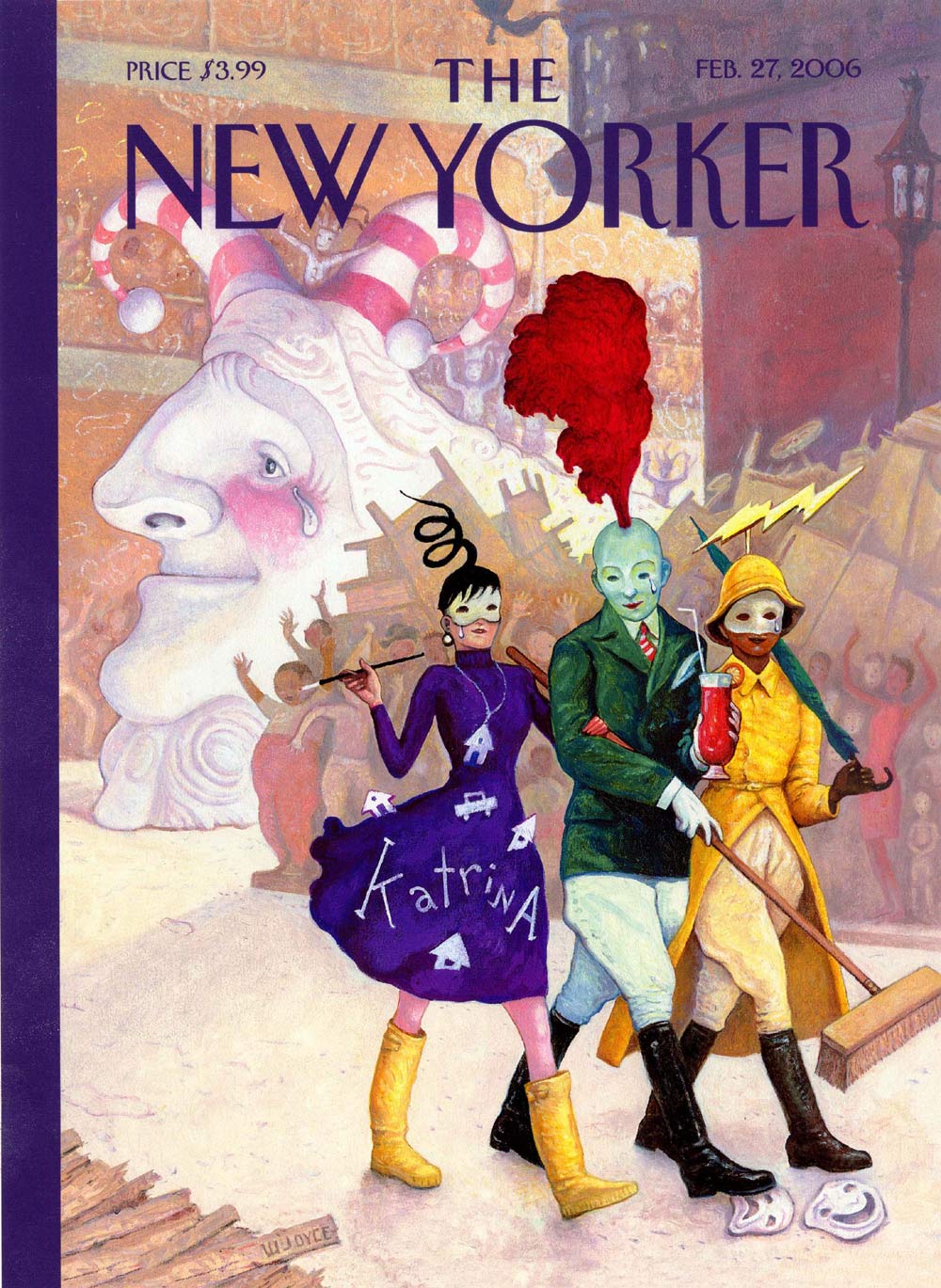
No one likes it when something they do for a magazine gets spiked. Bill Robinson,

a New Yorker illustrator, did a cover for the magazine to tie in with Mardi

Gras, and it ultimately got bumped for a more topical Dick Cheney – Brokeback

Mountain cover when the shooting incident occurred. Robinson tells

his story with rancor:

Louisiana had received its share of coverage lately I was told. They tried

to find a place for it inside the magazine. Everyone said they were sympathetic.

But nothing happened.

So we’ve been shunted aside again.

Our collective sorrow and tragedy mattered less than a single hunting accident.

I really had hoped that compassion would win out over clever.

But Robinson doesn’t have distance, of course. The fact is that the cover the

New Yorker ended up going with was fantastic, one of the best in recent memory.

Gothamist has them side-by-side,

and there’s really no contest. The Cheney cover elegantly covers many bases, from

Brokeback and the shooting to the carefully-cultivated cowboy image of both Cheney

and Bush; it does so cleverly and with impressive visual power. The Mardi Gras

cover, on the other hand, is visually a bit wishy-washy, and is rhetorically clunky

("Katrina" written out on a party frock for those who didn’t get the

meaning of the tears on all the faces.) Yes, the spiked cover works better when

blown up

to full size. But it’s not the kind of thing which grabs attention at the newsstand.

Posted in Uncategorized | Comments Off on New Yorker covers

Experimenting

The long-awaited All New felixsalmon.com will be here Real Soon Now, so I’m

experimenting with shorter entries. Do not be alarmed.

Posted in Uncategorized | 5 Comments

The global carry trade

It’s good to see that global financial markets can still get volatile occasionally.

Last week the Icelandic krona fell 9% in two days for no real reason: the plunge

was precipitated by a ratings downgrade from Fitch. Of course, people sold the

krona not because they feared an Icelandic default but because, well, everybody

else was selling the krona. And if everybody’s selling, then the carry-trade

salad days are coming to an end.

Brad Setser has some very

good analysis on all this. Of course, being Brad Setser, he feels compelled

to mention that Iceland was running a large current-acccount deficit. But Iceland’s

current-account deficit, as Brad knows full well, was no more the cause of the

krona’s fall than the Fitch downgrade was. The point is that currencies which

benefit from the carry trade are always going to be in a precarious position,

because there’s no hotter money than the money which is sitting in overnight

bank accounts run by traders with hair-trigger reflexes.

Here’s how it works: hedge funds, and prop desks, borrow money at something

less than 5%, and then buy the Icelandic krona, which yields something more

than 10% thanks to the central bank desperately trying to cool down an overheating

economy. It’s a great trade, unless and until there’s a sudden fall in the krona,

which can – and did – wipe out a year’s worth of carry in a day

and a half.

Where does this leave Brazil? I still think the Brazilian carry trade is a

no-brainer. It doesn’t even really matter where you’re borrowing: it can be

in yen at 0%, or in Swiss francs at 1%, or in euros at 2.25%, or in dollars

at 4.5%. The only number worth concentrating on is where you’re investing: in

Brazilian reais at 17%. No credit rating agency is going to downgrade Brazil

any time soon, I can assure you. And Brazil doesn’t have a current-account deficit,

so there’s no "natural" downward pressure on the currency. Yes, there’s

an election this year, which can cause volatility, but the worst-case scenario,

as far as the markets are concerned, is the status quo of a continuation Lula

government.

The krona collapse spilled over into Brazil (now there’s a textbook

example of contagion for you) not because traders were worried about Brazil

being next, but because they’d made so much money in Brazil that they needed

to cash out some of their positions there in order to cover losses in Iceland.

Smart investors will have treated the Icelandic affair as a fantastic Brazilian

buying opportunity.

My feeling is that the good times will come to an end in Brazil, as good times

always will. But it won’t be because of a collapse in the value of the Brazilian

real, so much as it will be due to a slow decrease in Brazilian interest rates,

combined with a slow increase in interest rates in the rest of the world. For

the time being, however, if I had any money to invest, I’d put it in Brazilian

reais.

Extra Credit Question: What happens to the dollar if and when the global carry

trade is unwound? I don’t think anybody knows the answer to that one. Historically,

the dollar has been the recipient of the flight-to-quality trade, which is the

opposite of the carry trade. On the other hand, as Brad notes, "can the

currency of a country with a $1 trillion external deficit really offer a safe

haven in an uncertain world?" And if it can’t, what will the new safe haven

be? Will people put even more money into property? It seems unlikely,

although no more unlikely than anything else.

Posted in Uncategorized | 11 Comments