New Yorker media kit

Jason Kottke’s found

the new New Yorker media

kit, and it certainly helps explain why I couldn’t

find a copy of the magazine in St Louis. Newsstand circulation

is just 46,808, compared to over 1 million subscribers. Looking over the calendar

it seems there’s no money issue this year, which is disappointing: that’s normally

one of their best. Although there are double issues in July and August which

have no theme allocated as yet. Interestingly September has an education issue:

I don’t recall seeing that one before.

Posted in Uncategorized | Comments Off on New Yorker media kit

The sentence with five full stops

We are editors, yes, but we must be writers as well. And sometimes a stylebook ruling or a factual correction conflicts with the goal of presenting prose that sounds as if maybe, just maybe, it was written by a human rather than a machine.

Bill Walsh, a copyeditor by profession, is absolutely right on this point. So what does he do when faced with this sentence? Look at the sentence, see if you can do better, and then I’ll tell you what Walsh’s solution is.

The group, which backed the Supreme Court confirmations of Chief Justice John G. Roberts Jr. and Justice Samuel A. Alito Jr., objected to the commentary.

Have you managed to come up with something less convoluted, easier to read, and possibly written by a human? Something like this, perhaps?

The group, which backed the Supreme Court nominations of John Roberts and Samuel Alito, objected to the commentary.

Well, here’s what Walsh came up with:

Oh, wait. That sentence was what Walsh came up with. It was his solution to the problem of saying “Supreme Court Chief Justice Roberts” when in fact Roberts is not the chief justice of the Supreme Court, but rather the Chief Justice of the United States.

Walsh’s sentence is symptomatic of one of my biggest problems with American broadsheet journalism: its pedantry and rules-based verbosity. The formal titles of Roberts and Alito were not relevant to the sentence; they just got in the way. But someone at the Washington Post has decreed that the formal titles of both men must always be used, and so the sentence grows. Certainly there is no sensible reason why we need these men’s middle initials, or need to be told that they share the same names as their respective fathers. The reason for writing “Chief Justice John G. Roberts Jr.” can’t possibly be to differentiate him from some other Chief Justice called John Roberts, so why do it?

As a wise man once wrote on the subject of middle initials,

To write “the Kenneth W. Starr investigation of the Monica S. Lewinsky scandal” is akin to writing “Las Vegas, Nev.-style gambling” or “the [Muhammad] Ali [formerly Cassius Clay] shuffle.”

Ah yes, that man was Bill Walsh. Physician, heal thyself!

One sacred cow that Walsh hasn’t dared to attack, to my knowledge, is the American insistence on placing what they call periods and we Brits call full stops in the middle of sentences. I was taught by some very smart English teachers, who explained that the full stop is the most powerful piece of punctuation: it ends a thought, a sentence, an idea. Which is one of the reasons why one-word sentences can be so effective. We’re all taught from a very early age that when you’re reading and you come to a full stop, you come to a full stop.

And yet Walsh manages to have no fewer than five full stops in the course of his one model sentence. What purpose is served by writing “John G. Roberts rather than John G Roberts”? (Obviously John Roberts is better still.) Why make a sentence harder to read by punctuating middle initials and those annoying “Jr.” addenda?

To my knowledge, no other English-speaking country follows these crazy self-imposed rules — which is a reason why newspapers in England or Australia or South Africa are generally easier to read. Newspapers exist to serve their readers, and newspaper readers are ill served by all this pedantry. Bill Walsh, far from perpetuating it, should be trying to drag the Washington Post’s language into the 21st Century.

Posted in Uncategorized | Comments Off on The sentence with five full stops

Bloomberg on immigration

One of the more interesting aspects of the immigration debate is the difference

between New York and Los Angeles. Los Angeles, full of immigrants, is split

between the Latinos and their supporters, on the one hand, and those who would

kick them all out if they could, on the other.

In New York, by contrast, virtually everybody is pro-immigrant. And it’s not

because there are fewer immigrants here: Michael Bloomberg notes

today that New York City has 3 million immigrants, of whom 500,000

are illegal. He adds:

Although they broke the law by illegally crossing our borders or overstaying

their visas, our economy would be a shell of itself had they not, and it would

collapse if they were deported. The same holds true for the nation.

Bloomberg makes some sensible points, which probably means he will be ignored

in this overheated debate. Just don’t ask me what I was doing reading the WSJ

editorial page.

Posted in Uncategorized | 7 Comments

What’s that per pixel?

When you’re selling a $3.4

million townhouse in the East Village, you can rest assured your broker

will show your place at its very best. Or, you know, not.

Posted in Uncategorized | 4 Comments

Where’s the beef?

I have something of a morning routine: I get myself a cup of coffee and read

the A section of the New York Times while waking up.

The institutional verbosity

of the Times makes my routine more difficult. But most of the time the NYT manages

to say what the news is, at least.

Not today. Here are the headlines on the paper’s lead

story:

BIG BOARD BIDS FOR EXCHANGES ACROSS EUROPE

A $10.2 BILLION OFFERING

Deal Would Give N.Y.S.E. a Foothold in 5 Capitals – Many Obstacles

It’s a bit verbose, and if you think about it too long it doesn’t make a lot

of sense: a takeover bid isn’t really an "offering", and the deal

would give the NYSE more than just a "foothold" in those capitals.

But the biggest error is one of omission. We know who the bidder is: the NYSE.

We know how much they’re bidding: $10.2 billion. But we have no idea who the

target is.

Such information always appears in the first paragraph, if not the first sentence;

in this case, they’re the same.

The New York Stock Exchange took a big step yesterday toward the creation

of a global marketplace by offering to acquire the operator of five European

stock and futures exchanges for $10.2 billion in cash and shares.

So now we know it’s stock and futures exchanges, and we know the NYSE wants

to pay in cash and shares. But we still don’t know who they’re bidding

for. Maybe in the next paragraph? No, that’s reserved for a quote from the NYSE’s

CEO. Maybe the paragraph after that? No, at that point we descend into classic

NYT portentiousness:

Finance and investment have been global phenomena for decades: Asian central

banks are among the biggest buyers of United States Treasury obligations,

big American commercial banks are joining their London counterparts in wooing

Middle East investors, and hedge funds based in Connecticut buy and sell in

markets from Iceland to Indonesia.

What??? This isn’t news, it’s filler: what’s known in England as "freelancitis"

when writers are paid by the word or the inch. And while I normally roll my

eyes at such stuff, it simply Does. Not. Belong. in this story above the central

and crucial information of who the NYSE is bidding for.

The next paragraph doesn’t help us out on that front either: instead, it’s

devoted to telling us that when the bid was made yesterday, "share prices

around the world were falling, seemingly in concert, beginning in Asia and continuing

in Europe, before recovering somewhat in New York". That’s not even market

reaction to the proposed deal, it’s just intraday noise with no connection to

the story at all.

Finally, in the fifth paragraph, 200 words into the story, we find that the

target of the deal is Euronext.

I’m sorry to say that the perpetrator of this nonsense is my friend Jenny Anderson,

a very good journalist who honed her newspapering skills at the New York Post.

Which is the kind of newspaper which would never, ever wait 200 words to reveal

the name of a $10 billion company being bid on. Clearly, however, the culture

of the Times can turn anybody.

Later on in the section, there’s an interesting

story about the Fulton Street transit hub. In the wake of the news that

the neigbouring World Trade Center memorial is hundreds of millions of dollars

over budget, we’re now told that something similar is going on with the plan

to simplify the mess that is the Fulton Street subway station. Only this time,

far from burying a key piece of information, the Times simply doesn’t bother

to supply us with the architect’s name at all. (It’s Nicholas Grimshaw, an excellent

UK architect who’s not well known on these shores.) They’d never do that to

Michael Arad.

The NYT is examining its front-page reporting with much

laboriousness these days. But for the time being, it would seem, that effort

has achieved nothing.

Posted in Uncategorized | 2 Comments

The politics of global warming

When I reviewed An

Inconvenient Truth last month, I complained that "it will be far too

easy for Republicans to dismiss this film as liberal propaganda." Little

did I know. MoveOn has now got

into the act, at a webpage whose address is http://political.moveon.org/seethetruth/

– that "political" in the URL more or less gives the game away.

Climate change is a political issue, but the key task for those who would push

it as such is to prevent it from becoming a party political issue.

Science does not have a left-wing bias, and even though it’s relatively rare

for a politician like Al Gore to have a scientific background, it’s far from

unheard-of and it’s not at all confined to lefties. (Margaret Thatcher, remember,

read Chemistry at Oxford.)

Yet in the US, it would seem, things are very different, largely as a result

of the influence and importance of the religious right in politics. Since these

people know the Truth, and know where to find it, it follows that anything which

contradicts that Truth is wrong. Most glaringly, of course, this applies to

evolution: since the Bible is right, Science must be wrong. And since scientists

are unanimous that evolution is right, it therefore follows that it is entirely

possible for the entire scientific community to be wrong about something. And

once people have doubt about the ability of scientists to get something like

evolution right, then pretty much anything can be questioned: that HIV causes

Aids, that people can be born homosexual, that emissions of greenhouse gases

cause climate change.

Note that you don’t even need to be a creationist in order for the creationists’

propaganda to do its work in this respect. All you need to do is be sympathetic

enough to the creationists as to believe that there’s actually a meaningful

debate: that even if the scientists are right, they might have been

wrong. Once the possibility that basic science is wrong has been raised,

it becomes vastly more difficult to persuade anybody that science can be trusted

on anything.

Last night, I had a mildly exasperating conversation with a guy called Sam,

who had read Michael Crichton’s anti-environmentlist novel State

of Fear. "I’m a lefty, I took a course on the environment in journalism

school, and even I found the book compelling," he said. Crichton, of course,

is the novelist and Bush

buddy who has carved something of a second career out of asserting that

global warming, insofar as it exists, is not much of a problem and is not anthropogenic.

One of the arguments that Sam found most compelling was when he said that since

carbon dioxide accounts for much less than 1% of the atmosphere, it really can’t

have much of an effect.

Sam even had a novel explanation for how it is that the entire scientific community

could be wrong, while a few brave voices (like, er, Bush and Crichton) could

be right. I don’t think that he was particularly religious; in any case, it

was clear that a call to Biblical authority would hardly convince me. So instead

he pulled out his trump card: "You should really read The

Structure of Scientific Revolutions," he said. "It proves

that all scientists can be wrong."

I could almost hear Thomas Kuhn rolling in his grave.

But on a much more basic level, there was a general theme running through my

conversation with Sam: the idea that there are things that science can’t explain.

He brought up the origin of the universe, the origin of the planet, the origin

of life. He said that science couldn’t explain how light can be both a wave

and a particle at the same time; and he was most insistent on the teleological

questions: why have we evolved? For Sam, life had to have some kind

of meaning, beyond the personal or interpersonal. Science couldn’t provide that

meaning, ergo there were shortcomings to science, and non-scientists such as

he could feel pretty confident dismissing an entire scientific discipline on

the basis of reading a science-fiction thriller.

One of the problems with any attempt to explain science to a non-scientific

audience is that the audience has to trust its interlocutor to be fair in its

marshalling of the facts and the scientific literature. Andy Revkin can say,

for example, "that humans are clearly warming the earth and this will have

profound consequences later in the century" – but if you don’t trust

Revkin to accurately summarise what we know and what we don’t know, then his

years of reporting on the subject will never convince you.

There have been hundreds of attempts to summarise the climate change facts;

Al Gore’s film is only the latest. More documentaries will be made; more books

will be written; more magazine articles will appear – although they will

have to be very good indeed to be better than The Climate of Man, the

series for which Elizabeth Kolbert and the New Yorker won a well-deserved

Ellie

award this year. And all of them will sit on top of the scientific literature.

If there’s a deep-seated mistrust of the whole praxis of science, then none

of these things is likely to grab the popular imagination, and politicians will

continue to be able to ignore global climate change with impunity.

I don’t know how to solve this problem. On an individual level, it can be done,

through pointing people to just some tiny bit of the primary literature. Anybody

who sees for themselves the rigour of pretty much any scientific paper will

take much less convincing that when the whole body of scientific literature

comes to exactly the same conclusion, then that conclusion must actually be

true.

But there will always be skeptics with unfalsifiable skeptical positions. The

great thing about the "intelligent design" arguments against evolution,

or the Crichtonist arguments against anthropogenic climate change, is that they

feel no need to posit scientific (ie, falsifiable) theories of their own. If

one part of one scientific model turns out to be wrong, they use

that not as evidence that scientists are doing their job, but rather as

evidence that "every single global climate model you ever heard of is completely

useless and inaccurate". The scientists are placed in an impossible position,

where any corroborating evidence is ignored and any real or imagined problems

with the models are magnified to enormous proportions.

I feel that the only way that scientists are going to be able to sway public

opinion is going to be when the religious right stops waging its current war

on science. If religious leaders treated science with respect, then Americans

might stop looking for reasons to mistrust scientists at every available opportunity.

Unfortunately, the attacks on scientific consensus seem to be getting bolder

and stronger – which means that Americans have more reason than ever to

doubt the likes of Al Gore and his science-based arguments.

Posted in Uncategorized | Comments Off on The politics of global warming

Todd Gibson on money and art

The interplay of art’s domain and money’s is very complex. The relationship

of money to any individual work of art, however, is very simple. There is

none. In practice, the culture usually sets a minimum value on works of art,

which is really just an ante. When I was an art dealer, any biggish work of

art was worth five hundred dollars. Any littlish work of art was worth two

hundred. Today, a biggish work is worth a thousand dollars and a littlish

work is worth three hundred. Everything you pay over that is the consequence

of previous external investments taken at risk.

So you pay a grand for a painting from an unknown artist’s studio. If you

wait until that artist has a dealer, you are going to pay more. If you wait

until she has good reviews, you are going to pay more still. It you wait until

Paul Schimmel down at MOCA notices her work, you are going to pay even more

than that, and if you wait until everybody wants one, of course,

you are going to pay a whole hell of a lot more, since as demand approaches

"one" and supply approaches "zero," price approaches infinity.

But you are not paying for art. You are paying for assurance, for

social confirmation of your investment, and the consequent mitigation of risk.

You are paying to be sure, and assurance (or insurance, if you will)

is very expensive, because risk is everything, for everybody, in the domain

of art.

–Dave Hickey, Dealing, 1997

OK, so now I’ve buggered myself royally. You can’t start a blog entry with

a long quote from Dave Hickey and then expect to write anything which doesn’t

shrivel up in comparison. But I felt impelled to get something really good down

here on the subject of art and money, in response to Todd Gibson’s latest

on the subject.

Gibson starts by setting up a classic straw man, in the form of an inchoate

"many managing art investments today". These "many," it

would seem, claim that art "is an alternate investment class that keeps

pace with or outperforms the market."

First off, there aren’t many people managing art investments today: certainly

not in the portfolio-manager type way that Gibson would have you believe they

are. Every so often some bright spark tries to set up an art investment fund,

and nine times out of ten it fizzles out before it is even officially launched.

So far, no one has set up a fund which has really caught the imagination of

investors and stayed around for long enough to demonstrate clear returns on

investment.

As a result, the handful of people who are trying to set up a business by managing

art investments certainly do not make the kind of claims that Gibson

says they make. Yes, it’s an alternate investment class. But no, they’re not

selling its outperformance compared to "the market", whatever that

might be. (The US stock market, I presume, although I’m not sure.)

Rather, there’s a very good reason that people are interested in alternative

investments, and it has nothing to do with outperformance: it’s called diversification.

If you had your money in a portfolio of high-flying stocks in 2000, you would

have seen your net worth plunge over the next couple of years. If you’d diversified

into high-flying contemporary artists as well, then the ability of your art

to hold its value in the face of plunging equity valuations would have saved

you some of that pain. Contrariwise, technology stocks proved a very good investment

during the art-market slump of the late 1980s. The fact that the two asset classes

are barely correlated is enormously valuable to certain investors, and essentially

helps explain the whole attraction of "alternative investments".

And yet, as I say, art funds have essentially gotten nowhere over the past

few years, even as the art market has gone through one of the biggest booms

in its history. Why is that? Obviously, because no one sees the point in investing

in art which they can’t personally enjoy. There’s a lot of talk in art-investment

circles about art’s "negative carry": the fact that far from paying

interest or dividends, art actually costs money to own – mainly

the costs of storage and insurance. The best-case scenario, if you buy something

really good, is that you can put the artwork on long-term loan to a museum which

will shoulder those costs for you. Art will never give you the kind of returns

you can get from reinvesting dividends – returns which are crucial

to the evaluation of any stock-market investment. Instead, art’s dividends (as

opposed to its capital gains) are entirely non-financial. You buy a work of

art because you love it, and because of the personal value that you derive from

owning it and seeing it on a daily basis. Buying a share in an art fund is like

buying a value stock without a dividend.

But this is not to say that it makes no sense to invest in art. Certainly,

I’d never recommed doing so: quite

the opposite. But for someone with enough investments, or a high enough

income, that day-to-day expenses are no longer much of an issue, there is wonderful

value to be gotten from art which one loves. And if a wealthy investor spends

a lot of money buying or "collecting" art, then his financial advisor

would be remiss not to take that art into account when setting out his investment

strategy. After all, the collector now has a large natural diversification out

of traditional investments, so it might well make sense not to put more money

into other high-risk, high-diversification strategies.

And Todd Gibson’s complaints ring rather hollow. He chastises the Mei-Moses

art index, for instance, on the grounds that "it only looks at the winners,"

conveniently ignoring the fact that the same thing is true of pretty much any

equity index you care to mention, and certainly of the DJIA and the S&P

500 indices that he mentions in his previous

post.

And he also has a most peculiar riff on the perceived success of Dorothy Miller

qua art investor, despite conceding early on that "she wasn’t,

I’m sure, collecting as an investment." Miller bought widely and

bought well, and scored enough home runs (Gibson cites Johns, Kline, Calder)

that I’m sure she made a handsome (if posthumous) financial return on her investment

– a return which, since she didn’t sell this art in her lifetime, she

obviously had little interest in. Gibson zeroes in, however, on one of her less

successful investments, a painting which sold at Christie’s in 1993 for just

over $1,000. What does he conclude from this?

Assuming that Miller bought the piece in the mid-1950s for around $125, the

painting as an investment barely kept pace with inflation and under-performed

the stock market. Even MoMA curator Dorothy Miller, with her great eye and

access to work by artists whose reputation she had a hand in making, was not

able to consistently pick investment quality art for her personal collection.

As Tyler Green might say,

Huh?

Firstly, Miller wasn’t trying to "pick investment quality art". Secondly,

notwithstanding that fact, Miller undoubtedly put together an investment quality

portfolio. And most importantly, the fact that Miller bought some art which

didn’t skyrocket in value is a necessary consequence of the fact that

she bought a lot of art which did: see that Hickey quote, above. Even Gibson

says that a lucky collector with a great eye will see big returns "one

or two times out of ten". This painting at Christie’s is a counterexample

of what, exactly? It’s like saying that Warren Buffett can’t be a great

investor because some of his investment picks went down.

And the really crazy thing is that Gibson concedes that Miller’s "bad"

pick actually increased in value in real terms. Think of all the times

you buy a thing you love – something you get value just out of owning.

It might be a book, or a car, or a kitchen appliance,or a diamond ring, or a

watch, or a computer, or a handbag, or a pair of shoes, or a cellphone, or anything,

really. The only thing these things have in common is that none of them

increase in value. Even in nominal terms, let alone real terms. And yet

when Dorothy Miller bought something she loved and it appreciated eightfold

in value, Gibson dismisses the purchase as under-performing the stock market.

The stock market! As though Miller might have been better advised to

hang brokerage statements on her wall instead of art!

Todd Gibson has now written two posts on "why art isn’t a great long term

investment". They concluded like this:

Well managed hedge funds will return 15-20% CAGR over a lengthy period. While

the return on this little Joan Mitchell painting has been about as good (on

a pure percentage basis) as could possibly be, when time is taken into consideration

by looking at CAGR the return isn’t amazing. It did beat the market

by a wide margin, but a smart asset manager can do significantly better.

About the best you can do is claim that art is a venture capital-type investment.

A few pieces, if you know how to pick them, may provide outsized returns.

Many more may mirror the market. The majority, though, will barely keep pace

with inflation—if even that.

The first post seems to say that even if your art manages to beat "the

market" by a wide margin, it still isn’t a great long term investment,

since there are hedge funds out there which have done even better than that.

The second seems to say that if the majority of your pieces keep pace with inflation,

a bunch of them mirror "the market", and a few provide outsized returns,

then that’s a suboptimal outcome.

Most people would be overjoyed to "beat the market" or to have made

investments which "provide outsized returns" – not Gibson. He

is only happy, it would seem, if all of his investments beat the market,

and if he can meet or beat the returns of the world’s best hedge fund managers

– just by investing in art.

All I can say is I’m very glad that I’m not Todd Gibson’s asset manager.

Posted in Uncategorized | 17 Comments

LCB Brasserie Rachou

I should be careful what I wish

for, I guess: when I turned up unannounced on Friday night and asked for

a table for four at Chubo, we were told that the restaurant was booked solid.

So instead we hopped in a cab and went uptown, to another great yet underappreciated

NYC restaurant, LCB Brasserie Rachou.

When my friend Simon was looking for a nice romantic place to celebrate his

wife’s 40th birthday a couple of weeks ago, I thought of LCB Brasserie; he went,

and came away raving about it. Maybe slightly more expensive than a typical

upscale French bistro, he said, but with vastly better food and service.

Frank Bruni gave

it two stars back in 2004, and I’d recommend that he return, since it’s

certainly better now than it was then. Cheaper, too: the choucroute he complains

about paying $30 for is now $24. The main courses are just as wonderful as the

ones Bruni had and raved about, but the desserts, which Bruni was unsure about,

are now divine – especially the soufflé. The words "the best

dessert I’ve ever had" were uttered. And I’m not going to forget my pike

quenelles any time soon – they were just gorgeous. Better, I have to say,

than the ones I had at La Caravelle just before it closed.

LCB Brasserie, just like its stuffier predecessor La Côte Basque, specialises

in traditional French cuisine. So while it’s always fun to be adventurous in

a restaurant, I’d highly advise the opposite here: the more old-fashioned the

dish, the better it’s likely to be. It doesn’t need to be posh – the choucroute

was amazing – but it certainly can be: I can’t imagine going anywhere

else for Dover sole meurniere.

And while the wine list is predictably heavy on the Bordeaux, it’s also reasonably

imaginative and surprisingly low-priced: at the high end, bottles can go for

hundreds of dollars less than they would cost at, say, Veritas, while at the

low end there’s a lot of interesting stuff in the $30 to $70 range, including

some fantastic Bordeaux. We had a stunning New Zealand pinot noir which, I was

gratified to see, came with a screw top: the more that grand restaurants serve

great wine from screw-top bottles, the less of a stigma will be attached to

them, and the sooner we can do away with anachronistic and unreliable corks

for the vast majority of our wine.

LCB Brasserie is not as popular as it deserves to be, which is a shame. Certainly,

anybody who loved La Côte Basque or who never got around to going there

or who was put off by its prices or its dress code should head to its successor

forthwith. The food is just as good, and the interior, the biggest change in

the restaurant, is in many ways improved. Plus, you don’t need to wear a tie.

If there were any justice in this world, a large chunk of the lunch crowd at

Michael’s, on the same block, would move a few doors down the street and start

getting much better food at much lower prices. But Jean-Jacques Rachou will

never emphasize healthy, low-calorie dishes, even if his salads are excellent.

Thank God.

Posted in Uncategorized | 1 Comment

NYT still doesn’t get the web

If the New York Times won’t, maybe Google will.

I’m talking about pointing to original research: something I’m very interested

in with my Report Report Report. (There have been quite a few articles I’ve

wanted to write an RRR on, but haven’t been able to get the original paper.)

This week, the NYT’s science editor, Laura Chang, is answering questions from

readers. I asked her why the NYT’s web stories couldn’t provide links to original

research, or why the NYT couldn’t even host copies of the research itself if

the authors were amenable, which they often would be. She didn’t answer my question

directly, but she answered

a very similar one:

I, like several readers who asked similar questions, also wish our articles

could include specific links to sources. We’re working on it, but it’s a more

difficult goal than we imagined. It can be a tedious job to insert such references

into articles, raising a basic question of best use of our reporters’ time.

This is a terrible answer. I admit that I don’t know how easy or difficult

it is to insert a hyperlink in a NYT news story, but I suspect it’s not quite

as hard as Chang makes out. But even if it is "a tedious job", journalists

should do it anyway.

The job of a journalist on the New York Times or at any newspaper is to serve

the paper’s readers. Most of the time, that means doing classically journalistic

things like interviewing sources and crafting clear and compelling stories.

And some of the time it means doing things which can be tedious: waiting outside

a courthouse for a defendent to emerge, for instance, or making sure that hyperlinks

go into stories.

The New York Times claims that nytimes.com is not simply the paper version

of the newspaper put up on the internet: it’s a web-based news source unto itself.

And certainly nytimes.com gets orders of magnitude more readers than the paper

version does. So it’s frankly stupid for journalists to do all manner of tedious

things for a paper story but to draw the line at creating a hyperlink.

The fact is that if you’re writing about a scientific report, and the report

is available online, you should link to it. Always.

But if the New York Times won’t maybe Google will: we now have Google

Scholar, which looks wonderful. I can’t wait to test it out for my next

Report Report Report.

Posted in Uncategorized | 1 Comment

Lies, damn lies, and Alex Tabarrok

Alex

Tabarrok today (in an article on which comments are closed):

Since Galbraith wrote, for example, the number of privately owned communities

has exploded. Today some 55 million Americans live in a private community,

many of which provide their own roads, garbage pickup, and aesthetic regulations.

No link, of course – but does that number seem as improbably high to

you as it did to me? A bit of googling didn’t take me to the source, but I did

find this:

By 2005, about 55 million people lived within a homeowners association, a

condominium, or a cooperative.

In other words, anybody who lives in an apartment lives, by Alex Tabarrok’s

definition, in a "private community". Which might be technically true,

but it’s certainly not the impression he’d like to give.

Posted in Uncategorized | 6 Comments

NYTblog RSS update

Pogue’s

Posts now comes with a full RSS feed. DealBook,

Asimov, Bruni,

however – still broken.

Posted in Uncategorized | 1 Comment

The supremacy of paint

Greg Allen looks

at the auctions in much the same way I

did, only instead of Ryman vs Irwin, he uses Nara vs Smithson. As ever,

the real money is in paintings. A handful of trophy sculptors (Koons, Hirst,

Cattelan) get the megabucks too, but most of the time, anything which requires

special, gallery-style installation is simply not going to fetch $$$. It’s gotta

be able to go well with the sofa, and Irwin and Smithson are bad at that. By

the way, that Mitchell that Todd

Gibson liked went for $51,000. Seems cheap, in this company – but

I’ve never been a fan of hers.

Posted in Uncategorized | 1 Comment

Art auctions

So this season’s contemporary art auctions have come and gone: $143 million at Christie’s, $129 million at Sotheby’s. Sotheby’s wins the Best Quote Award, however:

Tobias Meyer, director of contemporary art for Sotheby’s worldwide and the evening’s auctioneer, called the market “passionate and deep,” adding, “People bid according to their wealth, not the market.”

It’s actually an interesting insight: the art market has become a bit like the housing market, where sellers look for price and buyers look for whatever they can afford. If it takes $95 million to buy a Picasso, and they have the money available, then that’s what the new breed of buyers will pay.

The contemporary art auctions didn’t have anything in that stratospheric league, although they had their fair share of multimillion dollar pieces. For me, however, it wasn’t the Warhols and DeKoonings which stood out: everybody knows they’re going to go for vast sums of money. Rather, I was very surprised by the seven-figure prices being fetched by (relatively) second-tier artists.

I love Robert Ryman, I have to say: his white monochromes are beautiful, classic works of art. But $9.6 million?! It’s worth noting that a classic Robert Irwin circle piece from 1965-67, which is just as beautiful and probably even more important in art-historical terms, went for “just” $441,600 in the afternoon sale at Christie’s. It’s true that the Ryman can be hung on the wall in an expensive house or apartment, while the Irwin really needs its own installation, but still the 2000% difference in price seems excessive.

In a world where it’s still rare to see female artists fetching seven figures, it was gratifying to see an Eva Hesse go for $2.2 million. Cecily Brown just failed to make the mark, fetching $968,000, but she’ll undoubtedly reach it soon, if she hasn’t already done so privately. But $1 million for a Lisa Yuskavage seems pretty crazy to me, I must say.

The Hesse, interestingly, was sold at Christie’s in 1992 for $93,500 — which works out at a CAGR (compound annual growth rate) of over 25%. Pretty good investment. The trick, of course, is to sell not only at a large profit, but relatively quickly, too. If you wait more than 50 years, then your CAGR is going to come down to the 10-15% range even if you sell for 400 times the original purchase price. On the other hand, 10-15% isn’t at all shabby, especially when you add all the emotional equity in there as well. If you have some post-war art which you aren’t particularly fond of, it seems that now could well be the best time ever to sell.

Posted in Uncategorized | 2 Comments

Contest answer

So here’s the deal. The King James Bible, The Wizard of Oz, and the

UN Secretariat building in New York are all magnificent, towering achievements

on an artistic level. Can you imagine a "Bible as Literature" class

based on the New English Bible? Can you think of a film which has resonated

in the general public’s imagination more strongly or for longer than The

Wizard of Oz? Can you think of a building in New York more perfect than

the UN Secretariat?

I’m serious about the UN Secretariat, by the way. When I first arrived in New

York, I was magnetically attracted to the gleaming Chrysler Building, of course.

And then after working downtown for a while I moved my affections over to the

Woolworth Building. But the UN is probably closer to perfect than either of

them – and beats, in my view, the Park Avenue icons of the Seagram Building

and Lever House.

No, that’s not the answer. But ask yourself why the Seagram Building and Lever

House are so hugely admired, while the UN Secretariat is often forgotten. It’s

obvious: the Seagram was built by Mies and Johnson, while Lever House was built

by Gordon Bunshaft. The UN Secretariat, by contrast, was built by, um…

So that’s what I was driving at. When we think great literature, we think Shakespeare,

Tolstoy, Nabokov – authors. When film buffs talk of the greats,

they talk of Fellini and Wilder and Godard. Hell, pick up this week’s New

Yorker, and turn to Anthony Lane’s cinema review. Check out the caption

on the illustration: "Tom Cruise as special agent Ethan Hunt in J.J.

Abrams’s movie." Yes, even M:i:III, the ur-blockbuster, the ultimate

star-driven film, is attributed to one J.J. Abrams – someone who couldn’t

even be called a film director before this movie came out, because he’d never

directed a film before.

One minor milestone in the intellectual development of a child is when they

start moving away from liking certain books and certain music, and start liking

certain authors and certain bands. And once you go there, it’s almost impossible

to go back: everyone seems determined to give almost everything an author. (Which

might be one of the reasons why conspiracy theories are so common, and opposition

to Darwinism is so widespread.)

I’ve written before about

how such attributions of authorship can be silly, but they’re also important,

because great works of art can actually get much less attention than they ought

to if there isn’t an author to glorify.

The three examples in my contest, then, are all works of art which don’t have

a single author who can take the credit and the glory – and for that reason,

I think, they’re often overlooked when they would never be if they were "by"

someone famous. This is not a question of things being designed by committee,

although Miss Representation was closer to the answer than anybody else. But

in fact the fact that we want to attribute authorship of these artworks to someone,

or something, even if it’s only a committee, is telling. An artist, on one popular

view, is one of the three necessary elements for a work of art to exist, the

other two being an art object and a viewer. I hold up three possible counterexamples.

Posted in Uncategorized | 7 Comments

What comes after death?

This is what has become of Lot 61, the club that made Amy Sacco. The rear of

the puddle on the floor more or less corresponds to where the wall behind the

front bar used to be. It all looks so much smaller empty, in the weird way that

real estate always does. The door to the VIP room is still there, on the left.

Some things never change: the VIP room is still as attractive as it ever was.

Posted in Uncategorized | Comments Off on What comes after death?

Contest

A quick quiz for anybody who’s not Todd

Gibson. What connects:

  • The King James Bible
  • The Wizard of Oz (the movie, not the book)
  • The UN Secretariat building in New York?

A special treat to whomever is first with the answer I’m thinking of.

Posted in Uncategorized | 22 Comments

The pausal comma

Subaru’s jump

in March sales was, says, the company, because

consumers are responding to our new campaign, ‘It’s What Makes a Subaru,

a Subaru.’

Yes, that comma is there, always – in the print

ads, in the television ads, in the press releases. I’d love to have been

a fly on the wall at the advertising agency during the discussions over that

comma, and whether it should stay or go. Clearly, it’s ungrammatical. But it

also serves a purpose: it connotes a pause in the subvocalised (or, in the case

of the television ads, vocalised) reading of the slogan.

My initial feeling is to disapprove of putting the glorious comma to such mundane

use – but then again I’m sure that many poems use it in just such a manner

at the end of each line. And since there’s no other mark which would serve such

a purpose, perhaps we should treat this expansion of the comma’s role with equanimity.

Posted in Uncategorized | Comments Off on The pausal comma

29 things in my apartment which beep

  • Alarm clock
  • Humidifier
  • Electric toothbrush (after every minute brushing)
  • 3 telephone handsets
  • Clock radio
  • 2 desktop computers
  • 2 laptop computers (actually, 3 at the moment)
  • Washer
  • Dryer
  • Fridge
  • Freezer
  • Coffee maker
  • Dishwasher
  • Oven
  • Microwave
  • 2 digital cameras
  • Fax machine
  • 2 printers
  • Stud finder
  • 2 cellphones
  • Security alarm
Posted in Uncategorized | 4 Comments

A ticket to the opera

Karita Mattila and Anja Silja are two of the greatest actresses of their respective generations. You haven’t seen them in the movies, you probably haven’t even seen them on the TV. But if you’ve seen them on stage, the chances are that you haven’t forgotten the experience.

The really amazing thing about Mattila and Silja, of course, is that not only are they superlative actresses but they’re also among the finest singers of their respective generations. Mattila has been taking the Met by storm for the past few years, in Jenufa and Salome and various other roles. Silja has performed for decades in all the greatest opera houses of the world. But having seen her KostelniÆ’Ă§ka at Glyndebourne, I can’t imagine she’s ever found a more perfect role for her talents.

And now — and now. Well, to be honest, in February. They’re appearing together at the Met: Mattila opposite Silja in one of the most powerful operas of the 20th Century. All I can say is that it isn’t a question of whether I’m going: it’s a question of how many times I’m going. (Or how many times I can afford to go, more to the point. In most operas, I don’t mind if I’m far from the stage, since it’s all about the music. But in this case, I want to be up close, for the acting. And that, at the Met, is blood-drainingly expensive.)

The Met is not going to make it easy for me to get tickets, however. At the moment, the only way to get tickets for Jenufa is to buy a full series: tickets for seven or eight operas, all on the same day of the week. Let’s say I choose Friday nights. The only series incuding Jenufa runs from October until May, and costs $1,600 per seat for prime orchestra seats. (Premium seats in the Grand Tier are already sold out at $1,960 a pop.) Even way up in the back of the balcony you’re paying $544 per seat — well over $1,000 the pair.

These series are like cellphone minutes: you’re forced to buy more than you need. Sure, I’ll go see Jenufa and the Tan Dun opera anyway. But I’m also shelling out for Handel (snore) and “Il Trittico”, a series of lightweight one-act operas by Puccini which one can’t imagine appealing to the Jenufa crowd.

Eventually, the Met will start selling shorter series, and after that they’ll start selling trios: sets of three operas. If I’m lucky, there’ll be a trio with Jenufa and The First Emperor and something non-awful — but by that point the good seats will all have been sold to richer people than I. If I wait until single-opera tickets go on sale, the operas I want might well be sold out completely.

None of this, needless to say, engenders much in the way of goodwill on my part towards the Met. (This doesn’t stop them from phoning me up on a regular basis and asking me to donate money to them.)

The Met isn’t unique in using these tactics: any museum with a membership program does something similar. But the amounts of money involved are larger at the Met than they are anywhere else, and the whole edifice seems expressly designed to make it as hard as possible for people who haven’t grown up with opera to lower themselves gently into its waters.

Indeed, the Met seems to go out of its way to avoid advertising or promoting any individual production: the message it sends out, very consistently, is that the way to see the opera is to buy lots of tickets, as far in advance as possible, for things you think you’ll like and things you’re not so sure about. Which is great if you’re a sixtysomething lady of means on Central Park West who can happily organise her calendar a year in advance. But it’s not going to attract a younger, poorer, hipper crowd — the kind of people that the Met increasingly needs as its subscribers move either to Florida or to that great parterre box in the sky.

As Peter Gelb takes over from Joseph Volpe as general manager at the Met, he should shake up the box office. First, and most easily, he should accept returns. New Yorkers are busy creatures, and sometimes, through no fault of their own, they find one or two of their party unable to make it to the opera on a night booked months previously. Often, the tickets are great ones, for a performance which has been sold out for a long time. The fair way to deal with the situation is familiar to any theatregoer who’s lived in England. There’s a line for returns, and anybody with an extra ticket takes it to the box office, which then sells it to the first person in line. The original ticketholder gets the face value of the ticket back, and makes an opera lover very happy in the process.

But the Met won’t let that happen. If you try to return a ticket you can’t use, the Met will gladly accept it — but only as a donation. In other words, if you want your ticket to go to the first person in line, then you have to let the Met sell the same ticket twice, and keep all the proceeds both times. So instead you have to stand outside like some kind of furtive scalper, trying to work out whether and which people might be interested in your ticket. It’s a nasty, unpleasant experience — especially since you’re likely to be sitting next to the buyer of your ticket for the next five hours, as you both pretend you didn’t just engage in a vaguely illicit-feeling cash transaction.

A lot of people, understandably, don’t want to stand outside the Met scalping their own tickets. But because the Met won’t pay the owners a penny for their tickets, the owners have no incentive to return the tickets to the box office. So even as opera lovers desperately try to get their hands on tickets to what could be the experience of a lifetime, other tickets, unusable by the original owners, are being desperately given away to people who barely care about opera — or, worse, are simply wasting away in a drawer somewhere as the likes of Mattila and Silja play to paid-for but tragically empty seats.

Once Gelb has figured out the returns fiasco, he can then turn his attention to the subscriptions. I know that the Met values its subscribers, but ultimately it needs to meet the needs and desires of as many operagoers and would-be operagoers as possible. If it treats New Yorkers well, they are much more likely to repay the goodwill with goodwill of their own. So the Met should make it possible for people to buy good tickets to any opera in the season without having to wait for the monied classes to have their pick first. (The fact that they’re monied should be advantage enough.)

The current Met system is weird: it’s in some ways the opposite of the way that other wasting assets, like airline seats or hotel rooms, are sold. With airlines and hotels, the earlier you book the less you pay. With the opera, you end up paying the Met much more money if you book early (since the only way of doing so is to buy a big subscription package) than if you try to buy a premium ticket at the last minute.

On the other hand, no one is surprised that good hotel rooms cost more than crappy hotel rooms. At the Met, by contrast, any given seat costs the same amount, no matter what the opera is or who is in it. That’s why the Met needs the subscription packages: so that it can fill seats in the less popular operas.

There’s a better way, though. Put all seats on sale at the same time, and charge more for the in-demand productions than for the ones that fewer people want to go and see. Verdi will subsidize Monteverdi either way, but this way is much more democratic. It also gives the Met the opportunity to put on really interesting and experimental opera at low enough prices to attract the downtown art-music crowd.

The Met has had a high-handed attitude towards its patrons for far too long, which is one reason it’s perceived as snooty and elitist. It’s time to break down those barriers.

Posted in Uncategorized | 7 Comments

Equal housing opportunity on Central Park West

Anybody who read Clive Thompson’s excellent and fair-minded piece on Google in China in the NYT magazine this weekend will have flicked past yet another piece of real-estate porn to get there: a double-page spread from Zeckendorf Development, LLC advertising 15 Central Park West. “Residences from $3,000,000″ it says in large yet tasteful white-on-brown.

Lower down, in much smaller type, we find this:

We are pledged to the letter and the spirit of U.S. policy for the achievement of equal housing opportunity throughout the Nation.

Seriously, that’s what it says. And no, they still won’t sell you an apartment for less than $3 million.

Posted in Uncategorized | 1 Comment

Roberta Smith on Donald Judd

Roberta Smith gets the front page of the NYT arts section today to gush over the Donald Judd installation at Christie’s. She’s much less worked up than Tyler Green was over the fact that the Judds aren’t going to museums:

Judd might have viewed the sale with a certain pragmatic equanimity. I worked for him briefly in the early 1970’s, mostly on his catalogue raisonnĂ©. He remarked more than once that one purpose of his smaller, portable sculptures was to make money to pay for larger projects.

The foundation Judd mandated in his will is a very large project. He might even have liked the bold gesture of one big, widely publicized get-it-over-with auction. Besides, he famously hated museums, especially American ones.

Tyler’s response to Smith is so weak he essentially concedes the point to her. I’m sure that Smith, like Tyler, in an ideal world would like to have seen the Judd Foundation raise the money in a more considered way. But I’m inclined to agree with Smith’s more sanguine view of the sale, if only because Christie’s has proved that private institutions are clearly capable of showing Judds in a much better way than any museum. Sold to private collectors, these Judds might well get purpose-built permanent homes, instead of being thrown up willy-nilly on a wall without daylight as part of an incoherent 20th Century collection somewhere.

In any case, anybody who’s been to Marfa can understand why the Judd foundation is a little on the dysfunctional side of things: Donald Judd was an egomaniac who treated his children really quite dreadfully. Since those children now run his foundation, one can hardly expect the foundation to be a beacon of art-world best practices.

Posted in Uncategorized | 8 Comments

Revkin on climate change

Andrew Revkin has been covering global climate change for the New York Times

since 1988. Today, he gets the front page of the Week in Review section to try

to answer the key questions, which he puts this way:

Is global warming now a reality? What do scientists know for sure and when

are they just guessing?

The resultant article is very disappointing. Revkin is happy to concede that

"seas have risen about six to eight inches globally over the last century

and the rate of rise has increased in the last decade," but he resolutely

refuses to admit that such warming is man-made. Instead, he tells us twice that

we can’t be sure that recent hurricanes and other extreme weather are the fault

of anthropogenic global warming.

Of course, proving anthropogenic causality behind any given weather phenomenon

is basically impossible. But by emphasizing that impossibility and ignoring

the anthropogenic warming we do know about, Revkin creates the impression

of controversy in the outlines of a science where there is actually surprising

unanimity.

The headling of the article is "Yelling ‘Fire’ on a Hot Planet" –

clearly giving the impression that Al

Gore and his apologists are being more alarmist than reasonable about the

whole subject. I understand why the NYT would want to run a think-piece on global

climate change around the time of Earth Day. But I don’t understand why they

have to be so milquetoast on the subject, and emphasize the controversy at the

margins rather than the unanimity at the center.

Posted in Uncategorized | 3 Comments

Turntable

It was my birthday on Friday. I’d already got a couple of presents early: a

wonderful tough & waterproof watch for when my grandfather’s very fragile

one isn’t suitable, and a fabulous lab-flask-to-be-used-as-a-decanter inspired

by this post. But then

on the actual day I got a wonderful surprise: a turntable!

I’ve had a few of my favourite records lying around for years now, but haven’t

been able to play them for lack of a turntable. Now I have one plugged in, I’m

rediscovering stuff which even today is unavailable on CD. And the sound is

a wonderfully refreshing change. I’m not saying it’s better, but the first record

I put on (which happened to be the first to reach: there was no real choice

involved) was this

one from Oscar Peterson and Dizzy Gillespie, and you could just sink back

into the music, like Matisse’s famous armchair, in a way that you just can’t

with a CD or an MP3. I was hooked all over again.

For I was one of the very last people to give up on vinyl and move to CD. All

through university I would seek out the increasingly small number of record

shops which still sold LPs, and would play them on a hi-fi system which was

much better than any university student really ought to have. I can’t say how

excited I am to be able to rediscover the few I have here, and maybe bring a

bunch more over from England in the coming months.

One thing, though: putting the turntable together – or, more to the point,

putting the cartridge together – was decidedly fiddly and non-trivial.

I think I managed OK, but the needle seems to have a tendency to slide around

the disc when it nears the end of a side – it’s fine for all tracks but

the last, but then the counterweight system seems to lose traction when the

needle’s close to the center of the disc. Any idea why this might be or how

I can fix it?

Posted in Uncategorized | 2 Comments

Chesterfield

Warning: highly digressive post ahead. It starts talking about suburbia

and ends up in the more familiar realm of meta-media. Feel free to dip in and

out…

No posts for the past week – I was away on a work trip to the Midwest.

My days were spent in a cubicle in a bland office building by the side of the

highway; my nights were spent at the Homewood Suites in Chesterfied,

MO. It was an eye-opening view into suburban life in flyover country, and

I learned a lot.

Naturally, the main point of concern was the food situation. My office building

had nothing like a cafeteria: the closest that it comes is vending machines

selling salty and sugary snacks. So one’s lunch options are limited: you

can either bring in your own food from home, or you get in your car and drive

along the highway to the shopping mall, which has a typical shopping-mall food

court. There are a couple of restaurants which are open for lunch as well: I

tried Aquavin, which

despite its name and general nautical theme seemed to have little if any fish

on the menu. Which might be just as well given its location.

If the selection of restaurants in a midwestern suburb is unsurprisingly unexciting,

the selection of foods in a midwestern supermarket is superb. I love US supermarkets

(not the ones in New York, of course), and I think that places like Missouri

might be home to the very best. Schnuck’s,

where I shopped, is by all accounts nothing special by local standards, but

I was very impressed by the fresh food and the wide range of (admittedly nearly

exclusively Californian) wines.

There’s even genuinely local food if you look hard enough: I found a

barbecue place called Smokin’

Al’s where I ordered snoot (that’s pig snout, to you). Crispy,

crunchy, a little bit bitter, very interesting. Great local beer, too.

But the vast majority of anything retail-oriented, from restaurants to shops

to hotels, is part of a national chain. I suppose there must be huge economies

of scale somewhere which allow these chains to make more money than a mom-and-pop

operation might be able to make on their own. But I also suspect that most midwesterners

simply don’t share the New Yorker’s native mistrust of any chain.

Given the choice between Starbucks and a locally-operated coffee shop, they’ll

choose Starbucks because in places like Missouri Starbucks is nearly always

better than the locally-owned coffee shop.

And the Homewood Suites was a revelation: an enormous two-room suite, complete

with two (!) televisions, friendly staff, free breakfast, and even free dinner

(which might not have been very good, but hell, it was free). With

a corporate discount, I paid $79 per night. Normally when I stay in deeply-discounted

hotels, it’s clear that they make money on the extras: room service, spa service,

the minibar, restaurants, bars, internet service, phone calls, that sort of

thing. But the only food service at the Homewood Suites is free, the internet

is free, there is no minibar, and everybody uses their cellphone if they want

to make a call. Even the beer at dinner is free, if confined to Bud and Bud

Light. And there’s certainly no spa, although there is a (free) pool which is

open in the summer. When you pay the bill, it’s the room rate plus taxes: that’s

it. So how they make money off me I have no idea. After all, they have 24-hour

staffing, full maid service, a fully-functional kitchen, the whole bit. No wonder

all the hotels are chains: I just can’t see how any independent hotel could

compete with that.

The Homewood Suites’ amenities also helped me to understand why the broad

mass of Americans always seem to be so ill-informed whenever surveys are done

on what they think they know. The Homewood Suites helpfully provided me with

a copy of USA Today every morning, and I rapidly came to the conclusion that

it’s the only newspaper in the world about which it can be said that reading

it makes you know less than you did before.

I didn’t read much of USA Today: basically just the front page while

wolfing down a quick buffet breakfast before heading off to work. But the weird

thing was that every story I read seemed to be fundamentally wrong. There was

the one which said that the best way to understand the IMF is to think about

it as a global central bank: huh? (And no, IMF was not a misprint for BIS.)

And then there was the lead

front-page story on petrol prices: that was a doozy.

The headline was "Drivers curb use as gas goes up;" the lede was

this:

Americans have cut back gasoline use in apparent response to increasing prices,

separate surveys by the government and a petroleum trade organization showed

Wednesday.

But then you looked at the accompanying chart, which showed US gasoline consumption

of 9.1 million barrels per day last year, and, um, 9.1 million barrels per day

now. Not much drop there. Indeed, reading on, we were told that

Gas use last month was 0.6% less than a year ago, the American Petroleum

Institute reported… The U.S. Energy Information Administration (EIA) said

gasoline use the past four weeks was up a slight 0.8% vs.

a year ago.

Yes, up. One survey said consumption was down a little bit, one survey said

consumption was up by a slightly greater amount. And so USA Today leads with

a front-page story saying that gasoline use is down.

We then got this priceless quote, presented without any skepticism:

"If everyone decided to drive 3% less the next 30 days, prices would

crash," says Tom Kloza, senior analyst at the Oil Price Information Service.

‘Cos of course that would be enough to normalise relations with Iran and Saudi

Arabia and Venezuela, and bring full Iraqi capacity back on stream, and create

access to Mexican oil reserves, and basically bring oil back down to $35 a barrel.

I suppose. I have no idea.

And USA Today, I’m afraid, is what passes for news in Chesterfield. This New

Yorker might have made it out there, but The New Yorker certainly doesn’t. When

I was flying out to St Louis from La Guardia on Monday morning I reminded myself

to buy a New Yorker in the airport, but I never got the opportunity. And indeed,

once I got to Chesterfield there was no sign of the New Yorker in the huge magazine

rack at Schnuck’s. More surprisingly, when I went back to St Louis airport

on Friday, the CNBC Newsstand (one would think its sponsor would want to be

seen as delivering up-to-the-minute information) still had the previous week’s

New Yorker on display – the one with the Sy Hersh story that people were

talking about two weeks ago.

I suspect that national distribution of a weekly magazine is a very expensive

business, and that the New Yorker is the only nationally-distributed Condé

Nast weekly, and that its newsstand sales are very low in any case compared

to its subscription sales, and that therefore Condé doesn’t put

much effort or money into getting it to big cities and airports on a timely

basis. Every time I’ve tried to buy the New Yorker outside New York, I

always find a week-old issue for sale. Most distressing.

So instead of being able to read a good magazine on the flight back, I had

to make do with Harper’s instead. The May issue still lists Lewis Lapham

atop the masthead: why does this dreadful man refuse to go away? After the embarassment

of the March issue, which led with a long

essay by one of those nutjobs who refuses to accept that HIV causes AIDS,

one hoped that Roger Hodge, the new editor, would get rid of Lapham and his

atrocious column entirely. But evidently Lapham held on for at least two more

gruesome months. The May issue leads with a bad story bearing a very apocalyptic

headline: The New Road To Serfdom. Subhed: "An Illustrated Guide to the

Coming Real Estate Collapse".

In fact, there’s nothing in the article to make anybody think that housing

prices are going to collapse, and everything to make the reader mistrustful

of what he reads. The first illustration, for instance, shows a big house representing

Mortgage Loans 90%, next to a small box representing all other loans 10%. Do

mortgage loans now really make up 90% of all outstanding loans? Of course not.

The text in fact gives us a different statistic: “Since 2003, mortgages

have made up more than half of the total bank loans in America” –

by which the author, Michael Hudson, means not that mortgages became half of

the total loans in America in 2003 and have stayed at more than half ever since,

but just that mortgages made up more than half of new loans in 2003 and onwards.

This is not surprising. After the stock market collapsed in 2000, US companies

found themselves with wildly unbalanced balance sheets: too much debt and not

enough equity. So they stopped borrowing money from banks. At the same time,

banks discovered that they made much more money from their credit card operations

than they did loaning money directly to their customers, so they stopped loaning

money to consumers. In other words, mortgage loans were pretty much the only

type of loans that banks were still interested in making – so it’s

hardly surprising that they made up an increasing proportion of total loans.

Nowhere does Hudson give us the numbers on total mortgage lending, in dollar

terms, because that would look far less apocalyptic. He does say that total

mortgage debt will surpass national GDP by the end of the decade, but that’s

a silly ratio: GDP is a measure of annual production, while a mortgage lasts

for 30 years. Maybe increase in mortgage debt to GDP would be a useful ratio,

but Hudson doesn’t give us that.

And we still haven’t worked out where the 90% number comes from. Looking

more closely, we’re told that “Mortgages account for 90% of the

net growth in debt since 2000”, in a statistic attributed vaguely enough

to the Federal Reserve.

This could mean anything. On the face of it it simply can’t be true:

think about the total increase in debt by the federal government alone in that

time (Something over $2.5 trillion, according to this

page). If mortgage debt really outpaced the growth in federal government

debt by a factor of nine to one, then some $22.5 trillion in new mortgages would

have to have been written since 2000 – which I’m pretty sure is more than

the value of all US residential real estate combined.

So I suspect that Hudson was being incredibly sneaky, and used some measure

of debt which didn’t increase very much from 2000 to date – one

which excluded the federal government, say. In that time, some types of debt

would have increased in size (mortgages, for instance), while other types would

have decreased (like, say, unsecured personal lines of credit). Then it’s easy

to imagine that the total increase in mortgage lending might be 90% of the total

increase in whatever measure Hudson was looking at. Could that be what he means?

I hope not, because of that box saying that “all other loans” make

up 10% of the increase. But that’s only after subtracting all

the loan types which shrank in size. Hudson would be comparing the gross

increase in mortgage lending to the net increase in all other lending,

which seems very misleading. But since his footnotes are so weak, we have no

idea what the truth is.

In any case, I certainly read nothing in the May issue of Harper’s to make

me regret my decision to cancel my subscription. Roger Hodge, the incoming editor

of Harper’s, said

in New York magazine that magazines like his are "sort of the anti-blogs".

He’s right: all my favourite blogs are much more accountable to their readers,

and much more interesting to read, than anything in Harper’s.
Posted in Uncategorized | 2 Comments

Public schools are better than private schools

Wow. This is HUGE, and no one seems to have noticed it. Back in May 2005, Sarah

Theule Lubienski and Christopher Lubienski published a report

in the Phi Delta Kappan saying that after controlling for student background,

mathematics achievement in public schools is actualy higher than that

in private schools. It’s a striking finding: as the authors note,

The study focused solely on student achievement in mathematics — a subject

generally thought to be less influenced by family background and more influenced

by institutional effects than other school subjects such as literacy.

In other words, if this is true for mathematics, it’s likely to be even more

true for other subjects.

The study went all but unnoticed: Google shows

the grand total of four web pages linking to it. I only found it because one

year later, the Atlantic found 127 words for it in its "Primary Sources"

column.

This is a question I’ve been interested in for a while. In fact, last year,

when I was reviewing Freakonomics,

I put the question to Steven Levitt in an email:

I’m interested in the practical implications of your parenting chapter. It’s

long struck me that private primary and secondary education is probably the

single most expensive thing in America which nobody ever seems to stop and

wonder whether or not it’s worth it. I’ve seen lots of citations of the value

of a college education, but I’ve seen nothing about the marginal value of

a private-school education over a public-school education, or even whether

it’s nonzero. Do you think this is something which private schools can or

should be able to provide? Data showing that, after adjusting for parents’

income etc etc, privately-educated kids do measurably better than they would

have done in their local public schools?

Levitt replied:

Absolutely fantastic question. It is something I have been interested in

myself, but haven’t done research. It is a tough question, but the best research

I have seen suggests that Catholic schools might provide benefits to inner-city

black children. I am not aware of any evidence on college prep type of private

schools like the one I went to, but it may be out there. My own research,

which we touch on in the book, suggests that peer effects are much less important

than people tend to think — folks aren’t good at separating inputs from outputs.

Which is your point I think. The biggest peer effects we see in my work is

on outcomes like going to jail, but almost nothing on test scores or graduation.

Well, now we have some data, and it seems to show that paying for a private-school

education is money very badly spent: it’s like shelling out for a mediocre car

when the government will give you a better one for free.

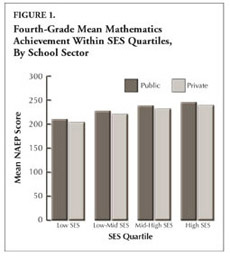
Here are the graphs showing private-school and public-school achievement in

fourth grade and eighth grade, within SES (social-economic status) quartiles:

In all four quartiles in both grades, public-school kids clearly outperform

their private-school counterparts. Although private schools

do have better mathermatics results than public schools, that’s entirely because

the kids in those schools are more privileged.

The Lubienskis conclude:

Our findings suggest that it is time for a critical reexamination of common

assumptions regarding the effectiveness of public and private schools. As

market-style reforms change the public school landscape, prompting many to

call for various forms of privatization of schooling options, it is important

to examine the evidence regarding whether private schools are, indeed, more

effective than public schools. In our study, once we accounted for the fact

that private schools tend to have higher-SES students than public schools,

we actually found just the opposite of what was expected: public schools outperformed

private schools within each SES quartile.

I could put it more simply: send your kids to public school.

They’ll do better than they would at private school, and with the money you

save you can further improve their upbringing, education and lifestyle in many

other ways.

UPDATE: It turns out there’s a more extensive and later survey, with much the same conclusions, which can be found here and was reported on in the NYT here.

Posted in Uncategorized | 21 Comments