In defense of vulture funds

Greg Palast is an admirably bulldoggish reporter. Pop over to his blog, and you’ll see that the last six entries are all on the subject of vulture funds in general, and the Donegal vs Zambia case in particular. Palast reported on the subject for BBC’s Newsnight: You can see the full video here, or get essentially the same gist in text form here.

At the same time, the Guardian’s Ashley Seager has been following the news of the case from a decidedly Palastian perspective. Here are some of his recent headlines, which give a pretty good idea of the tone he’s taking:

‘Vulture’ feeds on Zambia

Court lets vulture fund claw back Zambian millions

Bush could block debt collection by ‘vulture’ funds

All of this reporting is predicated on the basic notion that vulture funds are inherently evil things, doing things which can and should be banned. (This notion is not confined to leftist journalists, by the way. It is shared by sophisticated international economists, such as Anne Krueger, the former first deputy managing director of the IMF.)

I am broadly sympathetic to where people like Palast and Seager and Krueger are coming from: I think that debt relief for heavily-indebted poor countries is a very good idea, and I think that poor Africans struggling under their governments’ enormous debt burdens care little about distinctions between different types of creditors and other matters which I’m going to discuss here.

At the same time, however, I’ve seen the vulture funds get almost no defense in the press, and there are in fact quite a lot of reasons why they perform a good and useful function. (In this respect, they’re rather similar to the birds after which they’re named.) So read Palast if you want the argument against the vultures: What I’m going to write here is a deliberately one-sided defence of what they do and how they do it. With luck, I’ll be able to get Palast to respond.

(One big hat-tip before I start, to Andrew Leonard, whose blog entry on the subject I read just as I was heading into a completely unconnected meeting with Palast’s wife on Thursday. Another participant in the meeting asked for a “primer” on all this: I think between Palast’s stuff and my own, we should be most of the way there – assuming that the length of this entry doesn’t disqualify it from primer status.)

So. What is a vulture fund? Here’s Palast’s definition (actually, I should be accurate here – the byline on the piece is actually Newsnight’s Meirion Jones, who was the producer on Palast’s report):

Vulture funds – as defined by the International Monetary Fund and Gordon Brown amongst others – are companies which buy up the debt of poor nations cheaply when it is about to be written off and then sue for the full value of the debt plus interest – which might be ten times what they paid for it.

There’s a lot of stuff to unpack here. But to begin at the end, vulture funds – or distressed-debt investors, as they prefer to be known – are no great fans of litigation strategies. Yes, they do sue countries in US and UK courts, on occasion. But there are lots of other ways they can make their money. For instance, consider a vulture distressed-debt fund which bought Ecuadorean Brady bonds at 25 cents on the dollar in 1999 after that country defaulted, and then tendered into Ecuador’s 2000 debt exchange, in which bondholders were given securities worth about 70 cents on the dollar.

That was a highly lucrative trade, which involved no legal fees and which probably made more money, in terms of annualized return net of fees, than most if not all of the litigation strategies which vulture funds get into. As for debt which “is about to be written off”, that might be true in the Donegal-Zambia case, but it is far from being the norm. In fact, I don’t know of any other distressed-debt situation in which a vulture fund “swooped in” (sorry, these things are unavoidable) and bought debt which was about to be cancelled. I daresay there might be one or two situations that I don’t know about, but such trades are emphatically not the norm. In the vast majority of situations, vulture funds buy debt from investors who, for whatever reason, no longer want to hold it. And in doing so, they provide a very useful service.

Consider this: You’re an investor, and you buy the bonds of the sovereign nation of Ruritania for 100 cents each. The bonds pay their 7% interest for a couple of years and you’re happy, until one morning Ruritania decides it is going to default and not pay you anything. Now what do you do? “Oh well,” you can say to yourself, “easy come, easy go, I guess I lost all of my money”.

You could say that, but that would be pretty unlikely, because you’re a bond investor – and bond investors tend to be reasonably risk-averse. If you wanted to risk losing all your money, then you would have invested in something much riskier, like stocks.

But that’s not your only option. A bond is, after all, a legal contract, and Ruritania is contractually obliged to pay you your interest and principal in full and on time. Just as your bank can sue you if you stop making your mortgage or credit-card payments, you can sue Ruritania if it stops making its coupon payments.

But there’s a problem here. Legal fees are expensive, and you don’t have any money. What’s more, Ruritania has high-powered lawyers of its own, such as William Blair QC, Tony Blair’s brother, and can call at will on the awesome might of huge international law firms such as Cleary Gottlieb Steen & Hamilton.

There’s no way you can even retain, let alone afford, that kind of legal firepower – and in any case you have no appetite for a drawn-out legal fight which could last for years. What’s more, even if you win the legal fight, there’s still no guarantee that Ruritania will have any more respect for a court judgment in your favor than it had for the original bond contract. In other words, you could win in court and still be no better off than you were to begin with – worse off, in fact, since you’d be down all those legal fees.

Back to square one, then, it would seem: You’ve lost all your money. Except – there is one more option. Bonds, after all, are securities, which can be bought and sold. At any point in time, including now, any bondholder is free to sell his bonds to the highest bidder (or anyone else). And it turns out that in the market for Ruritanian bonds, there is a bid at 50 cents on the dollar.

Rather than losing your entire 100-cent investment, you can sell your bonds for 50 cents instead, and lose only half rather than all of your money. Ruritanian debt hardly turned out to be a fabulous investment, but at least it didn’t wipe you out completely.

Who would pay 50 cents on the dollar for Ruritanian debt? Well, bonds in default are known as “distressed debt”, so by definition anybody buying such a thing is a distressed-debt investor. Or, to use the more abusive term, a vulture.

From the point of view of bondholders, however, these particular vultures look more like white knights. Many large institutional investors will never pursue legal strategies against deadbeat debtors: that’s simply not their skill-set. And most of them aren’t even allowed to hold defaulted debt in the first place: they’re forced to sell their bonds if an issuer defaults. So what they need in such a situation is a market in such instruments which will give them some kind of non-negligible recovery value on their defaulted paper. Without such a market, there’s a good chance that they would never take the risk of investing in any foreign country’s debt in the first place.

I can hear Palast in the back of my head already. “Good!,” he’s saying. “Countries shouldn’t run up burdensome debts which will ultimately have to be repaid, with interest, by poor future generations.” Well, Palast is entitled to think that – if, indeed, that’s what he thinks. There’s certainly a case to be made that development institutions such as the World Bank should move away from loans and towards more grants to poor countries.

I’m not going to get into that debate here. I’m simply going to point out that ever since the 18th Century, successful nations have been those which have been able to finance themselves through the issuance of debt securities. (See James Macdonald for much, much more on this idea.)

More generally, debt is a Good Thing. On a personal level, few of us would ever be able to buy a car or a house without some kind of debt finance – and on a sovereign level, countries which desperately need roads or ports or schools or hospitals can build them today, rather than having to save up for years before being able to build them, only because they can raise debt capital.

Obviously, too much debt is a bad thing – that’s what “too much” means. But every democracy in the world borrows money, and it’s the worst type of paternalism to tell poor countries that they can’t or shouldn’t do something which all countries do and which its own citizens have voted for.

For debt finance to work, you need three things: a borrower, a lender, and a contract. The contract can be as simple as a verbal agreement that “I’ll pay you back tomorrow,” or it can be an inch-thick loan agreement with repayment schedules and covenants and negative pledges and waivers of sovereign immunity. But the important thing is that the borrower contracts to repay the lender. And one of the interesting things that lenders have learned over the years is that abstract sovereign entities, such as governments, are actually more reliable in this respect than sovereign individuals, such as kings or emperors.

Governments can and do repay their debt for ever. (Britain started issuing perpetual bonds in 1853, and by 1935, perpetual bonds made up more than 60% of the UK’s debt issuance.) Individuals, by contrast, die – and when they do, it’s often impossible to collect on their unsecured debts. Today, the safest debt instruments in the world are US Treasury bonds – the sovereign debt of the US government. Indeed, the rate of return on Treasury bonds is known as the “risk-free rate”.

So there’s nothing obscene about the idea that governments should owe individual creditors money, and there’s nothing remotely unusual about those debts being enforceable in a court of law. Pretty much every government in the world, with the possible exception of Cuba, has implicitly accepted the fact that they are responsible for the debts incurred by previous governments – and that, in turn, they can compel future governments to make certain repayments. Every so often, sovereign debts become overwhelming, and they are restructured by the mutual agreement of the debtor and its creditors. But outright repudiations of outstanding debt are very rare – and even when they do happen, as in the case of Cuba, the bonds continue to trade on the secondary market for 30 cents on the dollar or more – in the expectation that, sooner or later, a future Cuban government will finally make good on the debt.

If a government defaults on its obligations, then, the debt doesn’t simply disappear. It’s still there – and, sooner or later, it will have to be dealt with. Vulture funds are long-term investors who buy defaulted debt and then try to persuade the issuer to deal with it. Because they buy the debt cheap, they’re often willing to settle at much less than face value – in the famous case of Elliott vs Peru, for instance, the vulture fund, Elliott Associates, made numerous attempts to settle with Peru at a discount, all of which failed.

So Elliott resorted to litigation, and eventually got paid off, by Peru, in full.

Here’s how Palast puts it (it’s worth knowing that Paul Singer is the founder of Elliott Associates):

Newsnight went to New York to try to interview Paul Singer – the reclusive billionaire who virtually invented vulture funds.

In 1996 his company they paid $11m for some discounted Peruvian debt and then threatened to bankrupt the country unless they paid $58m. They got their $58m.

Now they’re suing Congo Brazzaville for $400m for a debt they bought for $10m.

I have some idea where the $400 million number comes from – I’m very familiar with the Congo case, having written about it at length in the September issue of Euromoney. I think that here Palast is wrong, and that he’s confusing the amount that Elliott is claiming from Congo with the amount that Elliott is claiming from French bank BNP Paribas in a separate, if related, case. And as for Elliott threatening “to bankrupt” Peru – what does that even mean? The only thing that Elliott threatened was that they would try to attach payments which Peru was making to other creditors. Elliott’s position was simply that Peru shouldn’t be able to get away with paying some of its creditors in full and on time, while ignoring the claims of other creditors of equal or greater seniority. How that’s related to bankruptcy, I have no idea.

But back to Donegal vs Zambia. In this case, Donegal and Zambia signed an agreement in April 2003, enforceable under UK law, under which Zambia would make certain debt payments to Donegal. Prior to that, in 1999, Zambia had officially recognized Donegal as a legitimate creditor. In the 2003 agreement, Donegal settled its $44 million debt for 33 cents on the dollar, to be repaid over the course of 36 monthly payments. Does that sound to you like they sued for repayment in full? Not at all: they were perfectly happy to take 33 cents on the dollar, and signed a legally binding agreement to that effect. It was only after Zambia defaulted on the 2003 agreement that Donegal took Zamiba to court, under the terms of the same legally binding agreement that had allowed Zambia to pay Donegal just 33 cents on the dollar.

It’s worth bearing in mind, here, that if Zambia had simply paid Donegal the payments it agreed to make in 2003, neither Palast nor anybody else would even have noticed, let alone cared. A country making debt repayments is simply not news. But when Zambia stopped paying and Donegal sued, then, suddenly, Zambia making the debt payment is tantamount to Donegal killing children, or at the very least preventing them from being educated. In the BBC piece, Palast finds a Zambian who says that if the country makes the payment, “you are talking about in excess of 300,000 children being prevented from going to school” – as if the payment is coming out of Zambia’s education budget, which it clearly isn’t. (In fact, it’s coming out of Mofed, a UK company owned by the Zambian ministry of finance.)

Half of the outrage against Dongeal comes from the fact that it is pursuing a legal strategy against Zambia – that it’s using a UK court to force Zambia to pay up. But it’s worth bearing in mind here that Zambia has broken its legally binding promises with regard to this debt not once but three times. It defaulted on the original debt it owed to Romania and which it promised to pay Romania in 1979; it broke its 1999 agreement with Donegal that it would recognize the transfer of the debt from Romania to Donegal; and it broke its 2003 agreement with Donegal setting out a repayment schedule at a highly discounted rate.

Zambia’s apologists would have you believe that we should pay no attention to the country’s previous promises. Zambia is poor, they say, and therefore it should be able to break its promises with impunity. But that simply doesn’t work. Countries need debt finance in order to be able to grow. That original debt, for instance, was used to buy tractors – material of immediate financial benefit to the Zambian economy. Zambia either didn’t have the money to buy the tractors outright, or it felt it had better use for that money, so it borrowed the money instead. But if it can’t pay for its tractors in the present, all that means is that it has to pay for the tractors in the future. If Zambia wants to invest in its economy today, it will similarly have to borrow money. But no one will lend the country anything if Zambia can simply decide on a whim to stop repayment agreements made as recently as 2003.

There’s a fascinating subplot running through the Donegal-Zambia case about corruption. The anti-Donegal types mutter darkly about the fact that Zambians may or may not have accepted bribes from people who may or may not have had association with Donegal, before signing the 1999 and 2003 agreeements. As a result, they say, any repayment obligations associated with those agreements are null and void. (Or, to use the legal term, ex turpi causa, known in the US as “unclean hands”.) The world of distressed debt is secretive and shadowy, and in his 134-page ruling, Mr Justice Andrew Smith spends a lot of time trying to unpack who paid what to whom, and when and why. Although he finds Donegal’s evidence unreliable on many occasions, ultimately he does side with them. And the main allegation of outright bribery relates to a payment of just $4,000 – which, as the judge says, “seems to me a very modest payment if the Acknowledgment [the 1999 agreement] had the value to Donegal that Zambia assert.”

Palast tends to ignore the $4,000 payment and concentrate more on a much larger payment of about $2 million in debt that Donegal made to Zambia’s Presidential Housing Initiative (PHI) in 1999. This payment is very much in line with the kind of thing that Donegal’s principal, Michael Sheehan, used to do before he founded Donegal, when he worked at an American not-for-profit corporation called Debt-for-Development Coalition, Inc. The idea behind the non-profit was exactly the same as the idea behind more contemporary calls for debt relief: that if a country owes money to a creditor, then the creditor writing off the debt has the same kind of development effects as the creditor donating money to the country in question. Donegal’s donation was debt relief, which makes it kinda ironic that Palast is so keen to portray it as a bribe.

It’s worth noting that Zambia’s PHI was a real development initiative, and that Donegal’s donation of $2 million in debt was not a bribe to any individual. It’s true that Donegal’s donation was not entirely selfless. When Zambia accepted the donation, it acknowledged formally and legally that Donegal did indeed own the debt that it was donating, and that the debt was legitimate. Both of these things were true. But from a tactical legal standpoint, the acknowledgment was something of a mistake, because until that point Donegal would have found it very difficult to successfully sue Zambia for recovery of the money it was legitimately owed.

Yet even after getting that formal acknowledgement, still Donegal did not sue Zambia for anything. Instead, it looked for debt-to-equity conversion opportunities: swapping its debt for ownership of a Zambian lottery, or a local bank, or Kafue Textiles, or other parts of the Zambian privatization program. It was only when these ideas went nowhere that Donegal started negotiating with Zambia for repayment in cash. Naturally, Donegal threatened legal action should they not come to an agreement, and indeed did eventually start to sue Zambia in the British Virgin Islands. While that litigation was pending, in 2003, Zambia and Donegal signed an agreement whereby Zambia would pay Donegal back 33 cents on the dollar.

Zambia made a few payments under the 2003 agreement before defaulting again. And so yet again Donegal started negotiating with Zambia. Donegal could have declared default as early as October 2003, thereby trebling the amount of money they were owed – but they didn’t, preferring intead to negotiate in good faith with Zambia for the arrears that Zambia owed under the agreement they had signed just a few months earlier. It was only when it became abundantly clear that Zambia had no interest in remaining current on the agreement that Donegal finally declared Zambia in default, ultimately giving rise to the proceedings which culminated in the court case in London.

Much of the literature on this case makes it seem as though Donegal simply bought debt from Romania for about $3.3 million, then turned around and sued Zambia for over $50 million, including legal fees. In fact, Donegal spent many years in negotiation with Zambia before it ever sued anybody for anything. It is Zambia, not Donegal, which has most egregiously violated its legal agreements, and it is Zambia which has chosen to spend its money on expensive lawyers rather than simply follow through on its own promises. Really, it’s the Zambians, not Donegal, who decided on a litigation strategy. It turns out that their strategy was not successful, and that they would have been better off simply paying Donegal what they agreed to pay Donegal in 2003. That’s not Donegal’s fault – it’s Zambia’s.

Palast also tries to explicitly tie the money that Donegal is receiving as a result of these court proceedings to the debt relief that Zambia has received from rich countries under the Heavily Indebted Poor Countries (HIPC) initiative. He asks Donegal’s Sheehan, in an ambush interview, “aren’t you just profiteering from the work of good people who are trying to save lives by cutting the debt of these poor nations?”. But in fact Sheehan’s court case against Zambia has no relation whatsoever to the HIPC initiative, and would surely have gone ahead whether or not Zambia received debt relief from the Paris Club of creditor nations or the World Bank or the IMF or anybody else. If Gordon Brown gives Zambia debt relief and Michael Sheehan doesn’t, that doesn’t mean that Michael Sheehan is “profiteering” from Gordon Brown’s work. It just means that Zambia doesn’t need to repay Gordon Brown on top of what it needs to pay Michael Sheehan.

There’s one other big beef which Palast, and Leonard, and Seager, and other journalists covering the case, seem to have with Sheehan: that he’s making a profit on his transaction. Well, yes, he is. But profit, in and of itself, is not a bad thing. There are plenty of other financiers who are making much more money than Sheehan, and some investors, such as Warren Buffett, are treated not as villains but as heroes for their ability to make money.

It’s also worth noting that Sheehan’s profit isn’t nearly as large as most of the journalists are making out. The stories concentrate on the $55 million that Donegal is claiming, rather than the $20 million or so that Donegal is likely to actually receive at the end of the day. And they tend to ignore the fact that Zambia really did borrow a lot of money back in 1979 to buy tractors – money on which it agreed to pay interest. If you take the $15 million or so that Zambia borrowed, and add on any reasonable interest rate on top of that, the result will take you to far more than the $20 million that Donegal is going to receive in settlement of that debt, including its own non-negligible legal costs. The real loser in this whole case is not Zambia but Romania, which sold its $30 million debt for $3.3 million. Even there, however, Donegal is a hero: Romania was in negotiations to sell the debt back to Zambia, but because there was another bidder involved (Donegal), Romania ended up receiving roughly twice as much money as it would otherwise have been able to receive.

Donegal’s opponents like to portray Zambian sovereign debt as debt of the Zambian people. Here’s Peter Otto:

While the judge was bound by the law to find in favour of the vulture fund, it is disappointing that he did not give a more imaginative decision. Remembering the judge in The Merchant of Venice, it would have been more to the point to require Michael Sheehan of Donegal International to collect the money “owed” in person from each of the Zambians, in cash. I think $7 per head is about right. And to add a clear explanation to each one as to why they should not eat for the following week would make the “justice” more personal.

Does Otto really think it would be more just for Donegal to force individual Zambians to pay $7 each in cash than for Donegal to receive $20 million from a company owned by the Zambian ministry of finance? ($7 multiplied by Zambia’s population of 11.5 million comes to over $80 million, so maybe $1.75 might have actually been more apropos.) Does he think that forcing individuals to starve is a good way of paying sovereign debts? Because certainly Zambia can pay this debt without forcing any Zambians to go without food.

And more to the point, does it make sense to think of a sovereign debt as being owed by the citizens of that country severally? Let’s say that the US government owes China $1 trillion. Should the Chinese government try to collect more than $3,000 from each US citizen, in cash? Maybe it should just go to each person and collect $150 or so in annual interest payments? Sovereigns, and sovereigns alone, have the ability to demand payments from their citizens. (They’re called taxes.) And so far, there has been no indiation whatsoever that Zambia will raise taxes as a result of this judgment. So let’s be a little bit careful with the rhetoric.

And let’s not take articles like this one from Ashley Seager, claiming that “President Bush could come to the aid of Zambia,” too seriously either. If you’ve come this far in this blog, you’ll be able to pick out the weaknesses in the report quite easily.

For instance, Seager says that

Donegal bought the debt, with a face value of $30m, from Romania in 1999 for less than $4m. Zambia agreed to pay Donegal $15m in return for a payment to the then president’s favourite charity. This payment, exposed by Mr Palast but which Mr Sheehan denies was a bribe, could mean Donegal falls foul of the US Foreign Corrupt Practices Act.

The idea that Zambia agreed to pay Donegal “in return for a payment to the then president’s favourite charity” is profoundly silly. After all, the payment to the charity was in the form of the very debt which Zambia was agreeing to pay. If the debt was worthless, then the donation to charity was worthless. And the payment was hardly “exposed by Mr Palast” – it’s all there in Zambia’s defense papers, and I’m sure that Palast was simply given the information on a plate by William Blair, QC.

(For the record: I have spoken to nobody about this subject since the Zambia news started coming out. All of my information comes from publicly-available sources, primarily the court judgment in the UK. I have never spoken to Michael Sheehan or any of his colleagues. I have spoken to some of the principals at Elliott Associates in the past. But since my story on their Congo case, I seem to have persona non grata status there, and I doubt that they would consider me particularly friendly to vulture funds in general.)

But back to that alleged bribe. Here’s some of what the judge has to say about the payment to PHI, and Zambia’s claim that Donegal’s offer to make a payment to PHI was tantamount to a bribe:

There is no reason to suppose that [PHI] was inherently an improper scheme or that it was set up with improper motives or that Donegal did or should have supposed at any relevant time that the PHI was other than a worthy scheme…

Mrs Chibanda was aware, before the debt was assigned by Romania to Donegal, that the purchasers of the debt had indicated that they might contribute, or that they proposed to make a contribution, to the PHI… However, there is no reason to suppose that that information was given to Mrs Chibanda covertly, …and it is apparent from Mr Mbewe’s evidence that she did not keep that information secret. It has been suggested that the information was given to Mrs Chibanda in order to influence her to obstruct the delegation’s proposal, and so was something in the nature of a bribe or improper inducement… I am unable to accept that. The mischief of bribes, or secret commissions, is that they are secret. It might be that Mrs Chibanda thought that the prospect of support for the PHI was attractive, and it might be that… Mrs Chibanda thought that the potential benefit to Zambia of having finance for housing those on low incomes was something properly to be weighed when deciding upon the relative benefits of Zambia buying back the debt and allowing it to be bought by a third party. I am unable to conclude that it was in itself improper for Mrs Chibanda to be made aware of the possibility that Donegal might contribute to the PHI.

In other words, nothing improper happened.

As for the idea in the Guardian article that “Mr Bush has the power to block collection of debts by vulture funds, either individual ones or all of them, if he considers it to be at odds with US foreign policy,” I’m not entirely clear where that comes from. Apparently Congressman John Conyers thinks that “the Foreign Corrupt Practices Act and the comity doctrine brought from our constitution allows the president to require the courts defer in individual suits against foreign nations” – and that’s something I simply don’t understand.

In any case I’m quite sure that Treasury, if and when they get wind of such a proposal, would swiftly squash it. There are hundreds of billions of dollars of dollar-denominated sovereign bonds traded under New York law, and all of them include a waiver of sovereign immunity. It seems to me that Conyers is asking Bush to reinstate precisely that sovereign immunity which the bond issuers have voluntarily waived – and that’s something that no debt-issuing country would want. If countries reverted to having absolute sovereign immunity in New York courts, then none of them could ever borrow money in dollars again. Capital flows to emerging-market countries would dry up overnight, and there would probably be an enormous rush to dump any bonds issued under New York law – creating a monster liquidity crisis in the financial markets, and probably consigning most of Latin America, at the very least, to another brutal recession like that seen in 1998. So the chances of anything like this happening are precisely zero, even if it were constitutionally possible, which I doubt it is.

The fact is that private-sector capital flows to emerging markets are vastly larger and more important for development than public-sector flows from the likes of the World Bank. All of those private-sector capital flows are predicated, ultimately, on contract law. When trillions of dollars in flows are based on contract law, eventually some contracts are going to end up in court. And when a country gets taken to court, sometimes it will lose.

But if you add up all of the judgments awarded against all of the emerging-market countries which have ever been sued in the history of the international capital markets, the final number would be so minuscule in comparison with the magnitude of international capital flows to emerging-market sovereigns that it would barely constitute a rounding error. And yet the tiny outside chance that a country might one day be taken to court is absolutely crucial if that capital is to continue to flow. Big institutional investors don’t like doing the work of suing sovereigns, so they essentially outsource that work by selling their defaulted debt to vulture funds. People might not like what the vulture funds do, but what they do is utterly necessary for everything else to function smoothly.

Oxfam has launched a campaign against Donegal entitled “Don’t let the debt vultures make a killing”. They should remember that vultures don’t kill anything. There are lots of reasons why Zambians are living in abject poverty today, and Donegal’s lawsuit is not one of them. Vulture funds create the conditions under which countries like Zambia can raise money for investments in health, education, and infrastructure.

Maybe Oxfam should consider sending them a thank-you letter instead.

Posted in Econoblog | 40 Comments

Armory

Sorry about the lack of posts today – I spent the morning working on

a long piece about vulture funds (coming soon!) and the afternoon at the Armory

Show. The fact that it’s all in one place now, rather than being spread

over two piers, is great.

It’s a good one, this year – largely thanks to the Brits, who really

stand out. (Keith Tyson at Haunch of Venison, Ceal Floyer at Lisson, and, much

as I hate to admit it, Damien Hirst at White Cube spring to mind.) One gallery

I hadn’t come across before (it’s been a long time since I’ve really done the

galleries in London) is Timothy Taylor, who has a huge collection of all-stars

on his list but who devoted a lot of wall space to Ewan Gibbs, whose small drawing

on graph paper of the Empire State Building is just lovely. Also from London

is Alison Jacques, who was showing an utterly gorgeous Catherine Yass Lock.

And, of course, there are my great friends Christabel Stewart and Darren Flook,

of Hotel, showing for the first time

this year, and whose Rita Ackermann was much better than the one mirroring it

at Almine Rech next door. That said however, Rech has a really great neon piece

by Nathaniel Rackowe which is one of the standouts of the Armory. Michelle’s

favorite piece, I think, was Mark Dion’s piece about stuffed polar bears at

Tanya Bonakdar. My favourite pieces might well have been the Tony Fehers at D’Amelio Terras and PaceWildenstein, if only because they were such a pleasant change from all the freneticism elsewhere. Oh, and a message from Michelle: Sean Kelly’s getting fat. So

anyway. Must get back to those vulture funds…

Posted in Not economics | Comments Off on Armory

Why expanding Sarbox doesn’t make sense

I’m a little bit late to the game, here, but let me point you to the latest

piece from Thomas Palley, entitled "Expand

Sarbox, Not Shrink It". The idea is that US shareholders need more

protection, not less, and Palley has no fewer than eight reforms which he thinks

should be mandated by the US government, including

  • Require that the CEO and Chairman of the Board be different

    persons.

  • Stop share buy-backs.
  • Make it obligatory for management to hold vested options

    for a period of three years.

Etc., etc. Talk about a recipe for decimating the public markets altogether.

Hasn’t Palley stopped to wonder what it is that’s driving the private-equity

industry? No one in the world would love these reforms more than Steve

Schwartzman and his like. Corporate governance is all well and good. But

just because something is desirable doesn’t mean it should be mandated. If shareholders

don’t really care about these things (as reflected by the share price), then

why should the government start getting all paternalistic and protective of

them? Let them take the risks, say I.

Posted in Econoblog | Comments Off on Why expanding Sarbox doesn’t make sense

No, Bush isn’t at fault for the subprime crisis

I’m still waiting for Dean Baker’s

blog entry on why the risk of a credit crunch means that we should start importing

more white collar professionals now. But in the mean time, enjoy this, from

the New

York Times leader column:

More than 20 percent of global private debt securities is now tied to housing

in the United States. That works out to $7.5 trillion — far larger than

the market for United States Treasuries. So if America’s mortgage market

heads south, the losses could be widespread.

The odds of a global financial crisis are still low, according to Mr. Zandi

and Mr. Licari, but they are rising. There is not a lot now that can be done

about the risks in the mortgage market. But the growing possibility

of hard times ahead is another argument for rolling back many of the recent

excessive tax cuts, so the government will have more resources available

to respond if a crisis comes.

Of course, the Times doesn’t mention that an enormous chunk of that $7.5 trillion

is made up of agency bonds from Fannie & Freddie, which are simply not at

risk. Why be honest when you’re taking a running jump at an anti-Bush punchline?

Bush has not been a great president, but I don’t think you can blame lax lending

standards in the subprime mortgage market on him. Hell, thanks to his fiscal

policy, interest rates are probably higher than they would otherwise

be.

Posted in Econoblog | 1 Comment

Fortune profiles Steve Schwarzman

Have you read Nelson Schwartz’s profile

of Steve Schwartzman? The best quote in the piece goes to Schwartzman himself:

"I’m in it because I like to be excellent and to win."

Schwartzman is painted as yet another humorless billionaire financier –

a breed that the world is creating far too many of, these days.

Posted in Econoblog | Comments Off on Fortune profiles Steve Schwarzman

How does bad news affect share price?

I’ve been looking a bit at JetBlue, and what happened to its stock price over

the past 10 days or so.

The

airline was hit very badly by New York’s snowstorm on Wednesday the 14th: that

day, and the following days, passengers were stranded and the press surrounding

the company was atrocious.

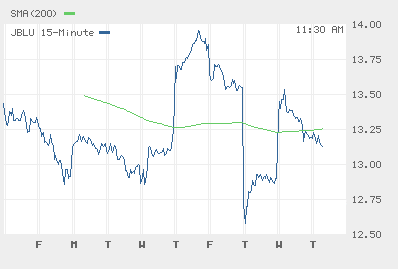
So what happened on the 14th? JetBlue’s share price rose, from $12.98

to $13.23. And what happened on Thursday the 15th, the day JetBlue made the

front page of the New York Post in the worst possible way? The stock opened

higher still, at $13.67, and closed at $13.85, after breaking the $14 level

intraday. The markets didn’t care about weather delays, they cared about the

fact that George Soros had amassed a 9.7% stake in the airline.

The stock stayed strong on Friday, closing at $13.56, but then it opened much

lower – at $12.57 – on Tuesday, after the long weekend. Why? No

news, really, but there was an analyst downgrade from Morgan Stanley. The stock

recovered a bit over the course of the day, closing at $12.90, and then opened

sharply higher on Wednesday, at $13.30. Why? This is a bit weird: JetBlue released

guidance saying that the storm would cost it $30 million in revenues in the

fourth quarter, and would lose money in the first quarter as well. But clearly

that news was better than the market was betting on.

Some hint of what’s was going on can be seen from a WSJ Marketbeat entry from

Tuesday, entitled "JetBlue’s

Blues Good for Shorts":

All told, 22.8% of the public float of 147.6 million shares is currently

being sold short for the airliner. There are only 13 other issues on the Nasdaq

with a larger number of shares sold short — but JetBlue has a larger

percentage of its shares held short than any of them.

The WSJ’s David Gaffen obviously saw that as a bearish sign rather than a bullish

sign – but in fact it set the ground for a nice little short-covering

rally the following day.

Here’s the JetBlue share price over the past 10 days:

big.chart.gif

chart.asp.gif

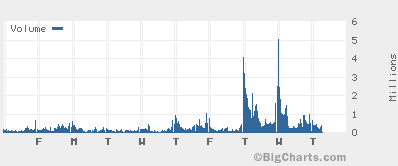
As you can see from the volume chart, there was almost no interest in JetBlue

during the storm on Wednesday, or during the aftermath on Thursday and Friday.

But volume at the beginning of this week, when there was much less in the way

of news, has been enormous. And in the grand scheme of things, the JetBlue share

price is still more or less in the same place as it was before all of this happened.

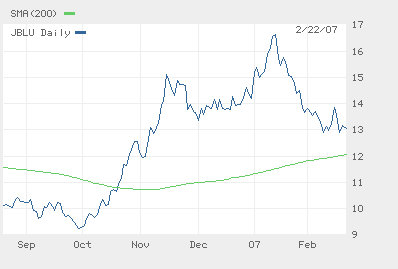
In fact, the whole storm in a teacup is utterly irrelevant in the context of

where JetBlue’s stock has traded over the past six months:

big.chart2.gif

Which all makes me think that news is much less important for share prices

than many people think, and that if you try to trade on the basis of news, you’re

not likely to get very far. The only time that JetBlue’s share price fell in

the wake of the bad news was almost a week after the storms –

and the drop only really lasted for one day. Good luck trying to trade that.

Posted in Econoblog | 1 Comment

Reading the EMTA volume survey

I love getting nerdy with EMTA’s volume surveys, and now they’ve released

the big annual survey for all of 2006. In case the press release has disappeared

behind a firewall again, here’s the gist:

Emerging Markets debt trading reached its highest annual level ever in 2006,

according to a report published today by EMTA, the Emerging Markets debt industry

trade association. Participants in EMTA’s Annual Survey of Emerging

Markets debt trading reported volume of over US$6.5 trillion in 2006, a 19%

increase compared with the US$5.5 trillion reported in 2005. Trading volumes

exceeded the nearly US$6 trillion recorded in 1997, when local markets accounted

for only 26% of overall EM trading activity.

EMTA also released the results of its Fourth Quarter 2006 Survey, which showed

that trading stood at US$1.634 trillion in the final months of last year,

compared with US$1.378 trillion in the fourth quarter of 2005 (a 19% increase)

and US$1.599 trillion in the third quarter of 2006 (a 2% increase).

The FT’s Joanna

Chung gets the big picture:

Eurobond volumes rose by just 1 per cent year-on-year to $2,675bn in 2006

while trading volumes in local instruments jumped 42 per cent to $3,687bn.

In other words, although the headline $6.5 trillion number is impressive, the

old-fashioned asset class of sovereign dollar-denominated bonds is rapidly becoming

a thing of the past – and indeed its heyday was a full decade ago, in

1997.

EMTA hasn’t quite caught up to the new realities yet, in that it breaks down

volumes by instrument in the eurobond category, but not in the local-market

category. So Mexico’s MBono 20 might be traded more than many of the top 10

eurobonds, but we just don’t know. (We do know, however, that Bonos in total

traded an eye-popping $589 billion in 2006, so it’s probably a safe assumption

to make.)

Volumes on pretty much every individual eurobond except the Brazilian 2040

are pretty pathetic. And even the Brazil ’40s saw their total volume traded

plunge to $477 billion in 2006 from $576 billion in 2005. After that, the Russia

’30s are in second place on $175 billion, and no other instrument cracks the

$100 billion level. The top-traded Mexican eurobond, the 2017, traded less than

$18 billion in 2006, and indeed all of Mexico’s sovereign eurobonds put together

traded less than $100 billion. Clearly, these things are sitting in buy-and-hold

accounts, rather than being used on a daily basis to express opinions on where

EM debt might be headed.

The Vene ’27s are less popular too: they traded $59 billion in 2006 compared

to $74 billion in 2005.

Meanwhile, local markets, especially Mexican local markets, are going from

strength to strength. Mexico’s numbers almost defy belief: the local markets

in total traded $697 billion in 2005, and $1.25 trillion in 2006. In

other words, Mexican local markets on their own account for almost 20% of all

emerging-market bond trading globally.

The surge in Mexican local-market volumes, combined with the drop-off in the

Brazilian 2040s, meant that Mexico has now overtaken Brazil to be the single

most traded country in EM, with $1.53 trillion in total compared to Brazil’s

$1.42 trillion. In 2005, by contrast, Mexico had just $905 billion in total

volume, compared to Brazil’s $1.55 trillion. Obviously, Brazil has some catching

up to do when it comes to local instruments, which grew to $518 billion in 2006

but which are now less than half the volume seen in Mexico. You’d think that

the high yields in Brazil would attract traders, but the problem is really regulatory.

It’s time that the Brazilian regulators made Brazilian local debt easily tradeable

anywhere in the world.

Posted in Econoblog | Comments Off on Reading the EMTA volume survey

Who to believe when it comes to systemic risks?

I’ve finally put Andrew

Leonard in my RSS reader, despite the Salon firewall, because he really

is worth reading. Still, he does have a habit of being a bit on-the-one-hand-on-the-other-hand

when it comes to systemic risks and subprime lending and all that jazz. Last

week he quoted people on both sides, but I’m going to go with this guy:

Kerr

quotes Scott Simon, head of mortgage and asset-backed securities investments

at Pimco, as saying, "We don’t believe there is any systemic risk at

all."

Why do I implicitly trust Simon on this one? Firstly, he actually has skin

in the game, while the gloomsayers don’t. And secondly, he’s putting his neck

on the line. If you say there’s systemic risk and nothing happens, that doesn’t

mean you were wrong. But if you say there is no systemic risk and something

does happen, then you look like a wally.

Now, I know the arguments on the other side. Buy-siders ignore lower-tail risks

because they can’t be blamed if something crazy and lower-tail happens. What’s

more, people who take such risks seriously tend to be too cautious, relative

to those who don’t, and underperform, and leave the industry. But the fact is

that Scott Simon is a bond investor. And I’ve never met a bond investor

who didn’t spend his entire working day worrying about risks small and large.

And if he’s comfortable with the risks out there, I’m not going to lose any

sleep.

Posted in Econoblog | Comments Off on Who to believe when it comes to systemic risks?

Even the World Bank doesn’t like Summit Communications

Christine

Bowers:

Let’s cut to the chase. What are the absolute worst things countries can

do as they build their image?

  • Blow your budget on a fancy, one-time insert in a big newspaper for $250,000.

On which subject, the comments are still coming on my post about Summit

Communications and AFA Press. But let’s be clear, here: the budget isn’t

blown because the insert is fancy.

Posted in Not economics | Comments Off on Even the World Bank doesn’t like Summit Communications

Mutual funds: Is there correlation between past performance and future performance?

Free

Exchange and Blodget agree:

past performance is no guide to future results, when it comes to mutual-fund

returns. Is this true? I posed

the question back in 2004, when I wrote this:

When a rather obnoxious man at Citibank tried to sell me some mutual funds

once, based on their outperformance, I actually spent quite a bit of time

researching this issue. Companies like Morningstar generally group funds into

quintiles: the top 20%, the next 20%, and so on. And there is in fact a certain

amount of correlation between past performance and future performance. Not

a lot, but a little. Funds in the bottom quintile will tend to underperform

in the future, funds in the fourth quintile will underperform but not quite

as badly, and funds in the top three quintiles are all roughly equally likely

to outperform in the future.

This generated a little bit in the way of comments. Said Simian:

Actually the academic evidence points primarily to a random walk when it

comes to mutual fund performance. Morningstar ratings – which are currently

based on risk-adjusted, peer-relative trailing returns for various horizons

(1 year, 3 year, 5 year, etc) – have generally been shown to be non-persistent

(Blake & Morley). So prior good performance does not suggest that future

performance will be particularly good or bad; it’s merely noninformative.

The studies which did find some, albeit not very strong, persistence (Warshawsky)

suggested that economies of scale played a role. In other words, if a fund

did well, assets poured into it, and a large fund is better able to control

and allocate costs, to a degree which overcomes the increased market impact

of its trades.

Which is actually the opposite of what Blodget is saying, which is that larger

funds are less likely to outperform.

The big message, of course, is clear: don’t buy mutual funds. And that’s good

advice even if it is followed by "every economist I have ever

met," to quote the Economist’s blogger. At the margin, however, is there

some kind of correlation between past performance and future performance? I

think Simian might have been referring to this

paper, by Elton, Gruber, and Blake, but it says that "We find that

past performance is predictive of future risk-adjusted performance".

Posted in Econoblog | 2 Comments

Hedge funds: Getting riskier?

So there’s this Great

Moderation, right? And the hedge funds are part of it. Look at all of them

with their high alpha underperforming the S&P 500: in other words, by bringing

down beta to incredibly low levels. Which is all well and good, but it’s hardly

exciting. We want activist investors like Patrick

Degorce: high risk, high return! Or even, for that matter, Brian

Hunter. A bit of excitement – you can lose your money or you can double

it, treble it! And so: "Best

Ideas" funds. Which are getting a bit of a bad

rap. But the returns have to come from somewhere, right? One alternative:

just lever up before you invest in that high-alpha, low-beta fund.

But then you run the risk of losing more than all your money.

Posted in Econoblog | 2 Comments

Shareholder of the day: Patrick Degorce

The Children’s Investment Fund sounds so cuddly, doesn’t it? And in fact it

does give a large chunk of its profits to charity. But it gets those profits

by buying up stakes in undervalued companies and forcing management to shake

them up – and the latest

target is ABN Amro.

TCI was founded by Christopher Hohn, but the formal

letter to ABN Amro, which is reprinted at Alphaville, was written by TCI

partner Patrick Degorce. He’s not pulling punches:

Since the current chairman of the Managing Board was appointed in May 2000

ABN AMRO has given shareholders a cumulative share price return of 0% (excluding

dividends) compared to (a) the ABN AMRO selected peer group of approximately

44% and (b) the Dow Jones Euro Stoxx Banks Index of 44% (all numbers are for

the period 1 June 2000 to 31 January 2007).This terrible shareholder return

is a function of the fact that ABN AMRO’s underlying earnings per share

has been broadly flat for around 6 years, during a time when nearly all banks

globally have enjoyed a period of strong earnings growth.The Managing Board

has presented several restructuring strategies over the last 6years which

were supposed to accelerate earnings growth which would be reflected in a

higher share price. In 2006 they again committed to cut costs and they have

so far failed to deliver.

Degorce reckons that breaking up ABN Amro could "justify a price significantly

in excess of EUR30 per share" – which isn’t all that much higher

than the €27.25 the bank is trading at in the wake of Degorce’s letter

becoming public. But the real impetus behind the letter, I think, is not to

split up the banks in ABN Amro’s "home markets" of Italy, Holland,

Brazil and the US Midwest. Rather, it’s to force ABN Amro to get its own house

in order before embarking on a foolish and expensive acquisition of Capitalia.

On the other hand, other parts of ABN Amro, such as the capital markets and

asset management businesses, might well get sold off, along with its Asian holdings.

Either way, Degorce has managed, with one letter, to increase the value of ABN

Amro by over $3 billion in one day, which is pretty impressive.

Posted in Econoblog | 11 Comments

Leonhardt gets Stern’s discount rate wrong

Aaaaarrrrgh! Why is it that when the debate over discount rates and climate

change finally makes it into David

Leonhardt’s NYT column, he gets it completely wrong?

The Stern Review assumed that a dollar of economic damage prevented a century

from now (adjusted for inflation) is roughly as valuable as a dollar spent

reducing emissions today.

This is not true. This is wrong.

John Quiggin has an invaluable backgrounder

on all this, but basically Stern’s choice of discount rate (eta = 1) means that

he adjusts for income, not for inflation. Global income presently is

about $7,000 per person, and global income in 2100 will be about $100,000 per

person, according to Stern’s projections. Using his discount rate and other

assumptions, a dollar of economic damage prevented a century from now is roughly

as valuable as 7 cents spent reducing emissions today. (In fact, it’s

less than that, because Stern adds another discount rate, called delta, on top

of eta.)

Leonhardt says that "spending a dollar on carbon reduction today to avoid

a dollar’s worth of economic damage in 2107 doesn’t make sense"

– but this is a straw man, since Stern never comes close to saying that

we should do such a thing. Leonhardt also spends a lot of time on the academic

qualifications of Stern’s opponents, but neglects to mention that Stern himself,

a former chief economist of the World Bank, is actually a real expert on discount

rates, and understands them much better than most economists do.

Leonhardt says that Stern is "right for the wrong reasons", and says

that "technically, Sir Nicholas’s opponents win the debate."

The problem is that this is a very high-level and complex debate, which is not

at all easy to follow. Leonhardt, with his talk of inflation, has shown that

he is not up to following it. This is no great failing, since I’m not up to

following it either, and most economists I know also can’t follow it. But if

you can’t follow the argument, you certainly shouldn’t be declaring winners.

Posted in Econoblog | 13 Comments

Gordon Brown: A true great?

David Smith (no Labourite

he) on Gordon Brown:

It is hard to find too much to criticise in the macroeconomic record of the

past 10 years. Any chancellor who leaves office having presided over growth

in every single quarter can be proud (Kenneth Clarke did so too, but over

four years, not 10). But unless the economy takes a dive in the next few weeks,

that will be Brown’s achievement. Continuous growth has been accompanied

by low levels of both inflation and unemployment.

Ten years at Number 11, with positive growth in every quarter? Brown has a

lot to be proud of – and that’s before you even start thinking about his

leadership of the international financial community. His chairmanship of the

IMFC (essentially the IMF’s board’s board) has been excellent, his constant

pushing on development issues has been salutary, and his willingness to spend

political capital on innovative ideas such as the IFF has been very impressive.

I’m sure that he’s more than ready to move next door. But he surely will go

down in history as one of the great finance ministers of the modern era.

On the other hand? Ridiculous levels of debt in the UK economy, which might

well prove to be unsustainable. A failure to make government spending more effective.

Fiscal indiscipline after the first few years. But in the grand scheme of things,

the positive surely outweighs the negative.

Posted in Econoblog | Comments Off on Gordon Brown: A true great?

Has London reached the limits of congestion charging?

On Monday, London’s congestion zone doubled

in size. The idea seems to be that if congestion charging is good (and so

far the congestion charge has been a success), then more congestion charging

is better. But John Kay

explains cogently why that ain’t necessarily so.

The western area of Belgravia and Kensington, Bayswater and Notting Hill

is mainly residential. More people live than work there and most of the vehicles

on its roads are private cars rather than vans and lorries. While most journeys

in the east central zone begin outside it, most journeys in the western area

begin within it. Most, perhaps all, of the revenues from the western extension

will be absorbed in operating costs, since so many travellers pay the discounted

residents’ charge. If they drive into the eastern part of the zone,

they will begin to recreate the congestion in the commercial areas the earlier

plan addressed.

In other words, there are a couple of hundred thousand residents of the new

congestion zone who used to be incented not to drive into the old congestion

zone, and who now can do so with impunity. Is this really a great idea? I guess

we’ll find out.

Interesting datapoint, from the Guardian:

The congestion scheme made revenues of £245m and a profit of £122m

last year, most of which was invested in buses. This makes a slight dent in

the £1.6bn per year running costs for TfL’s bus network, which earned

£961m from fares last year, leaving the taxpayer to cover a funding

gap of just under £600m.

The new extension to the zone is expected to generate profits of up to £40m,

but even then it would represent just a fraction of the cost of the bus network

and 3% of TfL’s total costs.

Posted in Econoblog | 3 Comments

Do huge university endowments attract donations?

The NYT’s Geraldine

Fabrikant had a long, loving profile of Yale’s David Swensen on Saturday

which says pretty much all the things you’d expect such a profile to say, including

how noble he is to toil away for a mere $1.3 million per year. I think he’s

just maximizing his own happiness:

In 1985, Yale recruited Mr. Swensen to manage its endowment. “I took

an 80 percent pay cut,” he recalls. “I was married, without kids.

I was worried that I would miss the money, but then I didn’t. So I worried

over nothing.”

Here’s the bit which jumped out at me:

Mr. Swensen’s track record and his growing cachet have helped Yale

attract donors who believe that their gifts to the university will be well

deployed…

Two years ago, Yale’s president, Richard C. Levin, brandished a chart

at a party celebrating Mr. Swensen’s 20th anniversary at Yale; during

those two decades, the university’s endowment had grown to $14 billion

from $1.3 billion. The chart showed a list of those who had made the most

significant financial contributions to Yale, and included names like Harkness,

Beinecke and Mellon. The name at the top of the list, however, was Swensen,

with a $7.8 billion contribution — Yale’s calculation of the amount

by which Mr. Swensen had outperformed average university endowments during

his tenure.

I’m fascinated by the idea that Yale’s gargantuan endowment ($20 billion and

growing) can actually attract donors. If I were approached by Yale

for a donation, I’d probably wonder how my few hundred or few thousand dollars

could possibly make a difference considering that the endowment is growing by

billions of dollars a year anyway. On the other hand, I can see the attraction

in giving money which will grow, rather than simply disappear once it is spent.

(Via Knobel)

Posted in Econoblog | 2 Comments

Sirius-XM: When monopolies are good for consumers

It was inevitable sooner or later, and now Mel Karmazin, of Sirius, has finally

decided to buy agreed to merge

with his great rival, XM. The decision seems to have been made on the basis

that it’ll be easier to persuade the FCC to agree to the merger now than it

would be under a future Democratic administration – why should that be

the case? And if the problem is that the two companies are the only companies

licensed to offer satellite radio in the US, why can’t they just agree to the

FCC issuing another license?

The deal reminds me of the Sky-BSB

merger in the UK in 1990. (I’m showing my age here.) And like that merger,

it makes sense both financially and at a common-sense level. Competition between

the two companies does not keep the price of a subscription down – rather,

both charge $12.95 per month, which is pretty much the maximum that Americans

will pay for radio. A merged company would (presumably) have much more programming

for the same price, which is a good thing for consumers.

Weirdly, it’s the protectionist broadcasters, who are lobbying against the

merger, who are playing the part of the big evil corporations here – and

not the would-be monopolists. As the WSJ

notes:

Two years ago, the National Association of Broadcasters lobbied hard against

XM’s effort to acquire WCS Wireless LLC for $195 million. The deal would have

given XM additional radio frequencies and allowed it to expand its service.

Broadcasters, however, complained that XM would use the acquisition to provide

local programming, which isn’t allowed under its current license. Ultimately,

the deal fell through after languishing without action at the FCC for nearly

a year.

The NYT

has the color on how the deal was done:

Anxious about Mr. Karmazin and Mr. Parsons being spotted together, the two

sides decided to meet in an inconspicuous spot: the Upper East Side apartment

of one of Mr. Parsons’s bankers, Dennis S. Hersch, a former lawyer who

joined JPMorgan Chase two years ago.

Mr. Karmazin met with Mr. Parsons for several hours in Mr. Hersch’s

living room one morning in late December, these people said. They sat on sofas

flanked by their advisers, James B. Lee and Mr. Hersch of JPMorgan Chase,

which represented XM, and Paul Taubman of Morgan Stanley, which worked for

Sirius. The men decided to pursue a deal.

How did I know Jimmy Lee would be involved somehow?

Posted in Econoblog | 3 Comments

Ecuador pays, Zambia loses

I’m back! Didja miss me? I missed you. I was in England, mainly (when I wasn’t

stuck on the tarmac at JFK), where even cafés encrypt their wifi. Most

annoying. But even if internet access was hard, I did get to pick up the Guardian

– where the Zambia

vulture fund story made the front page! If you want a great overview of

the case and the issues, however, you should read Alan

Beattie in the FT, who had the great good sense to talk to my friends Anna

Gelpern and Brad Setser, both of whom really know their onions on this sort

of thing. And while we’re in the sovereign-debt part of the markets, I haven’t

even been able to mention here that Ecuador paid its bond coupon in full and

on time! (Great headline in the IHT: "Ecuador’s

on-time bond payment confuses economists", over an AP story which quotes

the perspicacious Ramiro Crespo describing Ecuador’s debt policy as "erratic,

arbitrary, capricious and manipulative".) I think Crespo might be right

in seeing Venezuela’s fingerprints all over the decision. Venezuela’s public-finance

technocrats are rather sophisticated, and know how much a debt default would

amount to shooting oneself in the foot.

Posted in Econoblog | Comments Off on Ecuador pays, Zambia loses

Radio silence

Blogs are ridiculously addictive things. But I have a big story I have to write,

like, now. And it seems the only way I can get it done is by closing

my RSS reader and promising myself no blogging until it’s written. Plus, I have

to get on a plane to London later today. I’ll be taking my laptop, but the wifi

situation where I’m staying is decidedly suboptimal. (i.e., there isn’t

any). So we’ll see what happens between now and then, but in any case normal

service should resume on Tuesday.

BTW, I finally went to see Jenufa yesterday – the performance

I wrote about back in April.

I don’t think I’ve ever gone to an opera with such high expectations, only to

have them exceeded by so much. Without a doubt, my #1 operagoing experience

of the past 10 years. Utterly heartbreaking – and not (just) because of

the huge number of empty seats. The snow was surely partly to blame, but the

opera wasn’t even sold out, despite the fact that there were only five performances

in total. Those who did make it, though, will not soon forget it. There are

still tickets left for the final

performance – Saturday’s matinee. Go.

Posted in Not economics | 1 Comment

Banking and credit for illegal immigrants

Historically, illegal immigrants in the US have always had access to some kind

of credit, even if it was only loan sharks or payday lenders. The big problem

has been access to banking: getting a simple checking or savings account where

you can keep your money is non-trivial for legal immigrants, let alone

illegal ones.

Bank of America, now, is doing something quite sensible: it’s offering

credit cards to immigrants who have managed to get themselves a checking

account. In contrast to loan sharks and payday lenders, these credit cards help

build up your credit history, which will make it easier to get more substantial

credit, like car loans or mortgages, down the road. And although the interest

rate is high, it’s nothing by loan-shark standards.

Ooh, but Dan

Gross doesn’t seem to like it:

Miriam Jordan and Valerie Bauerlein report in the Wall Street Journal that

Bank of America is pitching a credit card to illegal immigrants. And the company

apparently put executives on the record to discuss it.

The weird thing that both the WSJ story and Dan Gross seem to miss is that

this credit card is only available to people who have held a Bank of America

checking account for three months. How many illegal immigrants do you

know with a Bank of America checking account? Says the WSJ:

Most banks require a Social Security number or ITIN to open an account, but

regulations also allow them to accept other government-issued forms of identification

in some instances, including passport numbers, alien identification numbers

or any government-issued document with photo showing nationality or place

of residence.

"In some instances" is right. The average illegal immigrant can’t

simply waltz into a Bank of America with a passport and open up a bank account,

I can assure you. The story, and Gross, make it sound like illegal immigrants

have easy access to banking services and tough access to credit; in fact, it’s

the other way around.

Posted in Econoblog | 8 Comments

Do hedge funds generate alpha?

Do hedge funds, in aggregate, generate positive alpha? If they do, that’s quite

impressive, seeing as how mutual funds, in aggregate, generate significantly

negative alpha.

Of course, the question is hard to answer, for two main reasons: Firstly, measuring

alpha is very hard, and secondly, getting data out of hedge funds is even harder.

Looking at indices certainly doesn’t help, since they don’t measure alpha and

they suffer from dreadfull survivorship bias.

Still, René

Stultz has taken a stab at summarizing the research on this subject:

Ibbotson and Chen (2005) examine the performance of hedge funds from January

1999 to March 2004. Their study uses 3,538 funds. After adjusting for various

sample biases, they conclude that… the average alpha of the funds is 3.7

percent. With this estimate, the alpha of hedge funds is particularly impressive

when compared with the alpha of equity mutual funds. Malkiel (1995) estimates

the alpha of all equity mutual funds at -3.20 percent…

A study by Kosowski, Naik, and Teo (2005) using an extremely large database

comes to the conclusion that the average alpha across hedge funds from 1994

to 2002 is 0.42 percent per month after adjusting for the problems in evaluating

hedge funds we discussed. However, the alpha in this study is not statistically

significant…

Fung, Hsieh, Naik and Ramadorai (2006) investigate the performance of funds-of-funds.

The authors argue that the data is much better for funds-of-funds than it

is for individual hedge funds and does not suffer seriously from the problems

discussed earlier. They consider three separate periods: January 1995 to September

1998, October 1998 to March 2000 and April 2000 to December 2004. They find

that the average fund-of-funds has a significant positive alpha during the

second period they consider, but the alpha is insignificant in the two other

periods…

The academic bottom line on hedge fund performance is captured well by these

studies. If one picks randomly a hedge fund, one should have a positive

insignificant alpha after fees.

In other words, hedge funds, before fees, really do, in aggregate, generate

substantial alpha. But they keep most of that alpha for themselves, in the form

of fees, leaving very little left over for investors.

Stultz also looks to the future, where, according to the summary at CXO,

the small positive alpha of hedge funds in aggregate is likely to move toward

the negative alpha of the mutual fund industry in the coming years.

Personally, I’ve read through Stultz’s report, and I can’t find him saying

that in quite as many words, although he does say that there’s likely to be

more of a convergence between hedge funds and mutual funds as the former become

larger and more regulated and the latter start embracing the kind of strategies

presently used only by hedge funds.

Alphaville

says that Stultz predicts lower hedge fund returns over the next ten years as

new managers enter the industry who aren’t as good as the old managers –

again, that’s there between the lines, but not really in so many words.

Even so, it’s interesting to me that hedge funds have, in aggregate, generated

positive alpha at all. And I wouldn’t be at all surprised if those days are

now at an end.

Posted in Econoblog | Comments Off on Do hedge funds generate alpha?

How to make investment bankers care about global warming

You knew that global warming was bad. But did you know it was this

bad?

If it gets too warm, what is going to happen with traditional wines like

Barolo and Burgundy? They grow in such specifically mild climates and settings,

after all; are these going to be the last vintages of these great wines?

I’ ve been reading several articles on the subject, and two of them struck

me as particularly relevant:

one was about California and how in the next 20 years, with the current trend,

the conditions to grow grapes there will no longer exist.

In fact, already the alcohol content of most California wines is very high;

hotter weather will result in higher sugar content and less water in the grapes.

This natural occurrence has advanced to the point where wineries are now investing

large sums of money in very expensive Spinning

Cone Column machines, or in the painstaking process of reverse osmosis

to remove a certain percentage of excess alcohol (euphemistically described

by the Conetech Corporation as "volatile flavor components") from

wines…

Pietro Colla, chief winemaker of Poderi Colla winery told me that in 2006

he harvested his Dolcetto at the beginning of September, almost a month earlier

than usual, and that the alcohol measured out to 15 % in some parts of the

estate (nearly two points higher than is normal for Dolcetto). Gianluigi Maravalle,

owner of Vitalonga estate, told me that the 2006 was among the hottest years

in the recent past: but more importantly, he had to delay the pruning of his

vines by couple of months because the plants didn’t "shut down,"

or go into dormancy.

Bankers have a habit of thinking about global warming in terms of ways to make

money. (They think about just about everything in terms of ways to

make money.) But if you tell them that it could mean the end of fine Burgundies…

Posted in Econoblog | 2 Comments

The Asia Pulp & Paper saga continues

The literature on emerging-market debt defaults is dominated by sovereign debt.

People talk a lot more about Ecuador and Argentina than they do about corporates.

But there’s one company whose default was so messy and so large that it’s entered

the consciousness, at least, of even the sovereign wonks: Asia Pulp & Paper,

or APP.

I’m not even going to attempt to unpack the nightmare that is APP

debt for you, partly because I’m far from an expert on it myself. But suffice

to say that the amount of legal time spent on it has been stratospheric. Anyway,

there was a mildly interesting wrinkle in Indonesia recently. An APP subsidiary

had issued dollar-denominated debt under New York law, and now a court in Indonesia

has decided that the New York debt issue was invalid as a matter of Indonesian

law.

Weird, huh? Obviously, the place to litigate a New York debt issue is New York.

But the decision doesn’t carry the power of precedent, and it doesn’t invalidate

bondholders’ claims. It just makes those claims harder to litigate in Indonesia,

while there are still dozens of jurisdictions around the world which will happily

recognize a New York court judgment against a company. Still, it’s clearly a

setback for any vulture investors who were looking to get paid out on APP debt.

Alphaville

has read a Q&A

in FinanceAsia on all this, and quite rightly points out that there’s a

certain amount of risk involved when you buy bonds under New York law of a company

whose assets are not in the US. And, of course, the risk increases with the

sketchiness of the country in which that company is based, which is why it’s

very rare for an emerging-market corporate to have a credit rating higher than

its sovereign. But really, there’s nothing new here. One generally assumes that

recovery rates on EM corporate debt are lower than on domestic corporate debt

– that’s built into the price. But if you’re that worried about default,

you probably shouldn’t be buying the bonds no matter what the recovery rate

is.

Posted in Econoblog | Comments Off on The Asia Pulp & Paper saga continues

Big banks complain to White House about FDIC interference in Basel II

They were complaining

to the Senate back in October:

"Recent proposals by the regulators, while well-intentioned, have the

potential to reduce the availability of affordable credit [and] adversely

affect competition among banks," said Jim Garnett, a top risk-management

official at Citigroup, at a Senate hearing.

Evidently that didn’t get anywhere, ‘cos they’ve now been reducd to complaining

to the White House:

Citigroup Inc., J.P. Morgan Chase & Co., and two other large U.S. banks

brought concerns about pending international capital standards known as Basel

II to White House officials as crucial deadlines for the standards approach.

The Jan. 4 meeting represents the most recent — and perhaps highest level

— attempt by the group of banks, which include Wachovia Corp. and Washington

Mutual Inc., to bring substantive changes to the Basel II capital proposal

before next year. The Federal Reserve and other bank regulators are still

discussing how to implement the standards by next January.

As if the White House is the optimal place to start getting into ridiculously

complicated and hard-to-follow debates about something (Basel II) which pretty

much nobody understands in full.

Martin Hutchinson

reckons that the US regulators are right, and that the US banks are wrong:

By allowing banks to employ use their own models, Basel II encourages the

move towards more arcane, unmanageable transactions, and relatively penalises

conventional old-fashioned banks whose risks are well understood. All financial

institutions should be constrained by a risk management system that is simple,

comprehensible and rigid. The largest Wall Street banks, such as Citi and

JP Morgan, need tighter controls than Basel II provides.

I’m not convinced: either that Basel II is insufficient, or that the extra

capital controls that US regulators want are a good way of redressing any shortcomings

that do exist. But I do stick by what I said

back in November:

If the FDIC had a problem with Basel II, it should have said so at some point

in the 1990s or at latest a few years ago, when things could still be changed.

Now, it’s too late.

Why on earth did the FDIC wait until now to spring this on the US banks which

are set to implement Basel II? I can absolutely see why Citi and JP are upset.

It’s all a function of the ridiculous amount of regulatory overlap in the US:

You can get the Federal Reserve on board, but that doesn’t mean you’ve got the

FDIC. Too many regulators have a habit of spoiling the broth.

Posted in Econoblog | 5 Comments

Citigroup umbrella, RIP

I’ve been reading the Sandy Weill page

on Wikipedia, trying to work out why he was so attached to that bloody red umbrella:

he only bought Travelers in 1993, and then he spun it off from Citigroup in

2002. [UPDATE: David Wighton of the FT reports that “Mr Weill became attached to the umbrella after commissioning a study that concluded it was ‘the single most trusted symbol in financial services’.”]

In any case, Travelers has now bought

its umbrella back, which with any luck means it will get removed from the

Citigroup building in Tribeca – both in neon and steel form.

I’m just upset that no one is revealing how much the umbrella went for. I’m

sure it’s the most expensive umbrella ever sold.

Posted in Econoblog | Comments Off on Citigroup umbrella, RIP