Krugman channels the Book of Revelations

Krugman’s lost it today, with a bizarre column which would makes Michiko Kakutani on a bad day look sensible. Not only is it all predicated on a silly conceit (“if we’re going to have a crisis, here’s how”), but he can’t even get that much right. Here’s the weirdest bit:

There was still one big unknown: had large market players, hedge funds in particular, taken on so much leverage — borrowing to buy risky assets — that the falling prices of those assets would set off a chain reaction of defaults and bankruptcies? Now, as we survey the financial wreckage of a global recession, we know the answer.

Maybe I’m being idiotic here, but can someone explain to me how falling “assets” (that’s stock prices and bond prices) cause “defaults and bankruptcies”? It seems to me that Krugman’s missing at least one crucial link in the chain — a credit crunch — and that even a credit crunch wouldn’t necessarily lead to “the financial wreckage of a global recession”.

The fact is that profitable companies need to issue neither equity nor debt to keep on going, and that unprofitable companies are much more likely to be bought by profitable companies than they are to default or to declare bankruptcy. I’m not saying that a market plunge wouldn’t hurt hedge funds — although I’m not saying that it would, either. I’m just saying that it wouldn’t obviously and necessarily send the real economy into a disastrous tailspin.

(By the way, for fans of Krugman Predictions, here he is on January 29, 2002: “I predict that in the years ahead Enron, not Sept. 11, will come to be seen as the greater turning point in U.S. society.”)

Posted in Econoblog | 8 Comments

Housing prices: Up!

Just in case you thought that US housing prices were falling: er, not so much. Kash Mansori has the details, but suffice to say that the US House Price Index rose by 5.9% in 2006, and by 1.1% in Q4.

“These data show that, on the whole, prices are still rising, albeit at a much slower pace,” said [OFHEO Director James B] Lockhart. “This suggests that house price appreciation is, for now, more in line with historical norms.”

49 of the 50 states saw prices rise in 2006; Utah prices rose by 17.6%. The only state to see a fall was Michigan, where prices fell just 0.4%. Another surprise: the Miami metropolitan area — supposedly home of the frothiest speculative bubble and the hardest consequent bust — actually saw prices rise by 15.3% in 2006. (Of course, the Miami metropolitan area is much more than South Beach. But still.)

Does this mean there’s nothing to worry about? Of course not. Maybe it just means, in Kash’s words, that “the housing bust has some way to go yet.” And it’s worth noting that the index is based on “conforming mortgages” for the purposes of Fannie and Freddie — which means nothing over $417,000, for starters, and certainly no co-ops. But if you’re in the market for a house and you’re wondering where the housing bust is, here’s your answer: it hasn’t fed into prices yet.

Posted in Econoblog | 2 Comments

What does yesterday’s money buy today?

Never mind those inflation calculators you find all over the internet — Free Exchange and Brad DeLong both have posts up today asking pointed questions about what yesterday’s money can buy today. First Brad DeLong, resuscitating an old post of his about the income of Fitzwilliam Darcy: apparently ߣ10,000 a year in 19th-Century Britain is equivalent to either $300,000 a year today or perhaps $6 million a year today, depending on how you look at it.

And then Maybe Megan McArdle quotes Matthew Yglesias quoting Robert Farley:

Why is it that the United Kingdom, which is in an absolute sense far more wealthy now than it was in 1930, having difficulty maintaining a foreign deployment of about 10,000 total in Iraq and Afghanistan, while in 1930 it deployed many multiples of that total all over the world, plus colonial auxiliaries who were partially paid for by the Crown?

Yglesias continues:

Farley gives some good answers to the question, but it’s worth noting that this is part of a perfectly general situation. As technology improves, the average level of productivity goes up. And as productivity goes up, wages go up as well, at least over the long term. The wages go up, however, more-or-less across the board whereas productivity has only actually improved in the select areas that have seen meaningful improvement. As a result, things that are intrinsically labor-intensive tend to get more expensive and rarer over time, even as overall living standards go up.

And Maybe McArdle explicates:

Occupying foreign nations being one of those labour-intensive things. The technical name for this phenomenon, with which Mr Yglesias didn’t want to bore his readers, is Baumol’s cost disease; it is thought to infest areas like health care as well as military operations.

But of course not everything which is labor-intensive has gotten more expensive over time — the obvious exception is anything which can easily be outsourced to foreign labor. A pair of shoes, for example, or a cup of rice.

The problem with foreign wars is not that they’re labor-intensive, but that the labor can’t be outsourced. Annoying as it must be to the Bush Administration, if you want to invade and occupy a foreign nation these days, you just have to do it yourself.

I’d also note, as a journalist, that productivity in journalism has barely improved over the past few decades, but that the cost of journalism has been plunging all the same. Word rates have barely budged since the 1940s, and, in the case of most bloggers, they’ve come all the way down to zero. Meanwhile, the cost to consumers of journalism has also dropped to zero. How come we hacks aren’t afflicted with Baumol’s cost disease?

Meanwhile, a DeLong commenter notes:

A good bit of the basket that a Darcy, had one existed, would have bought would have been personal service. You probably can’t buy the sorts of levels of personal service nowadays that a rich man during the Napoleonic wars could. Certainly not for $300K. And Schumpeter reminds us that no labour saving device is as good as the attentions of one body-servant.

And another does the math:

I think that in those days the wage for a live-in servant might be about 10 pounds/month. Applying the 600:1 ratio that would translate to $6,000 plus board but no other benefits. Sounds about right.

It’s worth noting here that the 600:1 ratio comes not from prices but from looking at relative income to the rest of society.

There are certainly a few things which have gone from middle-class commonplaces to upper-class luxuries within the space of a couple of generations: tailors and cobblers spring easily to mind. Live-in “help” is much less common than it used to be, and even something as non-obviously labor-intensive as a dozen oysters is vastly more expensive now, in real terms, than in the 50s or 60s.

I’d also be fascinated to look at the history of hotels through this lens. It strikes me that most hotels in the past were what we would consider luxury hotels today — luxury, in this sense, basically meaning “having a lot of staff”. As staff costs rose, and hotel-room prices started rising beyond the reach of much of the middle classes, a whole new set of mid-priced and low-priced hotels, which weren’t as labor-intensive, started to come in to being. On the other hand, there seem to be just as many luxury hotels today as there ever were in the past — which implies that between the rich and the on-expenses, the demand for such lodgings has remained strong even as the price has risen enormously. (The number of tailors and cobblers, on the other hand, has declined precipitously.)

Posted in Econoblog | Comments Off on What does yesterday’s money buy today?

Can carbon offsets backfire?

Al Gore and I both try to offset our carbon emissions. Are we actually making things worse when we think we’re making things better? The Economist and Tyler Cowen both try to make the case, and both are quickly slapped down by commenters including Joshua Gans. I’m not going to try to work out who has the better economics here, but I do think that organizations such as Climate Care, which sell such offsets, would do well to examine in some detail any possible unintended consequences associated with the areas they spend their money.

Posted in Econoblog | Comments Off on Can carbon offsets backfire?

Private equity grows up fast

Adventures in private equity: Remember how the Blackstone bid for EOP — at the time, the biggest private-equity bid ever — was quickly topped by another bid, from Vornado? Well, the same thing might happen to KKR’s bid for TXU. Credit Suisse, TXU’s bankers, have promised any potential rival bidder that they’ll be able to rustle up the same $40.2 billion in debt that KKR and Texas Pacific have already lined up elsewhere. Alphaville provides some color:

Credit Suisse would probably lend only about $13bn to $15bn of that sum, syndicating the rest to other banks, people familiar with the matter said.

“Only” $13bn to $15bn, indeed. That’s a hell of a lot of balance sheet to tie up in one client’s debt, no matter who the client is.

So might Blackstone or Carlyle get into a private equity vs private equity bidding war? Such things are very rare — there seems to be an unspoken rule that when private equity shops start bidding against each other, they all lose out in the long run.

On the other hand, maybe such a bidding war would help prevent such funds turning into the “unacceptable and unaccountable face of capitalism”, in the words of Guy Hands, who knows a thing or two about private equity. Interestingly, at the same conference, Carlyle’s David Rubenstein said that “We are so large and therefore need to operate like a public company.” Could the distinctions between public equity and private equity be disappearing as quickly as they appeared?

Posted in Econoblog | 1 Comment

Why don’t billionaires give their money away?

Austan Goolsbee wonders in the NYT today why billionaires don’t give more of their money away, given that they can’t spend it (there’s just too much of it to spend) and that even their children can’t realistically spend it either: “their fortunes are growing far faster than their number of heirs, so each of the children will have the same problems spending the money that their parents had”. He concludes:

In a few weeks, you will see the list of the world’s wealthiest people and how vastly their wealth has increased. Warren Buffett will probably be the only one pledging to give his fortune away. The other billionaires will probably think he’s crazy, but it may make him the most rational person on the list.

Greg Mankiw points out that Goolsbee is assuming that billionaires’ wealth increases at a rate of 10% per year, which might not be realistic, especially after accounting for inflation and taxes:

At a more modest return, say 4 percent, providing for heirs is a somewhat more plausible motive than Austan gives it credit for being. Remember that the number of heirs is approximately doubling every generation–a rate of about 3 percent per year. So consumption smoothing among you and your heirs would allow you to annuitize your wealth at a rate of only 1 percent. And if you want your family’s consumption to grow over time, the annuitization rate would be even lower.

But I see the question slightly differently. The real question facing billionaires, as I see it, is whether to give their money away now or later — specifically, after their own death. Buffett has clearly found a compelling use to which he wants his money to be put, and given the specifics of that use — poverty reduction, mainly — it makes sense to front-load the spending while he’s still alive. Other billionaires, by contrast, might not be nearly as convinced that they know today for certain where they want their money to go.

So the solution is to write a will. Your family gets what you want them to get, your favorite charities likewise — and if you ever change your mind, you can. You can increase your expenditure today and leave less money for your beneficiaries; alternatively, you can invest your money today and, if all goes according to plan, leave more money for your beneficiaries. If the fancy takes you, you can even do something halfway between the two, like trying to buy the LA Times — newspapers in general being very bad investments, but very gratifying toys for the ultra-rich. Meanwhile, as Goolsbee says, you get to “lord it over the other families who have less”.

Bankers never say they’re doing nothing; they say they’re “preserving optionality”. Maybe billionaires think the same way.

Posted in Econoblog | 13 Comments

What the markets did this week really isn’t important

Should we care about what the markets did on Tuesday? The news made the front page of just about every newspaper in the world, so it’s clearly important, right?

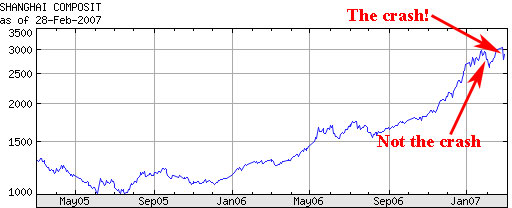
Well, let’s keep things in perspective. Here’s a stock chart for the Shanghai Composite, which crashed on Tuesday and brought the world down with it:

000001.Ss

See the crash? It’s that little blip which sent the index tumbling all the way back to where it was in mid-January: the Composite is still up 7.7% since the beginning of 2007, and up 148% since the beginning of 2006.

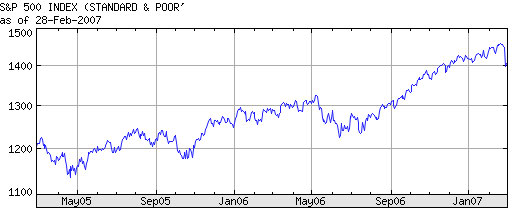
Now, here’s the S&P 500 over the same timeframe:

 Gspc

Clearly, the S&P 500 hasn’t more than doubled in the past year. But equally clearly it’s recovered more than once from much bigger falls than it saw on Tuesday. The only remotely unique thing about what happened on Tuesday is that it happened in one day, rather than happening over the course of a week or two.

The problem is that because of the news cycle, things which happen quickly are more newsworthy than more important things which happen slowly. So a big fall in the stock market over the course of one day makes front pages around the world — and if you’re going to make a big deal out of why the stock market fell, then you’re going to have to come up with some kind of reason for it.

Enter the bears. You want an explanation for why the market went down? Econobloggers from Roubini to Ritholtz to Baker have been telling you for months why the market should be going down! It all starts with the housing market: homebuilders have stopped building homes, which means that manufacturers have had to stop making stuff for all those homes, and that both the building and manufacturing industries are in recession. And given the huge rise in employment in those industries of late, it stands to reason that there’s going to be a pretty big fall in employment in those industries pretty soon. Meanwhile, suppliers of mortgages have stopped writing the crazy mortgages that were driving the housing industry, which means that it’s harder to buy a house than it used to be, and that prices have stopped rising and in fact have started falling in many areas. Because those crazy mortgages are no longer available, people who have them can’t refinance, and are defaulting in unprecedented numbers — which means their homes coming back on the market, which only serves to make the broader housing market worse. And high default rates also hit mortgage-backed securities, which make up a large chunk of the US bond market, raising fears of a credit crunch. Add it all up, and you get Recession — which is more than enough reason for a market “priced for perfection” to fall — and fall a lot.

Now, this story really hasn’t changed over the past 6 months. The same people are telling the same story that they have been telling for a long time — and, truth be told, those of them who made forecasts for when the market and the economy would turn south have seen those dates come and go. Now, it’s entirely possible that, finally, their time has come — that February 27 will be seen, in retrospect, to be the beginning of a nasty bear market where spreads widen out, credit contracts, stocks fall, and the economy slides into recession. But it’s way, way too early to tell. But at least the story makes for a good explanation for the fall in global stock markets. (And remember, journalists love compelling explanations for such things.)

In truth, one-day movements in the stock market are nearly always meaningless. OK, there was the crash of 1929, which was hugely important. And the crash of 1987, which was of minor importance. But as a general rule, anybody who tries to extrapolate a general stock-market direction from what the market does in one given day is on a fool’s errand. So the market might go down over the next few months, and it might go up over the next few months. But either way, what happened on Tuesday is not going to be particularly important in terms of the bigger move.

And what about the economy? Are we headed for recession or not? Here, the important market players all seem to be on more or less the same page. Ask Wall Street economists, or Fed governors, or the US Treasury what they think, and they’ll nearly all say that the economy might be slowing down, but they don’t see much risk of a recession or any other type of “hard landing”. On the other hand, there seems to be an equally compelling unanimity among newspaper columnists and econobloggers that the markets are delusional and cruising for a nasty crash.

Now it’s true that market economists, and the market in general, never seem to see a crash coming until it’s too late — so the fact that they don’t think there’s going to be one is hardly reassuring. Quite the opposite, in fact. On the other hand, no one ever made money by listening to macroeconomists.

As Brad DeLong says, “the macroeconomic outlook rarely changes suddenly”. Whatever is true today was true last week. So if you thought things were going fine last week, the release of a durable goods report and a one-day blip in the markets should not be enough to change your mind. Similarly, if you thought markets were overpriced last week, you should resist the temptation to believe that the markets have now suddenly come around to your way of thinking.

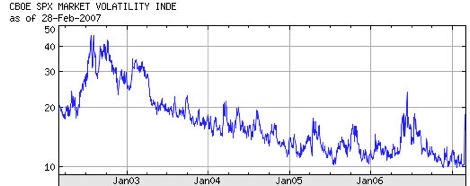
One last chart for you:

 Vix

That’s the VIX volatility index. It’s spiked up — last at 16, from typical levels between 10 and 12 of late. But the spike looks bigger because Yahoo charts make their y-axes logarithmic. We’re still a long way from the Great Unwind that so many people fear.

Posted in Econoblog | 2 Comments

Macroeconomics is just like nutritionism

Have you read that Michael Pollan article on nutritionism yet? You really should. Here’s a chunk:

Most nutritional science involves studying one nutrient at a time, an approach that even nutritionists who do it will tell you is deeply flawed. “The problem with nutrient-by-nutrient nutrition science,” points out Marion Nestle, the New York University nutritionist, “is that it takes the nutrient out of the context of food, the food out of the context of diet and the diet out of the context of lifestyle.”

If nutritional scientists know this, why do they do it anyway? Because a nutrient bias is built into the way science is done: scientists need individual variables they can isolate. Yet even the simplest food is a hopelessly complex thing to study, a virtual wilderness of chemical compounds, many of which exist in complex and dynamic relation to one another, and all of which together are in the process of changing from one state to another. So if you’re a nutritional scientist, you do the only thing you can do, given the tools at your disposal: break the thing down into its component parts and study those one by one, even if that means ignoring complex interactions and contexts, as well as the fact that the whole may be more than, or just different from, the sum of its parts. This is what we mean by reductionist science.

Does this remind you of anything? Macroeconomics, say? Economists like nothing more than to isolate different bits of the economy — housing starts, say, or durable goods orders, or initial jobless claims, or any one of hundreds of other statistical series — and try to work out how those numbers fit into what they invariably think of as the “economic cycle”. As far as I can make out, a large part of the reason why Alan Greenspan now thinks there’s a small chance of a recession in 2007 is simply that there hasn’t been one in 63 months, and therefore a recession is probably overdue. Which idea, of course, is utter codswallop, so he tries to dress it up by pointing to all manner of his beloved “indicators”.

The fact is that a manufacturing recession is a harbinger of a recession in much the same way as a diet high in monounsaturated fats is a harbinger of obesity. It might be, but, on the other hand, it might not be — and really, carving the economy up into little chunks and looking at the little chunks as indicators of what the whole insanely complex thing might do makes no more sense than carving a diet up into “nutrients” and looking at the nutrients as indicators of how the whole insanely complex body might react. Nutritionists and economists do this because it’s all they can do — no models have even come close to replicating the human body or the macroeconomy in all its chaos. But most of the time we’re all better off simply ignoring them.

Posted in Econoblog | 4 Comments

Mortality bonds and longevity bonds

You can bet on people dying: Liam Pleven and Ian McDonald in the WSJ have a good overview of how life-insurance companies are increasingly turning to the capital markets to hedge the risks they bear of insured individuals dying too soon. But can you bet on people living? The power team of Gillian Tett and Joanna Chung in the FT has a long and fascinating article about the other side of the coin: bonds issued by pension companies to hedge the risks of annuity holders, say, living too long.

The big problem is that at the moment all these instruments are largely targeted at sophisticated hedge funds, who want such large expected returns that issuance simply doesn’t make sense for the life insurers and the pension companies. In fact, a spate of mergers between pension companies and life insurers makes much more sense, since then the risks tend to cancel each other out. But such mergers aren’t easy: life insurers make their money by being constructive on mortality, while pension companies take the opposite view.

All the same, I’ve long been surprised at how unpopular annuities are. Pension plans usually wind up giving a recently-retired person a lump sum, and it would seem to make all the sense in the world to simply convert that lump sum into a guaranteed payment for life. But relatively few people do that, and so they run the risk of outliving their money. Maybe what’s needed is a combination annuity and health insurance product, which guarantees not only an income but also to pay all those dreadful medical expenses which can arise at the end of life. But there are precious few companies with the breadth of expertise to offer such a thing. Cue further insurance-industry consolidation!

Posted in Econoblog | 20 Comments

Will Goldman Sachs help absorb subprime losses?

According to a rumor over at Dealbreaker, one of the big losers in the subprime mess is none other than Goldman Sachs:

“Not sure if this is on your radar, but a Goldman trader took a $1B (yes, that is $1 Billion) position in a sub-prime mortgage index last week. He was fired today after the position suffered a roughly 35% decline. I can’t verify if it was closed out yet, but the loss thus far stands at about $350M. Talk about a bad week.”

This is bad for GS, of course. But it’s also really good news for anybody worried about the systemic risks associated with all these newfangled synthetic debt products. In the old days, banks wrote mortgages and took the associated risks. Then they started securitizing those mortgages, spreading the risk more thinly across bond investors. And then investment banks started creating products based on mortgage indices, which meant that the bond investors could offload a lot of their risk even further onto CDOs and hedge funds and prop desks at Goldman Sachs. Basically, the more money that Goldman loses, the less money that people who can’t afford it are losing. So, thank you, unnamed Goldman trader!

Posted in Econoblog | 2 Comments

Metaphor of the day

“If it walks, ducks and quacks like garbage it passes the smell test of being garbage.”

Nouriel Roubini

Posted in Econoblog | Comments Off on Metaphor of the day

Why the XM-Sirius merger might not be so good for consumers after all

The WSJ had a wonderful Reply-All (think a techy version of Econoblog) yesterday on the subject of whether the XM-Sirius merger would be good for consumers. Mark Cooper, a consumer advocate, said no; Donald Russell, a former DoJ lawyer, said yes. If you want to see a really strong debate on both sides, go check it out.

Before I read the debate, I was on Russell’s side, but Cooper is very persuasive. And as I was reading it, another thought occurred to me. Russell makes a big deal of the fact that XM and Sirius are both losing money, and that consumers would benefit from the lower costs of a merged company.

But what happens if the companies don’t merge, and continue to lose money? Eventually, presumably, some kind of bankruptcy or restructuring, which would allow the company concerned to get out from under its enormous debt burden, not to mention the huge contracts they’ve been signing with the likes of Howard Stern and Oprah Winfrey. Presto — a competitive company again, without having to go through an illegal merger!

I’m reminded of federal bailouts of US airlines, such as the one following 9/11. It’s not the job of the government to save companies who have racked up too much debt, either by bailing them out with cash or by allowing them to merge and create a monopoly. Why not let bankruptcy work its magic?

Posted in Econoblog | Comments Off on Why the XM-Sirius merger might not be so good for consumers after all

Is there any reason to still care about the Dow?

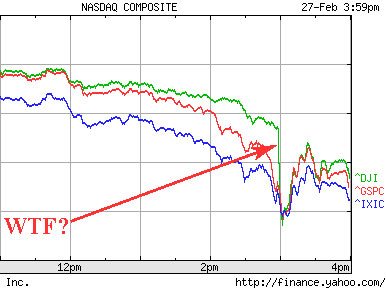
Marketplunge

Here’s the chart of yesterday’s price action in the Dow, the S&P 500, and the Nasdaq. Note anything crazy? Like a whopping great big down-250-points-in-one-tick plunge in the Dow at about 3pm?

As you can see from the broader stock indices, there wasn’t some market-wide moment of panic. So was there something which hit the 30 Dow stocks in particular? No. This from Dealbreaker:

“The market’s extraordinary trading volume caused a delay in the Dow Jones data systems,” said Dow Jones spokeswoman Sybille Reitz. “We decided to switch over to the backup system, and the result was a rapid catch-up in the published value of the Dow Jones industrial average.”

In other words, a computer glitch.

So to the obvious question: Can someone please just take the Dow behind the shed and shoot it, already? It’s an average, not an index, which makes it profoundly useless for measuring what stocks in general are doing. It comprises the grand total of 30 stocks, which makes it far from representative of the broader market in any case. And, as we saw yesterday, it can’t even calculate itself reliably. Is there any purpose for this anachronism whatsoever?

UPDATE: The WSJ (published by Dow Jones, whose computers went FUBAR yesterday) has a very good, and free, overview of what went wrong.

Posted in Econoblog | 10 Comments

Stern replies to Leonhardt

Remember last week, when the world was carefree, and all we had to worry about were minor things like the fate of the planet? David Leonhardt’s Economix column bravely entered the world of discounting — and managed to get it wrong. John Quiggin, who really understands this stuff, tried to explain it on his blog, but now we have Nick Stern himself explaining it on the NYT letters pages, with astonishing lucidity.

My analysis places much lower weight on a future dollar than a dollar now, for the ethical reasons that future generations may have higher consumption and that there is a (small) possibility of extinction, for example from a meteorite.

Professor Nordhaus advocates further discounting for the dubious reason that those born later have less significance. But reasonable people can differ on ethical issues.

Now there’s a really good explanation to use in future when someone like Leonhardt starts getting confused between delta and eta.

Posted in Econoblog | Comments Off on Stern replies to Leonhardt

Can one day’s fall mean the market is getting bearish on the US economy?

Brad Setser says that “I thought Leonhardt was better than usual” today — and he’s right. David Leonhardt’s Economix column comes on a Wednesday, which is perfect timing to look at the economic fundamentals, insofar as there are any, behind the stock-market fall on Tuesday.

Wall Street was caught off guard when the Commerce Department reported yesterday morning that orders for durable goods — big items like home computers and factory machines — plunged almost 8 percent last month…

Is the entire United States economy in danger of going the way of the manufacturing sector? Is it possible that we’re headed for a real recession?

For months now, the economy seemed to shrug off the forces weighing on it and just kept on growing. But those forces never went away. If anything, a number of them have gotten stronger. And that’s the most worrisome part of the bad news from the nation’s factories: it fits into a larger story…

the manufacturing downturn stems from a couple of larger economic problems. One, of course, is the housing slump, which has caused a big drop in new construction and much less demand for doors, windows, countertops and a lot of other things that kept factories busy in recent years…

The second big problem for manufacturers is the series of interest rate increases that the Federal Reserve has imposed since 2004.

The economic news certainly isn’t all bad. The housing problems still haven’t turned into a crisis, thanks in part to interest rates that are still not high by historical standards. So the most likely situation is not a full-blown recession (often defined as two consecutive quarters of a shrinking economy)…

But for all the attention that formal recessions get on Wall Street, they are not really the benchmark that matters to most people. A significant slowdown that falls short of a recession can do a lot of damage to stock prices, profits and wages.

I do have a couple of issues with this. One is the emphasis on recession, when even Leonhardt ends up hedging his bets and deciding that we’ll probably just end up with “a significant slowdown”, whatever that might be. For what it’s worth, it looks as though Nouriel is back onto his recession call: “These bad economic news from the US suggest that the US will enter into a recession this year – as I predicted last summer – as early as Q1 or Q2.” (He neglects to mention that only a few weeks ago he was talking about only a “growth recession“.) I’m sticking to my belief that if the market and an economist say two different things, you should go with the market every time. And on Tuesday the Intrade recession contract did rise — all the way to 22.

But more to the point, you can’t just say that “the economy seemed to shrug off the forces weighing on it and just kept on growing,” as though it’s some kind of pubescent boy. Economic growth is what happens when the positive forces outweigh the negative forces in an economy. And although there are always negative forces, the positive forces have been very strong — something which a lot of economists have been very wrong about. If the economy were as dependent on home building and manufacturing as many people seem to think, we’d be in a full-blown recession already.

I also think that the connection between the strength of the economy and the strength of the stock market is probably weaker now than it’s ever been, given the amount of high-tech financial engineering which increasingly underlies both corporate capital structures and stock trades. Obviously, when stock markets around the world fall, the pundits will immediately look to find reasons why the US or global economy might be faltering. You can’t blame Leonhardt for that. But it might also be worth asking what has kept the US economy growing for so long, whether those forces are now weakening, and if so, why now.

Posted in Econoblog | 5 Comments

No one knows why the market fell, and it doesn’t matter anyway

Dan Gross gets it. Andrew Leonard gets it too. In fact, any halfways-decent financial journalist gets it, and, if honest, would simply write a story saying “the market went down and we don’t know why”. But instead we’re inundated with “explanations”, from an assassination attempt on Dick Cheney (Daily Intelligencer: “Are investors balking because Cheney was attacked? Or because he wasn’t hurt?”) to a drop in one of the most boring economic series in the US. (Go on — quick — tell me what a durable goods order even is.)

One thing worth noting: Risk assets got hit, and the riskier the asset, the bigger the hit. Equities were hurt, and emerging-market equities were hurt more than US equities. Riskier bonds went down, safer bonds went up. In general, the markets behaved entirely rationally, and there didn’t seem to be much if any panic selling. Things are working the way they’re meant to work. If markets can go up — and they’ve been going up a lot over the past few years — then they should be able to go down too.

When the Dow hit its all-time high in October, there was a certain amount of commentary pointing out that high stock prices are mainly good for stock-market investors rather than for the economy as a whole. I wonder if anybody’s going to point out that a modest drop in the stock market is not really bad news for anybody — even stock-market investors are still sitting on healthy profits at this point.

Posted in Econoblog | 3 Comments

The world of Aaa debt just got a lot more interesting

It seems that no one has a pleasant word today for Moody’s, except maybe investors in Icelandic bank bonds. The ratings agency went on a triple-A spree yesterday, bringing pretty much every Icelandic bank up to Aaa status. Landsbanki was upgraded from A2: an incredible 5-notch upgrade.

John Glover at Bloomberg:

Moody’s Investors Service was blasted by Royal Bank of Scotland Group Plc, Dresdner Kleinwort and Societe Generale SA for new criteria that rank Iceland’s three biggest banks as better credits than ABN Amro Bank NV…

Last year, Kaupthing’s 23 billion euros ($30 billion) of bonds lost as much as 11 percent in value after Fitch Ratings cut the country’s credit outlook on concern economic growth and levels of borrowing were unsustainable.

“The market will be stupefied,” Tom Jenkins, an analyst at Royal Bank of Scotland in London, said in an interview after publishing a note titled “Moody’s Lose The Plot Completely” earlier today. “Creating Aaa rated banks across the board essentially means that there is no risk in investing in financials, and that buying a senior Kaupthing bond, for example, is effectively risk-free. It isn’t.”

The yield on Kaupthing’s 150 million euros of 5.9 percent bonds with no set maturity fell by a record 22 basis points to 155 basis points over German government bonds, the lowest in a year, according to Royal Bank of Scotland. The spread on ABN Amro’s 1 billion euros of 4.25 percent notes due 2016 is 27 basis points.

Alex Chambers, at Euromoney, pulls even fewer punches:

Most bank analysts are up in arms, while investors are dumbfounded. Here’s just one typical reaction: “We believe that the capital markets should ignore Moody’s entirely… Nothing has changed except that Moody’s credibility is lower and lower by the week” said BNP Paribas analysts in a note to investors this morning…

Moody’s ratings were once a great shortcut to good analysis, now they risk being seen merely as a detour.

Moody’s stock certainly took a beating in the wake of the upgrades, falling more than 5%, knocking roughly $1 billion off the company’s valuation. Ouch.

It is possible to see where Moody’s is coming from here. No major European bank has defaulted in living memory, which hardly squares with all those single-A credit ratings. It’s silly to pretend that banks won’t get bailed out in a crisis when in fact they always do. But on the other hand, Moody’s prides itself on including some kind of market risk in its ratings, and clearly, with Kaupthing debt trading at 155bp over, there’s a lot of risk priced in there.

The problem is that if you’re a CDO investing in triple-A securities, suddenly your world has been turned upside-down overnight. Should you just dump everything and invest in Icelandic bank debt? What’s going to happen to all those triple-A indices?

My take on all this is that if Moody’s had just stopped one notch short of Aaa and rated the Icelandic banks Aa1, then much of the uproar could have been prevented. But triple-A is a magical and special rating, and people get very offended when it’s handed out willy-nilly.

Posted in Econoblog | 14 Comments

VC narratives of our times

Steven Johnson explains today why he ended up accepting money for his Web 2.0 venture from VCs:

The assumption had always been that we would not seek out venture capital funding for the company — at least in its first year of life… we didn’t have any capital-intensive needs… we had no shortage of interest from angel investors…

So why are we — very happily — announcing a new round of financing today, with THREE venture funds participating? It begins with my friend Ed Goodman… When I started work on outside.in, Ed asked me to come in to talk about it with his partners. They had some great feedback on the concept, and Ed encouraged me to meet with Fred Wilson and Brad Burnham over at Union Square Ventures…

When we sat down for the first time, I was really just blown away by how well they understood the problems we were wrestling with… And — amazingly — they didn’t talk like VCs. They never once mentioned leveraging the incremental end-to-end value chain, or whatever. (Perhaps they did this for my benefit, and resumed picking the low-hanging fruit once I left the room — either way, it was a good show.) They said they could act much more like angels — investing smaller amounts than usual, with less restrictive terms…

And then in the closing days of the deal, my old partner from the FEED/Plastic days, Bo Peabody — one of the people I most admire in the Web investment world — asked if his fund Village Ventures could participate as well, so I couldn’t say no to that.

We’ve still got a great list of angels involved as well. Marc Andreessen just wrote in out of the blue to say that he really liked the site, and to ask if he could help out with the financing. Esther Dyson, John Borthwick, George Crowley, and Richard Smith — it’s a fantastic list of people to have behind you. (Along with our other founding investors, John Seely Brown, Mark Bailey, and Andy Karsch.)

In other words, Johnson already has money from Esther Dyson and Marc Andreessen and the like, but he now gets money from Fred Wilson as well, because Fred Wilson asked really nicely.

It’s very boring to talk about how much VC money is floating around the technology world these days, and at least in this case if outside.in works, it has the ability, in theory, to bring in insane amounts of money. But still, I have a feeling that outside.in is something which is very clever in theory, but which is going to be very difficult to make work in practice. Certainly it’s not simple enough for me to navigate intuitively. I really would love a great online guide to what’s going on in my immediate neighborhood. But whether outside.in will ever be that guide, I’m not sure.

Posted in Econoblog | Comments Off on VC narratives of our times

Negative equity datapoint of the day

I’m slowly becoming convinced that 95% of talk about negative equity comes either from anecdote or from extrapolation, and that there are actually few if any reliable statistics on how much negative equity there really is in the US.

But Noelle Knox of USA Today had an interesting story last week:

Here’s an alarming fact about Sacramento’s housing market: About one of every five existing homes on the market is a “short sale.” That means the home is worth less than the value of the mortgage, and the lender is willing to accept less than full repayment of the loan to avoid foreclosure, says Tracey Saizan, president of the Sacramento Association of Realtors.

Now, USA Today is notoriously unreliable when it comes to economic reporting, so I’m not taking this fully at face value. On the other hand, this sort of number doesn’t seem like the sort of thing that the president of the Sacramento Association of Realtors would just make up.

So let’s assume the number is true. That’s still no reason to panic. Read on a bit further, and you’ll find out that the total number of homes on the market in Sacramento is actually slightly lower than average, which means that 20% of a small number is a very small number. Now remember that subprime mortgages taken out at the beginning of 2006 are by far the worst performing subprime mortgages in living memory: a lot of them went straight into default, especially in California.

In that situation, it makes sense for a borrower to try to sell his house in distress, rather than go through foreclosure. But once these houses are sold, the problem is largely in the past.

It’s worth remembering, too, that many subprime mortgages capitalized interest payments at the beginning, when the buyer was incurring the biggest expenses associated with moving house. So it’s entirely possible that the house might be worth less than the mortgage even if the house hasn’t actually fallen much in value. According to the USA Today article, Sacramento prices are down 4.3% from a year ago — painful, to be sure, but hardly catastrophic. There’s no particular reason to believe they’ll continue falling, either: after all, New York, another bubblicious city, has a housing market on fire right now.

Posted in Econoblog | 1 Comment

Antarctica in the New York Post

If you’re in New York (or LA, I think), you might be interested in a 2-page article on Antarctic cruises in the New York Post today, which was written by, er, me. It’s online too, though not nearly as pretty: the main piece is here, and the sidebar is here.

Posted in Not economics | 8 Comments

Markets rediscover volatility

So Chinese stocks fell by 9%, Alan Greenspan uttered the word “recession“, US stocks are down, credit spreads are widening, and emerging-market bonds are being hit. It’s time to take a step back. The Intrade recession contract is at an all-time low, showing a recession probability of just 16%. Spreads are widening, yes, but off of all-time lows themselves. The biggest risk in emerging markets is — well, there isn’t one, really. Maybe the Latvian currency peg. US inflation expectations are falling steadily. In other words, there’s no reason for a bloodbath. Chances are that prices will go down, and then they’ll go back up again. As you were.

Posted in Econoblog | Comments Off on Markets rediscover volatility

Disagreement Case Study

Robin Hanson asks for disagreement case studies. When I was at RGE, I developed a bullish, trust-the-market persona to act as a foil to Nouriel Roubini’s ultrabearish position. Brad Setser was kinda in between. The interesting thing to me, which I’m sure will come as no surprise to Hanson, is that I ended up believing my own posts so easily and so quickly. I wasn’t putting voice to positions I’d held for a long time — but by putting voice to those positions, I ended up holding them. Similarly, after writing 5,500 words in defense of vulture funds, I’m now more well-inclined towards them than I was.

But in any case, let me try to answer Robin’s questions with regard to the disagreement between me and Nouriel on whether weakness in the US housing market would drive the US economy into recession. Says Robin, by way of introduction:

You realize that both your opinion and theirs may result in part from defects, such as thinking errors or not knowing something that the other knows.

This is surely true. So to answer his questions:

Do you conclude just from the fact that they disagree that they must have more defects?

No.

Do you think they realize that they can have defects, such as thinking errors or knowing less?

Yes. Nouriel’s reasonably good at admitting when he was wrong. And if asked, I’m sure he’d say that there were some defects in his reasoning in those cases.

Should the fact that you disagree be a clue to them about their defects? Is it a clue about yours?

My disagreement probably should be a clue to Nouriel about his defects, but it’s easy to understand why it isn’t: for one thing the disagreement came out of a deliberate attempt to disagree with him, and for another thing I have no economic qualifications. On the other hand, after spending a lot of time around Nouriel it’s very easy to see my own arguments the way he sees them. So I think I’m relatively clued-in about the defects in my own arguments.

Do they adjust their estimates enough for the possibility of their defects? If not, why not?

Yes and no. If you look at Nouriel’s estimates, he generally gets to his predictions by doing a bunch of economics, coming to an insanely bearish world-is-coming-to-an-end conclusion, and then diluting the result enormously for no obvious reason until it comes to a point where it’s still an outlier but at least it’s not a massive outlier. If lots of other very smart people were all more bearish than his official estimates, I think his estimates would be much more bearish than they are — so yes, I think he’s adjusting his estimates in the light of extant disagreements. On the other hand, his adjustments are quantitative, not qualitative. He doesn’t assume that he might be wrong; he remains very sure that he’s right.

What clues suggest to you that they have more defects, or under-adjust for them?

Nouriel has achieved no small measure of fame and notoriety from being as bearish as he is — his bearish position has given him a large number of groupies who hang on his every word, and a widely-read blog which drives traffic to his for-profit website. So in that sense he has every incentive to under-adjust for defects in his arguments. Also, as an economist coming more from the academy than from the market, he’s more likely in my view to overweight arguments based on economic theory and less likely to look at the frequency with which predictions based on such theories have spectacularly failed to come true. He also cherry-picks datapoints, but we all do that.

What clues suggest to them that you have more defects, or under-adjust?

I have little if any equity in being right: I’m blogging to have fun, jumping into the debate with both feet. I know that my opinions aren’t particularly considered, even though I do believe them to be right. Also, I’m not an economist, so I’m quite unqualified to opine on matters economic — not that that ever stopped me.

Do you both have access to these clues, and if so do you interpret them differently?

Yes. But I think that Nouriel underestimates the degree to which frequently reiterating a bearish position serves to overstrengthen the arguments for it in his mind and decrease whatever objectivity he might have. I wouldn’t have believed it myself, if I hadn’t observed it in myself at first-hand: the way in which I became a bull simply by writing a bullish blog.

Do you each realize some clues might be hidden?

Probably not.

Does your inability to answer any of these questions suggest you have defects?

I’ve never claimed that I didn’t have defects.

Consider all these questions again for your meta-disagreement about who has more defects.

I’m really quite uninterested in who has more defects, mainly because which of us has more defects has no bearing at all on which of us is right. I’m quite sure that Nouriel has more good arguments which favor his position than I do favoring mine. I just think that my arguments are right and that his aren’t. Mostly, our disagreement comes down to theory vs the market. Nouriel bases his arguments on theory, and if there are bearish signals in the market, then he’ll use them to bolster his case; otherwise, the market is wrong. Me, I start from a position of ignorance with respect to much economic theory, and simply look empirically at the fact that when economists say the market is wrong, the vast majority of time it is the economists who are wrong and the market which is right. So I do the opposite to Nouriel: I base my argument on what the market is saying and if there are economic arguments I’ll use them to bolster my case; otherwise, the economists are wrong. I think that I have the edge here, and Nouriel thinks that he has the edge; it probably all comes down to what timeframe you want to look at. If Nouriel’s bearish for long enough, eventually he’ll be right. But only people without any money in the market can afford the luxury of being wrong until they’re right.

Posted in Econoblog | 4 Comments

Was LTCM a lower-tail event?

I have to admit I’m a bit vague on the specifics of what happened in the LTCM blow-up. In my mind, it has always been inextricably linked with Russia’s debt default, although this many years later I’m not even sure that LTCM owned any Russian debt. (Maybe LTCM simply owned spread product, which gapped out in general in the wake of Russia’s default.) In any case, the general consensus, at least as I’ve understood things, has been that LTCM had a strategy which worked until it didn’t — that they were picking up small profits and leveraging those into large profits, while leaving themselves open to a large market reversal associated with some kind of event risk.

But here’s Eliezer Yudkowsky:

While LTCM raked in giant profits over its first three years, in 1998 the inefficiences that LTCM were exploiting had started to vanish – other people knew about the trick, so it stopped working.

LTCM refused to lose hope. Addicted to 40% annual returns, they borrowed more and more leverage to exploit tinier and tinier margins. When everything started to go wrong for LTCM, they had equity of $4.72 billion, leverage of $124.5 billion, and derivative positions of $1.25 trillion.

This actually rings much more true to me. The real killer of LTCM was not Russia, it was the fact that their strategies simply weren’t working any more. And that rather than look for other strategies, they reacted by piling on the leverage. Does anybody know if this is true? Did LTCM’s leverage rise sharply in its final year of operation?

Posted in Uncategorized | 6 Comments

Are private companies more environmentally responsible?

TXU is one of the most environmentally unfriendly companies in the world, and the enormous amount of bad press that it’s been getting as even spilled over onto banks such as Citigroup, Merrill Lynch, and Morgan Stanley.

Now, of course, TXU looks as though it’s going private, in what will be, if it closes, the largest private-equity deal of all time. Makes sense, no? Public companies get damaged by shareholder activism — TXU’s share price fell from $67 to $53 largely as a result of worries over the PR risks involved with TXU’s plans to build 11 new coal-fired power stations. Private companies, on the other hand, tend to be more immune to such pressures.

But in an interesting twist it turns out that the private-equity buyers of TXU, which include Goldman Sachs and Texas Pacific, are into saving the environment too. Reports Andrew Ross Sorkin:

Goldman Sachs has been a longtime proponent of reducing carbon emissions. Its former chief executive, Henry M. Paulson, now the secretary of the treasury, was also the chairman of the Nature Conservancy, an environmental activist group.

Texas Pacific’s co-founder, David Bonderman, is member of the board of the World Wildlife Fund, and Mr. Reilly is chairman emeritus. Mr. Bonderman called Mr. Reilly to help work on the deal and create what they ultimately called The Green Group, a committee of advisers that included Mr. Reilly, Roger Ballentine of Green Strategies and Stuart E. Eizenstat, the former chief domestic policy adviser for President Jimmy Carter.

“We didn’t want to be on the wrong side of history,” said a person involved in the bidding group who was not authorized to talk about the transaction before its formal announcement.

If TXU gets taken private, most of those 11 new coal-fired plants will be scrapped. Coal-fired plants will still be built, of course, but at least the most egregious offender on that front — TXU — won’t be nearly as much of the problem as it would have been if it stayed public.

Posted in Econoblog | Comments Off on Are private companies more environmentally responsible?

Explaining Zagat grade inflation

New York magazine’s Grub Street blog points me to a piece at smartmoney.com about the Zagat guides, which has some interesting datapoints:

When the Zagats started selling their 1983 New York restaurant guide, it was no mean feat for a chef to score a food rating of 20 or higher, the benchmark for “very good to excellent” in Zagat terms. Only one in four New York restaurants did so at the time. Today fully 70% reach those heights. It’s as if the bottom tier dropped out: Just over a decade ago 189 out of 1,300 New York restaurants rated 15 or below; today only 23 do, despite the fact that the guide now rates more than 1,500 restaurants.

Is this a function of the Zagats being too cozy with the restaurants they cover? Grub Street, which once edited the Long Island guide, thinks not:

Most people who provide quotes to Zagat eat frequently in just a few restaurants, which they wildly overrate. In the Long Island guide, nearly every sushi restaurant was praised as having (we’re making these up, because we’re clever that way) “sushi so fresh you’ll think you’re swimming in the ocean,” and every local Italian restaurant has “pasta to die for.” The respondents go wild with the numerical ratings as well. The Zagats may well be power mad, and the way they do business may not exactly project an aura of incorruptibility, but the Zagat respondents need no help driving the ratings up through the roof.

I’m sure this is true — but although it explains the high scores in the Zagat guides today, it doesn’t explain the lower scores in the Zagat guides of old. Why the grade inflation?

I think the main reason is hinted at by Grub Street: people used to send in surveys as a service to Zagats, in return for which they received the next year’s guide. Both the surveyers and the company benefitted from this arrangement. Today, however, Zagat is seen as a corporate behemoth, and the number of people who think that sending in a survey is some kind of public good is shrinking dramatically. So the main reason to send in a survey is now different: it’s to do a favor to one’s favorite restaurant, by making it look as good as possible and to see if one can help it beat the competition.

Zagat’s three-point system exacerbates the problem. The scores are given on a 30-point scale, but a score of 25, say, is actually just an average rating of 2.5, multiplied by 10. People naturally give their favorite restaurant a score off 3/3, and then score other restaurants off that benchmark. So if you’re doing a guide to an area where peoples’ favorite restaurants aren’t particularly great, then the scores are likely to inflate. Which may or may not help to explain why the Cheesecake Factory in Las Vegas is rated 21, while the Cheesecake Factory in San Jose is rated 16 — the kind of people who go to the Cheesecake Factory in Las Vegas are more likely to think of it as their favorite restaurant than the kind of people who go to the Cheesecake Factory in San Jose. (And, yes, the fact that the Las Vegas branch has a score over 20 does mean that a significant number of reviewers gave it that 3/3 rating.) As the Zagat guides become increasingly popular, the reviewers cease to be fine diners, and start becoming much more like the general population. As a result, fine dining establishments such as Jean Georges are no longer the benchmark by which other restaurants are judged.

But it’s also surely true that some of the grade inflation is simply due to the fact that restaurants now are better than they were in 1983. Does anybody really deny that?

Posted in Econoblog, Not economics | 1 Comment