
Lunch with Nassim Nicholas Taleb

So the lunch with Nassim Nicholas Taleb happened, in a rather pretentious little place on 15th Street, which at least was quiet. I arrived brimming with questions, and left with only a few of them answered, but had a great experience all the same.

I think I’m going to do a more formal Q&A with Taleb when both his book and the first reviews are out – probably by email. But here are a few questions I had going in to the lunch, along with any answers that Taleb gave me, if any. They should at least, give an idea of the kind of questions which get raised by his book.

  • Are common economic concepts such as cycles or reversion to mean remotely useful or even meaningful? (I asked Taleb this, and got a general reply about all economics being not only useless but also unethical.)
  • What does NNT think of Robin Hanson‘s blog, Overcoming Bias? (Taleb says he doesn’t know it. But he should – there’s enormous overlap between the blog and the book. The blogs he likes the most are Arts & Letters Daily and 3 Quarks Daily. He does read newspapers online, but usually through links from these sites. He’s not interested in news, per se.)
  • The “Black Swan” of the title comes from the idea that you can’t confirm a statement like “all swans are white” by observing white swans. Similarly, you can’t prove that OJ Simpson is not a murderer by closely observing him all day and seeing him murder nobody. On the other hand, if you give me two paragraphs and tell you they’re anagrams of each other, I’m likely to pick a letter at random, probably something uncommon like W or Q or Z, and count its occurrences in each of the paragraphs. If the occurrences match, I’ll be more likely to believe you. Is there some kind of real confirmation going on here? Or are all such observations largely meaningless unless and until you’ve either falsified the claim or proved it outright? (Taleb: Yes, there is some confirmation going on.)
  • Housing/property: Would NNT be a buyer or a seller in the current market? (No chance of an answer to that one, despite the fact that Taleb is a good friend of Robert Schiller.)
  • NNT’s own investments, which he says are mainly in Treasury bills: Why that, rather than overnight cash? (Unasked.)
  • NNT calls himself a “skeptical empiricist”. Does he think that people he meets think themselves to be skeptical empiricists, but aren’t? (Asked. Taleb loves being fooled by randomness, and is not much of a skeptical empiricist in his day-to-day existence. But he certainly is when it comes to investment advice. This led into a broader conversation about skeptics of the past, from Kripke back to Hume and even earlier. Taleb absolutely sees himself in the tradition of the philosopher who destroys epistemic edifices, rather than the philosopher who, after laying out a skeptical position, then tries to overcome it, in the way that Descartes tried to do with his evil demon.)
  • NNT draws the distinction between jobs which are scalable – jobs where income can go up a lot without the individual working any harder, such as writing books or trading options – and jobs which are not scalable, such as dentistry or prostitution, where to make more money you basically need to do more work. Taleb has always had scalable jobs, and says that all non-scalable jobs are dull. But what about emergency-room physicians, or homicide detectives, or even magazine journalists? (Taleb conceded this: admitted that, yes, there were non-dull non-scalable jobs. He admires George Soros mainly because Soros is so quick to change his mind or decide that he was wrong about something, and one of the main themes of his book is humility in the face of the fact that we don’t really know anything. So it was easy for him to concede the point: despite the fact that Taleb clearly has a very well-developed ego, he isn’t wedded to being right.)
  • NNT says that Syria and Saudi Arabia are more likely to descend into chaos than Italy is, precisely because there has been so little chaos in those countries of late. He contrasts them with Italy, which is built on chaos, and therefore less at risk of it. So does that mean that other stable countries, such as, say, Sweden, are also at risk of chaos? (Unasked.)
  • Warren Buffet – skilled, or lucky, or some combination of the two? And isn’t his main business, reinsurance, essentially one big bet against Black Swans? (Taleb said that reinsurers don’t make money, although insurers do: insurers live in what he calls Mediocristan, a world where the law of large numbers applies, and the number of car accidents, say, is predictable and therefore can reasonably be insured against. Reinsurers, on the other hand, live in Extremistan, a world with 9/11 and Hurricane Katrina and outbreaks of war and other unforeseeable events – and that’s a business Taleb would never want to be in. Ironically, however, he is actually in the business of insuring against Black Swans: that’s what the company he’s a part-owner of, Empirica, does. As for Buffett, he’s made his money not through reinsurance so much as by investing the large amounts of cash which come with owning a reinsurer. Is that luck or skill? Unasked.)
  • In Extremistan, the world in which we live, power laws apply where the successful become more successful and the unsuccessful become less successful. We can see this in the housing market right now, where New York City prices are stratospheric and rising, while prices in Detroit are at rock-bottom and falling. A Black Swan could hit New York CIty and hurt prices here. But could a positive Black Swan hit Detroit, and send prices there sharply upwards? (Not asked directly. But Taleb did point out that short-term Black Swans are usually negative, such as Hurricane Katrina or Russia’s sudden bond default, while positive Black Swans are usually long term, such as the rise of the internet or even the rise of New York City itself. So if Detroit does become great again, it won’t do so overnight: it takes a lot longer to build a house than to destroy one.)
  • Black Swans, by definition, are unexpected. But everybody and their mother these days seems to be forecasting or expecting a housing bust, a credit crunch, a disorderly unwinding of global imbalances, or something along those lines. If that happens, and it’s so widely expected, does that mean it’s not really a Black Swan? Was the equally-forecast popping of the dot-com bubble a Black Swan? (Asked, not really answered.)
  • NNT is very rude about the way that finance and economics types measure risk, with things like Value-at-Risk measurements and companies like RiskMetrics. Does that mean that Basel II is actually riskier than Basel I? Does it also mean that the CAPM should be discarded? Is investing money in such a way as to keep up with the S&P 500 with just one-third of its volatility not nearly as impressive an achievement as most financial professionals would have you believe? (Not asked directly, because Taleb was very keen that he hasn’t written a finance book. He wants his book to be found in the Philosophy section, not the Finance section, of bookstores, and will volunteer that its genre is “philosophy of history”.)
  • NNT, in his book emphasizes the “narrative fallacy” and the idiocy of believing that we can really or ever know the cause of any events in the real world. Where does that leave, say, monetary policy? If we can’t say that cutting interest rates caused the economy to grow, then what is a central banker to do? (Taleb did inch towards conceding some causality: he said that if a central bank raised interest rates and then there was a recession, you can reasonably claim that the rate hike caused the recession. But he also said that the economic forecasts on which central banks base their actions are worthless, and that even broad economic numbers such as GDP are much less useful than most economists believe.)
  • Does NNT buy insurance? (Yes.)

And here’s a few other things I learned over the course of the lunch:

  • Taleb was a bit mistrustful of Dan Gilbert’s book Stumbling on Happiness, which I loved, because he felt that Gilbert spent too much time on the jokes and the artful prose, rather than getting straight to the point. This is true, although I’m not sure it’s all that much of a criticism.
  • Taleb’s first* book, Fooled by Randomness, is now the biggest-selling book published in 2001. This puts into some perspective his anecdotes about a fictional Russian writer named Yevgenia Krasnova, whose first book, A Story of Recursion, is a surprise and runaway global bestseller. Interestingly, her second book, The Loop, is something of a dud.
  • Taleb says that options prices didn’t actually change much if at all in the wake of the invention of the universally-used Black-Scholes method of pricing option. In other words, Black-Scholes was much less useful than you might think.
  • Taleb, for all that he refuses to invest in the stock market and writes books full of rhetoric destroying much that we hold dear, is actually not a bear or a pessimist. ” I am convinced that the future of America is rosier than people claim — I’ve been hearing about its imminent decline ever since I started reading,” he writes at edge.org. ” The world is giving us more ‘cheap options’, and options benefit principally from uncertainty. So I am particularly optimistic about medical cures.”
  • One thinker who shares Taleb’s love of destroying sacred cows is Paul Feyerabend. But Taleb tries to be a bit more humble than Feyerabend, and less of what he calls a “poseur”.
  • Taleb considers economists, as a group, to be unethical. And most journalists, too. Because they “prolong the narrative fallacy”. He was on staff at a university for a while, but quit when he realized that he couldn’t stand being in the same faculty as people whose entire courses were based on the narrative fallacy. Now he’s pursuing a fellowship which will let him explore his ideas on his own, with a handful of colleagues – but even there he’s going to end up with some kind of presence at a high-profile business school. Taleb would love nothing more than to read books and cogitate in his library, maybe travelling the world occasionally. And he hates answering questions about the practical implications of his book: he’d much rather it was treated as pure philosophy. At the same time, he thinks his philosophy has merit precisely because it’s relevant to the way we think and lead our lives. It’s a delicate balancing act, and I’m not sure that Taleb has quite figured out how to perfect it.

So now we wait: the book is published on April 17, and a lot of reviews should be coming out around that time as well. It’ll be fascinating to see what people make of it – and if we’re lucky, we might even be able to get some response from Taleb to the reviews on this blog.

*OK, technically not his first book. His real first book was called Dynamic Hedging: Managing Vanilla and Exotic Options, and it’s available at Amazon for $63. But FBR was his first book for a general audience.

Posted in Portfolio | Comments Off on Lunch with Nassim Nicholas Taleb

Kerkorian’s weird bid for Chrysler

Kirk Kerkorian has gone public with a low-ball, $4.5 billion bid for Chrysler. He knows the company well: he had a 10% stake in 1995, when he tried to buy it for $20 billion, and held onto that stake until Chrysler was eventually sold to Daimler for $36 billion. So he’s already made $3 billion from Chrysler, and now he’s coming back for more.

But why would DaimlerChrysler accept such a low bid, when all the chatter values Chrysler at closer to $8 billion? Kerkorian tugs at the heartstrings in his letter. He tries to paint himself as the “right” ownership, which will “build Chrysler into a robust and lasting, stand-alone entity,” and who will make “the necessary investments” in R&D and manufacturing.

All of which might be true. But DaimlerChrysler CEO Dieter Zetsche‘s foremost obligation is to his shareholders, and he is going to have a devil of a time explaining why it’s leaving billions of dollars on the table just because Kirk Kerkorian is a nice guy.

Posted in Econoblog | 2 Comments

Lunch with Nassim Nicholas Taleb

So the lunch with Nassim Nicholas Taleb happened, in a rather pretentious little place on 15th Street, which at least was quiet. I arrived brimming with questions, and left with only a few of them answered, but had a great experience all the same.

I think I’m going to do a more formal Q&A with Taleb when both his book and the first reviews are out — probably by email. But here are a few questions I had going in to the lunch, along with any answers that Taleb gave me, if any. They should at least, give an idea of the kind of questions which get raised by his book.

  • Are common economic concepts such as cycles or reversion to mean remotely useful or even meaningful? (I asked Taleb this, and got a general reply about all economics being not only useless but also unethical.)
  • What does NNT think of Robin Hanson‘s blog, Overcoming Bias? (Taleb says he doesn’t know it. But he should — there’s enormous overlap between the blog and the book. The blogs he likes the most are Arts & Letters Daily and 3 Quarks Daily. He does read newspapers online, but usually through links from these sites. He’s not interested in news, per se.)
  • The “Black Swan” of the title comes from the idea that you can’t confirm a statement like “all swans are white” by observing white swans. Similarly, you can’t prove that OJ Simpson is not a murderer by closely observing him all day and seeing him murder nobody. On the other hand, if you give me two paragraphs and tell you they’re anagrams of each other, I’m likely to pick a letter at random, probably something uncommon like W or Q or Z, and count its occurrences in each of the paragraphs. If the occurrences match, I’ll be more likely to believe you. Is there some kind of real confirmation going on here? Or are all such observations largely meaningless unless and until you’ve either falsified the claim or proved it outright? (Taleb: Yes, there is some confirmation going on.)
  • Housing/property: Would NNT be a buyer or a seller in the current market? (No chance of an answer to that one, despite the fact that Taleb is a good friend of Robert Schiller.)
  • NNT’s own investments, which he says are mainly in Treasury bills: Why that, rather than overnight cash? (Unasked.)
  • NNT calls himself a “skeptical empiricist”. Does he think that people he meets think themselves to be skeptical empiricists, but aren’t? (Asked. Taleb loves being fooled by randomness, and is not much of a skeptical empiricist in his day-to-day existence. But he certainly is when it comes to investment advice. This led into a broader conversation about skeptics of the past, from Kripke back to Hume and even earlier. Taleb absolutely sees himself in the tradition of the philosopher who destroys epistemic edifices, rather than the philosopher who, after laying out a skeptical position, then tries to overcome it, in the way that Descartes tried to do with his evil demon.)
  • NNT draws the distinction between jobs which are scalable — jobs where income can go up a lot without the individual working any harder, such as writing books or trading options — and jobs which are not scalable, such as dentistry or prostitution, where to make more money you basically need to do more work. Taleb has always had scalable jobs, and says that all non-scalable jobs are dull. But what about emergency-room physicians, or homicide detectives, or even magazine journalists? (Taleb conceded this: admitted that, yes, there were non-dull non-scalable jobs. He admires George Soros mainly because Soros is so quick to change his mind or decide that he was wrong about something, and one of the main themes of his book is humility in the face of the fact that we don’t really know anything. So it was easy for him to concede the point: despite the fact that Taleb clearly has a very well-developed ego, he isn’t wedded to being right.)
  • NNT says that Syria and Saudi Arabia are more likely to descend into chaos than Italy is, precisely because there has been so little chaos in those countries of late. He contrasts them with Italy, which is built on chaos, and therefore less at risk of it. So does that mean that other stable countries, such as, say, Sweden, are also at risk of chaos? (Unasked.)
  • Warren Buffet — skilled, or lucky, or some combination of the two? And isn’t his main business, reinsurance, essentially one big bet against Black Swans? (Taleb said that reinsurers don’t make money, although insurers do: insurers live in what he calls Mediocristan, a world where the law of large numbers applies, and the number of car accidents, say, is predictable and therefore can reasonably be insured against. Reinsurers, on the other hand, live in Extremistan, a world with 9/11 and Hurricane Katrina and outbreaks of war and other unforeseeable events — and that’s a business Taleb would never want to be in. Ironically, however, he is actually in the business of insuring against Black Swans: that’s what the company he’s a part-owner of, Empirica, does. As for Buffett, he’s made his money not through reinsurance so much as by investing the large amounts of cash which come with owning a reinsurer. Is that luck or skill? Unasked.)
  • In Extremistan, the world in which we live, power laws apply where the successful become more successful and the unsuccessful become less successful. We can see this in the housing market right now, where New York City prices are stratospheric and rising, while prices in Detroit are at rock-bottom and falling. A Black Swan could hit New York CIty and hurt prices here. But could a positive Black Swan hit Detroit, and send prices there sharply upwards? (Not asked directly. But Taleb did point out that short-term Black Swans are usually negative, such as Hurricane Katrina or Russia’s sudden bond default, while positive Black Swans are usually long term, such as the rise of the internet or even the rise of New York City itself. So if Detroit does become great again, it won’t do so overnight: it takes a lot longer to build a house than to destroy one.)
  • Black Swans, by definition, are unexpected. But everybody and their mother these days seems to be forecasting or expecting a housing bust, a credit crunch, a disorderly unwinding of global imbalances, or something along those lines. If that happens, and it’s so widely expected, does that mean it’s not really a Black Swan? Was the equally-forecast popping of the dot-com bubble a Black Swan? (Asked, not really answered.)
  • NNT is very rude about the way that finance and economics types measure risk, with things like Value-at-Risk measurements and companies like RiskMetrics. Does that mean that Basel II is actually riskier than Basel I? Does it also mean that the CAPM should be discarded? Is investing money in such a way as to keep up with the S&P 500 with just one-third of its volatility not nearly as impressive an achievement as most financial professionals would have you believe? (Not asked directly, because Taleb was very keen that he hasn’t written a finance book. He wants his book to be found in the Philosophy section, not the Finance section, of bookstores, and will volunteer that its genre is “philosophy of history”.)
  • NNT, in his book emphasizes the “narrative fallacy” and the idiocy of believing that we can really or ever know the cause of any events in the real world. Where does that leave, say, monetary policy? If we can’t say that cutting interest rates caused the economy to grow, then what is a central banker to do? (Taleb did inch towards conceding some causality: he said that if a central bank raised interest rates and then there was a recession, you can reasonably claim that the rate hike caused the recession. But he also said that the economic forecasts on which central banks base their actions are worthless, and that even broad economic numbers such as GDP are much less useful than most economists believe.)
  • Does NNT buy insurance? (Yes.)

And here’s a few other things I learned over the course of the lunch:

  • Taleb was a bit mistrustful of Dan Gilbert’s book Stumbling on Happiness, which I loved, because he felt that Gilbert spent too much time on the jokes and the artful prose, rather than getting straight to the point. This is true, although I’m not sure it’s all that much of a criticism.
  • Taleb’s first* book, Fooled by Randomness, is now the biggest-selling book published in 2001. This puts into some perspective his anecdotes about a fictional Russian writer named Yevgenia Krasnova, whose first book, A Story of Recursion, is a surprise and runaway global bestseller. Interestingly, her second book, The Loop, is something of a dud.
  • Taleb says that options prices didn’t actually change much if at all in the wake of the invention of the universally-used Black-Scholes method of pricing option. In other words, Black-Scholes was much less useful than you might think.
  • Taleb, for all that he refuses to invest in the stock market and writes books full of rhetoric destroying much that we hold dear, is actually not a bear or a pessimist. ” I am convinced that the future of America is rosier than people claim — I’ve been hearing about its imminent decline ever since I started reading,” he writes at edge.org. ” The world is giving us more ‘cheap options’, and options benefit principally from uncertainty. So I am particularly optimistic about medical cures.”
  • One thinker who shares Taleb’s love of destroying sacred cows is Paul Feyerabend. But Taleb tries to be a bit more humble than Feyerabend, and less of what he calls a “poseur”.
  • Taleb considers economists, as a group, to be unethical. And most journalists, too. Because they “prolong the narrative fallacy”. He was on staff at a university for a while, but quit when he realized that he couldn’t stand being in the same faculty as people whose entire courses were based on the narrative fallacy. Now he’s pursuing a fellowship which will let him explore his ideas on his own, with a handful of colleagues — but even there he’s going to end up with some kind of presence at a high-profile business school. Taleb would love nothing more than to read books and cogitate in his library, maybe travelling the world occasionally. And he hates answering questions about the practical implications of his book: he’d much rather it was treated as pure philosophy. At the same time, he thinks his philosophy has merit precisely because it’s relevant to the way we think and lead our lives. It’s a delicate balancing act, and I’m not sure that Taleb has quite figured out how to perfect it.

So now we wait: the book is published on April 17, and a lot of reviews should be coming out around that time as well. It’ll be fascinating to see what people make of it — and if we’re lucky, we might even be able to get some response from Taleb to the reviews on this blog.

*OK, technically not his first book. His real first book was called Dynamic Hedging: Managing Vanilla and Exotic Options, and it’s available at Amazon for $63. But FBR was his first book for a general audience.
UPDATE: Taleb emails to clarify a couple of things: First, he wasn’t critical of Gilbert, just asking me about Gilbert’s style compared to his own. Second, he doesn’t sell insurance, but replicates it — its his clients who have the exposure, not himself.

Posted in Econoblog | 14 Comments

Does the SEC understand what a “principles-based approach” to regulation even is?

Marcy Gordon of the AP reports today that the SEC is easing up on some Sarbanes-Oxley regulations, specifically those which “require companies to assess the strength of their internal checks and balances to guard against fraud.” She continues:

The framework calls for greater use of an approach based on principles rather than ironclad rules, which is in line with a recommendation of a private-sector group that has been pushing for eased business regulations.

The SEC and the Public Company Accounting Oversight Board have worked for several months to resolve differences over the rules. Some experts and investor advocates complain that the SEC is strong-arming the board to weaken regulatory standards.

Officials of the SEC and the accounting board say they are striking a balance between protecting investors and reducing the financial record-keeping required of companies. The SEC and the oversight board want final rules in place by June so they would apply to audits of all 2007 statements.

Are SEC officials really talking about “striking a balance” – with the clear implication that reducing the burden on regulated companies will necessarily reduce investor protections as well? If so, then clearly they still Don’t Get It.

The point of a principles-based approach is that it increases investor protections, if done well, since companies can focus on the stuff that matters, rather than putting all their efforts into running everything past compliance lawyers who care much more about not breaking the rules than they do about doing the right thing.

Posted in Portfolio | Comments Off on Does the SEC understand what a “principles-based approach” to regulation even is?

My other car is a Gulfstream V

Good to see Tim Hanrahan of the WSJ in Michelle Leder territory, reading Ford’s latest proxy filing:

Chairman William Clay Ford and Chief Executive Alan Mulally were required to use company aircraft for all business and personal air travel for security reasons, and that their families and guests were allowed to accompany them on our aircraft. The company also said that “in order to ease the burden” of Mr. Mulally moving to Dearborn, Mich., and away from his family in Seattle, the compensation committee clarified that his arrangement covers travel by his wife, children and guests on company aircraft for personal reasons without him at company expense, when he requests it. For Mr. Ford, personal use of aircraft totaled $185,232, and was $172,974 for Mr. Mulally.

It gets better: Ford’s North America chief Mark Fields managed to rack up a $517,560 private-jet bill in 2006, commuting to Detroit from Florida. Apparently his “security” isn’t as important as that of the CEO, however: since January he’s been reduced to flying commercial.

Posted in Portfolio | Comments Off on My other car is a Gulfstream V

Should the world worry about a US recession?

“An old cliche holds that when the U.S. economy sneezes, the rest of the world catches a cold,” says David Wessel today, reporting on new IMF research which seems to show quite the opposite. “Sometimes,” he concludes, “a sneeze isn’t contagious.”

The problem with the research is that it’s the forward-looking bits, like the box on financial contagion by Peter Berezin, which are the most pessimistic when it comes to global spillovers from the US.

Prices for similar assets across countries have become more correlated with increasing financial linkages. In particular, for industrial countries, correlations among stock market indices and bond yields have increased…

There is a clear asymmetry in cross-country asset price correlations, with correlations increasing significantly during bear markets and recessions…

The importance of the United States appears to increase substantially during periods of market stress. For example, correlations across national stock markets are highest when the U.S. stock market is declining… Thus, it would seem that from the standpoint of U.S. investors, the benefits of global diversification tend to decline just when they are needed most…

50 percent of a shock to U.S. equity prices is transmitted to Europe after controlling for common shocks in both regions.

I should imagine that the linkages might be even greater when it comes to the behavior of high-yield debt during the next slowdown. If weakness in the US housing sector spills over into credit in general, it’s hard to see how the European debt markets could remain immune, since global liquidity tends to go where the yields are highest. On the other hand, of course, that very movement of liquidity from Europe to high-yield US debt would help to mitigate any domestic US credit crunch.

It’s also worth noting that the US remains very far from recession, and all this remains highly theoretical. There’s no shortage of doom-mongers who can construct a scenario at the drop of a hat where everything spills over into everything else and the world goes to hell in a handbasket. We’re even seeing such bearishness among fund managers now, with the UK’s Ken Murray selling half of his equities in anticipation of a US recession and a 20% global stock-market correction. But Murray’s total portfolio is tiny: just $350 million, or less than the annual income of some hedge-fund managers.

There are always doom-mongers, and, eventually, they will be proved right. But anybody purporting to know when that’s going to be is, frankly, a fool – as those people who sold equities after Alan Greenspan’s “irrational exuberance” speech in 1996 found out to their cost.

Posted in Portfolio | Comments Off on Should the world worry about a US recession?

Does the SEC understand what a “principles-based approach” to regulation even is?

Marcy Gordon of the AP reports today that the SEC is easing up on some Sarbanes-Oxley regulations, specifically those which “require companies to assess the strength of their internal checks and balances to guard against fraud.” She continues:

The framework calls for greater use of an approach based on principles rather than ironclad rules, which is in line with a recommendation of a private-sector group that has been pushing for eased business regulations.

The SEC and the Public Company Accounting Oversight Board have worked for several months to resolve differences over the rules. Some experts and investor advocates complain that the SEC is strong-arming the board to weaken regulatory standards.

Officials of the SEC and the accounting board say they are striking a balance between protecting investors and reducing the financial record-keeping required of companies. The SEC and the oversight board want final rules in place by June so they would apply to audits of all 2007 statements.

Are SEC officials really talking about “striking a balance” — with the clear implication that reducing the burden on regulated companies will necessarily reduce investor protections as well? If so, then clearly they still Don’t Get It.

The point of a principles-based approach is that it increases investor protections, if done well, since companies can focus on the stuff that matters, rather than putting all their efforts into running everything past compliance lawyers who care much more about not breaking the rules than they do about doing the right thing.

Posted in Econoblog | Comments Off on Does the SEC understand what a “principles-based approach” to regulation even is?

My other car is a Gulfstream V

Good to see Tim Hanrahan of the WSJ in Michelle Leder territory, reading Ford’s latest proxy filing:

Chairman William Clay Ford and Chief Executive Alan Mulally were required to use company aircraft for all business and personal air travel for security reasons, and that their families and guests were allowed to accompany them on our aircraft. The company also said that “in order to ease the burden” of Mr. Mulally moving to Dearborn, Mich., and away from his family in Seattle, the compensation committee clarified that his arrangement covers travel by his wife, children and guests on company aircraft for personal reasons without him at company expense, when he requests it. For Mr. Ford, personal use of aircraft totaled $185,232, and was $172,974 for Mr. Mulally.

It gets better: Ford’s North America chief Mark Fields managed to rack up a $517,560 private-jet bill in 2006, commuting to Detroit from Florida. Apparently his “security” isn’t as important as that of the CEO, however: since January he’s been reduced to flying commercial.

Posted in Econoblog | Comments Off on My other car is a Gulfstream V

Will Goldman Sachs lose money on New Century?

In the wake of New Century’s bankruptcy, Robert Lindsay gets his hands on the official list of the company’s biggest creditors. At the top of the list is Goldman Sachs, followed by Credit Suisse and a who’s-who of other big investment-banking names: Morgan Stanley, Deutsche, BofA, UBS, Lehman, Citigroup. Loan house C-Bass is in the #3 spot.

Most of these creditors have secured loans to New Century, and one of them, Barclays, tells Lindsay that “the vast majority of our exposure to all US sub-prime lenders is fully collateralised and short-term, pending distribution. We do not anticipate any material losses to arise from our exposure to the sector.”

There’s no indication of how big New Century’s obligations are, and my feeling is that by the time the company’s assets are sold off, the secured creditors are unlikely to be seriously hurt. But for those of a conspiratorial bent, Lindsay notes that Goldman executive Kathleen Brown “left late last Friday without any explanation”. Did she have anything to do with New Century? It’s unclear.

(Via)

Posted in Econoblog | 3 Comments

Should the world worry about a US recession?

“An old cliché holds that when the U.S. economy sneezes, the rest of the world catches a cold,” says David Wessel today, reporting on new IMF research which seems to show quite the opposite. “Sometimes,” he concludes, “a sneeze isn’t contagious.”

The problem with the research is that it’s the forward-looking bits, like the box on financial contagion by Peter Berezin, which are the most pessimistic when it comes to global spillovers from the US.

Prices for similar assets across countries have become more correlated with increasing financial linkages. In particular, for industrial countries, correlations among stock market indices and bond yields have increased…

There is a clear asymmetry in cross-country asset price correlations, with correlations increasing significantly during bear markets and recessions…

The importance of the United States appears to increase substantially during periods of market stress. For example, correlations across national stock markets are highest when the U.S. stock market is declining… Thus, it would seem that from the standpoint of U.S. investors, the benefits of global diversification tend to decline just when they are needed most…

50 percent of a shock to U.S. equity prices is transmitted to Europe after controlling for common shocks in both regions.

I should imagine that the linkages might be even greater when it comes to the behavior of high-yield debt during the next slowdown. If weakness in the US housing sector spills over into credit in general, it’s hard to see how the European debt markets could remain immune, since global liquidity tends to go where the yields are highest. On the other hand, of course, that very movement of liquidity from Europe to high-yield US debt would help to mitigate any domestic US credit crunch.

It’s also worth noting that the US remains very far from recession, and all this remains highly theoretical. There’s no shortage of doom-mongers who can construct a scenario at the drop of a hat where everything spills over into everything else and the world goes to hell in a handbasket. We’re even seeing such bearishness among fund managers now, with the UK’s Ken Murray selling half of his equities in anticipation of a US recession and a 20% global stock-market correction. But Murray’s total portfolio is tiny: just $350 million, or less than the annual income of some hedge-fund managers.

There are always doom-mongers, and, eventually, they will be proved right. But anybody purporting to know when that’s going to be is, frankly, a fool — as those people who sold equities after Alan Greenspan’s “irrational exuberance” speech in 1996 found out to their cost.

Posted in Econoblog | Comments Off on Should the world worry about a US recession?

How is the population of the US like a 7th grade dance?

The Creativity Exchange finds this chart from National Geographic, wonderfully described by Mark Thoma as “like a 7th grade dance with the boys huddled together on one side of the room, the girls on the other”.

Singles 2

Equally wonderfully, Thoma’s commenters are on the case, before you start drawing too many conclusions. Bruce Wilder shows that the numbers involved are tiny:

We are talking about comparatively tiny surpluses: L.A. tops the male surplus list with 40,000 in an area that has a workforce of 6,500,000 and a total population of almost 13,000,000.

And another commenter rips apart the magazine’s hilarious description of more females than males being a “plurality”:

What is that – something like 49% female, 47% male, 4% other?

Eventually, the chart gets nominated for submission to the Junk Charts blog.

But still, it was fun while it lasted. And there’s obviously something going on, even if it’s very small.

Posted in Portfolio | Comments Off on How is the population of the US like a 7th grade dance?

Will Shwarzman wind up buying Chrysler?

Blackstone’s Stephen Schwarzman is about to officially become a multigazillionaire, once his company goes public and everybody knows what his stake is worth. But in the public mind, will he really have overtaken Henry Kravis as the ne plus ultra of private-equity honchos? Maybe not. What he really needs is not more money, or more lavish parties; he needs to do something which will connect him to the entire country. You know, like buy Detroit.

Blackstone, it turns out, in concert with Centerbridge, is one of the two main suitors trying to buy Chrysler. The other is auto-parts supplier Magna International – if they become too much of a threat, maybe Schwarzman can buy them, too!

This certainly counts as a distressed sale for Chrysler. Daimler paid $36 billion for the automaker back in 1998, and now will be lucky if it gets $8 billion in this sale. But from the noises that Daimler’s shareholders are making, they’d be happy if DaimlerChrysler CEO Dieter Zetsche sold the US arm for a penny.

Posted in Portfolio | Comments Off on Will Shwarzman wind up buying Chrysler?

How is the population of the US like a 7th grade dance?

The Creativity Exchange finds this chart from National Geographic, wonderfully described by Mark Thoma as “like a 7th grade dance with the boys huddled together on one side of the room, the girls on the other”.

Singles 2

Equally wonderfully, Thoma’s commenters are on the case, before you start drawing too many conclusions. Bruce Wilder shows that the numbers involved are tiny:

We are talking about comparatively tiny surpluses: L.A. tops the male surplus list with 40,000 in an area that has a workforce of 6,500,000 and a total population of almost 13,000,000.

And another commenter rips apart the magazine’s hilarious description of more females than males being a “plurality”:

What is that – something like 49% female, 47% male, 4% other?

Eventually, the chart gets nominated for submission to the Junk Charts blog.

But still, it was fun while it lasted. And there’s obviously something going on, even if it’s very small.

Posted in Econoblog | 1 Comment

Will Shwarzman wind up buying Chrysler?

Blackstone’s Stephen Schwarzman is about to officially become a multigazillionaire, once his company goes public and everybody knows what his stake is worth. But in the public mind, will he really have overtaken Henry Kravis as the ne plus ultra of private-equity honchos? Maybe not. What he really needs is not more money, or more lavish parties; he needs to do something which will connect him to the entire country. You know, like buy Detroit.

Blackstone, it turns out, in concert with Centerbridge, is one of the two main suitors trying to buy Chrysler. The other is auto-parts supplier Magna International — if they become too much of a threat, maybe Schwarzman can buy them, too!

This certainly counts as a distressed sale for Chrysler. Daimler paid $36 billion for the automaker back in 1998, and now will be lucky if it gets $8 billion in this sale. But from the noises that Daimler’s shareholders are making, they’d be happy if DaimlerChrysler CEO Dieter Zetsche sold the US arm for a penny.

Posted in Econoblog | 2 Comments

Have the Kirchners taken over Argentina?

American Task Force Argentina is a Washington-based lobbying organization financed by vulture funds, which exists to extract money from the government of Argentina and move it instead to the hedge funds and others who own the country’s defaulted debt. They tend to have rather extreme views, and so I generally look forward to a bit of a giggle when I get one of their semi-frequent emails. Today, for example, they pointed my to a piece by Mark Falcoff which has just been posted on the website of the conservative American Enterprise Institute.

Imagine my surprise, then, when Falcoff’s piece turned out to be accurate, well-written, and, in fact, a very good guide to where Argentina stands today, under president Nestor Kirchner, and how it got there over the past few years. I’ve read a lot about Argentina over the years, and very little of this calibre. But there seems to be a weird sentence inserted into the final paragraph:

Argentina’s history tends to be cyclical. For the past seventy years or so, the country has bobbed back and forth between crises and recovery, each time convinced that it has finally found a formula for sustained prosperity. Elected governments and military dictatorships, Peronists and anti-Peronists, protectionists and free marketers have each taken their turn at the wheel, each enjoyed a moment of euphoria and mass support, each ultimately suffered discredit and collapse–with some recent presidents forced to depart the government palace by helicopter. Sooner or later the country will have to return to the capital markets and settle accounts with its remaining creditors if it wishes to sustain and improve its present recovery. In the meanwhile, Kirchner rides the high curve of a cycle. He can only hope that his own landing will be softer than that of all his predecessors.

That sentence (the italics are mine) is unrelated to anything that has gone before, and is, in point of fact, not true. Argentina has demonstrated that it’s perfectly capable of borrowing money from foreign investors – in fact it does so every month, in both pesos and dollars. It just uses its own capital markets, rather than those of New York or London. So it really has no need “to return to the capital markets”, insofar as it hasn’t returned already.

As for international bond investors (or, as the IMF likes to call them, “hot money”) being necessary for sustained growth – well, I think that the past seventy years or so of Argentine history proves that false, too. Latin America is very good at borrowing far more money than it can reasonably expect to repay, which creates a boom-to-bankrupcty cycle which benefits nobody. Given the real money currently pouring into Argentina for its beef and soy and oil, it shouldn’t need to be borrowing more from abroad in any event. In fact, Argentina could almost be seen as following a counter-cyclical fiscal policy, borrowing less when times are good. They should be applauded for this, rather than being told that the only way to improve their present recovery is to borrow even more.

It is true that if Argentina settled with its holdout creditors, that might increase the amount of foreign direct investment in the country. But it’s hard to make a compelling case that the increase in FDI would itself justify the up-front cost of paying off the holdouts.

That one sentence aside, however, I can highly recommend Falcoff’s piece. Here’s one provocative passage:

Unlike Bill Clinton, Kirchner is not particularly charming or charismatic. One wit has remarked that the Argentine president has accomplished the impossible: he has created a cult of personality with no personality at all. His home province is also unlike Arkansas. Santa Cruz has a mere 120,000 residents, but is blessed with huge amounts of oil and gas, of which Kirchner made uninhibited use during his mandate there. In contrast to the U.S. Constitution, the Argentine charter of 1994 makes it possible for the Kirchners–if their popularity endures–to theoretically rule the country for the rest of their lives either by taking turns in four-year terms or by succeeding each other for eight years at a time.

Argentines have always loved strong leaders, from Peron to Menem. Kirchner’s only the latest in a long line, and if he can keep control of the economy – a very big if – then he and his wife could be running Argentina more or less indefinitely.

Posted in Portfolio | Comments Off on Have the Kirchners taken over Argentina?

Property chart of the day

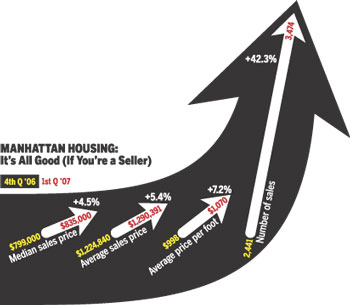
There are bad charts, and then there are really cool charts. Props to Nigel Holmes, at the New York Observer, for this one:

040907 Article Lab2

Just nobody show it to Nouriel Roubini.

Posted in Econoblog | Comments Off on Property chart of the day

Property datapoint of the day: 767 Fifth Ave worth $4 billion

John Koblin at the New York Observer today tries to put price tags on New York’s most valuable skyscrapers, and certainly comes up with some eye-popping numbers.

The General Motors Building, at 767 Fifth Avenue, is the most valuable building in the world, according to Koblin. Harry and Billy Macklowe purchased it for $1.4 billion in 2003, and it’s worth nearly three times that now: $4 billion. For one building. And not even a very good-looking one, either, unless you count the Apple Store’s glass cube out front.

And here’s another nice flip, should the landlord be in the mood: the even-uglier 200 Park Avenue.

It’s huge, it has fantastic views, it’s literally connected to Grand Central, and it commands huge rents. It sold in 2005 for a then-record $1.72 billion–but if the current landlord, Tishman Speyer, decided to sell today, it could double that price.

Meanwhile, Rockefeller Center, in toto, is worth $8 billion, give or take. In 1995, it filed for bankruptcy.

You can see why bankers like to lend against this sort of thing. And, also, why Fitch is so worried.

Interestingly, for all that Wall Street is, we’re told, the main reason why New York property values are skyrocketing, only one of the buildings on the list is home to a bank. (277 Park, the biggest of JP Morgan’s buildings.)

Posted in Portfolio | Comments Off on Property datapoint of the day: 767 Fifth Ave worth $4 billion

Is there any price Macquarie won’t pay?

Can you remember a week of late in which Australia’s Macquarie didn’t buy something? Today, it’s a bunch of UK cellphone and TV antennas. Boring, right? Not when you see the price tag: $5 billion. What’s more Macquarie is opening itself up to a world of regulatory pain, because after the acquisition it will control 100% of the UK TV broadcast market. Yes, 100%.

What cost a monopoly? Nicole Lee at Breaking Views says that it’s “a staggering 19 times last year’s ebitda,” and notes that “a similar business, France’s TDF, went for about 11 times ebitda only last year”. Given that earnings growth is going to be unspectacular in what is by any measure a mature market, the valuation looks hard to justify. Then again, this kind of thing seems to be a Macquarie speciality:

The real reason for paying so much is that infrastructure is hot. And Macquarie clearly would rather pay up than tell its investors that prices are too high. Just two weeks ago, its European infrastructure fund paid about 20 times 2006 ebitda for NCP’s UK car parks business.

Admittedly, car parks are valued more on the value of their real-estate than on the amount of their earnings. And if Macquarie can get away with owning a monopoly, that could mean extra profits there. But all these deals do smell a little bubblicious, all the same.

P.S. I never did get any clarity on how much Macquarie paid for Giuliani Capital. Does anybody have any ideas on that front?

Posted in Portfolio | Comments Off on Is there any price Macquarie won’t pay?

Have the Kirchners taken over Argentina?

American Task Force Argentina is a Washington-based lobbying organization financed by vulture funds, which exists to extract money from the government of Argentina and move it instead to the hedge funds and others who own the country’s defaulted debt. They tend to have rather extreme views, and so I generally look forward to a bit of a giggle when I get one of their semi-frequent emails. Today, for example, they pointed my to a piece by Mark Falcoff which has just been posted on the website of the conservative American Enterprise Institute.

Imagine my surprise, then, when Falcoff’s piece turned out to be accurate, well-written, and, in fact, a very good guide to where Argentina stands today, under president Nestor Kirchner, and how it got there over the past few years. I’ve read a lot about Argentina over the years, and very little of this calibre. But there seems to be a weird sentence inserted into the final paragraph:

Argentina’s history tends to be cyclical. For the past seventy years or so, the country has bobbed back and forth between crises and recovery, each time convinced that it has finally found a formula for sustained prosperity. Elected governments and military dictatorships, Peronists and anti-Peronists, protectionists and free marketers have each taken their turn at the wheel, each enjoyed a moment of euphoria and mass support, each ultimately suffered discredit and collapse–with some recent presidents forced to depart the government palace by helicopter. Sooner or later the country will have to return to the capital markets and settle accounts with its remaining creditors if it wishes to sustain and improve its present recovery. In the meanwhile, Kirchner rides the high curve of a cycle. He can only hope that his own landing will be softer than that of all his predecessors.

That sentence (the italics are mine) is unrelated to anything that has gone before, and is, in point of fact, not true. Argentina has demonstrated that it’s perfectly capable of borrowing money from foreign investors — in fact it does so every month, in both pesos and dollars. It just uses its own capital markets, rather than those of New York or London. So it really has no need “to return to the capital markets”, insofar as it hasn’t returned already.

As for international bond investors (or, as the IMF likes to call them, “hot money”) being necessary for sustained growth — well, I think that the past seventy years or so of Argentine history proves that false, too. Latin America is very good at borrowing far more money than it can reasonably expect to repay, which creates a boom-to-bankrupcty cycle which benefits nobody. Given the real money currently pouring into Argentina for its beef and soy and oil, it shouldn’t need to be borrowing more from abroad in any event. In fact, Argentina could almost be seen as following a counter-cyclical fiscal policy, borrowing less when times are good. They should be applauded for this, rather than being told that the only way to improve their present recovery is to borrow even more.

It is true that if Argentina settled with its holdout creditors, that might increase the amount of foreign direct investment in the country. But it’s hard to make a compelling case that the increase in FDI would itself justify the up-front cost of paying off the holdouts.

That one sentence aside, however, I can highly recommend Falcoff’s piece. Here’s one provocative passage:

Unlike Bill Clinton, Kirchner is not particularly charming or charismatic. One wit has remarked that the Argentine president has accomplished the impossible: he has created a cult of personality with no personality at all. His home province is also unlike Arkansas. Santa Cruz has a mere 120,000 residents, but is blessed with huge amounts of oil and gas, of which Kirchner made uninhibited use during his mandate there. In contrast to the U.S. Constitution, the Argentine charter of 1994 makes it possible for the Kirchners–if their popularity endures–to theoretically rule the country for the rest of their lives either by taking turns in four-year terms or by succeeding each other for eight years at a time.

Argentines have always loved strong leaders, from Peron to Menem. Kirchner’s only the latest in a long line, and if he can keep control of the economy — a very big if — then he and his wife could be running Argentina more or less indefinitely.

Posted in Econoblog | 2 Comments

Is there any price Macquarie won’t pay?

Can you remember a week of late in which Australia’s Macquarie didn’t buy something? Today, it’s a bunch of UK cellphone and TV antennas. Boring, right? Not when you see the price tag: $5 billion. What’s more Macquarie is opening itself up to a world of regulatory pain, because after the acquisition it will control 100% of the UK TV broadcast market. Yes, 100%.

What cost a monopoly? Nicole Lee at Breaking Views says that it’s “a staggering 19 times last year’s ebitda,” and notes that “a similar business, France’s TDF, went for about 11 times ebitda only last year”. Given that earnings growth is going to be unspectacular in what is by any measure a mature market, the valuation looks hard to justify. Then again, this kind of thing seems to be a Macquarie speciality:

The real reason for paying so much is that infrastructure is hot. And Macquarie clearly would rather pay up than tell its investors that prices are too high. Just two weeks ago, its European infrastructure fund paid about 20 times 2006 ebitda for NCP’s UK car parks business.

Admittedly, car parks are valued more on the value of their real-estate than on the amount of their earnings. And if Macquarie can get away with owning a monopoly, that could mean extra profits there. But all these deals do smell a little bubblicious, all the same.

P.S. I never did get any clarity on how much Macquarie paid for Giuliani Capital. Does anybody have any ideas on that front?

Posted in Econoblog | 1 Comment

What does it mean for something to be “contained”?

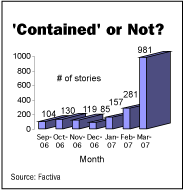
David Gaffen has a cute piece up at Marketbeat today, looking at the number of news stories on the subprime mess which contain the word “contained” or its cognates.

A Dow Jones Factiva search shows that the number of stories mentioning “subprime” and “contained” at the end of last year averaged around 110 or so — but that more than doubled in February, and jumped to a whopping 981 in March. This is hardly a scientific approach, but could be a measure of the urgency with which pundits have been trying to reassure investors the subprime mess won’t spill over.

Those doing the reassuring include portfolio managers such as Evergreen’s Walter McCormick, to bigwigs like Treasury Secretary Hank Paulson and Fed chairman Ben Bernanke.

This doesn’t reassure Gaffen, and it doesn’t reassure me. On the other hand, knee-deep as I am in Nassim Nicholas Taleb right now, I’m inclined to take a more existential view of things. After all, the idea of containment is closely connected to the idea of contagion, which in turn is tightly bound up with the idea of causation.

Sometimes, contagion and causation are easy to see. The Russia crisis caused the Brazil crisis, for instance – the Russia crisis was not contained. At other times, containment is easy to see: Argentina’s default caused no more general widening out of credit spreads, and Amaranth’s implosion caused no flight of capital out of hedge funds.

But credit spreads are so tight right now that they’re bound to widen out at some point. When they do, there will surely be no end of pundits crowing that they were right about the subprime mess “spilling over”, and that events are proving that the subprime mess was not “contained”. But what if these other debt markets would have widened out anyway, due to entirely fundamental reasons associated with reasonable levels at which to price risk?

I’m pretty sure that what we’ll see in practice is credit spreads in general widening out in the wake of the mortgage mess. Or, you could describe the same thing as credit spreads in general widening out in the wake of the French presidential election, or the appointment of Felix Salmon to a blogging gig at Portfolio. Causation is a hard thing to demonstrate – which means that containment, as a concept, has relatively little utility.

Posted in Portfolio | Comments Off on What does it mean for something to be “contained”?

Waiting for the commercial-property shoe to drop

Will commercial mortgages of the 2007 vintage turn out to be as misguided as residential mortgages in 2006? Fitch Ratings thinks there’s a serious risk of that. Does this sound familiar to you?

The phenomenon has granted borrowers easy access to capital and prompted the development of new, more highly leveraged debt structures.

Fitch said properties were also increasingly financed with no money down or even with loans for more than 100 per cent of a property’s value as owners borrowed greater amounts upfront to pay interest costs.

Commercial property certainly seems healthy at the moment. But that won’t last forever. I’m frankly surprised, given what we’ve learned about the residential mortgages being written this time last year, that banks haven’t tightened up at all on their commercial-property underwriting standards.

Posted in Portfolio | Comments Off on Waiting for the commercial-property shoe to drop

What does it mean for something to be “contained”?

David Gaffen has a cute piece up at Marketbeat today, looking at the number of news stories on the subprime mess which contain the word “contained” or its cognates.

Ob-Ai941 Contai 20070403162149A Dow Jones Factiva search shows that the number of stories mentioning “subprime” and “contained” at the end of last year averaged around 110 or so — but that more than doubled in February, and jumped to a whopping 981 in March. This is hardly a scientific approach, but could be a measure of the urgency with which pundits have been trying to reassure investors the subprime mess won’t spill over.

Those doing the reassuring include portfolio managers such as Evergreen’s Walter McCormick, to bigwigs like Treasury Secretary Hank Paulson and Fed chairman Ben Bernanke.

This doesn’t reassure Gaffen, and it doesn’t reassure me. On the other hand, knee-deep as I am in Nassim Nicholas Taleb right now, I’m inclined to take a more existential view of things. After all, the idea of containment is closely connected to the idea of contagion, which in turn is tightly bound up with the idea of causation.

Sometimes, contagion and causation are easy to see. The Russia crisis caused the Brazil crisis, for instance — the Russia crisis was not contained. At other times, containment is easy to see: Argentina’s default caused no more general widening out of credit spreads, and Amaranth’s implosion caused no flight of capital out of hedge funds.

But credit spreads are so tight right now that they’re bound to widen out at some point. When they do, there will surely be no end of pundits crowing that they were right about the subprime mess “spilling over”, and that events are proving that the subprime mess was not “contained”. But what if these other debt markets would have widened out anyway, due to entirely fundamental reasons associated with reasonable levels at which to price risk?

I’m pretty sure that what we’ll see in practice is credit spreads in general widening out in the wake of the mortgage mess. Or, you could describe the same thing as credit spreads in general widening out in the wake of the French presidential election, or the appointment of Felix Salmon to a blogging gig at Portfolio. Causation is a hard thing to demonstrate — which means that containment, as a concept, has relatively little utility.

Posted in Econoblog | Comments Off on What does it mean for something to be “contained”?

Property datapoint of the day: 767 Fifth Ave worth $4 billion

John Koblin at the New York Observer today tries to put price tags on New York’s most valuable skyscrapers, and certainly comes up with some eye-popping numbers.

The General Motors Building, at 767 Fifth Avenue, is the most valuable building in the world, according to Koblin. Harry and Billy Macklowe purchased it for $1.4 billion in 2003, and it’s worth nearly three times that now: $4 billion. For one building. And not even a very good-looking one, either, unless you count the Apple Store’s glass cube out front.

And here’s another nice flip, should the landlord be in the mood: the even-uglier 200 Park Avenue.

It’s huge, it has fantastic views, it’s literally connected to Grand Central, and it commands huge rents. It sold in 2005 for a then-record $1.72 billion—but if the current landlord, Tishman Speyer, decided to sell today, it could double that price.

Meanwhile, Rockefeller Center, in toto, is worth $8 billion, give or take. In 1995, it filed for bankruptcy.

You can see why bankers like to lend against this sort of thing. And, also, why Fitch is so worried.

Interestingly, for all that Wall Street is, we’re told, the main reason why New York property values are skyrocketing, only one of the buildings on the list is home to a bank. (277 Park, the biggest of JP Morgan’s buildings.)

UPDATE: As Miss Representation points out in the comments, there is another bank building on the list: Bank of America’s as-yet unfinished tower at One Bryant Park, which, we’re told, “will easily be more than $3 billion by the time it opens.” And I think BofA might have space at another building on the list, 9 W 57th Street, as well.

Posted in Econoblog | 1 Comment

Why do all investment-bank CEOs make $40m?

$40 million seems to be the going rate for an investment-bank CEO these days.

Executive compensation expert Graef

Crystal has done the math, and finds that the pay for Lloyd Blankfein

of Goldman Sachs; Stanley O’Neal of Merrill Lynch;

John Mack of Morgan Stanley; Richard Fuld of Lehman

Brothers; and James Cayne of Bear Stearns is definitely converging

on pretty much the same point, despite a huge amount of disparity in income

and sales.

Crystal smells smoke-filled rooms. And it’s not just the CEO pay he’s unhappy

about, either: he notes that Goldman COOs Gary Cohn and Jon

Winkelried, as well as CFO David Viniar, are all making

well over $40 million as well. He writes:

It’s hard enough for shareholders to digest Blankfein earning just under

$60 million last year — even though his company produced a 52 percent total

return level. To learn that Blankfein’s two top associates earn within a hair

of his pay level, must be annoying in the extreme.

I don’t buy it. What’s annoying is when a CEO, taking credit for and profit

from his employees’ work, ends up with a vastly disproportionate part of the

company’s total profits. That’s not happening at Goldman, as is evidenced by

the small difference in pay between the CEO and his direct reports.

What’s more, Crystal fails to mention that by all accounts some Goldman traders

took home $100 million bonuses last year, thereby earning significantly more

than the CEO. And in fact it’s this that I think explains why the CEO pay at

investment banks is bunching.

CEOs aren’t fungible: if Cayne left Bear, he couldn’t start working easily

at Goldman. But traders are fungible in that respect, and indeed get

poached on a regular basis by investment banks competing against each other.

So there’s a real market in traders, and top traders anywhere are liable to

pull in more than the CEO.

But CEOs have egos, too – and they’re unlikely to want to earn significantly

less than employees several levels of management down. So if top traders are

getting $50 million bonuses, that in itself is likely to explain the $40 million

pay packages for CEOs.

Posted in Portfolio | Comments Off on Why do all investment-bank CEOs make $40m?