Extreme Measures III: Cambiz Alikhani at the Financial Times

Yves Smith of Naked Capitalism submits:

As concern about tightening conditions in the credit markets and the continued erosion of the US supbrime and broader housing market has grown, so too have calls for Extreme Measures to combat these snowballing problems.

The first was from Bill Gross at Pimco, who suggested that the US government “rescue” the 2 millionish homeowners who stood to lose their homes. A second came from Gillian Tett, the capital markets editor at the Financial Times, who argued that investment bankers should decompose CDOs and other structured credits into their constituent parts. It’s a nice sounding idea that is completely unworkable. Willem Buiter’s and Anne Sibert’s proposal that central banks act as market makers of the last resort almost qualified by virtue of being a radical departure from current practice. However, it fails to meet the standard by virtue of being not insanely difficult to implement (Buiter and Sibert claim the Fed and other central bankers have the statutory authority to go this route).

The latest sighting is an article by Cambiz Alikhani of Arundel Iveagh Investment Management in the Financial Times, “Banks should form a bail-out vehicle to ease the credit crisis.” He begins with a suitably dramatic synopsis:

Over the past few months a modern day pyramid scheme of colossal proportions has begun to unwind. The sheer scale of it is clogging up the arteries of the financial system and has led to major disequilibrium within global credit markets.

His proposal on the surface sounds attractive:

This credit crunch could be alleviated by removing from the system the debt that created the problem in the first place….

It may therefore be appropriate for a core group of leading financial institutions to consider the idea of a “bail-out” vehicle that would be capitalised with the purpose of providing both pricing for the market and a source of demand for paper that cannot find another home.

The fact that such a vehicle is funded by financial institutions rather than governments would not only shield regulators from the accusation of “moral hazard” but could actually involve them in a very pro-active way.

They could play an important role in providing transparency with regards to the scale of the problem and with regards to the different pricing mechanisms used by different banks for exactly the same type of paper.

Thus regulators such as the Securities and Exchange Commission in the US and the Financial Services Authority in the UK could play the pivotal role of referee, while central banks provide the appropriate level of liquidity that the system needs in the meantime.

Alikhani invokes the LTCM bailout and the establishment of Resolution Trust Corporation as successful examples. Yes, they were successful, but neither is a precedent for this idea.

Let’s start by examining a few of the numerous practical impediments, then the relevance of LTCM and the RTC.

First, the formation of such an entity among private sector on a voluntary basis has no precedent, and for good reason. There are so many contentious issues that are zero sum (or likely to be treated by tough Wall Street negotiators as zero sum) to make it well night impossible for them to find common ground. What assets would be included? What sort of initial capitalization and ongoing support (working capital and expenses) would each firm provide? What would the governance structure be?

Let’s look at one issue that might seem to be simple, “What assets should be included?” To solve this problem on a good-faith basis, the various players would need to discuss what their exposures are so they would have an idea in aggregate of what the new entity’s funding requirements would be. But these firms are competitors and position information, even on an aggregate level, is tremendously sensitive. The likelihood of them exposing that is about zero. They all know that that information can and will be used against them.

Second, the formation of this entity is to solve a problem, namely the lack of a market (or at least an active, well functioning market) for certain types of debt. One impediment is considerable uncertainty as to what the paper (such as many CDO tranches) is worth (note that “uncertainty” may really be code for “there are no bids” or “the sellers know that the bids are likely to be so far below what they are willing to accept that they aren’t even willing to try to find a buyer.”)

Yet you need an answer to that very same problem, how to price the various assets, in order to establish the bail-out entity. In other words, this is a circular problem. Setting up the vehicle requires an answer to the very problem that it is supposed to solve.

Go through the mechanics. The banks create a new entity. They have to transfer the doggy assets into the entity. To transfer them, they need to assign a value (both the price in the accounts of each bank for the removal of the assets, and the price at which they are valued in the new entity, which presumably has to be the same number).

Alikhani notes in passing that the banks almost certainly are carrying similar assets on their books at different values now: “They could play an important role…. with regards to the different pricing mechanisms used by different banks for exactly the same type of paper.”

You have to solve the problem before you capitalize the entity, not afterwards.

Third, it isn’t clear at all that it is desirable to have large scale price discovery of these assets. Alikhani is making the mistake of assuming that ownership is concentrated in relatively few hands, presumably among the large investment banks.

But this dubious paper is scattered widely in the investor community. It’s held by hedge funds, pension funds, banks, insurance companies, and other asset managers. And at least in the case of CDOs, there are also derivative exposures against some of these instruments (credit default swaps were one of several means to achieve credit enhancement).

What happens if you have widespread price discovery? Hedge funds and other asset managers will have to remark their positions. Any leveraged players (certainly hedge funds, perhaps some other fixed income managers) will face margin calls. That will force more selling, and could lead to the collapse of some hedge funds (note that some funds have already failed in the absence of a market clearing). Discovery of the magnitude of the losses also would lead to panic among investors, and could (as it did in August) lead to redemptions at funds suffering only minor losses, which nevertheless added to selling pressure.

Losses and failures of leveraged players puts the loans at risk. The investment banks who are presumably sponsoring the formation of this entity could set in motion a chain of events that create large losses in their prime brokerage businesses. That’s a scenario they’d want to avoid at all costs.

In fact, what would be the best outcome for the financial community is very gradual price discovery, so the losses eke out gradually over time and the repricing of credit is orderly. Whether this can or can be made to come about is a completely different question. I sincerely doubt this will happen, but similarly, I can’t imagine the financial community voluntarily accelerating price discovery unless they somehow thought the consequences of not doing so were worse. I don’t think they would perceive there to be a compelling case, given the downside outlined above.

To return to the LTCM and RTC examples: neither is germane to this idea. There is a common, and widely held perception that the Fed brokered the rescue of LTCM. In fact, Peter Fisher, head of the NY Fed’s trading desk, had been asked by LTCM to look at its positions (by then it was an open secret that the firm was on the ropes). Fisher called the major investment banks and banks that were credit providers, ascertained that all wanted a work-out rather than a collapse, but no one was willing to put himself at a negotiating disadvantage by trying to lead such an effort.

Roger Lowenstein recounts the negotiations at the Fed’s offices in considerable detail in his book, “How Genius Failed”:

Fisher spoke for just a few minutes. He said the Fed was interested whether the private sector could find a solution that wold avoid a chaotic liquidation – one that would spare the system. Otherwise, he adopted a neutral stance, intentionally staying aloof from the particulars. [Herb] Allison [of Merrill Lynch] said, “It was like he had rented out a hall.”

Lowenstein notes that it was unprecedented for the Fed to summon executives from other firms together and even offer a very generalized proposal, and the bankers understood that the Fed had in essence recommended that it would serve them to solve this problem. But it is still important to remember that that is all the Fed did.

Also recall that LTCM was an existing entity, with a well defined set of positions that were readily valued. So there was no need to worry about who would manage the entity (although there was an issue about oversight). The biggest issues were how much each firm should cough up, how long the investment should be and what the arrangements with the LTCM principals should be (they had to be paid something to complete the wind-down; otherwise, they might as well abandon the firm).

As for RTC, the comparison is even less germane. The S&L assets fell into the government’s lap by virtue of it having provided deposit insurance to the failed entities and by being their primary regulator. There was some pressure to sell the assets, both because it required a considerable amount of working capital to fund the assets (which became increasingly controversial) and because the overhang of unsold assets was perceived to be detrimental to the surviving banks in the same geographical area as the dead thrifts.

Posted in banking, bonds and loans, hedge funds, regulation | Comments Off on Extreme Measures III: Cambiz Alikhani at the Financial Times

Steve Jobs Gives Me $100

Steve Jobs is giving me $100! Thanks, Steve!

I’m happy about this: my $499 iPhone has now essentially become a $399 iPhone, which is a very attractive price indeed. True, the real $399 iPhone has twice the capacity of mine. But I’ve been very happy with my phone for over two months now, and would probably have paid the extra $100 for those two months alone.

Plus, I have a feeling that my 4GB iPhone is going to become even more of a collector’s item than my first-generation 5GB iPod. Does anybody have one, except for me?

(Yes, I know that technically Steve isn’t giving me anything: I can only get $100 worth of Apple product. But what’s the chance that I’m not going to spend $100 on Apple product sometime soon?)

Posted in Not economics | 1 Comment

It’s Official: Most Hedge Fund Strategies Lost Money in August

Yves Smith of Naked Capitalism submits:

The UK’s Times Online, citing Hedge Fund Research (HFR), reports that hedge fund strategies of all sorts took a beating in August:

Of the 20 daily hedge fund indices tracked by HFR, only one managed a positive result in August with the other 19 showing a negative performance.

One fund index – the Macro index – lost more than 8 per cent of its value during the four-week period.

The uniformity of the losses across much of the industry raised questions over the role of hedge funds, which market themselves as alternatives to traditional equity investment in return for large fees. Hedge fund managers have traditionally been seen as traders able to avoid the bumps of turbulent markets and capitalise on volatility.

Not surprisingly, the article suggests that hedge fund fees may become harder to defend:

According to HFR’s data, the Global Hedge Fund Index – which includes a variety of strategy funds including long/short – lost 2.55 per cent of its value. Long/short funds pick cheap stock to buy and dear stocks to sell.

One hedge fund insider said: “Much of the money invested in hedge funds goes into long/short. These guys are pretty similar to conventional long-only managers. The main thing that distinguishes them is the outrageous fee they charge.”

For at least the last two years, critics of hedge funds have argued that investors were overpaying for the results that the typical hedge fund provided, yet fees have been remarkably immune to price pressure. But continued weak performance and withdrawal of client assets could finally lead to a change.

Posted in hedge funds | Comments Off on It’s Official: Most Hedge Fund Strategies Lost Money in August

Another Blow to Rating Agency Credibility

Yves Smith of Naked Capitalism submits:

A Bloomberg story today tells us that CreditSights found that AAA ratings for a new type of credit derivative may be as likely to default as junk.

In a report titled “Distressed CPDOs: We’re Doomed!”, CreditSights raised doubts about the ratings of constant proportion debt obligations, which use credit default swaps as a means to bet on the likelihood of default of a basket of investment grade companies. As Bloomberg reported,

“If you assume defaults and downgrades come in bunches rather than being evenly spaced out, CPDOs’ default rates are more what you would expect for low junk ratings than for triple- A,” David Watts, a CreditSights analyst in London, said in a telephone interview yesterday.

In slowdowns, corporate downgrades do become more common. This is a pretty basic analytical issue for Moody’s and Standard & Poors to have missed. However, the market appears to have been skeptical even before the CreditSights report was issued:

The CPDO model is being challenged as worsening perceptions of credit quality reduce the value of the credit-default swap contracts included in the securities. Those CPDOs that provided insurance on the 125 companies in the CDX index in March for a premium of 36.75 basis points, or $36,750 for every $10 million of debt, will have to pay nearer 70 basis points to end the contract when the index rolls on Sept. 20, based on current prices….

Prices of CPDOs dropped to as little as 70 percent of face value last month.

The (relatively) good news for rating agencies is that the amount of CPDOs outstanding is small. Bloomberg estimates the market as being in excess of $4 billion. But with rating agency credibility in tatters, more evidence of their shortcomings is the last thing they need.

Posted in bonds and loans | Comments Off on Another Blow to Rating Agency Credibility

Commercial Real Estate Prices May Drop 15% in Next Year

Yves Smith at Naked Capitalism submits:

Experts warn that the boom in commercial real estate prices, fueled by cheap credit, is going sharply into reverse.

Fitch had noted as early as April, and again in July that commercial real estate lenders were engaging in the same lax practices that led to grief with subprimes: 0% down, overly optimistic projections, deal terms that made sense only if you assumed price appreciation and a refinancing.

Bloomberg reports that investors are holding back from closing transactions because they believe prices will fall. If enough people believe that, which appears to be the case, it becomes a self-fulfilling prophecy. A second factor is that rising financing costs have driven high leverage buyers, such as private equity firms, to the sidelines.

Ironically, the story mentions the sale of Sam Zell’s Office Properties Trust to Blackstone, a $23 billion deal concluded in February. Sam Zell is widely regarded as one of the savviest value investors around. The fact that Zell, an old hand in real estate, was cashing out was widely seen as the sign of a market top.

That view proved to be correct. The deal was done at a record low capitalization for a REIT (lower cap rates = higher prices).

From Bloomberg:

Investors in July bought the fewest commercial properties since August 2006 and apartment building acquisitions were down 50 percent from June, data compiled by industry consultants at New York-based Real Capital Analytics Inc. show. Archstone-Smith Trust in August postponed its $13.5 billion sale to a group led by Tishman Speyer Properties LP until October. Mission West Properties Inc., the owner of commercial buildings in Silicon Valley, said on Aug. 13 that the company’s $1.8 billion sale may fail after a bank withdrew funding.

“There are so many deals falling apart,” said David Lichtenstein, chief executive officer of Lakewood, New Jersey- based Lightstone Group, an owner of more than 20,000 apartments and 30 million square feet of office and retail space. “People who can get out are getting out.”…..

Average prices for commercial properties might drop 5 percent to 15 percent in the next two years depending on the type of property and its quality and location, said Matthew Ostrower, an industry analyst at New York-based Morgan Stanley, the second-largest U.S. securities firm by market value.

Michael Knott, a senior analyst at Green Street Advisors Inc., a real estate research firm in Newport Beach, California, estimates commercial prices may fall about 10 percent in the next 12 to 18 months and up to 15 percent in the office market during that period….

Commercial mortgage rates have climbed as defaults rose in the subprime part of the residential real estate market….

The increase has halted a rally that lifted prices for office buildings, apartments and hotels to records this year. The average price paid for high-quality office properties in city centers reached $291 a square foot, up from $188 in 2005 and almost double the average $152 in 2001, Real Capital reported…

“You’ve got a lot of fear in the system from the capital markets,” Stein said. “As far as the pricing of credit, it was greed six months ago and it’s fear today.”.

Posted in banking, bonds and loans, investing | Comments Off on Commercial Real Estate Prices May Drop 15% in Next Year

Brad DeLong Argues That Central Banks Should Cut Interest Rates

Yves Smith at Naked Capitalism submits:

It’s always dangerous for mere mortals to take issue with Serious Economists, but let’s start with Professor of Economics at U.C Berkeley Brad DeLong’s thesis (hat tip Mark Thoma):

The fact that there is even a small liquidity crunch for banks implies larger liquidity crunches for less intensively regulated financial institutions, and even greater liquidity crunches for manufacturing and real-estate companies. It is hard to imagine that manufacturers are not now postponing orders of capitals goods, and that new home sales in the US are not dropping right now.

How does the Fed deal with such a situation?

Gingerly. A decade ago, former Fed chairman Alan Greenspan likened his problems of monetary management to driving a new car, having it suddenly stop, opening the hood, and not understanding a thing about what he saw. The changes in finance had been that great.

The Fed’s actions have involved what former Fed governor Larry Meyer calls “liquidity tools,” as opposed to interest rate-based monetary policy. The Fed hopes that it can handle the current situation without being forced to rescue market liquidity by cutting interest rates and thus giving what it fears would be an unhealthy boost to spending. The Fed still hopes that liquidity and confidence can be restored quickly, and that this summer will serve future economists as an example of how de-linked financial markets can be from the flows of spending and production in the real economy.

I think that the Fed is wrong: The fallout from the current liquidity panic means that a year from now we are likely to wish that the Fed had given a boost to spending this month.

DeLong has a bank-centric view of the world and seems not to have internalized how peripheral banks are as actors in credit intermediation these days. And because he is used to thinking in terms of traditional bank runs and liquidity crunches, he turns to traditional tools, namely, injecting liquidity.

Put it another way, this thinking is constrained by the familiar methods. If your only tool is a hammer, every problem looks like a nail. That ultimately may be the issue the Fed and other central bankers are up against.

DeLong and others treat the problem as liquidity, when the liquidity problems reflect concerns that Nouriel Roubini has discussed before, ones of insolvency and uncertainty. Lowering interest rates 50, or even 200 basis points is not going to make anyone any more willing to buy asset backed commercial paper. What might make them more willing is knowing if that particular counterparties have good collateral. Now I don’t know how you could create enough transparency to cope successfully with the fact that a lot of CP of all sorts matures this month, but a solution to that problem would considerably alleviate the seize up in the ABCP market, which is putting a strain on banks as ABCP issuers draw down on credit lines.

Similarly, cutting interest rates will not solve the problem of hung LBO financings, or subprime loans that are going to reset at higher rates, or commercial real estate financings done on overly aggressive terms, or hedge funds and pension funds sitting on CDOs and CLO traches that they know are worth less than they paid for them, but are hoping no one will re-rate it or otherwise take a step that would force them to discover a market price. John Dizard told us yesterday that some A rated paper that is yielding 35% on a current basis, is paying on a current basis and has good odds that the defaults won’t impair the principal value, is going begging. And he expects things to get worse.

I consider the problem analogous to the one described by Paul Krugman in his explanation in the New York Review of Books of why the Depression came about. Krugman disagrees with the common view that the Fed failed to provide enough liquidity:

If the money supply consisted solely of currency, it would be under the direct control of the government–or, more precisely, the Federal Reserve, a monetary agency that, like its counterpart “central banks” in many other countries, is institutionally somewhat separate from the government proper. The fact that the money supply also includes bank deposits makes reality more complicated. The central bank has direct control only over the “monetary base”–the sum of currency in circulation, the currency banks hold in their vaults, and the deposits banks hold at the Federal Reserve–but not the deposits people have made in banks. Under normal circumstances, however, the Federal Reserve’s direct control over the monetary base is enough to give it effective control of the overall money supply as well…..

In interpreting the origins of the Depression, the distinction between the monetary base (currency plus bank reserves), which the Fed controls directly, and the money supply (currency plus bank deposits) is crucial. The monetary base went up during the early years of the Great Depression, rising from an average of $6.05 billion in 1929 to an average of $7.02 billion in 1933. But the money supply fell sharply, from $26.6 billion to $19.9 billion. This divergence mainly reflected the fallout from the wave of bank failures in 1930-1931: as the public lost faith in banks, people began holding their wealth in cash rather than bank deposits, and those banks that survived began keeping large quantities of cash on hand rather than lending it out, to avert the danger of a bank run. The result was much less lending, and hence much less spending, than there would have been if the public had continued to deposit cash into banks, and banks had continued to lend deposits out to businesses. And since a collapse of spending was the proximate cause of the Depression, the sudden desire of both individuals and banks to hold more cash undoubtedly made the slump worse.

The difference between the Depression and now is that instead of having banks lend deposits as the main mechanism for financial intermediation, we have many other routes, particularly securitization and complete disintermediation of banks. Auto companies, for example, work with Wall Street to package and sell their car loans. ABCP conduits were another non-bank vehicle to obtain more efficient capital markets funding of mortgages.

This same point was made by Mohamed El-Erian, CEO of Harvard Management, in excellent article in the Financial Times, “In the new liquidity factories, buyers must still beware,” He explained that a great deal of the liquidity in the markets is created not by the monetary authorities, but by the participants themselves, and worked through a simple example, a private equity fund.

This is a useful piece, in that it provided an illustration anyone can use at a cocktail party, but has broad implications. The instruments and structures differ, but the process of creating ‘endogenous” liquidity is the same: borrow to buy assets, which when done on a large scale, leads asset prices to rise. We’ve pointed to other articles, most often in the FT, that describe liquidity creation on steroids, which results in risky borrowers getting overly favorable terms (subprime borrowers are far from alone).

El-Erian said, straight out, that the “leverage factories” have rendered the Fed’s 17 interest rate hikes ineffective. As he noted later, this makes a tough job even more difficult. Leverage cuts both ways. It amplifies gains and losses. All this leverage puts central bankers in an awkward position, for if they slow money supply growth, it could precipitate deleveraging, which would lower liquidity further than they had intended, which in an extreme case could lead to an economic slowdown or a financial panic. His scenario of late March is playing itself out now.

Now of course, the problem for DeLong, and ultimately Bernanke and other central bankers, is that if you accept that our current situation is serious (which a rate cut recommendation presupposes) but the likelihood of a rate cut achieving its intended aim is low, what do you do?

In short, as Roubini and James Hamilton have discussed, we may instead need a combination of fiscal stimulus and regulatory reform. That’s slow going, take a lot of thought, and requires the cooperation of Congress and the Admiinistration. So the appeal of resorting to interest rates (and praying they work) is obvious.

Posted in banking, bonds and loans, economics, fiscal and monetary policy | Comments Off on Brad DeLong Argues That Central Banks Should Cut Interest Rates

The Wall Street Journal Touts Dubious Research (CEO Performance Edition)

Yves Smith at Naked Capitalism submits:

Will someone, please, teach the reporters at the Wall Street Journal the basics about scientific research? I know it’s hard finding stuff to write about day in, day out. But the story “Scholars Link Success of Firms To Lives of CEOs” is a travesty.

The centerpiece of the article is a study by Morten Bennedsen, Francisco Perez-Gonzalez and Daniel Wolfenzon. Let’s note first that this paper has not yet been published in any recognized academic journal (it’s posted on the University of Texas website, where Francisco Perez-Gonzalez is a member of the faculty), so it is not yet clear whether it will be deemed to pass muster in respectable circles.

The study took the records of 75,000 Danish businesses from 1992 to 2003 and looked at whether events in the CEO’s life affected performance. The chart summarizes some of their findings. The death of child had the greatest negative impact on performance, followed by the death of a spouse. Conversely, the death of a mother in law was a plus.

Now this study has a certain intuitive appeal. Someone who is grieving might devote less time to his business, or make worse decisions than he would otherwise.

Nevertheless, correlation is not causation. A study of this sort at most highlights a possible connection.

Even at the gross level, the findings may not add up. Psychologists regard the death of a spouse as the most traumatic event one can suffer. One measure, the Holmes-Rahe scale (which has limitations of its own since the underlying research was done retrospectively, and was developed to see how stress levels translate into physical illness), rates death of a spouse as 100 while death of a close relative (which is where “death of a child: would fall) as 63. Yet this study found greatest drop in performance from the death of a child.

There are also differences between the demographics of the firms where the CEOs suffered losses compared to the ones that didn’t. This also makes it difficult to give too much credence to the findings:

Table I shows that event firms are larger, more profitable, older and grow faster than non CEO-shock firms, in all cases with differences that are statistically significant at the one-percent level. On average, event firms’ age is 15.5 years, while it is only 11.2 years for non-event firms. The differences in age between event and non-event firms are expected as CEO shocks are more likely to occur in relatively older firms as CEOs family size and age are larger for older firms.

Even if this research does have some validity for smallish companies in Denmark, it’s not clear it can be generalized to bigger corporations in the US. Large companies in fact may provide a refuge from painful events. As the Journal notes:

Gerald M. Levin was chief executive of Time Warner Inc. in 1997 when his grown son was murdered. “Of course I went into a tailspin,” he said. “I made…I won’t call it a mistake. I returned to what for me was a narcotic, I returned to work. I worked 25 hours a day.” He said he couldn’t judge whether his performance was affected but notes that he felt drained of emotion, as though “nothing that happened could affect me anymore.” Mr. Levin’s grief didn’t correlate with a drop in Time Warner’s stock price, which greatly outperformed the broader market during the three years after his son’s murder.

It’s only one datapoint, but someone betting against Time Warner after the death of Levin’s son based on the study above would have made a mistake.

The Journal article reports on other correlation studies that are at least amusing, like the one by David Yermack and Crocker Liu of Arizona State University that found that CEOs that built or bought a particularly large house had stocks that underperformed the S&P for the next three years.

But for others cited, it’s too easy to come up with alternate explanations:

Other academics have found underperformance, in both profits and stock prices, at companies led by executives who received awards such as best-manager kudos from the business press. The theory: Once they become stars, some CEOs may pay more attention to writing memoirs and sitting on outside boards and a little less to running their companies.

Ever heard of reversion to the mean?

It’s one thing to present this sort of fluffy research as a curiosity, quite another to treat it, as the Journal does, with unwarranted reverence.

Posted in governance, Media | Comments Off on The Wall Street Journal Touts Dubious Research (CEO Performance Edition)

More Cheery Housing Charts

Yves Smith at Naked Capitalism submits:

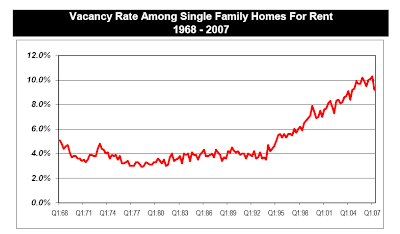
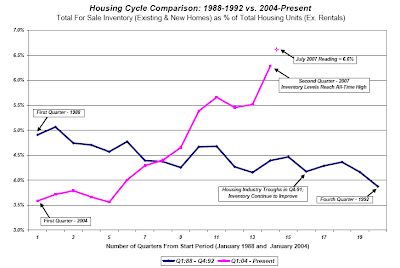
Michael Shedlock, of Mish’s Global Economic Trend Analysis, provides some uplifting charts and commentary that should quash any doubts that this housing cycle is worse than its predecessors:

….this housing cycle looks different than any I have seen. To this point, I have included two charts. I suggest studying them carefully. What you find is that the 1988-1992 housing cycle peaked in the first quarter of 1988 (1Q88) followed by a decline in “For Sale Inventories” until the cycle troughs in the 4Q ’91 (some 15 quarters later, which is typical).

Housing Inventory 1988-1992 vs. 2004-Present

Housing Vacancy Rates 1968-2007

In case the charts are hard to read, the pink line in the top chart is our current housing inventory level, while the blue line is the 1988-1992 inventory line. Shedlock’s point is twofold: in the last cycle, inventory peaked in 1988, but the market prices continued to tank until inventory levels had fallen, which took almost four years. Second, look how dizzyingly much higher current inventory levels are relative to housing stock than they were last time around.

And his second chart shows that houses for sale have plenty of competition from a rental market that also has a lot of slack.

The Prudent Investor offered this related factoid:

The Boston Globe runs a story that says credit card offers aimed at subprime debtors jumped 41% in the first half of 2007. Offers to those in the best credit grade fell 13%, paradoxically. Debtors paying their mortgage with their credit card. And you still want to own bank shares?

Posted in Portfolio | Comments Off on More Cheery Housing Charts

The Barriers to Bottom Fishing

Yves Smith at Naked Capitalism submits:

John Dizard, in today’s Financial Times, tells us why, despite the fact that a lot of fixed income paper is on offer at very cheap prices, no one seems to be stepping to the plate. And his explanation bodes ill for things turning around very soon.

The simple story is that even though the buys look compelling, most of the capital in the markets today isn’t in the hands of people acting on their own behalf but agents of various sorts, using other people’s money. And many, like hedge funds, use leverage.

So even if an asset is a screaming buy, these investors worry that they may get cheaper yet. That would pose two problems. First, they’d have to show a loss (remember, they mark to market) before the position eventually works out and shows a nice profit. Investors don’t like seeing negative or sub-par returns even in the best of times, and these are far from the best of times. Second, if they are using borrowed funds, they would face a margin call if the asset fell in price, which would force them to sell either that position (at a loss) or another one.

This line of thinking implies that the only people who can step forward and act as bottom fishers are people using their own capital, and the existing distressed bond funds (which presumable don’t use any or much leverage due to the volatility of their investments). But the amount of securities soon to be on offer is likely to considerably exceed the capacity of either of those two sources.

From the FT:

Late last week, a credit investor friend of mine was looking at a list of $4bn (face value) of securities being offered by some large fund being liquidated, apparently in London. There were single-A floating rate home equity securities being offered at 37.5 and 20 cents in the dollar. That is, a so-far performing bond, rated at the same level as many banks, being offered with a coupon of 35 per cent.

Nobody was buying it.

Let’s say you liked the value of the underlying collateral. Even with a very high default rate, this bond could well be covered by its collateral.

However, cheap though it is, the problem is that it could get cheaper. So professional credit investors, most of whom depend on bank lines, could be required to mark it down. Then, in a margin-call event, they could be at risk of not meeting the call, which is what happened to the previous owner.

But never mind the banks. What about the nervous limited partners? This is the problem outlined in a 1997 paper, which I once again recommend for your reading list, by Andrei Shleifer and Robert Vishny, called The Limits of Arbitrage.

The two mathematically rigorous economists showed how, at the very moments that an arbitrageur using investors’ capital could find the most compelling values, investors would be likely to pull their money back.

Well, people, we are right now at the limits of arbitrage in the structured credit markets….We’re just a month or two away from even bigger forced liquidations.

Posted in bonds and loans, hedge funds, investing | Comments Off on The Barriers to Bottom Fishing

Will Asking Mortgage Servicers to Modify Mortgages Have Much Impact?

Yves Smith at Naked Capitalism submits:

Bloomberg tells us that the Fed and the Treasury made a joint statement today asking mortgage servicers to take a more proactive stance, identify borrowers in danger of gong into default, and offer loan modification. Tanta at Calculated Risk provided a link to the “ Interagency Statement on Loss Mitigation Strategies for Servicers of Residential Mortgages,” and here is what we regard as the operative part:

Servicers of securitized mortgages should review the governing documents for the securitization trusts to determine the full extent of their authority to restructure loans that are delinquent or in default or are in imminent risk of default. The governing documents may allow servicers to proactively contact borrowers at risk of default, assess whether default is reasonably foreseeable, and, if so, apply loss mitigation strategies designed to achieve sustainable mortgage obligations.

Unfortunately, like other Bush Administration measures to address the growing housing crisis, there is less to statement than meets the eye.

The Fed and the banking regulators under the Treasury’s umbrella, such as the Office of the Comptroller of the Currency, have nicely asked mortgage servicers if they can use loan modifications to rescue more borrowers at risk of default. And in the good old fashioned days of banking, when the original lender held the mortgage, “mods” were the preferred way to prevent foreclosure, since in most cases a foreclosure was less attractive than keeping the borrower in place.

However, in our new world of securitized finance, what the servicer can and cannot do is determined by the servicing agreement between the legal entity that holds the mortgage assets on behalf of the various investors and the mortgage servicer. I am told that those agreements are governed by state law. Federal banking regulators have no authority to tell servicers to ignore or waive the terms of these agreements. Hence, all they can do is plead.

Most agreements restrict loan modifications, and our impression is that in many cases that extends to loss mitigation mods (it’s standard to restrict mods that aren’t related to loss mitigation; you don’t want the servicer enabling what is tantamount to refinance to take advantage of falling interest rates, for instance. The servicer would get the same fee as before, but you the investor would get less income). The Bloomberg story notes:

Even if loan-servicing companies want to make changes, their contractual obligations may block them.

Eight of the 31 subprime-mortgage deals that Credit Suisse Group bond analyst Rod Dubitsky looked at for an April report capped the amount of loan modifications that can be done at 5 percent of either the total loan number or their balances.

Banks and borrowers also may be worse off if they delay inevitable foreclosures because slumping home prices may create even lower resale prices, according to Josh Rosner, managing director at the New York investment research firm Graham Fisher & Co.

The last point, that delaying foreclosure may be a bad strategy financially, is important. Servicers would be reluctant to take actions that could easily be argued to have been to the investors’ detriment. So that is a further deterrent to mods in a falling housing price environment.

So the real reason this statement has little significance? Servicers have every incentive to keep borrowers alive. They collect handsome fees.

Another sign of the likely lack of practical significance of the regulators’ move: servicers were looking actively, well before this announcement, as to how much they could do in the way of mods. Bloomberg provides examples:

Banks and securities firms, including JPMorgan Chase & Co. and Bear Stearns Cos., say they’ve already begun contacting high- risk borrowers.

“Earlier this year, as we saw all these resets coming, we wanted to make sure people were aware,” Tom Kelly, a spokesman for New York-based JPMorgan, said today. “As the servicer of the loan, our goal is to keep the owner paying the mortgage.”

JPMorgan, which services about $700 billion of mortgages, is presenting borrowers with options including refinancing their loans or simply modifying their interest rate, Kelly said.

Bear Stearns, the second-biggest U.S. underwriter of bonds backed by mortgages, set up a team in April to meet with homeowners having difficulty making payments.

“Wall Street banks don’t want to foreclose on properties, because we’re not in the real-estate business,” Tom Marano, head of Bear Stearns’s mortgage business, said at the time. He said the so-called “Mod Squad” would try to modify borrowers’ loan payments to help them avoid foreclosure.

I hope I am proven wrong. Loan mods are the best solution for borrowers who have the ability to make a reasonable level of payments. But my fear is that the statement by the regulators will not embolden mortgage servicers to do more than they are already doing.

Posted in banking, bonds and loans, housing, regulation | Comments Off on Will Asking Mortgage Servicers to Modify Mortgages Have Much Impact?

Cash-Out Refis: The Missing Actor in the Subprime Drama

Yves Smith at Naked Capitalism submits:

Ah, fall is upon us, and with it comes the spectacle of renewed discussion of what to do about the snowballing subprime/housing mess. Members of Congress will compete for air time to Bemoan the Problem, Search for the Guilty, and Throw Money at the Problem. Note there may occasionally be thoughtful analysis and sensible regulatory proposals, but those are usually random occurrences.

The subprime problem has been in the public eye long enough that stereotypes about borrowers are emerging:

The Reckless Optimist. This type knew the mortgage was a stretch but went ahead anyway.

The Chump. These borrowers with low financial literacy didn’t understand the mortgage terms, and in some, perhaps many, cases were mis-sold.

The Unlucky. This group probably would have made good on its loans had not unfortunate events, like a job loss or serious illness, intervened.

The Greedy Speculator. This cohort includes people buying condos off the plan in hot markets and hoping to flip the property quickly, and people who mortgaged their home and bought rental properties with very little equity in either.

The Fraudster. In the old days, it was easy to tell not only who the bad guys were, but also what the crime was (you had either “fraud for housing,” in which someone got to own a house they shouldn’t have, and “fraud for profit,” where the real estate is simply an element in a financial scam). Now, in keeping with modern moral relativism, everyone and everything looks questionable. As Tanta at Calculated Risk tells us:

Telling the difference between the victims and the victimizers, the predators and the prey, and the fraudulent and the defrauded, is getting a lot harder when you have borrowers not required to make down payments able to lie about their incomes in order to buy a home the seller is overpricing in order to take an illegal kickback. The lender is getting defrauded, but the lender is the one who offered the zero-down stated-income program, delegated the drawing up of the legal documents and the final disbursement of funds to a fee-for-service settlement agent, and didn’t do enough due diligence on the appraisal to see the inflation of the value. Legally, of course, there’s a difference between lender as co-conspirator and lender as mark, utterly failing to exercise reasonable caution, but it’s small comfort when the losses rack up.

Because many of the key actors can be depicted as being more than one category, the drama of Subprime Lost can be told many ways, easily outdoing Rashomon in moral and narrative complexity. But don’t expect much in the way of production values.

However, one key actor has mysteriously been overlooked. And oddly, that actor seems to have been quite prominent in the real world (as opposed to media enhanced) version of this tale.

Perhaps it’s the lack of a catchy name. “Cash-Out Refinance” doesn’t exactly trip off the tongue. But its role in subprime has been largely overlooked. A June MarketWatch story mentioned it in passing:

More than half of subprime loans are actually cash-out refinance loans. Those loans are used to pay off credit cards or other debts, take trips to Bermuda, buy an unaffordable car or do some speculative investing – in the market, real estate or elsewhere.

“These loans are all about people in a tough spot,” said Matthew Lee, head of Fair Finance Watch, a Bronx, N.Y.-based community group that has championed the cause of urban borrowers for whom a traditional bank loan is out of reach.

We see subprime offers all-over the place: “consolidate your debts” or “tap you home’s equity,” the ads read. As Lee puts it, why not pay off credit cards with 18% annual interest rates with a 9% loan?

Half the subprimes were cash out refis. This isn’t implausible. Freddie Mac reported that cash-out (meaning the new mortgage was at least 5% larger than the one it replaced) refis for its borrowers were 35% in the second quarter of 2007, and noted that refinancings as a proportion of total mortgages were declining, which is typical in a rising interest rate environment.

Now why is this so significant? It gives a completely different picture of the nature of the problem. It suggests that many of the people who took out subprimes weren’t people who bought more housing than they could afford. It says they were already overstressed and overstretched financially. Using their home as a source of cash was a gamble to keep themselves out of bankruptcy, but in many cases, that bet didn’t work out.

The high proportion of cash-out refis suggests that it would behoove someone to do some investigation to get a better grip on why people took these loans and what became of them. Were most, as Lee suggested, in bad shape and taking the one way they saw out, or were they merely foolhardy overspenders? If they needed the new mortgage to pay off other debts, how did they get in trouble in the first place?

The last large scale study of why people filed for bankruptcy (published in 2005 but looking at 2001 bankruptcies) found medical expenses were the top reason and job loss/interruption was number two. If these are the real reasons that a large proportion of subprime borrowers went that route, it suggests a completely different set of remedies than if it is say, primarily a housing bubble (too many people felt they could gamble on appreciation) or predatory lender problem.

Dean Baker pointed out that some borrowers defaulted before reset, which suggests that pre-existing financial stress may have played a role:

[M]any of the subprimes were seriously delinquent or in foreclosure long before the mortgages reset to higher rates. In an analysis done early this year, the FDIC found that 10 percent of the subprime adjustable rate mortgages issued in 2006 were seriously delinquent (missed three or more payments) or in foreclosure within 10 months of issuance.

One other factor that may have contributed to the subprime frenzy: Lew Ranieri, the so-called father of mortgage backed securities, has stated that the overheated phase of subprime lending started at the end of the third quarter of 2005 and extended through most of 2006. When did the new bankruptcy law take effect? October 24, 2005. There is no ready way to prove a connection between the new law and the explosion phase of subprime growth, but consumers became much more cautious in taking on credit card debt after the law became effective. And the ones that had above median incomes which would force them into a Chapter 13 (meaning they’d have to repay their debts) might be even more eager to tap home equity if they saw themselves at risk.

The fact that the subprime crisis is devolving into a morality play means that the audience expects a deus ex machina to miraculously deliver a happy ending, when what we really need is some hardheaded analysis of how we got into this mess and some pragmatic remedies. But that isn’t terribly entertaining.

Posted in banking, bonds and loans, housing, Media | 6 Comments

Treasury Trading Down as Black Box Traders Withdraw

Yves Smith at Naked Capitalism submits:

Users of computer-driven strategies of all sorts have been taking it on the chin. Bloomberg tells us that the latest casualties are Treasury bond traders using quantitatively driven strategies hit by a sudden increase in volatility.

The failure of the models is producing more collateral damage than one might expect. Trading volumes in what is the biggest and most liquid market in the world have fallen by as much as 80%, according to interbroker dealers. This in turn has produced some dramatic responses. As Bloomberg reports:

Securities firms increased commissions as much as nine-fold to avoid losses should offers to buy or sell bonds suddenly disappear, according to Mark MacQueen, a partner at Austin, Texas-based Sage Advisory Services Ltd., which oversees $5 billion….

“There’s no question that even the most liquid market in the world, the Treasury market, has been facing bouts of illiquidity, occasional discontinuous pricing, and more anomalies than you normally get,” said Paul Yablon, head of global macro proprietary trading at RBS Greenwich Capital in Greenwich, Connecticut. `It’s typical of a financial crisis environment.”

The price swings showed up most in the market for Treasury bills, the safest securities with the shortest maturities. There were 15 days last month when yields on three-month bills swung by 10 or more basis points, according to data compiled by Bloomberg. That happened only six days from the start of 2002 through July. There were only five such swings in the aftermath of the September 2001 terror attacks….

Until a month ago, the interdealer market where firms trade anonymously typically had bids and offers for at least $500 million of two-year notes at the quoted market price, said ESpeed’s Ficke. Last week, the amounts were about $100 million, he said. New York-based ESpeed operates one of the two largest interdealer broker systems behind ICAP Plc….

“We’re still in very volatile markets, and as a trader I appreciate volatility,” said Theodore Ake, head of U.S. government bond trading at primary dealer Mizuho Securities USA Inc. in New York. “I just want liquidity with my volatility.”’

Posted in bonds and loans | Comments Off on Treasury Trading Down as Black Box Traders Withdraw

Bundesbank President Weber vs. White House on Housing Crisis

Yves Smith at Naked Capitalism submits:

Apologies for the heavy reliance on the Financial Times today, but the pickings elsewhere are meager indeed.

The FT has an interesting juxtaposition of stores on its website tonight. The lead story, from the Fed’s Jackson Hole conference, reports that Bundesbank President Axel Weber described the current credit crunch as resembling a bank run, but involving non-bank actors. However, central bankers cannot address this problem directly and may have to resort to easing monetary policy instead:

The current turmoil in the financial markets has all the characteristics of a classic banking crisis, but one that is taking place outside the traditional banking sector, Axel Weber, president of the Bundesbank, said….

The comments mark the first time that a top central banker has endorsed the notion that the non-bank financial system is seeing an old-style bank run….

The Bundesbank president said that the market had completely over-reacted to the credit losses in the US subprime mortgage sector….

However, the tools that modern central banks possess to address liquidity problems can only directly address such runs inside the traditional banking sector, and do not directly touch the non-bank financial sector, which has been hardest hit by the current credit crisis.

While the Bundesbank chief and others at the Fed conference saw a “run on the shadow banking system,” the White House cheerily maintained that things would sort themselves out on their own:

The private sector will find ways to structure debt arrangements that will ensure that most US homeowners facing big increases in their mortgage payments will stay in their homes, Ed Lazear, chairman of the White House council of economic advisers has told the Financial Times.

Mr Lazear said the administration did not believe it would be helpful to set up a government-sponsored vehicle to organise debt arrangements, which involve rescheduling or reducing payments by the borrower.

“I believe, and I think the president believes, that markets are very good at finding ways to solve problems,” he said.

Now admittedly, Weber and Lazear are addressing distinct but intertwined issues. The central bankers at Jackson Hole are discussing a global deleveraging that was set off by the US subprime crisis; Lazear is speaking more narrowly about the the subprime crisis as it affects US homeowners, and perhaps the broader US economy. And one could also argue that, since the markets are irrationally panicked, reassurance, even if it is a bit empty, is a good thing.

But the specter of the Administration hailing the virtues of the markets when those very same markets got us into this mess is an act of willful blindness. However this “do as little as possible” posture is consistent with President’s choice to announce his largely cosmetic housing program on the deadest Friday of the summer.

Posted in banking, bonds and loans, fiscal and monetary policy, housing, regulation | Comments Off on Bundesbank President Weber vs. White House on Housing Crisis

Fed Governor Mishkin Urges Swift Action to Combat Housing Price Decline

Yves Smith at Naked Capitalism submits:

In a paper presented at the Fed’s Jackson Hole conference, Federal Reserve governor Frederic Mishkin urged central bankers to respond quickly and aggressively to large falls in housing prices, arguing that it was less effective to wait to see the impact of falling housing prices on the economy.

Mishkin disputed the notion that consumer use of home equity to fuel spending plays much of a role in consumer spending (a view held by Greenspan); he looks instead to a more generalized wealth effect. However, in what sounds to me to be a bit of hairsplitting, he said that home price appreciation gave consumers more access to credit via having more collateral, making spending more responsive to housing price changes.

Now as a mere mortal, as opposed to a Serious Economist, I continue to be bothered by the lack of discussion of what happened in economies that had serious housing price falls (25% or more). My quick look showed they had nasty but not long lived recessions. Yes, recessions are unpleasant and hurt innocent bystanders, but we have considerable evidence of speculative activity that fed into this housing bubble. Shoring up the housing market enables, nay encourages, continued bad behavior (it’s called moral hazard). And some readers point out that high cost housing (prices have been and still are out of line with rentals and average incomes) is a tax on consumers as well.

Mishkin addressed the moral hazard problem by claiming that policy makers could address that issue by stressing that they weren’t focusing on the price of a particular sort of asset but on their price stability and employment goals. Given the focus of Mishkin’s paper, and the intense lobbying of the Fed by the housing industry and concerned Congressmen, I don’t see how it is possible to achieve that finesse. And independent of any attempt at optical illusion, the fact will remain that reckless lenders and consumers will have been shored up.

In addition, James Hamilton (enough of a Serious Economist to get to present a paper as Jackson Hole) comments approvingly on an observation by UCLA’s Ed Leamer (note he was lukewarm about other aspects of Leamer’s presentation):

I found another of Leamer’s main themes to be an intriguing suggestion. He claims we should think of monetary policy as doing very little about the long-run growth rate (which he thinks will be within 3% of a 3% annual growth line regardless of policy), and that stimulating the housing market therefore just changes the timing. Specifically, Leamer believes we bought ourselves a boom in 2004-2006 at the expense of a recession in 2007-2008.

That view suggests that monetary stimulus is no free lunch.

From the Financial Times:

Presenting a paper on the final day of the Fed’s Jackson Hole symposium, Mr {Frederic] Mishkin said policymakers should not wait until output falls, but should “react immediately to the house price decline when they see it.”…

Mr Mishkin said he was not suggesting that getting the right response to a house price slump is easy, but that “monetary authorities have the tools to limit the negative effects on the economy from a house price decline.”…

The clear inference was that Mr Mishkin believes this to be the case in the subprime sector.

Mr Mishkin said researchers differ on the extent to which increases in housing wealth boost consumption.

But he said it seemed reasonable to work on the basis that it was similar to the wealth effect from financial assets – about 3.75 cents of extra spending per dollar of housing gains….

The Fed governor reaffirmed the established Fed line that central banks should not set out to try to pop or even lean against asset price bubbles, beyond taking into account the effect of higher asset prices on spending. He said it was better to clean up after a bubble burst.

Mr Mishkin said that a central bank could “mitigate” the concern that easing monetary policy following the collapse of an asset bubble would make future bubbles more likely if it “publically emphasises that its monetary policy is not directed at stabilising any particular asset price but is rather focused on achieving price stability and maximum sustainable employment.”

Posted in banking, bonds and loans, fiscal and monetary policy, housing | 1 Comment

140 Million Facing “Arsenic Time Bomb”

Yves Smith at Naked Capitalism submits:

The BBC, reporting on a meeting at the Royal Geographical Society, says that 140 million people in developing countries are drinking water with such high concentrations of arsenic as to constitute poisoning. Experts estimate that one out of ten people living in these areas will die of aresenic-induced ailments, particularly cancer.

The problem resulted from the well-intentioned efforts of aid agencies to steer communities in poor areas away from using surface water, which is often badly contaminated by bacteria, towards well-digging, not realizing the well water could have high levels of arsenic.

From the BBC:

About 140 million people, mainly in developing countries, are being poisoned by arsenic in their drinking water, researchers believe….Eating large amounts of rice grown in affected areas could also be a health risk, scientists said.

“It’s a global problem, present in 70 countries, probably more,” said Peter Ravenscroft, a research associate in geography with Cambridge University….

Arsenic consumption leads to higher rates of some cancers, including tumours of the lung, bladder and skin, and other lung conditions. Some of these effects show up decades after the first exposure.

“In the long term, one in every 10 people with high concentrations of arsenic in their water will die from it,” observed Allan Smith from the University of California at Berkeley.

“This is the highest known increase in mortality from any environmental exposure….

Once the threat has been identified, there are remedies, such as as digging deeper wells, purification, and identifying safe surface water supplies.

Posted in development | Comments Off on 140 Million Facing “Arsenic Time Bomb”

Bush’s Mainly Cosmetic Homeowner Rescue Proposals

Yves Smith at Naked Capitalism submits:

The Wall Street Journal, in “Bush Moves to Aid Homeowners,” reports that today the President will set forth a program to help stressed borrowers at risk of losing their homes. Main elements:

Allowing the FHA to guarantee loans to borrowers who are at least 90 days behind on their mortgages but still living in their homes;

Temporarily suspending the income taxes charged on cancelled debt when a house is sold or refinanced for less than the amount of the outstanding mortgage.

No wonder Bush chose the deadest Friday in the summer for this announcement. There’s much less here than meets the eye.

Now admittedly, the tax relief on cancelled debt is a big item and will at least keep those who suffered the indignity and cost of giving up their home from carrying the further financial millstone of a big IRS bill. But this is aid to those who have already given up their house. It doesn’t salvage anyone.

The FHA move is largely cosmetic. Even as envisioned, the Journal tells us it will help relatively few people:

By allowing the agency to back loans for delinquent borrowers, the FHA estimates it can help an additional 80,000 homeowners qualify for refinancing in 2008, bringing its total of refinancing guarantees to about 240,000, senior administration officials said. Mr. Bush also plans to announce that the FHA will begin charging “risk-based” premiums, a move that will enable the agency to help riskier borrowers since they can charge those individuals higher insurance rates. Right now, FHA premiums are a flat 1.5% of the loan, and the change would give the FHA flexibility to charge some borrowers as much as 2.2%.

Still, the move will help only a small portion of homeowners — and few in high-cost states such as California or New York — because the FHA faces constraints on the size of the loans it can back and strict rules that borrowers must meet. The Bush administration has been pushing Congress to enact overhauls that would eliminate the required 3% down payment and raise the size of the loans the FHA can insure to as much as $417,000 from $362,790.

Note this measure is an administrative change; Senate Banking Committee chairman Christopher Dodd plans to sponsor an FHA bill that will presumably extend its reach.

The fact that a borrower has to be 90 days in default before he can start the FHA process (and who knows how speedy that will be) may not be fast enough to rescue some homeowners. While most states deliberately make foreclosure a protracted process, in Georgia, it can take as little as 60 days from a mortgage borrower being declared in default to his house being seized.

The Wall Street Journal unwittingly implies Bush may be grasping at straws to find other remedies:

In another move, Mr. Paulson and HUD Secretary Alphonso Jackson have instructed their staffs to begin working with mortgage lenders and others to identify borrowers who are in danger of defaulting. They also are trying to work with private lenders and mortgage giants Fannie Mae and Freddie Mac to develop loans for borrowers who will likely face default if they can’t get more flexible terms.

Perhaps the author was a bit careless in how she wrote this up, but “working with mortgage lenders” is not the place to find borrowers in trouble. The great majority of housing loans went into mortgage securities, which means the party that needs to be consulted is the mortgage servicer. If Paulson and Jackson actually said they want to talk to mortgage lenders, they haven’t even started to engage this problem seriously.

Ditto the comment about “trying to work with….Fannie Mae and Freddie Mac.” That is pure spin. As Financial Times commentator John Dizard tells us in “Fannie, Freddie to the rescue? Don’t bet on it“:

At a time when America, or at least Wall Street, needs a spineless hack as the head of a key agency, it is saddled with a credible man of principle: James Lockhart, OFHEO’s director. Yale graduate, Harvard MBA, lieutenant in the nuclear navy, risk management software entrepreneur, senior insurance executive, and former head of the Pension Benefit Guarantee Corporation. “A real hard-ass” in the words of a mortgage finance executive….

Lockhart was appointed in the middle of last year to the directorship when there was no immediate, obvious cost to anyone of having a competent, effective regulator who actually knows what those buttons on his computer are connected to.

What is worse, his resistance to Fannie and Freddie ballooning their balance sheets and loosening their controls is reinforced by his experience in a previous job. The Pension Benefit Guarantee Corporation, a thinly capitalised government insurance operation, which charged inadequate premiums for covering beneficiaries of failed pension funds, was in turnround, as they say in Hollywood, during his tenure from 1989 to 1993. Lockhart had to clean up other peoples’ messes and one can guess he doesn’t want to do that again.

So it will only be after many more problems surface and under strict conditionality that F&F will pump a bunch of new money into the housing finance pipelines.

Posted in bonds and loans, housing, Politics | Comments Off on Bush’s Mainly Cosmetic Homeowner Rescue Proposals

AAA to CCC and Other Rating Agency Horror Stories

Yves Smith at Naked Capitalism submits:

The news from rating agency land goes from bad to worse.

This Bloomberg article does much to explain why investors are avoiding subprime like the plague. AAA paper revealed to be CCC. Repeated incidents of financial institutions saying they have no/little subprime exposure, then shortly thereafter fessing up that they have a lot. And rating agencies, like the emperor who has suddenly realized he is naked, trying to disguise the fact that the data underlying their models isn’t germane.

While it was only $254 million of face value of CDO paper that was downgraded from AAA to CCC, that sort of revison is unprecedented. It’s worse than turning gold to lead, it’s closer to revealing that gold is actually nuclear waste. And the fact that it happened to several collateralized debt obligations suggests that other AAA rated tranches are similarly close to worthless.

From Bloomberg:

Last week, Standard & Poor’s butchered the ratings on $3.2 billion of debt from structured investment vehicles spawned by Solent Capital Partners LLP in London and Avendis Group in Geneva. About $254 million was slashed from the top AAA grade to CCC+ and CCC — slides of 16 and 17 levels, triggered by their investments in mortgage-backed bonds.

Think about that for a second. You left the office Tuesday owning a AAA rated security. By the time you got back to your desk on Wednesday morning, it was eight steps below investment grade in a category S&P defines as “currently vulnerable to nonpayment.” Try explaining that to your pension-fund trustees….

DBS Group Holdings Ltd., Singapore’s biggest bank, said on Aug. 7 it had S$1.4 billion ($921 million) at stake in collateralized-debt obligations. This week, it boosted that total to S$2.4 billion. It seems the bank had overlooked its commitment to a unit called Red Orchid Secured Assets….

A rare moment of comedy arises from what Moody’s Investors Service had to say about the oversight. “I don’t think DBS will be the only one who has missed something the first time,” said Deborah Schuler, a senior Moody’s analyst in Singapore….

Moody’s recently added some new phrases to its lexicon of code words. When the rating company refers to “updating its methodology” or “refining its risk assessments,” what it really means is that its historical models say absolutely nothing about how the future might turn out.

Last week, for example, Moody’s summarized “the most recent refinements” to how it treats bonds backed by so-called Alternative-A mortgages. “In aggregate, the change in our loss estimates is projected to range from an increase of approximately 10 percent for strong Alt-A pools to an increase of more than 100 percent for weak Alt-A pools,” Moody’s said.

So a mortgage-backed security with a rating based on, say, a 1.5 percent loss rate might now suffer 3 percent losses in its collateral, Moody’s said. How’s that for missing something the first time?

Posted in bonds and loans, regulation | Comments Off on AAA to CCC and Other Rating Agency Horror Stories

Hedge Funds: Good Activists?

Yves Smith at Naked Capitalism submits:

Hedge funds, even at their peak of popularity, were regarded with considerable suspicion. They have taken a shellacking in the last few months as subprime tainted funds have folded or reported poor results, and “quant” strategies have failed spectacularly, due to extraordinary, allegedly unprecedented, market turmoil. Of course, the problem with that defense is that extraordinary turmoil seems to happen roughly once a decade.

Now even though much of this criticism of hedge funds is deserved, it tends to lump them all together, when they in fact employ a variety of strategies. Yes, quant and various favors of fixed income investing are on the list, along with event driven (the new term for merger arbitrage), global macro, emerging markets, and equity long/short, to name a few.

One strategy that may deserve a better reputation than it currently has is activist investing. Hedge funds, as well as some institutional investors (the giant California Public Employees Retirement System, or Calpers, is a leader) and individuals, ranging from old-style raiders like Carl Ichan to Harvard Law professor Lucian Bebchuk, buy shares in companies with poor governance practices, like pay way out of line with performance, and agitate for change, often via shareholder resolutions or trying to change the composition of the board.

In simple terms, activists seek to remedy a deficiency in the operation of stock markets. Corporate officers are supposed to work for shareholders (or at least balance their interests against those of other constituencies). However, in public companies, shareholders have only a small ownership position and lack the resources and leverage to oversee company executives effectively. This produces what in the economic literature is called an agency problem: they’ve hired an agent, but cannot control him, and the result is that the agent, in this case corporate top brass, take advantage of the lack of effective oversight.

Activists target the most extreme cases of self-serving corporate behavior. And company officers seek to demonize their efforts. Hedge funds are painted as being raiders in new clothing, out for a quick buck, shaking down companies and then moving on to the next victim, um, target.

But is this characterization accurate? AllAboutAlpha discusses two academic studies, both of which conclude that hedge funds are more effective activists than either institutional investors or individuals.

The first paper, by Nicole Boyson and Robert Mooradian of Northeastern University, finds that hedge fund agitation leads to improvement in cash flows and operating performance. The reason seems to be that hedge funds, unlike their counterparts, target smaller firms that have decent operating performance. By implication, the hedge fund pressure leads them to improve financial management (particularly getting rid of excess cash and curtailing excessive executive rewards) and sharpen their operational management as well.

By contrast, institutional investors target large, poorly performing companies that are overpaying executives. While the harsh scrutiny may lead to some corporate governance reforms, these companies are so badly led (or unfixable) that the activists are unable to produce any improvement in the business’s fundamentals. Another reason the big institutional investors fail to achieve as much is that their shareholdings are generally too small. By contrast, hedge funds typically acquire a 10% stake, making them a force to be reckoned with.

The authors also note that, contrary to popular perception, activists are not short term players. The average time of ownership is over two years, while the average time a NYSE share is held is a mere seven months.

The second study, by Harvard’s Robin Greenwood and Morgan Stanley’s Michael Schor, is less charitable, but still finds hedge fund activists more effective than their institutional investor peers. However, they attribute their success primarily to better targeting, and the best targets are companies that can be put in play. Note that the study doesn’t say that the hedge fund activists, like the raiders of old, are out to force the companies they pursue to put themselves up for auction. The activists persist and try to get board seats and effect change. But they produce the best financial outcome when a target is sold.

This discussion begs the question of whether hedge fund activism benefits anyone other than the hedgies and their investors. If policing is ineffective, their efforts might have a deterrent effect and discourage some of the worst abuses. In other words, vigilante justice is better than no justice at all.

Posted in governance, hedge funds | Comments Off on Hedge Funds: Good Activists?

Commercial Paper Market Still in Distress

Yves Smith at Naked Capitalism submits:

Bloomberg tells us that the commercial paper market is shrinking rapidly.

This is a more serious issue than might appear. Commercial paper is an important, if not the most important, source of short-term funding for sizable corporations, mainly because it’s cheap and flexible. They can reading adjust the amount outstanding to reflect changes in their need for cash.

When CP matures, and an issuer cannot “roll” it, as in replace it with new CP, he has two choices. If he has the option, he can draw down standby lines of credit with his friendly bank. If he has no, or insufficient, backup lines, he has to get the cash somehow.

Both option 1 and option 2 have costs. Option 1 means he is using higher-cost funding and has limited the company’s alternatives for dealing with emergencies. But more important, the demand for cash at banks means it crowds out other bank lending, such as to small businesses.

Option 2 means the company goes into crisis mode, delaying payments to vendors, trying to accelerate payment from customers, possibly even deferring payroll if that is at all an option.

Now on a small scale, these moves would create a few casualties. But on a large scale, as is happening now, both will put a damper on the real economy. They suggest that the 4% GDP growth release for the second quarter may have perilous little relevance now.

From Bloomberg:

The U.S. commercial paper market shrank for a third week, extending the biggest slump in at least seven years, as investors balked at buying short-term debt backed by mortgage assets.

Asset-backed commercial paper, which accounted for half the market, tumbled $59.4 billion to $998 billion in the week ended yesterday, the lowest since December, according to the Federal Reserve. Total short-term debt maturing in 270 days or less fell $62.8 billion to a seasonally adjusted $1.98 trillion.

Commercial paper outstanding has fallen $244.1 billion, or 11 percent, in the past three weeks, suggesting the Fed’s Aug. 17 reduction in the discount rate has yet to entice buyers back into the market. More than 20 companies and funds including Cheyne Finance and Thornburg Mortgage Co. failed to sell new paper as investors fled to safer investments.

“I don’t think the Fed understands how critical the situation is,” said Neal Neilinger, co-founder of NSM Capital Management in Greenwich, Connecticut, in an interview today. “The market is going to overshoot itself and not lend money to people who deserve it.”…

The 11 percent decline over three weeks is the biggest since 2000, according to data compiled by Bloomberg….

In a sign that buyers are still favoring safer assets, an $18 billion auction yesterday for two-year U.S. government debt drew the most demand since 1992.

The sale drew $3.97 for every $1 sold, the most since at least 1992, according to Bloomberg data. For the past 12 sales, the bid-to-cover ratio has averaged $2.77…..

Posted in banking, bonds and loans, fiscal and monetary policy, regulation | Comments Off on Commercial Paper Market Still in Distress

The WSJ’s Greg Ip Defends Bernanke Against Martin Wolf

Yves Smith at Naked Capitalism submits:

Frankly, this is pathetic. If Bernanke and his minions can’t take the heat of some well-deserved criticism from the highly-regarded Martin Wolf of the Financial Times, they don’t belong in public service.

To recap: yesterday, Wolf issued a stinging rebuke of Bernanke’s conduct on the Financial Times editorial page, in “Central banks should not rescue fools.”

Wolf first took aim at Bernanke for giving all appearances of having submitted to political pressure. The Fed chairman not only met with Henry Paulson and Senate Banking Committee chairman Christopher Dodd, but then appeared jointly with them. The Federal Reserve is supposed to be independent, yet as Wolf put it, “This showed Mr Bernanke as a performer in a political circus.”

His next criticism:

Policymakers must distinguish two objectives: the first is macroeconomic stability; the second is a sound financial system. These are not the same thing. Policymakers must not only distinguish these objectives, but be seen to do so. The Federal Reserve failed to do this when it issued statements, on prospects for the economy and on emergency lending, on August 17. This unavoidably – and undesirably – confused the two goals.

Enter Greg Ip of the Wall Street Journal. Ip is widely considered to be a preferred, if not the preferred, outlet for informal communications from the Fed.

Now as of this hour, the WSJ first page‘s “What’s News” column has this summary of an article by Ip as its lead item:

Bernanke is showing signs of a break with Greenspan by distinguishing between the Fed’s two main roles of maintaining financial and economic stability.

This is a direct rebuttal to Wolf, editorializtion masquerading as news.

It gets worse. From the article “Bernanke Breaks Greenspan Mold,” by Ip:

To Mr. Greenspan, market confidence and the economy’s growth prospects were so intertwined as to make the Fed’s two duties almost inseparable. He cut rates after the 1987 stock-market crash and the near-collapse of hedge fund Long-Term Capital Management in 1998 to prevent investor reluctance to take risks from undermining the nation’s economic growth.

By contrast, Mr. Bernanke distinguishes between the central bank’s two functions. So, on Aug. 17, the Fed cut the interest rate and lengthened the term on loans to banks from its little-used discount window in hopes banks would use the window — or at least the knowledge it was available — to lend to solid borrowers having trouble getting credit amidst the market turmoil. The action was aimed at restoring the normal functioning of disrupted credit markets, not primarily at boosting growth.

Ip should be too seasoned a Fed watcher to buy this bunk (although some have suggested he serves as a scribe for the Fed). And it goes without saying that the existence of Wolf’s piece is never mentioned.

The discount window was not an effective mechanism for dealing with the seize up in the money markets, which was where the crisis lay. That problem resulted from a repudiation of asset backed commercial paper, which potential buyers feared might be tainted by subprime exposure. Many of the issuers who couldn’t roll it were either corporations or special purpose entities that had no access to the bank discount window. Thus Bernanke’s move was no remedy.

As we said at the time, the important act that day was not the discount rate cut, which was merely symbolic, but the Bernanke commitment via Dodd, that the Fed stood ready to act, which traders have taken as a promise that a Fed funds rate cut is soon coming. In fact, our reaction on August 17 was that Bernanke’s actions showed him to be the true heir of “Greenspan put” Al. But Ip would have us believe otherwise.

Our dim view is further confirmed by the fact that the Fed has allowed the Fed funds rate to trade below its target levels for most of the last two weeks (chart courtesy Calculated Risk):

Calculated Risk notes that this de facto easing is much less than during the 9/11 period.

So we can either believe Ip is an idiot or he is so loyal to his Fed sources that he will take a story line from them and faithfully write it up. I’m inclined towards the latter view. And if true, that is even more discouraging that what Wolf told us yesterday.

Posted in Media, Politics, regulation | 4 Comments

How Greenspan Diminished the Fed

Yves Smith at Naked Capitalism submits:

It must be miserable to be a central banker these days. Not only are they confronted with the worst mess in at least a generation, but too many interested parties, from the financial services industry to politicians and some members of the media, expect them to deliver the impossible, namely status quo ante.

The reassessment of Greenspan’s tenure is in full swing, and the focus has been on the wisdom of his policy moves. Many observers now argue it wasn’t such a good idea to have him drop rates every time things got a wee bit rocky, no matter how good it felt at the time.

We think Greenspan did damage in another way: he weakened the authority of the office.

Once upon a time, central bankers, to the extent they spoke at all, were voices of probity and reason, possessing the virtues of old-fashioned bankers but endowed with considerably more grey matter. But their stock has slumped as badly as the ABX (subprime) index, and the conditions were put in place by Greenspan.

Remember, a central banker actually has very few policy tools, and monetary policy is a blunt instrument. Moral suasion is one of their powerful but often not effectively used instruments. Greenspan, unfortunately, was an enabler, fond of impenetrable statements that left everyone perplexed but not worried since in the end he’d open the money tap in times of trouble. It was a hollowing out of the role of the central banker who, as William McChesney Martin famously remarked, was supposed to take the punch bowl away just when the party was getting good. Greenspan didn’t merely help create widespread asset inflation via overly aggressive rate cuts in 1998 and 2002, but also set a tone that makes it hard for his successor Bernanke to deliver tough messages.

If there were ever any doubts about Greenspan’s willingness to rock the boat, they were dispelled, irrevocably, on December 6, 1996. Greenspan, the evening before, had used the now famous phrase, “irrational exuberance,” as a question rather than a statement about a recent runup in the equity markets. The Nikkei fell 3% overnight. European markets traded down 2-3%. The Dow dropped 145 points before rallying late in the day.

And Greenspan took the trouble to clarify his remarks and retreat from any implication that stocks were too high.

Now readers might think this confirms Greenspan’s power, but actually it shows the reverse. The stock markets are not the Fed’s job. And worse, a Fed chairman should not try to talk the markets up. This revealed how Greenspan was hostage to the markets, and that attitude may have taken root at the Fed.

And his legacy lives on. Yesterday, in a Financial Times opinion, its top economics editor Martin Wolf lambasted Bernanke for succumbing to political influence and signalling his willingness to shore up financial markets. Wolf’s message was that the health of the system is not the sum of the health of the individual players. Firms that had bad business practices should suffer the consequences. Players that tout the virtues of capitalism and reap outsized rewards in bull markets shouldn’t have their mistakes socialized when the tide turns.

But Bernanke (and perhaps his ECB counterparts; unfortunately, even in the Financial Times, their remarks get little coverage) seem to be trying to both soothe rattled players yet maintain the pretense that they can and will be disciplinarians. But Greenspan has so compromised their ability to be candid that any truth will be interpreted through the Greenspan filter and read as worse than it is. And while the authorities don’t want to coddle market participants, they don’t want to feed their panic either.

Moreover their actions already belie that they can maintain both postures, that of being both supporter and disciplinarian. Like Greenspan, they seem to be coming down on the side of accommodation. Some examples:

While Fed officials had been trying to distance themselves from Senator Dodd’s “use all tools at his disposal” promise, even commentators that view Bernanke favorably and think he is being fairly tough, like Bloomberg’s Caroline Baum, still expect a Fed funds rate cut.

The Fed has implemented a de facto, if small, Fed funds rate cut already by letting it fall below the official level.

The ECB has also been more accommodate than most news reports suggest (hat tip The Prudent Investor).

Posted in Media, Politics, regulation | Comments Off on How Greenspan Diminished the Fed

S&P: Wall Street May Take Worse Hit Than in 1998

Yves Smith at Naked Capitalism submits:

Bloomberg reports that a Standard & Poors report points to a steeper fall in Wall Street earnings for the second half of 2007 than in the Russia default/LTCM crisis period, the second half of 1998. Weirdly, S&P goes to some length to say this isn’t a forecast but a “stress test.” Is that because this scenario is too politically charged, or because the possible outcomes for the industry are too murky for S&P to stick its neck out?

Intuitively, this projection makes sense. The 1998 debacle devastated emerging markets units and roiled the fixed income and swaps markets. This time, the fallout extends into investment banking, since M&A, the biggest profit engine, became dependent on large LBO deals. Currencies, derivatives, and fixed income, much more important profit sources than a decade ago, have also suffered badly.

From Bloomberg:

Standard & Poor’s said business conditions for securities firms are worse than in the second half of 1998 and revenue from investment banking and trading could fall 47 percent in the final six months of this year….

“This is more severe than in 1998,” when investment- banking and trading revenue fell 31 percent in the second half following Russia’s debt default, S&P analyst Nick Hill said in the statement…As in 1998, firms are likely to cut bonuses to stay profitable, said Hill, who is based in London….

S&P looked at seven U.S. and four European banks. Banks most at risk include Bear Stearns Cos., Deutsche Bank AG and others more dependent on fixed income, S&P said. The “least affected should be Citigroup Inc. and Morgan Stanley,” which are more diversified.

Markets recovered quickly after the 1998 drop and favorable economic fundamentals now could cushion the impact of declines in investment banking and trading, the report said. This time, “the source of the problem has shifted from emerging markets to the world’s most developed economy.”

Posted in stocks | Comments Off on S&P: Wall Street May Take Worse Hit Than in 1998

Climate Change Flooding Risk Underestimated

Yves Smith at Naked Capitalism submits:

The BBC, citing a study in Nature, informs us that climate change models have underestimated the risk of flooding. High atmospheric carbon dioxide levels mean plants suck less water out of the soil. Wetter soil means faster soil saturation in heavy rains, hence more serious flooding.

From the BBC:

Researchers say efforts to calculate flooding risk from climate change do not take into account the effect carbon dioxide (CO2) has on vegetation.

Higher atmospheric levels of this greenhouse gas reduce the ability of plants to suck water out of the ground and “breathe” out the excess.

Plants expel excess water through tiny pores, or stomata, in their leaves.

Their reduced ability to release water back into the atmosphere will result in the ground becoming saturated….

The higher the level of atmospheric CO2, the more the pores tighten up or open for short periods.

As a result, less water passes through the plant and into the air in the form of evaporation. In turn, this means that more water stays on the land, eventually running off into rivers when the soil becomes saturated.

The upside is that wetter soil should reduce the severity of droughts, but with higher temperatures, it’s not clear whether that effect is net positive.

Posted in climate change | Comments Off on Climate Change Flooding Risk Underestimated

New Business Opportunity: SMS Loan Sharking

Yves Smith at Naked Capitalism submits:

Lucy Kellaway, a Financial Times columnist who writes about corporate fads, once said no new business technique is too ridiculous to be put into practice. The Springwise newsletter (“New business ideas for entrepreneurial minds”), demonstrates that the same can be said of new business concepts.

This week’s edition breathlessly describes what can only be called technology enabled loan sharking:

Dutch consumers have a new way to take out loans: by SMS. Finnish Ferratum just launched its short-loan service in the Netherlands. Customers can borrow EUR 100, 200 or 300 for a term of 15 days, by texting Ferratum their name, date of birth, bank account and address. If they’ve pre-registered, the money is in their bank account within 10 minutes. First-time customers have to wait 24 hours. Speedy loans come at a cost: Ferratum charges a hefty 25% processing fee. Which means that consumers who borrow EUR 300 today, owe the company EUR 375 in 15 days time.

Do the math. On a simple interest basis, 25% for two weeks is 600% a year, a Mafia wet dream level of return. By contrast, payday lenders, under increasingly harsh scrutiny in the US, charge a mere 390%.

Now regardless of what you think of the ethics of this concept, it seems foolhardy to start a business that regulators are almost certain to shut down. But that line of thinking never deterred a bucket shop operator, nor does it discourage Springwise:

In Sweden, Estonia and Finland, where a handful of companies have started offering similar services over the past year, ombudsmen have been pushing for regulation. While critics claim that it’s unwise to offer people such effortless methods of sinking (further) into debt, one could also argue that consumers should be able to choose whichever form of credit works best for them. Though the rates smell of shark, the concept is definitely quick and easy 😉 One to look into if you’re in financial services or telecom. And for those of you seeking an antidote to fast credit: layaway is back.

Posted in banking, bonds and loans, personal finance, regulation | 1 Comment

Martin Wolf Takes Bernanke to the Woodshed

Yves Smith at Naked Capitalism submits:

Oh, I do so enjoy it when the Financial Times’ chief economics editor, the normally measured and thoughtful Martin Wolf, works himself into a lather.

Wolf blasts what he reads as the Fed’s vow of last week, uttered by Senate banking committee chairman Christopher Dodd, to keep the markets afloat (Dodd’s exact words were that Bernanke would “use all the tools at his disposal”). Traders took that as a promise that the Fed would cut rates at its regularly scheduled September meeting, although Fed officials had tried to dampen that notion. However, yesterday the Fed indicated that worsening conditions might warrant a policy response even sooner.

I admit I may have gotten this wrong. I saw having Dodd speak as a brilliant bit of stagecraft, since it might calm the markets (which were irrationally spooked) yet give the Fed chair plausible deniabilty. Note that the Japanese yen had spiked up sharply overnight, which could have led to a massive unwinding of the carry trade and in turn, large scale selling into an already deteriorating market.

But the fact that Bernanke even met with Dodd (and Paulson) was troubling (meeting Dodd without Paulson would have been more appropriate. The only reason for Bernanke and Dodd to talk would be about regulations, not the state of the financial markets).

Nevertheless, I hadn’t realized that Bernanke was present when Dodd made his remarks. That puts an entirely different coloration on things.

Wolf’s article, “Central banks should not rescue fools,” (subscription required) is a bill of indictment. The Fed should not become politicized, which is what giving Dodd such a visible role suggested. It needs to more clearly parse out the actions it takes to promote its two, not always consistent goals of economic stability and soundness of the financial system.

Martin bluntly characterizes the current game as one of finding a new sucker (the latest candidate being the taxpayer) and calls our current situation a “lemon crisis.” His solution is not to bail out lemon vendors, but to force them to turn lemons into something better than mere lemonade or let bottom fishers set a market clearing price.

From Wolf:

Sometimes a picture is worth a thousand words. The one last Wednesday showing Christopher Dodd… flanked by Hank Paulson….and Ben Bernanke….was such a picture. This showed Mr Bernanke as a performer in a political circus….The Fed has its orders: save Main Street and rescue Wall Street….

The question is how to help the system without encouraging even more bad behaviour….I think of the underlying game as “seek the sucker”: sucker number one is persuaded to borrow too much; sucker number two is sold the debt created by lending to sucker number one; sucker number three is the taxpayer who rescues the players who became rich from lending to sucker number one and selling to sucker number two.

The most recent game is a particularly creative one. This time the geniuses seem to have created a “lemons crisis”, after the celebrated paper by the Nobel laureate George Akerloff*. Consider the market in used cars. Suppose buyers cannot tell the difference between good cars and bad ones (lemons). They will then offer only an average price for cars. Sellers will withdraw any good cars from the market. This may continue until the market disappears entirely….

This seems to be precisely what has now happened to trading in certain classes of security…. With the suckers fled, the markets have frozen….

Yet the difficulty is not a lack of general liquidity… Nor is this a general crisis in lending…..

This then is a crisis in the market for financial lemons. So what should the authorities do about that? My answer is “nothing”….

Now suppose central banks….refuse to intervene in the afflicted markets. What would happen? Sellers must turn lemons into apples, pears, strawberries and all the rest. In other words, they must demonstrate the precise properties of what they are trying to offload. Where they cannot do this, they may have to hold securities to maturity. Meanwhile, vulture funds would invest in obtaining requisite knowledge. Losses will also have to be written off. How much of the market in securitised lending would survive this shake-out, I have no idea. But I do not care either. That is for the players to decide, after they realise the consequences of getting it wrong.

Burned children fear the fire. If some of the biggest and most powerful institutions in the world have been playing with fire, they need to feel the burns. It is not the central banks’ job to rescue them by creating a market in the incomprehensible. It is their job to preserve the banking system and the health of the economy. Neither seems now to be in grave danger.

Decisions made in panic are almost always bad ones. Stick to principles and let the masters of the financial system sort themselves out. They are paid enough to do so, after all.

Posted in fiscal and monetary policy, Politics, regulation | Comments Off on Martin Wolf Takes Bernanke to the Woodshed