Bush’s press conference

The leader of the free world gave his second prime-time press conference today,

and the world, or at least the US, was watching. For the best part of an hour,

George W Bush basically ignored whatever questions were asked of him, and single-mindedly

hammered away at his talking points, prime among them the idea that regime change

in Iraq is a central and necessary part of the war on terror.

It was clear to me that the purpose of the press conference was not to lay

out the case for war: Bush did that (much better than anybody expected) in his

State of the Union speech,

but there was little in the way of such argument today. There was no marshalling

of intelligence here, none of the kind of rhetoric we’ve been seeing from Tony

Blair for months. While Blair likes to concentrate on the high and real cost

to Iraqis of the present sanctions regime, Bush reiterated over and over again

the unknown and unknowable cost to Americans of a second terrorist attack on

the US homeland.

This is the kind of talk which goes down well in the heartland: all of America

was shaken by the events of September 11, and the president is doing his utmost

to persuade them – not through argument so much as by simply using the

words "Iraq" and "terror" in close conjunction over and

over again – that fighting back against Iraq makes perfect sense from

a war-on-terror point of view.

The global statesman we caught a brief glimpse of in January has gone. I’m

not surprised: Bush has always been bad in unscripted situations, and today

his old habits, the bizarre speech patterns, the flubs, were back. At one point,

Bush referred to "the events of September the eleventh" … pause

… then, with emphasis, "2001". As though he was comparing

them to the events of September the eleventh in, oh, 1973, or 1996. Later on,

he called the IAEA the IEAE. These mistakes are forgivable, but, combined with

very slow speech in general, they do sound like someone who isn’t used to having

to win arguments. Nearly all of the questions were more coherent than just about

any of the answers, which put Bush in a bad light for those people (a tiny minority

of the US population) who like to judge politicians in terms of their rhetorical

abilities.

Bush’s refusal to engage with the press corps kept the event on a very shallow

basis. Given the same amount of time, a Clinton or a Blair could and would have

presented their audience with a detailed and compelling world view. Bush just

droned his way through a frankly boring opening statement, and from then on

gave us nothing more than variations on the initial theme. He said that September

11 was Saddam Hussein’s "brand of terror", that Saddam was a direct

threat to the US, and that if he thought the US was safe from attack, that he

would be thinking differently. He was asked many times, in many different ways,

whether he wasn’t worried that, contrariwise, an invasion of Iraq would only

make such terrorist attacks more likely, but he never tried to answer the question.

There was no talk of Iraq becoming a beacon of democracy in the Middle East,

of Saddam’s ouster leading to more freedom and prosperity in the region as a

whole. There was just a very somber tone, garnished with the barest hint of

petulance when the subject of those who disagreed with the president was raised.

The most ridiculous part came when Bush was asked, directly, twice, whether

any war on Iraq would be considered a failure if Saddam Hussein were not personally

captured. He ducked the question, twice, and then, later on, in response to

a completely different question, said very clearly that if Saddam were to leave

the country, he’d be very happy with that. Since it’s pretty hard to see why

such an eventuality would become unacceptable once a war had been started, there’s

no reason for him not answering the question which was put to him – unless

he made a determination before he even started speaking that he would not even

attempt to answer direct questions.

Kudos, then, to Elizabeth Bumiller of the New York Times, who got a straight

answer to the straight question of whether the US was going to seek a UN Security

Council vote even if it didn’t think it would win. Answer: yes. The only question

now is what the vote is going to be on: at one point Bush seemed to imply that

the US might request a vote on little more than whether or not Iraq had complied

with Resolution 1441. He could probably get unanimity on that, thereby getting

something passed at the UN, even if it fell well short of authorising

the use of force.

But it was clear that Bush was in no mood for compromise where Iraq was concerned,

even if he might be flexible on the wording of UN resolutions. "When it

comes to our security, I really don’t need anyone’s permission," he said,

setting up the inevitable invasion as some kind of war of self-defence. He felt

no need to answer the question on what he might need to see before making the

final determination that war was necessary: obviously, to him, the need for

a war has already become apparent, and the only way to prevent one would be

for Saddam to either disarm forthwith or leave the country entirely.

In sum, then, this was not a performance to rally world opinion behind a US

invasion. Rather, it seemed to build on the recent paranoia-inducing activities

of the Department of Homeland Security, and try to build domestic support for

war on a foundation of fear that otherwise we would be risking a second 9/11,

or worse. This is an unusual, if not unprecedented, stance for America: the

idea that we should go to war now because otherwise who knows what these people

could do to us. Is it too much to ask that the president of the USA be fighting

for something, rather than simply against what he calls "weapons

of mass murder and terror"? After all, it’s not as if Bush doesn’t have

more of those than anybody else.

Yesterday, I attended a small campaign rally for Howard Dean, the Democratic

presidential candidate who’s generally considered to be the most liberal of

the bunch. (What that means is that he instituted civil unions as governor of

Vermont, but thinks that the other 49 states should make their own decisions

on such matters.) It was held in a trendy bar down the street from me, and was

packed with good-looking 20-somethings toting cellphones and BlackBerrys, who

cheered any kind of anti-war sentiment with gusto. Dean is a pretty slippery

politician: he’s highly Federalist, and so on most controversial issues (gun

control, education, gay rights) he generally seems to say that each state should

decide for itself what it’s going to do. But I did like him enough to look up

his website, where I found an incredibly well-argued

speech on foreign policy.

As it happens, Dean is opposed to many, if not most, of the positions of the

present administration. But what made me really angry as I was reading the speech

was not primarily the fact that Dean was right and Bush is wrong. It was the

fact that Dean could give such a speech at all, while Bush simply couldn’t.

Bush’s job is not to worry about the balance of power in the world: he can

leave that to Condi Rice. Bush’s job is to lead, and to lay out Rice’s

vision in a compelling enough way that the world feels that here is a man who

knows what he is doing. That’s what he had to do today, in front of the media.

And he failed. By not answering their questions, by speaking so slowly and so

repetitively that you could almost hear their eyes rolling up into the back

of their heads, Bush achieved precisely nothing.

The past month or so has seen the Bush administration lose momentum on Iraq.

The hawks were at their most feverish following the State of the Union; since

then, global demonstrations and shows of solidarity by Russia, France and Germany

have sent the pendulum swinging in the opposite direction. Colin Powell’s multimedia

presentation at the UN was nothing compared to the sight of millions of people,

around the world, unanimous in their desire for the US to back away from what

could be the beginning of World War III. Bush was given many opportunities to

speak to those people today, and flubbed every one.

Putin, Chirac and Schröder have public opinion on their side, and are

setting the agenda. Bush is flailing in his response, and Blair, exhausted by

Northern Ireland, isn’t providing the necessary backup. Bush is the commander-in-chief

of the US forces, and as such can override the objections of as many allies

as he likes. They can’t stop him from invading. But with their support, an invasion

would be an act of strength and international resolve. Without it, Bush loses

a lot of credibility. And he certainly didn’t increase that today.

Posted in Politics | 2 Comments

Frank Zappa

Music has been becoming increasingly Balkanised for many years now. From the

days of Gregorian chant to the present, there’s been an almost teleological

progression: the number of different types of music has increased, while the

audience for any given piece of music (expressed as a percentage of the music-loving

population) has steadily shrunk. It’s almost reached the point where music can’t

bring different types of people together any more: different people like different

music. None of the chart-topping acts have truly broad appeal: most of them

are, in fact, seriously disliked by most people.

But today I went to a concert with ten-year-old girls, eighty-year-old grannies,

Williamsburg hipsters and cardigan-wearing recluses. It was in Carnegie Hall,

but had probably the youngest audience that venerable venue has had in years;

certainly it was the most diverse. There was no snobbery, no sense that you

were part of some exclusive crowd. The home CDs of the concert-goers ranged

from avant-garde jazz to bubblegum pop to Tony Bennett to Andean nose-flautists. Probably some of us had little in the way of music

at home at all; certainly many of us had nothing by the main composer of the

evening.

It didn’t matter. Everybody in the hall had a whale of a time, and I’m pretty

sure we all left grinning from ear to ear. On the way out, there was a camraderie

amongst us. It was nothing like the grim-faced Music Lovers who loiter outside

the Knitting Factory eyeing each other suspiciously and obsessing over obscure

rarities: rather, we all had experienced a really fun concert, and were simply

in a great mood. As the gym slogan has it, No Judgements.

The concert, of course, or at least its second half, was orchestral arrangements

of pieces by Frank Zappa. Zappa started off as a wacked-out rock star, but didn’t

take long to get himself a certain amount of credibility in the serious (classical)

music world. Even so, his stuff isn’t often performed at Carnegie Hall, or other

venues of that ilk, and today’s performance certainly felt like a special occasion.

More interestingly, it felt like Zappa’s acceptance into the mainstream. That

almost never happens with dead musicians: if they weren’t broadly popular when

alive, the chances are that they’re not going to find new audiences once they’re

dead. But I think that what has happened is that (a) the very fragmentation

of music in recent years has forced people to become at least glancingly familiar

with a Zappaesque range of musical styles and vocabularies; and (b) what once

was daring and transgressive is now harmless and tinged with nostalgia.

That said, Zappa’s music still makes you sit up and take notice: it’s edgy,

exciting, exhilarating. We started off with a short piece called G-Spot

Tornado, a bit like John Adams’ A Short Ride in a Fast Machine

but crazier. Zappa has none of the self-conscious artiness of Adams: while the

latter uses venerable poets to come up with the rhyming couplets in his operas,

Zappa gives us wonderful poetry like this, from the centerpiece of the evening,

The Adventures of Greggery Peccary:

Is this the old loft with the paint peeling off it, by the Chinese police,

where the dogs roll by? Is this where they keep the philostophers now with

the rugs and the dust, where the books go to die? How many yez got? Say yez

got quite a few just sitting around there with nothing to do? Well I just

called yez up cause I wanted to see a philostopher be some assistance to me!

Rhyming couplets, yes, but with a Seussian flavour, as well as an anarchic

iconoclasm. The music is just as wild, if not more so: clashing dischords, wailing

guitars, and even, at one point, a section scored for three electric typewriters.

But somehow, today, such things are appealing, rather than offputting. Zappa

has become a bit like Kurt Weill, whose music obviously was a major influence:

a revolutionary artist whose art will live much longer than his revolutionary

fervour. (The music’s still biting, though. Anyone could love this music, but

no one will emerge from this concert completely unscathed. That’s part of why

it’s so loved.)

The American Composers Orchestra has certainly coped with much weirder things

than typewriters in its time, and in fact breezed through a score which, technically,

didn’t seem particularly demanding by contemporary-music standards. Our narrator,

David Moss, threw himself heart and soul into his role, his voice by far the

most versatile instrument in the orchestra despite the fact that almost never

could you say that what he was doing could really be described as singing. And

the conductor, Steven Sloane, was obviously having a whale of a time, and responded

marvelously to the audience’s very evident enthusiasm.

Elsewhere in the program, before the interval, we had to sit through three

commissions, all of which were pretty benign stuff. Nothing to set the heart

racing, nothing to object to. The harshness of most contemporary music in the

70s and 80s is now being replaced, I fear, with blandness. One of our new composers,

Dan Coleman, is arranging music for Lisa Loeb. Another, Hsueh-Yung Shen, wrote

a piece called Autumn Fall about which he writes that "the work

follows a large unbroken arch". (It’s something of an in-joke among readers

of contemporary-music program notes that at least 50% of all new music is "in

the form of an arch".) Zappa would skewer them all without a second thought.

There was more life and imagination in any 30 seconds of his music than in the

entire first half of the concert. Here’s hoping we get more of him at Carnegie

Hall, and that he continues to mix it up with young and old.

Posted in Culture | 5 Comments

Libeskind wins

It was a close-run thing, but Studio Daniel Libeskind has won the competition

to design the new World Trade Center site. Today was probably the biggest day

of his career, but he got there not through shameless self-puffery, as some

rival architects have been sniping in the press, but rather through a tireless

commitment to New York and its people. No matter what you think of the plan,

there’s no doubt that Libeskind’s heart is in the right place: everybody from

the family members of the 9/11 victims to New York state governor George Pataki

has been impressed by Libeskind’s dedication to genuine dialogue.

Even if the genuinely revolutionary plan was not, in the end, chosen, the process

by which Libeskind’s victory was achieved was exemplary, and will surely set

the standard for any kind of major urban planning commission, anywhere in the

world, for the foreseeable future. The Port Authority of New York and New Jersey,

which owns the WTC site and which is notoriously opaque when it comes to development

decisions, ended up being an integral part of the most genuinely consultative

and democratic architectural process any major city has ever seen. Given the

very high standard of many of the shortlisted

plans, I think that the ultimate reason that Libeskind won was that he was

most attuned to the process, and most willing to present his ideas as a work

in progress, something which could and should reflect the views of all the stakeholders

in the site, and not just his own ego.

As Lou Tomson, the president of the Lower Manhattan Development Corporation,

said during the announcement ceremony today, the plan was "born out of

tragedy but forged in democracy". The LMDC painstakingly sifted through

tens of thousands of comments from members of the public, not in lip service

to the ideal of public consultation, but as a necessary part of the process

for deciding what would ultimately happen on the WTC site. New Yorkers now have

ownership of the winning plan, which was definitely one of the most popular.

The fact that so many people really like the Daniel Libeskind plan is surprising

to me, an Englishman who well remembers the furor over his proposed addition

to the Victoria & Albert museum in London. But, of course, this is different:

Libeskind is not destroying anything that anybody loves, and bold new buildings

have much more of a place in New York than they do in London. As mayor Michael

Bloomberg noted today, the construction of Libeskind’s spire will mark the tenth

time in history that the tallest building in the world has been built on the

island of Manhattan.

What’s more, the Libeskind plan is one which repays careful attention to detail

– something New Yorkers have been giving all of the proposed designs.

Look at the way, for instance, in which he neither buried West Street nor allowed

it to interfere with the memorial setting on which it borders: by bringing the

memorial down 30 feet below grade, the cars on the highway are both out of sight

and out of earshot to those in the memorial zone.

Libeskind also understood something which was lost on Norman Foster: that this

was a site-use competition more than it was an architecture competition. Lord

Foster spent most of his presentation in December talking about his new skyscraper

– something that would probably never be built. Libeskind, on the other

hand, concentrated on site use, articulating a powerful area for a memorial

(to be designed by others) and placing key buildings along reconstructed Greenwich

and Fulton streets.

The center of his plan – and the new epicenter of Lower Manhattan, once

the plan is realised – is the crossroads of those two streets. It will

be one a great public space, ranking alongside St Mark’s in Venice, rather than

the grey and windswept Austin Toobin Plaza that most of us remember from the

World Trade Center of old. John Whitehead, the LMDC chairman, called it "one

of the world’s most majestic crossroads," and the Wedge of Light, to its

northeast, "a 21st Century piazza for New York City and the world".

Opposite the Wedge of Light, to the southwest, will be the memorial museum and

the Park of Heroes: something Libeskind has glossed in his plan as green space,

but something which the designers of the memorial have a lot of room to play

with. To the northwest will be a gleaming new cultural center, with a 2,200-seat

auditorium, abutting the great 1,776-foot spire. To the northeast will be a

hotel and convention center, while to the southeast will be a grand new transit

hub, which will eventually link lower Manhattan directly to airports to the

east and west.

The transit hub will be a Grand Central Terminal for the 21st Century: filled

with light, even well below ground. The low ground level of the memorial will

help immeasurably here, as will Libeskind’s ingenious idea of building the memorial’s

north wall out of glass. It might be stained, it might be etched, it will certainly

play a central role in the memorial, but it will also act as an illumination

for commuters on the other side. (To the south side of the memorial zone will

be a second wall, this time opaque, which will also be part of the memorial

competition. And the western wall will be the great slurry walls of the original

World Trade Center, which withstood unimaginable trauma and still prevented

the Hudson River from flooding Ground Zero. Part of them will be excavated to

Libeskind’s originally-proposed depth of 70 feet: bedrock.)

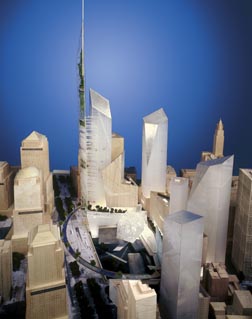
The

plan is centered on the memorial square. The photo at left, looking northeast

from more or less the Wall Street Journal offices in the World Financial Center,

is of the new model, and shows the memorial museum cantilevered over the "memory

foundations", as Libeskind calls them. A series of skyscrapers spirals

up from the foundations, up the ramp which descends parallel to West Street

(the big road nearest us) and around the south, east and north edges of the

site to culminate in the large spire holding the "gardens of the world".

On its 110th floor (the height of the original WTC) is a restaurant and observation

deck, but the memorial and the museum are down at ground level, where no one

needs to worry about being high up in the sky. Libeskind said he was aiming

for "places with intimacy and places with grandeur," and that’s what

he’s given us.

Most of the skyscrapers, it’s worth noting, are not going to be designed by

Daniel Libeskind. And since the lower floors of the signature tower are going

to have some tenants, there could be a lot of changes made from how the buildings

are envisaged right now. "It is now our task to make sure that the plan

you see becomes a reality," said New York governor George Pataki today

– but of course this plan is not exactly what will be built.

Libeskind said that within four years we should have the major public components

– the memorial site and museum, the cultural center, the transit hub,

and the restored skyline. Personally, I believe all of it except for the skyline:

I just can’t see this economy being healthy enough to support the construction

of the tallest building in the world.

I don’t see the federal government stepping in to help, either: the representative

of the president today was a minor functionary called Alfonso Jackson, the deputy

secretary at the Department of Housing and Urban Development. He gave a horribly

tone-deaf speech, wherein he basically tried to claim credit for everything,

as well as to imply that this plan was somehow integrally connected with both

the war on Iraq and Bush’s proposed tax cut. It’s clear that the White House

doesn’t really care about New York, and that the city and state – both

of whom are horribly in debt right now – are going to have to do most

of the heavy lifting when it comes to reconstructing the public areas of this

site. With the best will in the world, I don’t think they’ll quite manage the

skyscraper within four years, although I hope I’m wrong.

But even without the skyscraper, I’m heartened that New York now has a vision

for rebuilding which is both bold and popular. Not everyone will like it, of

course: there isn’t a major new building in the world that someone doesn’t hate.

But this site is going to be a powerful destination, and I predict that it will,

finally, be responsible for turning lower Manhattan into a vibrant residential

neighborhood. People are really going to want to live here!

Finally, a word about the decision. I have to admit I am a little disappointed:

I wanted the Think plan

to win. Where Libeskind is 1990s avant-garde, Think was genuinely futuristic,

with a vision of a vertical city which had never been attempted anywhere before.

But it was watered down over the past couple of weeks, with fewer buildings

inside the latticework towers, and the memorial museum lowered to the 30th floor

or so rather than being up in the 80s. The latticework was also made lighter

and cheaper, which would have meant it would have been much more difficult to

build new cultural elements as and when the funding for them became available.

In short, it was not entirely clear that the Think plan would really work, and

the rebuilding of a large part of the most important city in the world isn’t

the sort of thing which can be embarked upon with less than 100% certainty.

So I’m happy for Daniel Liebeskind, happy for New York, and happy indeed for

Rafael Vinoly and the other members of the Think team, who have surely got as

much of a profile boost from their unbuilt proposal as they could ever have

got from a finished building anywhere else. I can’t wait to see this plan become

reality.

Posted in Culture | 5 Comments

Personal: End of season

It’s the end of the season at Halley. You can feel it in the air. The 14

people who are staying for the winter want us to leave. They want their

home back and the job to begin in earnest. They want the solitude

returned, the politics removed and these lightweight jokers to climb on

the ship and sail off, armed with plenty of photos and stories of

antarctic hardship to tell their loved ones back home. They don’t know

the half of it!

The summer crew are also ready to leave. It’s been a long season, a

busy season and, I think, a very productive one. The base has been

resupplied, a lab has been built, masts erected, buildings jacked, field

campaigns pulled off, ice cores drilled, rocks collected and thorough

maintenance been carried out in every building. Halley will be good for

another winter now. We’re tired and it’s time to go home.

The ship has left and returned. The Weddell Sea science cruise is over

and cargo has been loaded. They’re ready to take us back to the North,

anxious to leave the antarctic oceans and terrible seas.

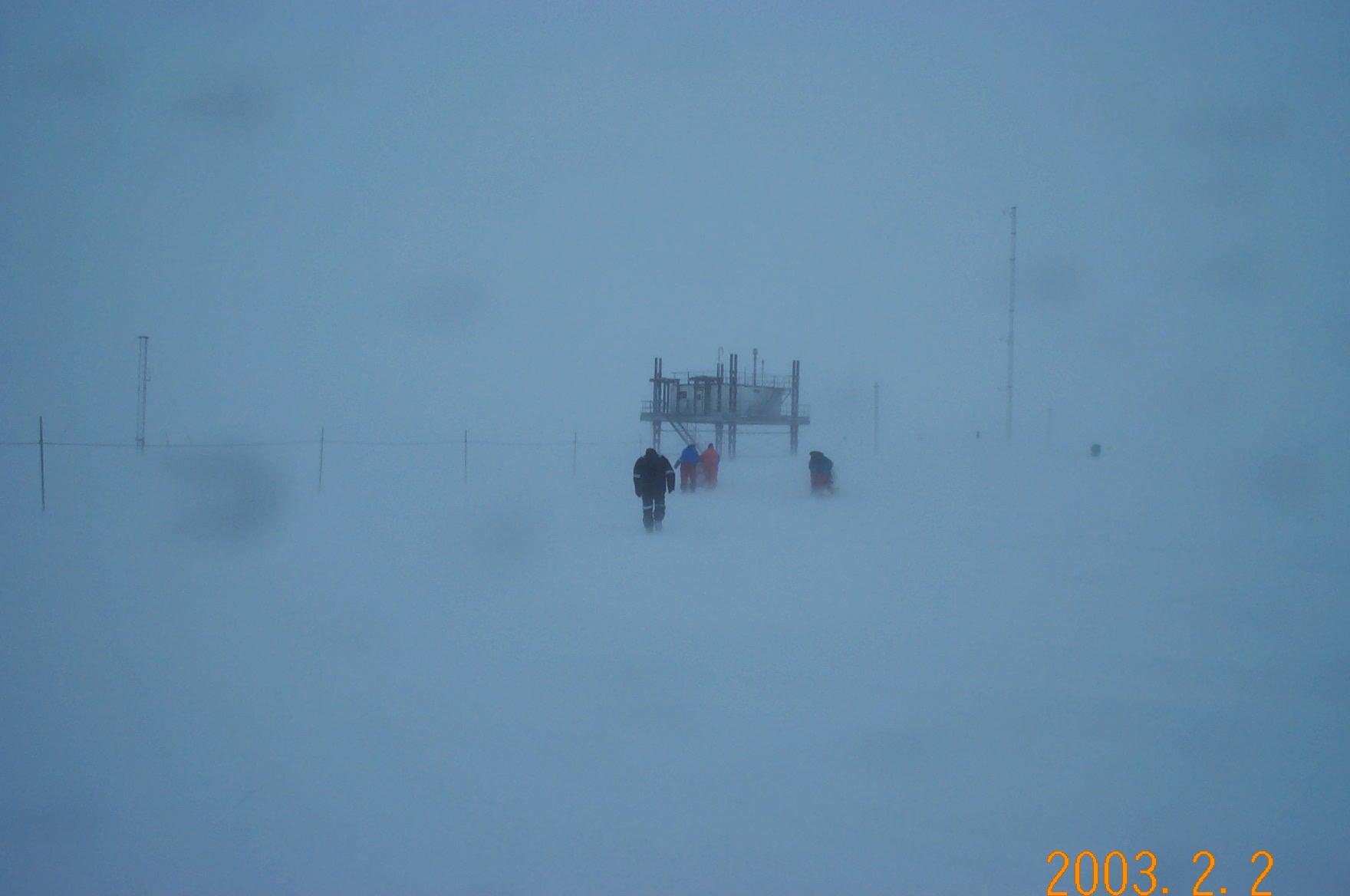
But we are stranded. The weather is the most brutal I have ever seen in

my life. It is the stuff in movies about the poles. Fifty knot winds and

blowing snow, 10m visibility. Howling gale I would call it. I’ve been

banned from visiting my lab. I got knocked over a few times just trying

to walk to a nearby platform earlier. Coming home, I think I flew! I

got frostnip on my cheek yesterday,- most exciting, like a lump of ice

under your skin. And then you realise it is your skin. But recovers very

quickly once a warm hand is put on it. Even past winterers can’t

remember such unyielding winds for days. Frostnip in February! Imagine!

And it was only two days ago that the the sky was calm and beautiful.

No, you don’t understand, words can’t express it. Like a cheesy airbrush

poster from Athena. Pastel pinks and blues and purples in the sky, light

blowing snow on the ground so you can’t tell where snow meets air,

desert gusts. Better yet, the sun has started setting and rising again.

It is utterly magical. Lingers for so long on the horizon, moves around

a bit and then reappears. The whole sky dances with colour. With the

sunset, and reduced light, I saw the moon for the first time in months.

Still no stars but the moon, hanging in the red and orange sky, large

and round, rising upwards in synchronicity with the sun as it set. And

the sky so calm. So calm that Mandy and I slept in a tent on Thursday!

Imagine that now! I can see nothing out of the window next to me.

Nothing but white. Which way is up?

Oh yes, and mirages! I haven’t told you about them. When there is a

strong variation of temperatures with altitude, light is refracted and

reflected within the air layers and moves in mysterious ways. The result

is, and this is no optical illusion, you can see further. (I always

thought that mirages were false, like water in the desert.) You can see

the ocean surrounding this ice shelf that Halley sits on. You can see

huge ice bergs and cliffs. Sometimes, you can see the ship.

Now that I think about it, perhaps it is an illusion. But I guess that

depends your definition of reality. The mirages are real. I see icebergs

that do exist. I see the edge of the ice shelf. Sometimes these things

are upside down: reflections within layers in the air of what is below

them. Like a great big mirror in the sky. So I guess it is an illusion.

But it’s real too. Like the way a dream is real.

And more! I’ve been flying! I sat in the cockpit of a Twin Otter

airplane and flew above this Antarctic continent! Do you know how many

times in my life I have dreamt of doing that? We went on a jolly around

the base, everyone who hadn’t been flying had the chance at some point,

and put this place into some perspective. The weather was dingle as they

say here, perfect. We flew to the creek where the ship dropped us off,

and up the coast. Huge cliffs of ice being eroded away by the sea below.

Waves come flying out from under the cliffs,- exactly opposite to what

they do at home on rock. And so blue. Bright, light, crystal blue below

the water’s surface. And then we flew further up the coast to the

‘Rumples’ that I mentioned before. They’re so small!! The only

significant feature on the horizon of Halley, I thought they were huge

mountains! No. Just a small little rumpling of ice over ice over ice,

stretching and compressing around some fixed feature below. And we saw

the ship from above as well. “Hellooo Shackleton! We’ll be there soon!”

Then we flew inland, to the Hinge Zone: where the ice shelf meets the

mainland. Here we see mountains. Crevasses! Vertical structure! It’s

glorious. Between all these places streches ice and ice and ice, flat,

covered in little patterns of sastrugi. Immense. So expansive. So…so

BIG! Following the line of crevasses and mountains of ice, we make our

way back to the coast again. I have no idea how; my face is glued to the

window. Ice moves so slowly but you can SEE it moving. You can see it

flowing, opposing flows meeting and fighting or pulling away and

breaking, making crevasses. Huge jaws, openings, cracks in the ice.

Movement in three dimensions. This is ice we are living on. It’s huge.

It’s like a snapshot, a still, of wild water.

Back at the ocean, we’re above Precious Bay. This place has everything:

ocean, mountains, penguins..and so close to Halley, the place with none

of this. Flat, white …but we did have a couple of emperor penguins

visit. I wonder how they’re doing outside today. It’s amazing any living

things survive here at all!

And back to base. There it is. A little, odd, randomly placed

collection of structures on steel stilts in the middle of an ice shelf

that’s moving closer to the edge every day.

I don’t know how long I’ll be here. We’re meant to leave any day now.

Held captive by the weather. Helps to put some perspective on this thing

we call life.

Posted in Rhian in Antarctica | 4 Comments

American Airlines sucks

I haven’t had a lot of luck with air travel of late. My flights always seem

to be delayed – and for some reason, when a flight is delayed more than

half an hour, it always turns out to be six hours at least. You lose a whole

day, your sleep patterns get completly screwed up, and, of course, any vague

hint of a bug you might have had getting on to the plane gets turned into a

full-on raging cold by the time you’ve spent 12 hours in a metal tube breathing

stale, fifth-hand, dry-as-dust air.

I’m in Argentina now, and my trip down here is a case in point. The kind of

people who say "you’re lucky" to someone with a terrible injury would

probably say the same thing about me: I was on the last plane out of JFK as

a major

snowstorm was blowing in to New York, and who knows when I might have been

able to leave had the flight been cancelled.

That said, however, the American Airlines experience left a very great deal

to be desired. On an evening when all flights out of the airport were significantly

delayed due to weather, they insisted on boarding us right on time, only to

sit at the gate… and sit at the gate… and sit at the gate a bit longer.

The announcements from the captain were mumbled, short, and unhelpful: something

about engines, power, de-icing, it was not clear at all.

After about an hour, finally a coherent message from the captain. The good

news: we were finally able to leave the gate. The bad news: a couple of standby

passengers who were meant to be on board turned out not to be, and so their

luggage would have to be removed. Of course, they had all the relevant information

an hour earlier, when we were waiting around twiddling our thumbs, but somehow

failed to act on it until the point when we were hopeful we might finally be

able to take off.

Eventually, the bags were found, the plane left the gate, and – I think,

nothing was made very clear to us – we started the first phase of de-icing.

Apparently there are de-icing "stations" at JFK: this is not a procedure,

like refuelling, that can be done at the gate. So various bits of the plane

got de-iced, and then we headed off to station number two, where the wings and

fuselage would get done. Except we never got there. What with heating and lighting

the cabin, and de-icing whatever they de-iced, they’d somehow managed to run

out of whatever battery power they needed to actually move the aircraft. So

we had to wait for another hour while someone could, in effect, give us a jump-start.

Then, the second phase of de-icing took at least twice as long as it should

have, for similar reasons to do with power. First one side of the plane got

de-iced, then the other, instead of them both being done at the same time.

More profoundly, the way we were running out of power created a big problem:

there now wasn’t enough fuel left to get us all to Buenos Aires. The captain

had three choices: cancel the flight, which no-one wanted; lose 60 passengers

to lighten the load; or refuel in Miami. In the end, the choice was made for

him: the crew had spent so long sitting on the ground that under union rules

they weren’t allowed to work the whole 11 hours to BA. So Miami it was.

It was exactly at this point that things really started to go wrong. Once the

flight had been sitting on the tarmac for a certain amount of time, Miami was

a certainty. In fact, the pilot more or less admitted we would have to refuel

there in one of his earliest announcements, while we were still stuck at the

gate. But let’s be charitable and say it took them a couple of hours to put

two and two together. The plane was meant to leave at 10:20, so by 12:20 American

Airlines should have been getting on the phone to Miami, organising a new crew

to replace the JFK crew, and generally attempting to ensure that we wouldn’t

need to spend any more time in Miami than we needed to refuel.

We finally took off, five hours late, at 3:20. The flight was fast and uneventful,

and we landed by 5:15. The crew, by this point, was very annoyed: rather than

working 22 hours New York – Buenos Aires – New York, they would

get paid for only nine or so, for the time spent idling in New York and the

flight to Miami. Still, they told us, not to worry: the American Airlines agent

would be waiting for us at the gate, along with the replacement crew, and we

should be on our way in no time.

Of course, when we get to the gate, there’s no agent there: no one in Miami

seems to have the foggiest notion what’s going on. Eventually, at 6:00, roughly

when we were expected to be leaving, an agent arrived, and seemed most surprised

to see us at the gate. After a bunch of scrambling around, it’s determined that

our nine-person crew from JFK is going to be replaced by a five-person crew

from Miami – they should be here any time. And, indeed, they all turn

up relatively quickly, except for the one who doesn’t. An extra crew member

must be found, which is likely to take an hour or so, and so at this point it’s

decided that maybe we should be let out of the airplane after all. We’d been

cooped up for eight hours, no one knows how long we’ll be stuck in Miami, and

the flight on to Buenos Aires is another nine: even American realised that it

might not be smart to make a 767 with more than its fair share of small children

stay in its seats for something over 18 hours at a stretch.

So we’re told that we can stretch our legs for half an hour. No longer will

groups of no more than four people at a time be accompanied to the phone booths

and back; rather, we can all enjoy the splendours of the American Airlines departure

lounge in Miami at our pleasure.

The departure lounge is a pretty grim place, outfitted with little more than

a Nathan’s hot-dog stand staffed by the surliest people I’ve ever seen in Miami

(although the fact that they were working at 6:00 on a Monday morning might

explain that bit). All the same, it’s an improvement over the interior of our

airplane’s fuselage.

Actually, scratch that. The surliest people I’ve ever seen in Miami weren’t

the hot-dog vendors, they were the gate Nazis. What no one bothered to tell

us when we were deplaning (yes, they really used that word) was that once we

were off, they wouldn’t let us back on again until they were good and ready.

No, they never said why. For me, it was no great hardship: all it meant was

that I couldn’t read my book, which I’d left safely tucked in the pocket on

the back of the seat in front of me. But for others, especially one woman who

had just got up to make a phone call and who had left two children on board,

including a four-year-old, this petty decision had huge consequences.

Everybody was cranky, remember: it was now 7 in the morning, and no one had

got much in the way of sleep. An 11-hour flight is pretty hard work at the best

of times, but now that another seven or eight hours were being added on to that,

most of them spent on board the airplane, people were getting angry. No one

at Miami knew anything; the only thing they told us was that they’d simply arrived

at the airport at 6:00 and really had no idea what was going on, where the crew

was, how many of them there had to be, when we might be taking off, when we

might be landing, or anything else.

At this point, understandably, various passengers decided that they’d had enough.

They were in Miami, which has many flights down to Buenos Aires each day, and

rather than stick around this accursed airplane, they were going to hang out

in Florida for a day or so and then, somewhat rested, continue on to Argentina.

After all, for the elderly or the very young, an 18-hour plane journey is the

last thing you want, and if you can avoid it, you do.

I don’t know whether anybody actually got off at Miami, whether their bags

had to follow them, or what. No one saw fit to tell us peons what was going

on: all we knew was that the 7:00 deadline for us to get back on to the plane

had come and gone, and there was no sign of anything happening. Communication

was nil. The American staff started playing the sorry-we’re-clueless card a

bit too often: sorry, I don’t know. I don’t know anybody who knows. I can’t

help you.

On the plane, it was the same story: people who’d missed dinner on the grounds

that it had been served at 4 in the morning when no one wants to eat were told

that no, they couldn’t have anything to eat, and that actually, I, your flight

attendant, haven’t had anything to eat since last night either. Oh, and no,

I can’t get you immigration cards for Argentina or anything like that, because

the JFK crew put them somewhere and we have no idea where. And in general, sorry

if you have no service on this flight, but you have to understand: we’re very

understaffed.

On arriving at Buenos Aires, we just got the standard "welcome to Argentina

and thank you for flying American" message: no apology for being eight

hours delayed, and certainly no attempt to make things up to us.

This general unhelpful attitude is something I’ve come across before with American

(and I’ve only flown them on two other occasions). I had an American flight

from Los Angeles to New York once, which involved a change at Dallas-Fort Worth.

All flights in and out of DFW were delayed for some reason, but we were assured

that because everyone was delayed by pretty much the same amount of time, there

shouldn’t be any difficulty making our connections.

Of course the story changed when we got to DFW. Sorry, your flight to LaGuardia

has left already: for noise reasons, planes aren’t allowed to land there after

a certain time, so it got bumped up the list. Again, a failure of communication

from one airport to another: while on the Argentina flight it was New York not

communicating with Miami, on the New York flight it was DFW not communicating

with Los Angeles. Of course, if we’d known in LA that we wouldn’t be getting

to New York that evening, we would never have left at all, and rather spent

one more night in California, catching an early flight back to New York the

following day. But because of information failure, we were stuck in Dallas-Fort

Worth overnight.

It got worse, though: American decided/decreed that the reason we were forced

to stay in Texas overnight was weather, not general incompetence on its own

part, and that therefore they weren’t even going to put us up in a hotel. If

we liked, they could procure some army-style cots and maybe a blanket or two

and we could sleep on the floor of the departure lounge.

Cock-ups, of course, happen on all airlines, through their fault or otherwise.

But where other airlines seem to genuinely want to make things better, American

seems to be as unhelpful as possible. Virgin once gave me a voucher for being

delayed, even though they’d phoned me in advance to tell me that the flight

was late and I could turn up a few hours later. Even the low-cost airlines in

Europe, like Buzz, or in the US, like JetBlue and SouthWest, are known for their

customer service. But American seems to have a completely different mindset.

I think that the problem could well be the aftermath of September 11. American

has been inflicting wave after wave of job cuts, and evidently a lot of the

lost jobs have been the people coordinating its different operations around

the country. I worry, too, that others have been in more vital areas: I don’t

think it’s coincidence that the Rockaway

crash happened so soon after September 11, when morale in the airline industry

was at its lowest and thousands of jobs had just been cut.

People are nervous about flying these days, and maybe they ought to be, although

their reasons for nervousness (war, terrorism) are, I think, misplaced. The

chances of an airline passenger being the victim of a terrorist attack are minimal.

But the chances of the same passenger falling victim to incompetencies which

are a result of downsizing following general nervousness about a terrorist attack

are much greater. It’s almost as though being scared of a flying is a self-fulfilling

prophecy: the more people that are scared of flying, the fewer people flying,

the more layoffs the airlines need to make, the less safe flying becomes, and

the more justified a fear of flying is.

Still, I’m going to continue to fly American, just because of their leg-room.

I’m telling you, once we were airborne, I actually managed to stretch out and

get some sleep – in economy! That doesn’t mean I like them, though.

Posted in Culture | 279 Comments

The Oscar nominations

I haven’t seen much in the blogosphere

over recent days on the subject of the Oscar nominations.

I’m a little surprised, since the big news is the way in which New York has

triumphed over Los Angeles. Every Best Picture nominee was produced wholly or

in part by a New York studio, while no LA-based studio received anywhere near

the astonishing number of nominations garnered by Miramax.

The big winner, at least at this stage, is Harvey Weinstein. Whatever happens

on March 23, the Miramax honcho has certainly proved himself the master Oscar

wrangler. That New Yorker profile is rapidly becoming little more than a historical

artifact: nothing succeeds like 40 – count ’em – nominations, including

a virtual lock on Best Picture.

Chicago got 13 nominations alone – that’s only one less than

the all-time record held by Titanic and All About Eve. And

while those two films are old-fashioned dramas, Chicago is what the

Golden Globes call a "comedy or musical" – something Oscar rarely

rewards. Since Annie Hall won in 1978, the only Best Picture which

falls into that category has been Shakespeare in Love, in 1999.

But Chicago is in with a good chance for a fair haul of statuettes

this time around, including the big one. Unlike Lord of the Rings,

which got 13 nominations last year and virtually nothing in the way of actual

awards, it doesn’t smell of spotty adolescents, and doesn’t seek to dazzle with

computer-generated imagery. (Titanic used a lot of CGI, but in a relatively

subtle way, designed so you wouldn’t notice it, rather than so you would.) Chicago

is more old-fashioned, dazzling with lots of glitz and look-at-me camerawork.

Moreover, the slow roll-out for Chicago means that by the time Academy

members are voting, it’s going to be at the height of its box-office success,

stuck front and center in the national consciousness, with a gross easily into

nine figures. Meanwhile, none of the other nominees (except for Lord of the Rings, of course) will have got anywhere near

the critical $100 million mark – something a film really has to achieve

if it’s going to win Best Picture.

The best comment I’ve seen about the nominations so far came from Greg Allen,

of greg.org. "Chicago is to movies,"

he said, "what

painted cows are to art." It’s a great line, but I think what Greg misses

is that much the same can be said of most Oscar winners. It’s not just the embarrassments

like Braveheart or Dances with Wolves which fall into the

category of big-but-superficial. Look at Gladiator: if it can win,

then surely Chicago can.

And if the Academy is too quick to reward actors who turn to directing (see

Braveheart and Dances with Wolves again) it’s also quick to

reward old theatre hands who are making their way into film (see The English

Patient and American Beauty). Chicago is just such a

picture, directed by Broadway veteran Rob Marshall, who has never directed a

feature film before. The Hours is another, directed by Stephen Daldry.

The fact is, however, that neither Marshall nor Daldry is going to win Best

Director. The Academy has been waiting a very long time to give Martin Scorsese

his long-awaited and long-deserved Oscar, and this is its opportunity. Scorsese’s

latest, Gangs of New York, is everything Oscar loves: a big, sprawling,

much-hyped labor of love, with star power (DiCaprio, Day-Lewis, Diaz) to die

for. It got a very impressive nine nominations, including the bizarre

Best Original Screenplay (surely it was adapted from the

book, which has

a big star on the cover saying "now a major motion picture"). And

so there’s a chance it’ll sweep, and pick up more than a buggins-turn gong for

Scorsese. But even if it doesn’t, Scorcese is going to get exactly the same

award that Al Pacino got in 1993, when he finally got his Oscar for Scent

of a Woman, which nobody thought was a particularly good film or a particularly

good performance.

The acting awards, on the other hand, are wide open. I have a funny feeling

that the Academy is finally tiring of giving Jack Nicholson Oscars, and that

this year the award will go to someone else, quite possibly Adrien Brody. My

hunch is that the excellent Julianne Moore will win Best Actress, beating out

Nicole Kidman. Wouldn’t it be wonderful if she won Best Supporting Actress as

well? That would really make my evening. It’s possible, if Catherine Zeta-Jones

and Queen Latifah split the Chicago vote.

The one thing I know for sure is that the second installment in the Lord

of the Rings trilogy has precisely zero chance of winning any major award.

Anybody who would like to reprise the bet

I had with Stefan last year is more than welcome to get in touch!

Posted in Film | 2 Comments

A cruise around the New York blogosphere

You probably didn’t notice, but I recently restructured my website. Entries

which used to have unwieldly URLs like https://www.felixsalmon.com/mt-blogfiles/archives/felixsalmon/000067.html

now have nice simple addresses like https://www.felixsalmon.com/000067.php –

a change which has more than simply cosmetic benefits. Now, I can check my referrer

log for who loves me and who doesn’t.

And it turns out that although I do get a few clickthroughs from friendly people

like 2Blowhards and Lockhart

Steele, the majority of referrals come from search engines – often

search engines which seem to have a very weird idea of what’s on my site.

An MSN search

for "flashing co-eds" brings my site up as number 4 on the list, and

a Hungarian Google search

for "grumpy gits" brings felixsalmon.com up in first place, thanks

to my sister’s use of the phrase in her entry

of January 20. (Why Hungarian Google brings me up where US Google doesn’t,

I have no idea.) There’s even a site called mamma.com ("the mother of all

search engines") which considers

my blog the fifth-best result for someone searching on "look for companies

in kuwait and environs".

The problem is, I’m a New York blogger, and I’d much rather have visitors from

New York blogs than from people looking for flashing co-eds or companies in

the Persian Gulf. The New York blogosphere is particularly vibrant at the moment,

especially since the launch of Gawker,

a site I described

on MemeFirst as "an inside-baseball

New York nanopublishing site". (That, in turn, was enough to get MemeFirst

its third listing on Gawker:

the first linked to a

story of mine about Herbert Muschamp, and the second

was about tall buildings. Since I’m one of the three editors of MemeFirst, that

makes me happy: we could use the traffic.)

It’s thanks to Gawker that I rediscovered Supermodels

Are Lonelier Than You Think, a wonderful fashionistablog which is running

a story today about

an "ethical infraction" by W magazine. Now I’ve written

before about the crazy levels to which Americans will go when they get bitten

by the "media ethics" bug, but this is ridiculous. I don’t know how

serious SALTYT is about this, but here’s the relevant bit:

Apparently W got a lot of ads from companies using Gisele because it had

a giant ed with her — or maybe vice-versa. To neophytes in the magazine trade:

asking advertisers to take advantage of their own model’s appearance is sort

of OK; to decide upon a model’s appearance only by the advertisers contributions

is not. It is an ethical infraction.

The whole piece is so crazy on so many levels that one barely knows where to

begin. For one thing, Gisele is the hottest model on the planet: I hardly think

that W needed any prodding from advertisers to put her on the cover of their

bumper March issue. For another thing, part of the reason that Gisele is so

hot is precisely because she’s doing these scorching spreads for Dior

and Dolce & Gabbana. (Although the Dior spread is actually only 6 pages,

not 10 as SALTYT reports.) Advertisers spend insane amounts of money on their

shoots, and it shows: why do you think Gawker illustrated their story with a

picture of the Dior ad, rather than a picture of the W cover? Because the cover,

by Ines van Lamsweerde and Vinoodh Matadin, is simply not in the same league

as the Dior ad, which I assume is by Nick Knight.

Editorial and Advertising: Which

would you buy the magazine for?

The editorial story with Gisele is perfectly good, and has some pretty sexy

shots (as well as some extremely peculiar ones). But flick on for a few more

pages and you get to the 8-page voyeur-porn Dolce & Gabbana sequence, which

includes one shot of Gisele pointing a video camera straight at her spread-open

crotch while her left breast falls out of her top. There used to be a time when

editorial shoots were more daring than advertising: now it’s the other way around,

and real fashionistas buy magazines much more for the ads than for the edit.

Besides, the whole premise of the SALTYT story is ridiculous. "How came

the Vogue issue with Natalia is full of CK ads, while the W issue with Gisele

is full of Dior, D&G, Balenciaga?" we’re asked. Answer: it ain’t. W’s

D&G and Balenciaga ads (8 pages in total) are buried at the back of the

book, while Calvin Klein has 10 pages right at the front, in prime real estate

before the first contents page.

In any case, there are much more interesting things to worry about right here

on the Lower East Side: namely, That Hotel, as helpfully blogged by Gawker here.

For the past year now, a huge 20-story monster has been rising on Rivington

Street between Essex and Ludlow, and finally the Wall Street Journal has revealed

today what it is to be. The original rumour was that it was going to be a W

(hotel, not magazine – really, can’t you tell the difference between a

hotel and a magazine?) but then people started hearing that actually it was

going to be a Standard, or at least owned or operated by Andre Balazs.

The truth? It’s going to be a Surface. As in Surface magazine. (Evidently, no,

we can’t tell the difference between a hotel and a magazine.) Lockhart Steele

had his own take

on the article up in double-quick time, saying that those $250 rooms will probably

be selling for $79 on Orbitz. I doubt it, myself: we’re in something of a hotel

desert down here, and I think it will do pretty well, both as a trendy high-design

destination and as a useful place for the visiting parents of LES yuppies to

stay.

What Lockhart missed was this bit of the WSJ article:

Mr. Stallings wanted to build a hotel with larger rooms and panoramic views.

But late last year, he met Will Candis, a publicist and former manager of

Hotel 17, a one-time welfare hotel in New York that marketed itself as a down-and-out

experience for young artist-types.

In other words, the vision for the hotel has been scaled down significantly.

Those "larger rooms and panoramic views" are gone; in their place

are smallish "studio-style rooms" which are more affordable in the

present economic climate and which will be sold not on the strength of their

luxuriousness but rather as design destinations with possible marketing tie-in

opportunities. Maybe if Hotel (The Mercer)

is the Old New York, then Surface (The Hotel) – as the new place is rather

cheekily naming itself – is the

New New York after all!

Posted in Culture | 5 Comments

City of God

At the beginning of City of

God, the critically-acclaimed new movie about the slums of Rio de Janeiro,

a young thug in the eponymous neighborhood is showing off his footwork to some

younger kids. As he kicks a football from foot to foot, the kids count along

with him – "11! 12! 13!" – until his friends run up with

the news that a gas truck is approaching. He boots the ball up into the air,

pulls out a gun, and shoots a hole through it as he turns to run off for the

hold-up. The director, Fernando Meirelles, freezes the football in mid-air,

a hole bulging out at its top where the bullet escaped along with the compressed

air inside.

The scene is shocking: the casual violence and gunplay, the way in which an

older hood nonchalantly scuppers a football game by deflating the ball, the

conflation of playful sport and serious crime. But guns are everywhere in this

film, from the very beginning, when a hood pulls a pistol on a runaway chicken,

to the blood-soaked ending. I can’t imagine that five minutes pass at any point

when we don’t see someone brandishing a gun, be it a hardened sociopath or a

six-year-old delinquent.

The anti-hero of the movie, Li’l Zé (Leandro Firmino da Hora) starts

on his life of crime by committing one of the bloodiest atrocities in Rio de

Janeiro history – not an easy task. What’s more, he does it just for fun,

laughing hysterically at the corpses in front of him, men and women who had

already given all their money to his accomplices. Oh, and did I mention he’s

barely into his teens?

But it’s not just Li’l Zé who acts like a character out of some dystopian

comic-book. At times, it seems that a scene can’t end without another character

being killed off, be it by hoods, by the police, by a jealous husband, or just

by sheer bad luck. At the beginning, the violence is shocking, even when all

that’s being shot is a football. By the end, we’re numbed senseless, and the

climactic all-out running street battle barely registers. Many more people die

than in the equivalent scene in, say, Michael Mann’s Heat, but the

sequence is so predictable that by that point we’ve given up caring. Boy becomes

hood, dies: it’s a story we see over and over again, with the only differences

in the details. Not one of the hoods escapes, not one is redeemed. Insofar as

there’s a narrative structure to the film, it exists only to provide enough

space to make sure that everybody dies at some point.

Everybody? Not quite. One boy does make it out of the slums and into a proper

job, due to a string of incredible coincidences. He’s Rocket (Alexandre Rodrigues),

our narrator, who miraculously avoids ever committing a crime, and whose love

of taking photos on the beach turns out to be his ticket out of the ghetto.

He’s the boy who can walk into the City of God with a camera and walk out in

one piece, unlike any of the middle-class journalists on the local daily. Armed

with his street savvy, he knows where the dirty deals are going to go down,

and parlays that knowledge into a magazine cover.

At the end of the film, a new generation of hoods is growing up,

plotting its own senseless killings, filling the vacuum left by the dead. We,

the audience, meanwhile, are not exactly filled with a missionary zeal to go

down to Brazil and save these poor children from their dog-eat-dog upbringings.

(They don’t even have hot running water, you know!) The omnipresent violence

in the film has turned it from an exposé into an exploitation flick,

or at best just another sub-Guy Ritchie gangster movie. (It doesn’t help that

the lead villiain looks astonishingly like one of the big drug dealers in Lock,

Stock and Two Smoking Barrels.) None of the characters are really developed,

with the possible exception of the lead, and the female parts are woefully few and

underwritten.

Part of the problem comes from the fact that the script was adapted from a

sprawling 500-page memoir, covering 30 years in the history of Rio de Janeiro.

In order to turn it into a film, it would seem that everything was cut but the

most violent parts, giving an impression of a slum so anarchic that it’s a wonder

anybody survives it at all. The hoods in this film get into arguments with each

other occasionally, and after a while one’s generally surprised if no one is

dead at the end of a disagreement over the relative merits of marijuana and cocaine. The idea that there is a community, a life beyond crime,

in the favela is completely lost.

That said, City of God has been a very successful and important film

in Brazil. It’s brought the plight of the slum-dwellers to the population as

a whole, and by telling their stories rather than simply demonising them as

evil criminals, it has changed the nature of the debate about how to deal with

the country’s rampant poverty. For that, it should be praised. The acting, too,

is first-rate, mostly from non-professionals plucked from the slums. Would that

many Hollywood actors had the naturalism of these kids!

But as an art-house film in cinemas in north America and Europe, City of

God is a failure. The director bangs too frequently on the same note; the

script has little shape, substance or subtlety; and the dispassionate, documentary-style

nature of the filmmaking leaves us unmoved. More worthy than it is good, City

of God is the type of film whose subject matter makes it hard to criticise.

Everything from the subject matter to the use of untrained actors makes us want

to like this film. But as entertainment, it’s not up to Hollywood standards,

as documentary, it’s too cavalier with reality, and and art, it simply lacks

depth and beauty.

Posted in Film | 2 Comments

personal: Feb 8th, 2002

I haven’t written for a while; the Halley summer season is nearing an end and

I’ve finally been able to start work in the CASLab. Plus, a huge storm is spiralling

above us and the weather has turned truly antarctic. I still love it though.

Howling winds, blowing snow, the snowscape like sand across a desert, flying

past, so dry, not sticking or stopping for anything. Windtails appear, skidoos

are more effort than walking, walking is an adventure in itself. The horizon

occasionally appears as a darker region in a vaguely horizontal smear across

the otherwise white world that starts at your feet and continues around the

sky.

All the bizarre Halley rituals start making sense: pointing vehicles to the

east, building elevated depot lines, tying things down and marking really obvious

huge containers with X’s of wood all around. Today, no-one can see much beyond

the next post in front of them. It’s fantastic. Really wild. I’d love to take

more photos (I did get a couple of penguins shivering up here this morning)

but that involves carrying a camera and removing gloves. It’s hard enough carrying

myself and getting all my clothes on in the first place! This is nothing compared

to the Winter weather, I know, and that’s not putting me off at all. Bring it

on! It’s wild and white and, well, yes, this IS what I came here for even if

it does make doing anything twenty times more complicated.

Rhian and friends manhauling equipment to the CASlab

What can I tell you about this week? I dunno. I feel much more tired writing

this than I have for past entries because I’ve finally started working on the

stuff I came here to do. It’s a good feeling although it was bliss to have few

cares in the world.

Now I get to install machines in the new lab, check flow rates on the pipes,

wonder why fans aren’t working, build whole systems to pull air out of the snow

and capture it in a cannister. It’s a far cry from the land of the faeries where

I’ve been these past couple of months but I still enjoy it immensly. And the

faeries are still there,– flying past the window at ridiculous speeds

with the snow.

I did see some ice crystals last week. Growing on the walls of tunnels that

are 20m under the snow surface. These tunnels were first laid on the ground

(well, ice shelf) when the base was first built, ten years ago. One of this

year’s winterers in fact was here at the time, he built Hally V and has come

back to see how the place has worn over the years I think! (I think the next

Halley web entry will be by him so could be interesting. The most

recent was written by the doctor and should be up for your perusal now I

think. There’s a

bit in there about the blimp that involves some blatant plagiarism from

my last blog so it’ll be easy reading for you..have a look for those of you

who want more science (Jim)!

Anyway..these crystals,– it was pure Narnia. Picture the scene. A hatch.

A harness. Wearing harness, open hatch, clip onto ladder and open trap door

beneath. Start climbing down the ladder. Down and down and down. (Be thankful

for harness.) People had told me about the ice crystals so I had my eyes open.

Until the power cut (only a litttle one). Lights back on again, eyes wide open,

I see tiny crystals covering the walls of this metal tunnel. Very sweet. Snow

seems to fall from above. I reach the bottom of the ladder at last and unclip.

Look around. A tunnel to the left, a tunnel to the right, and a few rooms going

off to the sides. Now this really is adventure story stuff. Famous Five? Scooby

Doo? Winnie-The-Pooh? I’m down a tunnel, I wouldn’t go as far as calling it

a labyrinth of tunnels, but it’s exciting anyway. (I went down there because

that’s where I store the cores of ice drilled from the hole way back when,–

remember?Down there it’s minus 17 so they’re not likely to melt.)

Anyway, here I am, looking for ice crystals. Yes! All around me, tiny little

crystals all over the walls. As I walk away from the entrance point, the individual

crystals start forming clusters on protruding points like nuts and bolts and

joins in the metal. Little ice flowers, perfect symmetry, growing outwards.

Like rosettes. But more cubic. Walking further away the flowers start growing

into each other and now there are fans pointing towards me, all around me, fans

of ice, perfectly straight shards of ice surrounding my head. The tunnel is

probably about six foot in diameter.Or was. I’m crouching now. Why am I crouching?

Oh my, I’m really having to bend my head down to walk through the tunnel..look

around, all around, huge crystals, perfect but crazy and getting longer all

the time. Octagonal spirals, cubes, straight edged fans, trapezoids, you name

it, they’re growing. The occasional weak orange sodium light reminds me of a

streetlamp in Narnia.This is Narnia.

Walked through a little door and found myself in another world, a world of

snow and crystals underground! Reaching to the edge, one single crystal starts

at my finger and reaches past my wrist. How long has it been here? Feels like

an age, must be a century a least. But no, only a decade! The continent that

freezes time. I forget, the buildings I live in are moving at 2m/day! We are

on a moving ice shelf here,- there is no ground, there is no ‘here’. Watching

the GPS change while you stay still is just wierd. Listening to old-comers returning

and exclaiming, “What are the Rumples doing over there? They always used to

be to the North!” The Rumples are a fixed feature where sea-ice meets the main

land, I think. Or where there is land below the ice. Whatever they are, they

don’t move and they are most definitely to the north-west.

I have digressed too many times to bother returning. That’s my signal to sign

off. The ship might sail away from here, with me on it, in as little as two

weeks now so I probably won’t write until then. In the mean-time I’ll be working

in the lab, loving the storm and helping the close-down and packing-up of base.

The winterers can’t wait for us to leave now and us summerers can feel it’s

time to head North. Even if we could all do with just a little more time…

More from the ship. Love from Antarctica. And love from the SNOW.

Posted in Rhian in Antarctica | 2 Comments

The two WTC finalists

The cliché about things designed by committees is going to have to be

rethought. The committee in charge of deciding what’s going to be built on the

World Trade Center site today announced its two

finalists – and they were about as bold and visionary as you could

get. And it wasn’t a committee of avant-garde architects, either: it included

representatives from New York City, New York State and even that epitome of

unimaginative conservatism, the Port Authority of New York and New Jersey. The

decision, it’s worth mentioning, was unanimous.

The committee, in fact, has chastened me into taking one of its finalists seriously.

When I first saw it, I said

that the Think plan for a World Cultural Center was "a crazy idea."

Just for good measure, I added that "This is a flight of fancy, it could

never happen."

Well,

I was wrong. It turns out that the plan, for all that nothing like it has ever

been seen before, is actually eminently practical. The idea behind the World

Cultural Center is to separate culture from commerce: to build around the footprints

of the World Trade Center, but this time filling the space with theatres and

libraries rather than salarymen and offices.

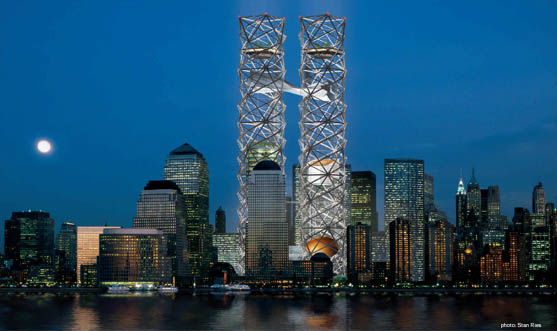
Two latticework towers, the tallest structures in the world, will rise where

the World Trade Center once stood – surrounding, but never touching, the

twin towers’ footprints. At ground level, there may or may not be reflecting

pools, but there will certainly be memorials below grade. High up in the sky,

at the points where the planes hit, there will be another memorial.

The innovative ideas in this project are breathtaking: the fact that wind passes

straight through the latticework, for instance, allows Think to install wind

turbines which will generate enough power to run the whole elevator system.

The engineering is extremely solid, and is designed to stay standing even if

large chunks are vaporised; furthermore, because the latticework is made of

huge steel beams, it’s more likely to break anything crashing into it, rather

than be broken.

These towers are light, in many senses: open to light and the air, they are

tall, but don’t cast oppressive shadows. They also keep the towers of light

which so touched New Yorkers last year: beams can be sent up through the latticework

and up to the heavens, this time exactly where the World Trade Center once stood.

Best of all, this plan, uniquely among the nine shortlisted proposals, would

restore the skyline almost immediately. The latticework towers would start going

up as soon as their foundations were finished, without having to wait for the

New York real estate market to pick up and anchor tenants to be found. The response

I’ve heard most often to the idea of putting towers back on that site is "who

would ever want to work there?" – here, you have the towers, but

precious few workers.

What’s more, even though the concept emphasises the triumph of art over commerce,

there’s still lots of land left over for offices and retail. In fact, the Think

team has kept very much to the spirit of the competition, and simply indicated

where the offices are going to go, without even vaguely trying to show what

they might look like. Larry Silverstein can build what he likes: because the

memorial and the heart of the redesign is concentrated within the area bounded

by Greenwich, Fulton, Liberty and West Streets, everything else in the 16-acre

site can be very close to New York real estate development as usual.

What that does mean is that this plan, almost uniquely among the leading candidates,

has relatively little in the way of parkland or open space. Think has taken

city streets and made them vertical: piling buildings (to be designed by a variety

of architects) on top of each other rather than alongside each other. The space

is up in the sky, not down on the ground. It’s a radically new vision for the

new century, and New York would be the envy of the world were it to play host

to it.

Daniel

Libeskind (I guess I ought to be spelling his name right now he’s a finalist:

I always thought it was Liebeskind), on the other hand, is now in the rather

unusual – for him – situation of being the conservative choice.

I loved his plan when he first announced it, and I still do: it will create

one of the world’s great public spaces, at the center of which will be a very

powerful memorial descending into the ground.

Just how far the memorial will descend is not entirely clear, however. Many

family members appreciated the raw nature of the space, and the fact that the

memorial site would be down in the foundations of the towers, 70 feet below

ground. But that might be impractical, for engineering reasons: the slurry wall,

which is a vital centerpiece of the Libeskind design, was not designed to hold

back the Hudson River without heavy foundations on its eastern side. So the

base of the memorial might have to be moved up a bit, something Libeskind is

fine with.

Either way, the Libeskind design is one of the most coherent and stunning.

The passage out from the bottom of the memorial to the top of the Gardens of

the World, 1776 feet up in the air, will be a magnificent and moving journey.

Moving around the site is intuitive and easy, and the transport hub is extremely

impressive.

Choosing between these two designs will not be easy. I strongly urge you to

check them both out and let me – and the Lower Manhattan Development Corporation

– know what you think. Ultimately, however, I think the final choice is

going to be determined by how much ambition the public sector has.

The Think design is far from being a waste of money. West Street remains just

as it is: for the amount of money that other plans spend on either burying or

covering it, Think can build its towers. And in fact, in many respects the two

proposals are the same: the site and size of the memorial, what to do with West

Street, where to put the transit hub, that sort of thing. As far as land use

goes, the decision has pretty much been made. Nevertheless, the Think proposal

is a lot more expensive than that of Libeskind, who calls his proposal "bargain

basement".

While there might be some private-sector sponsorship of cultural institutions

inside the Think latticework towers, they will still have an up-front cost to

the public sector of many hundreds of millions of dollars. And while the Think

towers would go up very quickly, the Libeskind spire wouldn’t rise until Phase

III, which could be a decade hence, if it happens at all.

So while my original reaction to the plans was to prefer Libeskind to Think,

I’ve now changed my mind. Libeskind is architecture we know: modern, avant-garde

architecture, which can be very good but which isn’t going to change the way

that people think about what’s possible and what buildings can be and represent.

The Think plan, on the other hand, turns whole groupings of buildings into a

living memorial, with books and theatre and dance and vibrancy, something visible

from all over New York, and something which, if it’s chosen, will actually get

built.

Be bold, I say. Think Think.

Posted in Culture | 8 Comments

Space exploration

Anybody with an interest in space exploration has known, pretty much ever since

the Columbia first launched in 1981, that the space shuttle was, scientifically

speaking, a white elephant. It was designed as a workhorse capable of taking

large loads into space on a regular basis, but it never came close to fulfilling

that destiny. Desperate to justify the shuttle’s existence, NASA started getting

its astronauts to perform scientific experiments in space. On the Columbia’s

last mission, the experiments included taking photos of dust and watching how

bugs get on in zero gravity. None of this was interesting or important, and

no one even pretended that it was.

So when people say

that the space shuttle ought to be scrapped because unmanned space flight is

cheaper and more scientifically useful, they’re basically doing little more

than repeating what’s been said for decades. They’re also missing the point:

the shuttle was never designed primarily as a scientific research device. Whatever

scientific knowledge that can be gleaned from spaceflight is an ancillary benefit.

I’m reminded of my sister, sunning herself (24 hours a day) in Antarctica right

now, on a hugely expensive scientific project which, while useful, is only

funded because of the UK’s geostrategic claims on the continent. Britain needs

a presence there, and scientists are a great way of establishing that presence

without any kind of belligerence. Remember that just as most astronauts come from the

military, Antarctic bases are usually run by military officers.

The reason why the Columbia disaster was huge news all over the world was not

because seven people died, and it was certainly not because the disaster might

have marked the end of any project of scientific research. Rather, humanity

identifies with the desire to conquer new territories, to explore our world

and its environs to the very limit of our abilities. That a man has walked on

the moon causes wonder even today; that a man hasn’t walked on the moon in decades

is evidence of the fact that doing so is of only the most marginal scientific

interest. When Columbia broke up on re-entry, the dreams of millions of people

around the world crashed back down to earth with it. (Think of when Lady Di

died: people mourned not an individual death, so much as everything she stood

for.)

But just because the space shuttle is a powerful symbol of America’s strength

and humanity’s quest for the heavens is no reason not to scrap it. The best

piece about the shuttle written in the aftermath of the Columbia disaster is

a short

essay in Time magazine by Gregg Easterbrook, titled The Space Shuttle Must

Be Stopped. Easterbrook clearly lays out why the shuttle is a flying anachronism,

worth billions of dollars to what used to be called the "military-industrial

complex" but fundamentally an answer without a question. You want manned

space flight? Fine. Safer, cheaper space vehicles could be built if the space

shuttle programme were scrapped, but it’s got so much political and economic

inertia that its abolition and replacement is almost impossible.

It’s pretty hard to imagine a bigger waste of money than the space shuttle.

Each launch costs half a billion dollars, a hundred times more than the launches

were originally meant to cost once the programme was up and running. Its primary

purpose is to build the International Space Station, whose own primary purpose

is to provide something for the space shuttle to do. The space station has already

cost $35 billion; the cost of its crew’s bottled water alone is almost half

a million dollars a day.

The really annoying thing is that all of this money-burning is actually hindering,

not helping, space exploration. If we’re interested in exploration at all, what

we need is an easy, cheap and safe way of getting into orbit. The shuttle, of

course, is none of the above. If the US government were to put its efforts into

developing such a transportation system, then it’s even possible that the private

sector would step in and help take things to the next level. But the space shuttle

and the space station are like huge vacuums, sucking up all available government

funds, and leaving nothing left over to modernise or rationalise humanity’s

adventures in space.

The US, it seems, learned nothing from the Challenger disaster in 1986. It

kept on running the shuttle programme regardless of its obsolescence, and has

essentially spent the last 17 years marching down a dead end. It’s time to stop

throwing good money after bad, and to start asking why we’re doing this at all.

The half-finished space station can be kept as a memorial to the hubris of the

USA and the avarice of its contractors; the shuttle itself, like the Apollo

programme, can then be remembered as something which sparked the imagination

of billions rather than as a white elephant with a nasty habit of killing astronauts.

The quest to put men into space is noble. The desire to keep the space shuttle

flying is not.

Posted in Culture | 11 Comments

The new New York

New York is changing. It’s getting smaller, friendlier, less corporate, less

ostentatious and maybe even a little bit more geniune. The stock-market bubble

has burst, the economy is turning rough, and people are less interested in what

you do, more interested in who you are. That’s my take, anyway. Others are less

upbeat, with the New York Post declaring

that my neighbourhood has been "jolted" by a crime wave of late.

I, however, feel just as safe here as I always have, and certainly the boutiques,

restaurants, bars and other signs of gentrification continue to open up apace.

One of the more recent such additions to the East Village scene is Sen,

a new restaurant on Avenue C which Michael Blowhard calls

"nouvelle-Asian". I don’t really know what that means; as far as I’m

concerned it’s Vietnamese, but mercifully free of the formica tables and fluorescent

lighting that most Vietnamese restaurants suffer from. There’s not even any

bamboo!

On the other hand, seeing as how the people behind this place also had a hand

in the likes of Sushi Samba and BondSt, Sen is blessedly attitude-free. You

can come in here not wearing black and feel perfectly comfortable; the waitstaff

is friendly and not oppressively beautiful; you don’t need to navigate your

way around doormen or Blahnik-clad maitre d’s. Now, if only they’d put their

name somewhere on the restaurant, it would be perfect. Like Smith

(RIP), the only time you ever see the name of the restaurant is on the credit-card

slip.

Actually, Smith’s demise is another indication of the new New York. Its replacement,

Starfoods, remains

a little bit fashionista but has lost a lot of Smith’s attitude. The food is

meatloaf, not rabbit ravioli; the waiters wear t-shirts, not designer duds.

Local tagger Pork has done a mural on the front wall. Most importantly, the

diners are having a good time on a relatively tight budget, rather than attempting

to be seen on an enormous one.

Sen’s the same. I ordered a whole curried fish for $19 which was pretty much

the most expensive thing on the menu. That would get you a couple of bites of

(exquisite) sushi at BondSt. The fish (red snapper, the day I went) was perfect:

crunchy on the outside, deliciously tender on the inside, and covered in the

kind of spices which make you wake up and tingle.

Sen has a certain amount of fusion food on its menu too: I’m particularly fond

of the frogs’ legs and the quail, both of which are available either as starters

or mains. On the more traditional side, there’s ironpot chicken or some great

curries. And the restaurant certainly has fun on the sake front: three different

infusions, including lemongrass and passionfruit, as well as an extensive menu

of excellent cold sakes. (Beware: these can be very expensive indeed if you

have a few of them: I can highly recommend the Masami, but it’s $11 for a pretty

small glass.)

The one thing I’d avoid is the desserts, even if a pastry chef from Jean Georges

did consult on them. As in nearly all Asian restaurants, they simply don’t work:

avocado ice-cream is not a good idea.

But if you live in the East Village, you don’t go to restaurants for your ice-cream:

you go to Il Laboratorio del

Gelato on Orchard Street. You knew that, right? It’s one of the few success

stories south of Delancey Street: the big six-lane road coming off the Williamsburg

Bridge is a formidable barrier to have to cross, but we’ll do it for ice cream

this good.

Is Il Laboratorio the new New York? Very much so. The owner, Jon Snyder, founded

Ciao Bella and then sold it before

it became the huge business it is now; his latest project is much smaller, and

even more artisanal.

There’s lots of this sort of thing going on: the road on which I live, Rivington

Street, is filling up with small art galleries showing interesting work without

Chelsea attitude. (That said, it’s also home to a monstrous new

hotel, which is definitely, and defiantly, Old New York. For what it’s worth,

my sources say the same as Lockhart Steele’s: that it’s not going to be a W,

it’s going to be a Standard. Either way, it’s going to be extremely yuppie.)

Even websites are getting smaller and cooler. The latest must-visit New York

weblog is Gawker, a veritable cornucopia

of guilty pleasures which was started on a shoestring budget by Nick

Denton and Elizabeth Spiers,

both formidable bloggers in their own rights. Lockhart Steele makes frequent

appearances, as does Aaron Bailey. But Gawker’s

more than just another blog: it’s actually an attempt to make money. It has

a cool and pared-down listings section every day (just one or two things really

worth knowing about) and tries to keep up with media gossip. (Today, for instance,

it managed to link to Radar magazine’s website

long before Romenesko

did.)* It also has some original reporting of its own, such as the truly great

interview with a drug-addled

Wall Streeter entitled "The Quest for the Perfect Coke Dealer".

Gawker is the new New York, then, in the way that dead old websites like New

York Sidewalk and New York Today were the old New York. Or look at alt-publishing:

Russ Smith, the founder and proprietor of the New

York Press, sold out to a couple of gay-press publishers who fired two editors

in as many weeks and brought in someone who was last seen editing an expat rag

in Prague. I doubt we’ll be reading much about Smith’s Concorde flights any

more.

I hope the new New York lasts, that my adoptive hometown can become somewhere

amenable to non-millionaires again. The city is going through a very nasty budget

crisis, and I’m sure there’s going to be a lot of negative equity in this town

when the housing bubble bursts, but every cloud has a silver lining. Look at

Buenos Aires: I’m told that in the wake of the economic crisis there, the city’s

cultural life has only got more vibrant. People who used to be obsessed by making

money are now unemployed and making art instead.

Here’s to the Small Apple!

*Actually, I’m wrong about this. Romenesko had a link to Radar on Thursday, almost a full 24 hours before Gawker. Sorry, Jim!

Posted in Culture, Restaurants | 3 Comments

Bush on Iraq

After the build-up, the

speech. And, against all my expectations, Bush played a blinder: he actually

lived up to the hype. The awkward Bush of the Presidential campaign, with his

bizarre pauses in the middle of sentences and omnipresent smirk, has disappeared

entirely. In his place is – finally! – a true global statesman,

someone at least on a par with his father.

The beginning of the speech was tough for a liberal like me to sit through:

the disingenuous statistics about the size of the tax cut, the claim that the

repeal of the dividend tax would help "nearly 10 million seniors".

But it was delivered with strength and conviction, and, at least from where

I was sitting, was received more with sorrow than with anger.

Then came the humanitarian stuff: $450 million for mentoring at-risk children,

$600 million for treating drug addicts, and – the big one – an extra

$10 billion, on top of $5 billion already pledged, for fighting AIDS in Africa.

The AIDS passage, especially, was genuinely moving, both on an emotional and

on an intellectual level. Bush obviously feels compassion for Africans with

AIDS, and he also realises that this kind of gesture does an enormous amount

of good for the image of America in the eyes of the rest of the world. $10 billion

is a tiny sum compared to what the coming war will cost, and I’m sure that a

lot of that money will go straight to US drug companies and will do very little

for African economies. But it will do wonders for African lives, and that’s

a great thing.

Using the humanitarian programmes as the segue from the domestic to the foreign

part of the speech was a good idea. But it didn’t really work in practice: the

jump from fighting AIDS in Africa to fighting terrorists around the world was

abrupt and painful. Suddenly the compassion was gone, and the cowboy was back:

All told, more than 3,000 suspected terrorists have been arrested in many

countries. Many others have met a different fate. Let’s put it this way, they

are no longer a problem to the United States and our friends and allies.

This kind of talk goes down very will in Middle America, but the audience in

the Wash-Bos corridor and in Europe was not half as impressed. Osama bin Laden

was conspicuous by his absence: rattling off a list of "a key Al Qaeda

operative in Europe, a major Al Qaeda leader in Yemen" is going to convince

nobody that the war on terror is being won.

But then came the grand finale of the speech – the moment we had all

been waiting for – and Bush was good.

Today, the gravest danger in the war on terror, the gravest danger facing

America and the world, is outlaw regimes that seek and possess nuclear, chemical

and biological weapons. These regimes could use such weapons for blackmail,

terror and mass murder. They could also give or sell those weapons to terrorist

allies, who would use them without the least hesitation.

This is sterling stuff, in a speech. We all know, intellectually, that Pakistan

and North Korea are both much more likely to sell weapons of mass destruction

to terrorists than Iraq is. But that’s no reason in itself not to act against

Iraq, and in terms of rhetorical ramping-up, Bush was doing a very good job

indeed. His words were slowing down, and his seriousness showed: no smirks here.

In an implicit acknowledgement that the "axis of evil" phrase that

he used last year was counterproductive, Bush addressed North Korea and Iran

with the statement that "different threats require different strategies."

There was nothing interesting or useful on North Korea: he seemed to be threatening

them with "isolation, economic stagnation and continued hardship,"

which is something they’ve surely grown used to by now. But he didn’t dwell

on Iran or North Korea. Rather, he moved swiftly on to Iraq. The naive, angry

and somewhat inchoate post-9/11 Bush of 2002 has become a focussed and determined

Bush in 2003:

A brutal dictator, with a history of reckless aggression, with ties to terrorism,

with great potential wealth will not be permitted to dominate a vital region

and threaten the United States.

Yes, Bush is saying, this is a war about oil. (That’s what "vital region"

means.) But just because it’s about oil doesn’t mean we’re wrong to wage it.

After all, Saddam has a lot of chemical and biological weapons which he can

give to terrorists at any time. We in the US even believe he’s still trying

to operate a nuclear weapons programme.

And then came the nut graf of the whole speech:

Year after year, Saddam Hussein has gone to elaborate lengths, spent enormous

sums, taken great risks, to build and keep weapons of mass destruction. But

why? The only possible explanation, the only possible use he could have for

those weapons, is to dominate, intimidate or attack. With nuclear arms or

a full arsenal of chemical and biological weapons, Saddam Hussein could resume

his ambitions of conquest in the Middle East, and create deadly havoc in that

region. And this Congress and the American people must recognize another threat.

Evidence from intelligence sources, secret communications, and statements

by people now in custody, reveal that Saddam Hussein aids and protects terrorists,

including members of Al Qaeda.

Actually, Bush kind of rushed through that last bit. I heard it, wondered if

he’d really said what I thought he’d said, and kept on listening. I don’t think

Bush really punched it with the weight it needed. But maybe that’s because it’s

a bit of a fudge: Congress and the American people must recognise that Saddam

is protecting Al Qaeda, but the US isn’t going to actually divulge any evidence

that that might be the case.

Many in Europe, and some in America, will be skeptical: we remember Nayirah

from the first Gulf War, tearfully telling of Iraqi soldiers brutally pulling

babies from incubators and leaving them to die – all of which, of

course, was completely made up.

This time, however, we have proxies, people who can demand to see the evidence

themselves. For, in the shock announcement of the evening, Bush declared that

The United States will ask the UN Security Council to convene on February

the 5th to consider the facts of Iraq’s ongoing defiance of the world. Secretary

of State Powell will present information and intelligence about Iraq’s illegal

weapons programs, its attempts to hide those weapons from inspectors and its

links to terrorist groups.

I sincerely hope that this means the US has some serious goods on Saddam Hussein.

If it does – if Powell can convince the French, at least, that Saddam

has been hanging out with Al Qaeda, and can give them weapons of mass destruction

at any time – then maybe the war, which now seems inevitable, could be

waged with international backing, rather than simply being taken by the rest

of the world as yet another example of US imperialism.

Bush wasn’t done at this point: he needed a neat rhetorical flourish ("As

we and our coalition partners are doing in Afghanistan, we will bring to the

Iraqi people food, and medicines, and supplies. And freedom") and some

militaristic drum-banging (the "America believes in you" message to

the armed forces got the most applause of the evening). He also ended on a religious

note which sounded horrible to this atheist, but which I’m sure played very

well in most of America.

But in toto, the speech was a resounding success. Bush built on the

hawkishness

of Wolfowitz, and the internationalism

of Powell, and came up with something bigger and better than either: a sense

of strength, resolve, and (we hope) global leadership. I still don’t want a

war in Iraq: nothing that Bush said could make me change my mind on that. But

at least I can hold out some hope today, which I didn’t have yesterday, that

Bush might be able to rally his European allies around to his cause. And a war

with Europe’s backing is vastly preferable to one without it.

Posted in Politics | 5 Comments

personal: atmospheric antarctic science

So you’re all asking about science, I get the hint!

Not my favourite topic (especially amongst friends), as you know, but, just

this once, I’ll try and tell you what I’m doing here. Or meant to be. For those

of you who haven’t already been put off by the title of this blog.

It’s actually been very humbling being here and seeing the degree of support

and infrastructure that is dedicated to Antarctic scientific research. There

are whole huge debates, I know, about whether Antarctica should be dedicated

to “peace and science” as it is or whether tourists, artists, musicians, adventurers

etc should be allowed more access. And I wouldn’t be arguing in support of the

scientists necessarily. Still, this is the way it is right now and I certainly

am glad to be working in the area that has enough clout in today’s world to

keep a military presence out of Antarctica and, for now, to be hindering the

exploitation of mineral resources here. Had this continent been dedicated to

“peace and the arts”, who knows, I may have studied drama after all.

So it’s really important to be doing ‘good’ science. The people who work here:

the chippies and sparkies and plumbers and steelies and chefs and genny-mechs

and vehicle folk… their jobs all exist in the name of science support (although

yes, I know, we’re ultimately here for political reasons). And although they

are all here for their own personal reasons, just as I am, they also need to

believe in the work that is happening here, just as I do.

Which is where I struggle since although I’m a scientist (or perhaps because

of it) I struggle with the moral high ground that science often pulls, not to

mention many of the very suspicious experiments that have been justified ‘in

the name of science’. I know, you’ll tell me about electricity and medicine

and bridges and vehicles and all these other things that have evolved through

scientific investigation and without which we wouldn’t do very well these days.

Plus I am a bit daunted by the idea that this ‘good science’ is being entrusted

into the hands of people like me. Those of you who know me may well also worry.

So how do I justify my science? It all goes back to climate change. Really.

For a long time ice cores have been used to try and gain some understanding

about past climates. If we know about past climates, then we might be better

able to predict future climates or, at the very least, appreciate whether recent

dramatic changes in the climate are likely due to man’s influence or merely

are part of a cycle that has ancient timescales.

Snow falls on the ground. It is light and fluffy and full of air. As more snow

falls, this earlier snow settles and becomes more compacted. With time, the

weight of snow above it becomes so heavy that it starts turning into ice. Any

air that is mixed in amongst the snow becomes trapped in bubbles in the ice.

Centuries later these bubbles become even more compacted and the ice is totally

translucent, ancient, a memory, like fossils and lake sediments, of days when

dinosaurs walked this planet. (A pilot was telling me just the other day over

tea about one place in Antarctica covered in whole fossilised dinosaurs.)

Unlike dinosaur fossils, the ice has a timescale, depth, which can be used

to understand not only what ancient climates were like but also how it has changed

with time. The ice is not just water, the trapped air is not nitrogen, oxygen,

carbon dioxide and argon. There are other chemicals and particles that might

suggest the presence of forests or deserts. More recent ice shows a record of

lead from petrol, and then it reducing again when unleaded fuel was introduced.

And around the time of industrialisation it looks like methane and carbon dioxide

concentrations soar. And so, it seems does the temperature of the planet. Obviously,

temperature can’t be measured directly from the ice..but the ratio of different

isotopes of oxygen trapped in air can tell you about temperature. It’s all proxy

data you see,– it’s all theories and assumptions but it does also seem

to be in agreement. And this is the basis of a sound scientific theory.

The problem is, we are making a massive assumption that once the snow falls

to the ground, all light and airy, the chemical compostion of the air doesn’t

change. It just gets pushed deeper and deeper and eventually trapped in bubbles

in ice until thousands of years later some random scientist drills a very deep

hole, takes a slice of ice and analyses the air that is trapped within it.

It’s a fairly sound argument once the air is trapped. However, you and I know

full well that no small layer of snow is going to stop air from diffusing upwards

and downwards and, quite frankly, wherever it’s warmer (if it’s cold) or colder

(if it’s warm). And on its travels it might pick up molecules from the clouds

and deliver them to the snow or molecules in the snow and free them into the

open atmosphere. It’s all physics. And chemistry. Maybe maths. It doesn’t really

matter what it is, it doesn’t care even if we do. I’m no glaciologist as you

know so the above story is a massive simplification. And I’m not patronising

you,– I really know little more than this (but I’m learning).

What I do know is that to truly understand the record of molecules trapped

in air deep, deep down in the ice, we need to understand what happens to air,

and more importantly, the various molecules in it, between the surface and the

trapped bubbles. Which is why I’ve been employed as an atmospheric chemist.

And why I’m drilling holes (to probe chemistry in the snow) and flying blimps

(to probe chemistry in the air). Oh yeah, and why, next year, we’ll be firing

a laser out of the east window of the CASLab,- the one with the stunning view.

That’s to monitor absorption of light from different molecules in the air. Not

as star-trek as earlier blog-readers might hope but still pretty cool. I was

peering out that window just the other day when I’m sure I saw a morris minor

kite contraption heading off to the pole….

More details on that stuff, if you’re interested, anon… hope you’re all well,

and thanks for keepiong the emails/blogs aflowing.

Posted in Rhian in Antarctica | 7 Comments

Zakaria on Iraq

Fareed Zakaria, one of the best commentators on international affairs, has

now written a very peculiar column

in favour of a war in Iraq. He runs through all the reasons why it could be

a disaster (Saddam torching oilfields, provocation of a terrorist attack with

Iraqi weapons of mass destruction) and then says "The risks are real. But

so are the potential benefits."

After listing a few of these benefits, Zakaria concludes that "There are

always risks involved when things change. But for the past 40 years the fear

of these risks has paralyzed Western policy toward the Middle East. And what

has come of this caution? Repression, radical Islam and terror. I’ll take

my chances with change."

There are two major problems with this line of argument. The first is that

Zakaria’s list of "potential benefits" is incredibly overoptimistic.

Consider this one:

The cause of radical, violent anti-Westernism—the one ideological trait

that is shared by both Saddam and the Islamic fundamentalists—would

be dealt a severe blow. Osama bin Laden once said that when people see a weak

horse and a strong horse, they naturally want to side with the strong horse.

No one will want to side with a dead horse.

Huh? Is Zakaria saying that the terrorists who flew into the World Trade Center

considered the USA to be a weak horse and Saddam Hussein to be a strong one?

If they were going after weak targets, why didn’t they attack Belgium? It

seems much more likely that anti-Westernism would be bolstered by the unprovoked

US invasion of an Arab country than that it would be "dealt a severe blow".

Or this:

If oil prices stay low, over time the pressures for reform could build even

more. The regimes of the Middle East—most of which are nondemocratic

and nonperforming—will find it increasingly difficult to stay in power

if they don’t open up. In short, if oil goes to $10 a barrel, the Saudi

monarchy goes to Majorca.

True, oil prices could drop in the wake of an Iraqi invasion – provided

that Iraq’s oil wells haven’t been torched, and that the new Iraqi regime doesn’t

join OPEC, both of which are far from foregone conclusions. And it’s also true

that a plummeting oil price could deal the death blow to the Saudi monarchy.

But what basis has Zakaria for assuming that some kind of people’s regime in

Saudi Arabia would be any less dangerous than the one we have right now? The

Saudi monarchy are allies of the US, while most of the population hates the

Great Satan. If Islamists can win elections in Turkey, what kind of hardliners

would end up running Saudi Arabia? Who’s to say that they wouldn’t use their

petrodollars to develop their own WMDs on a timetable much faster than the likes

of Pakistan and North Korea could ever dream of?

Zakaria’s point is that democracy and economic vitality are good things, that

they might be consequences of a war on Iraq, and that the Middle East has suffered

too long under the current repressive regimes. But even if he’s right, and change

would be destabilising in a good way rather than in a bad way, he still hasn’t

really made a case for a pre-emptive invasion of Iraq.

There are lots of places where change would be a good thing: nearly all of

sub-Saharan Africa for starters. In Venezuela, the stand-off between the democratically-elected

president and his ruling-class opponents has almost destroyed the economy. In

North Korea, the totalitarian regime really has destroyed the economy. Yet in

all these places, the US accepts that it does not have a mandate for enforcing

change.

In fact, as recently as 1991, the US accepted that it had no such mandate in

Iraq. Back then, Saddam Hussein was a much greater threat than he is now: as

Nicholas Kristof points

out in the New York Times today, the UN destroyed much more Iraqi weaponry

during the duration of the inspections regime from 1991-98 than the US did during

the Gulf War. Yet even with Saddam Hussein being months away from having a nuclear

weapon, George Bush the elder did not push for regime change, accepted the norms

of international law, and left the Iraqi government in power.

The decision to stop the war with Saddam Hussein still in power was, says

war skeptic Norman Schwartzkopf, "probably the only decision that could

have been made at that time." Yet now, we are told, everything has changed,

and the American imperium has conferred upon itself the right to go barging

in to one of the most geopolitically fragile regions on the planet with its

fingers crossed that everything will turn out all right in the end.

But the US plainly does not have the support of the international community

in this endeavour. Zakaria makes the good point that in the case of the countries

of the Middle East, that’s probably because the ruling elites have the most

to lose from any growth in democracy and freedom. But that argument doesn’t

wash in the case of Europe. And without European support, a unilateral US action

would only redouble the anger and resentment that the rest of the world feels

towards America.

It is entirely possible that invading Iraq will be a good thing, with positive

consequences. (Of course, the opposite is true as well.) But the ends do not

justify the means. Sometimes we must stop short of doing good, just because

we’re not allowed to.

Posted in Politics | 2 Comments

Powell on Iraq

It’s obviously the season for major speeches from the Bush administration.

Last Thursday, Paul Wolfowitz gave a very

hawkish address to the Council on Foreign Relations, and tomorrow George

W Bush himself will give his State of the Union address, which Elisabeth Bumiller

says is

"the most historically important State of the Union speech that any [former

White House speechwriter] can remember".

In between, yesterday, we had Colin Powell at Davos. Certainly, when it came

to Iraq, it was hawkish, and that was what was picked up on by the headline

writers. "Powell, in Europe, Nearly Dismisses UN’s Iraq Report," says

the New York Times, with sub-heads reading "Says US Can Fight Alone"

and "He Sees It as Useless to Give More Time to Inspectors". The Wall

Street Journal takes a similar stance: "Tough Message," it leads,

followed with "At Davos, Powell Pushes Back Against Resistance Over Iraq",

and "Secretary of State Says US Deserves Trust of World, But Nation ‘Will

Lead’". Then comes a full-colour list of "Powell’s Punches,"

quotes from his speech:

  • "When we feel strongly about something, we will lead. We will act even

    if others are not prepared to join us."

  • "Multilateralism cannot become an excuse for inaction."
  • "We continue to reserve our sovereign right to take military action

    against Iraq alone or in a coalition of the willing."

This attitude makes sense, in the light of Powell’s position. He has already

been very publicly undermined by France, Germany and Russia, all of whom have

indicated that they would veto any UN Security Council resolution authorising

war on Iraq. At the same time, the White House and the Pentagon are making it

crystal clear that they intend to go to war, with or without the support of

the "Axis

of Weasel".

Powell is generally seen these days as a beleaguered internationalist in the

Bush administration, working alongside Tony Blair in a desperate attempt to

bring the rest of the world in line with what Cheney, Rumsfeld and Bush have

already decided they are going to do. But he is also an old soldier, and the

author of the Powell Doctrine of overwhelming force. He knows that war is going

to happen, it would seem, and he knows that if you’re going to wage war, you

can’t do it half-heartedly. Hence the speech in Davos, the Iraq portions of

which can basically be summed up as "You don’t like what we’re doing? Well,

screw you, we’re right, you’re wrong, and we’re going to do it anyway".

But what’s this? The WSJ story is continued on page A6, where we see the headline

"At Davos, Powell Tries to Mend Rift with Allies". And although you

won’t see a lot of evidence of that in the Journal’s own story, you will see

it in the speech itself. Most of the speech, it turns out, wasn’t about Iraq

at all. First of all he rattled off a list of places – Afghanistan, Bosnia,

Kosovo, Macedonia, Kuwait, even the whole continents of Africa and Latin America

– where, he said, "we seek nothing for ourselves other than to help

bring about security for people that have already suffered too much". Indeed,

America did the same thing for Europe in the aftermath of World War II, he said.

Then, after the Iraq passage, he moved on to North Korea, and said something

it’s hard to imagine coming out of the mouth of the president: "the United

States has been the world’s biggest donor of humanitarian assistance to North

Korea and we will continue to contribute to their humanitarian requirements

and needs".

He even tried to strike an optimistic note with regard to the Palestinian question,

saying that "the creation of a democratic, viable Palestine is possible

in 2005". (Although seeing as how he asked the impossible from both sides

– a "new and different leadership" for the Palestinians, and

economic aid for them from Israel – I’m not holding my breath.)

And he ended on an internationalist note which would have been boilerplate

in the Clinton years but which is welcome coming from the Bush administration:

We understand full well that whatever we can do, whatever we can do as one

nation, is nothing compared to what we all can do if we unite, if we become

part of a great partnership of freedom-loving nations, nations that are committed

not only to our own development, but nations that are committed to the hungriest,

most desperate people anywhere in the world.

For sure, this kind of grandstanding is not going to change anyone’s mind on

Iraq, and indeed it’s not going to convince anyone that the US is actually committed

to strengthening any kind of international institutions. But it does go down

well with the assorted internationalists at Davos, and does help create a feeling

that although Europe and America might disagree strongly on Iraq, they’re still

ultimately allies, committed to the same ends if not the same means.

That’s something which has been in doubt in recent months. As US imperialism

and unilateralism has expanded, Europe has seen America – and America

has seen itself – as a global hyperpower, a hegemon above international

law, a country with a worldview at odds on many levels with that of Europe.

Robert Kagan’s Power

and Weakness is just one of many essays which have been appearing of

late, trying to examine a phenomenon which Timothy Garton Ash characterises

in the latest New York Review of Books as America’s "Anti-Europeanism".

Whatever else you might say about Powell’s speech in Davos, it was internationalist

in tone, and showed no hint of anti-Europeanism. It took issue with Europe’s

stance on Iraq, but more in the spirit of friendship than enmity. Here’s the

key passage:

Henry Kissinger, decades ago, wrote a book on the Atlantic alliance, and

he called it "The Troubled Partnership". I am told that later Henry

had second doubts about the title when he found that some bookstores were

placing it on the shelf reserved for books about marriage counseling. But

maybe the bookstore owners knew what they were doing, because problems with

some of our friends across the Atlantic go back a long time, more than two

centuries by my count. In fact, one or two of our friends we have been in

marriage counseling with for over 225 years nonstop, and yet the marriage

is intact, remains strong, will weather any differences that come along because

of our mutual shared values.

In the same speech as some of his most hawkish statements to date, then, Colin

Powell went out of his way to try to keep the marriage together. That’s important,

considering that from all their public statements, the likes of Cheney, Rumsfeld

and Wolfowitz would be perfectly happy with a divorce. Let’s see what Bush says

about Europe tomorrow: this really could set the tone for transatlantic relations

for the foreseeable future.

Posted in Politics | Comments Off on Powell on Iraq

AOL Time Warner and publishing

Once upon a time, business visionaries could look at companies as diverse as

AOL and Time Warner and see synergies there. One provided content; the other

the means to drive that content to consumers. But those days are long gone now,

and the new bosses of the merged company are saying that they are "committed

to selling noncore businesses". The question is what, exactly, AOL Time

Warner’s core business is.

Evidently, as Daniel Gross points

out in Slate, it still includes AOL. A spin-off of AOL would make a much

bigger dent in the company’s $26 billion of debt than what seems like a rather

desperate

attempt to sell off the book publishing business for somewhere south of

$400 million.

The weird thing is that if you believe that big media conglomerates make sense

at all, then you would presumably believe that publishing operations have a

place within them. Gross points out that Time Warner has done a pretty bad job

of finding synergies with its book department, but that doesn’t mean it can’t

be done. The New York Times, for instance, under its new editor, Howell Raines,

is making a much more concerted effort to make sure that its publishing arm

publishes its own journalists’ work. And although Talk magazine didn’t

work out in the end, there was surely some substance in the idea of finding

synergies between a magazine (Talk), a movie studio (Miramax), and a publishing

house (Talk Miramax Books). Time Warner has the magazines and the movie studio:

why not keep the books?

I hate to even float the idea, because authors have a hard enough time as it

is, but it would make perfect sense for Time Warner’s publishing house to automatically

write the film rights into every contract it signed with a new author. Since

most first-time authors are happy to get picked up with a major publisher at

all, it would probably cost them very little. But Warner Bros would then have

a huge number of film rights which it could either develop or sell: every time

it had a bestseller on its hands, it would make money not only from the book

but also from the film.

What’s more, the synergies run both ways: books can become big films, but films

can become big books as well. Look at the New York Times paperback non-fiction

bestseller

list this week. Three of the top six books are film tie-ins: Catch Me

If You Can, The Gangs of New York, and the Antwone Fisher book.

Talk Miramax is far too small to turn films into mass-market paperbacks, but

Time Warner isn’t.

As Michael over at 2Blowhards never

tires of pointing out, the general public doesn’t like what he calls "contempo

lit". And people are conservative when it comes to books: that’s why so

few authors ever make a living by writing fiction. Readers only buy books by

authors they know, and (of course) they only know the authors they read. So

a handful of writers benefit from a virtuous circle, and the rest are largely

ignored. Film offers publishing houses a way out of this dilemma. Once I’ve

spent a couple of hours watching Frank Abagnale or Antwone Fisher on screen,

I feel I know and like them enough to go out and buy their books. These books

are review-proof: look at the way that none of them has a link to a Times review.

Antwone Fisher could be the worst writer in the shop, and people would still

rush out and buy the book.

But my point is more about AOL Time Warner than about the nature of paperback

bestsellers. Publishing houses obviously have a place in a media conglomerate,

in the way that dial-up internet service providers don’t. But AOL Time Warner,

flailing around for cash, is selling its books division even after all the AOL

guys have left senior management. OK, books are a low-margin business, and maybe

there are good reasons for putting up the "for sale" sign. But it

does leave me wondering whether AOL Time Warner has anything approaching a strategy.

For ever since Time Warner was bought out by the dot-com cowboys, the indications

have been somehwat to the contrary.

Posted in Media | 8 Comments

Wolfowitz on Iraq

I went to the Council on Foreign Relations today, for a "policy

address" (I guess that’s one notch up from a common-or-garden speech)

by deputy defense secretary Paul Wolfowitz. It was obviously part of a concerted

effort by the White House to fight back in the War on Public Opinion: national

security adviser Condoleezza Rice had an almost identical (if shorter) argument

on the New York Times Op-Ed page this morning.

There’s no doubt that the US is losing

momentum in its drive to war in Iraq: Russia, China, Canada, France and

Germany have all now come out as unambiguously opposed. Presidential spokesman

Ari Fleischer’s list of possible supporters seems rather less imposing: Britain,

Italy, Spain, unnamed eastern European nations, and Australia. So with the anti-war

demonstrations reaching Washington in

force last weekend, it was clear that the administration needed a rhetorical

knock-out blow were it to regain the upper hand.

Wolfowitz certainly had a large and important audience for his speech: I was

seated in the overflow room, next to Harold Evans and Tina Brown. But he signally

failed to deliver that knock-out blow.

The main thesis of the Wolfowitz and Rice arguments is that Iraq isn’t really

disarming. Look at South Africa in 1991, they say: there‘s disarmament

for you. Which is all well and good, but does rather leave one waiting for the

other shoe to drop. I think the world can probably agree that Iraq is not South

Africa. But the rest of the Wolfowitz argument is rather more difficult to sign

on to.

In Iraq’s hands, says Wolfowitz, weapons of mass destruction are better termed

"weapons of mass terror", a designation which didn’t go down well

with the audience, the vast majority of whom, I’m sure, have read Politics

and the English Language. The renaming recalled the White House’s rather

pathetic attempt to rename suicide bombers as "homicide bombers":

haven’t they learned their lesson?

Actually, Wolfy slipped once, at the end, and had to catch himself –

"weapons of mass d… terror". And his argument for the renaming was

even weaker than the renaming itself: "In the hands of terrorists, what

we often call weapons of mass destruction would be more accurately described

as weapons of mass terror," he said, and then immediately started talking

about "Iraq’s weapons of mass terror". He didn’t even attempt

to demonstrate that Iraq’s WMDs are, or ever will be, "in the hands of

terrorists". He just made a vague hand-waving reference to "the terror

networks to which the Iraqi regime is linked", which could, really, mean

anything.

The rest of the speech was not much more persuasive. Once he’d got over his

initial hump of trying to rope Iraq into the War on Terror without any evidence,

Wolfowitz basically rehearsed a lot of the old stories about how Saddam Hussein

is hiding weapons from the UN inspectors. OK, Paul, we believe you there as

well.

But in between the lines of the speech was an astonishing arrogance, which

was both picked up on and amplified in a pathetically short question-and-answer

session following it. In the speech, it’s very hard to work out what is accepted

fact (from UN sources) and what is simply US assertions, based upon intelligence

that they may or may not have but in any case cannot divulge.

The first question came from former director of central intelligence William

Webster. The US obviously had a lot of intelligence, he said: when could it

be shared with the rest of us, so that more of a case for invasion could be

made? Wolfowitz’s answer was unclear, but it sounded as though the answer was,

to all intents and purposes, "after the war is over".

One questioner characterised the tone of the speech as "trust us,

we know things we can’t tell you, but if you knew them you’d be with us too".

Surely one of the fudamental principles of a democratic and free nation, he

asked, is precisely that government shouldn’t, and can’t, be trusted –

hadn’t we learned that in Vietnam? Wolfowitz barely deigned to answer. Who do

you want to trust, he basically said, us or Saddam Hussein? "Neither",

it seemed, was not an option.

He gave a similar non-answer to a woman who tried a slightly different tack.

Surely you’ve shared your intelligence with the French and others, she said:

if it’s so compelling, how come they’re not on board? Wolfowitz’s answer was

breathtaking. France has a misguided but "well-intentioned belief that

the key to preventing war is to persuade us that we mustn’t act," he said.

He was sorry, but there was no persuading to be done over here: if France wanted

to prevent war, it should concentrate its efforts on persuading Iraq to disarm.

(Since we had already been told by both Rice and Wolfowitz himself that their

idea of disarmament was basically to make like South Africa, this didn’t seem

an especially promising tack.)

Wolfowitz is not a particularly good speaker. He peppered both his speech and

his answers to questions with the phrase "time is running out," without

ever clarifying what he meant by the phrase. Maybe he just likes its menacing

tone. He certainly alienated a lot of the audience when he took only five questions,

and didn’t really answer any of them.

In general, the speech seemed designed as an attempt to reframe the debate

over war: to move the crucial question over the UN inspections away from what

they may or may not have found, and towards whether what Iraq is doing counts

as disarmament. But it seems unlikely that either domestic or international

public opinion will rally behind a war which is predicated on the idea that

Iraq hasn’t been as helpful as South Africa was.

With three of the five permanent members of the Security Council now opposing

war, there seems to be no chance that the US is going to attempt to get another

resolution before invading. So the only hope we have that the US will not invade

is that it will start listening to what the rest of the world is saying: a pre-emptive

war would be illegal, would polarise the Arab world against the US, and could

radically destabilise Saudi Arabia, among other possible negative outcomes.

Of course, it would also cause the deaths of thousands of UK, US and Iraqi soldiers,

as well as Iraqi civilians and possibly foreign "human shields". But

based on the behaviour of Wolfowitz today, America is in no mood for listening

to anyone.

Posted in Politics | 5 Comments

January 20th already!!-personal-

My goodness! Has a week gone by already?! Where did it go?! How can it be that

the days are so long, so very long that this morning feels at least two months

ago, but the weeks are so short? Answer me that, o riddle master. The days,

well, they are years, they are a whole lifetime and a blink. Maybe it’s because

we work eleven hour days, fairly long by most people’s standards, but it’s still

light outside so your mind at the end of the day is saying "take me outside

to play, look it’s still daytime, we have hours before bed!” while your body

is saying “nooo, not more, I’ve been out there all day, where were you then,

o off-with-the-fairies playmate of mine?!” And so it goes on. Sometimes one

wins, othertimes the other. Tonight, I think it shall be early to bed. But then,

I say that every night…

Yesterday was a Sunday, our day off, and I slept all day. Well, most of

it, and then went outside to see friends here kite-surfing. What a

wonderful sport that is! So silent! so fast! Whoooosh, like the wind.

Pulled along at great speeds while your feet are bound to skis or a

snowboard. They look so graceful, it looks so natural.

Have you ever tried surfing (in the sea)? I did once. All I remember is feeling

like I was inside a washing machine that was stuck on the spin cycle. Occasionally

allowed to gasp for air before another horrific onslaught of eddies removed my

sense of gravity and orientation entirely.

Kitesurfing is not that different. It’s wonderful, believe you me, when

the wind picks up the kite. It’s exhilarating when you get pulled along

faster than a skidoo, it’s predictable that you will soon be flat on

your face. Again. But the snow is soft and the day is long so I came

home a bit soggy, a little bruised, very windswept but with a big grin

across my face.

Last Sunday we went on a trip to visit a nearby emperor penguin colony. The chicks

were hip height but still fluffy. Bizarre proportions. The parents, so sleek and

slender didn’t fit in really. The entire bay was made up of strange formations

of snow and ice. Like stalactites or stalacmites (whichever are the ones that

grow upwards?). How did they form? The wind? The sea? The salt? The antarctic

katabatics? No, of course not. Penguin poo. What else?!

Without being too graphic, snow is white and reflects sunlight exceedingly well.

Anything darker than snow absorbs light and heat… and so melts the snow underneath.

At one point there were 10,000 penguins in this not overly-large bay so do the

mental imagery for yourself…. however it formed, the final effect was surreal.

And this is what you have: waist high formations of ice (or rather waste deep

melting spots, but anyway…), hip high baby penguins, adults of the same size

but looking out of place, and to top it all off, head height humans in dayglo

polar gear dangling multiple cameras within reaching distance of the lot. The

penguins seemed much less bothered by us than we, them. It was actually quite

sad too as the stronger chicks had already left for the sea and many of these

that were left will probably never make it. But they had such strong characters!

They huddled in creches of about 10 chicks per adult and made the most extraordinary

coo-ing call that is individual to each and the way that parents find their kids.

These parents aren’t returning now though,- it’s up to the chicks to shed their

fluff and seek out fish. It was all very odd and then we left.

But that’s not what people have been writing to me about. Jim asks: “How are the

living accomodations, food, people, wildlife, weather, your work etc.”, Vanessa

asks why I’m digging a big hole anyway, Steve, of course, wants to know about

sewage and fresh fruit (not related), Kirsten wants to hear about the ‘humdrum’,

Toni the community and when the ship will be returning and Chris, bless him, asked

about the view from my window.

The best news is that I now have a window! Until last week I was living

in a windowless room that wasn’t conducive to much except sleeping. Now,

Mandy and I have a wonderful bright north facing window that brings us

much joy every time we walk through the door. The view is of the sky and

the snow but also of a few buildings, a handline and the vehicles, all

lined up in a row (at night time). Bulldozers and snowcats and skidoos

and cranes. Lots and lots of big toys that we all love. This is the

biggest playground in the world! The weather has not been that cold,

hovering around freezing or a bit below. When it’s calm, it’s beautiful,

not more than a couple of warm layers needed. When the wind picks up

however, it can bite. But it’s a fresh bite. The air so clean. And the

water! the water we drink and wash in and cook with and make ice from

(!I know, odd!) tastes so…well…so pure! This week I’m on melt-tank

duty which means that at 6:45pm every evening I go out to the melt tank

with three others and shovel snow down some pipes for about 20-30

minutes until it is full. The same happens in the morning (a different

four people) and from this little act we have sufficient water for all

the washing machines, kitchen requirements, bathroom and drinking needs

for 40 people. Not bad, eh?! I love the showers. They are brief, but to

be bathed in fresh antarctic snowmelt….

From there I don’t feel I should move to sewage although I guess it’s

all plumbing….let it just be said that it either gets combusted or

poured into the ground to form a great big frozen mass. This is

hopefully changing in the future.

Fruit we do still have, most notably apples, pears and oranges. They

haven’t been frozen, just carefully wrapped in paper and stored in a

coolroom on both the ship and base. Stay amazingly fresh. I remember a

similar method happening in Nepal when the apples lasted for months if

they were buried deep in the earth where it was cool. More fruit will be

arriving on the ship in a couple of weeks so we are encouraged to help

ourselves to as much as we like which is fantastic.

The people and community are still a lot of fun. Everyone’s working

hard so it’s no more the party atmosphere that was on the ship…but

everyone wants to be working hard and working here so there’s a certain

joy and helpfulness that I don’t think you get on your average

construction site. Even the grumpy old gits, whose character it is to be

a grumpy old git, wink at the end of a grumble.

The ship has just left the Falklands again and is due back here in a couple of

weeks. After relief #2, she sails off for a science cruise for two weeks and then

picks those of us up who aren’t staying for the winter at the end of February.

I believe that I am due to be back in the land of roads, trees and nights mid-March

sometime.

I’m losing the plot, the flow has petered, my tired body is asking for rest and

the daylight outside can’t be hidden from my mind’s eye for much longer. For now,

I leave you for another week or so, to my daydreams, to the wonder of ice and

beautiful skies. Search out a star for me tonight.

Posted in Rhian in Antarctica | 6 Comments

The IHT is dead! Long live the NYT!

Last November, the New York Times played hardball with the Washington Post

and forced the Post to sell its 50% share in the International Herald Tribune.

The conventional wisdom at the time was that the Times wanted to create what

was essentially an international version of itself (first New York, then America,

now the world!). And that’s precisely what has been confirmed by the rather

sad letter of

resignation sent out to all IHT journalists today by Peter Goldmark, its

outgoing chairman and CEO.

Goldmark obviously would like this letter to be taken as a courageous stand

against the monolithic powers on 43rd Street ("Believe me, I will pay dearly

for this, both financially and in other coin"). But in fact it reads more

as the death rattle of an anachronistic dinosaur.

Bemoaning the news that the IHT’s journalists will now report "exclusively"

to New York (what? there won’t be any editors in Paris?), Goldmark laments the

fact that "I am the last publisher of the IHT as an independent newspaper

with its own voice and its own international outlook on the world."

According to Goldmark, the IHT’s independence is a valuable commodity: "The

world needs more independent voices, not fewer. And at a time when the world

is growing to mistrust America, it needs thoughtful voices and independent perspectives

that see the world whole and are not managed from America."

But the world never considered the IHT to be an independent voice. It was owned

and run by Americans, and filled largely with copy from the two most important

American newspapers. It was indisputably an American voice – sometimes

with the slightly crusty air common to expats all over the world, but always

American.

There is, of course, no shortage of thoughtful voices and independent perspectives

that see the world whole and are not managed from America. France, Germany,

Italy, Australia, Spain, the UK – even Canada – all of these countries

and many more have a vibrant press with an independent and international perspective.

What the world lacked, ironically enough, was a truly American perspective

on world events – a generalist counterpart to the Asian and European editions

of the Wall Street Journal. CNN International is a very different animal to

CNN in the US, and for all that the New York Times sets the agenda in the States,

very few people read it in Frankfurt, London, Paris or Tokyo. The IHT, with

its stale news and parochial fustiness, was no New York Times.

Even Goldmark admits that the status quo ante was untenable. Underfunded and

unloved, the IHT was an artifact of the 60s and 70s, when international travel

was still something glamourous and American expats appreciated a means of keeping

up with goings-on back home. When the baseball results were not available immediately

with the click of a mouse, it served something of a purpose. In the 21st Century,

it was little more than a resting home for Times journalists of a certain age,

curmudgeonly pipe-and-slippers types who were too fusty for anywhere else.

The Times has taken the obvious and sensible decision to leverage its unrivalled

editorial machine in New York and use it to beef up the IHT. With an increase

in investment and greater competitive drive, perhaps the Tribune will once again

become a newspaper that people read, rather than fondly remember. That won’t

"leave a big hole", it will fill it.

Posted in Media | 10 Comments

Felix’s guide to using MetroCards

The Metropolitan Transportation Authority, better known to

New Yorkers as the MTA, is proposing

to abolish subway tokens as part of its drive to help close a budget gap of

$2.8 billion (or $951 million, depending on whom

you believe) for 2003 and 2004. You won’t have seen this, but according

to the dreadful Clyde Haberman in the New York Times today, only 9% of bus and

subway rides are now paid for with tokens, and so it seems a sensible economy

to make.

(The reason that you won’t have seen the statistic is that no one in their

right mind would ever have read past a third paragraph which begins thusly:

"These details — so fascinating that you may already be turning the

page — are mentioned to make a point about nostalgia. It isn’t what it

used to be.")

85% of all rides are now paid for with MetroCards, so it’s obvious how New

Yorkers like to pay for their public transportation. MetroCard is the way of

the future, and, if the MTA gets its way, it’s going to be the only way of the

future. (On the subways, at least, you can’t pay directly in cash, which accounts

for the final 6% in the statistics.)

But MetroCards are not completely understood, even by those who use them on

a regular basis. As a public service, then, I hereby present Felix’s

guide to using MetroCards: eight rules it’s useful always to keep in

mind.

  1. Know your balance. There are two ways in which MetroCards

    are inferior to the tokens they replace, and this is one. If you have half

    a dozen tokens in your wallet, you have half a dozen rides. If you have a

    MetroCard in your wallet, you have, um, anywhere from zero to 50 rides. Every

    time you swipe your card, the remaining balance comes up on the little screen.

    Pay attention! If the number is low, remember you need to refill it or buy

    a new card.

  2. Discard empty cards. If the remaining balance is zero,

    throw the card away. The one way to know for sure whether you have at least

    one ride remaining is to only hold on to cards with at least one ride left

    on them. This is not environmentally friendly, since one of the good things

    about MetroCards is that they can be refilled. But walking around with a zero-balance

    MetroCard is a very bad idea, since you’ll forget it has nothing on it, and

    end up getting annoyed trying to pass through a turnstile just a train is

    pulling in to the station.

  3. Keep a spare. When the balance on your MetroCard gets low,

    don’t refill it, get a new one. Keep the old one as a spare: that way if you

    exhaust the new one before you’ve had a chance to replace it, you’ll know

    you’ve got an emergency ride or two left. If you do replace the new one in

    time, then keep that one as an extra spare. Trust me, you’ll use it.

  4. Never spend less than $15. Why lose out on a free bonus?

    Every time you spend $15 or more, you get a 10% bonus automatically added

    on to your card, worth at least one free ride.

  5. Be careful with the exact amounts you’re spending. If

    Mr Colman’s profit is in the mustard left on the side of the plate, then a

    good chunk of the MTA’s cashflow comes from 50-cent or $1 fragments of rides

    which sit, unusable, on MetroCards. This is going to become a lot easier to

    work out if the fare increases to $2 from $1.50 – but much harder to

    work out if it rises to $1.75. But in general, make sure that the amount of

    credit on your card is a multiple of the standard fare.

    This is not an easy rule to comply with, especially if you’ve taken rule #4

    to heart. $15 will get you 11 rides, and $30 will get you 22 rides, but there’s

    no amount which will get you any whole number of rides in between. If you

    wanted 15 rides, say, you would have to pay $21, which you get you a card

    with $23.10 of credit on it. After those 15 rides, you’d still have 60 cents

    of useless credit left over. Even if you spent $20.50, there would be an annoying

    5-cent overage at the end.

    I will, however, tell you the solution to the common problem of what to do

    with the change left over on a $10 MetroCard. After six rides, there’s $1

    left on it: how much do you refill it with, if you’re going to comply with

    rule #4? Answer: $25. The 10% bonus makes your $25 worth $27.50 of credit;

    add that $1 and the total on the card is $28.50, or 19 rides. If you think

    of yourself as buying 19 rides for $25, that comes out at just under $1.32

    per ride.

  6. Remember the 1-Day Fun Pass. Many New Yorkers who don’t

    buy unlimited-ride MetroCards on a regular basis are losing out by not buying

    the one-day card. Last Thursday, for instance, I took the subway up to 57th

    Street for a panel discussion I wanted to see, took another ride down to 33rd

    Street for a lunch meeting, and then a third one back home again. Already,

    by this point, I would have been better off buying a "fun" pass

    rather than swiping my pay-as-you-go card. By the time I went up to 23rd St

    and back for another meeting in the late afternoon, I’d used up $7.50 of credit

    on my MetroCard (which cost me about $6.80 because I follow rule #4) when

    I could have gotten it all for $4.

    This rule might not be in effect for long, however. Even if the standard fare

    goes up from $1.50 to $2, that 33% increase is dwarfed by the proposed 75%

    increase in the price of the one-day pass, from $4 to $7. And it’s rare indeed,

    outside the realm of tourists, that someone knows before their first ride

    in the morning that they’re going to be making at least half a dozen subway

    or bus journeys that day (not including free transfers).

  7. Buy your card when you get to where you’re going. Because

    you’re following rule #1, you’ll know when you get on the subway that it’s

    time to buy a new card. When you get off, you’ll often have a minute to spare

    before you have to be where you’re going. Or maybe you’re going home, and

    you’re not in much of a rush. This is the perfect time to buy your new card,

    since there’s no chance that the time you spend buying it will make you miss

    your train. The only time it’s completely safe to buy a card when you go in

    to the station is when you’re at one of those smaller stations where the train

    tracks are easily visible from the MetroCard machines, and you can see if

    your train has just left. Take your anger at missing your train, and turn

    it into happiness that you now have the opportunity to buy a new card!

  8. Beware double-charging. When MetroCards first came out,

    there was a rash of complaints from people saying that they had been charged

    double – $3 – for their rides. If the first avantage of tokens

    is that you always know how many you have left, then the second advantage

    is that they’re completely reliable: you put your token in the turnstile,

    and walk through. With MetroCards, on the other hand, it often takes multiple

    swipes before you get admitted. Many people, when they see the message saying

    "please swipe again", simply try a different turnstile. That’s fine.

    The problem is when the message says "please swipe again at this turnstile".

    For reasons which are rather complicated and hard to understand, the swipe

    system means that your $1.50 gets deducted from your card before the turnstile

    lets you through. If your swipe is too fast, or too short, or something like

    that, then you can end up on the wrong side of the turnstile with $1.50 already

    deducted from your card. If you stay at the same turnstile, it recognises

    the card, and doesn’t deduct another $1.50. But if you move to a different

    turnstile, you get charged twice over.

Learn all these, and you’re pretty much there. You still have to master the

swipe action, of course, but that can only come with practice: I can’t help

you on that. Just remember: your subway ride won’t often be pleasant, but it

can be efficient.

Posted in Culture | 12 Comments

Charlie Kaufman films and digital video

I’ve been to a lot of films recently, and I don’t have the time, I’m afraid,

to write about them all. But I would like to try to correct what seems to be

a general misconception that the cool new film to see is the one written by

Charlie Kaufman – Adapatation.

The fact is, Charlie Kaufman did write the cool new film to see, and it is an

adaptation of a popular book. But the book isn’t The Orchid Thief,

it’s Confessions of a Dangerous Mind.

Let’s get Adaptation out of the way first. Every columnist, it is

said, is allowed precisely one column about how hard it is to write the column,

how he has nothing to say in his column, how he needs to turn in something but

can’t think of anything to write, that sort of thing. Even when it’s done well,

it reeks of desperation. Adaptation is the filmic equivalent of that

one column. Charlie Kaufman has got away with it, mainly because he’s Charlie

Kaufman, and in the wake of the success of Being John Malkovich, he

and Spike Jonze could do pretty much anything they wanted. But insofar as Adaptation

represents a whole new genre in filmmaking, it only does so because it’s a genre

which shouldn’t exist, and which should never be repeated.

Tortured-writer films, of course, are nothing new: think Barton Fink.

But the idea of writing yourself into your movie, as well as the author of the

book you’re adapting, doesn’t raise interesting questions about the difference

between fiction and reality: it’s really just a po-mo pain in the arse. And

it doesn’t help that Kaufman turns out to be not so good at writing writers:

of the four leads (counting Nicolas Cage twice), three are writers, and only

the fourth (John Laroche, played wonderfully by Chris Cooper) is either sympathetic

or believable.

To see what a good adaptation should be like, one only needs to go see Confessions

of a Dangerous Mind instead. It’s a rollicking yarn, which purports

to be the true story of Chuck Barris, a man responsible for many game shows

on the telly. Barris wrote a memoir in which he claimed to have led a secret

life as a CIA hitman, and the film, ingeniously, is completely faithful to the

book: nowhere does it indicate that Barris made the whole thing up.

At the same time, the director, George Clooney (!) has saturated virtually

every frame of the film with various cinematographic effects: the real-life

interviews are blown out, with a few high-impact colours, while the scenes set

in the golden era of network television are as stylised and appealingly artificial

as anything in Catch

Me If You Can. Clooney hired Newton Thomas Sigel as his cinematographer

after working with him on Three Kings, but this time brought a much

more coherent directorial vision to Sigel’s tricked-out talents.

Clooney loves his virtuoso shots: my favourite was one set in the lobby of

NBC, when Barris (Sam Rockwell) joins an official tour of the building, peels

off to ask where he can get a job, is pointed off screen, and then is next seen

in the very same shot leading a tour himself. It goes on: the camera zooms in

on a conversation between two employees, one of whom is the girl we first saw

leading the origional tour, and then zooms out to include Barris in his third

incarnation, listening to them swoon over the prospect of meeting a man in middle

management. I’m not sure why it made me think of Alfred Hitchcock, but it’s

certainly look-at-me filmmaking, and Clooney pulls it off with aplomb.

Clooney stars, as well (natch: when was the last time you saw an actor making

a directorial debut in which he didn’t star?) as deadpan CIA agent Jim Byrd.

As Ricky Jay says in Heist, this motherfucker is so cool, when he goes

to bed, sheep count him. In fact, Clooney is almost too cool for his own film:

his still, central presence is so magnetic that our supposed hero seems little

more than a flailing doofus by comparison, even when he’s sparring with his

cold war femme fatale, Patricia (Julia Roberts). They quote Nabokov

at each other: "All the information I have about myself is from forged

documents". It’s a quotation I haven’t been able to verify, although it

sounds plausible enough – maybe Pale Fire? – and it’s about

as close as the film comes to admitting the rocky basis of its own foundation.

The other major character in the film is Penny, in a performance of beautiful

openness and freshness by the underrated Drew Barrymore. It’s very rare for

the women in biopics of men to be fully-rounded characters, but here we feel

if anything that we understand Barris’s girlfriend more than we understand him.

In a world where even biopics about women directed by women (Frida)

end up with the guy getting all the glory and the interesting exposition, it’s

very good to see Clooney and Barrymore creating a strong, memorable female character.

One alternative to strong, memorable female characters, of course, is weak,

memorable female characters. Rebecca Miller has created three of these, in Personal

Velocity, a film subtitled "Three Portraits".

The three women – Delia (Kyra Sedgwick), Greta (Parker Posey) and Paula

(Fairuza Balk) are not actually weak, although one could be forgiven for getting

that impression from the omniscient male narrator who irritatingly insists on

telling us what’s going on in each of the three episodes.

The first episode, Delia’s, is by far the weakest. Sedgwick plays a battered

wife who gathers up her kids and runs away from her husband to try to find a

new life for herself upstate. Um, that’s it, really. It’s worthy, and artfully

allusive, but I couldn’t really fault the man who walked out of the movie theatre

after it was over, thereby missing a wonderful performance by the always-excellent

Posey.

My problem with Posey’s story is not that it is badly told, but that it carries

with it the vaguest smell of anti-semitism. Posey plays a content downtown bohemian

book editor, toiling away on cookbooks while her boss (Wallace Shawn) ignores

her. She’s estranged from her father, a successful Jewish lawyer, and very close

to her husband, an unsuccessful WASP. Over the course of the film, she starts

turning those two relationships around, renewing her relationship with her dad

while drifting apart from her husband.

The problem is that the catalyst for this change in her life is when she suddenly

gets a high-profile editing job, out of the blue, on the recommendation of the

latest hot author’s ex-girlfriend, who knew her at Harvard. (If you’re not following,

don’t worry, it’s not important.) Before you know it, she’s consumed with ambition,

jumping ship to other publishing houses, thinking of hitting up her father’s

friends to start up an imprint of her own, that sort of thing. At the same time,

she’s rediscovering her Jewish roots, with a digression about a rabbinical student

she had an affair with shortly before her marriage, who complained that her

fiancé wasn’t even Jewish. It’s hard to see why Miller makes such a big

deal of the religious aspects to the affair, unless it’s to somehow imply that

a Jewish husband might somehow have been more in tune with the avaricious monster

that Posey eventually turns into.

In the final story, Balk plays a confused former runaway who, after a nasty

accident in downtown New York, heads upstate in her car for no particular reason

that she can think of. On the way, she picks up a kid who’s standing in the

rain by the side of the road. There are lots of big issues here: abuse, pregnancy,

runaways, and again none of them are addressed face-on: you just watch the film,

see Balk struggling with her issues, and then, as in the previous two stories,

see everything end on a grace note which doesn’t really tie anything up but

at least gives the impression that our protagonist has reached some kind of

self-realisation.

It would all make for a vaguely good film, if it wasn’t for the fact that it

was shot on digital video (DV), and is therefore nigh-on unwatchable. Much has

been made over the past few years of the way in which DV lowers the costs of

making films, thereby removing the monopoly which Hollywood has over what we

see in theatres.

The fact is, however, that DV is still a very, very long way from producing

pictures of the sort of quality which would be even halfways acceptable to Hollywood.

The magic of the movies – the reason why so many people love them so much

– is up there on the screen somewhere, in that cone of projected light.

At any point in Confessions of a Dangerous Mind, it is possible to

just forget everything about the structure of the film, and simply bask in the

images, in a pure This Is Cinema kind of way.

With films shot on DV, however, the opposite is true. You constantly have to

try to stop yourself from being distracted and irritated by digital artifacts

in the image, by nastily pixellated light sources, by supposedly straight diagonal

lines which look more like jagged ladders. Flesh tones are appalling, as a rule,

and there’s no sensuousness on screen, even in the most high-budget of DV features,

like The Anniversary Party or Dancer in the Dark.

DV isn’t even up to television quality yet. Or rather, if you watch a DV-shot

film on DVD, it’s obvious that it was shot on DV, even when you’re watching

it on a perfectly ordinary television. I’m not all that surprised, if you compare

the size and sophistication of the average television studio’s cameras with

the cheap hand-held numbers that are used by most people shooting films on DV.

I’ve found that most of the time, reviewers and festivalgoers deliberately

overlook the weakness of the medium when they’re rating movies. That’s how films

like Tadpole

come to get big theatrical releases: they’re a huge success at Sundance, where

everybody’s well versed in ignoring the elephant in the room.

When I spend my $10 to go see a movie, however, I’m looking forward to the

full cinematic experience. However touching a story might be, a film shot on

DV is never going to give me that. (With the possible exception of Dancer

in the Dark.) I think that it could be for that reason alone that I

much preferred Igby Goes Down and 13 Conversations About One Thing

to Tadpole and Personal Velocity. So if you want to make a

movie that people will really love, make it on film. Whatever the extra expense

is, it’s worth it.

Posted in Film | 15 Comments

Why Bush should ignore the stock market

To keep my mind sharp, I like to spend a certain amount of time reading bloggers

with whom I disagree, such as the estimable 2

Blowhards and the slightly less estimable Andrew

Sullivan. Sullivan’s not so hot on rhetoric, but he is good on links, and

a few days ago he managed to find what he called

"the best explanation I’ve yet read of the rationale behind the Bush economic

proposal".

Since I’ve read a lot of very cogent attacks on the Bush plan, and no good

defenses of it, I followed the link (you might need to go through a tedious

registration process, I’m afraid) to a

piece by Ryan Lizza in The New Republic. All I can say is that if the Republicans

have to rely on friends like these, then they will have very little need for

enemies.

"Conservatives inside and outside the White House fervently believe that

the key to economic health (and Bush’s reelection) is a booming stock market,"

says Lizza, explaining why the centerpiece of the Bush proposals is the abolition

of the income tax on dividends.

It’s as though the White House is the last place on earth where the 90s-bubble

Kool-Aid is still flowing freely. What Bush and his advisers want, it would

seem, is to recreate the Clinton years, where a booming stock market and its

attendant "wealth effects" drove up consumer spending and boosted

the economy. In the 1990s, GDP grew at an astonishing pace for a mature economy,

but stock prices grew much, much faster still. In the short term, that combination

does indeed create wealth effects and higher consumer spending, but it’s not

a combination which can either be legislated or sustained. Corporations, collectively,

can’t grow faster than the economy as a whole, and share prices can’t grow faster

than companies indefinitely.

But what happened in the 1990s is that a lot of very rich people became exceedingly

rich people with very little effort. And far from having learned their lesson

– that if something seems too good to be true, it probably is –

they just want to do everything they can to recreate those days.

The fact is, a booming stock market is by no means necessary for economic health.

If you look at the golden age of the 50s and 60s when countries like the US

and Germany were growing much faster than anyone dares to hope these days, their

respective stock markets might have been going steadily north, but they weren’t

booming. What Bush is attempting here, it seems, is a short-term goosing of

the stock market, which in turn will create enough of a wealth effect that the

economy will continue to grow into the 2004 election, and he will get re-elected.

But the cost of his re-election (which would probably happen anyway, given the

disarray in the Democratic party and the respect that Americans have for a Strong

Leader with Moral Clarity) will be soaring deficits stretching indefinitely

into the future.

Once upon a time, it was quite easy to find deficit hawks in the Republican

party. It’s easy enough to see that every extra $500 billion which the federal

government has to borrow is $500 billion which can’t be lent to and invested

in the private sector. It’s no coincidence that the 1990s stock market boom

coincided with the era of balanced budgets: if Bush really wanted to set the

stage for a sustained rebound in equities, he wouldn’t be spending $360 billion

he doesn’t have on this dividend-tax abolition scheme.

More profoundly, however, the Bush administration doesn’t seem to understand

that the stock-market-led economic growth of the 1990s had big problems, which

are clear with hindsight. The shenanigans at Enron, WorldCom and the like have

been blamed on a culture of stock options, in which managers are rewarded much

more greatly the higher-risk their strategy. But they were also the fault of

the equity culture generally, where the distinction between companies and shares

was almost completely erased. If company X reported that it had managed to double

its profits over the past year, the press would lead on what happened to the

stock price. If it went up, the news was good; if it went down, the news was

bad.

In the case of IPOs, things were even crazier still: a very strong case can

be made that the main reason for eBay’s success is that it got a huge market

share very early on, based on all the priceless publicity following its IPO.

Everything became turned upside down: any sensible method of valuing a stock

was thrown out the window, and any sensible means of going public was also discarded.

Before the bubble, any bank who lead-managed an IPO which went up two, three

or ten times on its opening day would never get another mandate again: look

at all that money they left on the table! But now, such jumps were signs of

success, not of failure.

Now that the bubble has burst, it’s easy to see the excesses of the recent

past, and to realise that sustainable economic growth should come from well-thought-out

investment decisions made in an economy where risks and returns can be quantified

and managed. But if you’re a multimillionaire, as most of the decision-makers

in the Bush cabinet seem to be, it seems that you’re more likely to be blinded

by the dazzle of the riches you made in the Clinton era. And so rather than

fixing America (in the good sense of the word), they are trying to fix the stock

market (in the bad sense).

Most of us realise now that the stock market should reflect the fortunes of

companies, not drive them. Any market where the key driver of a stock is not

the underlying company but rather that very stock’s own performance will always

find itself riddled with feedback loops and crazy valuations. Meaningless numbers

like the percentage by which a stock has fallen from its 52-week high should

play no part in investment decisions: either the stock is a good buy at its

current levels or it isn’t. Where it was in the past is irrelevant.

Yet the White House still chases after its hoped-for 10% rise in the equity

markets, just like a CEO trying one more gimmick to boost the value of his stock.

Never mind the underlying fundamentals: look at the frothiness of the asset

price! If this is what happens when CEOs take over the country, give me back

the politicians, please.

Posted in Finance, Politics | 1 Comment

Personal: January 10 2003!

Okay, Okay! I hear you all! Thankyou for the wonderful emails that have

been coming in..and sorry for my laziness in replying. I shall try to do

better next time!

And the questions, I’ll try to answer. It’s difficult though. It’s been

busy, very busy…but also very of-another-planet-like and I don’t

really know where to begin. Relief, Relief is when I wrote last I

think..and that was a fairly poor attempt I admit. As of New Years Eve

we’ve been off night shift, off relief and onto more of a normal

schedule, if anything here can be described as normal. The days, the

working hours, the food, the people I can all describe to you. But that

doesn’t bring across the feeling like I’m on the moon.

The working days are 8am-7pm with various tea, coffee and food breaks

in between. The food is outstanding. Yes, fresh fruit still! Fresh

veggies! Amazing vegetarian options being delivered three times a day.

Stir-fry, spanakopita, cheesecake, strudel, curry, quiche, …I haven’t

eaten this much diverse and good food so regularly..um…ever probably.

(And that’s no offence meant to my mum…it’s hard to beat two new

desserts every day!)

The people are still the same as the ones on the ship, plus those who

came in early and, of course, those who have been here all winter (or

two). Thankfully, the latter group are amazingly sane and normal. In

many ways they’re my favourite of the lot as they have a certain comme

si, comme ca about them that the ever-rushing summerers cannot enjoy,

the season being very limited in time. So much to do! Labs to build,

buildings to jack up so thy don’t get buried, generators to install,

fuel drums to be brought in and out, carpentry, electrical work, mast

erecting, cable lying, plumbing… plus, ofcourse, the science. From my

side of things I’ve started drilling a 20m hole with a hand drill (that

I’ve been dreading). It’s comical but coming along. Next comes blimp

flying and then after that, moving into the New Lab.

Aaah yes, The Lab!

It’s Up! Hurrah, hurree…amazing of most mazing days… three shipping

containers hoiked on a platform. Take off the middle walls and kaboom!

here’s a ready to rumble lab. Well, almost. We still need power, and

floors, and some work on the platform, and wiring, and plumbing… but in

principle, it’s ready to go. And what a lab! State of the Art stuff

this. My favourite bit? The electropolished tubing? The high-volume air

flow filters? The window that the laser will fire through? No, of course

not.

The view from the window.

What a stunning job all the workers have done at not setting a toe,

boot or snowball in the Clean Air Sector to the immediate East of the

lab. It’s as if the lab was flown there. Looking out the window, there

is white. Expansive, infinite, flat…but not flat. Look at the

sastrugi! Look at the wind patterns. A solitary bird. The Clouds. Of

course, the clouds. The Sky. Always different.

Out there, out there is Antarctica. Silent, apparrantly empty,

essentially untouched by human hand. No life even.

People relate to saving trees, saving whales, protecting living things.

What are we protecting here? There is no life out there. Except the

whole of the Earth and all the life it supports. That blows my mind.

Posted in Rhian in Antarctica | 5 Comments

Apple’s new objects of desire

Steve Jobs, Apple’s $1-a-year CEO (not including the 10 million shares and

$90 million corporate jet that the grateful board gave him for turning the company

around) excelled himself in showmanship yesterday. He was giving his annual

keynote address, which everybody expected to be pretty boring, and after an

hour and a half the most exciting announcement was that Apple had developed

a new web browser.

Safari, for that’s what it’s called,

isn’t, it turns out, all that exciting after all: once the übergeeks at

Mac OS Rumors got their hands on it,

they rapidly decided they were going to stick with Chimera.

Personally, I hate the "user-friendly" bookmarks system. And the name’s

silly, too: surely Jaguar should run in Safari, rather than the other way around?

But then, just when everybody thought Jobs was running out of time, he announced

the arrival of his new baby: the 17"

PowerBook. Immediately, every Mac lover in the world wanted one. It’s bigger

and faster and thinner and sexier than anything else in the world, and Jobs

kept on piling on the added extras. FireWire 800, Airport Extreme (with a vastly

improved base station retailing at $100 less than the old cost), Bluetooth,

even a glow-in-the-dark keyboard – the Apple faithful were lapping it

up.

It’s the sort of announcement which makes you immediately forget all the sensible

advice along the lines of "if all you’re going to do is X, then you don’t

need Y, you only really need Z". Just before Christmas, for instance, Walter

Mossberg wrote a column

saying that

While tweaking every last bit of speed out of a PC may matter for techies

and heavy game players and people doing things like professional video or

audio production, it doesn’t make sense for average consumers doing typical

tasks. You won’t be able to type, or print or surf the Web any faster with

a bunch of technically faster components in your PC.

The biggest jargon scam involves the speed of the processor chips that drive

PCs — Intel’s Pentium 4 and its competitors. The most prominent number in

many computer ads is the processor clock speed — 2.0 Gigahertz, or 2.53 or

whatever. But this doesn’t really translate into improved performance for

the user, especially for mainstream users whose typical PC tasks wouldn’t

tax the capabilities of far slower processors. If you’re doing e-mail, Web

surfing, digital-music playback, simple photo work, word processing and other

office-type tasks, a 2.53 GHz processor won’t make those things noticeably

better or faster than, say, a 1.5 GHz processor.

What Mossberg wrote about PCs goes for Apples as well, although Apple’s architecture

means that a 2GHz Intel processor could be slower than a 1Ghz Apple chip.

But Apples have always been luxuries, rather than necessities: it’s always

been possible to get a Wintel machine which basically has the same functionality

(but with less beauty and less user-friendliness) for less money. And given

how much time most of us spend at our computers, these particular luxuries are,

in my opinion, well worth it. It’s a bit like the way in which even relatively

low-paid people will shell out quite a lot for their spectacles: they wear them

every day, they create the face they present to the rest of the world, and so

it’s important to get it right. Similarly, people feel better when

they’re sitting using OS X than they do in front of Windows.

And what the 17" PowerBook offers is something even frugal PC users have

been wanting for a long time now: a huge, flat screen. Even when you look at

desktop computers, consumers in general have been pushing hard for flat screens

in general and large flat screens specifically. While the ratio of laptops to

desktops remains about 1:2, flat-screen systems in general (including laptops)

have already overtaken systems with big and clunky old-fashioned monitors. And

with its 1440×900 screen, the new Apple screen shows almost three times as much

information as an old-fashioned 800×600 screen.

With a nice wide screen like that, you can set up a whole new way of working

in side-by-side windows, rather than having to switch back and forth the whole

time. And there are obvious advantages for anybody who ever does desktop publishing

or any kind of video editing, where you want to be able to see two TV-shaped

screens next to each other, or a whole magazine spread.

So I think that Paul Boutin, in Slate, was being a bit rude when he called

Apple’s new beauty an iSUV, "half computer and half Cadillac Escalade".

He’s right that gigabit data jacks are a little bit on the over-specced side

for the vast majority of users, at least for the time being. But the first rule

of computers is that they always go out of date, and anybody who’s still dealing

with an external USB hard drive knows what it’s like to feel that it just takes

far too long to transfer large amounts of information.

Boutin says that "Among the rows of jaded industry journalists at Jobs’

feet, two things were obvious: Nobody, but nobody, really needs this computer.

And everybody wants one." The second thing is certainly true. But I’m not

sure about the first. This computer could be the first laptop which is good

enough to replace a desktop machine at, say, video or magazine production companies.

It has the new Airport Extreme built in, which means that a single $199 base

station could service a whole office, with people being able to move around

to wherever they’re needed, without being stuck at a desk. And the distinction

between a desktop at work and a laptop for travelling would be lost: you’d just

use the same machine for everything. And any time you needed a truly

ultra-fabulous screen, you’d just plug it in. (With those screens costing

$3500 a pop, going laptop could actually save money: rather than buying a screen

for everyone who ever needs one, you only need as many screens as will be needed

at any given time.)

It’s important to remember that $3300 is not much money in a corporate context,

where the annual cost of supporting computers nearly always exceeds the sticker

price on the machines themselves. You’d need to buy 30 of the new PowerBooks

just to reach the $100,000 that a single tech-support person easily costs.

The computer which genuinely "nobody, but nobody, really needs" is

not the new 17" PowerBook but its little brother, the 12"

PowerBook. This bizarre little computer is basically a slimmed-down 12"

iBook with an imperceptibly faster

chip, a shiny metal casing, and a slightly bigger hard drive. The screen is

exactly the same, 1024×768.

I can see why the PowerBook is better than the iBook, but I can’t see why it’s

80% better: the price of the new, small, PowerBook, is $1800, compared to $1000

for the iBook. (OK, the iBook costs $1300 if you want the same CD-burning drive

that’s in the PowerBook, but that’s still a $500 savings.) The natty gadgets

in the 17" PowerBook are mostly absent: there’s no Airport Extreme card,

no FireWire 800, no backlit keyboard. And in terms of weight, the newer model

saves a whopping 100 grammes: it’s 2.1kg, compared to 2.2kg for the 12"

iBook.

And for the sake of being able to launch this utterly pointless computer, Apple

wasted acres of space on its lovely new 17" PowerBook. Believe it or not,

the keyboard on the two machines is exactly the same size: Apple’s gone and

put huge stereo speakers on the 17" model where it could have had a desktop-style

extended keyboard, complete with number pad, forward-delete key, and all the

other things those of us who used to have desktops miss when we move to a laptop.

But I’m sure that Apple’s not counting on the 12" PowerBook to drive its

sales of notebooks in 2003. It’s the big one which everyone wants, and I have

a feeling that a lot of people will somehow be able to persuade themselves to

buy it. Hell, it’s only 6% of the price of that Cadillac Escalade.

Posted in Culture | 2 Comments