
Let’s have more bank consolidation

Dan Gross is writing about bank branches in Slate. It seems that in current boom times, the number of branches is expanding even as the number of banks is contracting:

According to the Federal Reserve, even as the number of banking companies falls each year, the number of branches rises steadily.

At the same time, in bust times, the number of branches is likely to contract even as the number of banks… contracts:

When the banking business goes south, or if the economy slips into recession , branches, with their high fixed costs, quickly become a liability. In 1993, for example, the number of bank branches fell by nearly 1,000, according to the Federal Reserve. In 2000, a net 1,859 branches were closed. (The number of branches didn’t regain the 1999 peak until 2002.) Indeed, the ability to save money by shuttering overlapping branch networks is one of the factors that helps drive bank mergers during periods of sluggish economic growth.

The main conclusion to draw from all this is that the number of banks in the US is going to continue to fall, no matter what happens to the economy. That is actually a good thing: the US has too many small banks, which consume vast amounts of regulatory time and energy to no particularly useful end. Indeed, the various regulators (FDIC, OCC, Treasury, Federal Reserve, etc) are likely, at the margin, to constrain the actions of the big banks because they’re worried about giving similar freedoms to small banks, and want to keep a flat competitive playing field.

In other words, let’s have more bank consolidation. Quite clearly, reducing the number of banks has no adverse impact on the number of bank branches.

Posted in Portfolio | Comments Off on Let’s have more bank consolidation

Zell doesn’t get the web

Employees at Tribune are now the main owners of Tribune, thanks to Sam Zell’s innovative ways with ESOPs. Their problem is that although they own the company, they don’t control it: Zell does. And so they have to simply cross their fingers and hope that he knows what he’s doing.

Judging by comments reported by the Washington Post on Saturday, however, he doesn’t.

It’s time for newspapers to stop giving away their stories to popular search engines such as Google, according to Samuel Zell, the real estate magnate whose bid for Tribune Co. was accepted this week.

In conversations before and after a speech Zell delivered Thursday night at Stanford Law School in Palo Alto, Calif., the billionaire said newspapers could not economically sustain the practice of allowing their articles, photos and other content to be used free by other Internet news aggregators.

“If all of the newspapers in America did not allow Google to steal their content, how profitable would Google be?” Zell said during the question period after his speech. “Not very.”

Newspapers have allowed Google to use their articles in exchange for a small cut of advertising revenue, but search engines also help to distribute their content to wider online audiences.

This is all pretty much garbage, as Jason Calacanis, among others, has done a very good job in pointing out. For one thing, the Washington Post is simply wrong when it talks about Google giving newspapers “a small cut of advertising revenue” — that’s not possible, since Google News doesn’t have any advertising.

Which also helps to answer Zell’s question. If all of the newspapers in America did not allow Google to steal their content, how profitable would Google be? It would be just as profitable as it is today. And Google doesn’t steal their content any more than it steals anybody else’s content: Google indexes their content, which is something else entirely.

I have a rule of thumb for judging any kind of regularly-updated website which is being run on a for-profit basis. If your business plan looks like this, then it’s doomed:

People who want information will come to my site, where they will search for that information and find it, or otherwise be directed to it.

That’s simply not how people use the internet. There are maybe one or two websites which fit that bill: Wikipedia and IMDB spring to mind. But I suspect that even they get an enormous amount of their traffic from Google, because they have such a high Page Rank. Wikipedia’s traffic really started skyrocketing when Wikipedia started becoming the top search result for hundreds of thousands of Google searches.

If Zell wants to make money online, he has to embrace Google, not fight it.

Posted in Econoblog | 1 Comment

Hedge funds get the New York Magazine treatment

New York magazine loves its special issues, and this week it’s alighted on hedge funds. The conceit is “Behind the Hedge,” which is illustrated with a picture of… a guy behind a hedge. Really. Is there anything new or interesting here? Not that I can see. But if you’re looking for contrarian indicators, this issue could be a good sign of the beginning of the end of the hedge-fund craze.

Posted in Portfolio | Comments Off on Hedge funds get the New York Magazine treatment

In defense of socially responsible investing

Joe Nocera is not a fan of socially responsible investing, or SRI:

My problem is that socially responsible investing oversimplifies the world, and in so doing distorts reality. It allows investors to believe that their money is only being invested in “good companies,” and they take foolish comfort in that belief. Rare is the company, after all, that is either all good or all bad. To put it another way, socially responsible investing creates the illusion that the world is black and white, when its real color is gray.

Nocera does perform the useful service of pointing out that the main SRI screening company, KLD, has vastly insufficient resources for the job it’s trying to do:

KLD is a small firm that constructs socially responsible indexes, including the Domini 400. Its 40-member staff includes about two dozen researchers who supposedly dig into companies and decide which should be included in its indexes — and which should be excluded. Its biggest index, the KLD Broad Market Social Index, uses the Russell 3000 as its universe, which it has whittled down to 2,050 companies it deems acceptable…

Two dozen researchers are monitoring 3,000 companies — and writing in-depth reports? How is that even possible? It’s not. Mr. Kinder told me that the employees almost never go abroad to do on-site inspections, but rely on media reports, blogs, interactions with activist organizations and conversations with the company itself. That hardly seems like enough to make a decision on whether a company is good or bad.

But his conclusion goes way too far:

It would be nice if we could invest our money only in companies that had terrific human rights record, fabulous environmental values and wonderful compassionate cultures.

Too bad it’s impossible.

Let’s be very clear, here, about what KLD is doing: it’s taking the Russell 3000 as a starting point, and then removing roughly one-third of the most egregious companies. If you don’t want to invest in companies that kill people, like arms manufacturers or tobacco firms, then KLD’s index is a great place to start. But at no point is anybody at KLD or anywhere else saying that all 2,050 of the firms on their list have “terrific human rights record, fabulous environmental values and wonderful compassionate cultures.”

There are funds which seek only to invest in companies which make the world a better place, in firms which have great environmental records, and so on. Such funds have no interest in whether BP or ExxonMobil is a more ethical investment: they would never invest in either. And they also have no interest in Nocera’s other example, Nike vs Reebok, for the same reason.

It seems Nocera is judging “negative” funds — those which exclude the worst companies — by the standards of “positive” funds — those which include only the best companies. That’s unfair. There are many flavors of SRI, and investors can and should be able to choose between them. Why does Nocera seemingly believe in denying investors that choice?

Posted in Econoblog | 2 Comments

Meme of the week: More debt, less equity

Floyd Norris and Dean Baker and Wcw are all on the case of the good old-fashioned debt arbitrage. As Wcw puts it, either “bonds are overvalued, equities undervalued, or both”.

Or, of course, you have to remember the bearish position: equities are overvalued, but bonds are even more overvalued. Which is not very helpful if you’re looking for somewhere to invest, but at least makes you feel a little bit better if you don’t have any money to invest in the first place.

As a public service, let me explain what all these people are talking about, using a hypothetical company which makes $1 billion of profits every year, which amounts to $1 per share. It pays those profits out in dividends, and the stock price is 15 times earnings, or $15 per share.

Now let’s say the company borrows $10.2 billion, at an interest rate of 5% per year, and uses it to buy back its stock at say $17 per share. Now there were 1 billion shares outstanding originally, but the company has bought back 60% of them, which means that the total amount of shares outstanding has dropped to 400 million. It’s still making $1 billion per year, but now it needs to repay $510 million per year in interest, so total profits have now dropped to a mere $490 million. It pays those profits out in dividends, and – presto – the dividend has actually risen, to $1.22 per share! That’s 20% earnings growth, that is, so the stock price is no longer 15 or even 17 times earnings, but rather 20 times earnings. Which puts it at $24.50.

In other words, it’s quite easy, if debt is cheap enough, to raise your earnings per share without raising your total earnings, just by borrowing money. Note that in my example, if the company paid 6% a year on its debt rather than 5% per year, none of the leveraging would work. But at 5%, it can boost the share price by more than 60%.

Posted in Portfolio | Comments Off on Meme of the week: More debt, less equity

Let’s have more bank consolidation

Dan Gross is writing about bank branches in Slate. It seems that in current boom times, the number of branches is expanding even as the number of banks is contracting:

According to the Federal Reserve, even as the number of banking companies falls each year, the number of branches rises steadily.

At the same time, in bust times, the number of branches is likely to contract even as the number of banks… contracts:

When the banking business goes south, or if the economy slips into recession , branches, with their high fixed costs, quickly become a liability. In 1993, for example, the number of bank branches fell by nearly 1,000, according to the Federal Reserve. In 2000, a net 1,859 branches were closed. (The number of branches didn’t regain the 1999 peak until 2002.) Indeed, the ability to save money by shuttering overlapping branch networks is one of the factors that helps drive bank mergers during periods of sluggish economic growth.

The main conclusion to draw from all this is that the number of banks in the US is going to continue to fall, no matter what happens to the economy. That is actually a good thing: the US has too many small banks, which consume vast amounts of regulatory time and energy to no particularly useful end. Indeed, the various regulators (FDIC, OCC, Treasury, Federal Reserve, etc) are likely, at the margin, to constrain the actions of the big banks because they’re worried about giving similar freedoms to small banks, and want to keep a flat competitive playing field.

In other words, let’s have more bank consolidation. Quite clearly, reducing the number of banks has no adverse impact on the number of bank branches.
Posted in Econoblog | 1 Comment

Citi eyes Pandit: Does it still care about retail banking?

Is Citi going to buy Vikram Pandit’s hedge fund, Old Lane? According to today’s WSJ, yes. The WSJ runs down the list of reasons why such an acquisition would make a lot of sense: Pandit would immediately beef up Citi’s alternative-investments arm, which has been headless for a year, and might also make an excellent potential successor for Citi CEO Chuck Prince down the road.

The mooted acquisition price of $600 million doesn’t seem ridiculously high for a $4 billion hedge fund: if such a fund makes 2-and-20 and has a 15% return, that would mean income of $200 million in just one year.

If Pandit does pop up at Citi, who would he be up against in the CEO-succession stakes? Here’s the WSJ:

If Mr. Pandit joins Citigroup, his arrival could ignite a more vigorous contest among executives who could become potential heirs to Mr. Prince. He could be facing off against Michael Klein and Thomas G. Maheras, co-heads of Citigroup’s corporate and investment-banking unit, and Ajay Banga, who runs the international consumer business.

The interesting thing here is that three of the four named potential successors, including Pandit, are investment bankers at heart, even though Citigroup isn’t really an investment bank. Which raises one fascinating idea: might Citi, at some point, consider selling or spinning off its retail arm? Its performance certainly hasn’t been much to write home about compared to the likes of Wachovia or Bank of America. But without a cheap deposits base, it would be even harder for Citi to succeed in the investment banking business – which these days requires a huge amount of capital.

Posted in Portfolio | Comments Off on Citi eyes Pandit: Does it still care about retail banking?

Meme of the week: More debt, less equity

Floyd Norris and Dean Baker and Wcw are all on the case of the good old-fashioned debt arbitrage. As Wcw puts it, either “bonds are overvalued, equities undervalued, or both”.

Or, of course, you have to remember the bearish position: equities are overvalued, but bonds are even more overvalued. Which is not very helpful if you’re looking for somewhere to invest, but at least makes you feel a little bit better if you don’t have any money to invest in the first place.

As a public service, let me explain what all these people are talking about, using a hypothetical company which makes $1 billion of profits every year, which amounts to $1 per share. It pays those profits out in dividends, and the stock price is 15 times earnings, or $15 per share.

Now let’s say the company borrows $10.2 billion, at an interest rate of 5% per year, and uses it to buy back its stock at say $17 per share. Now there were 1 billion shares outstanding originally, but the company has bought back 60% of them, which means that the total amount of shares outstanding has dropped to 400 million. It’s still making $1 billion per year, but now it needs to repay $510 million per year in interest, so total profits have now dropped to a mere $490 million. It pays those profits out in dividends, and — presto — the dividend has actually risen, to $1.22 per share! That’s 20% earnings growth, that is, so the stock price is no longer 15 or even 17 times earnings, but rather 20 times earnings. Which puts it at $24.50.

In other words, it’s quite easy, if debt is cheap enough, to raise your earnings per share without raising your total earnings, just by borrowing money. Note that in my example, if the company paid 6% a year on its debt rather than 5% per year, none of the leveraging would work. But at 5%, it can boost the share price by more than 60%.

Posted in Econoblog | 2 Comments

Hedge funds get the New York Magazine treatment

Splash070416 560

New York magazine loves its special issues, and this week it’s alighted on hedge funds. The conceit is “Behind the Hedge,” which is illustrated with a picture of… a guy behind a hedge. Really. Is there anything new or interesting here? Not that I can see. But if you’re looking for contrarian indicators, this issue could be a good sign of the beginning of the end of the hedge-fund craze.

Posted in Econoblog | Comments Off on Hedge funds get the New York Magazine treatment

Citi eyes Pandit: Does it still care about retail banking?

Is Citi going to buy Vikram Pandit’s hedge fund, Old Lane? According to today’s WSJ, yes. The WSJ runs down the list of reasons why such an acquisition would make a lot of sense: Pandit would immediately beef up Citi’s alternative-investments arm, which has been headless for a year, and might also make an excellent potential successor for Citi CEO Chuck Prince down the road.

The mooted acquisition price of $600 million doesn’t seem ridiculously high for a $4 billion hedge fund: if such a fund makes 2-and-20 and has a 15% return, that would mean income of $200 million in just one year.

If Pandit does pop up at Citi, who would he be up against in the CEO-succession stakes? Here’s the WSJ:

If Mr. Pandit joins Citigroup, his arrival could ignite a more vigorous contest among executives who could become potential heirs to Mr. Prince. He could be facing off against Michael Klein and Thomas G. Maheras, co-heads of Citigroup’s corporate and investment-banking unit, and Ajay Banga, who runs the international consumer business.

The interesting thing here is that three of the four named potential successors, including Pandit, are investment bankers at heart, even though Citigroup isn’t really an investment bank. Which raises one fascinating idea: might Citi, at some point, consider selling or spinning off its retail arm? Its performance certainly hasn’t been much to write home about compared to the likes of Wachovia or Bank of America. But without a cheap deposits base, it would be even harder for Citi to succeed in the investment banking business — which these days requires a huge amount of capital.

Posted in Econoblog | Comments Off on Citi eyes Pandit: Does it still care about retail banking?

Putting that NYT payrolls chart in perspective

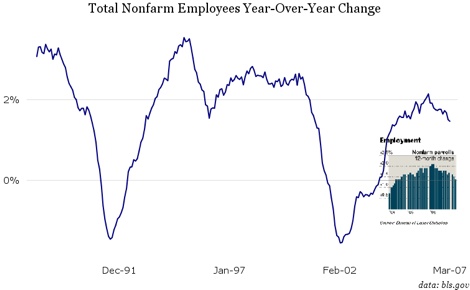
Remember that NYT chart from earlier today? Well, one of my favorite chart-makers, Wcw, or West-Coast Whiner, has helpfully converted it into a line chart, which does kinda put it in perspective. Here’s Wcw’s chart, with the NYT chart underneath:

Nfpyoy.Mar072

As you can see, there is a case to be made that payrolls are falling slowing down on a year-on-year basis, even though they’re rising accelerating on a month-on-month basis. But in the grand scheme of things they’re actually pretty steady, compared to the wild swings we’ve seen in the past.

Posted in Econoblog | 2 Comments

Does microcredit work?

Blogs such as MicroCapital and Poverty News Blog are reprinting a Newsweek article by Mac Margolis which is summed up in the standfirst: “Critics put trendy poverty lenders to the test,” it says, “and find they’re neither a real business nor a real help.”

Who are these critics? The main one is Thomas Dichter, a well-known aid-doesn’t-work type at the Cato Institute. The others are not clear: is it really a criticism of microfinance to say that most microfinance programs are unprofitable? Many microfinance types would say that their main job is poverty alleviation, not turning a profit, and that they’re more than happy to spend grant monies on the poor before trying to set themselves up as a profitable financial institution. I personally sit on the board of a community development credit union (CDCU) in New York – LES Peoples – which isn’t “sustainable” unless you count the grants we receive. But we’ve been receiving them for 20 years, we have assets of almost $20 million, we’re the largest CDCU in the country, and we’re widely lauded by everyone from Hillary Clinton to Mike Bloomberg. Just because you don’t turn an operating profit, doesn’t make you a failure. Not by any means.

Margolis also has an interesting way of spinning good news as bad news:

Alex Counts, director of the Grameen Foundation, which is in charge of replicating the Bangladesh-based Grameen Bank around the world, admits that only a tenth of the bank’s 7 million clients are “true entrepreneurs” who “started borrowing $100 and are now borrowing $10,000 to $20,000,” but says that most are making ends meet.

Admits“? That Grameen bank has helped only 700,000 clients to move from microloans to loans in the tens of thousands of dollars? If that’s failure, let’s have more of it!

As for Dichter, Margolis quotes an essay of his entitled “Microfinance Reconsidered,” which apparently has been published by the Cato Institute, although I can’t find anything of that name on the Cato website. The closest thing I can find is a paper by Dichter called “A Second Look at Microfinance: The Sequence of Growth and Credit in Economic History,” which is mainly historical and concentrates solely on the history of finance in developed countries such as the UK, rather than looking at microfinance in the developing world today.

As for the substance of the debate, Margolis is right that there’s much more heat than light in all the stuff being written. The big exception, in my view, is a wonderful paper by Shahe Emran, Mahbub Morshed and Joseph Stiglitz, which explains why microfinance works, in practice, in places like Bangladesh. It turns out that the main factor behind all these puzzles is the place of women in society, and especially extreme illiquidity in the market for women’s labor: a little bit of credit acts as a catalyst for women outside the labor market, turning them into economically productive individuals.

To put it another way, the interest on a microloan isn’t really return on capital, it’s return on labor. It’s just that without a tiny bit of capital, the labor is nascent and can’t be tapped. That’s why microcredit works.

Posted in Portfolio | Comments Off on Does microcredit work?

Does microcredit work?

Blogs such as MicroCapital and Poverty News Blog are reprinting a Newsweek article by Mac Margolis which is summed up in the standfirst: “Critics put trendy poverty lenders to the test,” it says, “and find they’re neither a real business nor a real help.”

Who are these critics? The main one is Thomas Dichter, a well-known aid-doesn’t-work type at the Cato Institute. The others are not clear: is it really a criticism of microfinance to say that most microfinance programs are unprofitable? Many microfinance types would say that their main job is poverty alleviation, not turning a profit, and that they’re more than happy to spend grant monies on the poor before trying to set themselves up as a profitable financial institution. I personally sit on the board of a community development credit union (CDCU) in New York — LES Peoples — which isn’t “sustainable” unless you count the grants we receive. But we’ve been receiving them for 20 years, we have assets of almost $20 million, we’re the largest CDCU in the country, and we’re widely lauded by everyone from Hillary Clinton to Mike Bloomberg. Just because you don’t turn an operating profit, doesn’t make you a failure. Not by any means.

Margolis also has an interesting way of spinning good news as bad news:

Alex Counts, director of the Grameen Foundation, which is in charge of replicating the Bangladesh-based Grameen Bank around the world, admits that only a tenth of the bank’s 7 million clients are “true entrepreneurs” who “started borrowing $100 and are now borrowing $10,000 to $20,000,” but says that most are making ends meet.

Admits“? That Grameen bank has helped only 700,000 clients to move from microloans to loans in the tens of thousands of dollars? If that’s failure, let’s have more of it!

As for Dichter, Margolis quotes an essay of his entitled “Microfinance Reconsidered,” which apparently has been published by the Cato Institute, although I can’t find anything of that name on the Cato website. The closest thing I can find is a paper by Dichter called “A Second Look at Microfinance: The Sequence of Growth and Credit in Economic History,” which is mainly historical and concentrates solely on the history of finance in developed countries such as the UK, rather than looking at microfinance in the developing world today.

As for the substance of the debate, Margolis is right that there’s much more heat than light in all the stuff being written. The big exception, in my view, is a wonderful paper by Shahe Emran, Mahbub Morshed and Joseph Stiglitz, which explains why microfinance works, in practice, in places like Bangladesh. It turns out that the main factor behind all these puzzles is the place of women in society, and especially extreme illiquidity in the market for women’s labor: a little bit of credit acts as a catalyst for women outside the labor market, turning them into economically productive individuals.

To put it another way, the interest on a microloan isn’t really return on capital, it’s return on labor. It’s just that without a tiny bit of capital, the labor is nascent and can’t be tapped. That’s why microcredit works.

Posted in Econoblog | 5 Comments

Are payrolls actually falling?

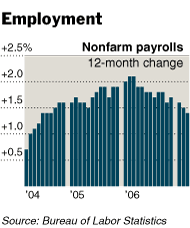
0407-Biz-EconjobsThe NYT has an interesting chart accompanying its payrolls story today. While the text is as upbeat as you’d expect given the excellent figures, and despite the fact that the WSJ is running a story headlined “Economists Wonder if March Is the Peak for 2007 Job Growth”, someone on 43rd Street seems to have decided to run a graphic showing payrolls going down.

The chart violates a basic rule of charting, which is that a bar chart like this should be used to show how quantities change from month to month. Looking at the bar chart, you expect the March bar to refer to March figures, the February bar to refer to February figures, and so on. But in fact they refer to a year-on-year differential, which is better displayed with a line chart.

Still, that’s a quibble: A line chart would still be going down, even as everybody is talking about the payroll numbers going up. What gives? To be honest, I’m not entirely sure. Year-on-year figures obviate the need for seasonal adjustment, so maybe the real trend is down but is being hidden by the seasonal adjustments. Alternatively maybe the enormous revisions that the BLS has been doing to the time series of late make the year-on-year figures less useful than they otherwise would be.

In any case, it’s not immediately clear to me why year-on-year figures should be charted when all of Wall Street concentrates solely on the month-on-month number. If you’re going to use these figures, you should at the very least somewhere explain why.

Posted in Portfolio | Comments Off on Are payrolls actually falling?

Are payrolls actually falling?

0407-Biz-EconjobsThe NYT has an interesting chart accompanying its payrolls story today. While the text is as upbeat as you’d expect given the excellent figures, and despite the fact that the WSJ is running a story headlined “Economists Wonder if March Is the Peak for 2007 Job Growth”, someone on 43rd Street seems to have decided to run a graphic showing payrolls going down.

The chart violates a basic rule of charting, which is that a bar chart like this should be used to show how quantities change from month to month. Looking at the bar chart, you expect the March bar to refer to March figures, the February bar to refer to February figures, and so on. But in fact they refer to a year-on-year differential, which is better displayed with a line chart.

Still, that’s a quibble: A line chart would still be going down, even as everybody is talking about the payroll numbers going up. What gives? To be honest, I’m not entirely sure. Year-on-year figures obviate the need for seasonal adjustment, so maybe the real trend is down but is being hidden by the seasonal adjustments. Alternatively maybe the enormous revisions that the BLS has been doing to the time series of late make the year-on-year figures less useful than they otherwise would be.

In any case, it’s not immediately clear to me why year-on-year figures should be charted when all of Wall Street concentrates solely on the month-on-month number. If you’re going to use these figures, you should at the very least somewhere explain why.

Posted in Econoblog | 6 Comments

Is the US exploiting its military strength in trade negotiations?

The US knows how it likes its trade negotiations. It’s a simple rubric: the US puts its proposal on the table, and its interlocutors accept.

In the Doha round of the WTO talks, as we know, this hasn’t worked very well. So the US is signing bilateral preferential trade agreements instead, the latest of which is with South Korea. In turn, these bilateral agreements only serve to weaken the case for global trade agreements. Jagdish Bhagwati says that “the whole world has practically collapsed into bilateralism which is driven by sloppy arguments and failure of leadership by the major powers such as the United States.” And Martin Wolf hates these bilateral agreements as well. So why do they happen? Robert Wade has an interesting take on Wolf’s blog:

Singapore’s prime concern was less with the economics of the agreement than with the military-security impact: the government calculated that the agreement would help to tie the US into the region militarily. Presumably the South Korean government has been making a similar calculation, being only too aware of growing sentiment in the US to “bring our troops home”, including from East Asia, at the same time as North Korea could explode on its doorstep and China-Taiwan could explode to the south.

In other words, this isn’t a trade agreement at all: it’s a trade-for-security agreement. One could even, if one was feeling uncharitable, characterize it as the US extorting trade concessions from the East Asians in return for keeping a military presence in the region.

(Via Mark Thoma)

Posted in Portfolio | Comments Off on Is the US exploiting its military strength in trade negotiations?

Is the US exploiting its military strength in trade negotiations?

The US knows how it likes its trade negotiations. It’s a simple rubric: the US puts its proposal on the table, and its interlocutors accept.

In the Doha round of the WTO talks, as we know, this hasn’t worked very well. So the US is signing bilateral preferential trade agreements instead, the latest of which is with South Korea. In turn, these bilateral agreements only serve to weaken the case for global trade agreements. Jagdish Bhagwati says that “the whole world has practically collapsed into bilateralism which is driven by sloppy arguments and failure of leadership by the major powers such as the United States.” And Martin Wolf hates these bilateral agreements as well. So why do they happen? Robert Wade has an interesting take on Wolf’s blog:

Singapore’s prime concern was less with the economics of the agreement than with the military-security impact: the government calculated that the agreement would help to tie the US into the region militarily. Presumably the South Korean government has been making a similar calculation, being only too aware of growing sentiment in the US to “bring our troops home”, including from East Asia, at the same time as North Korea could explode on its doorstep and China-Taiwan could explode to the south.

In other words, this isn’t a trade agreement at all: it’s a trade-for-security agreement. One could even, if one was feeling uncharitable, characterize it as the US extorting trade concessions from the East Asians in return for keeping a military presence in the region.

(Via Mark Thoma)

Posted in Econoblog | 4 Comments

Do you want biofuels, or do you want to feed the hungry?

Tyler Cowen is an economist with a heart. He thinks he knows that protectionism and subsidies are ever and always a Bad Thing, but at the same time he can’t bring himself to say anything too bad about tortilla subsidies in Mexico.

My head knows what is right but my heart is torn. Can Mexico can afford the protectionism which keeps local producers going and gives it the world’s best and most diverse corn, the world’s best tortillas, and supports a major part of its national identity, most of all for its most oppressed and politically sensitive groups? I am emotionally torn and will not proceed with the question any further.

If you’re going to have subsidies, in other words, then subsidizing tortilla prices is a really good way to funnel a much-needed good to the poor. (Tortillas account for half of poor Mexicans’ calories, and have been rising in price as corn prices soar in hopes of a future built on corn ethanol.)

In the May/June issue of Foreign Affairs, Ford Runge and Benjamin Senauer say quite explicitly that biofuels in general, and corn ethanol in particular, will “exacerbate world hunger”.

The World Bank has estimated that in 2001, 2.7 billion people in the world were living on the equivalent of less than $2 a day; to them, even marginal increases in the cost of staple grains could be devastating. Filling the 25-gallon tank of an SUV with pure ethanol requires over 450 pounds of corn — which contains enough calories to feed one person for a year.

Meanwhile, the article notes, US corn subsidies were $8.9 billion in 2005 alone. If the US is really serious about moving towards ethanol and biofuels, at the very least it should abolish import restrictions on Brazilian sugar ethanol, which is much cheaper and more efficient than US corn ethanol in any case.

But there is a humanitarian case for taking a second look at the whole issue of biofuels in general. Back to the Foreign Affairs article:

The production of cassava-based ethanol may pose an especially grave threat to the food security of the world’s poor. Cassava, a tropical potato-like tuber also known as manioc, provides one-third of the caloric needs of the population in sub-Saharan Africa and is the primary staple for over 200 million of Africa’s poorest people. In many tropical countries, it is the food people turn to when they cannot afford anything else. It also serves as an important reserve when other crops fail because it can grow in poor soils and dry conditions and can be left in the ground to be harvested as needed.

Thanks to its high-starch content, cassava is also an excellent source of ethanol. As the technology for converting it to fuel improves, many countries — including China, Nigeria, and Thailand — are considering using more of the crop to that end. If peasant farmers in developing countries could become suppliers for the emerging industry, they would benefit from the increased income. But the history of industrial demand for agricultural crops in these countries suggests that large producers will be the main beneficiaries. The likely result of a boom in cassava-based ethanol production is that an increasing number of poor people will struggle even more to feed themselves.

Posted in Portfolio | Comments Off on Do you want biofuels, or do you want to feed the hungry?

Payrolls: Great!

There’s no one around on the stock market to celebrate, but this morning’s jobs report was fantastic. (Unless you’re Barry Ritholtz, of course, in which case it’s “not a big number”.) Not only did March payrolls rise by a very strong 180,000, but both February and January were revised upwards as well, and unemployment is now down to 4.4%; economists had actually been expecting it to rise. Hell, there was even a rise in construction employment, although it didn’t quite make up for the fall in February.

Bonds are down half a point or so, stock futures are up a little, and Fed fund futures are rapidly giving up any hope of a rate cut.

Standard disclaimer, here: although the monthly payrolls report gets a lot of press and can send markets gyrating wildly, the margin of error is enormous, and sober observers have started using words like “meaningless” and “random”. All the same, the bulls have a smile on their faces this morning. Maybe it’s because they’ve been proved right; on the other hand, maybe it’s just because a lot of them have the day off.

Posted in Portfolio | Comments Off on Payrolls: Great!

Payrolls: Great!

There’s no one around on the stock market to celebrate, but this morning’s jobs report was fantastic. (Unless you’re Barry Ritholtz, of course, in which case it’s “not a big number”.) Not only did March payrolls rise by a very strong 180,000, but both February and January were revised upwards as well, and unemployment is now down to 4.4%; economists had actually been expecting it to rise. Hell, there was even a rise in construction employment, although it didn’t quite make up for the fall in February.

Bonds are down half a point or so, stock futures are up a little, and Fed fund futures are rapidly giving up any hope of a rate cut.

Standard disclaimer, here: although the monthly payrolls report gets a lot of press and can send markets gyrating wildly, the margin of error is enormous, and sober observers have started using words like “meaningless” and “random”. All the same, the bulls have a smile on their faces this morning. Maybe it’s because they’ve been proved right; on the other hand, maybe it’s just because a lot of them have the day off.

Posted in Econoblog | 2 Comments

Do you want biofuels, or do you want to feed the hungry?

Tyler Cowen is an economist with a heart. He thinks he knows that protectionism and subsidies are ever and always a Bad Thing, but at the same time he can’t bring himself to say anything too bad about tortilla subsidies in Mexico.

My head knows what is right but my heart is torn. Can Mexico can afford the protectionism which keeps local producers going and gives it the world’s best and most diverse corn, the world’s best tortillas, and supports a major part of its national identity, most of all for its most oppressed and politically sensitive groups? I am emotionally torn and will not proceed with the question any further.

If you’re going to have subsidies, in other words, then subsidizing tortilla prices is a really good way to funnel a much-needed good to the poor. (Tortillas account for half of poor Mexicans’ calories, and have been rising in price as corn prices soar in hopes of a future built on corn ethanol.)

In the May/June issue of Foreign Affairs, Ford Runge and Benjamin Senauer say quite explicitly that biofuels in general, and corn ethanol in particular, will “exacerbate world hunger”.

The World Bank has estimated that in 2001, 2.7 billion people in the world were living on the equivalent of less than $2 a day; to them, even marginal increases in the cost of staple grains could be devastating. Filling the 25-gallon tank of an SUV with pure ethanol requires over 450 pounds of corn — which contains enough calories to feed one person for a year.

Meanwhile, the article notes, US corn subsidies were $8.9 billion in 2005 alone. If the US is really serious about moving towards ethanol and biofuels, at the very least it should abolish import restrictions on Brazilian sugar ethanol, which is much cheaper and more efficient than US corn ethanol in any case.

But there is a humanitarian case for taking a second look at the whole issue of biofuels in general. Back to the Foreign Affairs article:

The production of cassava-based ethanol may pose an especially grave threat to the food security of the world’s poor. Cassava, a tropical potato-like tuber also known as manioc, provides one-third of the caloric needs of the population in sub-Saharan Africa and is the primary staple for over 200 million of Africa’s poorest people. In many tropical countries, it is the food people turn to when they cannot afford anything else. It also serves as an important reserve when other crops fail because it can grow in poor soils and dry conditions and can be left in the ground to be harvested as needed.

Thanks to its high-starch content, cassava is also an excellent source of ethanol. As the technology for converting it to fuel improves, many countries — including China, Nigeria, and Thailand — are considering using more of the crop to that end. If peasant farmers in developing countries could become suppliers for the emerging industry, they would benefit from the increased income. But the history of industrial demand for agricultural crops in these countries suggests that large producers will be the main beneficiaries. The likely result of a boom in cassava-based ethanol production is that an increasing number of poor people will struggle even more to feed themselves.

UPDATE: Andrew Leonard fingers not corn ethanol but Nafta and globalization for the rise in tortilla prices

Posted in Econoblog | 2 Comments

Is Chrysler actually worth more than $0?

Breaking Views analyst Antony Currie has the down-low on the Kirk Kerkorian bid for Chrysler – and if you don”t have access to his ultra-exclusive website, you can get much the same analysis in the comments section of felixsalmon.com for free!

The key thing to bear in mind is Chrysler’s unfunded healthcare liabilities, which are currently hovering around the $17 billion mark. As Floyd Norris notes today (also behind a subscriber firewall, sorry), “Kirk Kerkorian is not so much offering to buy Chrysler as he is volunteering to be paid to take it on.”

It’s here where it starts to make sense for DaimlerChrysler’s Dieter Zetsche to choose a union-endorsed bid. As Currie explains,

Kerkorian has made his deal contingent on unions granting concessions. Assume a one-third cut in these worker benefits, a bit more than Ford Motor and General Motors got 18 months ago, and that takes $5.5bn off Daimler’s bill. That would still leave Daimler holding some $7bn of Chrysler’s bag. But that’s significantly less than it’s currently stuck with, so the company’s shareholders would not be damaged. Moreover, Daimler and Tracinda might even be able to cut that back more by offering the unions an equity stake in Chrysler as part of the deal.

On the other hand, it’s early days yet, and it’s all but certain that someone else will pop up with a bid to rival Kerkorian’s. Currie has one intriguing notion: how about General Motors? If a real bidding war gets under way, Chrysler might even sell for more than $0!

Posted in Portfolio | Comments Off on Is Chrysler actually worth more than $0?

Will Goldman Sachs lose money on New Century?

In the wake of New Century’s bankruptcy, Robert Lindsay gets his hands on the official list of the company’s biggest creditors. At the top of the list is Goldman Sachs, followed by Credit Suisse and a who’s-who of other big investment-banking names: Morgan Stanley, Deutsche, BofA, UBS, Lehman, Citigroup. Loan house C-Bass is in the #3 spot.

Most of these creditors have secured loans to New Century, and one of them, Barclays, tells Lindsay that “the vast majority of our exposure to all US sub-prime lenders is fully collateralised and short-term, pending distribution. We do not anticipate any material losses to arise from our exposure to the sector.”

There’s no indication of how big New Century’s obligations are, and my feeling is that by the time the company’s assets are sold off, the secured creditors are unlikely to be seriously hurt. But for those of a conspiratorial bent, Lindsay notes that Goldman executive Kathleen Brown “left late last Friday without any explanation”. Did she have anything to do with New Century? It’s unclear.

(Via)

Posted in Portfolio | Comments Off on Will Goldman Sachs lose money on New Century?

Is Chrysler actually worth more than $0?

Breaking Views analyst Antony Currie has the down-low on the Kirk Kerkorian bid for Chrysler — and if you don”t have access to his ultra-exclusive website, you can get much the same analysis in the comments section of felixsalmon.com for free!

The key thing to bear in mind is Chrysler’s unfunded healthcare liabilities, which are currently hovering around the $17 billion mark. As Floyd Norris notes today (also behind a subscriber firewall, sorry), “Kirk Kerkorian is not so much offering to buy Chrysler as he is volunteering to be paid to take it on.”

It’s here where it starts to make sense for DaimlerChrysler’s Dieter Zetsche to choose a union-endorsed bid. As Currie explains,

Kerkorian has made his deal contingent on unions granting concessions. Assume a one-third cut in these worker benefits, a bit more than Ford Motor and General Motors got 18 months ago, and that takes $5.5bn off Daimler’s bill. That would still leave Daimler holding some $7bn of Chrysler’s bag. But that’s significantly less than it’s currently stuck with, so the company’s shareholders would not be damaged. Moreover, Daimler and Tracinda might even be able to cut that back more by offering the unions an equity stake in Chrysler as part of the deal.

On the other hand, it’s early days yet, and it’s all but certain that someone else will pop up with a bid to rival Kerkorian’s. Currie has one intriguing notion: how about General Motors? If a real bidding war gets under way, Chrysler might even sell for more than $0!

Posted in Econoblog | 1 Comment

Kerkorian’s weird bid for Chrysler

Kirk Kerkorian has gone public with a low-ball, $4.5 billion bid for Chrysler. He knows the company well: he had a 10% stake in 1995, when he tried to buy it for $20 billion, and held onto that stake until Chrysler was eventually sold to Daimler for $36 billion. So he’s already made $3 billion from Chrysler, and now he’s coming back for more.

But why would DaimlerChrysler accept such a low bid, when all the chatter values Chrysler at closer to $8 billion? Kerkorian tugs at the heartstrings in his letter. He tries to paint himself as the “right” ownership, which will “build Chrysler into a robust and lasting, stand-alone entity,” and who will make “the necessary investments” in R&D and manufacturing.

All of which might be true. But DaimlerChrysler CEO Deiter Zetsche‘s foremost obligation is to his shareholders, and he is going to have a devil of a time explaining why it’s leaving billions of dollars on the table just because Kirk Kerkorian is a nice guy.

Posted in Portfolio | Comments Off on Kerkorian’s weird bid for Chrysler