
Selling Stadium Seats

Everything old is new again.

Take the "new twist in stadium financing" which Megan

Barnett is reporting on today. The idea is that the seats in the new Yankees

Stadium will be sold in advance, to investors who will own them in perpetuity.

Not only is this "a new way of raising money," says Barnett, but it’s

even been patented.

Um, can anybody say "prior art"? I can give you an example of exactly

the same structure being used as long ago as the 1860s: the financing of the

Royal Albert Hall, in London. Here’s a few snippets from a long and very detailed

history of

the hall at British History Online:

One respect in which the hall as built was consonant with the Prince’s ideas

was in its financing by private rather than public money…

In August 1864, while on the train to Norwich, he wrote to tell Grey what

he had decided. ‘I have come to the conclusion that the only way to get the

Memorial Hall done is to do it!’ He had therefore determined to circulate

a prospectus, appeal for subscribers himself, and then go to the Commissioners

for a lease of the site. His idea was to sell sittings in the hall at £100

each: he had already sold three… What Cole in his resourcefulness was selling

was… freehold sittings. This was to have very complicating consequences

for the managers who later had to run the hall essentially on its box-office

takings…

The hall was put in hand just before a rise in building costs, and with the

aid also of thrifty management it was possible to announce at the opening

that the hall had been built for about the estimated sum of £200,000.

Or, if it did exceed that figure, it was not by an extravagant amount: the

total cost was probably some £214,000…

In 1865 Cole had told Gladstone that the hall would be built without recourse

to public funds. At the opening the Prince of Wales was able to state that

this was so…

By the time the hall had been begun its friends and enemies were already drawing

attention to the difficulty that would be found in inducing impresarios to

take the hall when the best seats were already sold in virtual perpetuity.

In 1877 the Commissioners’ secretary said that the sales had been at too low

a price, which should have been £150 instead of £100 per seat.

There was no endowment fund, and with the running charges estimated by a hostile

but accurate critic at £5,000 per annum the hall was launched on a virtually

impossible task of at once maintaining itself and serving science and art.

Now I’m sure that someone has already worked out how to deal with similar problems

in the case of Yankee Stadium. The team gets a lot of revenue from sources other

than ticket sales, so George Steinbrenner can probably live with other people

owning "his" seats. What’s more, I don’t think that the Yankee Stadium

proposal envisages selling nearly as many seats in perpetuity as was the case

with the Royal Albert Hall.

But this is absolutely not a new idea. It’s been done – reasonably successfully

– before. To this day, individuals and corporations own seats and boxes

in the Royal Albert Hall, and there’s a lively secondary market in them. So

I do wonder how this patent managed to get granted.
Posted in economics | Comments Off on Selling Stadium Seats

The Newly-Normal Treasury Curve: Good News or Bad News?

Are you relieved that the US yield curve is sloping upwards again? I am. For

the first time in years, there’s an obvious and safe place where people can

invest their money: Treasury bonds. They felt ridiculously overpriced for years,

bid up by foreign central banks and by a dearth of other places to invest, but

the recent sell-off has finally made it possible to get comfortably over 5%

on your money over pretty much any time horizon, completely risk-free.

Of course, there’s a catch. James

Stewart:

The problem is that the conventional wisdom about yield curves and the economy

has been stood on its head in recent years, and no one has yet offered a convincing

explanation why…

No less an authority than former Federal Reserve chairman Alan Greenspan called

the recent inverted yield curve a "conundrum." That’s because the

Fed’s campaign to raise short-term rates led to lower, rather than higher,

long-term rates. Do we now have the makings of a new conundrum, higher long-term

rates that remain so in the face of slower growth or even Fed cuts? (…)

I don’t think investors should underestimate the significance of a sustained

rise in long-term rates to an economy that has become gorged on easy credit.

In other words, if times were good when the curve was inverted – and,

yes, times were very good indeed – then it’s entirely consistent to think

that times might be bad now that the yield curve looks "normal" again.

And there’s one thing which remains abnormal about the current situation. While

risk-free rates have spiked up substantially, credit spreads have barely budged.

The whole market, it seems, is waiting for the other shoe to drop, and for spread

markets to widen out in line with the new higher-interest-rate environment.

But it hasn’t happened yet.

That’s either cause for relief, or cause for worry. I tend towards the latter:

if the yield curve is starting to look normal, the spread curve is likely to

move back to a more normal shape too, sooner or later. I’d be much happier in

Treasuries right now than in credit.

Posted in bonds and loans | Comments Off on The Newly-Normal Treasury Curve: Good News or Bad News?

Why Bearish Forecasts are Meaningless

The FT has an interview

with UBS CEO Peter Wuffli today, in which he intones gravely

about the dangers facing credit markets:

Mr Wuffli is also keenly aware rosy conditions will not go on indefinitely:

“What is not here to stay is the absence of default, the absence of

inflation over a longer period of time, and of essentially flat yield and

credit curves,” he says.

The Wuffli comes in the wake of Steven Rattner’s equally grave

op-ed

in the WSJ:

To think that corporate recessions — and the attendant collateral damage

of bankruptcies among overextended companies — have been outlawed would be

as foolhardy as believing that mortgages should be issued to home buyers with

no down payments and no verification of financial status.

All of which is perfectly sensible. But I have to ask, who are these

people of whom Rattner speaks so disparagingly when he says that "the current

ahistorical performance of high-yield markets has led seers and prognosticators

to proclaim yet another new paradigm"? Are there really people so enamored

with the idea of a Great Moderation that they believe that defaults are a thing

of the past?

The markets these days seem to be full of eminence grise types who

mutter darkly about how all this modern spread tightening can’t go on for ever,

you know. (Bill Rhodes of Citigroup has been doing it pretty

much all decade long.) But of course if you’re a pundit, it’s much easier to

be a bear than a bull. If the market tanks, a bull is proved wrong immediately.

But if it goes up, bears just nod sagely and say "just you wait".

Eventually, of course, they’re proved right – although it’s worth noting

that even at the bottom of the dot-com stock-market crash, prices were still

well above their levels when Alan Greenspan gave his famous "irrational

exuberance" speech.

What I’d dearly love to see from some of these people is something they’ll

never provide: call it falsifiability, in a nod to Karl Popper.

Ask yourself if there’s any conceivable state of affairs which would prove these

people wrong. If the answer’s no, then frankly their warnings are pretty meaningless.

Posted in bonds and loans | Comments Off on Why Bearish Forecasts are Meaningless

Is there a word for this?

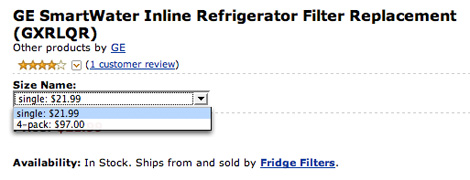
It happens at Amazon, it happens at my local grocery store (sorry about the colour — it’s a cellphone pic), and it happens every day all over the world. But is there a name for it?

Filters

Photo 020506 001

Posted in Econoblog, Not economics | Comments Off on Is there a word for this?

The Whole Foods Complaint: Weak

It’s not easy, being CEO of a public company. Seriously. You work for a huge

organization, yet you don’t have a boss. On the other hand, you report to a

board of directors, and, ultimately, your shareholders. Chances are, you’ve

worked your way up a few organizational org-charts in your time, and you know

how to behave towards individual bosses. But dealing with a board is a very,

very different manner.

John Mackey, it would seem, the CEO of Whole Foods, decided to be straightforward

in his dealings with his board. He gave them the unvarnished truth when it came

to his proposed acquisition of Wild Oats, and he also, for good measure, denigrated

the abilities of other supermarkets to compete with Whole Foods.

I’m sure his board was delighted, and they signed off on the acquisition. But

all those communications were found by the FTC when it started investigating

the merger. And the FTC didn’t

like them one bit (PDF). Now the interesting thing about the FTC complaint

is that it has almost no arguments in it; almost no numbers. Instead, it seeks

to use Mackey’s words against him. As David

Kesmodel notes in the WSJ,

The lawsuit quotes Mr. Mackey as saying that the company "isn’t primarily

about organic foods" but "only one part of its highly successful

business model," citing as others "superior quality, superior service,

superior perishable product, superior prepared foods, superior marketing,

superior branding and superior store experience."

In what way, exactly, is this supposed to be damning? It seems to me that Mackey,

here, is essentially saying that any supermarket could become a direct

competitor of Whole Foods if it started concentrating less on prices and more

on things like store experience.

In fact, the complaint then goes on to quote Mackey being dismissive of a potential

threat from Safeway: Safeway might have organic food, he says, but it doesn’t

have Whole Foods’s ability to market a lifestyle. For that reason, he says,

Safeway is unlikely to poach Whole Foods’s customers.

Never have I seen a CEO’s salesmanship taken at such face value. What would

have happened if Mackey had gone up to his board and told them that Whole Foods

needed to merge with Wild Oats in order to be able to defend itself from the

entrance of Wal-Mart and Trader Joe’s and Safeway into the organic food market?

The FTC would have found nothing objectionable, and the merger would probably

have happened by now.

There is nothing compelling in the FTC complaint. The idea that Whole Foods

and Wild Oats have a monopoly on pleasant shopping experiences and therefore

should be banned from merging is laughable on its face.

Mackey, to his credit, is being very transparent about the whole process. He

had no objections to the FTC complaint being unsealed, and in fact put up a

long

blog entry in response to it. In it, we learn that the FTC asked for more

than 20 million documents from Whole Foods: no wonder they managed

to find a handful which seemed, to them, damning!

And as Mackey notes,

If eliminating a competitor is inherently "bad" or "wrong"

then the FTC should probably never allow any mergers to ever occur, because

most mergers necessarily mean the elimination of a competitor from the marketplace.

His whole blog entry is well worth reading: it’s a heartfelt cry against the

FTC which stands in stark contrast to the dry and unpersuasive FTC complaint.

He shows that Whole Foods prices are unrelated to whether or not there’s a Wild

Oats in the area, and says that numerous supermarkets, including Trader Joes

and Safeway, are bigger competitors to Whole Foods than Wild Oats is. By the

time you’ve finished reading it, it’s very hard to feel much sympathy with the

FTC.

I’m still

confused as to why the FTC picked on Whole Foods, of all companies –

and Mackey is clearly confused as well. The FTC is rapidly losing credibility

here, but it’s probably far too late for the FTC to back off. More’s the pity,

for all concerned.

Posted in M&A, regulation | Comments Off on The Whole Foods Complaint: Weak

Signs of Caution in Private Equity?

Tenille

Tracy sees one private-equity consortium outbid another private-equity consortium

to win Home Depot’s HD Supply business for $10 billion, and she smells weakness:

There has been talk that private-equity firms are exercising more caution

in their deal making. Given that half of the potential bidders ducked out

of this deal, that caution is becoming more apparent.

I think there may indeed be some newfound caution in the private-equity market:

after bandying

around numbers in the $6 billion to $8 billion range for the combined Jaguar

and Land Rover, for instance, analysts are now soft-pedalling,

saying that the UK car companies might go for just $1.5 billion. I guess we’ll

see.

And there are indications of caution in the Home Depot sale, too. The final

price tag of $10 billion is large, but it’s well short of the $13 billion that

some observers expected the unit to fetch when its sale was announced in February.

On the other hand, the fact that some private-equity companies dropped out

of the bidding altogether should not be taken as a sign of weakness. It’s a

known fact that private-equity shops hate to bid against each other in the first

place, and if there are half a dozen consortiums circling a potential acquisition,

most of them are naturally going to drop out rather than wade into a bidding

war. Much better that another shop pays too little than that you yourself pay

too much.

Posted in private equity | Comments Off on Signs of Caution in Private Equity?

Anecdote Inflation

Wilbur Ross, talking

to the FT in April:

Anecdotally we syndicated a loan for one of our companies recently, and I

noticed that one of the hedge funds had bought it, bought a small piece, a

$10 million piece, but never came to any of the due diligence meetings. So

I called the fellow who runs the hedge fund, because I know him, and said:

thank you for participating, but I was surprised nobody came for diligence.

He said: for a $10m loan, it is not worth sending someone to a meeting. Makes

you wonder how many $10m pieces are in that portfolio without any due diligence.

Wilbur Ross, talking

to Reuters in June:

Ross gave an anecdote of one hedge fund who took a $20 million stake in one

of his portfolio companies. “I called him to thank him, but I told him

that nobody from his fund came to due diligence. He said ‘I know that.’

I was surprised, and he said ‘we’re only going to put $20 million

in we didn’t think it was worth sending anyone.’ So it makes me

wonder, how many of these fellows are buying the things without due diligence.”

Posted in bonds and loans, private equity | Comments Off on Anecdote Inflation

Arrogance + Insecurity = Success, Steve Jobs Edition

A few weeks ago, David

Neubert told me that all successful traders are both extremely arrogant

and extremely insecure – that’s what makes them successful. The throwaway

statement hit me with the force of revelation: take it seriously, and it can

really change the way you look at the world.

For example, take today’s column from John

Kay, on the late, great Richard Rorty. Rorty "debunked

the notion that scientists could succeed in a search for the mirror of nature,

the truth about “The Way the World Is”," says Kay, and yet

"business journalists continue to believe that chief executives can tell

them “The Way the World Is” at their companies."

Journalists, you see, believe in truth, uncovering it, reporting it. But in

business and finance, truth doesn’t matter. What matters is being successful.

A successful businessman, were he to follow in the footsteps of Rorty, will

spend no time worrying about what was true yesterday. The only thing that matters

is what is true today, which is to say what works today.

If you read John Heilemann’s

piece on Steve Jobs, some major flip-flops stand out, all wildly

successful: Jobs making nice with Microsoft, in 1997; Jobs making nice with

Intel, in 2006; and, of course, the biggest of the lot, Jobs allowing the iPod

to work with Windows in 2001, only months after being adamant that such a thing

would never happen.

It’s probably impossible for any human being to be more arrogant than Steve

Jobs. But there is one person who can change Jobs’s mind, and that’s Steve Jobs.

When the iPod was launched, Jobs saw it as a tool to help sell Macs. But it

wasn’t long until he took another look at the electronics universe and saw that

the iPod could be much bigger than the Mac. And the rest is history. Underneath

Jobs’s arrogance is always the ability to admit that he was wrong. And that

is one key to his company’s recent success.

Posted in technology | Comments Off on Arrogance + Insecurity = Success, Steve Jobs Edition

The A380: Not the World’s Most Convenient Private Jet

Some bright spark with more money than sense has just dropped $300 million

on an Airbus A380 superjumbo jet – for

his personal use. That works out at about $30,000 per square foot of cabin

space, before paying for fuel, pilots, refits, or anything else.

If you don’t care about destroying the planet, then private jets are certainly

a great way to fly: they’re vastly more comfortable and convenient than flying

commercial. For one thing, you never need to worry about being at the mercy

of major airlines’ hub-and-spoke systems: you can fly from wherever you are

to wherever you’re going, without changing planes.

Unless you own an A380, of course. The superjumbo is so enormous that it can

only land at a very limited number of airports, and I’m quite sure that none

of them are in rich-peoples’ playgrounds such as Aspen, Nantucket, or Bermuda.

Which means that our A380 owner, who I’m sure won’t stay anonymous for long,

is going to have to downsize to a smaller private jet any time he wants to fly

somewhere without a major metropolitan airport.

Posted in consumption | Comments Off on The A380: Not the World’s Most Convenient Private Jet

Is Citigroup Too Big?

Sandy Weill thinks that Citigroup should

be big, and gave this quote to Bloomberg:

Being large and having a strong balance sheet enables a company to withstand

the financial turmoil that happens every now and then in global markets.

The quote did not go down well with Tom Brown, who responded

vitriolically:

What he means is exactly what we’ve been saying here for months: Citi has

gotten so big, and lumbering, and broadly diversified that it simply can’t

generate meaningful organic growth anymore. The law of large numbers won’t

allow it. Great, Sandy! If all I wanted from my investment was an instrument

that would "withstand financial turmoil" I’d simply buy Treasury

bills and be done with it. Presumably Citigroup’s shareholders want something

more than that.

They’re both wrong.

Weill is quite right that if a bank has a strong balance sheet, that will allow

it to withstand financial turmoil. That’s what a strong balance sheet is.

Being large, however, protects you only in the moral hazard sense that regulators

are likely to consider you "too big to fail". Which will come as no

consolation to shareholders, who get wiped out in any bailout situation.

I think that what Weill means is that Citi is so enormous it is necessarily

well diversified. It can’t be brought to its knees by a property crash, say,

or by a series of Latin American sovereign debt defaults, because it has its

eggs in too many baskets. This is a fair point – but the same thing could

be said of many much smaller banks.

What Weill does not mean is what Brown says he means, which is that

Citi can’t grow organically. Indeed, at this point, Citi is so enormous that

it has very little choice in the matter: it’s so big that it can spend $8.5

billion on 69% of Japan’s Nikko Cordial, for instance, and no one so much as

blinks. In retail banking, Citi is not as aggressive as its faster-growing rivals,

and the solution to that problem is not to start buying those rivals, and it’s

not to spin off Citi’s retail arm. Rather, it’s simply for Citi to get more

aggressive.

And Brown would do well to look at what the Law

of Large Numbers actually says before he cites it. It’s a law in probability

theory, and it really isn’t applicable to Citigroup at all.

As for the relative merit of Citigroup stock and Treasury bonds in a time of

financial turmoil, on that question reasonable people can vary. Certainly the

former has done much better than the latter of late.

The question isn’t whether Citigroup is too big to grow – if the parts

can grow on their own, then the sum of the parts can grow just as much. The

real question is whether Citigroup is too big to manage, and whether

it’s possible to steer a ship that big and complex. But if HSBC isn’t too big

to manage, Citigroup shouldn’t be impossible to control: they’re not that far

apart in size.

The difference is that HSBC has a corporate culture, while Citigroup still

feels like a set of very disparate parts. If a strong leader could communicate

a simple and effective vision for the company, the calls for its breakup would

soon cease. But such people are hard to find.

Posted in banking | Comments Off on Is Citigroup Too Big?

Steve Schwarzman Basks in the Limelight

Steve Schwarzman is a busy man these days, what with running

his company around the world (Blackstone just bought

a back-office company in India), preparing his company for an IPO this month,

fighting Congress on the taxation of private equity, and even attempting to

bail

out a Bear Stearns hedge fund. But he still manages to find time in his

schedule for being feted by the rich and famous, for instance at a New York

Public Library event

last night in his honor. Such events seem to be quite

common for Schwarzman these days:

Mr. Schwarzman and his wife, Christine Hearst Schwarzman, have become regulars

at events like these, and increasingly of late, honored guests. He was given

the Leadership Award at his alma mater, Yale University, on Thursday night.

Columbia University’s National Center on Addiction and Substance Abuse awarded

him with a Distinguished Service Award in April of last year.

Of course, there was also Schwarzman’s notorious $3 million birthday party

in February, where he stage-managed all the accolades: "When Blackstone

colleagues prepared a video tribute, he sought to squelch any roasting, asking

his peers not to poke fun at him," reported

Henny Sender and Monica Langley in a Schwarzman profile last week.

Today, the WSJ’s DealJournal is reporting on some of the oily obsequiousness

directed towards Schwarzman from Maria Bartiromo at the NYPL

event:

Bartiromo said she was introducing Schwarzman “not as a journalist”

but as a friend. She called Schwarzman “truly a wealth creator”;

a “winner”; someone who “loves the camera, likes the attention,

and it loves him.”

“Steve,” Bartiromo said, “you’re a pioneer. There’s

no other way to look at it. It’s all good.”

Ugh. I just hope that Bartiromo is never forced to report on her "friend"

Schwarzman.

Posted in private equity | Comments Off on Steve Schwarzman Basks in the Limelight

Monday Links Do The Twist

Enough links to keep anybody happy for at least an hour:

Personal Finance: Sonya

Smith-Valentine says that auto loans are a better idea than home-equity

lines of credit if you want to buy a car, even if they carry a higher interest

rate. It’s a question of discipline, you see. I’m not convinced: the

important thing is how much interest you pay in aggregate, on all your debts,

rather than how much interest you pay on your car payments specifically. And

the extra money you make in car payments could be better used to pay down more

debt at a lower interest rate.

Development: Marc

Andreessen finds an old

Q&A with Kenyan economics expert James Shikwati, who

wants we in the West to stop sending aid to Africa. I’d be interested to know

whether there’s much of a difference between Shikwati’s views and those

of Andrew Mwenda.

Economics I: These two arguments follow a similar argument:

sometimes cheaper (or free) isn’t always a good thing. Steve Waldman,

with an assist

from Dani Rodrik, teases

out the argument further:

If the best thing a teenager could do with a couple hundred thousand dollars

is to turn it into a four-year annuity for college, the utility maximizing

teenager will do that. If she chooses to do something else, by revealed preference,

that must be the better choice. Right? No.

Economics II: Alex

Tabarrok, riffing on a proposal

from John Edwards, likes the idea of prizes for healthcare

research, but says that "in fact, optimal prizes must increase

the profits of US drug companies". Why is it that whenever an economist

uses the phrase "in fact," one must always be on one’s guard against

crazy and baseless assertions?

Economics III: Tabarrok’s co-blogger Tyler Cowen,

blogfather at GMU, uses

the incentive of a prize to get people to buy his book

at Amazon and propel it up the sales charts there. The trick seems to be working:

it’s #236 in books, and it doesn’t even come out until August! The prize is

very bloggy indeed, and quite clever in the way Cowen trusts his readers.

Economics IV: Brad

DeLong vs Paul Krugman,

who’s moonlighting at the essential-for-highbrows new website Vox

EU.

Cities: The falling dollar means New

York is cheap! Or cheaper than 14 other world cities, anyway.

Banking: Can US Trust’s Frances Aldrich Sevilla-Sacasa

maintain her brand’s reputation now that it’s being

renamed U.S. Trust, Bank of America Private Wealth Management? Or USTBOAPWM

for not-very short, I guess.

Technology: John

Heilemann on Steve Jobs. It’s long, I haven’t read it.

But Paul Kedrosky is unimpressed.

Media: The Wall Street Journal’s cover price is going

up by 50% to $1.50. Subscribers are not affected, except that now the Journal

gets to trumpet Even! Bigger! Savings! for people who take out a subscription.

Private Equity: The Epicurean Dealmaker has a onetwo

punch on tax rates in the private equity industry. Well worth reading.

Closures: Andrew

Leonard bemoans the fact that Sierra Nevada Pale Ale has moved from twist-off

to pry-off caps. Apparently this is better for the beer and more environmentally

friendly to boot. But it’s less convenient. Not to worry, Andrew, sooner or

later the entire wine industry will move to twist-off caps, which are similarly

better for the wine and more environmentally friendly to boot. The loss of beer

convenience will then be made up for with the gain of wine convenience.

Posted in banking, cities, development, economics, Media, personal finance, remainders, technology | Comments Off on Monday Links Do The Twist

Yahoo: Terry Out, Jerry In, No Real Change

I have a feeling that all this excitement about Terry Semel’s

ouster

at Yahoo will be seen in retrospect to be overblown. (To give you an idea of

how big a deal this is, Nick Denton at Valleywag

has devoted his last seven posts to the news.)

The company is now in play, or at least the market thinks

it is, Jerry Yang’s protestations to the contrary notwithstanding.

But the problem with Semel was not that he was unwilling to sell the company;

the problem with Semel was that he was an Old Media guy who was never really

fast enough to keep Yahoo new and vibrant.

And if it’s fast, new and vibrant you want, I really don’t think that Yang’s

your man. Denton actually nails

it:

Yahoo’s press release, announcing the management putsch at Yahoo, is one

of the most nauseating examples of corporate doublespeak I’ve read in a long

while. "Yang

and Decker to Focus on Realizing Yahoo!’s Strategic Vision by Accelerating

Execution, Further Strengthening Leadership and Fostering a Culture of Winning."

This attempt to spin, in the most desperate of situations, isn’t clever; it’s

pathetic, and emblematic of a company still in deep denial about its defeat

by Google.

Can you remotely imagine Google putting out a press release like that? Excessive

corporate-speak is a sign that you haven’t got a clue what you’re actually meant

to be doing, and instead start talking

like this:

What is that vision? A Yahoo! that executes with speed, clarity and discipline.

A Yahoo! that increases its focus on differentiating its products and investing

in creativity and innovation. A Yahoo! that better monetizes its audience.

A Yahoo! whose great talent is galvanized to address its challenges.

The depressing thing is that I’m not quoting Semel, here: I’m quoting Yang.

In his own blog. Anybody who writes on his own blog about "operational

excellent mentality" and "critical initiatives" and galvanized

talent is a CEO with a passel of management consultants instead of a vision.

The guy’s not even 40 yet and already he’s talking like this? Maybe becoming

a billionaire does that to you.

Posted in defenestrations, technology | Comments Off on Yahoo: Terry Out, Jerry In, No Real Change

Adventures in Web Design, eBay Edition

eBay is cleaning

up its act:

Analysts said sellers were moving to other places on the Web in search of

buyers who had grown weary of an overwhelming array of product choices on

eBay…

Ms. Whitman said that chief among the changes was a new home page design.

The company is testing simplified layouts that are less likely to confuse

shoppers than the old version, which analysts said was among the most cluttered

in the e-commerce industry.

This is naturally great news for those of us who like clean, uncluttered websites

like the NYT, Wikipedia, and Google. (And Portfolio, too.) It’s worth noting,

however, that for every clean, successful website there’s also a cluttered,

successful website: think MySpace or Craigslist or Drudge. Or the Wall Street

Journal.

I think that empirically speaking, the best bet is definitely in the direction

that eBay is moving: something in the middle, like Amazon. Amazon tweaks its

design constantly, not according to what looks good, necessarily, but rather

according to what works. And looking at its latest iteration, what works best

seems to be a happy medium: a little clutter, perhaps, but nothing overwhelming.

Posted in technology | Comments Off on Adventures in Web Design, eBay Edition

Underbidding for Dow Jones

Floyd Norris asks a provocative

question today behind a NYT firewall: Could An Underbid Win

Dow Jones?

(Update: The whole entry’s now up

at DealBook, for free.)

The bulk of shareholders would disagree, of course, but if the board voted

to approve a deal with Pierson and G.E. in return for, say, $55 a share in

cash or stock, and the Bancroft family said it would not take any price from

Mr. Murdoch, who has offered $60, public shareholders might go along and the

courts might agree.

I see two big problems here. The first is that the days of "not taking

any price from Mr Murdoch" are clearly over: Dow Jones is in play, and

Murdoch is the presumptive buyer. And the second problem is actually pointed

up by Norris himself:

The Bancrofts control the super-voting shares but cannot sell control of

the company, because the shares lose their super-voting privileges if sold.

The point here is that if the Bancrofts sell their shares to GE, Pearson, or

anybody else, then the current public shareholders would – finally –

control the company. In order for a GE-Pearson underbid to succeed, the underbidders

would have to persuade a majority of DJ’s public shareholders to accept less

money than Rupert Murdoch is offering. And I can’t see an easy way of doing

that.

Certainly, the markets don’t believe that an underbid is in the offing. Dow

Jones is trading at $58.84, and indeed briefly spiked over the $60 mark on Friday.

At the moment, a credible bid would have to come at $60 or above, I think.

Posted in Media | Comments Off on Underbidding for Dow Jones

Kingdom Holdings: The New Berkshire Hathaway?

Fancy investing in an extremely successful hedge fund without paying 2-and-20?

Kingdom Holdings might be your best bet yet. The investment vehicle of Saudi

Arabian billionaire Prince Alwaleed bin Talal, is planning

to raise $840 million in an IPO on the Saudi stock exchange, Bloomberg is reporting

today. The stake would value Alwaleed’s company at $16.8 billion, which sounds

like a lot of money until you realise that its assets total $24.7 billion, and

that it’s had a truly magnificent run so far:

Kingdom’s average return on investments over the last 16 years is 20 percent,

the closely held company said. Kingdom has outperformed the MSCI and Standard

& Poor’s global indexes by more than 10 percent in that period, it said.

Kingdom could be the next Berkshire Hathaway (maybe it already is the

next Berkshire Hathaway), and I suspect that its shares will trade up sharply

in the secondary market. Although exactly when that’s going to be remains very

unclear. It’ll also be very interesting to see if Alwaleed will pursue a

dual listing in either New York or London – or, indeed, if he’ll sell

a stake privately to the Chinese central bank…

Posted in stocks | Comments Off on Kingdom Holdings: The New Berkshire Hathaway?

Why the GE-Pearson-Dow Jones Deal is Unlikely to Happen

I’m trying to work out how the GE-Pearson deal for Dow Jones, being mooted

in both the WSJ

and the FT

today, could possibly work.

According to the WSJ, neither GE nor Pearson has much interest in injecting

much in the way of cash into the proposed joint venture. GE would instead contribute

CNBC, while Pearson would hand over the FT Group. Both of which are valuable

properties – but those valuable properties aren’t going to end up even

partially in the hands of Dow Jones shareholders, who will need cash to give

up their shares.

As a result, the new joint venture is going to have to borrow the best part

of $4 billion to pay DJ shareholders – and if today’s Dow Jones doesn’t

have enough income to cover the interest payments, then they’ll have to come

out of the profits of CNBC and the FT Group.

In other words, the deal would probably mean lower profits for both GE and

Pearson going forwards – a prospect which neither company is likely to

relish. To be sure, there’s an argument that the increase in value from owning

the Wall Street Journal and Dow Jones’s other assets would make up for the lower

profits. But GE and Pearson don’t generally think like that.

What’s more, the crucial question of editorial control over the WSJ would still

remain. If it remains a headless beast with no controlling shareholder with

the ability to execute a real vision, it will continue on its slow yet inexorable

decline. But that seems to be exactly

where the Bancrofts are headed.

In order for the deal to work, then, there would have to be a lot

of trust involved: the way I see it, both the Bancrofts and GE would have to

trust Pearson to run the Journal effectively, and allow Pearson to have real

control over the paper. That’s unlikely, not least because Pearson has never

really demonstrated its ability to run a newspaper. Rupert Murdoch has newsprint

in his veins. Pearson, not so much.

Posted in Media | Comments Off on Why the GE-Pearson-Dow Jones Deal is Unlikely to Happen

Bear’s Benighted Bearish Bear-Market Bet

What’s causing the losses at Bear Stearns’s High-Grade Structured Credit Strategies

Enhanced Leverage Fund? On Saturday, Kate Kelly of the WSJ reported that the

fund was short subprime indices:

The Bear fund has different bets on the health of subprime mortgages, both

positive and negative, but has been hurt particularly by a negative bet after

a rebound on a key index that tracks the sector…

The fund bet a popular index that tracks subprime mortgages, the ABX, would

fall. Late last year and early this year, those moves bore good returns, says

a person familiar with the matter. Then the tide began to turn. After reaching

a low of 62 late in February, amid rising numbers of defaults and delinquencies

in the subprime market, the ABX unexpectedly recovered in the months that

followed, reaching 72 in mid-May. It has since gone back down to 61. This

led to losses for Mr. Cioffi.

I can see how someone who was short the ABX would suffer on its way up from

62 to 72. But why is the fund suffering now, when the ABX is at an all-time

low? There are a few different answers.

First, hedge fund strategies are very complicated things. Journalists love

to be able to sum them up in a clean sentence: LTCM bet that credit spreads

would narrow, or Amaranth bet that the spread between two gas futures contracts

would rise. But in fact most hedge-fund strategies are more complicated than

that, and a "short" bet on subprime mortgages can go very sour even

when the ABX index is falling.

That’s especially true in the world of subprime, where the ABX index is more

of a trading vehicle than an actual index of how the subprime market more generally

is doing. It should certainly not be thought of as an index like, say, the S&P

500, which impartially reflects the performance of underlying securities. Given

the illiquidity of most subprime securities, that wouldn’t be possible: that’s

why most traders prefer to trade the ABX instead. But that does mean the ABX

has something of a life of its own, and that anybody using it to extrapolate

wider subprime woes should tread very carefully.

Finally, of course, there’s the possibility that Bear’s Cioffi was forced to

cover his short positions on the way up from 62 to 72, and incurred a lot of

losses in May, rather than during the more recent move back south. With his

ABX short covered, he found himself long the market at its highs, just as the

market was set to take another tumble. And with his short-covering losses spurring

redemptions, he found himself unable to get out of his long positions in a bear

market without suffering even bigger losses. In other words, he lost money on

the way up and then lost even more money on the way down.

This is all speculation, of course, and even Bear Stearns itself is probably

unclear on some of this: otherwise it wouldn’t have had to alter

its official April results from a loss of 6.5% to a loss of 19%. Besides,

officials at Bear probably have bigger problems on their hands right now than

explaining to journalists exactly what went wrong and how. Still, this is already

a salutary case: a hedge fund seems to have managed to go bust by making bearish

bets in a down market. Leverage can have that effect, if you’re not careful,

or if you’re unlucky.

Posted in bonds and loans, hedge funds, housing | Comments Off on Bear’s Benighted Bearish Bear-Market Bet

Shortchanging vs Counterfeiting: Which is the Bigger Problem?

I went to my local coffee shop this morning, ordered a double cappuccino,

and was shocked to find myself shortchanged. Don’t shrug, this is serious. In

fact, shortchanging at local coffee shops costs Americans $331 billion –

yes, billion with a b – per year. Have you any idea how huge

that number is? If you add up all the various kinds of property crimes in this

country, everything from theft, to fraud, to burglary, bank-robbing, all of

it, it costs the country $16 billion per year. The problem of shortchanging

in coffee shops is twenty times larger, and the amount of law-enforcement

resources devoted to it reflects a staggering misalignment of priorities.

Of course, you have every reason not to take my word on this. After all, the

$331 billion figure seems a little… shall we say exaggerated. You

might well ask where I got that number from, considering that it’s sixteen times

the market capitalization of Starbucks. And if I didn’t tell you, you’d probably

dismiss it as bullshit.

Yet when exactly the

same rhetoric comes from Dan Glickman, the head of the MPAA, nobody seems

to blink. Or nobody in Washington or the press, anyway. Read the comments over

at the Consumerist,

and you’ll see what a more representative sample of the public thinks –

let’s just say that Mr Glickman doesn’t get a lot of respect.

Of course, Mr Glickman isn’t about to tell us where his numbers come from.

Instead, he’ll point us to TheTrueCosts.org,

which is basically just a website devoted to parroting ever-more-ludicrous numbers.

My favorite:

"According to the U.S. Department of Commerce, the U.S. auto industry could

hire 200,000 additional workers if the sale of counterfeit auto parts was eliminated."

I am quite sure that the Department of Commerce has run no such study. Rather,

the Department of Commerce are two hands washing each other, each citing the

other, with no solid basis for their statistics at all.

And then – you really can’t make this stuff up – there’s the video.

It’s so poorly produced it can’t even get the axes on its chart right, even

though that’s the still from the video which makes it to the "Get the Facts"

page. I’ve put a screenshot below: that’s fair use, m’lud. And the rhetoric

is hilariously overblown: "In the last month, it’s almost guaranteed you

unknowingly bought a counterfeit," we’re told, before a seamless segue

into a parade of "criminal networks abroad, organized criminals, and even

terrorists" who "have infiltrated supply chains". Truly, it’s

the Reefer Madness of the 21st Century.

If the argument from anecdote was actually strong, then they wouldn’t need

the bogus statistics to back them up. But it’s worth noting that, in recent

headlines, counterfeit

toothpaste seems perfectly safe, while genuine

dogfood turned out to be fatally flawed.

Naturally, the lack of large-scale disbelief when anti-counterfeiting forces

spin stuff like this means that they never feel compelled to justify their bogus

statistics. But for the record, if anybody wants to give it a go, I’m happy

to give them as much space as they need on this blog. Anybody? Anybody? Bueller?

counterfeit.jpg

Posted in statistics | Comments Off on Shortchanging vs Counterfeiting: Which is the Bigger Problem?

Inflation Statistics: Best Ignored, Unless You’re Poor

There’s lots

of chatter today about the inflation

numbers, and whether we should care more about the headline number or the

core number – which wags like to call "inflation ex-inflation".

Just like any individual statistical datapoint, however, this one means very

little. The core rate of 0.1% is indeed low, but in fact it was thisclose

to hitting the market expectations of 0.2%. Meanwhile, the headline rate of

0.7% is indeed high, but headline inflation is incredibly volatile. In September

2005, it reached 1.2%, which presaged nothing except a negative reading the

following month.

Barry

Ritholtz and Kash

Mansori both have graphs up today showing core and headline inflation. They’re

both pretty volatile series, but the latter is clearly so volatile that a single

high datapoint must be considered all but meaningless. As ever, unless you are

paid to follow the market’s intraday gyrations, all such releases are really

best ignored.

On the other hand, it does seem clear that there is a significant and positive

gap emerging between headline inflation (which includes food and energy prices)

and core inflation (which strips them out). The gap is essentially a tax on

poverty.

The poor spend a much larger percentage of their income on food and energy

than the rich do, and they don’t benefit much from large drops in microprocessor

prices. If this gap is sustained going forwards, then the real income of the

poor is going to be eroded by inflation much more quickly than the real income

of the rich. Not that there’s much the poor can do about it. The rich, on the

other hand, have the Federal Reserve on their side, since the Fed targets the

core inflation rate.

Posted in statistics | Comments Off on Inflation Statistics: Best Ignored, Unless You’re Poor

Stocks From A to C

Apple is a company which makes products which look gorgeous,

and which people aspire to buying. Everybody loves the stock, which has been

going through the roof. Crocs, on the other hand, is a company

which makes products which look atrocious, and which has no aspirational attributes

whatsoever. Everybody

hates the stock, which has been going through the roof, and whose performance

indeed makes that of Apple look

decidedly mediocre.

So which of these overvalued but soaring stocks should you buy? Maybe this

Wallstrip video can help. Lindsay Campbell uses

an Apple laptop, to be sure. It’s sleek and it’s beautiful. She also hates the

shoes ("basically a hollowed-out nerf football for your feet"), and

hates the stock as well ("With more and more retailers making their own

knock-offs, you kind of have to wonder how long the magic can last"). But

when it comes to the Apple vs Crocs showdown, only one of those products can

make her fly.*

*Which one of those products made Lindsay Campbell fly is left as an exercise

for the reader. But let’s just note that since the video came out two months

ago, CROX has risen by 70%, more than double the rise in AAPL. Try doing that

in Final Cut Pro!

Posted in stocks | Comments Off on Stocks From A to C

Survivorship Bias Datapoint of the Day

Veryan

Allen has many bones to pick with John Bogle, most of which

seem to be some variation on the basic theme that hedge funds are a better investment

than index funds. Interestingly, he never takes issue with Bogle’s main point,

which is that index funds are a much better investment than mutual funds. But

he does pull out one very interesting statistic:

If you had bought the ORIGINAL 500 components and held on with no adjustments

whatsoever you would have outperformed the "real" S&P 500 even

though only 86 names survived the past 50 years.

It’s true that big indices are, almost by definition, overweight winners. The

Intels and Microsofts of this world have to comprise a large part of the S&P

500 and the Dow, otherwise those indices simply wouldn’t reflect the reality

of the markets. But you’d be wrong, it would seem, if you concluded that their

returns have been boosted as a result. The Dow drops Bethlehem Steel and adds

Microsoft? Great – but remember that it adds Microsoft only after that

company has already posted the vast majority of its gains.

Maybe a really long-term buy-and-hold investor should just buy 10

shares apiece of each stock in the Dow Jones Industrial Average, and hold on

to them all. I wonder how the returns would compare to those of the Dow itself.

Posted in stocks | Comments Off on Survivorship Bias Datapoint of the Day

Garrard: The Clinton Connection

My colleague Lauren Goldstein Crowe has been ahead of the

curve of late in covering the creative leadership at Garrard, the UK jeweler.

Apparently Stephen Webster is in,

although it’s less

clear whether Jade Jagger is out:

Ron Burkle, the owner of Garrard and, since Friday, a major investor in Stephen

Webster, is loathe to cut all ties with Jade because of her status as offspring

of Mick Jagger.

Little did Lauren know, when she was writing this, that the biggest Garrard-related

celebrity of them all – yea, bigger even than Mick Jagger – wasn’t

on the creative side at all. Instead, he turns out to be one

of the owners of the company:

Mr. Clinton has assets of $100,001 to $250,000 in one Yucaipa investment,

Garrard Worldwide Holdings Inc., a retail jeweler with a flagship store in

London.

Yes, that’s Bill Clinton. Although somehow I doubt we’ll ever

see him sporting any Webster-designed man-bling.

Posted in Politics | Comments Off on Garrard: The Clinton Connection

Answers About Bear Stearns’ Mortgage Exposures

Yesterday, I wondered

what the connection was between the weak subprime-mortgage market, on the one

hand, and some weakness in the second-quarter results from Bear Stearns and

Goldman Sachs, on the other.

Today, Kate

Kelly and Serena Ng of the WSJ try to answer some of those questions, although

their article is a bit confusing. It starts off by talking about a Bear Stearns

hedge fund, which has indeed taken a serious bath in subprime mortgages, but

which hasn’t had a significant effect on Bear’s bottom line. Later on, they

seem to continue to elide the difference between the performance of managed

funds and the banks’ operating results:

Both Goldman and Bear yesterday sounded one common chord: that continued

troubles in the mortgage market remain a big worry.

With the sort of weakness investors are seeing in the subprime market, "there’s

no hedging strategy you’re going to be able to employ that’s going to completely

immunize you," said Sam Molinaro, Bear’s chief financial officer, in

an interview. Investors have made big profits on subprime loans in recent

years, and losses on risky mortgage loans "are to be expected,"

he added. "While you don’t like to have them, it’s a fact of life in

the business."

In a call with reporters, Goldman finance chief David Viniar was even blunter.

"I don’t think we’ve seen the bottom" of the subprime problems,

he said.

Bear, which is known for its tough risk controls, has so far been unable to

navigate its way out of the turmoil. This raises the specter that other Wall

Street funds are sitting on big losses that could crop up in the days and

weeks ahead.

I do understand that banks generally make more money in bull markets than in

bear markets. But what exactly are the losses being talked about by Bear’s Molinaro,

here? Are they losses for the bank, or losses for investors? And the same question

can be asked of those hypothetical "Wall Street funds" which might

be sitting on large losses.

To the rescue comes my favorite informant on matters subprime, who sent me

an email yesterday explaining a lot of this. (He hasn’t given me permission

to use his name yet, so for the time being he’ll remain anonymous.) Firstly,

he explains why the subprime losses are showing up in the banks’ second-quarter

results, rather than their first-quarter results.

The reason is that the subprime meltdown didn’t really happen until the end

of the banks’ first quarter, which ended in February. So in a large part of

their first quarter they continued to make money by securitizing and trading

subprime mortgages, as well as by lending money to subprime originators. Then,

when the bottom fell out of the market in February, volatility spiked upwards,

and banks generally make money in times of high volatility. So what they lost

in terms of securitization and lending revenues they made up for on the trading

floor.

In the second quarter, however, volatility fell back down, but there was much

less activity on the lending and securitization fronts. Which means the banks

were hit on both fronts, and there was no way for them to make money in the

subprime sector. Unless and until subprime wakes up again, it’s unlikely to

be a source of much profit for banks. And of course if a sector was providing

large profits and now provides very little in the way of profits, then that

means the bank’s profits are falling. In journalists’ shorthand, this often

equates to "losses" in the sector: the important thing is not whether

profits are greater than zero or not, but rather whether they’re going up or

going down.

The sector is still alive: the same WSJ story reports that Merrill Lynch yesterday

launched a $1.6 billion bond issue backed by subprime mortgages, which "generated

significant investor interest". But such deals were certainly much more

common a year ago than they are now. And with long-term interest rates rising,

consumers’ appetite for new housing debt is sure to be constrained.

Banks such as Bear Stearns and Lehman Brothers have made a lot of money in

recent years from the mortgage sector in general and the subprime part of it

in particular. For the foreseeable future, they’re going to have to look elsewhere

for those profits.

Posted in bonds and loans, housing | Comments Off on Answers About Bear Stearns’ Mortgage Exposures

Vaclav Klaus’s Denialist Ranting

Have I mentioned that I take requests? If you email

me, or leave

a comment asking for my take on a certain subject, there’s a very good chance

I’ll do as asked. And so: Anne wants to know what I think of Czech president

Vaclav Klaus’s editorial

in the FT, which Henry

Farrell describes as an attempt "to figure out how many denialist cliches

can be squeezed into a single 700 word op-ed".

Part of my problem with Klaus’s piece is that I honestly have no idea what

he’s talking about, much of the time. "Small climate changes do not demand

far-reaching restrictive measures," he writes. "Any suppression of

freedom and democracy should be avoided." Um, no disagreement there. But

what "restrictive measures" and "suppression of freedom and democracy,"

exactly, does he have in mind? We might learn more on Thursday, when Klaus will

respond to FT readers in a Q&A. But for the time being, I think we have

to assume that Klaus is simply performing the classic politician’s trick of

Blaming The Other – in this case, European technocrats who would slow

down his country’s economic growth in the name of preventing a global environmental

catastrophe.

There’s really no argument in Klaus’s piece, so it’s hard to argue against

it. I mean, how does one sensibly respond to a writer who can write this?

In the past year, Al Gore’s so-called “documentary” film

was shown in cinemas worldwide, Britain’s – more or less Tony

Blair’s – Stern report was published, the fourth report of the

United Nations’ Intergovernmental Panel on Climate Change was put together

and the Group of Eight summit announced ambitions to do something about the

weather. Rational and freedom-loving people have to respond.

The fact, of course, is that Al Gore, and Tony Blair, and Nick Stern, and the

scientists at the IPCC, and the politicians at the G8, are all very much "rational

and freedom-loving people". And frankly, the only way for rational and

freedom-loving people to respond to the IPCC reports and everything else is

by trying their darndest to minimise greenhouse-gas emissions. Because if they

don’t, they’ll find billions of environmental refugees swarming to the few places

on the planet which will still be inhabitable – places, I might add, like

the USA and the Czech Republic.

The fact is that the Czech Republic, of all countries, probably has more upside

than downside from at least the next degree or two of global warming. Its agriculture

will become more fertile, its winters will become milder, and overall it will

become a more attractive place to live. After that, when everything starts going

horribly pear-shaped, Vaclav Klaus, who’s turning 66 next week, will probably

be in no position to care.

Posted in climate change | Comments Off on Vaclav Klaus’s Denialist Ranting