How to Improve Mortgage Disclosures

Memo to Elizabeth

Warren: Maybe we don’t need a strong new federal regulator, so much as we

just need better disclosure. Kenneth

Harney has found an FTC study with some startling findings:

In a study involving 819 recent prime and sub-prime mortgage customers in

12 locations around the country, the Federal Trade Commission found that,

using current truth-in-lending and good faith estimate disclosures:

• Nearly nine out of 10 borrowers could not identify the correct amount

of upfront charges connected with a loan.

• Four out of five had trouble understanding why the stated interest

rate on the loan note was different from the "annual percentage rate"

highlighted in the truth-in-lending disclosure.

• Two-thirds did not know that they would incur a substantial penalty

if they refinanced within the first two years…

FTC researchers Janis Pappalardo and James M. Lacko

tested the latter hypothesis by developing a new, combined disclosure form

that focused on the main functional categories of costs — and potential

consumer snares — in mortgage originations and settlements…

Eighty percent of those using the new form could answer 70% or more of all

questions about their mortgages correctly, compared with only 29% of those

using the current disclosures.

The executive summary of the report is here,

and the full report is here

(both in PDF format). The full report is very long (282 pages), but it’s worth

skimming for some of the eye-opening anecdotes from the interviews conducted.

It’s definitely worth checking out the last three pages of the executive summary,

which give an example of the proposed new disclosure form – a model of

clarity and excellent information design. Any reputable mortgage lender should

start implementing this standard immediately, even if they’re not officially

required to by the FTC.

(Via Alea)

Posted in housing, regulation | Comments Off on How to Improve Mortgage Disclosures

Larry Summers: The Pundit Without Policies

We should decrease inequality without harming economic growth.

Eight words. Now, you have no need to read Larry Summers’s

900-word FT

column this month.

Somehow, Summers contrives to end his column just as it’s about to get interesting:

if he’d gone on any longer, he might have been forced to sketch out an actual

policy or two which might actually achieve reduced inequality.

But the really annoying thing about this column is not that Summers won’t make

recommendations about future policy: it’s that he won’t even tell us what he

thinks about past policy. Take this kind of thing:

Given what has not happened to the pay cheques of average workers over the

period of the information technology-induced acceleration in productivity

and cyclical expansion, it is not plausible to suppose that policies that

focus only on aggregate economic growth are sufficient to meet current challenges.

It’s certainly hard to read, but it’s also fundamentally meaningless in the

absence of any indication as to what policies he’s talking about. Indeed, there’s

no such thing as an economic policy which focuses only on aggregate

economic growth: any given policy will affect some parts of the economy more

than others. So come on, Larry, tell us: which policies, exactly, did you have

in mind here?

Posted in fiscal and monetary policy, technocrats | Comments Off on Larry Summers: The Pundit Without Policies

Bear Stearns: Takeover Speculation Returns

I’m beginning to understand why Bear Stearns CEO Jimmy Cayne was

hesitant to take over the prime-brokerage duties for his firm’s own hedge funds:

yet again, Bear is being talked about as a takeover

candidate. The latest pundit to prognosticate about a Bear acquisition is

Merrill Lynch bank analyst Guy Moszkowski, who said on Friday,

according to DealBook, "that if the investment bank loses a lot of money

in the rescue effort, it could become vulnerable to a takeover attempt".

Of course, Moszkowski is very well insulated from being wrong here by that

whopping great "if". It’s worth remembering that so far Bear hasn’t

lost anything at all, and that in fact there’s a decent chance it might end

up making a fair amount of money on the deal. Bear is still refusing to bail

out the more highly levered of the two troubled funds, which also puts it in

a safer position.

That said, Bear is always a takeover candidate, if only because it’s much smaller

than rivals such as Lehman Brothers or Moszkowski’s own Merrill Lynch. It’s

trading at a price-to-book ratio of 1.6, which seems pretty low compared to

Merrill’s 2.0, Lehman’s 2.2, Morgan Stanley’s 2.4, and Goldman Sachs’s 2.7.

And there’s always some big European universal bank which wants to expand its

investment-banking footprint in the US. But color me unconvinced for the time

being: if Bear has remained independent this long, I doubt a dodgy hedge fund

or two will constitute its undoing.

Posted in banking | Comments Off on Bear Stearns: Takeover Speculation Returns

Energy Markets: Insufficiently Regulated

Why regulate markets? In the case of the stock market, the answer is that retail

investors – what you might call low-net-worth individuals – have

their livelihood at stake, and don’t have remotely the same amount of sophistication

as the big players in the market. As a result, regulations help to ensure that

small shareholders don’t get taken unfair advantage of.

In other markets, however, such as credit default swaps and foreign exchange,

there are few if any small investors. Everything that happens is transacted

between consenting adults, as it were: sophisticated investors walking in to

a deal with their eyes open. So in these markets, there’s much less regulation.

Which brings us, finally, to the energy markets. Here, there’s a lot more tension.

On the one hand, there are no small investors in these markets, which means

that there’s a prima facie case to keep them only lightly regulated.

On the other hand, these markets directly affect energy prices, and energy prices

directly affect not only investors but all Americans. As California saw when

Enron was manipulating the market, unregulated traders can cause huge amounts

of pain to millions of individuals who have no direct market exposure whatsoever.

Which brings us to the report

of the Senate Investigations Committee into the Amaranth affair. Amaranth was

trading on exchanges which were either lightly regulated (NYMEX) or completely

unregulated (ICE). Here’s one of the Senate report’s conclusions:

(3) Amaranth’s actions in causing significant price movements in the

natural gas market demonstrate that excessive speculation distorts prices,

increases volatility, and increases costs and risks for natural gas consumers,

such as utilities, who ultimately pass on inflated costs to their customers.

(a) Purchasers of natural gas during the summer of 2006 for delivery in the

following winter months paid inflated prices due to Amaranth’s speculative

trading.

(b) Many of these inflated costs were passed on to consumers, including residential

users who paid higher home heating bills.

According to Ann

Davis in the WSJ, Amaranth has already seen and responded to the Senate

report:

Amaranth released a critique of the Senate report by Chicago economic consultancy

Lexecon Inc., saying the statistical analysis was "based on spurious

correlations and incomplete data analyses" and failed to establish that

Amaranth was the cause of the big price moves. Amaranth also said it didn’t

"dominate" or "distort" natural-gas trading, that many

economists reject the theory that speculators can control prices, and its

closure occurred without major repercussions in the broader markets.

This is less than compelling. "Many economists" don’t set prices;

the markets do. And markets can be manipulated, at least in the short term,

even if in the long term the speculators tend to lose out, as Amaranth found

to its own cost.

It’s true that Amranth’s closure, in a market awash in liquidity, had no systemic

repercussions. On the other hand, in a more bearish environment things might

have been very different. And in any case Amaranth had already manipulated energy

prices by that point, and consumers had seen higher energy bills than would

otherwise have been the case.

So I’m inclined to side with the Senate on this one. Markets don’t always need

to be tightly regulated. But when traders at hedge funds can make billions of

dollars essentially by artificially increasing the energy bills of the rest

of us, there’s a strong case that regulators should step in.

Posted in regulation | Comments Off on Energy Markets: Insufficiently Regulated

Murdoch Closer to Acquiring Dow Jones

The NYT’s 3,900-word investigation of Rupert Murdoch lands

with a thud this morning, and there’s really nothing there. HuffPo would

have it that the "NYT

Savages Murdoch"; if so, then, as Dennis Healy once said, this is like

being savaged by a dead sheep. There’s certainly nothing in the article to derail

Murdoch’s deal to buy Dow Jones, which seems to have taken one

step back and two steps forward over the course of the weekend.

Meanwhile, not to be outdone, Ken Auletta has 7,375

words on Murdoch and Dow Jones in the latest New Yorker. He’s clearly skeptical

that Murdoch will be able to keep himself out of interfering with the Journal’s

editorial affairs:

In 1995, I spent several months reporting for a Profile of Murdoch for The

New Yorker. During ten days in his offices, I attended meetings, witnessed

negotiations, listened to his phone calls, and conducted about twenty hours

of taped interviews with him. At least a couple of times each day, he talked

on the phone with an editor in order to suggest a story based on something

that he’d heard. This prompted me to ask, “Of all the things in

your business empire, what gives you the most pleasure?”

“Being involved with the editor of a paper in a day-to-day campaign,”

he answered instantly. “Trying to influence people.”

On the other hand, he points out that even the New York Times isn’t immune

from the influence of its owner:

“It’s in choosing editors that Arthur [Sulzberger] gets what

he wants,” observed Daniel Okrent, who was the Times’ first Public

Editor. “And not just the executive editor, Bill Keller. I don’t

think Keller would pick, say, a foreign editor that Arthur did not approve

of. Also, any executive editor of the New York Times knows that among the

things Arthur cares about most are race and gender equality.”

It looks very likely that we’ll see for ourselves just how hands-on Murdoch

will be as an owner of the WSJ. Certainly there seems to be a good chance that

he would make WSJ.com free, which would be a wonderful move.

Posted in Media | Comments Off on Murdoch Closer to Acquiring Dow Jones

Sunday Links Sparkle Like Diamonds

News and views from around the web:

Floyd Norris, behind the TimesSelect firewall, notes that

sometimes it pays for banks

to stick their heads in the sand, although he stops far short of suggesting

that this might be one of those times.

In 1990 and 1991, when many banks went under, regulatory forebearance probably

saved some from meeting that fate. A refusal to recognize a reality that turned

out to be temporary now looks wise.

Al Ries thinks the

iPhone will fail because "divergence devices have been spectacular

successes" while "convergence devices, for the most part, have been

spectacular failures". Um, can anybody say cameraphone? Or Blackberry?

Edward Hugh has 7,681

words on Latvian economics. I dare you to read them all.

Pat Toomey claims that raising taxes on private-equity shops

"can only have a

major adverse effect on the industry and a host of unintended consequences".

But he doesn’t explain why, and he also doesn’t explain why private equity principals

and companies should pay much lower taxes than anybody else. File under: "stunningly

unconvincing".

Brad Greenspan, the would-be

Murdoch spoiler seeking a minority stake in Dow Jones, says that the company

should launch a new business television

channel to compete both with CNBC and with Murdoch’s forthcoming channel.

‘Cos launching TV channels is so easy.

Scott Armstrong says that "even when done properly, statistical

significance tests are of no value".

Michael Bloomberg says

you should spend seven days a week at the office. Best Buy, not

so much.

And finally, something that the buyer of Damien Hirst’s $100

million skull

might be interested in: Diamond

derivatives!

Posted in remainders | Comments Off on Sunday Links Sparkle Like Diamonds

The Bear Bailout: A Plea for Transparency

Financial commentary is parasitical on financial news: we pundits can’t have

opinions on what’s going on if no one tells us what’s going on. In the case

of Bear Stearns bailing out one of its troubled hedge funds, this is a big problem.

There’s some reasonably good commentary out there, from the likes of Tanta

and Yves

Smith, but all of it is hamstrung by a dearth of hard facts. To make matters

worse, the news coverage often includes commentary masquerading as news, which

can make it even harder to work out what’s true and what’s speculation. (See

Tanta for much more on this.)

In the case of the Bear Stearns situation, the rush to be first has also meant

that CNBC’s Charlie Gasparino, especialy, seems to be reporting as news things

which are really just informed speculation. (JP Morgan is liquidating its collateral!

Barclays stands to lose hundreds of millions of dollars!). If these things appeared

in a blog entry, it would be easier to take them with the requisite pinch of

salt.

Finally, there’s the problem that a lot of the financial journalists reporting

on the Bear Stearns funds don’t seem to fully grasp what’s going on, either

because they lack the facts or because they lack the requisite financial sophistication.

It’s at times like this, then, that I start really wishing for some disintermediation

of the financial press. I don’t know who the reporters at CNBC and Bloomberg

and the WSJ and the NYT are talking to in order to get their facts, but it’s

likely to be the same small group of individuals. The need to talk to all those

different reporters is a pain for the individuals concerned, which is exacerbated

by the fact that they then need to see their information presented to the public

in ways they might never have intended.

What I’d love to see would be a lot more transparency from Bear Stearns, its

prime brokers, and anybody else involved in this and other messes. Take the

facts you’re giving to a few chosen journalists, and instead put them up on

a public website for the world to see. That way all of us can draw our own conclusions

should we be so inclined – and the chosen journalists can still write

the exact same stories, based on the exact same facts.

This is the tack

taken by John Mackey of Whole Foods, who blogged

everything in order to get out his side of the story, rather than relying

on the press to get everything right.

Now that the public gets its financial information from an incredibly wide

range of sources, it’s becoming less and less useful for banks and other financial

entities to talk only to a small number of media sources. And they don’t have

the time to talk to every blogger or interested party who has questions. So

they should start to publish stuff themselves. Then we could all have a much

better take on questions such as whether the prime brokers lending to the Bear

funds really do stand to lose any money.

It stands to reason that they would: after all, in the younger, more leveraged

fund there does seem to be a high likelihood that total losses will exceed the

total amount of equity in the fund. In that case, lenders are going to have

to bear some of the brunt. But as of right now, it’s almost impossible to tell

who those lenders might be, and how much they might be on the hook for.

Posted in banking, bonds and loans, hedge funds, Media | Comments Off on The Bear Bailout: A Plea for Transparency

Elizabeth Warren on Financial Sector Regulation

In most respects, we live much safer lives today than we did a generation or

two ago. Our cars, our homes, our food, our toasters – all of them are

free now from many dangers that existed in decades past. The world of financial

products, by contrast, has moved in the opposite direction. Millions of Americans

suffer severe financial harm, up to and including foreclosure and bankruptcy,

because of financial products they bought in an age of ever-increasing financial-product

innovation. That innovation brought risk to the masses – something which

can carry no little upside, but which also has a very real cost in terms of

ruined lives.

Harvard’s Elizabeth Warren is at the forefront of efforts to implement a federal

regulatory agency which would be charged not with the protection of the financial

industry itself, so much as with the protection of the consumers it serves.

She has a manifesto

of sorts in the latest issue of Democracy: A Journal of Ideas, which I linked

to a couple of weeks ago, and which is well worth reading. I spoke to her

this afternoon, to ask her more about her ideas – ideas which seem to

be popular with John

Edwards:

Edwards’ plan includes a Borrower’s Security Act, new rules for the credit

card industry to help give consumers debt relief. He also would limit payday

loans, which frequently are used by low-income earners.

He said he would create a Family Savings and Credit Commission to help protect

consumers from abusive financial practices. He also said he would eliminate

the Office of Thrift Supervision, a financial regulatory division under the

Treasury Department that he called an “excess regulatory bureaucracy.”

When she spoke to me, Warren said that "credit products aimed at both

middle class and poor families are designed to trick them, trap them, and otherwise

pick their pockets," and that a principles-based federal regulator was

needed to address the problem.

That regulator would regulate more than just credit products such as credit

cards, payday loans, and mortgages. It would also, in Warren’s vision, regulate

a host of other financial products as well, including checking accounts, with

their sometimes-enormous fees, and money remittances, which can also be very

expensive, especially if they’re sent from a local corner shop rather than from

a bank.

"It’s not that you want to ban Western Union," explained Warren.

"It may be appropriate to ban certain hidden fees and high costs. Safety

regulations can promote consumer-friendly competition and also can be good for

business."

What Warren wants to do is prevent the race to the bottom that is reasonably

common at the moment. She’s currently in the middle of a field project, where

she’s examining a representative cross-section of indivduals who declared bankruptcy

in March. One of those individuals is a 78-year-old widow, whose husband died

18 years ago and who bought a small house where she could look after her elderly

sisters. Her social security check covered the mortgage payments.

Three years ago, a "nice lady" at a bank phoned her up and persuaded

her to take out a variable-rate mortgage, on the understanding, or so she thought,

that she could switch back to her fixed-rate mortgage if rates went up. Of course,

she couldn’t, and now this 78-year-old widow is in foreclosure and is going

to have to live in her car.

"There’s nothing on the face of the story that makes this unlawful,"

says Warren. "If she had understood the deal the bank was offering, her

answer would have been no, no, and a thousand times no. But it’s the deal she

took, not the deal she understood."

Warren sees a bigger picture, too:

Not only did that mortgage company steal from her, they also stole business

from the mortgage company where she had been paying. They also stole from

every competitor in the marketplace who doesn’t want to engage in that kind

of predatory behavior.

If creditors are banned from using certain very profitable but deceptive practices,

then their competitors in that marketplace can build a business around a cheaper

product.

Warren is not trying to protect people from bad decisions. "People will

still be able to get in trouble with credit," she says. "This idea

is designed to stop the tricks and traps."

It might well be an idea whose time has come. It’s quite astonishing that a

large range of sophisticated financial products, from mortgages to insurance

contracts, are sold by entities who are either completely unregulated or who

are regulated at such arm’s length and with such little regard for consumers

that they might as well be unregulated. A mortgage broker, for instance, is

quite within her rights to sell a prime credit a subprime mortgage – and

as a result, a very large proportion of subprime mortgages, perhaps as many

as half, have been issued to people who could have borrowed much more cheaply.

"None of the regulatory agencies has the consumer as its primary focus,"

says Warren. "The obligation of the Fed, the OCC, the OTS and the other

federal agencies is to protect the profitability of the financial institutions

and the stability of the financial markets."

Warren contrasts the situation on the mortgage front with the situation in

the securities industry. Securities brokers, unlike mortgage brokers, do have

a fiduciary duty, and are reasonably heavily regulated. Anybody can still buy

a high-risk security if they really want, but they’re unlikely to be pushed

that security by a broker. And that makes a world of difference, in practice.

Says Warren:

If we look at the SEC and the broker-dealer rules, much of this protection

is already in place for people who hold stocks. The phone call to the elderly

widow could not have been made from a brokerage. Why is your stock portfolio

better protected than your home?

It’s easy for people living in the world of finance to lose sight of how mortgages

and other consumer products work in practice: "Americans don’t see mortgages

as risk products," she says, despite the fact that in recent years they

have been used that way, to make highly-levered bets on the housing market.

If someone wants to make a speculative housing bet, Warren is happy to let

them do so. If they tick a box saying that they’re financing their house as

a speculative investment, and they’re clearly cognisant of the fact that if

they can’t refinance or sell in two years then they might not be able to make

the mortgage payments when their ARM adjusts, then they should be free to take

out that kind of mortgage. Warren just wants to make sure that products which

make sense for housing speculators aren’t being sold to normal families who

have every intention of staying in their home for decades.

Neither Warren nor I has any desire to ban subprime mortgages, and it’s worth

emphasizing that neither of us is particularly unhappy with the interest rates

that many borrowers pay. In extreme circumstances, they can certainly be excessive,

as in the payday lending industry or on certain credit cards. But what Warren

is proposing is not – or not only – some kind of anti-usury device

which would stop lenders from charging market rates for money. Rather, it’s

an attempt to inject some transparency and accountability and responsibility

into a system which at present verges on anarchy and thrives on obfuscation.

I’m sympathetic. In an era of disintermediation, consumer-finance companies

are making bigger profits than ever, which is weird. They’re also generally

extremely unpopular. Any well-meaning company finds it hard to compete against

sleazier companies with hidden fees: as a board member of my local credit union,

I’ve noticed this myself. Debt is a good and necessary thing, and no one is

advocating that it be abolished. But there’s no good reason to hide from borrowers

the true costs of their debt.

Posted in personal finance | Comments Off on Elizabeth Warren on Financial Sector Regulation

The JPM Ground Zero Tower: Beer Belly, or Modern Herm?

Steve Cuozzo isn’t pulling any punches today: he says that the skyscraper JP

Morgan is proposing to build at Ground Zero is "hideous",

and he’s not wrong. Curbed

has a bigger version of the rendering, which really does look atrocious.

There has to be a good chance that an abomination such as this will never be

allowed to be built, especially at such a sensitive site. But assuming it is,

will Cuozzo’s "beer belly" moniker stick? If you ask me, there’s a

more suitable visual metaphor for this building and its cantilevered trading

floors filled with the Big Swinging Dicks of Wall Street. I wonder if any of

the classicists at Kohn Pederson Fox have ever come across the ancient fertility

statues known as Herms?

Posted in architecture | Comments Off on The JPM Ground Zero Tower: Beer Belly, or Modern Herm?

When CEOs Don’t Meet Their Own Speechwriters

The CEO bubble, it would seem, is more impervious than even the most cynical

of us might think. According to an anonymous

speechwriter, these masters of the universe are inaccessible even to those

who are paid to write their very thoughts:

A colleague of mine who had written about 50 speeches over 10 years for a

boldfaced name-brand C.E.O. discovered this very painfully. Finally ushered

in to meet the great man for the first time, she proudly found herself introduced

as the scribe who had written a particular speech.

This really does beggar the imagination: someone writing 50 speeches for a

man over the course of 10 years, and never meeting him once the entire time

– not even at the very beginning, to get to know him. Of course, since

both the author of this piece and the speechwriter in question are anonymous,

it’s hard to work out how much credibility to ascribe to the anecdote: is there

any good reason why a speechwriter should himself remain anonymous, if he protects

the identity of his clients?

But I asked a friend of mine who’s done a fair amount of speechwriting for

CEOs over the years, and he said that although it "sounds ridiculous, it

is possible".

Which just goes to show how out-of-touch CEOs can be. If they don’t even talk

to their own speechwriters, how on earth do they keep in touch with developments

in and around their own companies?

Posted in leadership | Comments Off on When CEOs Don’t Meet Their Own Speechwriters

Hedge Funds’ Insider Trading in Convertible Bonds

How do hedge funds get their outsize returns? And why do so many hedge funds

list "convertible arbitrage" as one of their main sources of profits?

Could the answer to both questions be "insider dealing"?

French regulators have fined three hedge funds the maximum-allowable €1.5

million ($2 million) apiece for trading

on inside information in advance of a big convertible bond issue from Vivendi

Universal. Deutsche Bank got hit with a €750,000 fine, and a fourth hedge

fund received a €1 million penalty. All told, the fines total more than

$8 million.

To understand what happened here, one has to understand how convertible bonds

work in reality. Convertibles are bonds which can convert into stock at a certain

price at a certain point in the future. Investors get the certainty of bond

coupon payments, plus an option to buy stock at a given price if the stock has

risen. But in fact investors in convertible bonds are almost never simple buy-and-hold

funds or individuals who like the structure. Instead, convertible bonds are

bought overwhelmingly by hedge funds, who use them as part of a sophisticated

relative-value play which invaribly involves shorting the underlying stock.

When an investment bank issues any securities, be they bonds or stocks or convertibles,

it will sound out investors in advance to see how much they’re willing to pay.

But this practice is particularly problematic in the case of convertibles.

Let’s say you’re a hedge fund, and you get a phone call from Deutsche Bank

asking how much you might pay for a Vivendi Universal convertible bond. You’re

more than happy to talk numbers with the guys on Deutsche’s syndicate desk –

and then, as soon as you put down the phone, you start shorting Vivendi shares

like there’s no tomorrow.

Because convertible bonds are always bought by investors who go short the underlying

stock, share prices tend to fall when a convert is issued. So if you have advance

notice that a convertible bond is coming, you can make money even without buying

it at all, just by shorting the stock. More likely, you will buy the bond as

well, when it’s issued, but it’s always better to short a stock at a higher

price, before everybody knows about the convertible, than it is to short the

stock at a lower price, when the convertible is issued.

The only problem is that you’re trading on inside information, and that’s illegal.

As Bloomberg’s Elisa Martinuzzi reports:

Underwriters typically speak with investors to gauge demand before selling

securities. They are required by [French regulators] to tell buyers they can’t

trade on the information and they must store the dates and times of the conversations.

Of course, if buyers really felt that they couldn’t trade on the the information,

then they’d never agree to talk to the syndicate desk in the first place. There’s

no reason to tie your own hands without being paid somehow. But sometimes the

insider trading is so large and so egregious that the regulators have no choice

but to step in.

In the case of the Vivendi offering, the share price fell an eye-popping 14%

in the three days before issue, so it’s hardly surprising that the regulators

investigated. Indeed, the most depressing thing here is that the convertible

bond issue in question happened all the way back in 2002: it takes a long time

for these cases to be investigated and prosecuted, and even this one is still

ongoing, with the hedge funds appealing the decision.

So don’t expect the market in convertible bonds to dry up any time soon. But

do leave it to the professionals. They have much more information than you do.

And I can assure you that they make much more than $2 million on their most

successful trades, in any case: even after paying the fines, they’re likely

to come out ahead on this deal.

Posted in Portfolio | Comments Off on Hedge Funds’ Insider Trading in Convertible Bonds

The Populist Case Against Private Equity

Marc Andreessen posted a cute blog entry yesterday listing

14 questions any prospective investor in a private-equity fund should ask

of its managers. The main problem with the list is that any private-equity professional

should be able to deal with all 14 very easily: none of the questions are all

that tough. But they are germane.

Andreessen clearly has little time for private equity: if he wants leverage

on the S&P 500, he says, he can get that by buying call options, avoiding

huge private-equity fees, as well as the risk that the specific fund in question

will not be one of the 10% of funds which tend to make the most outsize profits.

It’s a good point.

And Andreessen isn’t above a little populist ribbing, either:

When one of your pet management consultants or operating partners walks into

the tire company you just bought, wearing his $3,000 Zegna suit, $400 Turnbull

& Asser shirt, $80 Pantherella cashmere socks, $600 A Testoni alligator

loafers, $5,000 Omega watch, $500 Gucci cufflinks, and $150 Hermes tie, what

exactly is he telling the general manager of that tire company about running

that business that the general manager didn’t already know?

The answer, of course, is that most companies aren’t, actually, run as profit-maximizing

machines. Think of yours. Is your whole working life devoted to making the absolute

greatest possible amount of money for your company’s owners? Maybe if you work

for a bank, it is. But in the old-school, often family-run industries which

private equity targets, there’s often a much more collegial atmosphere, where

managers and employees form a healthy team which looks after, rather than firing,

its weakest members, and which has an eye on happiness and legacy and corporate

longevity rather than growth and profit at all costs.

This, of course, is exactly why the French, among others, are so mistrustful

of private equity…

(HT: TED)

Posted in private equity | Comments Off on The Populist Case Against Private Equity

Why Blackstone Won’t Skyrocket Today

Neck-on-the-line prediction of the day, if not the decade, comes from Peter

Cohan at Bloggingstocks, who put a post up yesterday evening headlined "Blackstone’s

units to triple tomorrow, close at $90". If he’s right, he will deserve

some serious accolades, and will almost certainly attract millions of dollars

for his firm, Peter S Cohan & Associates. On the other hand, if he’s right,

pigs are likely to start flying, and there’s a good chance that the stock will

cease trading after they lift Steve Schwarzman, on a litter, to a heavenly bed.

Cohan’s stated reason for his ultrabullishness is silly:

The value of these units is likely to skyrocket tomorrow when they begin

trading on the New York Stock Exchange. The reason is that the offering is

seven times oversubscribed — that means that orders for Blackstone’s units

exceed supply by a factor of seven!

Cohan knows, or should know, that the main reason that the offering is oversubscribed

is, well, that it’s oversubscribed. Let’s say you want 1,000 shares. You know

that if you put in an order for 1,000 shares, then you’ll be scaled back to

much less than that. So instead you put in an order for 5,000 or 10,000 shares,

in the hope that come this morning, you’ll actually receive the 1,000 shares

you wanted in the first place.

There’s certainly no reason to believe that a lot of demand for BX

at $31 means there’s any demand at all for it at $90. I daresay the stock will

rise today: with 17 underwriters on this deal, there will be a lot of egg on

a lot of faces if it doesn’t. But it’s not going to triple, or even double.

(Via Gaffen)

Posted in private equity, stocks | Comments Off on Why Blackstone Won’t Skyrocket Today

How the Subprime ABX.HE Index Works

The WSJ’s Carrick

Mollenkamp has a big piece on the ABX.HE index today – and about time,

too. The index, of mortgage-backed securities backed by subprime mortgages,

has been cited incessantly over the past few months as an indicator of how well

such securities are performing in the market. Recently, in the wake of the troubles

at Bear Stearns, the most-watched index, of the sub-investment-grade tranches,

has fallen to an all-time low.

But amidst all the hype and buzz, no one’s actually stopped to ask what the

ABX.HE index actually is. Many observers know what it isn’t: a simple

index like the S&P 500, which just looks at a large set of securities and

tells you where they’re trading. But the "about"

page at the index’s owner, Markit, is less than useful: it calculates the price

by "capturing daily price fixings". Er, thanks.

And Mollenkamp doesn’t really clarify things much either. This is all she writes

on how the ABX is calculated:

From offices in London, Markit collects credit-default-swap pricing data

from about 80 credit-market dealers. Markit’s computers then compile and clean

those data and distribute them early the next morning to clients.

What Mollenkamp doesn’t mention is that any given ABX.HE index comprises just

20 names, all of which are mortgage-backed securities with the same credit rating,

and all of which were issued within six months of each other. Each name carries

a 5% weight in the index.

The level of the index reflects not the price at which those names are trading,

but rather the price at which credit default swaps on those names are trading.

(The MBSs themselves barely trade.)

So if you ask me where the triple-B ABX index is trading, there’s no real answer:

the 06-01 series, which includes bonds issued in the second half of 2005, is

trading at 88.5. The 06-02 series, which includes bonds issued in the first

half of 2006, is trading at 74.9. And the 07-01 series is trading at 67.4. It

seems that older securities trade richer than more recently-issued ones, although

with only 20 bonds in each index, it’s not entirely clear how representative

they are.

To make matters worse, there’s orders of magnitude more liquidity in the index

than there is in any underlying name – and even the index isn’t all that

liquid, especially not during fraught times like now. So although it’s relatively

easy to make a directional bet on where the index is going, any investor doing

so is ultimately placing his bets on where a very small number of illiquid single-name

CDS contracts are going to trade. Worse still, there’s a general feeling in

the market that trades in the index drive trades in the underlying single names,

rather than the other way around.

What it all adds up to is something which is not necessarily representative

of anything much at all. But it’s the best we’ve got, so it’s what people use.

Posted in bonds and loans, housing | Comments Off on How the Subprime ABX.HE Index Works

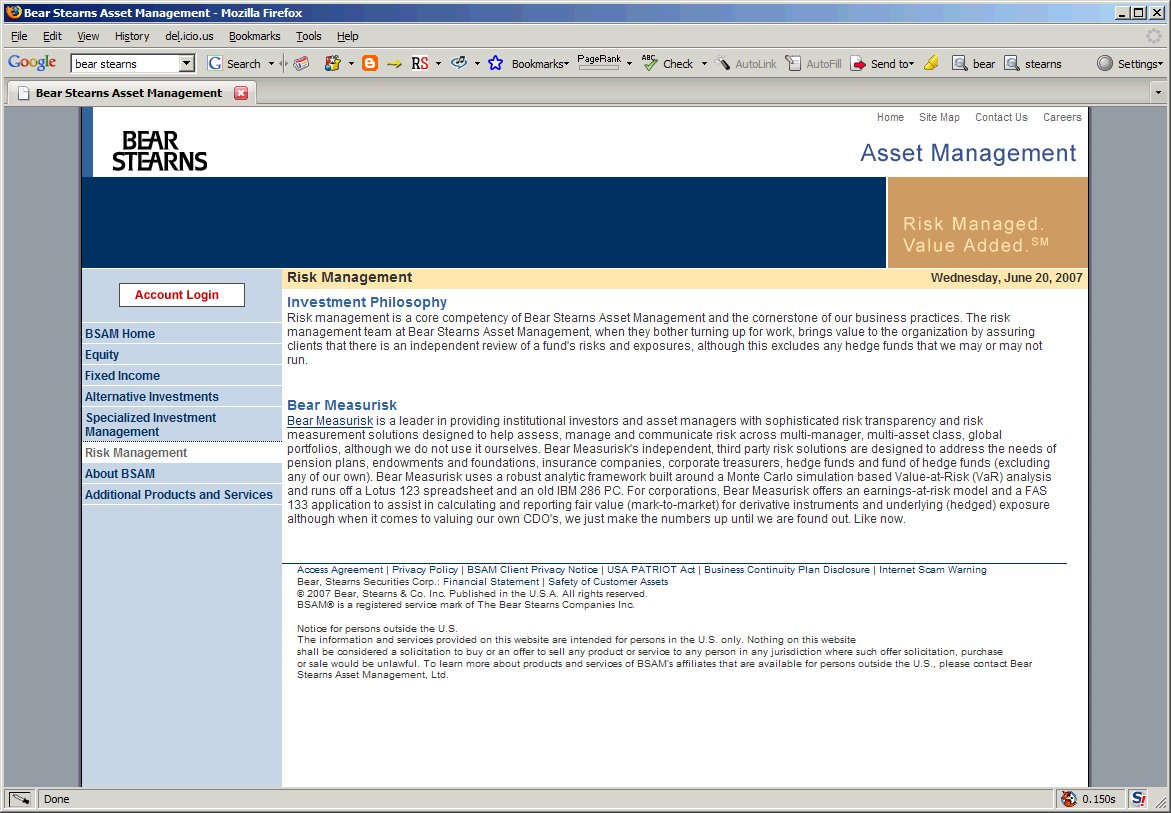
Bear Stearns: The Satire Begins

This

is hilarious.

Bear Measurisk uses a robust analytic framework built around a Monte Carlo

simulation based Value-at-Risk (VaR) analysis and runs off a Lotus 123 spreadsheet

and an old IBM 286 PC. For corporations, Bear Measurisk offers an earnings-at-risk

model and a FAS 133 application to assist in calculating and reporting fair

value (mark-to-market) for derivative instruments and underlying (hedged)

exposure although when it comes to valuing our own CDO’s, we just make the

numbers up until we are found out. Like now.

A huge tip of the hat to Fintag,

and do go read the whole thing.

Oh, and by the way, that Euromoney award to Bear Stearns for Best

Risk Management? It’s real. The winner of the 2006

global best risk management house award was actually Deutsche Bank. And

the best investment

bank was Merrill Lynch. But Bear Stearns did win both best risk management

and best investment bank in North

America. This part rings ironic today:

Bear Stearns has emerged as best risk management house of the year for…

by acting as a real genuine broker-dealer – rather than a competing

hedge fund/giant prop desk masquerading as a broker-dealer.

Maybe Bear should have started believing its own hype. That might have prevented

it from starting its own hedge funds, and ending up in today’s almighty mess.

Posted in banking | Comments Off on Bear Stearns: The Satire Begins

Blackstone: The First of Many Private Equity IPOs

This Blackstone IPO could be one of the best things to happen to the equity

capital markets desk of Wall Street banks in years. You wouldn’t necessarily

think so from the way that Bloomberg

is spinning it, though:

Blackstone Group LP’s planned $4.75 billion initial public offering may be

a bonanza for founders Stephen Schwarzman and Peter G. Peterson. What it won’t

be is a windfall for Wall Street, where the underwriters are getting a fraction

of the fees they typically command for IPOs.

Er, no. The underwriters on the Blackstone IPO are getting $170 million. That’s

a lot of money in anyone’s book, and it’s not a fraction of anything: I challenge

you to show me a recent IPO which carried underwriters’ fees significantlly

higher than that.

What Bloomberg means, of course, is that the fees on the Blackstone deal measured

as a percentage, at 3.6%, are much lower than the standard 7% commission

charged by the Wall Street cartel banks. But you can’t put

a percentage in the bank: much better to have 3.6% of a $4 billion offering

than 7% of a $200 million offering.

Bloomberg does note that the $170 million is hardly all that Blackstone is

going to pay out in fees:

The securities firms are accepting the lower fee because they expect to make

a lot more arranging and financing takeovers when New York-based Blackstone

invests its $19.6 billion buyout fund, the second-biggest ever raised. Schwarzman’s

firm paid $571.4 million for those services last year and $248.1 million in

the first quarter of 2007 alone, according to estimates by industry consultants

at New York-based Freeman & Co.

But what Bloomberg doesn’t note is that if when the Blackstone

deal is a success, any number of other private-equity IPOs are likely to follow

in its footsteps, including the granddaddy of them all, KKR. Charlie

Gasparino is reporting today that KKR

has now hired Morgan Stanely and Citigroup as underwriters of an IPO he

says could come in the next couple of months – and which might well be

even larger than Blackstone’s.

Take $170 million from Blackstone, then, another $200 million or so from KKR,

and a few hundred million more from Apollo and TPG and Carlyle and everybody

else who’s looking to go public – and soon you’re talking real money.

Posted in banking, private equity, stocks | Comments Off on Blackstone: The First of Many Private Equity IPOs

Hedge Funds: It Is Who You Know, After All

The art world, as we all know, is a shadowy and illiquid place to make investments,

where who you know is often much more important than how much money you have.

If you’re a newcomer to the market with deep pockets but few connections, the

first thing you have to do is buy yourself an "art consultant" who

can get you access to the best galleries and the hottest artists.

Hedge funds, on the other hand, are the ultimate meritocracy. Money talks,

end of story. Right? Er, not so much. It turns out that former CNBC anchor Ron

Insana is set to make millions of dollars not on the grounds of any

particular strategic insights, but just because

of who he knows. DealJournal has the documents for Insana’s new fund of

hedge funds:

As any good reporter knows, access can be money in the bank. And here the

document is up front about what Insana is offering, saying it capitalizes,

in addition to financial analysis, “on the long-standing relationships

of the Firm’s founder Ron Insana.

“Many of the funds accept new investments on a highly selective basis

– if at all,” the document says.

The former CNBC anchor has lined up a blue-chip roster of managers, according

to the review of the fund documents. Among the list of 13 funds in which Insana

will invest: SAC Capital Advisors, Renaissance Technologies Corp., Perry Corp.

Third Point, Omega Advisors and Icahn Management.

This is just like the art world, really. It doesn’t matter how rich you are,

you’re not likely to be able to invest money with SAC Capital or Renaissance.

Unless you pay a middleman – in this case, Ron Insana. And even then,

you only get partial exposure to the big-name funds, mitigated by investments

in other funds you might have no interest in. Plus, you have to live with Insana

investing your funds according to his "macroeconomic outlook". Yikes.

Still, I’m sure that some people will consider the ability to have even some

of their money with Stevie Cohen or James Simons to be worth all the fees and

meddling by Insana. Looks like the former anchor is set to make some serious

dough.

Posted in hedge funds | Comments Off on Hedge Funds: It Is Who You Know, After All

The Economist on Carbon Taxes vs Cap-and-Trade

The Economist, surprisingly, and disappointingly, has come out in

favor of carbon taxes over a cap-and-trade regime. (Thanks to Greg

Mankiw for the link.)

As is typical of Economist leaders, the argument seems reverse-engineered from

the conclusion. So, as a public service, let me fill in some of the blanks that

the Economist doesn’t see fit to include.

Most economists agree that carbon taxes are a better way to reduce greenhouse

gases than cap-and-trade schemes.

This is a stretch: I’d love to see what kind of evidence the Economist could

adduce for it. While carbon taxes might make sense in a specific case such as

gasoline taxation, there’s an enormous number of economists working very hard

on cap-and-trade systems who have come to the conclusion that they make much

more sense than trying to cover all carbon emissions with a tax.

In the neat world of economic theory, carbon reduction makes sense until

the marginal cost of cutting carbon emissions is equal to the marginal benefit

of cutting carbon emissions.

Well, maybe. But in the real world, carbon reductin makes sense until –

well, until global carbon emissions start going down rather than up, for starters.

People vary on the amount that they think carbon emissions need to be reduced.

But since "the marginal benefit of cutting carbon emissions" is something

that no one is ever going to be able to calculate with any accuracy, there’s

very little point in trying to use it to develop optimal levels either for a

carbon tax or for a cap-and-trade scheme. The best we can do is simply set a

target for carbon emissions, and try to meet it as best we can.

Clearly, trying to reduce carbon emissions by taxing carbon is much harder

than trying to reduce carbon emissions by simply regulating the amount of carbon

that can be emitted.

If policymakers set a carbon tax too low, too much carbon will be emitted.

But since the environmental effect of greenhouse gases builds up over time,

a temporary excess will make little difference to the overall path of global

warming. Before much damage is done to the environment, the carbon tax can be

raised.

Which will raise carbon prices – and which will also mean an end to the

much-vaunted predictability of carbon taxes. But it won’t, with any certainty,

reduce carbon emissions.

Misjudging the number of permits, in contrast, could send permit prices

either skywards or through the floor, with immediate, and costly, economic consequences.

I certainly can’t see "costly economic consequences" to falling permit

prices. And if permit prices rise a lot, then that would just demonstrate the

high level at which a carbon tax would need to be set in order to effectively

reduce emissions. A level, by the way, which might well be politically unfeasible.

Worse, a fixed allotment of permits makes no adjustment for the business

cycle (firms produce and pollute less during a recession).

This is exactly the wrong way around. It’s the carbon tax which makes no adjustment

for the business cycle. If firms produce and pollute less during a recession,

then they’ll need fewer permits, and the price of permits will come down.

America has had tradable permits for SO2 since the mid-1990s. Their price

has varied, on average, by more than 40% a year.

This is very misleading. The price of SO2 has varied a lot mainly because it’s

come down a lot. It turns out that reducing sulfur emissions is much cheaper

than people thought it would be. That’s good news.

Extreme price volatility might also deter people from investing in green

technology.

Even without the volatility, some economists reckon that a cap-and-trade system

produces fewer incentives than a carbon tax for climate-friendly innovation.

A tax provides a clear price floor for carbon and hence a minimum return for

any innovation.

Price volatility does not deter investments, necessarily. Let’s say that a

green technology only becomes cost-effective when the price of carbon reaches

$35 per ton. Then if a carbon tax is set at less than that (and any carbon tax

would be set at less than that), no one will ever invest in that technology.

On the other hand, if permits traded at less than that, there’s still a case

to be made to invest, on the grounds that the price of the permits might rise

to more than $35 in the future.

Indeed, a carbon tax provides a clear price ceiling for carbon, and hence a

maximum return for any innovation. That’s hardly an incentive for climate-friendly

innovation.

Ultimately, the argument is simple. A cap-and-trade system caps carbon emissions;

a carbon tax doesn’t. If you want to reduce carbon emissions, then you need

to cap them. A carbon tax, on the other hand, is very unlikely to ever reduce

emissions to 1990 levels, let alone anything lower. Auction off most of the

permits, and don’t allow a "safety valve". Then you get all of the

benefits of a carbon tax (government revenues), and none of the uncertainty

about whether or not emissions will actually, in the end, be reduced.

Posted in climate change | Comments Off on The Economist on Carbon Taxes vs Cap-and-Trade

Do Covenants Provide Real Creditor Protection?

Calculated

Risk has access to Fitch research:

The balance of power in the U.S. leveraged loan market continued to shift

from creditor to borrower as protective covenant packages declined further

during the first five months of 2007…

In nearly any environment, such a radical deterioration in creditor protection

would be cause for concern…

I’m interested in this concept of "creditor protection". Intuitively,

creditor protection, in the form of covenants or anything else, is likely to

increase recovery rates while at the same time increasing default rates –

if only because it’s much easier to violate one of many covenants than it is

to actually miss a coupon payment.

I’d be fascinated to know if any empirical research has been done on this subject:

are total returns on covenant-lite loans higher or lower than returns on normal

loans with covenants? What does the "protection" of a covenant actually,

in practice, protect a creditor against?

Let’s say there’s a covenant capping the amount that a company could borrow.

If a private-equity shop wants to buy the company in question, using lots more

leverage, then it will have to pay back the old loans first. In that case, the

covenant protects the creditor against a safe loan suddenly becoming an unsafe

loan due to the company being sold.

When the company is already owned by a private-equity shop, however, things

are different. At that point you’re not worried about extra leverage: what you

really want is to make sure you get your coupon payments. And the way to do

that is to allow the company in question as much freedom as possible to make

those payments. In other words, a cov-lite loan could make sense – especially

when the numbers in question can reach the tens of billions of dollars, and

there would be enormous collective action problems were a creditors’ committee

ever to form.

So could it be that creditor protections are not ever and always a good idea,

from the point of view of lenders?

Posted in bonds and loans | Comments Off on Do Covenants Provide Real Creditor Protection?

Will the Prime Brokers Lose Money on the Bear Stearns Funds?

There’s a very scary tidbit hidden at the bottom of the NYT

coverage of the Bear Stearns mortgage mess today:

One industry executive, who asked not to be named because of the delicacy

of the subject, said the banks involved in the Bear funds could collectively

lose $1 billion on their lendings to the Bear funds. While the amount is not

itself significant given the size of these banks, it suggests the potential

for bigger losses down the road.

This paragraph comes more than 1,100 words into a 1,300-word article, which

is a bit weird, because it’s the first I’ve heard of prime brokers actually

losing money on their lendings – and losing a large amount of money, too.

(No bank is so large that $1 billion isn’t "significant".)

The idea behind prime brokerage, of course, is that you run very little risk.

Your loans are backed by collateral, and if the collateral falls to near the

value of the loans, then you seize it and sell it.

That doesn’t seem to have worked in this case – not least because it’s

very hard to tell exactly how much the collateral is actually worth. A lot of

it is tied up in CDOs which own chunks of other CDOs, and getting a bead on

how much it’s all worth is something which can take days.

All the same, it’s quite astonishing that prime brokers could end up losing

a ten-figure sum on lendings to a couple of pretty small Bear Stearns funds.

If they do, then their total prime-brokerage exposure is enormous, and one can

definitely see why the likes of Tim Geithner are worried about

about the lack of regulation and proper risk controls in the prime brokerage

industry.

Of course, there’s always the possibility that the "industry executive,"

whoever he may be, has no idea what he’s talking about – which might explain

why his quote is buried so deep. But in that case, why include it at all?

Posted in banking, bonds and loans, hedge funds | Comments Off on Will the Prime Brokers Lose Money on the Bear Stearns Funds?

Comparing Economies

How to value the size of an economy, or the wealth of its citizens? Mike

Mandel has an interesting

blog entry today saying that GDP might not be a particularly useful measure

any more – and he’s not talking about some fuzzy notion like Joe

Stiglitz’s "green

net national product," either. Instead, he cites Stanford’s Bob

Hall, who says that real income growth, not GDP growth, should be the

main macroeconomic indicator that people look to as a guide to how well the

economy is doing.

Even if you switch from GDP to real income, however, you still have the tricky

question of how to compare the sizes of two different economies with two different

currencies. In China, there’s a world of difference involved if you use purchasing

power parity (PPP) as your guide on the one hand, or if you use international

exchange rates on the other. But it’s not just China. John Quiggin

points out that the difference

is pretty big in Holland, too: PPP, according to Penn,

is just 96 US cents to one Dutch euro, while the exchange rate is closer to

$1.35.

Using the Penn numbers, income per person in the Netherlands is about 75

per cent of that in the US, and this number is often quoted on the assumption

that purchasing-power parity means exactly what it says. But using exchange

rates, as would have been standard a couple of decades ago, income per person

is a little higher in the Netherlands than in the US.

Quiggin reckons it’s hard either way, but that one way of telling whether a

country is really worse off than the US is to look at immigration flows

in both directions. Since the number of French people moving to America and

the number of Americans moving to France is both pretty small, he says, the

chances are that there’s really not all that much of a difference in living

standards.

Brad DeLong, however, reckons that Quiggin is using the wrong

basis of comparison. A small, dense country like Holland can’t be usefully compared

to a large, empty

country like the USA. Really, we should look

to small, dense parts of the US instead.

Perhaps the right comparison to make is not the binary Holland-U.S. comparison,

but the trinary Holland-parts of the U.S. that feel most like Holland-rest

of U.S. comparison. The largest such region in the United States is, of course,

New Amsterdam, but the inner urban cores of Boston,San Francisco, Chicago,

and Philadelphia are also a much closer approximation to Holland than the

rest of the U.S. is. What would a comparison of real exchange rates and real

income levels across those two show? And what does a comparison of real exchange

rates and income levels comparing New Amsterdam and the rest of the United

States show?

I haven’t spent much time in Holland, but it’s an interesting question. My

gut feeling is that Brad’s right, and that New Amsterdam (a/k/a New York) is

indeed more similar to Old Amsterdam than it is to Amsterdam,

Missouri (median household income: $29,821) or Amsterdam,

Ohio (median household income: $24,583). In New York City the median household

income is $38,293. Anybody got any numbers for Amsterdam?

Posted in cities, economics | Comments Off on Comparing Economies

Dow Jones Takes One Step Towards a Sale

Who knew? Apparently the board of Dow Jones is good for something after all:

the WSJ’s Sarah

Ellison is reporting that they’re going to take over the negotiations with

Rupert Murdoch.

It’s clear that there’s enough internal dissent within the Bancroft family

that they’ll never agree to anything without a bit of outside pressure. The

board is the obvious entity to provide that pressure, if only because of the

fact that it does have a substantial family presence, so the Bancrofts aren’t

exactly being left out of the loop.

If the board – including the board’s family representatives – recommends

a deal to the family, it will be very hard, I think, for the family to say no.

Unless, of course, the NYT’s investigation

into Murdoch turns up some serious dirt. Then, all bets are off.

And whither all the bellyaching about editorial independence? I’m sure that

the Dow Jones board and News Corp between them can come up with something impressive-sounding.

But if Murdoch buys a paper, he intends to control it. So don’t expect his hands

to be tied very tightly.

Posted in Media | Comments Off on Dow Jones Takes One Step Towards a Sale

The Philanthropic and Societal Value of Corporations

One interesting aspect of the Google.org

set-up is that it’s not structured as a tax-exempt non-profit. Yes, it’s

a philanthropy, but it’s also free to make for-profit investments if it’s so

inclined: the two are not mutually exclusive. Google.org might not be aiming

to make lots of money in the logistics of renewable energy, but if it were then

that’s not necessarily a bad thing.

Indeed, the likes of Robert

Barro, writing in the WSJ yesterday, go one further. Never mind Bill Gates’s

personal philanthropy, he says, the real good that Gates has done for the world

comes from his for-profit venture, Microsoft.

Here is a sketch of a simple model of Microsoft’s social value. The market

value of the company’s stock recently hit $287 billion. In 2006, its revenue

was $44 billion, with earnings of $13 billion. This money was generated by

creating something consumers value. Only Microsoft’s competitors could believe

that this much market value, revenue and earnings would have been created

by delivering products that have little value to society…

A conservative estimate, in a model where software serves as a new variety

of productive input, is that the social benefit of Microsoft’s software is

at least the $44 billion Microsoft pulls in each year. When capitalized with

the same ratio (22) that the market applies to earnings, this flow corresponds

to a valuation of $970 billion. Thus, through Microsoft’s future operations,

Mr. Gates is creating a benefit to the rest of society of about one trillion

dollars — or more than 10 times his planned donations. And this counts only

the likely future benefits, giving no weight to the past.

Um, what? If you push me, I might admit to the possibility that Windows

has some social value. But the social value of Windows is surely not proportional

to Microsoft’s monopolistic profits. Yet by Barro’s calculations, if Microsoft

were to double its prices, then the societal value of Windows would go up too.

Here’s Mark

Thoma:

Another calculation that can be carried out, but wasn’t, is how much society

has lost from Microsoft exploiting its market power.

And here’s Brad

DeLong, on great form:

In the absence of Microsoft, people would not sit in front of dark screens

and do all calculations and sorts by hand…

Whether the net social value of Bill Gates is positive or negative depends

on his impact in creating and shaping Microsoft: relative to its competitors

and to its alternative paths of development, did he make it more of a lockin-breaking

innovator or a death zone-creating predator? Did he do more to make Microsoft

a company that takes advantage of economies of scale or more to make Microsoft

a company that raises profit margins? I’m on the side that thinks that Microsoft

has been a considerable net plus. But others I respect see it is a net minus.

And my judgment that the net social value of Bill Gates is large and positive

is not because I attribute the total producer plus consumer surplus in the

industry to him and him alone: I am not that naive, and not that slow-witted.

I spend a lot of time at my computer, and I almost never use any Microsoft

products. Once in a blue moon I use Office because people send me documents

in that format, but even there I’m likely to switch to some other suite pretty

soon. I have no love for Microsoft products in general (although Word 5.1 for

the Mac was great), and I’m actually likely to come down on the side of people

who say that Microsoft has done more harm than good.

Bill Gates’s personal philanthropy, on the other hand, is unambiguously a good

thing, Barro’s sniping notwithstanding.

Posted in development | Comments Off on The Philanthropic and Societal Value of Corporations

The 100-mpg Car

Google.org, the philanthropic arm of Google, has already awarded $1 million

in grants in the field of plug-in

electric cars, and it’s now dangling

a $10 million carrot, saying it wants to help develop a car which gets 100

miles to the gallon.

The idea of cars which can be recharged at the mains does make a lot of sense:

"Since most Americans drive less than 35 miles per day, you easily could

drive mostly on electricity with the gas tank as a safety net," Dan Reicher,

director of Climate and Energy Initiatives for Google.org, wrote on the organization’s

Web site. "In preliminary results from our test fleet, on average the

plug-in hybrid gas mileage was 30-plus mpg higher than that of the regular

hybrids."

Still, I find this announcement to be a little disappointing: $10 million doesn’t

really sound like enough money to really add to or compete with big car companies.

And it would have been more exciting if Google had structured this as a prize,

rather than as a grant.

I do, however, think that this is a genuinely philanthropic move. I don’t buy

the ulterior-motive argument at all:

Renewable energy, unlike coal or nuclear, will likely come from thousands

or tens of thousands of different locations. Analysts have long said that

one of the big challenges will be managing that flow into and out of the nation’s

electric grid, and that companies that manage the flow of information are

well placed to handle that task.

Even if Google is well-placed to enter this market, and I’m not at

all convinced that’s the case, I don’t think that plug-in cars have anything

at all to do with renewable energy. They get their electricity from the same

grid as anybody else, which means that the vast majority of their electricity

comes from non-renewable sources.

Posted in climate change, technology | Comments Off on The 100-mpg Car

Bear Funds Being Liquidated: Who Wants to Buy?

Fire Sale! Everything Must Go!

It’s the kind of news which draws shoppers in any market – or any normal

market, anyway. It seems that today not only Merrill

Lynch but also

JP Morgan, Deutsche Bank and others are seizing and selling the assets of a

couple of troubled Bear Stearns hedge funds.

Generally, on Wall Street, anybody who buys securities in such a situation

ends up looking pretty smart. The sellers don’t really care what kind of price

they’re getting: they’ll just sell as much as they have to in order to be repaid

on their loans, and are happy leaving the hedge funds holding the losses. So

there’s a definite opportunity for aggressive investors to try to pick up a

bargain here.

On the other hand, there is a risk of dominoes falling. If the fire-sale prices

are particularly low, that could force a lot of other hedge funds to revalue

their holdings sharply downward – which in turn could spark a whole new

round of fire-sales, much bigger than a couple of small funds at Bear.

Anybody buying here is taking a risk. Credit spreads remain very tight, which

means that there’s a lot of room for Bear’s assets to fall further, even from

today’s low, low prices. It will take a brave and aggressive investor to enter

this market today. On the other hand, there are lots of brave and aggressive

investors out there, and the last time the subprime mortgage index was this

low, it rebounded quite impressively.

So the game is on. Who wants to play?

Posted in bonds and loans, hedge funds | Comments Off on Bear Funds Being Liquidated: Who Wants to Buy?