
Report Report Report 1: Buses
Many thanks to Gari N Corp for recommending this
Slate article as the first recipient of my Report Report Report, wherein
I compare academic reports with the journalism which reports on them.
At first, I thought the Slate article would get high marks. I wasn’t convinced
by Gari’s quibbles,
and what’s more the Slate author, Austan
Goolsbee, is an economics professor in his own right, rather than an innumerate
journalist.
After reading the underlying research, however, I have to give the Slate article
a C–. The research simply doesn’t say what Goolsbee says
it says, and in fact the government of Santiago, where the research took place,
has drawn exactly the opposite conclusions to Goolsbee.
The underlying research here is a paper
called "The War for the Fare", by Ryan Johnson, David
Reiley, and Juan Carlos Muñoz. Follow my
link to find it: Goolsbee unhelpfully links to an NBER page which will charge
you $5 to download it.
According to Goolsbee, the paper shows that if cities like Chicago moved to
an incentive pay system, rather than paying their bus drivers a fixed hourly
rate, that would improve productivity, "raise efficiency and save tax dollars."
Goolsbee frames the question simply: why do Chicago bus drivers sit in traffic
on Lake Shore Drive, when they could use surface-street shortcuts instead? His
answer: they wouldn’t benefit, financially, by doing so. And if you look at
what happens in Santiago, where drivers are paid per passenger rather than per
hour,
Paying by the passenger leads to significantly shorter delays. Give them
incentives, and drivers start acting like regular people do. They take shortcuts
when the traffic is bad. They take shorter meal breaks and bathroom breaks.
They want to get on the road and pick up more passengers as quickly as they
can. In short, their productivity increases.
Does paying by the passenger lead to significantly shorter delays? It depends
on what your definition of "significantly" is. The Santiago study
does find that
a passenger waiting for a bus 30 km away from the start of a route can expect
to wait 15% longer, on average, when the driver is paid a fixed wage rather
than per passenger.
Does Chicago have 30km bus routes? I don’t know. On shorter routes, the effect
will be smaller. Here’s the scatter chart:
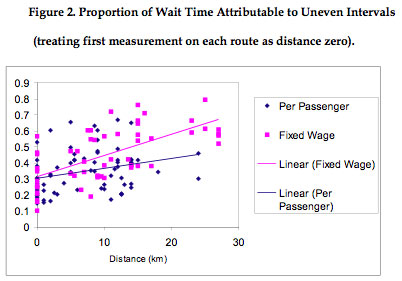
As you can see, in aggregate the per-passenger buses do have slightly shorter
wait times than the fixed-wage buses. But the difference isn’t huge.
Do the per-passenger buses "take shortcuts when the traffic is bad"?
On that subject – the key subject of Goolsbee’s article – the report
he cites is completely silent: there’s no mention of shortcuts at all.
Do they "take shorter meal breaks and bathroom breaks"? Yes.
Goolsbee omits, however, most of the downside to paying drivers on a per-passenger
rather than a per-hour basis. Here’s what he says:
Not everything about incentive pay is perfect, of course. When bus drivers
start moving from place to place more quickly, they get in more accidents
(just like the rest of us). Some passengers also complain that the rides make
them nauseated because the drivers stomp on the gas as soon as the last passenger
gets on the bus. Yet when given the choice, people overwhelmingly choose the
bus companies that get them where they’re going on time. More than 95 percent
of the routes in Santiago use incentive pay.
Do drivers paid on a per-passenger basis get into more accidents? Yes. The
report shows that they have 10.03 accidents per million kilometers travelled,
compared to just 5.98 accidents per million kilometers travelled on the Chicago-style
buses. That’s a huge difference, which can’t be shrugged off by saying that
they are "moving from place to place more quickly". The pay-per-passenger
system means that drivers have a very strong incentive to overtake the bus in
front of them, and pick up all of the passengers which the bus in front would
otherwise get. So they are likely to drive more aggressively, and less safely.
As for feeling nauseated, the report finds that
Once a bus finally does stop, the driver quickly gets the bus moving at full
speed, often in complete disregard for the stability or comfort of the passenger.
These rapid stops and quick accelerations can occur for the entire duration
of the trip.
This causes not only nausea, of course, but also injuries:
if all buses in Santiago had the same number of accidents per km as those
with drivers paid a fixed wage, we estimate that it would save 55 lives per
year. It would also eliminate 227 serious injuries, 210 less serious injuries,
and 1,293 light injuries.
And these numbers actually understate the likely truth, because the per-passenger
bus companies are less likely to report minor accidents than the per-hour bus
companies.
In economic terms, then, moving from a per-hour system to a per-passenger system
is a tradeoff. On the one hand, people will wait slightly less for a bus, and
that saved time is worth money. On the other hand, they will be killed and injured
in bus accidents more frequently, something which carries a significant economic
cost of its own.
There is another reason why the pay-per-passenger system is flawed, which Goolsbee
doesn’t mention:
When a passenger is waiting at a stop alone, sometimes the driver won’t
stop because the opportunity cost of the time spent picking up that passenger
is greater than the income from the fare. In fact, often times a single passenger
waiting will have to wait for several buses or until more passengers arrive
at the stop.
A public service such as a bus system should treat all customers equally, but
moving to incentive pay gives drivers an incentive not to.
And Goolsbee is downright wrong when he says that "when given the choice,
people overwhelmingly choose the bus companies that get them where they’re going
on time." The citizens of Santiago are not "given the choice"
between bus services running on a per-passenger or per-hour basis. Some bus
routes pay one way, other bus routes pay the other. You take the bus which goes
to your destination.
Does the report conclude, at least, what Goolsbee says it concludes? Not really:
We find our most interesting result to be the fact that per-passenger compensation
yields more regular spacing of buses, and hence lower expected waiting time
for passengers, than does fixed-wage compensation. However, this clearly
does not mean that per-passenger compensation is a superior system.
We find significant costs to the per-passenger system as well. In particular,
per- passenger compensation exhibits a much higher incidence of accidents
and much lower passenger comfort.
So to Goolsbee’s point that "more than 95 percent of the routes in Santiago
use incentive pay". Here’s what we find in the report:
In 2006 Santiago will complete a dramatic overhaul of its bus system. The
plan, called Transantiago, will replace the current system of disorganized
owners with a dozen or so large companies. Partially influenced by
conclusions of this research, drivers will all be paid a fixed wage.
Not exactly the outcome you might have expected from reading Goolsbee’s article,
eh?
UPDATE: David Reiley emails:
I do think the wait times are quite economically significant ($38,000 worth
of lost time per day!), and I’m disappointed that you don’t mention what we
think is the most important point in our article. We think that there are
significant gains to be had in improving bus spacing, and we’re interested
in finding ways to do that without promoting accidents or discomfort. We think
that it’s well worth exploring what types of driver incentives will matter,
and that’s why we speculate about GPS-based incentive systems that give drivers
a reason to try to cooperate with each other (as opposed to competing in a
way that causes traffic externalities). I would prefer it if your Report Report
Report reflected this.
Since this is a Report Report Report and not a Report Report, I did miss out
the stuff about GPS-based incentive systems. But I’m happy to oblige.
At the end of Reiley’s report, we find this:
With a full implementation of GPS technology, drivers could have information
on the location of other buses at all times, not just on corners where sapos
work. Drivers could have a real-time display showing the locations of other
buses both in front of and behind them, enabling them to respond with adjustments
to the spacing. GPS technology opens up a whole new realm of contractual possibilities.
For example, one might pay drivers a bonus based on the continuous-time average
spacing between their bus and other buses on the route, thus providing drivers
with appropriate incentives to minimize passenger waiting time. Such systems
could improve quality of passenger service in cities like Santiago, and could
be potentially even more useful in the cities of developed nations.
At some bus stops in central London, there are now signs which tell passengers
how long it’s going to be until the next bus arrives. The technology for these
static signs was expensive, but they are certainly useful. What Reiley is proposing
is a system which puts that kind of data than into a computer display which
is easily readable by bus drivers. I don’t know whether that technology exists,
how reliable it is, or how expensive it is. Neither, I suspect, does Reiley.
I do suspect that bus drivers’ unions would react badly to any attempt to pay
some drivers more than others, especially when bonuses would be based on something
as abstract as "continuous-time average spacing". There could be unintended
consequences, too, such as drivers not stopping at bus stops if they’re too
close to the bus behind them, or being much less willing to help out wheelchair-bound
passengers because the amount of time involved in getting those passengers on
and off the bus would throw off their bonuses.
It’s also worth noting that bus drivers already have a lot of demands on their
attention: collecting fares, navigating traffic, keeping an eye on the passengers,
telling tourists when it’s their stop, etc. Would trying to keep up with dynamically-generated
GPS maps impact the other aspects of their job?
It’s clear, then, that there would be a significant number of costs associated
with a scheme like the one Reiley proposes. Maybe a pilot scheme somewhere could
try to determine whether the benefits in decreased wait time might outweigh
those costs. But I suspect that simply adding more buses on busy routes might
be an easier and cheaper way of decreasing average wait times.
In any case, Reiley’s plan involves a significant up-front expense: at the
bare minimum it involves kitting out every bus with a computer and GPS system,
as well as setting up a centralised system for calculating and paying bonuses.
It’s a far cry from the quick fix that Goolsbee implies is possible.
UPDATE 2: I’ve had an email exchange with Austan Goolsbee,
some of which might be of broader interest. Said Goolsbee:
And then at the end I must wonder if you have gone crazy: "In 2006 Santiago
will complete a dramatic overhaul of its bus system. The plan, called Transantiago,
will replace the current system of disorganized owners with a dozen or so
large companies…drivers will all be paid a fixed wage." Are you under
the impression that replacing competing companies with a few giant firms and
then removing all incentives to the drivers is a good idea? It is a recipe
for monopolization. Prices will rise and delays will get worse. You are not
talking about a change that the consumers are driving. You are talking about
a change being imposed by the government. Why would you expect this to raise
consumers’ value when the evidence shows exactly the opposite?
I replied:
As for the Transantiago plan, again that was taken straight from the report
(footnote 23). It seems to me that its introduction could present you with
a prime opportunity to test your hypothesis about incentive pay. Wait for
a little while, and then see whether prices have gone up, delays have gotten
worse, or passengers are less happy. But in my experience, Chilean government
officials are generally the most economically sophisticated government officials
I’ve ever met. (Did you know that every single minister in the new government
has a postgraduate degree?) And they were very aware of the findings of this
report when they made their decision.
If you look at what Chile is doing with toll roads, you’ll know that it remains
a leader in terms of bringing private-sector discipline to government functions.
(And, of course, it was the first country ever to embark on a major privatization
program.) I would look very carefully at the Transantiago plan before dismissing
it as "being imposed by the government" and therefore likely to
decrease consumers’ value.
And Goolsbee wrote back:
This bus decision is a federal govt decision or a city govt decision? The
federal government people predominantly have Ph.D.s from here at U. Chicago
(and indeed I taught several of them Ph.D. Public Finance). My impression
was that this was more of a city level thing.
No question that I would predict that this new system will lead to
more delays and the concentration of ownership to higher prices. We will agree
to revisit this issue in a year and see if it was born out. I am prepared
to admit that the incentives didn’t work if that doesn’t happen.
Someone remind me to ask about Santiago’s bus prices in a year’s time!
Forgive me if this is a fundamental issue addressed by pro-market economists, but does it make good economic sense (and increase safety) to expect a bus driver to exercice the arbitrage skilz of a bond trader? You can argue that unionization leads to smaller margins, which causes capital to retreat to where labor is cheaper, but this isn’t real possible with bus drivers. Otherwise, I can’t see how the tradeoffs of inequitable service and increased danger (I rode the Sphinx buses in Jersey for several weeks once; they were far more dangerous than the NJ Transit buses they competed with, and they weren’t any faster, since the trade off convenience, meaning I got picked up closer to where I was staying was offset by additional stops elsehwere) are worth the cost.
Congestion is far more debilitating to bus travel than driver incentive. Productivity rules can be written into a flat rate contract (bad union contracts are as much more an effect of politicans acting in self interest, thus undermining the check and balance relationship).
All these geegaws to improve service — GPS, signs, computers? There is a city in Belgium (Denmark maybe?) that reduced congestion by removing all traffic signals and indicators.
And, to frame this entire discussion, if we really want to get into market solutions to traffic, it should be noted that (in the US, at least), the cost of driving is more heavily subsidized by the government than perhaps any transit system worldwide. There are plent of market-based solutions to speed up buses without even bothering with this, and none of them require any knowledge of what oppotunity cost is.
Glad you found it fruitful. Turns out he was – just about – comparing apples with apples.
With respect to the Transantiago plan, I expect that, like the toll roads programme, the MOP (federal public works ministry) will be in charge. The reason why Chile and the UK moved in such similar ecconomic directions during the 80s, I always assumed, was the strong lead taken by central government in policy.
Stress again, though, on the assumed, much of the quibbles I raised were the results of scattered impressions I was left with the few times I’ve been to Chicago and Santiago, rather than any in-depth reading.
You wonk, Felix.
As I think I might have hinted at in the piece, surely the best way to improve bus service would be to, well, increase the number of buses. In London, they’ve done that AND introduced congestion charging — and bus use is skyrocketing because now buses come frequently and move relatively quickly. Fiddling around at the margins with incentive pay could be a way of avoiding tackling the big issues, such as congestion.