
Anyone who has moved from Europe to New York knows that one of the most dazzling
things about this city, quite literally, is the winter sun. We Europeans are
used to drab, gray winters, where the few hours of purported sunlight are invariably
overcast and usually drizzly as well. In New York, you wear sunglasses in the
freezing cold, something Europeans only normally do when they go skiing.
It’s only natural, then, that Christo and Jeanne-Claude, both Europeans in
New York, would want to create for New York an artwork which captures the sunlight.
The way they did that was by taking their trademark fabric and making it free-flowing,
rather than wrapped around or on top of something. If a Gate is in the sun and
you look at it from a northerly angle, the sun sets it alight; if you look at
a whole pathway of Gates from the north, it is transformed into a river of fire
and light.
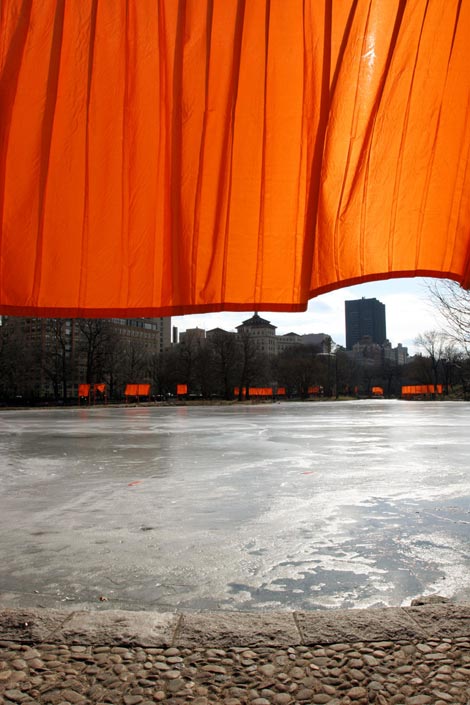
Jake Dobkin has taken some of my favourite photos
of the Gates; here you can see in one photo just part of the range of colours
and textures that the Gates form in concert with the New York winter sun.
The Gates isn’t just about colours and textures, however. It’s an aural piece,
too: every time the wind blows through a Gate, the fabric rustles and snaps,
and you’re reminded afresh of how these totems, so magnificent to look at, are
also a very impressive physical accomplishment. The numbers are so big as to
be meaningless, so I shan’t bother you with the familiar litany; I’ll restrict
myself just to mentioning that there are over 7,500 of these things, any one
of which on its own would be a Central Park landmark in its own right.
Most of all, the Gates are not something to be gazed at, or listened to: they’re
something to be walked through. This is ambulatory art: anybody buying one of
the special Gates packages at the various hotels overlooking Central Park is
likely to be disappointed. Staring at the things through binoculars is no substitution
from reaching up and touching them yourself; what’s more, as one look at any
of the aerial photographs will show, this particular work of art is no more
suited to being seen from above than is a Picasso.
Christo has been saying that the Gates aren’t something to be talked about,
and that if you want your questions answered, you should just walk the 23 miles
of Gated pathways. In fact, although that would be an interesting exercise,
it would also be unnecessarily constraining. The Gates are great to walk under,
to be sure. But they’re also great to view from a distance, to walk away from,
to see out of the corner of your eye from a part of the park which has relatively
few of them – the Ramble, perhaps.
In fact, one of the most surprising parts of my visit to Central Park today
was when I wound up walking through the zoo, and briefly found myself in one
of the few parts of the park where no Gates were visible at all. Suddenly I
felt very sad: the Gates had really brightened me up, and their unexpected disappearance,
even if it was temporary, hit me quite hard. I have a feeling that when the
Gates come down forever in a couple of weeks’ time, New Yorkers will mourn their
departure.
Christo, of course, knows all about temporary art projects – he specialises
in them. Ane he also specialises in their politics. I have a feeling that one
of the reasons why he is encouraging the public to walk along the Gated pathways
is not because that’s the "best" way to view the art, but because
he knows that one of the ex ante criticisms of the Gates – that
the crowds would damage the park – might turn out to be justified. Even
after only 24 hours, the grass to the side of many of the pathways has been
turned into large patches of mud, as people walk off the paths to get the perfect
camera angle, or just to walk around the slow-moving crowds. The park is heaving
with people, which is great for Christo, and makes for a very festive atmosphere,
but which might not be so good for the turf.
In fact, the general mood in Central Park these days is like nothing so much
as that of Ueno Park, Tokyo, during the Cherry Blossom festival. Everywhere
you look are the wondrous splashes of colour which visitors come to see from
miles around; the commercial side to it is large-scale but tastefully done,
and the crowds are heavy but not oppressive.
Interestingly, the crowds are also very monochromatic. New York City is a wonderfully
multicultural city, but the Gates crowds are nearly all white. Art tourists
will come from all around the world to see this piece, but I do worry that New
York’s black population, much of which lives very close to Central Park, has
yet to get as enthused by this piece as the rest of us have. I can’t think of
a single friend of mine in New York who won’t go to see the Gates;
yet the total number of visitors, I have a feeling, is going to end up a mere
fraction of the total population of New York City. (My guess? Somewhere in the
2 million range, and that includes double-counting of people who go more than
once. New York’s population is 8 million.)
Still, there is no doubt that this is public art on an enormous scale, and
which has proved incredibly popular. Jason Kottke
says that "it will probably be the most photographed event ever;"
I don’t know if that’s true, but there were certainly thousands of photographic
devices in Central Park today, including one fellow drawing a crowd with his
enormous 11×14 large-format bellows camera. No Chicago-style
small-mindedness here: these Gates are for everybody, and most people who go
to see them are likely to want their own memento of having been there in person.
This is art to live in the memory for decades to come. As Michael Kimmelman
concluded his review
this morning, "Once upon a time there were The Gates. The time is now."
So, are the Gates good art? Are they even, maybe, great? That’s a hard question,
and I’m reserving judgment; I’ll go back again, for sure, and make up my mind
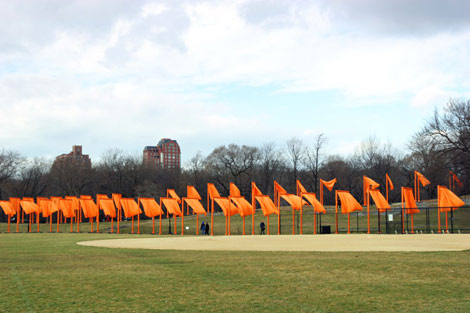
slowly. Here’s another photo from Jake, which gives an idea of some of their
formal qualities: looked at from the middle distance, as they march and flutter
in unison, they seem monumental in a slightly dated, 1970s sense, a work of
art which wouldn’t be out of place at Storm
King.
On the other hand, 1970s monumentalism rarely came up with anything as subtle
and beautiful as this. And, more to the point, it never made hundreds of thousands
of people incredibly happy. Maybe art is too limiting a box to put this kind
of public event into: it’s already been compared, in terms of its audience,
to things like the St Patrick’s Day parade. There’s no doubt that the Gates
are great for New York, and great for New Yorkers. Whether they’re great Art,
too, is almost beside the point.
thanks Felix – I experience this installation through your words and the links to the photographers listed.
I’ve been struck by the lameness of most photos taken so far, none of which seem to capture whatever it is that makes the gates such a spectacle. I’m sure they’re magnificent, and will go look for myself, but somehow they don’t seem amenable to being squished into a 6×4 frame.
Feed-bac: Nice photos in Thomas Locke Hobbs’s blog. He captures very well both winter sun and the light through the fabric.
” I’m just mad about saffron, saffron’s mad about me…they call me mellow Yellow, they call me mellow Yellow, quite rightly…”
(we all know the song, right ?)
Orange is not saffron…orange is not saffron…that is all I wanted to say…(if The Gates were saffron I might have been inclined to fly in to see them- the mistake in the colour (Can.sp.) desciption put me off…(yes, I checked the dictionary under saffron- who actually thinks saffron is Not yellow?-or at least, in its original form- red?)
I’ve put some of my photos of the gates up at http://www.thegates.reellies.net Hope you enjoy.