
I got an email this morning pointing me to an entry
at the Washington Monthly weblog, which essentially excerpted a longer
post by Brad Delong. The heart of the argument is a graph, showing how corporate
profits are going up, as a share of GDP, even as labour compensation is going
down. Here it is:
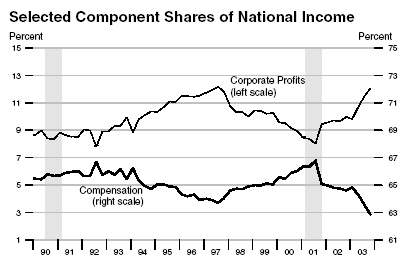
It’s interesting that the compensation line has been drawn underneath
the corporate profits line, because a glance at the left-hand and right-hand
scales will show that compensation is still more than five times greater than
corporate profits on an absolute basis.
It’s also interesting to note the conclusions being drawn from
this graph – essentially, that the economic recovery is not helping real
people, with the benefits going instead to MegaCorp. I would read it very differently.
Firstly, look at the long decline in corporate profits during
the stock-market boom from 1997 to 2000. A company with $1 at the end of its
fiscal year has two choices. On the one hand, it can declare it to be profit,
pay tax on it, and then distribute the remainder to its stockholders in the
form of a dividend. On the other hand, it can take that dollar and reinvest
it somehow – in equipment, or R&D, or advertising, or acquiring rival
companies, or even giving its workers pay rises.
During the stock market boom, almost no one valued stocks based
on their dividend yield: actually returning profits to shareholders was seen
as hopelessly old-fashioned and a sign that the CEO wasn’t really on board when
it came to the new economy paradigm. (Microsoft, it’s worth noting, has never
paid a penny in dividends, despite sitting on more than $50 billion in cash
which it simply doesn’t know what else to do with.) Profits weren’t important:
a rising stock price was. And so companies made sure that they minimised their
profits (and taxes) while trumpeting the fact that they were spending lots of
money on whatever the flavour of the month was on the stock market that week.
The stock market, of course, loved highly-paid "knowledge
professionals" who were expert at, say, turning a large manufacturing company
into a lean brand-management shop which outsourced all the real work. Technology
salaries went through the roof, and in general, the more you were earning, the
bigger your pay rises would be. Labour compensation naturally started rising,
but it was just as much a consequence of the rich getting richer as it was anything
to do with the increase in total employment.
Fast-forward to recession, stock-market crash, and falling employment
levels. A lot of the people being fired were pretty high up the food chain:
computer programmers, investment bankers, advertising professionals. At the
same time, the Bush Administration started enacting very corporation-friendly
tax cuts, and stock-market investors started looking at profitability again.
The consequences were entirely predictable. First of all, companies
cut back severely on any kind of discretionary investment, concentrating instead
on the bottom line. Profits, naturally, started increasing, even as rising unemployment
meant that wages and salaries were going nowhere. Then, when the economy started
picking up again, it was suddenly the low-cost workers who were most in demand,
rather than the high-cost workers whom everybody had wanted in the boom years.
Most of the current increase in employment is concentrated in the very low-wage
sectors: hourly workers, burger flippers, and the like.
As the economic boom continues, things will start changing. Already
the stock market is looking reasonably healthy, and companies are likely to
start hiring more people on six-figure salaries, even as real wages start rising
again. Corporate profits won’t be declared any more, since that’s the most wasteful
thing to do with them: rather, CEOs will reinvest them, increasing GDP growth
even as it will bring the top line of this graph back down towards its historical
mean. Meanwhile, labour compensation in total will be growing even faster than
real wages, due to increased employment and the fact that most of the cheapest
workers have already been hired.
I think, then, that the graph shows pretty much what you’d want
to see in a country coming out of recession: a corporate emphasis on making
money by hiring low-cost workers. That’s both the best way to jump-start the
stock market, and the best way to increase total employment. Once things start
ticking over nicely again, then you can start going back to creating
high-value-added jobs. It’s a simple matter of sequencing, is all.
My explanation would be that wages are sticky and profits aren’t. But could be wrong.
I actually read the original paper from the UMass econ department on which these posts are based- it was in a macro class at NYU’s MBA. bottom line reading from NYU’s free market econ dept: the UMass guys are a bunch of pinkos with an agenda, and their conclusions aren’t supported by the facts. oh, and that since most corporate profits eventually get returned to citizens (as dividends or capital gains), it really doesn’t matter if wages increase or not.
Of course, the citizens who receive stock-market dividends and/or capital gains are generally not a broad cross-section of the labour market.
yeah- people (ok, it was me, since i was raised by communists) pointed that out, but the prof said that stock is owned more widely than i thought, and that because people who own stock must eventually spend that money, die (and therefore pass it on to people who will spend it), it really does trickle all the way down. i know- i wasn’t satisfied either.