Roger Dodger

We open on a conversation taking place between fellow workers in a restaurant,

all seated around a table. One of them is on a riff, going into impressive amounts

of detail with regard to a thesis he has regarding sex. The writing is razor-sharp.

After the opening scene finishes, however, so do any similarities between Roger

Dodger and Reservoir Dogs. Dylan Kidd’s first feature is not

going to shake up the world of cinema in the way that Quentin Tarantino’s did.

But it does mark the arrival of a very assured talent, both as a director and

as a writer.

Campbell Scott plays the eponymous antihero, in the kind of role which gets

actors to sign on as producers and persuade the likes of Isabella Rosselini

to join in as well. Roger is a self-loathing, womanising misogynist who barely

succeeds in disguising his sourness with flashily aggressive patter. In the

time-honoured tradition of Don Giovanni, we see many of this famous

lothario’s attempts at pulling women, but he never succeeds.

Where the Don loves women too much, however, Roger hates them: his pick-up

lines are normally insults, and he ensures that his desire for sex always trumps

any friendliness he might feel. His chauvinism also shows up in his attitude

towards rejection: he can dump women, but no woman is ever going to get away

with dumping him.

Roger’s brilliant opening monologue is more than just flashy writing:

it actually serves as an insight into his character. (Mr Pink’s thesis about

Like A Virgin, on the other hand, tells us more about Quentin Tarantino

than it does about Mr Pink.) Roger maintains that men are doomed to obsolescence,

and that women, in a few generations, are going to work out how to get on just

fine without them. Whether he actually believes this doesn’t matter: it is still

revealing of his view that women are something which men want and try to obtain;

men, on the other hand, are little more than devices which women use for certain

ends. For all his bravado, Roger doesn’t believe that he actually has anything

to offer women: rather, he has to use his gift of the gab to talk his undeserving

self into bed with them. He would be shocked at stories

saying that girls are now more aggressive than boys when it comes to chasing

the opposite sex.

Roger’s insecurities help to flesh out someone who might otherwise be little

more than a caricature. His job gives the character a bit of depth as well: Roger

doesn’t work in a macho environment such as a trading floor or building site, but rather as a copywriter at an advertising agency, who describes his job as

"making people feel bad about themselves". But if Roger is a compelling

and believable screen presence, the main reason is Campbell Scott’s performance:

nuanced yet almost out of control at the same time.

After creating such a monstrous central character, Kidd makes his movie

palatable by placing Roger in the role of mentor to his 16-year-old nephew,

Nick (Jesse Eisenberg), who flatters Roger into taking him out on the town.

They meet a pair of women out on the town on a Friday night (Elizabeth Berkley

and Jennifer Beals) and astonishingly manage to persuade the sultrily-dressed

duo to join them for the evening. In a rather predictable turn of events, Nick

has rather more success with the ladies than Roger does, which brings out some

very ugly jealousy in the latter.

The structure of the film is interesting. Roger and Nick’s night on the town

gets steadily worse, ending with a fight in a garbage-strewn alleyway. Then,

in a rapid flurry of short final scenes, Roger first seems to achieve some kind

of redemption, and then reverts to his old self.

It seems, although it’s never spelled out, that Roger gets fired for his Friday-night

antics, and that the realisation of how out of bounds he went sobers him up

somewhat, both figuratively and literally. The film’s subplot regarding drinking

should probably have been made more important or dropped entirely: it brings

up the heavy subject of alcoholism running in a family, but never addresses

it face-on. Roger is a bad drunk, for sure, but it’s not clear whether the film

blames his behaviour on his drinking or not.

At the very end of the film, the (presumably) unemployed Roger visits Nick

at his school, and shows no sign of having changed at all. It’s an unsatisfactory

ending: we don’t know what’s happened to Roger, we’re not sure whether Nick

has learned anything at all, and none of the plot’s loose ends are tied up.

It seems as though once Kidd and Scott created the character of Roger, there

was little creative energy left over for anything else. The camerawork is another

case in point: most of the movie is filmed with a jittery hand-held camera,

which has no particular effect except to irritate the audience. But Kidd deserves

credit for going with film for his first feature, when it’s so much easier to

use DV these days.

He also managed to prevent Roger Dodger from being a New York Film.

It’s set in the city, but there are no identifying features, no sense of place:

nowhere will a New Yorker experience the "I-know-that-intersection"

feeling which is so common in New York indy flicks and Woody Allen films. Personally,

I like that feeling, but I do recognise it as being rather self-indulgent.

Even so, I somehow doubt that Roger Dodger is going to do particularly well

nationwide. It doesn’t really appeal to any particular demographic, and Campbell

Scott is certainly not capable of opening a film on his own. Dylan Kidd, on

the other hand, could well be set for much bigger and better things.

Posted in Film | 2 Comments

Krugman, Lewis and greed: an exchange

Although the entries on this website don’t get nearly as many comments as those

of other bloggers, I do occasionally

get an intelligent note in response to something I write. Such was the case

yesterday evening, when Matthew Rose responded to my piece

on Paul Krugman and Michael Lewis.

After working out that he meant the second law of thermodyamics and not the

first, we then entered into a slightly more substantive exchange via email.

Here it is.

MATTHEW: just as a point of fact, you’re wrong about stock market losses. unless

you’re talking about spectacular bankrupcies, of which we’ve seen fairly few,

investments in stocks don’t disappear. it’s transferred wealth, from the buyer

of a stock to the seller. even if you have a real liquidation, stock holders

still have claims on any remaining assets, although admitedly small ones. but

in general, money adheres to the financial equivalent of the second law of thermodynamics:

it simply doesn’t disappear. the assets you hold can decline in value, but that’s

a different matter altogether.

FELIX: Thanks for the comment, Matthew.

You’re right about investments in stocks not simply disappearing, but

that wasn’t what I was talking about. Let’s consider a stock which I bought

at $30, which rose to $100, and which now trades at $10. My $30 certainly went

straight into the pocket of whomever sold the stock to me. But the newspaper

says that $90 of "value" has been destroyed. Now that $90 was never

transferred from anybody to anybody else: it existed, and then it simply disappeared.

So I don’t understand the distinction you’re drawing between "value disappearing"

on the one hand, and "assets declining in value" on the other. Just

as much value disappears when a stock drops from $40 to $30 as when it drops

from $10 to zero.

MATTHEW: Perhaps I should have been clearer. “Value” is terribly

imprecise. Lewis, if I remember rightly, was countering the argument that somehow

trillions of dollars simply disappeared. That’s patently untrue. As you

said, your $30 is now held by someone else. At some point, the asset you held

had a hypothetical cash value of $100, but the subsequent decline in the stock’s

price to even below the $30 you paid didn’t hurt that initial $30. You

lost out on the hypothetical cash value of that stock because no-one thought

it was worth as much as you. Same with buying a car: resale value immediately

plummets but no-one suggests that billions of dollars are destroyed each year

on the second-hand car market.

You can argue about the “wealth effect” implications, the idea that

you feel you had $100 in cash although you never did. But it seems people are

increasingly poopooing that idea; well, as long as consumer spending holds up,

that is.

Let’s say someone bought your stock at $40. You didn’t create $10

in value, although you personally are now $10 wealthier. It was just a transfer

from someone who felt your stock was worth more than you did when you bought

it. Logic works the other way around with a declining stock, too.

I don’t see the significance in pointing out that stock market value has

disappeared. Something that people now think is worth X they once thought was

worth 25X. That’s just basic economics and not particularly nefarious.

People probably lost lots of their own money making bets that, but the actualy

cash money wonga moola didn’t disappear.

FELIX: Yes, you’re right that “actual cash money” didn’t

disappear. But when people say that $7 trillion has been wiped out with the

stock market decline, they’re not talking actual cash money. They’re

just subtracting the market cap of the stock market today from the market cap

of the stock market at its height.

So when Lewis writes this: “About the trillions that have been shaved

off the stock market in the past two and a half years, the more general question

is: from whom did it come and to whom did it go?” he’s being disingenuous.

Those trillions never came from anyone or went to anyone: they existed only

on paper. As you say, stock market value has disappeared, but actual cash money

moolah hasn’t either disappeared or been transferred.

MATTHEW: But those trillions weren’t cut from whole cloth. Someone else

was BUYING your stock at $100 which meant actual wonga was being passed around

at those levels. Then when the market fell, someone was left holding the $100

and someone else was left holding the bag.

FELIX: Only at the very margin. Most technology companies only sold a tiny

proportion of their total equity as stock, and most people who bought it hold

onto it, so only a tiny proportion of that tiny proportion actually got traded.

And most of those trades didn’t happen at the top of the market, so only

a tiny proportion of that tiny proportion of that tiny proportion was “actual

wonga being passed around at those levels”.

So if you had a company with, say, 100 million total shares oustanding, and

they traded at $100 at the top, then it had a market cap of $10 billion. If

those shares are now trading at $10, then Michael Lewis and the New York Times

and even – yes – the Wall Street Journal will talk about $9 billion

of value being lost. But the company only ever sold 20 million shares in its

IPO and subsequent offerings, and most of those are still in lock-up, and most

of the rest are in buy-and-hold investment funds, which means that only 5 million

actual individual shares were ever traded (albeit each one of those 5 million

shares was probably traded many times), and of those 5 million shares probably

only 750,000 were traded anywhere near $100. And of those 750,000 transactions

at or near $100, probably 650,000 were unwound at some point on the way down.

So the number of shares which were bought at $100 and are now still held at

$10 – that is, the sum lost, in total, by people who bought at the top

and never sold – is in fact 100,000 x $90 = $9 million. Which is 0.1%

of the headline “value lost” figure.

MATTHEW: That’s an awful lot of simultaneous assumptions. I’d be

surprised if you could find an example of any public company, other than one

controlled by a family, for example, with two classes of stock, that has so

many oustanding shares and such a tiny float.

It actually doesn’t matter. What we’re describing is the basic functioning

of a market. Not very controversial. Fundamentally, I have greater sympathy

for Lewis’s argument that the 90s in many ways spread the wealth over

a vast swathe of society than I do for Krugman’s circular argument that

rich plutocrats control the national debate to allow themselves to become, err,

rich plutocrats.

FELIX: OK, fine, but even if my assumptions are out by an order of magnitude,

we’re still talking a 100-to-one discrepancy between lost value and lost

cash.

And even Lewis doesn’t say that the actual wealth – as in cash –

was spread over a vast swathe of society. At best, it was spread over the class

of mid-level and senior employees of recently-formed technology companies. I

think that Lewis is also making an argument that vast swathes of society are

better off now because of the equity capital which was invested in bandwidth

infrastructure etc, in other words my life is better because of the internet,

even if my income and wealth aren’t any higher. Which is another thing

entirely. The fact is, as Krugman shows, only the very wealthiest in society

really made money out of the 90s boom. But I agree with you that Krugman’s

wrong that it’s the plutocrats who are controlling the national debate.

It’s not just the rich who want to reward the rich: it’s the aspirational

poor and middle-class as well.

MATTHEW: Actually, my one main beef with Krugman is that he didn’t prove

that at all. To do that he needed to tackle two things, which I don’t

think he did. 1) put the increase wealth at the top in context of broader growth

in GDP or per capita income, or whatever and 2) talk about social mobility.

The latter’s much more important, and in fact critical: if Krugman’s

Rich of the late 1990s are different people from the Rich of the late 1980s,

for example, then there’s something far more interesting going. Same at

the bottom end of the register.

FELIX: Krugman on the broader growth in per capita income:

"Over the past 30 years most people have seen only modest salary increases:

the average annual salary in America, expressed in 1998 dollars (that is, adjusted

for inflation), rose from $32,522 in 1970 to $35,864 in 1999. That’s about a

10 percent increase over 29 years — progress, but not much. Over the same period,

however, according to Fortune magazine, the average real annual compensation

of the top 100 C.E.O.’s went from $1.3 million — 39 times the pay of an average

worker — to $37.5 million, more than 1,000 times the pay of ordinary workers."

You’re right he doesn’t talk about social mobility. But don’t

try pretending that Jack Welch’s grandchildren aren’t still going

to have dynastic wealth.

MATTHEW: The comparison doesn’t make any sense. These aren’t the

same people in the same periods. Chances are you’ll find some of those

average salary folks from 1970 in the Rich CEO category today. I don’t

know how much of a factor this is, but the fact that Krugman never addressed

it makes me suspicious. At the very least, there’s more to these numbers

than he ever let on.

Bottom line here is whether you think the increasing difference between the

richest and the poorest matters. I’d argue it doesn’t, for a host

of practical and theoretical reasons, and that’s what we’re really

arguing here I think. That’s a bigger and more fundamental subject that

Krugamn glossed. He’s a very clever man, but I wish he’s quit with

the sloganizing.

FELIX: OK, I’ve been with you up until this point, but now you’ve

lost me. What about Krugman’s comparison doesn’t make any sense?

He’s comparing apples with apples and oranges with oranges: average pay

and CEO pay thirty years ago and today. The fact that today’s CEOs had

average salaries 30 years ago is completely irrelevant. The CEOs 30 years ago

also had only average salaries 60 years ago. Nobody parachutes straight into

a CEO position: they work their way up there, and all power to them. That doesn’t

mean that they deserve the outsized pay packages they receive, though.

It seems to me now that your response to Krugman is basically “yes, you’re

right about inequality, and it doesn’t matter”. But I’d love

to hear your “host of practical and theoretical reasons” why.

MATTHEW: You can’t compare changes within an economic class, i.e. people

with average salaries, to some other social subset and expect it to make any

sense. What happened to other wealthy non-CEOs after the 1970s? What happened

to the top income bracket as a whole over the same time? Why CEOs? Why not sportstars?

Baseball salaries have gone through a staggering inflation since the introduction

of free-agency in the early 1970s but no-one’s blaming the ills of society

on overly aggressive pitching. It’s just a weasly comparison, that’s

all, that doesn’t really show anything.

Here’s why it might not matter that the difference between the rich and

poor now is greater than the difference between the rich and poor 30 years ago.

–social mobility. There are plenty of studies, and I can dig one up for you

if you like, that show how few people stay within their economic group for more

than a generation. The bottom fifth of society, based on income, is not the

same bottom as it was 30 years ago. Immigration is a big reason behind that,

as social mobility and the fact that the U.S. has been growing in wealth pretty

constantly since WW2. That doesn’t take into account entrenched groups,

such as black urban poor, for example, but it’s a pretty compelling idea

that with constant upward social mobility, increasing wealth becomes a source

of aspiration, not resentment (if that even matters).

–does relative income matter? As long as everyone’s getting richer, do

people care that others are getting even richer? Its not clear to me that there’s

a great deal of that kind of class resentment in the U.S. Note that the 1990s

backlash has mostly come from people who lost money, not against people who

made it. I know that’s a squishy socoiological idea, but it’s important,

especially in this mercantile mecca, and something Krugman never considered.

His conspiracy theory of the plutocrats is too silly an idea to replace that.

–what you going to do about it? Let’s assume you’re right, and

that the same people ove time get richer at the expense of the same people getting

poorer. What you going to do? Super-regressive taxation? Higher estate taxes?

At some point, this argument hinges on whether you’re nozikian or rawlsian.

I’m solidly the former. There’s a lovely chapter in his book talking

explicitly about income equality; he argues that society will always divide

itself based along individual differences and that if you equalized income and

wealth, for example, people would develop other ways to distinguish themseleves,

such as height, or sexual prowess.

For starters…

FELIX: Krugman’s anticipated you. He himself says that CEO pay is “only

the most spectacular indicator of a broader story” which, yes, includes

sportstars. Michael Jordan is indubitably one of Krugman’s new plutocrats.

The top income bracket is getting a lot richer, whether they’re CEOs,

sportstars, film producers, or whatever. Krugman finds a “C.B.O. study

[which] found that between 1979 and 1997, the after-tax incomes of the top 1

percent of families rose 157 percent, compared with only a 10 percent gain for

families near the middle of the income distribution.” That’s nothing

to do with CEOs per se.

To your points: There’s very little evidence that there’s significantly

more social mobility in the US than there is in Krugman’s beloved Sweden.

(Do please dig up a study which shows otherwise if you think there is one.)

In other words, inequality is not a price you have to pay for social mobility:

the correlation between the two is marginal.

If I point out a social ill, it’s not enough to respond that those harmed

don’t seem to mind. Citizens of the USSR during Stalin’s reign of

terror actually genuinely thought he was a great man. (Weird, but true.) They

might not have bought in to all the communist rhetoric he spouted, but most

of the worst excesses of the era can be placed squarely at the feet of Stalin

personally rather than communist theory. And the populace actually admired Stalin

personally, throughout, even those in the gulag. Now, I’m not saying that

a welfare mother who says that welfare ought to be abolished is in the same

situation as any of Stalin’s victims. I’m just saying that whether

or not people are harmed by inequality is something which we ought to be able

to measure objectively, rather than by resorting to opinion polling. And if

you measure things like infant mortality and literacy rates in the US, it comes

bottom among OECD nations. That’s a bad thing, and it can be chalked up,

at least partially, to inequality and the fact that the rich don’t look

after the poor.

As for what one can do about it, one can at the very least try not to exacerbate

the situation. You’re right that in every society there are some people

who will rise above other people. That’s true in Sweden, and it was true

in Krugman’s 1960s. Krugman and I are not utopians who envisage a world

where all people and incomes are the same. We’re just saying that the

inequality in the US today has gone too far. Maybe a CEO really does deserve

to make 40 times more than an average worker – that is, make more in a

day than the worker does in a month. But now the ratio has gone into quadruple

figures, the CEO makes more in one day than the worker does in three or four

years. And I can see no justification for that. Therefore, don’t abolish

the estate tax, which does a lot of redistributive good at the expense of a

tiny proportion of the population. Don’t pass tax bills where 50% of the

benefit goes to 1% of the population. Do concentrate on improving the lot of

the poorest 10% of society before improving the lot of the richest 1%.

And don’t put words into my mouth: I’m not saying that the increase

in the wealth of the rich has come at the expense of a decrease in the wealth

of the poor. I’m just saying that the richer you are, the more likely

it is that you’re going to get much richer very quickly, and the poorer

you are, the more likely it is that you’re not going to any richer at

all. And maybe we should seek to find ways of redistributing that marginal future

excess wealth from the people who are already stinking rich to the people who

actually need it.

MATTHEW: I think this is the point where we stop. Boiled down to too many fundamental

differences. For example, “deserve” has nothing to do with it. There

aren’t many breakdowns in how the market allocates wages, except when

you start dicking around with it, such as minimum wages. And I don’t believe

there is anything such as excess wealth and am uncertain about the notion of

income redistribution for some undefined notion of fairness.

(At this point Matthew also pointed me to an old Wall Street Journal editorial,

which, he says, "shows how income mobility renders moot a lot of the arguments

about economic inequality.")

But of course I don’t want to leave Matthew with the last word. Who do you

think is right?

Posted in Finance | 3 Comments

Punch-Drunk Love

If there’s one thing that Paul Thomas Anderson loves, it’s virtuouso camerawork.

In his first film, Boogie Nights,

it was generally considered to be a nod of the head to Martin Scorcese. But

the impossibly long tracking shots have remained through Magnolia

to his latest film, Punch-Drunk

Love. When the director starts showing off his camera-slinging abilities

in a romantic comedy, of all things, you know he’s got it bad.

Punch-Drunk Love is no ordinary romantic comedy, however, even if

you put to one side the question of the amount of time that the director evidently

spent setting up shots of the interior of a 99-cent store. (Anderson’s influences

seem to have extended past fellow filmmakers to include Andreas

Gursky.) For one thing, the girl’s completely in love with the boy from

the beginning. For another, it is certainly uncommon for the standard romantic

comedy to start with a car suddenly flipping up into the air and tumbling down

the road – especially when said car accident is never referred to for

the rest of the film. It’s a magical-realist touch, a bit like the frogs in

Magnolia, which sets the emotional tone for the rest of the movie:

edgy, with a hint of forces beyond our control.

Adam Sandler stars as Barry Egan, a man who grew up with no fewer than seven

sisters, and who, as a result, is not entirely balanced. He’s the sort of person

who demands something verging on omniscience from customer support people, he

sometimes talks to himself, and he sometimes cries a lot for no reason. Oh,

and sometimes, if provoked, he can explode in a violent outburst. Again, not

exactly a traditional romantic lead, and in fact it’s far from clear why his

sister’s wide-eyed English colleague Lena Leonard (Emily Watson) is so in love

with him.

Sandler himself is perfect for the role, a vulnerabile and trusting naif who

has a lot of inner strength – strength which, more often than not, manifests

itself in counterproductive ways. There was Oscar talk before this film came

out, but he’s not going to win; in fact, I predict he won’t even get nominated.

He suffers from the same problem as Jim Carrey, who got nominated neither for

Man On The Moon nor for The Truman Show: the Academy doesn’t

take comic actors seriously, and certainly never gives them a Best Actor gong.

Another count against Sandler is that despite the film’s critical success,

audiences have hated it. The opening-night audience, when it was polled by CinemaScore,

gave

the film an absolutely rotten D+ rating. To give you an idea how bad that is,

this is from CinemaScore’s FAQ: "Where it *IS* nearly perfect, is in the

negative. If a movie gets lower than a B+ (and a B+ is strictly marginal) from

opening night true believers, then the chance that ANYONE is going to like it

is vanishingly small."

What could these people have hated so? They weren’t ignorant hicks who wandered

into an Adam Sandler flick and got a nasty surprise: Punch-Drunk Love opened

only in very limited release, in the major movie centers (New York, LA), and

was sold out for all of its opening weekend. Maybe they wanted an earnest, overlong

and operatic film along the lines of Boogie Nights (152 minutes) or

Magnolia (188 minutes). Punch-Drunk Love is only 89 minutes

long, and says nothing about the human condition.

I doubt they objected too much to the visuals, although maybe the Adam Sandler

fans in the audience did. The film is gorgeous, shot in super-wide 2.35:1 anamorphic

Panavision, and Anderson makes full use of it. Egan gets onto a plane? We get

something straight out of Stanley Kubrick, with our blue-suited hero striding

directly towards the camera, in front of an undifferentiated mass of grey-suited

clones, and then turning to walk down the pure-white route to the aircraft,

slowly dissolving into the light at the end of the tunnel until his silhouette

looks like something from Close Encounters. It’s fantastic, as well as being

a friendly I-can-do-better-than-that response to the opening sequence of Jackie

Brown.

The scene which made it onto the film’s poster

is even better. The foreground is dark, with out-of-focus hotel guests milling

back and forth; the background, of people enjoying themselves on the beach,

is in crystal-clear focus. And in between, silhouetted against the Hawaiian

sun, the girl finally gets the romantic kiss with her boy for which she has

been pining since the beginning of the movie.

And at various points in the movie, the screen goes completely abstract, and

is covered with amorphous coloured blobs and lines. It looks fantastic, but

it could definitely be considered weird by anybody expecting a conventional

narrative.

Best of all is a long scene in the factory where Egan works. Already flustered

from a telephone call he received that morning, Egan is confronted by his sister

and his sister’s friend. He likes the friend, the friend likes him, but the

presence of his sister flusters Egan even more. Meanwhile, the phone calls keep

on coming. The camera starts off conventionally steady, tracking Egan as he

walks across the warehouse and trips over something on the floor; by the end

of the scene it’s hand-held, darting around frantically, in and out of focus,

with the music getting faster and more nervous. The writing is fantastic, to

boot.

What we’re seeing is Anderson coming into his own as a filmmaker, doing his

own thing as opposed to, say, Martin Scorcese’s. For this scene doesn’t impress

the audience in the way that Scorcese might. Instead of creating a feeling of

professionalism and seamlessness, the length of time without a cut serves to

ratchet up the tension. And because there’s no denoument, because the tension

isn’t dissipated by the narrative of the film, the scene works a bit like the

car crash at the beginning. It creates a none-too-pleasant feeling in the audience,

one which doesn’t fit well for people expecting a romantic comedy.

Maybe that explains the D+ rating. Punch-Drunk Love is a difficult

movie to pigeonhole, best described by what it’s not (conventional romantic

comedy, Adam Sandler star vehicle, PT Anderson extravaganza) than by what it

is. If you go with an open mind, I think you might well like it. But you almost

certainly won’t get what you expected.

Posted in Film | 5 Comments

50-50 nations

Mickey Kaus says

that "a 50-50 tie may be the new equilibrium state of American politics",

and helpfully provides links to other

people who have said the same

thing in the past. It stands to reason that in a two-party state, the parties

will find themselves moving in the direction of the center. And the New York

Times front an article

today on how an individual – New York governor George Pataki – has

moved from being essentially conservative in 1994 to being essentially liberal

in 2002.

Which all set me to thining: why doesn’t a similar thing happen in the UK?

British elections are just as likely as not to be landslides, whether for Thatcher

or for Blair. And all the opinion-polling, focus-grouping and position-tweaking

in the world doesn’t seem to be doing the Tories the slightest bit of good.

Basically, I’m wondering why there seems to be no chance of a Tory government

in the foreseeable future. The reasons I came up with:

  • The UK (or Great Britain, at least) has a three-party system, not a two-party

    system, and therefore a vote against one party doesn’t need to be a vote for

    the other. In the US, if one of the parties caters too much to its core constituencies

    (the unions, the Christian right) then alienated moderates run straight into

    the arms of the opposition. In the UK, they run straight into the arms of

    Charles Kennedy, which is a much less frightening prospect.

  • Both Democrats and Republicans are more naturally universal than Labour

    and the Conservatives. Just look at their names – while everybody in

    the US is both a democrat and a republican, most Brits aren’t affiliated with

    organised labour, and neither do they consider themselves to be particularly

    conservative. Even within the Tory party, the Thatcherite wing was and is

    far from small-c conservative.

  • In the US, the executive and legislative branches are separately elected.

    So even when the president wins election by a comfortable margin, the electorate

    still constrains him through Congress. That’s impossible in the UK. It’s also

    much easier to split your vote in the US: vote Pataki for governor and Hillary

    Clinton for senator, say. In the UK, you can vote against your party in terms

    of local elections, but they have very little effect on national politics.

  • The fact that there are 50 elected governors and 100 elected senators, as

    well as a kind-of-elected vice president, means that both parties have a relatively

    large pool of powerful politicians from which they can pick their presidential

    candidates. Once a UK party loses power, on the other hand, none of its MPs

    hold any kind of important office. That makes it much harder for the opposition

    to take back power: basically, the party in government has to lose the election,

    rather than the opposition winning it. Remember that the only politician in

    the UK who’s elected by more than 80,000 people is the mayor of London.

All of which is to say that the British constitutional system would be vastly

improved by having a powerful and elected second chamber. It would be a good

thing for many reasons, of course, and the conclusion is far from ground-breaking.

But my point is that a second chamber would do more than simply provide a legislative

check on the executive. It could become a proving-ground for the opposition,

giving politicians who aren’t in government an opportunity to take on an important

public role. I’m not sure that even a second chamber would be able to rehabilitate

the Tories in their present parlous state. But it might have helped to create

a stronger opposition candidate in the 1992 election than Neil Kinnock. And

it could even give the Liberal Democrats the national legitimacy they need to

become the official party of opposition.

Posted in Politics | 2 Comments

Krugman, Lewis and greed

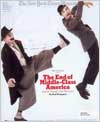
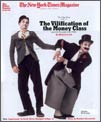
The New York Times Magazine has given the cover of its last two issues to what

it calls The Class Wars. The first

story, by Paul Krugman, glossed the growing inequality in the US, and bemoans

the fact that "income inequality in America has now returned to the levels

of the 1920s." The second

piece, by Michael Lewis, was headlined "In Defense of the Boom,"

and takes a contrarian stance with regard to the late-90s technology bubble.

"If your measure of social progress is corporate profits, it is easy to

take a dim view of the boom," writes Lewis. "It is more difficult

to do so if you step back a bit and survey the bigger economic picture."

Adam

Moss, the editor of the magazine, decided to pair the articles off against each

other, with the successive covers of the magazine running photos from the same

shoot: first of all a robber baron kicking a working stiff out of the picture,

then the same working stiff dragging a handcuffed robber baron off to jail.

In case the pictorial rhetoric wasn’t enough, the headline on the cover of the

second magazine was "The Vilification of the Money Class".

But in fact you’ll look in vain for any defense by Lewis of the obscene pay

packages that Krugman attacks. While Krugman hasn’t drunk nearly as much of

the New Economy kool-aid as Lewis has (see this

1997 Slate article for an example of his skepticism about such things), the

fact is that the two writers are simply looking at two very different aspects

of the 90s boom.

Krugman concentrates on the increasing inequality in individual wealth and

pay, pointing out that top executives earned less than one fifth of their present

salaries as recently as 1987, "the year Tom Wolfe published his novel The

Bonfire of the Vanities and Oliver Stone released his movie Wall Street".

Lewis, on the other hand, looks on the excesses of the 1990s with a kind of

detached wryness. "It’s more than a little nuts for a man who has a billion

dollars to devote his life to making another billion, but that’s what some of

our most exalted citizens do, over and over again," he writes. "That’s

who we are; that’s how we seem to like to spend our time. Americans are incapable

of hating the rich; certainly they will always prefer them to the poor."

Lewis’s main thesis is that the technology boom did wonderful things for the

way companies were organised, for the way they were financed, and, not least,

for the economy as a whole. If we now start looking back on those days as an

evil era of stock manipulation and systematic shafting of the little guy, then

we risk losing sight of all the good things we had, including "the depth,

breadth and extent of wealth-sharing" in technology companies. The fact

that so many employees had such great stakes in their companies, says Lewis,

helped not only to spread the wealth around; it also gave companies a means

to structure their payroll in such a way that employees got paid more in good

times and less in bad times. In consequence, says Lewis, the number of layoffs

was minimised.

Lewis even takes the argument one step further, using the example of his own

purchase of Exodus shares at the height of the boom. "What happened to

my money?" he asks. "It didn’t simply vanish. It was pocketed by the

person who sold me the shares." That person, he goes on to say, was, more

likely than not, a working grunt at Exodus Communications. The foolish speculator

(Lewis) got fleeced for his greed; the noble worker got the cash.

Michael Lewis is bright enough to know that he’s only telling one side of the

story here. For one thing, employees in the technology boom didn’t hold nearly

as much stock as he likes to make out. They held stock options. That’s a very

different thing, because options skew the incentive structure. If a manager

holds stock worth $100 and considers a risky maneuvre which could send the stock

to $110, he has to weigh the 10% return against the risk that the whole company

could be endangered. But if the manager holds options to buy the stock at $95,

then his return becomes 200%: worth a lot more risk. What’s more, the interests

of the manager (boost the stock as much as possible, as quickly as possible)

aren’t necessarily aligned with those of shareholders (make sure the upside

on the stock exceeds the downside).

And yes, Michael, when people say that $7 trillion (or whatever) in stock-market

value has vanished, they’re right. It hasn’t passed from middle-class speculators

with too much cash to people who were lucky enough to sell at the top of the

market. It’s vanished. Yes, the money which was spent on buying shares at the

top was also given to people who sold shares at the top. But the vast majority

of shares were neither bought nor sold anywhere near the top. If a portfolio

manager bought a million shares of Exodus at $20 and marked his position to

market every day, then at the top he had made $140 million on his investment.

And when Exodus went bankrupt, that $140 million was gone, along with the intial

$20 million. Vanished. Into nobody’s pocket at all. So when Lewis writes that

"stock market losses are not losses to society. They are transfers from

one person to another," he is simply wrong.

Lewis also gets things right, of course. Yes, the bubble wasn’t the fault of

Merrill Lynch, or even of Wall Street in general. And Lewis is a dab hand with

the aphorisms: "By forcing Merrill Lynch to agree that its advice was corrupt,

Eliot Spitzer helped the firm avoid saying something much more damning and much

more true: that its advice on the direction of stock prices is useless. Always.

By leading the firm to the conclusion that it had misled the American investor,

Spitzer helped it to avoid the much more embarrassing conclusion that the American

investor had misled Merrill Lynch."

What he means is that the middle-class masses looked at the vast amounts of

money being made in technology stocks and got greedy. They started wanting to

get in on the act too, and they forced Wall Street to play catch-up –

not with the venture capitalists, so much as with the taxi-driving day-traders.

Cue another Lewis aphorism: "That’s the odd thing about the present moment:

it is widely understood as a populist uprising against business elites. It’s

closer to an elitist uprising against popular capitalism."

This is the point at which we can take the Krugman and the Lewis articles and

find some kind of synthesis. How can they both be right – Lewis that the

boom years were mainly driven by the little people, and Krugman that the little

people got very little from the boom years, and that nearly all of the benefits

accrued to those at the very top?

The answer is that while Krugman is right about the what – there is,

indeed, much more inequality in the US economy now than at any point in living

memory – he’s wrong about the why. Krugman discounts Sherwin Rosen’s "superstar

hypothesis" – basically, that, increasingly, we’re in a winner-takes-all

economy – in favour of something rather fuzzier to do with societal norms,

corporate culture, and the evaporation of any guilt that executives might have

once felt about paying themselves untold millions of dollars per year.

Krugman then goes on to say, basically, that the great unwashed are really

stupid, and will quite happily believe whatever rich people want them to believe.

"In addition to directly buying influence, money can be used to shape public

perceptions," he writes. While that might be true to a certain extent,

I don’t think it’s the main, or even a main, reason why policies which benefit

mainly the top 1% of the population continue to receive such widespread public

support.

Rather, it’s worth recalling Lewis’s comment at this point, that Americans

will always prefer the rich to the poor. And also recall this month’s Harper’s

Index, where we find this:

Percentage of U.S. college students who believe the “next Bill Gates”

is among today’s generation of college students: 50

Percentage who say they are the next Bill Gates: 24

People support policies which benefit the rich not because they are rich, but

because they believe that they will be rich. Voting Republican is like buying

lottery tickets: it hurts the poor, but the poor do it in much greater numbers

than the rich.

It’s not just that Americans are a naturally aspirational nation, although

that’s part of it. It’s deeper than that: it goes all the way back to the American

Dream. The whole point of being an American, for most of its citizens, is this:

that anyone can make it. And even those who have statistically negligible chances

of ever doing so not only believe that they can, but also believe that they

will. And when they get there, goddamn it, they will have earned it. And there’s

no way that they want the government taking their hard-earned fortune away from

them.

And with this in mind, we can now revisit Lewis’s thesis that the 90s boom

was a bottom-up affair, a grassroots movement, if you will. He’s right: the

day-traders who fuelled the rocket-like ascent of the stock market were not

the hedge-fund elite, but rather the aspirational poor. And Krugman’s right,

too: those day-traders didn’t make any money at all. The people who made money

were people like Jeff Bezos and Michael Bloomberg, Wall Streeters who had enough

money even before they started their respective companies to live comfortably

for the rest of their lives.

But the billions that Bezos and Bloomberg made shined like beacons for the

population as a whole. They weren’t disgusted by them, the way that Krugman

is; rather, they were hypnotised by them. As the pot of gold at the end of the

rainbow became bigger and bigger, the desire for it grew proportionately. There

was no outrage because it wasn’t theirs, it was mine, if only.

So Krugman’s right: the rise in inequality was indeed fuelled by greed. But

it wasn’t the greed of the new plutocrats, so much as it was the greed of the

whole mass of the US population. And Lewis is right too: that very greed financed

technological investment and innovation which is sure to help the economy as

a whole, even if it never repays the original investors. But that doesn’t justify

the fact that the top 1% of the population got the lion’s share of the economic

benefits of the boom.

Posted in Finance | 1 Comment

Frida

At the end of Frida,

the new film by Julie Taymor, the great Mexican muralist Diego Rivera (Alfred

Molina) says of his wife, the painter Frida Kahlo (Salma Hayek), that "never

before has a woman committed such agonised poetry to canvas". It’s a fitting

remark for a serial philanderer: one is reminded of Jonathan Miller’s famously

insulting compliment to Susan Sontag, that she was "the smartest woman

in America". But it carries echoes of the filmmaker, too: Taymor’s debut

film, Titus, was a

piece of agonised poetry which I consider to be one of the greatest films of

the past 20 years, by woman or man. And, if she will excuse me for saying so,

it is the best movie by a female director I’ve ever seen.

Frida, however, is much less successful. A lot of the blame has to

be laid at the feet of the five different people responsible for writing the

thing, including the author of the biography on which the film was based. The

screenplay fails on every level, from wooden lines ("You were my comrade,

but you were never my husband"), through characters who are introduced,

never to reappear (Antonio Banderas as David Alfaro Siqueiros) and ultimately

the lack of any kind of narrative structure or dramatic arc.

The two leads never transcend the writing to create vividly memorable three-dimensional

characters; whether this is the fault of the actors, the director, or the script

is difficult to say. When Rivera’s ex-wife tells Kahlo that "it’s hard

to believe that he’s had half the women in this room," she’s right: it

is hard to believe. And Salma Hayek, who produced the film as well

as starring in it, seems to have spent so much energy getting the movie made

that there was precious little left over for acting. Occasionally we will see

a glint in her eye, a flash of strength and determination, but more often we

simply don’t understand what she’s doing. What makes her fall in love with Rivera?

Why does she tell him that she won’t sleep with him as a prelude to sleeping

with him? Why does she marry him, and, more puzzling still, why does she remarry

him? The central problem of this film is that it is mainly a portrait of a relationship,

and that relationship never really comes to life.

It would also seem that a director of Taymor’s unbounded imagination is too

constrained by the biopic format to do her talent justice. On the one hand,

the fact that she’s telling a real story prevents her from creating from whole

cloth the kind of visually stunning worlds that brought her such acclaim in

both Titus and The

Lion King. On the other hand, her attempts to insert affective, allegorical

sequences, with puppets or montage or paintings morphing into life, sit uneasily

in what is otherwise a relatively straight-up chronological story.

Mundane considerations such as how to show the passage of time don’t apply

in a film like Titus, but here they’re important: when Kahlo goes from

having short hair in one scene to long hair the next, it looks like a continuity

error rather than an indication that a year or more must have passed. And while

Taymor has a couple of visually stunning tableaux (Kahlo, after her trolleybus

accident, lying on the broken floor of the vehicle, covered in blood and gold

dust; later, her plaster cast being removed from her torso, cracked open like

a chrysalis to reveal her perfect, dust-covered breasts) they’re occasional

flashes of inspiration rather than definining every scene of the film like they

did in Titus.

It’s also sad that there’s absolutely no indication of Kahlo’s development

as an artist. It’s as though she received her gift from the gods at an early

age: she’s a fully-developed painter from the minute we see her pick up a brush.

In fact, we learn more about Rivera as an artist than we do about Kahlo: the

way he struggled with the contradictions of a communist painting murals for

the national palace; how he sold out and crashed out in New York. When Kahlo

goes to Paris, by contrast, we don’t see her art once: all we see is her living

the high life and seducing Josephine Baker.

Even the score, by Elliot Goldenthal (Mr Julie Taymor), shrinks like a violet

exposed to the harsh Mexican sun: where Goldenthal was strong and to the fore

in Titus, he’s weak and backgrounded here. The one time you really

notice the music is in the scene where Leon Trotsky (an utterly unconvincing

Geoffrey Rush) arrives by motorcade and pulls up outside Kahlo’s father’s house.

For some reason, Goldenthal picks this moment to unleash one of his post-minimalist

Glass-Nyman pastiches: one assumes it symbolises the arrival of the European

into Mexico, but it just seems out of place in practice.

Only praise, on the other hand, should go to the cinematographer, Rodrigo Prieto

(Amores Perros). He

slings the camera like a cowboy, but is completely in control the whole time,

and gets stunning shots of both interiors and the Mexican landscape. I can’t

wait to see what he does with Curtis Hanson in 8

Mile.

Much as I’d love to, I can’t recommend this film. There’s a lot to like in

it, and I know many boys and girls who are likely to go for the Frida Kahlo-Josephine

Baker sex scene alone. But if it’s a great biopic of a great artist you’re looking

for, I’d point you in the direction of Bird,

instead. And if it’s a great picture by a great artist you’re looking

for, stick to Titus.

Posted in Film | 5 Comments

A message from my sister

I guess I should introduce myself. I am Felix’s sister, Rhian. Most of

you reading this probably know me anyway cos you’re my friends and I’ve

told you to read this. But it is Felix’s page and one must assume that

people read his page who don’t know me and might wonder why the writing

style has changed so suddenly.

Interspersed between culture and food, opera and economics, high living and

humour, you may occasionally come across me. I am the opposite of Felix so whatever

he is, I’m not and you can build your own impression of me from that.

Now, because of our dissimilarities, Felix is a wonderful brother to have.

I can consult him on everything I don’t know and be given an opinion without

having to think about it. It’s really quite useful. I am, however, slowly

realising that there are more opinions out there than just his and mine so we’re

opening up the Very Important Things to a wider audience. Like what books to

take to Antarctica and whether flying to San Francisco for an opera

is an entirely normal thing to do. Justifiable, no doubt; excessive, perhaps.

I digress.

Today I’ve been Christmas shopping. Normally this is something I save

until Dec 23rd at the earliest but this year (and next, and the one after that,

if the boat gets in…) I will be on the southernmost continent unable to

shop. How nice! So I’ve been Christmas shopping and was dismayed to find

Cambridge packed with people on a similar mission. As a result, none of you

are getting very much and most of you are getting nothing at all. Instead, we

can meet on this web-page and have a cyber-conversation which is far cheaper

and more rewarding experience for everyone anyway.

The idea is that amidst the postings of high culture Manhattan you may find

a reminder that there are people far, far away where there is no organised culture,

no opera, no shopping and, alas, no continual connection to the internet. Felix

will send me the debate via the daily cyperpulses I will get aboard ship and

on base. I will be travelling aboard the Ernest

Shackleton, and hopefully going to Halley

Station.

Through these websites, and the general British Antarcic Survey website,

you can track where I am, read current diaries and find out if we ever make

it. Unlike last

year.

Anyway, I leave in three weeks, so the time has come to choose some books.

Today, armed with my list from the bookclub,

I gave up on Christmas and installed myself in Waterstones instead.

I am very fickle. It’s got to feel good, look good and have a great opening

line. So I came home with:

The New York Trilogy, by Paul Auster (amazon.com,

amazon.co.uk)

recommended by Felix.

Catch-22, by Joseph Heller (amazon.com;

amazon.co.uk)

from Terry’s hit list

Ghostwritten, by David Mitchell (amazon.com;

amazon.co.uk)

and Three to See the King, by Magnus Mills (amazon.com;

amazon.co.uk)

from Michelle’s choices

And The Great Gatsby, by F. Scott Fitzgerald (amazon.com;

amazon.co.uk)

from Anna’s.

Everything is Illuminated (recommended by both Felix and Michelle)

was in my hands and very almost bought but it was hardback and had big writing;

not good for my weight limit. I can go back though. The Master and Margarita

can, likewise, still be bought if enough of you feel like reading along.

Terry, Why Call Them Back From Heaven was not in stock but I fingered

Philosophy and Social Hope for a long time before the deep down knowledge

that it terrified me too much to go it alone became pretty apparent. If any

of you out there feel like reading along and holding my hand, I’ll go

back and buy it. As a small compensation, however, I bought

Homage to Catalonia by George Orwell (amazon.com,

amazon.co.uk),

recommended by Felix . It seemed accessible but I hope deep enough that Terry

will not give up on me forever.

(Andre, I’ve read Perfume… excellent choice though, thankyou.)

Now then, I also have on my bookshelf, waiting to be packed:

You Shall Know Our Velocity (Dave Eggers), Coming Through Slaughter

(Michael Ondaatje), The Songlines (Bruce Chatwin), The Adventures

of Huckleberry Finn (Twain), African Laughter (Doris Lessing),

To Kill a Mocking Bird (Harper Lee), The Bridge of Saint Luis Rey

(Thornton Wilder), The Poisonwood Bible (Barabara Kingsolver), The

God of Small Things (Arundhati Roy), One Hundred Years of Solitude

(GG Marquez), Poems by Robert Frost, The Prophet (Khalil

Gibran), Death in Venice (Thomas Mann) and, I’m sorry to say

The Amber Spyglass by Philip Pullmann. I am also yet to finish The

Lord of the Rings. I started delving into Meditations by Marcus

Aurelius last night (courtesy of Phil) and they’re coming too. There’s

also The Coldest March (Susan Solomon) as compulsory Antarctic reading

and Tamata and the Alliance (Bernard Moitessier) that Alex gave me

to instil yet more adventuresomeness into my spirit.

I can’t take all of these. Really, I can’t. So, please, fill out

a comment box and cast your votes. (On that note, if you can think of anything

else I’ll need, add away. I have also just bought a CD player that plays

mp3s and a v cheap but v cute ‘digital dream’ digital camera that

I got cos Steve has one and I reckon even I can operate. And I’ll take

a posh camera too but am torn between an SLR or rangefinder…)

Posted in Rhian in Antarctica | 19 Comments

the girl and the fig

Sonoma county, just north of San Francisco, has to be one of the most expensive

places in the world. Basic B&Bs cost about $200 a night, with a 2-night

minimum at weekends, while small vineyards go for millions. When I went for

a wine-tasting tour last weekend, a crappy St Francis merlot was horribly metallic,

the sort of thing you’d reject in a Glaswegian pub. It was also $25 a bottle.

Good wines – the sort of things which cost maybe $8-$13 in your local

wine shop from Australia or Argentina – cost $50 at the Sonoma wineries.

So when we needed a place to eat on Friday night, I wasn’t expecting anything

amazing. We cruised around the town of Sonoma, and one of the first restaurants

we saw was called the

girl and the fig (they want it in lower case, they can have it in lower

case). "I like girls, and I like figs," I said, so we checked it out.

The menu looked

good, we went in and asked if they had any tables that evening, they did, and

the choice was made.

the girl and the fig is cozy and comfortable: easily the most welcoming hotel

restaurant I’ve ever been in. Maybe that’s a California thing, maybe it’s because

it had already been going for four years in a different location before it moved

in to the Sonoma Hotel about a year ago. The staff are efficient, friendly and

informal; the settings are rustic in ways that make you feel at ease, without

sacrificing any quality. (The wine glasses, naturally enough for Sonoma, were

top-notch.)

I think I would have been happy eating at the bar, where a casually-dressed

clientele paired flights of wine with delicious-looking cheese plates. When

we were shown in to the dining room, I already knew one thing I was going to

order: we started off with the combination platter of three cheeses and one

aged sausage.

Before it arrived, we had to decide if we were going to go for flights of wine,

or whether we should do the old-fashioned thing and order a bottle. I thought

that flights would be too distracting, and that drinking 2oz glasses of wine

with food was a bit on the impractical side, so I ordered a local cinsault off

the very approachable wine

list. (Castle Vineyards, the wine maker, is so small that I think the only

place you can get their wine is at the winery or at the girl and the fig.) It

turned out to be a great choice, although I’m sure I could have more or less

thrown a dart at the reds and come up with something equally good.

The wine list is exceptional in more ways than one. While being very carefully

chosen, and obviously biased towards local wines, nearly everything on it is

under $50. the girl and the fig has obviously decided not to apply standard

restaurant markups to the wine, which means they can offer good Sonoma wines

at non-threatening prices. What’s more, you’ll look in vain for any chardonnay,

merlot or cabernet sauvignon – this is a place to discover less well known

Rhône varietals like cinsault, mourvedre and – especially –

viognier.

The cheese was easily the best I’ve ever had in north America. Going against

type, we were given a hard goat, a hard sheep, and a soft cow. The sheep, Ossau

Iraty from the Pyrenees, was nutty and delicious. The goat, with the fabulously

Californian name of Cypress Grove Midnight Moon, was only just hard: it held

together fine, but melted in your mouth. But it was the cow which really blew

us away. A triple cream cheese called Pierre Robert from Seine-et-Marne in France,

it was soggily soft and bursting full of flavour. Apparently it’s enriched with

crème fraiche, which sounds a bit dubious to me, but boy does it work.

At about this point I wanted to order another cheese plate, with another three

cheeses (they have a dozen or so on the menu at any one time), but our first

courses were coming. I had the specialite de la maison, the fig salad,

while Michelle had a butternut squash soup (her favourite) which she pronounced

the best she’d ever had. (On the other hand, she usually says that when she

has butternut squash soup.)

Good as the fig salad was, I still think that figs are a bit like oysters or

lobster: the sort of thing which is best eaten pure and unadorned, on its own.

Perhaps the fig salad is a year-round thing, and they have to gussy the figs

up for the time when they’re not fresh. But these were good figs, and good figs

don’t want to be covered in a port vinaigrette, no matter how light.

Then, while Michelle had the fig salad as a main course, I moved on to the

duck. I’m one of those people who finds it almost impossible not to order duck

when he sees it on a menu, so I’ve had a lot in my time, but this was definitely

among the best I’ve ever tasted: the skin was so crispy it crunched, while the

flesh melted in the mouth.

The meal was at an end, we were both very happy indeed, and the last of the

cinsault had been poured. But just as we were about to make the standard no-we’re-completely-stuffed

noises, I spied a port and fig ice cream on the desert menu, and the friendly

waitress told us about the pot de creme special. We couldn’t resist.

Much as I love my local ice

cream artisan, I have to say the port and fig ice cream was beyond a doubt

the best ice cream I’ve ever had. Lusciously creamy and lip-smackingly flavourful,

it was almost enough to make me think that there are good ways to cook with

figs after all. And then the pot de creme – what my grandmother used to

serve as her world-famous petit pots, only bigger, darker, and covered in coffee

whipped cream. Michelle, the chocaholic, said it was the best chocolate desert

of all time, and I was inclined to agree, yet even so it was so rich that the

two of us together couldn’t finish it.

All that was left was the bill, which I have to say I dreaded. When a restaurant

serves food this good, with chocolate, ice cream, duck and cheese all in best-ever

land, you know you’re not going to get away without a painfully hit wallet.

When it’s in Sonoma, you know it’s going to be worse. But our four courses,

with a fantastic local wine and excellent coffee, came to just $112.55 (before

tax and tip) for the two of us. I’ve had meals which cost that much per person

which don’t compare.

No wonder, then, that when we started telling people where we’d eaten, they

all looked at us in astonishment and asked us how on earth we managed to get

a reservation: apparently the girl and the fig is known throughout northern

California as a gourmand’s paradise. All I can do is thank my lucky stars we

managed to get a table on an hour’s notice, thank the girl and the fig for the

best meal I’ve had all year, and hope that I will be able to repeat the experience

some time. And encourage you all, if you find yourselves anywhere within a 50

mile radius of Sonoma (and that includes San Francisco) to get a reservation

and go there.

Posted in Restaurants | 10 Comments

St Francis in San Francisco

I’m sure that I wasn’t the only New Yorker to book a flight to the west coast

when I heard that the new general director of the San Francisco opera, Pamela

Rosenberg, had decided to put on a production of Olivier Messiaen’s Saint

François d’Assise. I doubt, however, that the opera meant quite

as much to any of my fellow pilgrims as it did to me.

Saint François d’Assise – a five-hour extravaganza for a chorus

of 150 and an orchestra nearly as big, including 22 woodwinds, 68 strings, and

five percussionists – is almost impossible to put on: think Mahler’s Eighth

doubled. But in celebration of the composer’s 80th birthday in 1988, Kent Nagano

and the London Symphony Orchestra managed to corral the necessary forces for

a concert performance at the Royal Festival Hall.

I was 16, without any discernible interest in contemporary classical music,

and the plan was that my parents would go to the concert while I was left back

home to watch TV or whatever it is that 16-year-olds did back then. But it didn’t

work out that way: my father couldn’t make it, and my mother, in a flash of

inspiration, asked if I might want to come along instead.

I still vividly remember that evening, right down to the exact seats we were

sat in (on the aisle on the right-hand side) and even where we parked the car.

I had no idea at all what I was getting myself into.

Messiaen does the audience no favours at all in the first couple of scenes.

"On first hearing, the score of Saint François d’Assise may strike

some as a random assemblage of notes bearing no relationship to any music encountered

before," says John Palmer in San Francisco’s program notes, and that was

pretty much the case for me. At the beginning of the opera, there’s no brass,

very little woodwind: just lush orchestration and Messiaen’s inimitable densely-layered

textures. My mother, or the program, had told me that the piece was somewhere

between an oratorio and an opera, but I’d had precious few encounters with either

art form at that point, so that didn’t help me too much.

The production was semi-staged, and the singers hadn’t memorised five hours’

worth of music for the sake of one performance, so they had to carry their parts

around with them whenever they moved. And although we in the audience had a

copy of the libretto along with a translation, it’s hard, on first hearing,

to work out exactly what’s meant to be going on, plot-wise, just from reading

the text. So insofar as a story was told that evening, it was told by the orchestra.

And what an orchestra!

As the colours slowly started entering the music, as we started hearing snatches

of birdsong or the occasional curtailed crescendo, I found myself being increasingly

drawn in to Messiaen’s musical world. And then, at the end, came the astonishing,

incredible finale: a mind-blowingly loud and joyous starburst which, as Michelle

says, clears your sinuses right out. I’d never heard anything like it in my

life, and I don’t think that many of the other patrons in the Festival Hall

that night had, either: they ended up giving Nagano, the LSO and Messiaen the

longest and most heartfelt standing ovation I’ve ever seen.

That evening was the beginning of my education in classical music, and from

then on, with my mother’s help, I went to as many performances of the likes

of Bartók, Shostakovich and Britten as I could. But Messiaen always held

a very special place in my heart, and although I knew that his other works would

never quite achieve the heights of Saint François d’Assise, I always

looked forward to them enormously.

The opera itself, of course, was never put on: far too expensive, and far too

obscure. After its premiere in Paris in 1983, there was one production in Salzburg,

and that was about it until this year. At one point there were hopes that the

great operatic philanthropist Alberto Vilar might underwrite a production at

the Met in New York, and to that end Robert Spano and the Brooklyn Philharmonic

put on a concert performance of a few scenes, to bring him around. It just so

happened that my mother was visiting New York at the time, and I couldn’t believe

my luck in being able to turn the tables and take her to the very piece that

she had taken me to all those years previously. What we heard was just as good

as I’d remembered.

And then came the news from San Francisco: the opera company had made the daring

decision to hire Pamela Rosenberg from Stuttgart and that, to demonstrate the

city’s new-found seriousness about opera, she was going to put on Saint

François d’Assise in her very first season, in the city named after

its hero. There was no way I was missing this.

I’d never been to the San Francisco opera before. It’s a beautiful building,

and maybe it was just me projecting, but I could feel a buzz of anticipation

before the curtain rose. This was the defining opera of the season – it

is featured on the company’s t-shirts – and the reviews had been terrific.

For my part, I felt like a seven-year-old on Christmas Eve. I was nervous, as

well, for I had dragged along four friends of mine, none of whom had much experience

with opera, or any at all with Messiaen. Would they like it as much as I had,

14 years ago?

As soon as the opera started, the worrying stopped. The acoustic in the San

Francisco opera is crystalline, and you could hear all the layers in the music

perfectly. This production is a triumph for many people, but above all for Donald

Runnicles, San Francisco Opera’s long-time music director, and his orchestra.

Some of the music, especially in the great sermon to the birds, is almost impossible

to conduct, and Messiaen deliberately leaves a lot of its progress to the individual

musicians, out of the control of the conductor. I remember back in 1988 watching

with awe as Kent Nagano flipped through the enormous score of the piece at a

rate of about five or six pages a minute, conducting furiously in 2-3-2/32 time

or something equally complex as astonishing birdcalls came flying out of the

orchestra at us. Very few conductors would dare attempt it, and it is a great

testament to the rapport between Runnicles and his orchestra that he pulled

it off with such aplomb.

The production design was less of a triumph, although it was perfectly good.

I really didn’t need to see the chorus all dressed up in trenchcoats: it’s a

tired trope, which has nothing to do with what the opera is about. The revolving

ramp was ingenious, but it revolved far too much, and far too loudly: for an

opera house, San Francisco sure has noisy machinery. (It was particularly noticeable

in the final two scenes, when Saint Francis dies; for some reason the revolve

just kept on creaking away throughout both of them.)

And there were some peculiar choices, too: why leave Saint Francis stranded

above the orchestra pit during his transfiguration? (He’s meant to disappear

completely, to the point where "only a spot of light remains".) And

why bring on the stage hands at the end of the sermon to the birds?

But there were ingenious touches, as well, such as the one-winged Angel, whose

viol was replaced by the wires holding up the ethereal platform on which (s)he

was walking.

Laura Aikin, who played the Angel with a twinkle in her step, was truly magnificent.

She has a central role in the production: not only is she the only female soloist,

providing our sole relief from the men of the monastery, but she is also visually

striking, in bright blue, in stark contrast to the browns and greys of the rest

of the production. Her mischievous characterisation was a joy to watch, and,

most importantly, gorgeously beautiful to listen to, with a strong, clear soprano

voice which penetrated straight to the heart.

Chris Merritt, as the Leper, also has a magnificent voice, as well as the acting

chops to really make us feel his suffering and consequential anger at the world.

In his scenes with Saint Francis, he more than held his own against Willard

White, which is not an easy thing to do.

And then there was Willard White, in the horrendously difficult title role.

I saw him a few years ago as Wotan in the Ring cycle at Covent Garden, and this

has got to be at least as taxing as anything which Wagner came up with. White’s

stamina was impressive, as was the clarity of his French, but I would have liked

a little more power. (Of course, I know how much I’m asking here, seeing how

much he has to sing: I’m not sure anybody would be capable of that.)

In any case, seeing the opera acted out on stage definitely helped a great

deal in understanding the action and the sequence of the scenes. And the acting

abilities of the cast, White foremost among them, were outstanding. His horror

of lepers, his transportation when the Angel plays the music of the invisible,

his suffering at the end – all were powerfully conveyed. While the concert

performances of this work were primarily musical events, seeing it staged helped

to emphasise the spiritual.

The one great disappointment of the San Francisco production was in the grand

finale. It might have been that the chorus was slightly smaller than in the

concert performances, it might have been that the orchestra was buried in a

pit, it might have been the sheer size of the opera house. I think it was mostly

the acoustics of the San Francisco Opera: clear, but none too reverberant. Whatever

it was, the great chord at the end had neither the emotional impact nor the

sheer decibel volume of the concerts I’d seen in London and New York. It ranked

maybe 7 out of 10 on the goosebump-meter: impressive, but not mind-blowing.

That said, however, the production was indubitably a triumph. San Francisco

has every reason to be very proud of Pamela Rosenberg, and I hope they revive

this production in the next few years. (I think every night sold out: San Franciscans

certainly embraced it.) Maybe next time I can take my mother, and truly repay

the gift she gave me in 1988.

Posted in Culture | 7 Comments

The Trials of Henry Kissinger and Bowling for Columbine

Left-wing documentaries are popular in New York City these days. I’ve been

to two this week: The Trials of Henry

Kissinger on Thursday afternoon, and Bowling

for Columbine on Sunday night. Both showings were almost sold out, and the

latter film managed to gross over $200,000 in just eight theatres over the weekend:

that’s over three times as much, on a per-theatre basis, than any of the top

Hollywood films.

It’s fashionable to sneeer at Michael Moore, the Man Who Would Be Schlub who’s

actually an Upper East Side millionaire. But at the same time, as my friend

Kieran once said of the Guardian‘s Matthew Norman, I think he’s some

kind of genius. The same can, unfortunately, not be said of Eugene Jarecki,

the director of the Kissinger film.

I would highly recommend that anybody interested in Kissinger read either Christopher

Hitchens’ two original articles for Harper’s magazine, or else the book

they were turned into. The idea behind the project was not to simply rehash

the same old stories about US agression that we’ve all heard a hundred times

from Chomsky, Sontag and the lefty-peacenik-crunchy-granola crowd. Rather, Hitchens

had the genius idea to take the public evidence which is currently available,

and turn it into a prosecutor’s brief. With forensics always uppermost in his

mind, he builds a very strong case that Henry Kissinger can and should be prosecuted

under international law for crimes against humanity: others have been sentenced

to long jail sentences or even death for much lesser crimes.

Film, however, is not a medium naturally suited to jurisprudence or the following

of paper trails. It’s also especially ill-suited to the slow and painstaking

way in which Hitchens shows Kissinger to be situated at the top of a pyramid

which controlled all aspects of US national security, from the armed forces

to the CIA.

So although the film starts off by talking about Hitchens’ war-criminal thesis,

in fact it never even so much as bothers to say which crimes, specifically,

he’s guilty of. Rather, we’re given a shallow history of US involvement in Indochina,

East Timor, and Chile, with an emphasis on the way in which Kissinger personally

bears responsibility for countless deaths in each one.

The film is also very confused about whether it’s meant to be a crusading piece

of passionate partisan rhetoric, or whether it would rather be an objective

judge of Hitchens’ accusations. It makes noises towards the latter at its start,

but there’s no evidence at all that a genuinely critical eye was ever brought

to bear on what Hitchens has to say. All we get in the film is Kissinger’s former

lieutenant Alexander Haig doing his best impression of a lunatic reds-under-the-beds

type, admitting he hasn’t even read the book under discussion, and calling Hitchens

a "sewer pipe sucker". All most entertaining, but hardly edifying.

Surely Jarecki could have found an academic somewhere who could at least attempt

to place Kissinger’s actions in their Cold War context.

Michael Moore, on the other hand, in Bowling for Columbine, has complete

freedom to do whatever he wants, since he never even bothers with a pretense

of objectivity. Sometimes he goes too far, as when he attempts to draw some

kind of connection between domestic gun violence in the US, Kissinger’s misadventures

in Indochina (ITMA),

and Osama Bin Laden’s attacks on September 11. Moore also seems to have no sense

of restraint or control. This can be a good thing, as when he badgers Terry

Nichols’ gun-nut brother James to the point where he finally admits that maybe

civilians shouldn’t be allowed weapons-grade plutonium on the grounds that "there

are some wackos out there"; but it also means extremely graphic footage

of people getting shot or the second plane flying into the World Trade Center

which I, for one, could certainly have done without. (The footage was so graphic

that it made it very difficult to concentrate on what was going on in the film

for the next few minutes.)

What Moore lacks in understatement he more than makes up for in filmmaking

ability: he keeps the movie galloping along, even when he himself has no idea

where it’s going. The film starts off seemingly about white kids with guns,

but moves on to the broader culture of violence in the USA, gets sidetracked

by tying that in to racism (via a clip from South Park) and the relationship

between white suburbs and the black inner city, then decides that it’s not guns

which kill people, it’s fear which kills people, before finally ending

on a point of some confusion in the wake of an interview with Charlton Heston.

Along the way, Moore manages, with the help of a couple of kids who

got shot at Columbine, to persuade Kmart to stop selling ammunition for handguns.

It’s a major victory, and even he is shocked that he actually managed to make

something happen: when the flack from the company announces the new policy,

he can barely believe what he’s hearing.

Moore also scores what must be one of the biggest coups of his television interviewing

career: talking to Charlton Heston in his Beverley Hills pool house, he gets

Moses to blame the number of gun deaths in the USA on this country’s "multiethnic"

nature. It’s a shocking moment: the whole cinema as one took a sharp intake

of breath and turned to the person sitting next to them with a "did he

really say what I think he just said?" look.

Of course, Moore also takes gratuitous potshots at George W Bush, which got

the cinema hooting with laughter, as when he replays one of those press conferences

where the President warns of a grave but utterly unknowable danger, and blames

"evildoers" for the heinous acts which haven’t actually happened yet.

It’s at times like these that Moore is at his best: while Roger

and Me had enough narrative drive to structure a feature-length documentary,

Bowling for Columbine feels more like a concatenation of TV-sized bites.

To his credit, however, Moore does leave us with more questions than answers,

and even shows two sides of himself: on the one hand the New York liberal we

all know only too well, but on the other hand the lifelong member of the NRA

who really believes that it’s possible to have widespread gun ownership alongside

nugatory gun violence. (Moore spends a lot of time developing this thread in

Canada, to no obvious punchline.)

So don’t see The Trials of Henry Kissinger, read the book instead.

And do see Bowling for Columbine: you’ll have a great time, and get

to meet some very interesting Americans in the process.

Posted in Film | 15 Comments

felixsalmon.com redesigned

Welcome to the new-look felixsalmon.com! The incomparable Stefan Geens has installed the excellent Movable Type onto my server, and what you see now is the result.

It’s going to take me a little while to move all my old postings into the new template, mainly because I’m going upstate this weekend for a fundraising dinner, and I won’t have internet access. I’ve put the last few months’ worth up, though.

And in the meantime, I encourage you to make full use of the comment boxes which are now attached to each of my posts. Let the debate begin!

Posted in Announcements | 6 Comments

Rosenbaum, Hitchens and the Left

Christopher Hitchens has a new book

out, on George Orwell. Orwell is one of those figures who tends to mean

whatever you want him to mean: he’s been adopted by political partisans

(and, indeed, non-partisans) from across the spectrum, each one of whom

finds his views perfectly encapsulated in Orwell’s body of work.

The irony, judging by the latest column

from the puffed-up Ron Rosenbaum in the New York Observer, is that Hitchens

himself is starting to be treated in exactly the same way – and

while he’s still alive, no less!

Stefan Geens seems to admire this piece to the point of saying

that he regrets not having had a subscription to the New York Observer.

Huh? Putting the merits or otherwise of Rosenbaum to one side, the Observer

is basically an Upper East Side gossip sheet filled with dinosaurs like

Hilton Kramer and pointless Democrats like Joe Conason. It’s read mainly

for its real-estate column, and its hilarious pieces on the difference

between Chapin and Spence. Why Geens thinks he’ll be "slowly easing"

into this piece of vanity publishing over the next few years I have

no idea.

But of all the reasons to subscribe to the New York Observer, Ron Rosenbaum’s

political commentary has to be the worst. He might have interesting

insights on the puzzles of Pale

Fire, but his views on leftism in America seem little more than

a warmed-over rehash of Martin Amis’s ramblings in Koba

the Dread.

At the risk of sounding like Rosenbaum myself, I wrote

about the Amis book on September 8, but I didn’t go into too much detail

about the Amis v Hitchens feud: I reckoned Hitchens was more than capable

of defending himself. The difference between Rosenbaum and myself, however,

is that I provide a helpful link when I refer to my past entries, while

Rosenbaum doesn’t. His solipsism ("I think I made that clear in

a column published here on Jan. 28"; "See my Nov. 6, 2000,

column") serves no purpose: after all, no one saves their back

issues of the New York Observer, and no one is going to trek down to

the New York Public Library in attempt to follow the references.

Rosenbaum’s actually worse than Amis, at least when he gets on to the

subject of the Left’s response to September 11 – a subject on which

he rightly admires Hitchens. For while Amis picks his fights with an

articulate, named individual (Hitchens), Rosenbaum flails unimpressively

against an inchoate neo-Marxism which he sees all around him but can

never seem to cite.

Look at the "two idiocies" he tries to fight back against

in his column. The first is a relatively benign paragraph at the end

of a film review, saying that Tom Hanks in Road to Perdition

is "an American everyman, a pure-hearted killer who will commit

no end of mayhem to ensure a better life for his children." From

this, Rosenbaum deduces, after ratcheting up the sarcasm to embarrassing

levels, that

Because they [Al Qaeda] hate America, they must be for liberation,

and so we can’t blame them; we must accuse ourselves of

being killers. In fact, we should thank them for providing

our witty writer with an occasion for reminding the world that the

"American everyman" is a killer. (Rosenberg’s emphases.)

This response is so wildly disproportionate to its provocation, and

bears so little relation to what was actually being said, that one worries

for whatever critical faculties Rosenbaum ever had. But it’s actually

typical of his rhetoric. Rosenbaum’s second "idiocy" –

the "idiocy di tutti idiocies", in his words –

was a nameless college professor saying that 9/11 might prompt Americans

to do what the Germans did in the 1960s, and critically examine their

past.

Before 9/11, of course, even Rosenbaum would have agreed with the statement

that Americans ought to critically examine their past more than they

do. Now, however, saying such a thing demonstrates no less than an "inability

to distinguish America’s sporadic blundering depradations from

Germany’s past, Hitlerism".

One more example: a Slate Breakfast Table discussion

with David Gates on the anniversary of the attacks. Gates draws a parallel

between the Taliban and John Ashcroft’s obsession with "the flag

stuff, the United We Stand stuff, the under-God stuff, the rituals of

American civil religion, the encroachments of that old-time religion."

Quoting Susan Sontag, he then points out that both of them oppose "pluralism,

secularism, the equality of the sexes, dancing (all kinds), skimpy clothing

and, well, fun".

It’s easy to disagree with this. But it’s easier to simply drown the

point being made, and that’s what Rosenbaum does in response, this time

couched in a bit more politesse, since it’s a friend he’s talking to:

What comes across—and again I could be wrong—is that we

are just about the worst thing in the world. No diff between Ashcroft

and the Taliban.

But are you saying the Bush administration or America is morally equivalent

to the Taliban? Do you see any significant differences?

What kind of tone-deafness is this? Is it not possible, any more, to

make the point that the things we hate about the Taliban are actually

the same things that we hate about the present Administration? Or, at

least, is it not possible to say that without having to be boringly

explicit about the fact that yes, actually, given the choice, we’d rather

be where we are than in an Islamo-fascist theocracy?

The thing which annoys me is that Rosenbaum, in the Observer column,

is explicitly aligning himself with Hitchens, who’s far more intelligent

and nuanced, and who actually is the recipient, in Koba the Dread,

of the same sort of argument that Rosenbaum then goes on to gloss in

the last part of his piece.

For Rosenbaum, making much the same mistake as Amis, says that "the

Left [has] failed to come to terms with its history of indifference

to (at best) and support for (at worst) genocidal Marxist regimes abroad".

He slams "the contemporary Left’s curious neutrality-slash-denial

after the facts had come out about Marxist genocides—in Russia,

in China, in Cambodia, after 20 million, 50 million, who knows how many

millions had been slaughtered." The contemporary Left, he says,

has a "blind spot" when it comes to Marxist genocides, and

claims that America "is the worst force on the planet".

Here, Rosenbaum stops citing anybody at all, and given his demonstrated

knack for hyperbole, we can hardly take it that this characterisation

of the Left is in any way accurate. But even if it were, he should have

read his beloved Hitchens a bit better: here’s an excerpt from his reponse

to Amis in the Guardian.

You demand that people – you prefer the term "intellectuals"

– give an account of their attitude to the Stalin terror. Irritatingly

phrased though your demand may be, I say without any reservation that

you are absolutely right to make it. A huge number of liberals and

conservatives and social democrats, as well as communists, made a

shabby pact with "Koba", or succumbed to the fascinations

of his power. Winston Churchill told Stalin’s ambassador to London,

before the war, that he had quite warmed to the old bastard after

the Moscow Trials, which had at least put down the cosmopolitan revolutionaries

who Churchill most hated. TS Eliot returned the manuscript of Animal

Farm to George Orwell, well knowing that his refusal might condemn

it to non-publication, because he objected to its "Trotskyite"

tone. (You can read all about this illuminating episode in my little

book on Orwell.) I think we can say fairly that the names of Churchill

and Eliot are still highly regarded in conservative political and

cultural circles. You have a certain reputation for handling irony

and paradox. How could you miss an opportunity like this, and sound

off like a Telegraph editorialist instead, hugging the shore and staying

with the script?

However, while all of those and many other dirty compromises were

being made, the Bulletin of the Left Opposition was publishing exactly

the details, of famine and murder and deportation and misery, that

now shock you so much. I evidently wasted my breath in telling you

this, but there exists a historical tradition of Marxist writers –

Victor Serge, CLR James, Boris Souvarine and others – who exposed

and opposed Stalin while never ceasing to fight against empire and

fascism and exploitation. If the moral and historical audit is to

be properly drawn up, then I would unhesitatingly propose the members

of this derided, defeated diaspora, whose closest British analogue

and ally was Orwell, as the ones who come best out of the several

hells of the last century. A pity that you felt them beneath your

notice.

It is, surely, undeniable that the strongest criticism of Marxist genocide

came from the Left, and that the Right has often made very strange bedfellows

itself: note Hitchens’ point that "Moscow directly ordered the

French Communist party to help put down the rebellion against De Gaulle,

and Brezhnev both sought and received Lyndon Johnson’s advance assurance

that a Red Army invasion of Prague would be considered an ‘internal

affair’".

Of course, there were misguided Stalinist apologists in the West. I

defy, however, Rosenbaum to find any leftist who still believes, as

he seems to think they all do, that McCarthy was worse than Stalin.

If this is the man who’s saying goodbye to the Left with such vitriol,

then I’m sure the Left, in turn, will say good riddance to him. And

no, Stefan, this is not what Hitchens is saying, not by a long shot.

I’m with Hitchens on the subject of whether America "deserved"

9/11. But I’m a long, long way from Rosenbaum.

Posted in Politics | 4 Comments

Secretary

Secretary is, at heart,

a by-the-numbers love story. Troubled girl meets troubled boy, they

fall in love, but their troubles drive them apart before they are eventually

overcome and our loving couple lives happily ever after.

If the problem with this relationship were that the girl was black

while the boy was white, or that the girl was a Capulet while the boy

was a Montague, then the plot would be as old as the hills. But you know

what’s different in this film: the girl (Maggie Gyllenhaal) is a masochist

who likes to be dominated, while the boy (James Spader) is, well, fond

of a little spanking now and then. What’s more, the girl is a fragile

young thing, straight out of a mental institution, while the boy is

a successful lawyer, who’s much older than her. Oh, and he’s also her

employer; she’s his secretary.

Early on in their relationship, Mr Grey (Spader) manages to succeed

where all manner of highly-trained mental-health professionals had failed:

he persuades Lee (Gyllenhaal), through sheer force of personality, that

she must no longer cut herself. Lee’s mother, of course, is overjoyed,

but we’re not, for the very next day Grey’s forceful personality starts

showing itself in a rather less unambiguously positive fashion.

The first spanking scene between the two is fiery, shot through with

sexual energy and confusion. But although we see the relationship develop

from there, even unto the use of some rather extreme props, the movie

doesn’t help us to understand what’s going on in either of the characters’

heads. It’s clear that Lee becomes enamored of her submissive role,

and, by extension, her employer. What’s much less clear is whether or

not she has simply replaced one self-destructive mode of behaviour with

another.

The replacement part is clear: Lee runs to her employer’s house when

her home life reaches the emotional pitch at which she would formerly

have gone racing for the razor blades. It’s the self-destructive part

which is left ambiguous: she seems only to blossom under Grey’s tutelage,

while Grey himself becomes increasingly tormented and eventually breaks

the whole thing off.

Through voiceover, we learn what Lee is thinking, but Grey is much

harder to understand. Is he feeling guilt and remorse at abusing his

position of trust with a young and impressionable girl? Is he, rather,

disgusted at his own predilections, and anxious not to drag anybody

else into his own perversities? Or is he simply a repressed top who

isn’t sexually enlightened enough to rejoice in the appearance of his

perfect bottom when he finds her?

I won’t spoil the film for you when I say that in the end Lee finds

reserves of strength unavailable to Grey, and confronts him with a declaration

of love which he could never have come out with himself. When he finally

gets around to declaring the love to be requited, the story becomes

a fairy-tale (albeit one where the bride wears black), and the two live

happily ever after.

So what are we to make of all this? Do happy ends justify immoral means?

If Lee Holloway not only forgives her boss’s behaviour but finally becomes

a wholesomely sexual woman because of it, are we to assume that the

film is in some way excusing his inexcusable actions? And what are we

to make of the fact that Lee was mentally disturbed enough to be institutionalised?

That there’s a connection between mental illness and masochism, even

that the latter can cure the former?

I think the film would ultimately shy away from such questions: it

might be an indie flick, but it’s not that deep. Rather, Secretary

is a gorgeously shot, beautifully-paced love story with a twist, and

if you go in with an open mind, you’ll laugh while watching it and come

out happy. If you think that a responsible film shouldn’t raise issues

it isn’t prepared to deal with, however, and if you think that it’s

wrong for Secretary to glorify workplace abuse, then you won’t

get any arguments from me.

Posted in Film | 1 Comment

Barbershop

A bit later than I originally intended, I finally got around to seeing

Barbershop tonight. If

you haven’t done so as well, I highly recommend you follow suit: it’s

an excellent film, which pulls off the almost-impossible feat of being

popular without having to give up its intelligence.

Most of the film is set in the barbershop of the title, a barely-going

concern which was inherited by its proprietor, Calvin (Ice Cube) from

his father. It’s been the place where colourful Chicago south siders

have hung out and shot the breeze for over 40 years, and only when he

sells it does Calvin finally appreciate how much it really means.

Sounds hokey? Well, it is, a little, but not uncomfortably so. And

the Message is delivered with so much humour and panache that it never

stirs up any resentment. There’s also a broad slapstick subplot about

a pair of Laurel-and-Hardy small time crooks trying to rip off an ATM

machine, which not only keeps the laughs coming when the situation back

in the barbershop gets too serious, but also serves to give the camera

a little fresh air. Without that subplot, the film would essentially

be a claustrophobic stage play.

And for all that it takes place pretty much entirely in the same location,

a transferred stage play à la Six

Degrees of Separation or Glengarry

Glen Ross this is not. There’s very little in the way of character

development: the film basically takes a set of sterotypes, puts them

in the barbershop, and then has each one redeem himself in turn. The

oreo and the wigger start out fighting and end up as friends, the twice-convicted

felon helps solve a crime, the put-upon girlfriend asserts herself and

dumps her boyfriend, and the overweight African ends up getting the

girl. Sophisticated character development this is not.

Another thing that Barbershop isn’t: "Smoke

moved to the South Side of Chicago," as I guessed it might be in

my September 17 blog. Calvin is no Auggie Wren, although Eddie, the

character played with relish by Cedric the Entertainer, would not be

out of place in the Brooklyn tobacconist, opining in his hilariously

anti-pc way on the subjects of Martin Luther King, Jesse Jackson, Rosa

Parks, OJ Simpson, and other icons of African-American history.

It’s because of those lines that Jesse Jackson, Al Sharpton and others

have called

for a boycott of the movie, not (thankfully) that anybody seems to be

paying them the slightest bit of attention. But if anything is really

offensive about the film, it’s not a couple of lines put into the mouth

of an eccentric old barber who never has anybody in his chair.

For it’s not the treatment of African-American icons which rankles,

but rather the treatment of Africans. Dinka (Dinka!), the African

character played by Leonard Earl Howze, isn’t even given a specific

country from which he’s meant to come (unlike the Punjabi convenience-store

owner across the street, who corrects the misapprehension that he’s

Pakistani). He is a naive doofus who seeks – successfully –

to learn from his American brothers, a man who finally gets what he

wants not by dint of his charming love of poetry so much as through

the delivery of a well-timed left hook.

Still, one can only get so offended by the portrayal of any given character

in this film, given how broadly painted most of them are. And Dinka

gets one of the most touching scenes in the film: when the girl he gave

a card to asks him whether he wrote the poem inside himself, he breaks

into a mile-wide, completely unselfconscious grin, and proudly says

that no, it was actually Pablo Neruda.

It’s scenes like that, or the one where Calvin is being chased through

the icy streets of Chicago by a thug trying to give him $20,000,

which stick with you after you’ve seen the film. Barbershop never

takes itself too seriously, and so when, occasionally, it comes to a

note of grace – when Eddie, for instance, shows how really

to shave a man – we feel elevated, rather than preached at.

So go see this film. You won’t learn anything about human nature, about

African-American life in the inner city, or even about cutting hair.

But you will have a good time, you won’t feel as though your intelligence

has been insulted, and you will greatly admire the central performance

by Ice Cube. In a time when Hollywood films in general and African-American

films in particular nearly always play for the lowest of the lowest

common denominators, that’s an achievement to applaud.

Posted in Film | Comments Off on Barbershop

Men in uniform

Three stories for you:

• Two air marshals panic

on a flight from Atlanta to Philadelphia, brandishing guns at terrified

passengers and arresting a blameless former Army major (of Indian descent,

natch) for "observing too closely" what was going on, according

to the newly-formed Transportation Safety Administration.

• During the IMF meetings in Washington, DC, this weekend, there’s

a medium-sized anti-war demonstration outside my hotel. As it’s coming

to an end, one group of protestors decides to walk (or march) in the

same general direction as I’m headed, towards the IMF. They’re punk

kids like I see hanging out in the East Village the whole time, maybe

19 years old, wearing torn jeans and bandanas covering their faces.

If asked, they’d probably describe themselves as anarchists. As they

start walking and chanting down Connecticut Avenue, they’re followed

by a group of policemen. There are maybe 20 kids in all; the total number

of police can’t have been below 40. Half of the officers were on white

bicycles with the words "Smith & Wesson" on their sides;

the other half were on motorcycles. All of them were a lot bigger, and

a lot more threatening, than any of the demonstrators.They ride up alongside

the kids, gunning their engines, glaring at them from underneath their

helmets, and generally acting as aggressively as I’ve seen police act

in this country. When the kids reach an intersection, they’re immediately

surrounded by police, all with their truncheons out, who get right up

next to them and start shouting at them to disperse.

• When I get back to New York, there’s a lot of laundry to be done,

and I persuade the security guard in my building to let me in to the

laundry room despite the fact that it’s past 10pm and the room is meant

to be locked at that hour. While I’m in there folding t-shirts, a couple

of English guys from one of the ground-floor apartments come through

to have a cigarette in the courtyard. A minute or so later, the security

guard comes barrelling through the laundry room and orders them out

of the courtyard, telling them they’re not allowed there after hours.

A conversation then proceeds along the following lines:

English Guy 1: (inaudible)

Security Guard (aggressively): –I wouldn’t advise that if I were

you.

English Guy 2: –Excuse me?

Security Guard: –I’d advise you not to fuck with me, because I

can break your face.

English Guy 2: –He was only saying that he wouldn’t want your job.

The security guard then watches the English guys leave, tells me to

get a move on with my laundry-folding, and also volunteers that people

ought to be careful what they say in such situations, because a misunderstanding

such as this one could easily have resulted in his fucking them up.

"I’m good at that," he says.

What all of these stories have in common is the shoot-first-ask-questions-later

attitude of the officials entrusted with ensuring our safety. In each

of the cases, the officers strutted their stuff, while the people they

were ostensibly protecting got intimidated, scared, and mistrustful

of their protectors’ goodwill and intentions.

It’s clear that in all of these cases, a less antagonistic approach

would have been more fruitful. Rather than whipping out a gun and screaming

at the passengers (many of whom thought they were being hijacked: the

air marshals were, after all, in plain clothes), a flight attendant

could simply have been asked to make an announcement over the intercom.

If a policeman were to have simply approached the kid at the front of

the protestors and asked him where they were headed, a relatively civilised

conversation would probably have ensued. And if the security guard in

my building had approached a couple of residents smoking in the courtyard

with less aggression, the chances of a "misunderstanding"

would have been greatly diminished.

The worst clashes at G7/IMF/WTO meetings have been in ill-prepared

cities where the police overreacted: Seattle, Turin. When Davos was

in New York, or the World Bank meets in Washington, the protestors invariably

get heard without significantly disrupting either the city or the meetings.

That was the case this year, too, despite the behaviour I witnessed:

I have a feeling that if the number of protestors had been greater,

the situation would have been escalated to someone with a cooler head.

In general, though, there are obvious dangers to leaving the job of

protecting airline passengers to "highly trained law enforcement

professionals" who have had

maybe two weeks’ training and who, on one occasion, managed to discharge

their weapon by mistake in the middle of a flight from Washington to

Las Vegas. For although even poorly-trained air marshals can help protect

passengers against hijackers, hijacking an airplane is probably the

last thing any potential terrorist would be planning right now.

In the meantime, overzealous marshals, policemen and security guards

only serve to make us ever more conscious of the terrorist threat. The

purpose of terrorism is to create widespread fear and nervousness; it

seems that those who would prevent it are having much the same effect.

Posted in Culture | Comments Off on Men in uniform

Reading and travelling

I’m in Washington this week, for the IMF annual meetings. I took

the train down here, and, as is often the way with trains, there were

lots of cancellations and delays, and I had quite a bit of time on my

hands.

Desperate to read something other than Credit Suisse First Boston’s

104-page Latin America Quarterly, it didn’t take me long to get

engrossed in a back issue of the New York Review of Books which I’d

never got around to finishing. (Where others keep reproachful piles

of New Yorkers by their bedside, I generally manage to read most of

what I’m interested in every week. My guilty consciences –

the magazines I desperately want to read but never quite get around

to doing any more than dipping into – are the New York Review and

Foreign Affairs.)

As the train shuffled laboriously down to Union Station, I recalled

an amazing issue of the magazine about a year ago, which I took on a

trip with my girlfriend to California. It was full of fascinating and

impeccably-written essays on all manner of topics, and I found myself

sneaking off to my bedroom to read a couple of pages before dinner,

rather than schmoozing in a friendly manner with Michelle’s family.

And then it occurred to me that a vastly disproportionate number of

my great experiences as a reader have been while travelling. If I think

of many of the books I enjoyed the most – The

Comfort of Strangers, Requiem

for a Dream, Foucault’s

Pendlum, Infinite

Jest – all were read on holiday. I would say of the last two

that they have to be read on holiday – it’s only in such a

situation that one ever gets the chance to read them in an amount of

time short enough to be able to remember everything that went before.

But the McEwan novel is compact enough to be read just about anywhere;

capable of being fit into the busiest of schedules. It’s not the

time-available thing, I think, it’s the guilt thing.

For the fact is that with the exception of an occasional half-hour

between going to bed and going to sleep, it’s very rare that any

of us have time over the course of the day to read a book or magazine

without feeling a little guilty – without thinking that we ought

to be doing something else.

When on holiday, however, or stuck in one of those gaps-between-meetings

on business trips, we relax a little. Reading, then, stops being a guilty

pleasure and starts being simply a pleasure.

So let me share with you now one of the best paragraphs I’ve

come across in a very long time. You won’t have any difficulty

identifying the author (Alan Bennett) – here his voice is so distinctive

it verges on the self-parodic. But he has such a wonderful ear that

he can get away with it. I don’t know if you’ll enjoy it as

much as I did down here, but I’m sure you’ll love it all the

same.

So, then, the opening paragraph of Miss Fozzard Finds Her Feet, from

his latest collection

of short stories, The Laying On of Hands:

Bit of a bomshell today. I’m pegging up my stocking when

Mr Suddaby says, ‘I’m afraid, Miss Fozzard, this is going

to have to be our last encounter.’ Apparently this latest burglary

has put the tin hat on things and what with Mrs Suddaby’s mother

finally going into a home and their TV reception always being so poor

there’s not much to keep them in Leeds so they’re making a

bolt for it and heading off to Scarborough. Added to which Tina, their

chow, has a touch of arthritis so the sands may help and the upshot

is they’ve gone in for a little semi near Peasholme Park.

Posted in Culture, Media | Comments Off on Reading and travelling

Dick Armey, intellectuals, and the Jews

I doubt that House majority leader Dick

Armey is going to go down in history as a great intellectual heavyweight.

His weapon of choice is more the sledgehammer than the scalpel, and

his less-than-subtle pronouncements on the Palestinian question have

got him into trouble

in the past.

In an interesting twist, however, the man who was accused just a few

months ago of calling for the ethnic cleansing of Palestinians is now

being accused

of anti-Semitism. In a discussion in Florida in front of a largely Jewish

audience, he said that there were two types of Jewish Americans: those

with "deep intellect", who work in "occupations of the

brain" like engineering, science and economics; and liberals, with

"shallow, superficial intellect", who work in "occupations

of the heart". He meant artists, not cardiac surgeons.

Florida is the center of the fight between Democrats and Republicans

for the Jewish vote, which has historically been overwhelmingly Democratic.

Over the past year, however, the Republican rhetoric of pre-emptive

action against Arabs who want to kill us has resonated with many in

the Jewish community. Hence Armey’s presence at the discussion, and

hence the Democrats’ gleeful response.

Much of the debate is extremely boring: just as socialists used to

call anybody who disagreed with them a "fascist", now Republicans

and foreign-policy hawks are using "anti-Semite" even against

prominent Jewish Zionists such as Gerald Kaufman. So if the tables are

being turned and Dick Armey is getting a taste of his own side’s rhetoric,

I don’t really mind, even if it’s clear that he’s no more anti-Semitic

than Kaufman is.

What’s much more interesting is Armey’s non-apology apology the following

day, when he told reporters he was simply making a broader point about

liberals’ wrong-headedness. "If you were a southern Anglo Baptist

liberal, I promise you I would say you were not well educated and probably

not a very deep thinker, because that’s what liberals are," he

said.

"Liberals are, in my estimation, just not bright people. They don’t

think deeply, they don’t comprehend, they don’t understand a partial

derivative, they have a narrow educational base as opposed to the hard

scientists."

Southern Anglo Baptist liberal? Who could Armey possibly be thinking

of? Surely not the world’s most famous Rhodes scholar, the man who even

conservatives agree was one of the most intelligent presidents ever?

Whatever else you might accuse him of, being "not well educated"

and "just not bright people" seems a bit of a stretch. But

even putting that to one side, it’s an interesting piece of rhetoric.

It fits into the famous Charles Krauthammer thesis

that conservatives think that liberals are stupid. Liberals, of course,

don’t believe the opposite: we might oppose everything Condi Rice stands

for, we might think she’s wrong, but we don’t think she’s dumb.

I’ve even known a couple of bright right-wingers personally: one, a

distant relation, was Keith Joseph, the house intellectual of the Thatcher

era.

More interestingly, however, Armey has taken the standard Democratic/Republican

distinction and overlaid it onto CP Snow’s "two cultures"

distinction between the humanities and the sciences. In his book, it

would seem, the liberal arts are the Liberal arts, and the basic conservative

laws of science (mass, energy, momentum) are actually Conservative as

well.

It’s quite a brave thing to say, especially in this most anti-intellectual

of administrations. (Somehow I doubt that George W Bush is a whizz with

partial derivatives.) It also goes against the standard dumbbell view

of Democratic voters: that they’re generally either very smart or very

stupid, while the GOP gets the broad mass in the middle.

And, in the final analysis, it’s very unlikely to be true. The most

left-wing university in Britain has historically always been the London

School of Economics. The UN’s Intergovernmental Panel on Climate Change

is made up of nothing but hard scientists, and is hated by all self-respecting

conservatives. What’s more, scientists tend to work in universities,

and universities are generally very liberal places. If voting were confined

only to those people who understand partial derivatives, I think the

Democrats would be very happy: they could finally make political capital

out of the astonishing mess that is president Bush’s economic policy.

Does Armey know this, deep down, do you think? Probably not: for all

his posturing, he’s not really a scientist, he’s merely a former

economics professor. That’s why he chose proficiency with partial derivatives

as his metric for whether one belongs on the side of Einstein or that

of Shakespeare. I’m sure he’s very good at them: economists usually

are. But they’re also very good at getting into lengthy, heated and

incoherent debates with each other. Maybe that’s how Armey got his present

lofty position in politics.

Posted in Culture, Politics | 2 Comments

8 Women and True Lies

No review of Barbershop here, I’m afraid, despite the fact that it

remained at the top of the box-office chart

for the second week running last weekend. It was my girlfriend’s birthday,

so she got to choose, and she chose 8

Women instead. (She’s got a thing about French movies.) As it happened,

we’d seen True Lies on

DVD the night before, and, to my astonishment, the two films actually

have quite a lot in common.

Never mind the fact that both films are chock-full of knowing references

for the film-buff crowd, albeit references to very different sets of

movies. Ultimately, both films are hugely enjoyable romps which venture

deep into camp but which still maintain an extremely high standard in

their set-pieces. Pastiche is all too often played for cheap, broad

laughs; in these films, it’s combined with a genuine love of, and ability

in, the genre pastiched.

I’m not sure which film would have been harder to make. On the one

hand, François Ozon had to deal with eight superstars, all of

whom needed – and received – loving attention. I fear to think,

for instance, of how long it took to film the scene where Emmanuelle

Béart lets down her hair, transforming herself into a latter-day

Marilyn; or of the time spent setting up the lighting for the shot where

Fanny Ardant, a wry smile on her face, smokes in the corner by the velvet

drapes while watching a classic performance by Catherine Deneuve.

On the other hand, the stunts in True Lies are amazing. Think of Jamie

Lee Curtis dangling from Arnold Schwarzenegger’s arm, who himself is

dangling upside-down off a helicopter silhouetted against the setting

sun. Or the pair of Harrier jump jets firing two missiles each at a

low causeway, which then explode – one! two! three! four! –

each just behind the escaping truck, except the last, which sends the

truck flying up into the air along with a section of road. Either of

these shots, or any of half a dozen others, probably cost more than

the entire budget for 8 Women, and would have taken weeks to set up.

For if it takes a lot of skill to pull off the kind of couture-fest

which we see in 8 Women, it surely takes just as much to be able to

blow things up with quite the aplomb of James Cameron. Great pure action

films are rare indeed: Die

Hard would have to be on the list, of course, and Speed,

but I’m not sure that Raiders

of the Lost Ark really counts, or even James Cameron’s own Aliens.

(I would include Starship

Troopers on the list, however.)

Both 8 Women and True Lies pull off a very difficult balancing act:

they’re ridiculous enough that we laugh, but accomplished enough that

we don’t laugh at them. We laugh just because we’re having a

rollicking good time and because the films have transcended the unbelievable.

We love to watch Arnold Schwarzenegger play a world-class tango dancer,

just as we relish the super-exaggerated plot twists in 8 Women. But

we also genuinely admire whoever came up with the idea of Arnold riding

a horse up a hotel elevator, just as we can often barely bring ourselves

to read the subtitles in 8 Women, the performances are so magnetic.

Both of these films are highly derivative, and both of them are all

the better for it. So do what Arnold should have done in that elevator:

get off your high horse and enjoy the ride. Have some fun!

Posted in Film | Comments Off on 8 Women and True Lies

Good news at the Box Office

The numbers

are in for the weekend, and the news is good! At the top of the list

is Barbershop, a $12

million-budgeted film which took in $20.6 million over the three days.

Next is the unstoppable My

Big Fat Greek Wedding, crusing over the $110 million mark in total

gross despite a budget of only $5 million. Then there’s One

Hour Photo, which cost $12 million to make and grossed $8 million

in one weekend despite difficult subject matter and the fact that the

intelligentsia in New York and LA have already had three weeks of limited

release in which to see it.

What’s more, each of the top three films was shown in fewer theatres

than any of the films in the rest of the top ten. One Hour Photo, for

instance, in 1,212 theatres, grossed more than Swimfan,

in 2,860; Barbershop, in 1,605 theatres, almost quadrupled the gross

of Signs, in 3,061.

Clearly, there’s an appetite for quirkier fare, for films which don’t

slavishly follow the Hollywood rule-book. There’s an appetite for blockbusters,

too, of course, but look at MGM’s films over the past year and a half:

Barbershop was the studio’s biggest opening weekend since Hannibal

in February 2001. It beat out at least three of the studio’s would-be

blockbusters which turned out to be flops: Windtalkers,

Rollerball and Hart’s

War, which cost over $250 million between them.That’s enough to

make 20 One Hour Photos, or 50 Greek weddings.

Studios need blockbusters, of course. They’re the foundation upon which

Hollywood is built, and a lot of the mystique of the movies would disappear

if all we were offered was intelligent, quirky films. But this week’s

box-office chart, even if it is a bit anomalous, points to the fact

that there is an audience of moviegoers out there who aren’t the lowest-common-denominator

adolescent boys at which most of the rest of the list is targeted. Swimfan,

Stealing Harvard, xXx, Austin Powers, Spider-Man, Men in Black II –

in their attempt to reach a broad consumer base, they ironically end

up alienating most of the population. Meanwhile, Igby

Goes Down, an $8 million film also from MGM, managed to gross more

than $300,000 in just ten theatres last weekend. When it finally goes

into wide release, it, too, should have a better weekend than Rollerball

ever did.

But the best news of all this weekend was the success of Barbershop

outside its "urban" (read: black) niche. The idea of a neighbourhood

store where local characters can drop in and pass the time of day is

pretty universal, and the film obviously appealed to Middle America

as well as the inner cities. I’m looking forward to seeing it myself,

after which I’ll post a review; for the time being I’m assuming that

it’s basically Smoke

moved to the South Side of Chicago. One thing I am sure of: America

is waking up to the fact that rappers can make great actors. Ice Cube

takes the lead in Barbershop, alongside Eve; elsewhere, we’ve seen fantastic

performances from Ice-T, in New

Jack City, say, or Mos Def, in Top Dog/Underdog on Broadway.

Later this autumn, Eminem is appearing in 8

Mile, and already he’s received a lot more critical acclaim than

Britney Spears or Mariah Carey ever got as actresses.

Cross over, say I! Let the rappers act, let the actors sing. (Think

of Michelle Pfeiffer, Jane Horrocks, Nicole Kidman.) Let the whites

go to black films, let the teenagers go to indy flicks, let the movie

business get shaken up a bit. We don’t need to rely on DV to change

cinema, all we need to do is break out of our niches.

Posted in Film | 2 Comments

Koba the Dread

When Tina Brown signed her ex-boyfriend Martin Amis to the nascent

Talk Miramax Books, she certainly knew there was a memoir

in the pipeline; a collection

of reviews and essays was part of the deal as well. But after that,

surely, this great British novelist would surely provide — well,

a novel. Instead, we get Koba

the Dread, a history book-cum-memoir which less than two months

after its publication has already sunk to 1,440 on amazon.com’s sales

ranking. It might have made the front page of the Sunday New York Times

book review section, but the American public clearly has little time

for a précis of Stalin’s purges, interspersed with personal anecdotes

and peculiar sideswipes at Christopher Hitchens.

Bizarrely, the genre this book most closely approximates is neither

textbook nor memoir, but weblog. It was written, as far as I can make

out, while Amis was on holiday in Uruguay with "several yards of

books about the Soviet experiment". Sometimes Amis puts all those

books to one side and rattles off stories of himself at his father’s

knee in the company of Philip Larkin; most of the time he’ll pull one

of the books off the shelf and use it to bludgeon the figure of Iosif

Stalin. In keeping with the book’s solipsistic tone, thoughts of Stalin

bring up musings on Kingsley Amis, Christopher Hitchens and even Martin’s

own daughter, and so we hear about them as well.

None of it, I have to say, makes a great deal of sense. Amis jumps

around a lot, both chronologically and stylistically, and it can be

very hard to keep up. One minute he’ll be waxing grandly on the "politicization

of sleep"; the next he’ll quote a gulag survivor’s memoir just

because a particular passage speaks powerfully to him; and the next

his conversational tone will return, and we’ll get the feeling that

we’re eavesdropping on one side of an argument between Amis and Hitchens

in which a detailed knowledge of all several yards of books is assumed.

Amis is a much better novelist than he is polemicist, however, and

he has picked as an adversary one of the greatest polemicists in the

business. Hitchens’ demolition

of Amis in the Guardian is much more fun to read than the ponderous

and slightly incoherent accuasations against which he is defending himself;

his book

review in the Atlantic starts with a section of over-generous praise

before morphing effortlessly into a well-deserved skewering session.

The real weakness of the book, however, is its historical unreliability.

Because Amis did no originial research, his prose is littered with paragraphs

like this one:

Stalin’s aims were clear: crash Collectivization would, through

all-out grain exports, finance wildfire industrialization, resulting

in breakneck militarization to secure state and empire "in a hostile

world." According to Robert Tucker, Stalin was beginning to picture

himself as a kind of Marxist Tsar; he hoped to improve and replace Leninism

(with Stalinism), and also to buttress the state "from above,"

as had Peter the Great. What remains less clear is whether his strategy

was thought through, or simply and intoxicatedly ad hoc. The Five Year

Plan, after all, was not a plan but a wish list. It was certainly Stalin’s

intention, or his need, to regalvanize Bolshevism, to commit it, once

again, to "heroic" struggle. And yet, unlike Hitler, who announced

his goals in 1933 and, with a peculiarly repulsive sense of entitlement,

set about achieving them, Stalin is to be seen at this time as a figure

constantly fantasticated not by success but by failure.

Wow. There’s a lot of omniscience here: "Stalin’s aims were clear…

It was certainly Stalin’s intention… Stalin is to be seen at this

time as". But there’s also that peculiar "According to Robert

Tucker" in the middle: is Amis hedging, or simply citing?

And he puts quotation marks around "in a hostile world", without

any indication of who or what he might be quoting. Then, that bizarre

final sentence: "And yet, unlike Hitler…" — why him,

all of a sudden? And what on earth does "fantasticated" mean,

anyway?

The most withering criticism of Koba the Dread has come not from Hitchens,

or from Michiko Kakutani in

the New York Times ("the narcissistic musings of a spoiled, upper-middle-class

littérateur"). It has come, rather, from Anne Applebaum

in Slate."Contrary to the reviews," she writes,

"Koba the Dread is not, in fact, a competent account of Stalin’s

reign but rather a muddled misrendering of both Soviet and Western intellectual

history."

Amis has failed, in other words, even at the relatively modest task

he set himself. If we can’t trust his take on Soviet history, the very

foundations on which the book is built crumble, and we are left with

nothing at all.

Amis says

that he’s working on a new novel, one which harkens back to the comedy

of Money.

If I worked at Talk Miramax, I’d be very happy about that: Mart’s attempts

at genre-hopping only seem to land him in trouble. Bring on the old!

Posted in Media | 3 Comments

Holier-than-thou journalism

Jim Romenesko’s superlative Media

News blog has long been one of the first sites I visit every morning.

It’s interesting not only for the stories it links to but also as a

measure of what’s considered important in the US media. Judging by the

number of stories written and the number of letters which make it to

Romenesko’s lively letters

page, media ethics is right at the top of the list.

Recently, much of the debate has centred on the St Petersburg Times

buying

naming rights to a sports stadium in Tampa. There’s an obvious conflict

of interest there: any damaging news report about the stadium could

damage the newspaper itself, both financially and by association.

Such conflicts don’t really bother me. For one thing, I’m sure the

rival Tampa Tribune is more than capable of digging dirt on the new

St Pete Times Forum; for another, we’ve long since grown used to the

fact that media outlets have business interests. You’re not going to

see an ABC special on dismal working conditions at Disney World, or

a New York Post exposé of dodgy accounting at News Corporation.

(Hell, you’re unlikely to see the New York Post write the Disney story

either, if allegations

about cosiness between Messrs Eisner and Murdoch are true.)

But I never object to serious-minded US journalists discussing questions

of media ethics: its something I’m sure the UK media world could benefit

from. At least, I never objected until today, when I saw a headline

on Romenekso’s site reading "Critic: TV reporter showed awful judgment

by delivering eulogy". It linked to an LA Times story

by Howard Rosenberg titled "A Journalist Breaks the Golden Rule".

I’m sure that journalists break the Golden

Rule the whole time, but if anybody was doing unto others as they

themselves would not like to be done to, it was Howard Rosenberg, and

not the subject of the story, Anna Song. Song’s big mistake was to deliver

a eulogy at the funeral of two girls who were kidnapped and murdered

in Oregon City. She was not the only one to do so: many others delivered

eulogies as well, including the city police chief. But she was singled

out for criticism because, in Rosenberg’s words, her eulogy "transformed

her into an activist, and would fit nicely into the ‘Conflicts of Interest’

chapter of any book on journalism ethics." He goes on to explain:

"However well meaning, in other words, Song crossed a line, violating

a basic tenet of journalism by participating in a story she was supposed

to be observing as a reporter, as an outsider."

I cannot for the life of me work out what Rosenberg could have been

thinking when he wrote those words. How on earth could a eulogy which

even Rosenberg says was "earnest, dignified and moving" have

transformed Song into an activist? Rosenberg never deigns to

tell us what Song is now an activist for, of course. That minority

group of people who are opposed to kidnapping and murder, perhaps? Maybe

it was that cultish sect characterised by sadness and sympathy when

two sets of parents lose their young daughters.

As for the idea that reporters can and should only report on stories

to which they have no personal connection, well, maybe that works if

you’re a columnist on the LA Times. It doesn’t work if you’re a beat

reporter in a city of 26,200 people. If you know your beat, you know

your community, and if you know your community, by definition you’re

going to be personally connected to many of the stories you’re reporting

on. If you’re not, you’re not doing your job.

Rosenberg is himself not exactly clean and above-board, either. He

uses a sly rhetorical device in his piece: first he mentions that Song

"became Miss American Teen in 1993 and represented her high school

as a Portland Rose Festival princess two years later"; a bit further

down, he refers to her as "little more than a callow youngster".

These pieces of deprecation-posing-as-reportage are designed to make

us feel that Song is probably just eye-candy hired by her television

station more for her looks than for her journalistic abilities.

I hope that Song and her boss, Mike Rausch, will have the strength

to refuse to be the slightest bit intimidated by the LA Times’ heavy-handed

and misdirected criticism. What Song did was both moral and admirable;

what Rosenberg did was slimy and wrong.

Posted in Media | 4 Comments

Michael Bloomberg

I was no great supporter of Michael Bloomberg’s mayoral bid. His cookie-cutter

style of management (all news stories have the same structure, all bureaus

have the same fishtank) might work with people who are self-selected

for the organisation, but couldn’t work in the much more anarchic world

of city politics. Worse, who was this billionaire with no political

experience to waltz in with the chutzpah to think that he could

run New York City? I’m opposed to individuals buying elections, which

is exactly what Bloomberg did, at a cost of about $80 a vote.

Eight months after Bloomberg took office, however, I have to say I’m

pleasantly surprised at the job he’s doing. Here’s a short profile of

him I’ve written.

* * *

Michael Bloomberg has placed himself in charge of coordinating the

memorials and ceremonies on the first anniversary of the attacks on

September 11, despite the fact that he is pretty much the only person

involved who played no significant role on the day itself. He’s

displaying no timidity, either: he says it was “totally my decision”

not to allow any original speeches during the memorial service. There

will only be readings – the governor of New York will read Lincoln’s

Gettysburg Address, while the governor of New Jersey will read excerpts

from the Declaration of Independence.

Bloomberg has yet again demonstrated his ability to take control of

proceedings without getting anybody’s back up. Like his predecessor,

he’s an authority figure; unlike him, Bloomberg is well-liked.

Rudolph Giuliani was a feisty former prosecutor who loved to pick

fights and micromanage everything in his control. Bloomberg, on the

other hand, is a former CEO who prides himself on his ability to find

the best people to run large areas of the municipal government, and

then delegate responsibility to them. He also has no discernible chips

on his shoulder, which certainly helps in negotiations. There was a

long list of politicians Giuliani refused to meet, while Bloomberg will

reach out to anybody. A recent press conference for foreign journalists

was the second such event Bloomberg has had in one year; Giuliani did

none in his eight years as mayor.

Nine months after he took office, Bloomberg is enjoying the longest

honeymoon period in New York mayoral history. New Yorkers, after eight

years of the autocratic Giuliani, don’t seem to mind Bloomberg’s

paternalism, so long as it comes without Giuliani’s abrasiveness.

Bloomberg’s ability to hop back and forth across political lines

no New York politician would dare cross enabled him to take control

of the city’s school system – something every previous mayor

tried, and failed, to do. And he is now moving on from the welfare of

the city’s children to that of its adults: he slapped a $1.50-a-pack

city tax on cigarettes, and wants to ban smoking in all bars and restaurants.

He looks likely to succeed: New Yorkers loved to fight all of Giuliani’s

proposals, but have lost all their appetite for adversarial politics

in the Bloomberg era.

New York’s new mayor, a former Salomon Brothers bond trader,

is comfortable with numbers and statistics. He boasts of the fact that

crime in Times Square is so low that it sometimes becomes hard to measure;

when he wants to make a point, he’ll cite the residential occupancy

rate in Battery Park City (95%) or the number of different nationalities

lost on September 11 (91).

And when asked about the risk of another terrorist attack on New York

City, this time using weapons of mass destruction, Bloomberg gives a

wholly characteristic response, a combination of his disdain for the

incalculable and his determination to make New Yorkers better off, whether

they like it or not. “People die because they don’t wear seatbelts,”

he says, “because they drive while under the influence of drink,

because they smoke.” Better to concentrate on real risks which

we know how to deal with, than to obsess over hypothetical attacks which

by their very nature will be unexpected.

Bloomberg says the next emergency in New York probably won’t

be a terrorist attack, it’s much more likely to be an accident.

“The danger is that we let the terrorists win by letting the press

sensationalise risks that have always been there and will always be

there,”he says.

Bloomberg’s is a hyper-rational view of what happened on September

11. Unpacked, the argument goes something like this: There was always

a chance that New York would be targeted by terrorists, as demonstrated

by the bombing of the World Trade Center in 1993 and its destruction

eight years later. New York had, more or less, a degree of preparation

for such an attack commensurate with its likelihood. The city remains

a potential target, but the fact that a major attack happened quite

recently does not in itself increase the probability that another is

going to happen any time soon. We are now better informed as to the

risk of a terrorist threat, and the police and fire departments in New

York are better coordinated and better prepared. But the best way to

save lives is still to get people to stop smoking, rather than, say,

investing in radiation pills for all 8 million New Yorkers.

This line of argument is not the type of thing you’re likely

to hear from a professional politician any time soon. Most politicians

don’t understand probabilistic reasoning; the general public certainly

doesn’t. But Bloomberg doesn’t care about being understood

so much as he cares about doing the right thing. And weirdly, even when

New Yorkers don’t understand the rationale behind his actions,

they trust him to be doing the right thing in any case. That’s

far from typical for this most loudmouthed and opinionated of cities.

In fact, it could be the one area in which New York really has changed

since September 11.

Posted in Politics | Comments Off on Michael Bloomberg

Kagan’s Power and Weakness

If you have a little time to spare, I would highly recommend reading

Power and Weakness, Robert Kagan’s essay

about "why, on major strategic and international questions today,

Americans are from Mars and Europeans are from Venus". My friend

Matthew Rose tells me that it’s already proving rather influential in

what he calls "various policy/commentary circles", and I’m

sure you wouldn’t want to find yourself in one such unprepared.

As I say, I would highly recommend you read the original essay, even

though it’s about twice as long as it needs to be. If you simply don’t

have the time, however, then in a nutshell Kagan’s argument is this:

that Europeans, with little might to their name, like international

norms because they’ve built some kind of Kantian utopia, where such

things trump military might. Americans, on the other hand, with nearly

as much military might as the rest of the world combined, are much more

inclined to a Hobbesian/Machiavellian view of the world, and, moreover,

have provided the security shield which has allowed Europe to develop

peacefully over the past 57 years.

The essay is excellent, and there is a temptation to admire this piece’s

intelligence and insights to the point at which one overlooks its elisions

and oversights. Its broad thesis, I think, is largely correct: Europe

is living in a postmodern Kantian paradise whose security is only assured

by brute Hobbesian US strength. At least, I think that was unarguable

up until the end of the Cold War, when the Soviet Union constituted

a threat to Western European regional security which nobody denied.

Now, however, for all that Europe is a “military pygmy”

compared to the US, it still has more than enough firepower to deter

any state you might care to mention from a direct assault upon it. Kagan

is convinced that the only reason that Europe is secure is that any

potential aggressors know that they’d have the US to answer to

were they to act. But that’s not the case: while the US is overwhelmingly

more powerful than Europe, France and Britain both have militaries (not

to mention nuclear weapons) big enough to deter any tinpot dictator

like Slobodan Milosevic or even Saddam Hussein from launching a direct

attack on the EU.

Which leaves Russia — a country which certainly has enough in

the way of nationalistic rumblings to worry the Kantians of the EU.

But even in the case of Russia, a direct assault on the European Union

is unthinkable: the worst that could happen would be some kind of attempt

to expand to the borders of the former Soviet Union. And Germany’s

attempts to reach out economically to Russia and start to integrate

it into the European economy have to be a more constructive way of bringing

Russia to Kantian paradise than would be building more tanks.

Quoth Kagan:

Most Europeans do not see the great paradox: that their passage

into post-history has depended on the United States not making the same

passage. Because Europe has neither the will nor the ability to guard

its own paradise and keep it from being overrun, spiritually as well

as physically, by a world that has yet to accept the rule of "moral

consciousness," it has become dependent on America’s willingness

to use its military might to deter or defeat those around the world

who still believe in power politics.

I disagree. I think that Europeans do see the great paradox,

but with the emphasis very much on the “deter” rather than

the “defeat” of the final clause. As Kagan himself notes,

“Europeans generally believe, whether or not they admit it to themselves,

that were Iraq ever to emerge as a real and present danger, as opposed

to merely a potential danger, then the United States would do something

about it – as it did in 1991.” So there’s no need to go in

and topple Baghdad now. What’s more, Saddam Hussein, a man who has shown

a unusual degree of ability on the self-preservation front, is unlikely

to suicidally attack Europe, America or anybody else anytime soon.

It’s quite a simple argument: either Saddam’s going to start

attacking other countries, or he isn’t. If he isn’t, then

we can let him be, following the principle of the 1648 Treaty of Westphalia,

which established the principle of nonintervention in the domestic affairs

of other states. If, on the other hand, Saddam is going to attack, then

we can wait until he does so and then destroy him with the full support

of the world community. Meanwhile, any invasion now would mean that

it was the US which was making an unprovoked attack on another sovereign

state, violating every principle of international peace. Kagan’s

justification of such an action as, basically, “well, that’s

the way a Hobbesian world works” isn’t good enough. When has

a “pre-emptive” attack by one country on another ever been

considered moral or justifiable?

The United States, of course, in its role as global policeman, has

certainly attacked regimes which haven’t marched across international

borders: Kosovo being a prime example. But what’s being mooted in Iraq

goes beyond "humanitarian intervention": the justification

here is much more that we should take out Saddam before he’s capable

of taking out us. I have met one person, a former UN official, who approves

of invading Iraq on humanitarian grounds. But there’s only one nation

whose long-term security is uppermost in the thoughts of the Bush administration

hawks, and it’s not Kurdistan.

I would also like to take the opportunity to poke a couple of holes

in what Rose calls Kagan’s "money quote":

The psychology of weakness is easy enough to understand. A man armed

only with a knife may decide that a bear prowling the forest is a

tolerable danger, inasmuch as the alternative – hunting the bear armed

only with a knife – is actually riskier than lying low and hoping

the bear never attacks. The same man armed with a rifle, however,

will likely make a different calculation of what constitutes a tolerable

risk. Why should he risk being mauled to death if he doesn’t need

to?

Kagan then goes on to conclude, at the end of the following paragraph,

that

Europeans like to say that Americans are obsessed with fixing

problems, but it is generally true that those with a greater capacity

to fix problems are more likely to try to fix them than those who have

no such capability. Americans can imagine successfully invading Iraq

and toppling Saddam, and therefore more than 70 percent of Americans

apparently favor such action. Europeans, not surprisingly, find the

prospect both unimaginable and frightening.

Sounds good, doesn’t it? But actually, it doesn’t stand up

to scrutiny. Pretty obviously, bear=Saddam, knifeman=Europe, shooter=USA.

But the problem is that the situation never arises where the man armed

only with a knife needs to decide whether or not to hunt the bear: he

always knows that there’s another man with a rifle who will shoot

the bear before it mauls anybody. So he doesn’t need to make any

cost-benefit calculations about hunting the bear versus not hunting

the bear. He knows he’s not going to be mauled, because the chap

with the rifle is right behind him. So there’s no point in going

bear-hunting: the minute the bear becomes a real and present danger,

it gets shot.

Now consider the situation from the bear’s point of view. So long

as there’s a man with a rifle in the forest, he knows better than

to go after either man. So what’s the shooter afraid of? Remember

that the knifeman, although he doesn’t like the bear, certainly

doesn’t want the man with the rifle to shoot it, because that would

violate the Rules of the Forest (aka the Treaty of Westphalia). So from

the shooter’s point of view, the bear might be a potential danger,

but there’s no point in pissing off the knifeman by going after

it: if and when the bear actually attacks, it can be shot then just

as easily.

Stop and think: why would an American invasion of Iraq be “not

surprisingly” unimaginable and/or frightening to Europeans? It

would only be so if (a) Europe could conceivably lose a war with Iraq;

and (b) Europe would not have the backing of the US in such a war. Neither

condition obtains in the real world. Kagan misses his own point, which

is that America has taken on the role of Europe’s guardian.

Kagan doesn’t take sides on the should-we-or-shouldn’t-we-invade-Iraq

debate. But it’s actually easy to frame it in terms of his forest scenario.

The only reason to tear up Westphalia and shoot the bear anyway is because

the bear might lend its claws to suicidal rabbits, who can creep up

on the man with the rifle when he’s not looking and cause serious

damage with them. They certainly die in the process, which is why the

bear itself never does such a thing, but they’re suicidal rabbits,

remember, so they’re not so fussed about that. The shooter, worried

about rabbits bearing bear-claws, then decides that the only way to

avoid that threat is to kill the bear and declaw it.

And this is where we get to the Mars/Venus distinction between Europe

and the US. Both of them are well aware that shooting bears because

of a threat from rabbits violates centuries of international protocol.

And because Europeans care about international protocol and Americans

don’t, Europeans are opposed to bear-shooting while Americans think

it’s actually rather a good idea.

There’s one more hole in Kagan’s argument I’d like to point

out, and that’s where he says that “although the United States

has played the critical role in bringing Europe into this Kantian paradise,

and still plays a key role in making that paradise possible, it cannot

enter this paradise itself. It mans the walls but cannot walk through

the gate.” Someone should remind Kagan that the US is itself a

federation, and has been living in its own Kantian paradise for much

longer than the Europeans have — in fact, since the end of the

Civil War. America’s states have gone so far as to leave their

defenses completely open, relying only on the Second Amendment to provide

individual citizens with small arms. One Republican pundit told me once

that her answer to “who’s in charge here?” would not

be the mayor of New York nor the president of the United States, but

rather the governor of New York State. States’ rights are a cornerstone

of Republican ideology, and many of the most hawkish members of the

present Administration would consider the USA a hegemonic power, to

be sure, but one constituted of 50 separate units.

Kagan claims that “Americans apparently feel no resentment at

not being able to enter a "postmodern" utopia.” But surely

the reason they feel no resentment is because they’re already in

one. Only twice in its history has America been attacked by foreign

agents: Pearl Harbor and September 11. Both attacks profoundly changed

the American national psyche, but neither of them compare to the kind

of invasions that most of the rest of the world’s countries have

suffered again and again. Both attacks started — and stopped —

right on the very edge of US national territory. Never has the American

heartland had to worry that a foreign power would take over the USA.

It’s undeniable that America is very suspicious of the European

programme of international courts, laws, treaties, etcetera: it wants

the freedom of action to which it feels its role as the world’s

policeman entitles it. Yet domestically, it has no problem circumscribing

its own states’ rights in myriad ways, through federal laws. Europe’s

Kantian paradise, on this view, is simply a recapitulation of America’s,

on an international rather than intranational scale. The US should be

comfortable with such structures, but of course Kagan provides good

historical reasons why it isn’t: its own federal system was set

up when it was weak, just as Europe’s looser federation reflected

that continent’s military weakness compared to the USA and the

USSR. Now that America is by far the strongest country in the world,

it has no use any more for such structures.

I’m not saying that there’s a nice, clean analogy between US states

and European countries. What I am saying is that Americans have long

experience of living in a federation where one doesn’t need to worry

about being invaded by a neighbouring state, and that such an experience

parallels the Kantian utopia which Kagan says the US cannot enter.

Kagan’s main point, however, rings true.Europeans and Americans need

to understand their differences, and America, especially, "could

begin to show more understanding for the sensibilities of others, a

little generosity of spirit." That way lies a lot of international

goodwill. Policemen find it much harder to do their job when those on

whose behalf they are working mistrust them. America has a choice between

galvanising Europan opinion behind its police work on the one hand,

or turning the rest of the world into a police state. The former is

in everyone’s interest, especially America’s.

Posted in Politics | 3 Comments

What are stock analysts for?

Stock analysts, the CNBC superstars of the go-go 90s, have been back

in the news of late. Henry Blodget, Merrill Lynch’s star internet

analyst, said one thing in internal emails and another in public reports,

bringing down a $100 million fine on his firm. And Jack Grubman, Salomon

Smith Barney’s telecoms analyst, has recently quit his $20 million-a-year

job, but still faces lawsuits alleging, most recently, that he upgraded

his rating on AT&T only so that his firm could get a lucrative

underwriting deal from the telecoms giant.

The general problem with such people, from the point of view of Eliott

Spitzer or Gretchen Morgenson, is that they’re duplicitous hyprocrites,

who purport to be giving advice to investors on which stocks to buy

when in fact they’re just buttering up their firms’ potential clients.

Spitzer, New York’s ambitious attorney general, has received glowing

press and is now better placed than ever for his forthcoming run for

governor. Morgenson has already got her Pulitzer. It’s easy to see

why analyst-bashing is so popular right now: as greedy investors look

at the ruined state of their stock portfolios, they love anybody who

says that someone other than themselves is to blame.

Among people long familiar with Wall Street, however, the shock was

not at the behaviour of the rogue analysts, but rather at the way

in which the fearless press (not to mention the Pulitzer committee)

was lapping it all up. After all, it was common knowledge during the

boom that these analysts were earning tens of millions of dollars

a year: where did people suppose that money was coming from?

I was set to thinking along these lines after reading a piece

by former analyst Paul Kedrosky in the National Post. Stock analysts

purport to be stock pickers, he says, but in fact they’re not: if

they were good at picking stocks, they’d be picking stocks rather

than analysing them. Kedrosky claims that the purpose of stock analysts

is to provide essentially a set of fresh eyes for institutional investors:

maybe they’ll see something the fund-manager missed, or come up with

an interesting new angle. The actual rating – buy, sell, hold – is,

on this view, irrelevant.

I think Kedrosky is hopelessly out of date, although things might

be swinging back in that general direction. For one thing, ratings

upgrades and downgrades do move stock prices, so they can’t be quite

as irrelevant as Kedrosky says. For another, Kedrosky seems stuck

in the old world of financial markets, where companies just went ahead

and did their thing, analysts analysed, and investors arrived at a

collective decision for the value of the company. There were no feedback

loops: a company’s fundamentals were reflected in its stock price,

but the stock price itself was not one of those fundamentals.

Most importantly, in the old days, stock analysts were modestly paid,

mainly because they produced no revenue for their firm. The only way

they could justify their existence at all was by invoking the honour

of institutional investors, who apparently felt duty-bound to use

Bank X’s trading desk to buy or sell any stock which they were dealing

in as a result of Bank X’s research. Whether that was actually the

case or not nobody knew, and in any event the marginal increase in

brokerage commissions which the average analyst brought in was never

enough to justify a seven-figure salary.

It was obvious, then, when analysts started becoming superstars and

bringing home seven figures monthly as opposed to annually, that something

significant had changed. And it was obvious, too, what that change

was: the primary audience for analysts’ research was no longer institutional

investors, but rather the very companies they were covering. A hot

analyst like Blodget or Grubman could create a buzz around a company,

which would keep investors concentrating on the rising share price

rather than asking awkward questions.

WorldCom was a prime example. It was generally considered a Bernie

Ebbers story: iconoclastic CEO, through sheer force of personality,

single-handedly shakes up the fusty US telecommunications industry

and creates hundreds of billions of dollars of value in the process.

But in fact it was just as much a Jack Grubman story: every time Ebbers

bought another company, Grubman would put out a bullish research note,

and the market capitalisation of WorldCom would increase by more than

the price Ebbers was paying. Ergo, all WorldCom’s acquisitions were

successful. It was quite a nice little virtuous cycle while it lasted:

super-charged revenue growth drove up the stock price and p/e ratio;

a super-charged stock price gave Ebbers a highly valuable currency

with which to make further acquisitions; and the fast pace of acquisitions

drove the company’s revenue growth.

All this was dependent on Grubman and his fellow telecoms analysts:

it was they who never pointed out that WorldCom wasn’t actually adding

any value to the companies it bought, and that it made no sense to

behave as though any company automatically doubled in value the minute

it got bought out by the Ebbers machine. There was a good reason for

them not pointing this out: while neither of the companies concerned

got much in the way of bottom-line value out of the mergers, the banks

who advised WorldCom on its acquisitions made hundreds of millions

of dollars in M&A fees. (They got nearly as much out of underwriting

WorldCom’s ever-increasing debt issuance, as well.)

So there was never any doubt where Grubman’s $20 million a year was

coming from: it was trickle-down from the deals he was incessantly

pushing, and the fees they generated for Salomon Smith Barney. Ebbers

and Grubman needed each other, and both profited handsomely from the

relationship. Investors signed on for the ride because while it was

working it worked for them, too. If you followed Jack’s picks, you’d

make a lot of money. In the bubble years, stock prices often rose

simply because they were rising, and not for any fundamental reason;

the Grubmans of this world were there to reverse-engineer some sort

of vaguely plausible rationale for the behaviour of an irrationally

exuberant market.

So now we see why Michael Armstrong, the CEO of AT&T, would put

pressure onto his friend Sandy Weill, the CEO of Citigroup, to get

Grubman to upgrade his company. If Jack Grubman – long a thorn in

AT&T’s side – were suddenly to upgrade Ma Bell, all three of them

could jump onto the ensuing bandwagon and make a lot of money. So

Grubman takes another look at the company, suddenly decides he likes

what he sees, upgrades it, and – presto! – Citigroup/Salomon Smith

Barney gets a $45 million gig underwriting an AT&T spin-off. (A

few months later, Grubman changes his mind and downgrades AT&T

again, but by that point the money is in Sandy Weill’s bank.)

Where Grubman and Blodget tripped up was in believing their own hype

too much. For years, there had been a direct correlation between the

degree of their own optimism and the degree of their own success.

(Blodget made his name by putting a $400 price target on Amazon.com

when it was trading at $243; Amazon hit the target less than three

weeks later.) So when the market turned sour, they stayed on the bullish

side, touting the same old stocks for the same old reasons, but not

getting the same old response any more. They should have realised

that the party was over, and that every virtuous cycle can turn into

a vicious cycle. They should have realised that falling stock prices

can be just as self-fulfilling as rising ones, and jumped onto the

bearish side of the market. But they had been too optimistic for too

long. (It was the fact that they were among the truest of True Believers

in the first place that had led to their success.) So individual investors,

along with Spitzer and Morgenson, can now blame them for maintaining

"buy" ratings all the way down on stocks which lost 99%

of their value.

We’re now left picking up the pieces, in a world where investment

banks are bending over backwards trying to disclose their inevitable

conflicts of interest. But no amount of Chinese walls and disclosure

statements will ever make analysts trustworthy again. Only when analysts’

salaries drop back down to pre-bubble levels, and they’re no longer

superstars in their own right, will it make any sense to take investment

advice from a sell-side institution.

Posted in Finance | Comments Off on What are stock analysts for?

Smoking in Manhattan

Stefan Geens, a man whose description of his blog on nycbloggers.com

starts with the sentence "free trade is good," has gone decidedly

off Milton Friedman’s deep end in his latest post.

It reminds me of the old joke: How many Chicago School economists does

it take to change a lightbulb? None: if the bulb needed changing, the

market would have done it already.

In Stefan’s conception, if 75% of New Yorkers wanted non-smoking bars

and restaurants, then 75% of bars and restaurants would be non-smoking.

Since this hasn’t happened, then any poll which shows such a thing must

be "a load of bollocks".

Before getting on to the reasons why Stefan’s argument is a load of

bollocks, let me point him first of all to the relevant press

release from the New York City Coalition for a Smoke Free City,

and also to the New York Times article

(linked to from stefangeens.com, of all places) which says that 76%

of the 7,000 members of the New York Restaurant Association favour a

law banning smoking in bars and restaurants. Stefan wonders whether

the former poll might not have made it clear that restaurants and bars

were considered workplaces; the press release clearly states that the

question was about "all workplaces, including offices, restaurants

and bars".

In fact, it’s easy to see both how 75% of New Yorkers might want smoke-free

bars, Stefan’s own personal opinion to the contrary notwithstanding,

and also to see how the mere desire for such things might not be sufficient

to bring them into existence.

First things first: Non-smokers like smoke-free bars for reasons which

everybody knows. But if you go to LA, where smoke-free bars are the

law, you’ll even find a lot of smokers lauding them. Were they common

before the law was passed? No. Here are some reasons why not:

  • The relative force of the prohibition. If smokers aren’t allowed

    to smoke by law, they won’t. But if an individual bar decides to go

    unilaterally non-smoking, it’s likely to be on the receiving end of

    a lot of smokers’ complaints.

  • The fact that most groups of friends include smokers, who are hooked

    to a highly addictive substance; furthermore, their addiction seems

    only stronger when it’s combined with drinking. In short, smokers’ desire

    to smoke in bars is a lot stronger than non-smokers’ desire to drink

    in non-smoking bars.So a group of smokers and non-smokers will inevitably

    go to a smoking bar if given the choice. Only if the smokers have

    to step outside to light up, will they.

  • The fact that Beautiful People, the trend-setters with the white American

    Express cards who most bars want to attract, tend to be much more likely

    to smoke. And non-smokers, who have lived all their lives in a city

    with smoking bars, have shown themselves more than willing to go to

    such places. So switching from smoking to non-smoking status carries

    quite a large downside (the loss of the smokers and their friends) with

    very little upside (the extra patronage of the boring types who seek

    out non-smoking bars, should such people actually exist).

Basically, it seems as though Stefan has confused the desire for New

York to ban smoking in bars with a desire to go to non-smoking bars, given

the choice. It’s a subtle difference, but an important one: I’m sure that

most of the 75% would rather go to a cool bar with smoking than an uncool

bar without it. But they’d prefer even more to go to a cool bar without

smoking, which is only going to happen if a law is passed. That’s why

they want the law!

Personally, I’m agnostic on the issue of whether I prefer smoking or

non-smoking bars. I’ve been to good exemplars of both. But the way Mike

Bloomberg is presenting this, my own preference is not really the point.

If I don’t want smelly clothes and red eyes, I don’t need to go to bars

in the first place. Bloomberg’s point, which I think is unarguable, is

that bar proprietors and staff are seriously harmed by second-hand smoke:

his proposed law would exist primarily to protect them.

All manner of workplace-safety laws are on the books already, for very

good reason. The way I see it, this is another law of that ilk. Bartenders

have to work in the smokiest sections of the smokiest bars for eight hours

a night, up to six nights a week. That’s a horrible workplace condition,

even if the bartender is a smoker. I predict that if this law goes into

force, there will be a lot of grumbling for a few months, and then people

will realise that they actually prefer it the new way, while bars will

realise that they’ve lost no custom. The population will be healthier,

bartenders will be happier, and everyone will win. Especially the bar

owners with gardens.

Posted in Culture | 5 Comments