Waiting for the commercial-property shoe to drop

Will commercial mortgages of the 2007 vintage turn out to be as misguided as residential mortgages in 2006? Fitch Ratings thinks there’s a serious risk of that. Does this sound familiar to you?

The phenomenon has granted borrowers easy access to capital and prompted the development of new, more highly leveraged debt structures.

Fitch said properties were also increasingly financed with no money down or even with loans for more than 100 per cent of a property’s value as owners borrowed greater amounts upfront to pay interest costs.

Commercial property certainly seems healthy at the moment. But that won’t last forever. I’m frankly surprised, given what we’ve learned about the residential mortgages being written this time last year, that banks haven’t tightened up at all on their commercial-property underwriting standards.

Posted in Econoblog | Comments Off on Waiting for the commercial-property shoe to drop

Why do all investment-bank CEOs make $40m?

$40 million seems to be the going rate for an investment-bank CEO these days.

Executive compensation expert Graef

Crystal has done the math, and finds that the pay for Lloyd Blankfein

of Goldman Sachs; Stanley O’Neal of Merrill Lynch;

John Mack of Morgan Stanley; Richard Fuld of Lehman

Brothers; and James Cayne of Bear Stearns is definitely converging

on pretty much the same point, despite a huge amount of disparity in income

and sales.

Crystal smells smoke-filled rooms. And it’s not just the CEO pay he’s unhappy

about, either: he notes that Goldman COOs Gary Cohn and Jon

Winkelried, as well as CFO David Viniar, are all making

well over $40 million as well. He writes:

It’s hard enough for shareholders to digest Blankfein earning just under

$60 million last year — even though his company produced a 52 percent total

return level. To learn that Blankfein’s two top associates earn within a hair

of his pay level, must be annoying in the extreme.

I don’t buy it. What’s annoying is when a CEO, taking credit for and profit

from his employees’ work, ends up with a vastly disproportionate part of the

company’s total profits. That’s not happening at Goldman, as is evidenced by

the small difference in pay between the CEO and his direct reports.

What’s more, Crystal fails to mention that by all accounts some Goldman traders

took home $100 million bonuses last year, thereby earning significantly more

than the CEO. And in fact it’s this that I think explains why the CEO pay at

investment banks is bunching.

CEOs aren’t fungible: if Cayne left Bear, he couldn’t start working easily

at Goldman. But traders are fungible in that respect, and indeed get

poached on a regular basis by investment banks competing against each other.

So there’s a real market in traders, and top traders anywhere are liable to

pull in more than the CEO.

But CEOs have egos, too – and they’re unlikely to want to earn significantly

less than employees several levels of management down. So if top traders are

getting $50 million bonuses, that in itself is likely to explain the $40 million

pay packages for CEOs.

Posted in Econoblog | Comments Off on Why do all investment-bank CEOs make $40m?

DealBook monetizes the takeover boom

Subscribers to the New York Times got an extra section to throw away unread

this morning: DealBook, Andrew

Ross Sorkin’s M&A-obsessed blog, now has a quarterly spin-off on paper.

The Spring

2007 section is full of mildly fluffy articles about financial markets,

and has cascades of hundred-dollar bills on the front. Money!

Inside, find out about bankers’

golf handicaps, or read another write-around and unauthorized

profile of Ken Griffin. (Yes, there was one

yesterday, too.)

For DealBook the blog, this means its first blog entries with bylines –

please let’s have them all the time, not just quarterly. And for DealBook the

special section, this means full-page ads from companies you’ve never heard

of like MacKenzie Partners and Innisfree,

who will help you out when an activist investor starts waging a proxy war against

your company. After all, if takeover bids are booming, then the business of

defending against takeover bids must be booming too!

Posted in Econoblog | Comments Off on DealBook monetizes the takeover boom

How good is BofA’s Ken Lewis at integrating acquisitions?

Peter Scaturro knows private banking. And when Nationsbank

Bank of America bought the company he ran, US Trust, they thought they were

buying his private-banking expertise at the same time. Think JP Morgan buying

Bank One for Jamie Dimon, or Apple buying NeXT for Steve

Jobs.

BofA didn’t want Scaturro to run the whole bank, but they did want him to run

the private-banking operations. That would actually mean a huge rise in the

total assets under management that Scaturro was responsible for: US Trust had

a perfectly respectable $93 million, but the private-banking arm of Bank of

America had $172 billion, bringing the total up to $265 billion – more

than the leading US private bank, JP Morgan, and vastly more than Citi’s private

bank, which is being run this week by Sallie Krawcheck.

But, it was not to be. Scaturro’s

now resigned, even before he formally took on his new job. The WSJ has all

the gory details: in a nutshell, Scaturro was going to be running the new

private bank in name, but not in fact. The real boss was going to be

Brian Moynihan, Bank of America’s president of Global Wealth and Investment

Management, who clashed with Scaturro on everything from ATM fees to computer

systems.

Moynihan comes a the BofA culture of economies of scale, while Scaturro was

much more comfortable giving highly personalized – and very expensive

– service to billionaires:

Bank of America executives, steeped in a more middle-America culture, also

looked askance at U.S. Trust’s lavish New York headquarters, according to

people familiar with U.S. Trust’s side of the deal…

Mr. Moynihan’s mantra is "scale": Mechanization and a one-size-fits-all

product suite has made Bank of America excel in such areas as branch and business

banking, where products are commodities and where "customer delight"

scores are scrutinized.

Mr. Scaturro, by contrast, preaches "specialized service" to millionaire

and billionaire clients who demand constant attention and performance. The

company’s marketing events include intimate dinners for clients with top authors

or politicians, private concerts and cocktail parties at its Manhattan townhouse.

Mr. Moynihan, according to people familiar with meetings held to orchestrate

the banks’ integration, viewed some of U.S. Trust’s marketing events as overly

costly and ineffective.

Bank of America, and its predecessor NationsBank, has been among the most

aggressive at categorizing its "rich" clients — from super-rich

down to merely rich — and tailoring services along those lines, which has

meant some people accustomed to personal bankers end up steered to toll-free

phone numbers for service.

During one integration meeting, Mr. Moynihan’s team even suggested charging

ATM fees to U.S. Trust clients — seen as the ultimate insult to pampered

customers who entrust millions to their advisers.

The story here will be familiar to anybody in an institution bought by Nationsbank

or Bank of America, including many on the investment-banking side of the BofA

of old. The Charlotte executives love to make acquisitions of operations where

they’re weak, but then they have a habit of imposing their own systems on the

new company, despite the fact that they bought the new company precisely because

its own systems were better. (It’s worth remembering that BofA’s current private-banking

portfolio wasn’t grown organically: it, too, was bought in, through acquisitions

such as that of FleetBoston.)

BofA CEO Kenneth Lewis says that his main job right now is

digesting all the acquisitions that his company has made in recent years. But

this latest news seems to indicate that BofA is still refusing to adjust to

new cultures, and is still insisting on imposing its own methods on everyone

and everything it has bought. Which is unlikely to make the integration process

any easier. As the WSJ notes,

Bank of America reached its unprecedented size through more than 20 acquisitions

during the 1980s and 1990s. As the bank scurried from one deal to the next,

it hemorrhaged customers of companies it had paid dearly to acquire.

Posted in Econoblog | Comments Off on How good is BofA’s Ken Lewis at integrating acquisitions?

Putting Blackstone’s $4 billion IPO in perspective

Just how big is the Blackstone IPO? Over at DealJournal, Dana

Cimilluca calls it "the biggest initial public offering since Google".

But in fact it’s much bigger than that.

Check out Renaissance Capital’s league

table of the biggest US IPOs of all time. If Blackstone raises $4 billion,

that would put it in 6th place, as the biggest IPO since CIT Group was spun

off from Tyco in 2002, almost five years ago. If you exclude spin-offs, then

Blackstone will be the second-biggest US IPO ever, and the biggest since UPS

went public in 1999. Either way, Blackstone will be much bigger than Google,

which raised $1.7 billion, according to Renaissance.

Of course, if you take off your US-centric blinkers, then Blackstone is a veritable

minnow compared to China’s ICBC, which raised $21.9 billion back in December.

Posted in Portfolio | Comments Off on Putting Blackstone’s $4 billion IPO in perspective

Putting Blackstone’s $4 billion IPO in perspective

Just how big is the Blackstone IPO? Over at DealJournal, Dana

Cimilluca calls it “the biggest initial public offering since Google”.

But in fact it’s much bigger than that.

Check out Renaissance Capital’s league

table of the biggest US IPOs of all time. If Blackstone raises $4 billion,

that would put it in 6th place, as the biggest IPO since CIT Group was spun

off from Tyco in 2002, almost five years ago. If you exclude spin-offs, then

Blackstone will be the second-biggest US IPO ever, and the biggest since UPS

went public in 1999. Either way, Blackstone will be much bigger than Google,

which raised $1.7 billion, according to Renaissance.

Of course, if you take off your US-centric blinkers, then Blackstone is a veritable

minnow compared to China’s ICBC, which raised $21.9 billion back in December.

Posted in Econoblog | Comments Off on Putting Blackstone’s $4 billion IPO in perspective

DealBook monetizes the takeover boom

Subscribers to the New York Times got an extra section to throw away unread

this morning: DealBook, Andrew

Ross Sorkin’s M&A-obsessed blog, now has a quarterly spin-off on paper.

The Spring

2007 section is full of mildly fluffy articles about financial markets,

and has cascades of hundred-dollar bills on the front. Money!

Inside, find out about bankers’

golf handicaps, or read another write-around and unauthorized

profile of Ken Griffin. (Yes, there was one

yesterday, too.)

For DealBook the blog, this means its first blog entries with bylines –

please let’s have them all the time, not just quarterly. And for DealBook the

special section, this means full-page ads from companies you’ve never heard

of like MacKenzie Partners and Innisfree,

who will help you out when an activist investor starts waging a proxy war against

your company. After all, if takeover bids are booming, then the business of

defending against takeover bids must be booming too!

Posted in Portfolio | Comments Off on DealBook monetizes the takeover boom

How good is BofA’s Ken Lewis at integrating acquisitions?

Peter Scaturro knows private banking. And when Nationsbank

Bank of America bought the company he ran, US Trust, they thought they were

buying his private-banking expertise at the same time. Think JP Morgan buying

Bank One for Jamie Dimon, or Apple buying NeXT for Steve

Jobs.

BofA didn’t want Scaturro to run the whole bank, but they did want him to run

the private-banking operations. That would actually mean a huge rise in the

total assets under management that Scaturro was responsible for: US Trust had

a perfectly respectable $93 million, but the private-banking arm of Bank of

America had $172 billion, bringing the total up to $265 billion – more

than the leading US private bank, JP Morgan, and vastly more than Citi’s private

bank, which is being run this week by Sallie Krawcheck.

But, it was not to be. Scaturro’s

now resigned, even before he formally took on his new job. The WSJ has all

the gory details: in a nutshell, Scaturro was going to be running the new

private bank in name, but not in fact. The real boss was going to be

Brian Moynihan, Bank of America’s president of Global Wealth and Investment

Management, who clashed with Scaturro on everything from ATM fees to computer

systems.

Moynihan comes a the BofA culture of economies of scale, while Scaturro was

much more comfortable giving highly personalized – and very expensive

– service to billionaires:

Bank of America executives, steeped in a more middle-America culture, also

looked askance at U.S. Trust’s lavish New York headquarters, according to

people familiar with U.S. Trust’s side of the deal…

Mr. Moynihan’s mantra is "scale": Mechanization and a one-size-fits-all

product suite has made Bank of America excel in such areas as branch and business

banking, where products are commodities and where "customer delight"

scores are scrutinized.

Mr. Scaturro, by contrast, preaches "specialized service" to millionaire

and billionaire clients who demand constant attention and performance. The

company’s marketing events include intimate dinners for clients with top authors

or politicians, private concerts and cocktail parties at its Manhattan townhouse.

Mr. Moynihan, according to people familiar with meetings held to orchestrate

the banks’ integration, viewed some of U.S. Trust’s marketing events as overly

costly and ineffective.

Bank of America, and its predecessor NationsBank, has been among the most

aggressive at categorizing its "rich" clients — from super-rich

down to merely rich — and tailoring services along those lines, which has

meant some people accustomed to personal bankers end up steered to toll-free

phone numbers for service.

During one integration meeting, Mr. Moynihan’s team even suggested charging

ATM fees to U.S. Trust clients — seen as the ultimate insult to pampered

customers who entrust millions to their advisers.

The story here will be familiar to anybody in an institution bought by Nationsbank

or Bank of America, including many on the investment-banking side of the BofA

of old. The Charlotte executives love to make acquisitions of operations where

they’re weak, but then they have a habit of imposing their own systems on the

new company, despite the fact that they bought the new company precisely because

its own systems were better. (It’s worth remembering that BofA’s current private-banking

portfolio wasn’t grown organically: it, too, was bought in, through acquisitions

such as that of FleetBoston.)

BofA CEO Kenneth Lewis says that his main job right now is

digesting all the acquisitions that his company has made in recent years. But

this latest news seems to indicate that BofA is still refusing to adjust to

new cultures, and is still insisting on imposing its own methods on everyone

and everything it has bought. Which is unlikely to make the integration process

any easier. As the WSJ notes,

Bank of America reached its unprecedented size through more than 20 acquisitions

during the 1980s and 1990s. As the bank scurried from one deal to the next,

it hemorrhaged customers of companies it had paid dearly to acquire.
Posted in Portfolio | Comments Off on How good is BofA’s Ken Lewis at integrating acquisitions?

Are there really no powerful (out) gays in America?

Proof, if proof be needed, that The Gays have yet to Make It In America: Out magazine’s list of the “50 Most Powerful Gay Men and Women in America”. As with all listicles, of course, one can’t take it too seriously. But apparently the 15th most powerful homosexual in America is, er, Fred Hochberg. Who’s so powerful he doesn’t even make it into Wikipedia. Apparently he runs some subsidiary of the New School in New York called Milano, and used to run the Small Business Administration in the Clinton years.

And — get this — the 22nd most powerful homosexual in America is none other than our very own Nick Denton! Nick comes one notch beneath James B Stewart, who is a financial journalist, of all things. In fact, the list is full of bloggers and journalists: something called the “New York Times Gay Mafia” comes in at number 7, Perez Hilton is at 15, John Aravosis is at 19. None of them, I don’t think, really count as powerful. Hell, #2 on the list is Anderson Cooper, who’s little more than a talking head on the telly and who isn’t even out!

In other words, there aren’t any powerful gay people in America. Certainly no one on the order of a Peter Mandelson, say.

(Interesting comparison: the Independent on Sunday’s Pink List of the top 101 gays in the UK.)

Posted in Not economics | 3 Comments

Tuesday remainders

  • Blogger Fred Wilson (oh, OK, he’s a venture capitalist too) has sold his West Village townhouse for $33.15 million, a downtown record. He bought it for $7.35 million in 2000. And the rest of Manhattan’s property market is still booming, too.
  • If you include the stakes held by governments and controlling families, Europe’s stock-market capitalization has now overtaken that of the US.
  • Tribune’s total debt is set to top $13 billion in the wake of the Zell deal.
  • Citadel’s Ken Griffin: Beautiful house, beautiful wife, but not exactly loved.
Posted in Portfolio | Comments Off on Tuesday remainders

Tuesday remainders

  • Blogger Fred Wilson (oh, OK, he’s a venture capitalist too) has sold his West Village townhouse for $33.15 million, a downtown record. He bought it for $7.35 million in 2000. And the rest of Manhattan’s property market is still booming, too.
  • If you include the stakes held by governments and controlling families, Europe’s stock-market capitalization has now overtaken that of the US.
  • Tribune’s total debt is set to top $13 billion in the wake of the Zell deal.
  • Citadel’s Ken Griffin: Beautiful house, beautiful wife, but not exactly loved.
Posted in Econoblog | Comments Off on Tuesday remainders

Credit Suisse takes aim at UBS’s Latin staff

For reasons I don’t pretend to understand, Credit Suisse and UBS — the two big Swiss banks — are also the two big international heavyweights in the world of Latin American equities. Recently, UBS beefed up its presence in Brazil substantially, when it bought local equities powerhouse Pactual. But did that leave the urbane and fabulous Sebastien Chatel, who was running Latin equities in New York, feeling a little surplus to requirements? Maybe, since Latin Finance reports in its morning email today that Chatel has been poached by Credit Suisse. (Of course, Credit Suisse has owned its own Brazilian investment bank, Garantia, for years.)

Emboldened, perhaps, by its New York coup, Credit Suisse in Zurich decided to go one better, and lured away an entire 16-person Mexican private-banking team, according to Bloomberg’s Adriana Arai.

What does all this mean? If nothing else, it looks as though the banks who are closest to the dealflow in Latin America certainly seem to be in bullish mode. You don’t find high-profile teams and individuals getting poached like this in bear markets.

Posted in Econoblog | 3 Comments

Questions for Nassim Nicholas Taleb

I spent a very large chunk of Tuesday, September 11, 2001, sitting in my living room, watching the television, which told me nothing I didn’t already know. I spent a very large chunk of the following week reading hundreds of thousands of words in the New York Times, New York Post, and any other newspaper I could lay my hands on. These, too, told me pretty much nothing. Why this hunger for information, when I knew there really wasn’t any information there?

The answer, I think, is that an incomprehensible and unique event such as 9/11 is something which simply doesn’t fit well in our brains. We have an overwhelming need to fit it into some kind of narrative. Reading the newspaper and watching the TV quickly helped to construct any number of narratives into which 9/11 could fit. The US government created one such narrative, naming it the War On Terror.

I’m reading Nassim Nicholas Taleb‘s new book at the moment, and he spends a lot of time talking about the “narrative fallacy”. It’s something I’ll definitely ask him about when I see him — I’m hoping to have lunch with him on Thursday. There’s lots of other stuff in the book which is fascinating as well, and I know that I have an advantage here because I have a copy of the book and you don’t. But I’m still interested — what questions do you think I should ask NNT?

Posted in Econoblog | 7 Comments

How private equity principals pay very little tax

Have you been scratching your head, wondering why public companies, which drove US economic growth for decades, are rapidly being taken private — a seemingly backward step? I haven’t seen any really compelling explanation of this, but I’m beginning to think that a lot of it comes down to taxes.

An editorial in the New York Times today cites a paper by Victor Fleischer in which, over the course of 51 densely-argued pages, he shows that private-equity principals get taxed at ridiculously low rates for no good reason. Here’s the tax dodge: if you’re running a private-equity fund, then most of the money you invest belongs to your investors, or limited partners. You do personally have some “skin in the game”, however — usually somewhere between 1% and 5% of the total amount in the fund.

Now because you have made an investment in the fund, most of your individual profits can be structured as being capital gains on that investment, rather than income. Let’s say you own 1% of the fund, but receive (as is standard) 20% of its profits. Thanks to your 1% stake, that entire 20% profit share — and often some if not all of your 2% management fee as well — is taxed at the 15% capital gains tax rate.

And that’s not all: You also get to defer your taxes until the fund is wound up, another benefit potentially worth millions.

What this means in practice is that private-equity billionaires like Blackstone’s Stephen Schwarzman essentially have a 15% tax rate, because all their income is treated as capital gains.

Of course, that isn’t enough for Schwarzman, who’s also trying to structure the Blackstone IPO in such a way as the company itself also manages to avoid paying any corporate income taxes. The trick is to have Blackstone not run any businesses itself, but simply own subsidiaries which have so much debt that interest payments wipe out all their profits. Those interest payments then go to Blackstone, which in turn can claim that it’s passively deriving its income from interest, and that therefore it’s just a “partnership with passive investments” which has minimal tax liabilities.

Private-equity shops have managed to get away with these shenanigans thus far mainly because they’ve been pretty good at flying under the radar. But it increasingly seems as though Blackstone and Schwarzman have stuck their necks too far above the parapet. And if Congress wakes up and changes the tax treatment on them, that will impact not only Schwarzman but all other private-equity principals too, as well as principals at venture-capital funds. Predicts venture capitalist Fred Wilson:

The capital bases of the very best venture capital firms are increasingly made of of the general partners’ own capital. They continue to invest third party capital as well. If the economics of managing third party capital gets much worse, I bet we’ll see the best firms move to investing only their own capital.

Which might be true, but is no reason not to make the change.

Posted in Econoblog | 2 Comments

Today in protectionism

Gabriel Kahn of the WSJ has a big front-page article datelined Milan today, on how it’s hard out there for a major Italian industrialist, what with having to deal with interference from the government all the time.

Mr. Tronchetti Provera’s fight offers a window into the murky relationship between Europe’s governments and its grand families. Though European companies operate globally and have shareholders around the world, they are still buffeted by the intersection of outsized personalities, industrial dynasties and national politics…

This type of behind-the-scenes jockeying was mostly purged from the U.S. decades ago. In Europe, governments privatized state assets in the 1990s but maintained influence by selling big stakes to friendly families.

It’s true that the grand US families of yesteryear — the robber barons who used to control the country — are now a thing of the past. But protectionist government interference is not. Yes, it possibly happens even more in Europe: only today, Germany’s E.On has given up trying to buy Spain’s Endesa, and the Spanish government is a big reason why. On the other hand, Aeroflot is going after Alitalia, the Italian flag-carrier — something it surely wouldn’t have done if it anticipated fatal government push-back. And it’s worth noting that of Italy’s four major wireless companies, three are already foreign-owned:

The rest of the mobile sector is controlled by the United Kingdom’s Vodafone, Egypt’s Naguib Sawiris and Hong Kong’s Li Ka-Shing.

Meanwhile, of course, the US government seems to have little compunction in enacting protectionist measures of its own when it comes to paper, steel, ethanol, or the sale of US ports to a company in the United Arab Emirates. And don’t even get me started on the CNOOC-Unocal bid. Most governments occasionally try to stop the sale of large or important national companies to foreigners. In Italy, grand families still own a lot of companies, so the government interferes with grand families. But that says more about corporate ownership structures in Europe than it does about European protectionism.

Posted in Econoblog | Comments Off on Today in protectionism

Does Zell have any desire to flip Tribune?

Sam Zell is providing equity in his bid for Tribune, and he’s certainly taking it private. What’s more, as we’ve seen, he’s loading Tribune up with the kind of debt load normally seen only in deals run by private-equity companies. So — is this a private-equity deal, in all but name? David Carr certainly seems to think so.

Taking Tribune private will take pressure off quarterly earnings, but other challenges will remain, including eventually finding an exit for investors in an industry that seems a little short on a future right now…

In the long run, newspaper companies could find new traction in a Web era, using strong local brands and trusted content to rebuild as a digital business. But the profit horizon on that is years away, long enough to try the patience of private equity money.

My feeling is that Sam Zell is not “private equity money” in this sense: he has no limited partners demanding 20% annualized returns, and he never needs to exit if he doesn’t want to. Indeed, Zell might see Tribune as his opportunity to build a permanent legacy.

Becoming a newspaper magnate automatically confers the kind of profile and respect which simply isn’t available to a common-or-garden billionaire whose wealth is tied up in relatively unknown companies such as Anixter International. Since he doesn’t needs the money, it’s hard to see why Zell would even want to sell.

Posted in Econoblog | Comments Off on Does Zell have any desire to flip Tribune?

How much risk are PE shops offloading onto their advisers?

Do you ever get the impression that risk just goes around in circles? I’m relatively sanguine about a lot of the risk being created in the financial system right now largely because so much of the risk has been moved off banks’ balance sheets and into the portfolio of investors such as private-equity shops and hedge funds whose very raison d’être is to take on that kind of risk. But then today I see a Q&A with Jeff Raich, head of global M&A at UBS:

DJ: How can [KKR] handle such a big deal [as First Data] alone?

Raich: It’s partly a function of the investment banks becoming their partners. This is a continuing trend. You not only need to show up with debt, but equity and possibly an equity bridge as well. That’s the current ante for banks to play in mega-LBOs.

In other words, the investment banks have long since ceased to be fee-based advisers, and are now primarily valued for their ability to bring their own risk appetite to the table. And they’re not just taking on senior debt, they’re taking on equity bridges and even outright equity risk.

I would hope that the banks concerned are good at placing that kind of risk in internal hedge funds or PE funds where it belongs, and not on their own balance sheets. But I have a feeling that if and when a blow-up occurs, more than one investment bank will find itself severely damaged by the repercussions.

The good news, of course, is that a damaged investment bank is hardly the end of the world. But it’s the beginnings of a hint of a possibility of some systemic risk, all the same.

Posted in Econoblog | Comments Off on How much risk are PE shops offloading onto their advisers?

Just because something stinks to high heaven, doesn’t mean it’s illegal

Remember that list of banks involved in KKR’s bid for First Data? Citigroup, Credit Suisse, Deutsche Bank, HSBC, Lehman Brothers, Goldman Sachs and Merrill Lynch are all going to be lending KKR money to lever up the target company. And they’ve all known that for a while. And they’re all going to want to hedge their exposure in the CDS market. Color me unsurprised, then, about this:

The cost to insure $10 million of First Data bonds from default surged to $104,000 a year on Friday, up 58% from just two weeks earlier, according to Markit Group data. The contracts more than doubled today to $210,000 as all that new debt from the buyout will increase the risk of default — and the cost to insure against it.

The WSJ’s Dana Cimilluca reckons that where there’s smoke, there’s probably fire:

Chasing down any leakers may prove tricky for regulators — and maybe that’s why it’s so rare for anyone to get in trouble in these cases. Then there are seven banks financing and “advising” on this deal, and that’s a lot of lips.

But maybe the real reason that it’s so rare for anyone to get in trouble in these cases is that no one did anything illegal — at least when it came to the CDS market. (The trading in options is properly something for regulators to be concerned about.) A CDS is a bilateral agreement between two counterparties, and is not a security. If bankers made a large mark-to-market profit by buying First Data protection before the KKR acquisition was announced, that’s actually perfectly legal, even if they did so on inside information. Yes, pace Jon Najarian of Optionmonster, it “stinks to high heaven”. But there’s no point in regulators going after the bankers here, because no regulations were broken.

This is yet another reason why US markets should move to a principles-based regulatory approach, rather than the rules-based approach currently in force.

Posted in Econoblog | Comments Off on Just because something stinks to high heaven, doesn’t mean it’s illegal

Who had the biggest IPO of the first quarter?

What was the biggest US IPO of 2007 so far? You don’t know off the top of your head? No matter — you can just pop over to MarketWatch, which has a whole story on Q1 IPOs, headlined “IPOs fatten by 18% to $12 bln in first quarter“. All you need to do is read the lede:

NEW YORK (MarketWatch) — Led by a strong performance from hedge fund manager Fortress Investment Group, the crop of U.S. initial public offerings raised 18% more money in the first quarter, tipping the scales at nearly $12 billion.

But there’s a problem. Read on a bit:

Fortress Investment Group continues to stand out as the biggest first-day gainer so far in 2007 with an opening day pop of 67%. It’s also the second-richest IPO to debut so far this year with a purse of $634 million.

You can read on even further: you won’t find any information on what the first-richest IPO might have been. Instead, you get lots and lots of information of how those IPOs did in the secondary market: on their first day, and to date.

Political journalists are often taken to task for treating important political news only in terms of electoral horse races. This is exactly the same syndrome: IPOs as horse race, with precious little attention paid to the fact that they’re actually means of raising capital. So we hear about the small-cap companies whose stocks rose a lot, but we don’t hear at all about the company which actually managed to raise the most money in the stock market last quarter.

It’s not just MarketWatch’s “IPO Report”, either: Red Herring’s “IPO Watch“, which puts the headline number at $10.2 billion rather than $11.9 billion, does exactly the same thing. But at least it doesn’t talk about an “18% gain” without saying what the number is an 18% gain from. (The fourth quarter of 2006? The first quarter of 2006? The third quarter of 1961? Who knows?)

So, bless Reuters. It, too, spends a lot of time talking about first-day pops — which probably say more about the pricing abilities of investment banks than they do about the strength of the underlying companies. But eventually we find this:

Movie theater advertiser National CineMedia Inc. offered the largest deal of the quarter at $882 million, closed its first day, Feb. 7, up 22 percent at $25.67 and closed the quarter at $26.70.

There — see? In amidst the pricing information, we’ve found the actual leader in terms of money raised! But because it’s not a hot sector and it didn’t radically underprice its IPO, most of the financial press feels perfectly comfortable ignoring it.

Posted in Econoblog | Comments Off on Who had the biggest IPO of the first quarter?

Junk loans on track to overtake junk bonds

Are all private markets slowly being eclipsed? Private equity shops are buying up public companies faster than ever, with today’s KKR-First Data deal being only the latest. But it’s not only equities which are moving into the privately-owned twilight: it’s debt, too:

Three-quarters of loans to junk-rated US companies are now provided by hedge funds and other non-banks, according to a new report on the US leveraged loan market…

Non-bank lenders owned $400bn of leveraged loans at the end of last year — 10 times the amount a decade ago, and equivalent to about two-thirds of the high-yield bond market.

If the recent steep growth of the leveraged loan market continues, it could overtake the high-yield bond market by 2009, S&P LCD reckons.

In other words, junk bonds are rapidly becoming a thing of the past. Today, it’s all about junk loans — illiquid instruments which hedge-funds hedge in the equally opaque and non-public CDS market. The good news, insofar as there is any, is that if and when a lot of these loans go sour, the impact on the banking system will be much lower than the volume of loans would imply. But the bad news is that ever-larger chunks of corporate balance sheets are now completely unregulated.

Posted in Econoblog | 2 Comments

This day in Coca-Cola executives

Coca-Cola. Great company. Must have great executives, right? The Carlyle Group certainly thinks so:

Carlyle Group is on Monday expected to announce the hiring of Coca-Cola’s most senior executive in Asia to spearhead regional investments across consumer-related businesses.

I wonder what they think of the news out of Starwood today:

Steve Heyer was unexpectedly ousted as chief executive officer of Starwood Hotels & Resorts Worldwide Inc. after he clashed with the company’s directors…

He was a president at Coca-Cola Co. before joining White Plains, New York-based Starwood.

Posted in Econoblog | Comments Off on This day in Coca-Cola executives

Investment bankers get floor-plate envy

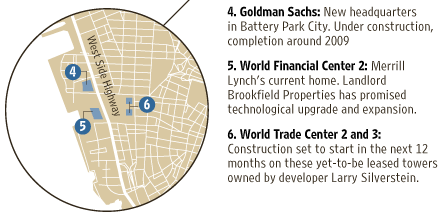
The WSJ has a big article today on the demand in investment banks for big NYC trading floors. Apparently the new Goldman Sachs tower in Battery Park City will have no fewer than six trading floors, each of a very impressive 72,000 square feet. That’s huge — I’m pretty sure it’s significantly larger than the Salomon Smith Barney trading floor at the old 7 World Trade Center, and I think that was the largest in Manhattan at the time. Of course, if you’re willing to leave Manhattan, the sky’s the limit: the UBS trading floor in Stamford is 103,000 square feet.

If you see lots of coverage about the size of “floor plates” in the new buildings at the World Trade Center site, this is why. Larry Silverstein, the owner, would love an investment-banking tenant, but can’t provide that kind of contiguous square footage in any of the new buildings. The WSJ reports that “construction will start within the next year” on the two new office towers at the eastern edge of the site; I’ll believe it when I see it.

One intriguing part of the WSJ article comes in its graphic:

P1-Ah552 Tradin 20070401201231

Note how number 5, in this graphic, is clearly 2 World Financial Center, both in terms of where it sits on the map, and in the accompanying text. Which might come as a surprise to Merrill types who think they work at 4 World Financial Center, up to the northwest. Is Brookfield be thinking of moving Merrill from 4WFC to 2WFC? And do the people at the WSJ know something about this? They might: after all, they work at 2 World Financial Center themselves.

UPDATE: Well, I bollixed that one up. The WSJ is at 1WFC, not 2WFC, and it seems that ML has long since spilled over from 4WFC to 2WFC, and is presently in a large chunk of both.

Posted in Econoblog | 3 Comments

Circuit city maximizes the pain/gain ratio

The NYT’s David Carr can certainly provide a punchline:

Last summer, I needed some gadgets for a multimedia project, so I walked in to a Best Buy. A young man walked me around the floor, assembling a bag of components before promising me that it would all work. It did

In a classic case of extrapolation from anecdote, Carr then concludes that Circuit City, which just laid off 3,400 salesclerks, is going to lose the customer-service war with Best Buy. (This is one of those wars that both sides are likely to lose.) But it’s certainly true that it’s hard to have much faith in a company which can make announcements like this:

Circuit City said it let go of workers who were making 51 cents or more an hour above what the company had set as market wages. It wouldn’t provide specific salaries. The company said the workers, who received severance packages, could reapply for their jobs at lower pay in 10 weeks.

In other words, Circuit City’s most experienced sales people, some of whom were making the grand total of 51 cents per hour more than what the company considers to be “market wages”, all got canned overnight. Carr makes the easy, lazy, and entirely apropos comparison:

If you add up salary, bonus, stock options, and other perks, Philip J. Schoonover, chief executive, and W. Alan McCollough, chairman, received almost $10 million in various kinds of compensation last year for steering the company to its imperiled state.

Actually, $10 million in total compensation between two executives seems almost modest by today’s standards — but still, if you save 51 cents per hour on 3,400 workers working 35 hours a week, that comes to just over $3 million a year. It’s almost impossible to think of a policy which could cause so much pain on the individual level while saving so little money at the corporate level.

Posted in Econoblog | 1 Comment

How much debt will KKR saddle First Data with?

It’s not just Sam Zell who’s throwing the leverage around. If you think his $11 billion in new debt is excessive, just you wait until you see the size of the credit line that KKR will have lined up for its $29 billion acquisition of First Data.

Ever since First Data spun off Western Union at the end of last year, it’s basically been a boring company with steady cashflows. How do you get private-equity-style returns out of that? Easy: leverage. I haven’t seen any numbers yet, but just look at the number of firms providing equity (one: KKR) compared to the number of firms providing debt:

Citigroup, Credit Suisse, Deutsche Bank, HSBC, Lehman Brothers, Goldman Sachs and Merrill Lynch have committed to provide debt financing for the transaction subject to customary terms and conditions, and are acting as financial advisors to KKR.

Of course, getting all those firms on board also means that there are many fewer places for any potential KKR rival to raise the funds for a counteroffer.

Posted in Econoblog | Comments Off on How much debt will KKR saddle First Data with?

Zell buys Tribune with eye-popping leverage

Sam Zell wanted to buy the Tribune Company for $33 a share, putting in $300 million of his own money. But somehow Tribune managed to engineer a bidding war — an impressive feat, given that virtually nobody really wanted to buy it — and so now Zell’s paying $34 per share, or $8.2 billion, of which $315 million will come from his own pocket. Which is definitely not so much of a premium that it would make the difference between an attractive deal and an unattractive deal. (Remember that Tribune stock was trading at over $60 in 1999.)

Zell could probably get a large chunk of money straight back out of Tribune if he sold the LA Times to the underbidders, Eli Broad and David Geffen. But don’t hold your breath for that to happen. Zell is no longer a mere billionaire: he’s now a bona fide press magnate. And for all that he says his investment is purely financial, the LA Times is the kind of toy that no press magnate worth his salt would ever jettison for mere cash.

There are some eye-popping leverage numbers in the official statement — numbers which make the deal look very much like a buy-it-and-lever-it-up private equity transaction.

Tribune has financing commitments from Citigroup, Merrill Lynch and JPMorgan Chase to fund the transactions. In the first stage, Tribune will raise $7.0 billion of new debt of which $4.2 billion will be used to complete the tender offer and the remaining $2.8 billion will be used to refinance existing bank credit facilities. In the second stage, Tribune will raise an additional $4.2 billion of debt which will be used to buy all the remaining outstanding shares of the company. Tribune’s existing publicly-traded bonds are expected to remain outstanding.

This means that by the time everything’s finished there will be $11.2 billion in new Tribune bonds outstanding, over and above the bonds which already exist. Even with $2.8 billion in bank credit being paid down, that’s $8.4 billion in new debt. Tribune CEO Dennis FitzSimons says that “going forward, employees participating in the ESOP will be invested alongside Sam Zell, one of today’s most successful investors”. The Employee Stock Ownership Plan is the main part of Zell’s financing strategy, but one can’t help but wonder whether Tribune’s printers and journalists have quite the same risk appetite as Sam Zell. I guess they don’t have much choice.

Posted in Econoblog | 1 Comment