I’ve been looking a bit at JetBlue, and what happened to its stock price over
the past 10 days or so.
 The
The
airline was hit very badly by New York’s snowstorm on Wednesday the 14th: that
day, and the following days, passengers were stranded and the press surrounding
the company was atrocious.
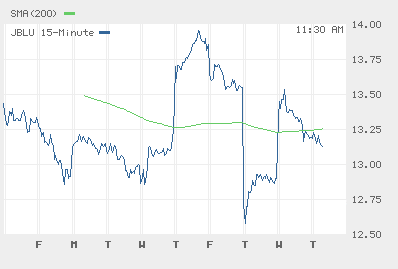
So what happened on the 14th? JetBlue’s share price rose, from $12.98
to $13.23. And what happened on Thursday the 15th, the day JetBlue made the
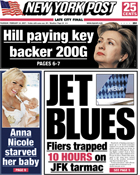
front page of the New York Post in the worst possible way? The stock opened
higher still, at $13.67, and closed at $13.85, after breaking the $14 level
intraday. The markets didn’t care about weather delays, they cared about the
fact that George Soros had amassed a 9.7% stake in the airline.
The stock stayed strong on Friday, closing at $13.56, but then it opened much
lower – at $12.57 – on Tuesday, after the long weekend. Why? No
news, really, but there was an analyst downgrade from Morgan Stanley. The stock
recovered a bit over the course of the day, closing at $12.90, and then opened
sharply higher on Wednesday, at $13.30. Why? This is a bit weird: JetBlue released
guidance saying that the storm would cost it $30 million in revenues in the
fourth quarter, and would lose money in the first quarter as well. But clearly
that news was better than the market was betting on.
Some hint of what’s was going on can be seen from a WSJ Marketbeat entry from
Tuesday, entitled "JetBlue’s
Blues Good for Shorts":
All told, 22.8% of the public float of 147.6 million shares is currently
being sold short for the airliner. There are only 13 other issues on the Nasdaq
with a larger number of shares sold short — but JetBlue has a larger
percentage of its shares held short than any of them.
The WSJ’s David Gaffen obviously saw that as a bearish sign rather than a bullish
sign – but in fact it set the ground for a nice little short-covering
rally the following day.
Here’s the JetBlue share price over the past 10 days:
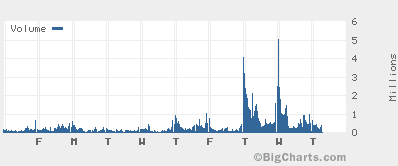
As you can see from the volume chart, there was almost no interest in JetBlue
during the storm on Wednesday, or during the aftermath on Thursday and Friday.
But volume at the beginning of this week, when there was much less in the way
of news, has been enormous. And in the grand scheme of things, the JetBlue share
price is still more or less in the same place as it was before all of this happened.
In fact, the whole storm in a teacup is utterly irrelevant in the context of
where JetBlue’s stock has traded over the past six months:
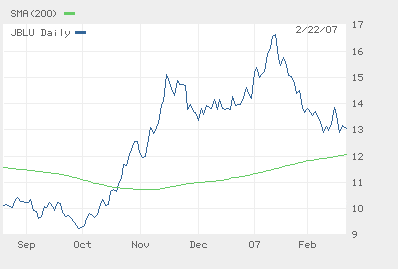
Which all makes me think that news is much less important for share prices
than many people think, and that if you try to trade on the basis of news, you’re
not likely to get very far. The only time that JetBlue’s share price fell in
the wake of the bad news was almost a week after the storms –
and the drop only really lasted for one day. Good luck trying to trade that.
Surely the scale of the harm the storm had caused, especially its particular impact on Jet Blue, didn’t become clear until they announced on Saturday (I think) that they were canceling the better part of Monday’s schedule. As evidence for this I adduce that I hadn’t checked in on JBLU in quite a while, but did so shortly after the market opened Tuesday, just to see how badly the stock would be hit. Which could just prove that I’m behind the news cycle, but I certainly prefer not to think that. (The story about people sitting on the tarmac for several hours seemed like an isolated incident, though I did discuss it with an acquaintance I bumped into on the train Thursday morning. It didn’t seem like a threat to the franchise, though.)