
I’ve long
been a cheerleader for the WTC redevelopment. Even when others started griping,
I was still optimistic about
the prospects for the site and the likelihood that it could become a vibrant
and world-beating neighborhood. In recent days, however, I’ve started getting
a little more pessimistic, the release of a very

sexy new site rendering notwithstanding.
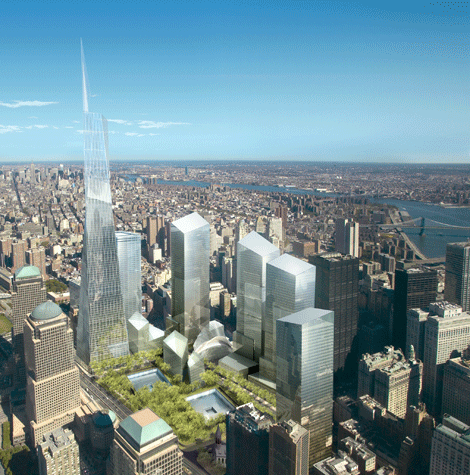
The new picture is interesting for a couple of reasons. For one thing, the
Freedom Tower pictured is almost exactly the same, as far as I can tell, as
the one which was unveiled
nine months ago. That Freedom Tower was a last-minute thrown-together compromise,
and since then the foundation stone has been laid, and some kind of construction
has begun.
There are two possibilities here. The first is that over the course of the
past nine months, zero progress has been made on what the tower is going to
look like, especially its upper half. The second is that David Childs and Larry
Silverstein do have a good idea of what they’re building, but they’re keeping
it secret – maybe because they fear what the public and/or Daniel Libeskind
might think of the changes. Neither of these two possibilities makes me particularly
hopeful about the future of construction on the WTC site.
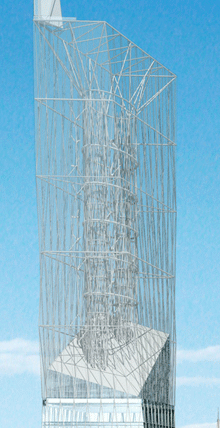
That said, there is one obvious difference between this rendering and the one

which was released in July. Look at the trelliswork at the top: the old rendering
is on the left, the new one is on the right.
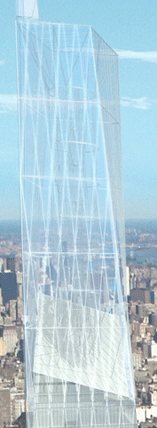
Doesn’t it look to you that the top of the Freedom Tower has been glazed?
If you magnify the image even further, it’s clear that the buildings viewed
through the top of the tower are much less clear than the ones viewed to the
side – DBox, the renderers, clearly want it to look as though we’re looking
through glass. What’s more, the windmills, which were never much in evidence
to start with, seem to have disappeared altogether. Is the top of the Freedom
Tower going to become a useless glass box? I do hope not.
My guess is that neither rendering looks much like what we’re eventually going
to get. I stand by what I said
in February: the spire will look very different from what it’s being rendered
as right now, the sloping roof is likely to go, and there’ll be some kind of
observation deck at the very top.
And the really big picture, of course, is that the Freedom Tower is a camel.
As Paul Goldberger explains in his new
book, it’s essentially the product of wishful thinking by George Pataki,
who somehow managed to convince himself that David Childs and Daniel Libeskind
– both big-time architects with a strong impression of what the new tower
should look like, and an even stronger conviction that the other guy was wrong
– could somehow be forced to fruitfully collaborate on the skyscraper.
It was never going to happen, and the final building is quite probably worse
than either man would have come up with on his own – although I daresay
it’s better than Childs’ Bear Stearns building in midtown.
 Other
Other
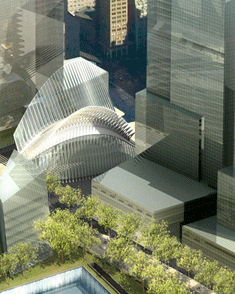
bits of the new rendering are also interesting. Look at the detail on the left:
not only has Dey Street
been restored, but Cortlandt Street is just visible as a vehicular street as
well. That’s good news: it shows that in at least one design shop New York City
has won out over the floor plate Nazis, although of course none of this is final.
The one thing I can’t work out is the jagged reflection in the office tower
behind Santiago Calatrava’s PATH terminal. It seems to be the reflection of
some kind of building, but which building is not at all clear. This is actually
the most annoying part of the rendering: I would much have preferred an idea
of what we’re going to see in four or five years, rather than a wishful-thinking
plan including four large office towers which probably won’t be built for decades
and in any case won’t look anything like this if and when they are built. Hidden
behind the middle two, for instance, is most of the Wedge of Light and all of
the Millenium Hilton: I still don’t really have any idea of how the PATH station
and the Wedge of Light are meant to interact and point pedestrian traffic coming
from the Brooklyn Bridge, say, down towards the memorial.
What we do see quite clearly in this rendering is the memorial, and the way
in which it’s almost entirely at grade. Libeskind’s pit of memory is long gone,
and what remains of the slurry wall will be as nothing compared to the edifice
which so impressed Libeskind and the people who chose his design from the shortlist.
More generally, when I reread what I wrote back in 2002, I feel a sense of opportunity
squandered:
It all starts down in the dirt, by the huge slurry walls which stop the Hudson
River from rushing in to the site. These were and are true engineering marvels:
as Liebeskind says, they "withstood the unimaginable trauma of the destuction
and stand eloquent". He keeps them exposed, 70 feet below ground, and
then spirals up and out, into the rest of the site and beyond.
At the bottom is the museum and the memorial; at the top is a vertical "gardens
of the world", rising in a glorious spike well above the rest of the
skyline. The buildings in the rest of the site are extremely strong as well,
especially the ones which border on what Liebeskind rather unfortunately calls
the "wedge of light". This is a triangular plaza which will have
no shadows each year on September 11 between the hours of 8:46am and 10:28am.
It’s mirrored by the Heroes Park, one of three or four green spaces in the
plan.
What’s left of this vision? The slurry walls are gone, the spiral walkway is
gone, the gardens of the world are gone, the spike is rapidly going, the wedge
of light won’t have no shadows at the crucial time, thanks to the Millenium
Hilton, the Heroes Park has all but disappeared… as Goldberger says, Libeskind’s
plan has been "ground down" to the point at which we can reasonably
ask ourselves why we needed a major architectural name to design the WTC site
at all. With all the compromises which have been made, it’s looking increasingly
as though the high-profile competition was little more than a shiny toy which
took the eyes of the public off the places where the real decisions were being
made – mainly the offices of George Pataki and Larry Silverstein.
As Goldberger says, what was needed here was someone with a strong vision and
the ability to make it happen – someone like Francois Mitterand, who did
something similar in Paris. Pataki was not that man; I have a feeling that New
York’s deputy mayor Dan Doctoroff, with the wholehearted backing of Michael
Bloomberg, might have been.
New York City, which has had very, very little say in the development of the
WTC site, had a wonderful plan for Lower Manhattan as a whole, much of which
– especially housing – has been jettisoned by the Port Authority
and the LMDC. The cooks in charge of this particular broth were the wrong ones,
I fear: some deal surely could have been done whereby New York City received
the land under the World Trade Center from the Port Authority, in return for
the land under JFK and LaGuardia airports. Doctoroff would then have had much
more power, Pataki would have had much less, and there might well have been
many fewer compromises along the way.
Just look at the results of the competition for the cultural buildings: the
Joyce Theater and the Drawing Center are going to be the anchor tenants at the
new site, because their competition, mainly the New York City Opera, was considered
to be too big to fit into the small gaps remaining between office buildings.
I’m all for facing up to realities, but there comes a point where you simply
can’t give office buildings which might never be built priority over an institution
like the New York City Opera, which isn’t all that big to start with. If Ground
Zero is too small to accommodate one medium-to-large cultural institution, then
there has to be a strong case for revisiting the whole question of why so much
space has to be set aside for offices.
I might look as though I’m contradicting myself here: Last September, I wrote
that
In theory, Silverstein could be bought off with a cash settlement rather
than office space. But he doesn’t seem to understand the cashflow situation
here: far from the taxpayer giving money to Silverstein to go away, Silverstein
is actually the central, necessary source of funds for rebuilding the WTC
site in the first place. It is Silverstein who held the insurance contracts
on the World Trade Center, you see, and without those insurance proceeds,
nothing is going to get built on the site at all.
But the situation has changed. Silverstein’s insurance payout is barely going
to be able to cover the cost of the Freedom Tower, after his legal expenses
and his rent to the Port Authority have been paid. Yes, Silverstein does have
a contractual right to rebuild 10 million square feet of office space –
but surely there’s a case to be made for crossing that bridge when we come to
it. No one expects Silverstein to exercise that clause in his contract any time
soon, and in the meantime there’s a whole new neighborhood to be built.
I went to a press conference
with Daniel Libeskind this week, and if I’ve learned anything from being a journalist
for the past ten years, it’s that the fewer questions someone answers, the more
worried they are. Libeskind, on Wednesday, answered very few questions, and
fell back time and time again on the stock answers that he’s been wheeling out
for the past two years. The only news we got was regarding new projects of his,
nothing pertaining to Ground Zero, where I get the feeling he’s been doing very
little work this year.
I would like to think that Libeskind will get the commission to design at least
one of the new cultural buildings, and that being able to get involved with
the minutiae of a real building on the site will bring his enthusiasm and involvement
levels back up. But the bigger battle has been lost, I think: at every turn
since the initial choice of Libeskind as master planner, political realities
have trumped the larger vision. While I’m still optimistic for the neighborhood
in the long run, I don’t think it’s going to be the greatest piece of urban
planning that the world has ever seen. And it should have been.
Beautiful?
A new rendition of the WTC/Freedom Tower Site has been done. I really like it, even though it probably doesn’t show the final product as it will be in four years time. Felix Salmon has some worries about it: “For one thing, the Freedom Tower pic…
Beautiful?
A new rendition of the WTC/Freedom Tower Site has been done. I really like it, even though it probably doesn’t show the final product as it will be in four years time. Felix Salmon has some worries about it: “For one thing, the Freedom Tower pic…
Beautiful?
A new rendition of the WTC/Freedom Tower Site has been done. I really like it, even though it probably doesn’t show the final product as it will be in four years time. Felix Salmon has some worries about it: “For one thing, the Freedom Tower pic…
Beautiful?
A new rendition of the WTC/Freedom Tower Site has been done. I really like it, even though it probably doesn’t show the final product as it will be in four years time. Felix Salmon has some worries about it: “For one thing, the Freedom Tower pic…
Beautiful?
A new rendition of the WTC/Freedom Tower Site has been done. I really like it, even though it probably doesn’t show the final product as it will be in four years time. Felix Salmon has some worries about it: “For one thing, the Freedom Tower pic…
Beautiful?
A new rendition of the WTC/Freedom Tower Site has been done. I really like it, even though it probably doesn’t show the final product as it will be in four years time. Felix Salmon has some worries about it: “For one thing, the Freedom Tower pic…
I hate to say it, but “welcome to the club, Felix.” This whole thing has been played and played hard, with Libeskind as the entertaining Freedom Jester in Pataki’s court.
And all with the relentlessly sacred perception of Progress Being Made, to boot.
You are certainly right that the current rebuilding process and proposed plan will never lead to the architectural and urban design for Ground Zero that 9/11 deserves. But “political realities [had] trumped the larger vision” well before Libeskind took his first bow at the Winter Garden in December 2002.
Silverstein told Newsday on 20 September 2001 — just nine days after 9/11 — that he was going to build four office towers. On 13 December 2001, Newsday quoted Silverstein to the effect that “it will probably be more than four” and that “50-55-60-65 stories is probably a mix that would work on that site.” Newsday reported that day that Silverstein “said he [was] working to re-impose the grid of streets that crossed the site before the Trade Center was built.”
Trust your instincts. The “competition” was a sideshow, and Ground Zero has been a very brave new world since day one.
That it has taken the public this long to start smelling the fish is a stinging indictment of the media (including Goldberger), who for three years have played architectural patty-cake with rebuilding officials, refusing at every turn to ask the hard questions that still must be asked if we are to remember 9/11 at Ground Zero by achieving something truly great there.
As it is, most of the public has no idea that an illegal, irresponsible, unsafe, inferior, and wasteful design is being advanced in their name to serve base financial and political interests. To allow this plan to go forward would be an indictment of our culture and a visible stain on our history.
New World Trade Center Site Renderings Draw Worries, Praise
Blogger Felix Salmon was optimistic about the Freedom Tower, but he recently noted some concerns.
New York’s coming skyline, today… in Malmà
On the southermost tip of Sweden, facing Copenhagen across the Baltic Straits, a remarkable and beautiful skyscraper is nearing completion — the Turning Torso. Three things about it make it particularly relevant as a taste of things to come in…
Since the last building was destroyed by an airplane…dont you think that it would be “smart” to make this one out of a little more than just glass? Oh well I guess the architect will find out sooner or later…
To me Freedom tower looks horrible….i would much rather see the twin towers back
Can you tell me where the image came from?
The so-called Freedom tower is discusting, it just looks wrong. I am/was a big fan of the orinigal twin towers, and i think that they topped off the n.y skyline beautifully untill they were demolished. As for Silverstein that man is a peice of shit and should be charged with murder, why? because he was responsible (along with others)for the whole 9/11 so-called terror attacks. BRING THE TWIN TOWERS BACK not some shithouse freedom tower and dispose of silverstein, if i met that man i would break his his fuckin neck, peice of shit jew.
As the holiday coming,the atmoshpere is hot,still anxious about haven’t bought the nice !you will got lot of surprise here!
nice post .make hair straight and fashionable.GHD products are being used by many beauty salons.
yes,you are all right.
are precious possession for not only women but men also. you may have a try make
everyone in your family fashionable.
thank you for this good post .
has made a comeback once again this winter.comfy boots waiting for you.
Near the Liangyu Sen very first claimed: “His side is just not for you to strip injure them? Have you viewed that is so questionable strip?In .