 This
This
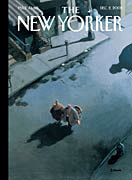
week’s issue of the New Yorker is an excellent reminder of why it is
the best magazine in the world. Who else would commission the great Michael
Sowa to do a Thanksgiving cover illustration? (Talking of the cover, I have
a rare early-print-run copy of the magazine which is missing the "The"
in "The New Yorker" on the cover. Make me an offer and buy this collectible
now, while you have the opportunity!)
Anyway, where but the New Yorker would this
wonderful piece by Gay Talese ever appear?
Talese has revisited the Verrazano-Narrows Bridge, the most elegant suspension
bridge in New York, 40-odd years after it was built. He covered the original
construction of the bridge, and now, in his trademark style, has gone back to
find the same people he talked to back then. Not all are still alive, of course,
but one of them was still working on the bridge as recently as 1991. Here’s
Talese, with his limpid prose style:
Despite his advanced age and his occupational ailments, Edward Iannielli
had drawn one of the most difficult assignments on the renovation project—that
of removing rust from the highest points of the towers… After arriving at
the top of the tower—a journey that took twenty minutes—he leaned
out into the sky and went to work with wire brushes and scrapers to remove
rust, and then, wearing rubber gloves, to smear a rust-resistant paste onto
whatever corrosion existed along the flat surface and bolts of the tower.
As he did this, he envisaged himself thirty years earlier, inserting these
same bolts into the same steel, and once more he felt a sense of identity
with the great structure. Tears came to his eyes, and, dipping his gloved
left hand into a bucket of reddish paste, he reached out to touch an untarnished
plate of steel which was secured by a row of bolts and, with his bent middle
finger, he wrote as clearly as he could, in block letters, "Catherine"—the
name of his wife of thirty years, who had recently died of cancer.
"Leaned out into the sky" – I love that. And Talese’s a master
of the comma: there are eight in that last sentence, but he uses an em-dash
where 95% of people would use a comma. Most powerfully, there isn’t a comma
or any punctuation at all after "bolts", where the big break in the
sentence occurs. It might be reading "bolts and braces" but in fact
it’s "bolts and now I’m on to something completely different". I’ve
noticed this in a lot of writers, especially Updike; I don’t know whether it’s
got a name. But I’m sure, again, that the vast majority of people would simply
end the sentence at "bolts" and then begin a new one.
There’s no real story to Talese’s piece: it’s episodic, moving from character
to character, stopping along the way to remember how things were 40 years ago,
and to compare how things are today. The attack on the World Trade Center features
prominently, of course, this time viewed from a fresh perspective – that
of the people who worked on its construction. (Naturally enough, there was a
large overlap between the Verrazano-Narrows workers and those who built the
twin towers.)
At one point the towers are described as "ninety-five per cent air".
In that one phrase is encapsulated a whole world of difference – between
the old world and the new, and between the blue-collar world and the white-collar
world. Skyscrapers which predate the World Trade Center are big, solid buildings
– think the Empire State. And people like Edward Iannielli, who worked
on 50-odd skyscrapers in and around New York, like them that way. But things
are different now: property developers want buildings to be as airy as possible,
since that makes them more desirable to tenants and maximises rentable floor
space. Even classicist architects, who might put columns or stone cladding on
a new building rather than the standard modernist curtain wall, will still use
modern construction techniques to keep the inside as column-free and airy as
possible.
I think (and this is only a hunch) that people like – and classicist
architects use – columns and their ilk in contemporary architecture precisely
because they give the impression of support and solidity, even when they’re
purely decorative. While the architectural world continues to use state-of-the-art
technology to create bigger and bigger open spaces, a lot of people still like
to feel that they can see the way in which their building is being
held up. In the World Trade Center, they couldn’t: the interior columns were
thrust out to the walls, and read to the eye simply as window-frames. What modernists
considered genius made the likes of Iannielli very uncomfortable. But the modernists
have won this war, and "flimsy", to use his word, is here to stay.
This is an interesting gloss on great piece of writing, but I feel that you err when you state, in the paragraph that follows the block quotation, that a natural break occurs in the sentence after the word “bolts.” It doesn’t, any more than a natural break occurs after the word “sky” in “he leaned out into the sky and went to work.” In the “bolts” sentence, too, Talese wants us to feel the continuity of action in the reaching out to the steel plate to the writing of the name. One way he does this is to omit the comma after “bolts.”