
The New York Times Magazine has given the cover of its last two issues to what
it calls The Class Wars. The first
story, by Paul Krugman, glossed the growing inequality in the US, and bemoans
the fact that "income inequality in America has now returned to the levels
of the 1920s." The second
piece, by Michael Lewis, was headlined "In Defense of the Boom,"
and takes a contrarian stance with regard to the late-90s technology bubble.
"If your measure of social progress is corporate profits, it is easy to
take a dim view of the boom," writes Lewis. "It is more difficult
to do so if you step back a bit and survey the bigger economic picture."
 Adam
Adam
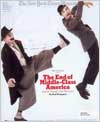
Moss, the editor of the magazine, decided to pair the articles off against each
other, with the successive covers of the magazine running photos from the same
shoot: first of all a robber baron kicking a working stiff out of the picture,
then the same working stiff dragging a handcuffed robber baron off to jail.
In case the pictorial rhetoric wasn’t enough, the headline on the cover of the
second magazine was "The Vilification of the Money Class".
But in fact you’ll look in vain for any defense by Lewis of the obscene pay
packages that Krugman attacks. While Krugman hasn’t drunk nearly as much of
the New Economy kool-aid as Lewis has (see this
1997 Slate article for an example of his skepticism about such things), the
fact is that the two writers are simply looking at two very different aspects
of the 90s boom.
Krugman concentrates on the increasing inequality in individual wealth and
pay, pointing out that top executives earned less than one fifth of their present
salaries as recently as 1987, "the year Tom Wolfe published his novel The
Bonfire of the Vanities and Oliver Stone released his movie Wall Street".
Lewis, on the other hand, looks on the excesses of the 1990s with a kind of
detached wryness. "It’s more than a little nuts for a man who has a billion
dollars to devote his life to making another billion, but that’s what some of
our most exalted citizens do, over and over again," he writes. "That’s
who we are; that’s how we seem to like to spend our time. Americans are incapable
of hating the rich; certainly they will always prefer them to the poor."
Lewis’s main thesis is that the technology boom did wonderful things for the
way companies were organised, for the way they were financed, and, not least,
for the economy as a whole. If we now start looking back on those days as an
evil era of stock manipulation and systematic shafting of the little guy, then
we risk losing sight of all the good things we had, including "the depth,
breadth and extent of wealth-sharing" in technology companies. The fact
that so many employees had such great stakes in their companies, says Lewis,
helped not only to spread the wealth around; it also gave companies a means
to structure their payroll in such a way that employees got paid more in good
times and less in bad times. In consequence, says Lewis, the number of layoffs
was minimised.
Lewis even takes the argument one step further, using the example of his own
purchase of Exodus shares at the height of the boom. "What happened to
my money?" he asks. "It didn’t simply vanish. It was pocketed by the
person who sold me the shares." That person, he goes on to say, was, more
likely than not, a working grunt at Exodus Communications. The foolish speculator
(Lewis) got fleeced for his greed; the noble worker got the cash.
Michael Lewis is bright enough to know that he’s only telling one side of the
story here. For one thing, employees in the technology boom didn’t hold nearly
as much stock as he likes to make out. They held stock options. That’s a very
different thing, because options skew the incentive structure. If a manager
holds stock worth $100 and considers a risky maneuvre which could send the stock
to $110, he has to weigh the 10% return against the risk that the whole company
could be endangered. But if the manager holds options to buy the stock at $95,
then his return becomes 200%: worth a lot more risk. What’s more, the interests
of the manager (boost the stock as much as possible, as quickly as possible)
aren’t necessarily aligned with those of shareholders (make sure the upside
on the stock exceeds the downside).
And yes, Michael, when people say that $7 trillion (or whatever) in stock-market
value has vanished, they’re right. It hasn’t passed from middle-class speculators
with too much cash to people who were lucky enough to sell at the top of the
market. It’s vanished. Yes, the money which was spent on buying shares at the
top was also given to people who sold shares at the top. But the vast majority
of shares were neither bought nor sold anywhere near the top. If a portfolio
manager bought a million shares of Exodus at $20 and marked his position to
market every day, then at the top he had made $140 million on his investment.
And when Exodus went bankrupt, that $140 million was gone, along with the intial
$20 million. Vanished. Into nobody’s pocket at all. So when Lewis writes that
"stock market losses are not losses to society. They are transfers from
one person to another," he is simply wrong.
Lewis also gets things right, of course. Yes, the bubble wasn’t the fault of
Merrill Lynch, or even of Wall Street in general. And Lewis is a dab hand with
the aphorisms: "By forcing Merrill Lynch to agree that its advice was corrupt,
Eliot Spitzer helped the firm avoid saying something much more damning and much
more true: that its advice on the direction of stock prices is useless. Always.
By leading the firm to the conclusion that it had misled the American investor,
Spitzer helped it to avoid the much more embarrassing conclusion that the American
investor had misled Merrill Lynch."
What he means is that the middle-class masses looked at the vast amounts of
money being made in technology stocks and got greedy. They started wanting to
get in on the act too, and they forced Wall Street to play catch-up –
not with the venture capitalists, so much as with the taxi-driving day-traders.
Cue another Lewis aphorism: "That’s the odd thing about the present moment:
it is widely understood as a populist uprising against business elites. It’s
closer to an elitist uprising against popular capitalism."
This is the point at which we can take the Krugman and the Lewis articles and
find some kind of synthesis. How can they both be right – Lewis that the
boom years were mainly driven by the little people, and Krugman that the little
people got very little from the boom years, and that nearly all of the benefits
accrued to those at the very top?
The answer is that while Krugman is right about the what – there is,
indeed, much more inequality in the US economy now than at any point in living
memory – he’s wrong about the why. Krugman discounts Sherwin Rosen’s "superstar
hypothesis" – basically, that, increasingly, we’re in a winner-takes-all
economy – in favour of something rather fuzzier to do with societal norms,
corporate culture, and the evaporation of any guilt that executives might have
once felt about paying themselves untold millions of dollars per year.
Krugman then goes on to say, basically, that the great unwashed are really
stupid, and will quite happily believe whatever rich people want them to believe.
"In addition to directly buying influence, money can be used to shape public
perceptions," he writes. While that might be true to a certain extent,
I don’t think it’s the main, or even a main, reason why policies which benefit
mainly the top 1% of the population continue to receive such widespread public
support.
Rather, it’s worth recalling Lewis’s comment at this point, that Americans
will always prefer the rich to the poor. And also recall this month’s Harper’s
Index, where we find this:
Percentage of U.S. college students who believe the “next Bill Gates”
is among today’s generation of college students: 50
Percentage who say they are the next Bill Gates: 24
People support policies which benefit the rich not because they are rich, but
because they believe that they will be rich. Voting Republican is like buying
lottery tickets: it hurts the poor, but the poor do it in much greater numbers
than the rich.
It’s not just that Americans are a naturally aspirational nation, although
that’s part of it. It’s deeper than that: it goes all the way back to the American
Dream. The whole point of being an American, for most of its citizens, is this:
that anyone can make it. And even those who have statistically negligible chances
of ever doing so not only believe that they can, but also believe that they
will. And when they get there, goddamn it, they will have earned it. And there’s
no way that they want the government taking their hard-earned fortune away from
them.
And with this in mind, we can now revisit Lewis’s thesis that the 90s boom
was a bottom-up affair, a grassroots movement, if you will. He’s right: the
day-traders who fuelled the rocket-like ascent of the stock market were not
the hedge-fund elite, but rather the aspirational poor. And Krugman’s right,
too: those day-traders didn’t make any money at all. The people who made money
were people like Jeff Bezos and Michael Bloomberg, Wall Streeters who had enough
money even before they started their respective companies to live comfortably
for the rest of their lives.
But the billions that Bezos and Bloomberg made shined like beacons for the
population as a whole. They weren’t disgusted by them, the way that Krugman
is; rather, they were hypnotised by them. As the pot of gold at the end of the
rainbow became bigger and bigger, the desire for it grew proportionately. There
was no outrage because it wasn’t theirs, it was mine, if only.
So Krugman’s right: the rise in inequality was indeed fuelled by greed. But
it wasn’t the greed of the new plutocrats, so much as it was the greed of the
whole mass of the US population. And Lewis is right too: that very greed financed
technological investment and innovation which is sure to help the economy as
a whole, even if it never repays the original investors. But that doesn’t justify
the fact that the top 1% of the population got the lion’s share of the economic
benefits of the boom.
just as a point of fact, you’re wrong about stock market losses. unless you’re talking about spectacular bankrupcies, of which we’ve seen fairly few, investments in stocks don’t disappear. it’s transferred wealth, from the buyer of a stock to the seller. even if you have a real liquidation, stock holders still have claims on any remaining assets, although admitedly small ones. but in general, money adheres to the financial equivalent of the second law of thermodynamics: it simply doesn’t disappear. the assets you hold can decline in value, but that’s a different matter altogether.