
Old celluloid decays in a spectacular manner. Ricky Jay and Rosamond Purcell
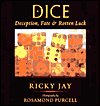
have just published a fine book
on what happens to old dice (they start cracking up, quite literally, and quite
beautifully), and Bill Morrison has made a film,
called Decasia, made up entirely
of old footage which is now falling apart. Both of these were on display last
night at the Angel Orensanz Center on Norfolk Street.
 The
The
book is a pretty diversion, the sort of thing which will probably mostly be
bought as a gift. (The price is right, too: just $12.95, or $10.36 at Amazon,
for a hardback, albeit one of only 64 pages.) The film, on the other hand, is
much more ambitious. It’s Morrison’s first feature: up until now, he’s made
short art films which get shown at the likes of MoMA
and the ICA.
Decasia started life as a visual accompaniment to the premiere of
a symphony by Michael Gordon. Last night, however, the symphony was reduced
to a soundtrack, and the film itself was the center of attention. It’s structured,
in Morrison’s words, "like an onion": the further towards the beginning
of the film a certain piece of footage appears, the further towards the end
more footage from the same sequence is likely to reappear. All of the footage
has been slowed down, so that you see each frame two or three times, in order
to make the decay visible to the eye.
 It
It
doesn’t take long to get the general idea. At the beginning, the eye is naturally
caught up by the scratches, abrasions and other signs of dying celluloid, but
soon it notices the original picture remaining relatively steady even as the
film stock itself erupts with random nitrate-based excrescences.
Celluloid does not decay in any kind of predictable way. Sometimes it gently
warps, so that it looks as though we’re viewing the original image through a
veil of water, with drops falling down on to it at various points. Sometimes
the film is completely scratched out in the middle or at the edges. Sometimes
black becomes white and white becomes black, and the image looks irised, with
edges emphasised and subtle shades of grey eliminated. (The final film is in
black and white, although some of the original footage had colour in it.)
Most startling are the times when faces get stretched, as though they were
rubber, in a manner very similar to what happens if you scratch around on a
still-wet Polaroid with the cap of a ballpoint pen. A friendly judge can suddenly
become an horrific death’s-head mask, and then go back to normal a couple of
frames later. The fact that the change is pure happenstance only adds to the
feeling that we suddenly got a glimpse of ugly reality below the surface.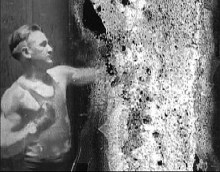
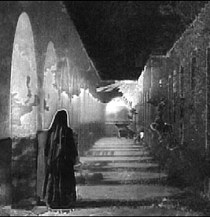
Other sequences linger in the memory: a crocodile of children, for instance,
walking slowly towards the camera under a lowering black sky, overseen by a
shadowy pair of nuns who have been transformed into ghoulish sentinels. Or a
boxer, attacking something unseen in the middle of the frame, as though he’s
battling for the victory of something over nothing.
Two sequences form the centerpiece of the film, however. The first is a very
short snippet from an old Eisenstein documentary, showing a baby, blackened
by celluloid decay, being born by Caesarean section. The second, which is far
too long, shows aeroplanes silhouetted against a dull grey sky, dropping dozens
of parachutists who then descend slowly to the ground. It’s at this point that
Morrison is most hamstrung by the fact that he’s working with an already-existent
symphony, as opposed to the composer working with him. The music forms an extended
climax, and so what we see must be extended as well.
At other points, however, the music is a saving grace: it gives the audience
something to hold on to, and gives the dialogue-free film something other than
a wholly abstract structure. The film is already too long, at 70 minutes; it
would be completely unwatchable without music. The dark and looming symphony
also gives the film its low center of gravity, as it were: makes the audience
ponder questions about the connection between growing and decaying, rather than,
say, thinking about the mildew on the inside of their shower curtain.
I do have a couple of questions about the influences on Decasia. The
title (and the New York Times) seem to posit a link to Fantasia,
which I don’t see at all. Fantasia is one of the greatest films ever
made, and I’d hate to think that anybody setting images to music thinks that
they’re working in the same tradition. I think a much more obvious influence
Peter Greenaway’s meditation on the beauty of decay. But in a way, the films
got made in the wrong order: there’s so much more to the Greenaway than there
is to watching old rotting newsreel. (And Michael Nyman is a better composer
than Michael Gordon.)
The difference, of course, is that the films come from very different traditions:
Greenaway from making movies for theatrical release, and Morrison from making
artworks using the medium of film. And while Greenaway is big on constructing
his own art installations, and Morrison showed Decasia at Sundance,
the gap still remains. Art films are always too long, and artists working in
film always slow down their films too much. If someone has paid a couple of
hundred thousand dollars for a film, they’re not likely to feel impatient while
watching it. If someone has paid ten dollars to go see a film, on the other
hand, they expect to be entertained. And no one really expects anything to happen
in an art film, for better or for worse.
If you’re interested in seeing Decasia, by the way, it’s going to
be on the Sundance Channel towards the end of the year.
I agree with a lot you have here-but those nuns REALLY freaked me out.
i dont agree